
X-Ray Film Market Overview
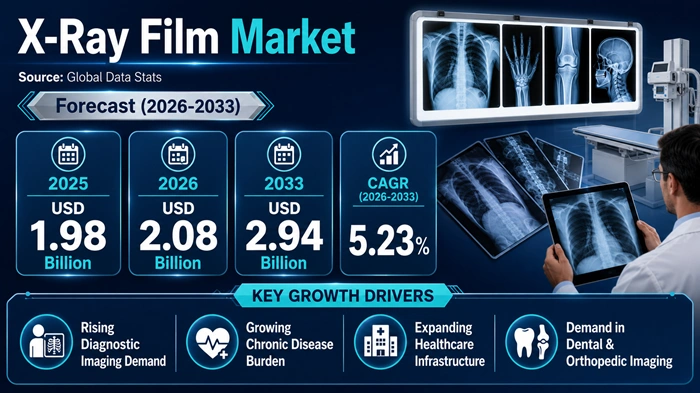
The global x-ray film market size is valued at USD 1.98 billion in 2025 and is predicted to increase from USD 2.08 billion in 2026 to approximately USD 2.94 billion by 2033, growing at a CAGR of 5.23% from 2026 to 2033.
This measured but steady growth reflects a market caught between two forces, ongoing reliance on conventional film in cost-sensitive healthcare settings and industrial testing, and the continued global shift toward digital radiography. Rising diagnostic imaging volumes tied to chronic disease detection, expanding healthcare access in developing regions, and sustained demand for film-based non-destructive testing in heavy industry are together keeping this legacy technology commercially relevant even as digital alternatives gain ground.
AI Impact on the X-Ray Film Industry
Digital Analysis Tools Are Reshaping Workflows Even Where Physical Film Still Dominates
Artificial intelligence is having an indirect but meaningful effect on the x-ray film market, primarily by accelerating the broader shift toward digital imaging in facilities that have the budget to modernize. Hospitals and diagnostic centers that adopt AI-assisted image analysis software require digital inputs to function properly, which has pushed many mid-sized and large healthcare providers to transition away from physical film toward computed and direct radiography systems. This trend is gradually shrinking the addressable base of x-ray film customers in wealthier markets, even as overall diagnostic imaging demand keeps rising.
At the same time, AI-powered digitization tools that scan and convert existing physical film archives into searchable digital records are helping healthcare systems bridge the gap between legacy film infrastructure and modern data management practices. This has created a modest secondary market around film digitization services, even as it slowly reduces reliance on producing new film going forward. In industrial testing environments, where film remains valued for its high resolution in weld and pipeline inspection, AI-based defect detection software is increasingly being paired with scanned film images, extending the practical life of film-based inspection workflows even as digital detectors continue capturing a growing share of new equipment purchases.
Growth Factors
Rising Diagnostic Volumes and Emerging Market Infrastructure Continue Supporting Demand
The single strongest factor sustaining demand across the x-ray film market is the steady global rise in diagnostic imaging volumes, driven by aging populations and growing rates of chronic conditions such as respiratory disease, cancer, and orthopedic disorders that require repeated imaging over time. In many developing regions, hospitals and clinics continue to rely on conventional film-based x-ray systems because the upfront capital cost of full digital radiography equipment remains out of reach for smaller facilities. This cost gap means film retains a meaningful role in healthcare delivery even as digital adoption accelerates in wealthier markets, keeping overall unit demand relatively stable.
A second important growth factor is the continued use of x-ray film in industrial non-destructive testing applications, particularly for inspecting welds, pipelines, and structural components in sectors like oil and gas, aerospace, and heavy manufacturing. Film-based radiography remains a trusted and regulator-approved method in many of these applications because of its proven reliability and the extensive body of historical comparison data built up over decades of industrial use. As infrastructure investment continues expanding across emerging economies, this industrial testing demand provides a steady counterbalance to the gradual decline of film use in medical imaging, helping to support overall stability within the x-ray film market.
Market Outlook
A Slow, Managed Decline in Medical Use Offset by Resilient Industrial and Emerging Market Demand
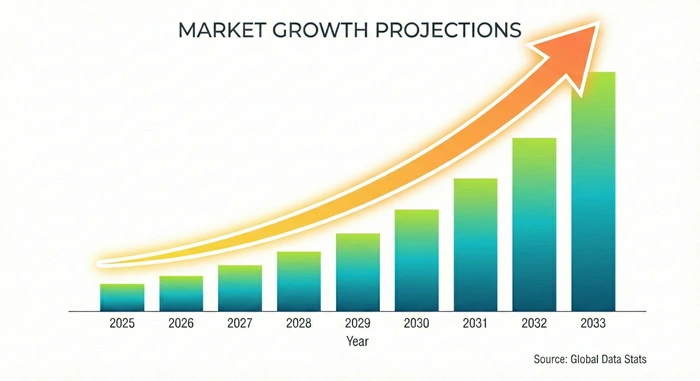
Looking ahead through 2033, the x-ray film industry is expected to follow a pattern of gradual transition rather than sharp disruption, with medical film usage continuing to decline steadily in developed markets while remaining comparatively resilient in developing regions where digital radiography infrastructure investment lags behind. Healthcare providers in South Asia, parts of Africa, and portions of Latin America are expected to continue relying on film-based systems for years to come, simply because the total cost of ownership for digital equipment, including servicing and staff training, remains a genuine barrier. This creates a durable, if slowly shrinking, base of demand that will continue supporting film manufacturers well within the forecast period.
Industrial applications are expected to provide an increasingly important stabilizing influence on overall market performance, since non-destructive testing standards in several regulated industries still favor or mandate film-based inspection methods for critical infrastructure. Manufacturers that diversify their product portfolios to serve both remaining medical demand and steady industrial testing needs are best positioned to navigate this transitional period profitably. Companies willing to invest in efficient, lower-cost production processes for niche film applications are likely to maintain solid margins even as overall volume growth in the x-ray film market remains modest compared to fully digital imaging categories.
Expert Speaks
-
"We continue to see meaningful demand for film-based radiography in markets where healthcare infrastructure investment has not yet caught up with digital imaging costs, and we remain committed to serving that need reliably." — CEO, Fujifilm Holdings Corporation
-
"Industrial radiography customers value the proven reliability of film for critical inspection work, and that trust is not something that changes overnight even as digital detectors improve." — CEO, Agfa-Gevaert NV
-
"Our strategy has shifted toward supporting healthcare providers through this transition period, offering both film and digital solutions so facilities can modernize at their own pace." — CEO, Carestream Health Inc.
Key Report Takeaways
-
Asia Pacific leads the global x-ray film market, holding approximately 40% market share in 2025, supported by large patient volumes, expanding healthcare access, and continued reliance on cost-effective film-based imaging in many facilities
-
Latin America and parts of Asia Pacific are among the fastest-growing regions, projected to expand at a CAGR near 6% through 2033, driven by rising healthcare infrastructure investment and growing diagnostic imaging demand in underserved areas
-
Public hospitals and diagnostic centers represent the dominant customer base, relying on film-based systems where budget constraints limit full digital radiography adoption
-
Medical diagnostic applications contribute the most to overall market revenue, reflecting the sheer scale of routine imaging performed across global healthcare systems
-
Blue-sensitive film remains the most widely used film type, prized for its balance of image quality, processing speed, and cost efficiency across general diagnostic use
-
Industrial non-destructive testing film will grow at a steady pace among application segments, holding close to 22% market share with a CAGR near 6% through the forecast period, supported by continued infrastructure investment in oil, gas, and manufacturing sectors
Market Scope
| Report Coverage | Details |
|---|---|
| Market Size by 2033 | USD 2.94 Billion |
| Market Size by 2025 | USD 1.98 Billion |
| Market Size by 2026 | USD 2.08 Billion |
| Market Growth Rate from 2026 to 2033 | CAGR of 5.23% |
| Dominating Region | Asia Pacific |
| Fastest Growing Region | Latin America |
| Base Year | 2025 |
| Forecast Period | 2026 to 2033 |
| Segments Covered | Product Type, Application, End User, Region |
| Regions Covered | North America, Europe, Asia Pacific, Latin America, Middle East & Africa |
Market Dynamics
Drivers Impact Analysis
Rising Diagnostic Imaging Volumes and Industrial Testing Demand Remain the Two Most Reliable Growth Forces
| Driver | (≈) % Impact on CAGR Forecast | Geographic Relevance | Impact Timeline |
|---|---|---|---|
| Rising diagnostic imaging volumes tied to chronic disease | ~34% | Global, strongest in Asia Pacific, Latin America | Short to long-term |
| Continued industrial reliance on film for non-destructive testing | ~29% | Global, led by oil, gas, and manufacturing sectors | Medium to long-term |
| Limited digital radiography penetration in developing regions | ~22% | Asia Pacific, Latin America, Middle East & Africa | Short to medium-term |
| Expanding healthcare access in emerging economies | ~15% | Asia Pacific, Latin America | Medium to long-term |
Rising diagnostic imaging volumes, driven by aging populations and increasing chronic disease burden, remain the most consistent driver supporting demand across the x-ray film market. As more patients require repeated imaging for conditions like fractures, respiratory illness, and cancer monitoring, overall imaging volumes continue climbing even in regions transitioning toward digital systems, since not every facility can modernize equipment at the same pace. This creates a lingering baseline demand for film that persists even as digital adoption spreads.
Industrial non-destructive testing represents the second major driver, since regulated industries such as oil and gas pipeline inspection and aerospace manufacturing continue to rely on film-based radiography for certain critical applications where proven historical reliability matters more than digital convenience. This steady industrial demand provides a valuable buffer against declining medical usage in developed markets, helping manufacturers maintain production volumes even as the overall growth rate of the x-ray film market remains moderate compared to faster-growing digital imaging categories.
Restraints Impact Analysis
Digital Radiography Adoption Remains the Single Biggest Long-Term Threat to Film Demand
| Restraint | (≈) % Impact on CAGR Forecast | Geographic Relevance | Impact Timeline |
|---|---|---|---|
| Accelerating shift toward digital radiography systems | ~42% | Global, strongest in North America, Europe | Short to long-term |
| Environmental and disposal regulations tied to film chemicals | ~26% | Europe, North America | Medium-term |
| High processing and storage costs compared to digital files | ~19% | Global | Short to medium-term |
| Declining film manufacturer count reducing supply options | ~13% | Global | Long-term |
The single most significant restraint facing the x-ray film market is the accelerating global shift toward digital radiography, as computed and direct digital detector systems become more affordable and easier to integrate with modern hospital information systems. Hospitals in wealthier markets are increasingly viewing film-based systems as outdated, since digital images can be shared instantly across departments and stored without the physical space requirements of film archives. This structural shift continues to erode the addressable market for new film production in developed economies.
Environmental regulations governing the disposal of chemicals used in traditional film processing, including silver recovery requirements, add further cost and compliance burden for healthcare facilities and manufacturers alike. Combined with the ongoing consolidation among film producers, which has reduced the number of viable suppliers over the past decade, these restraints are gradually narrowing the commercial runway for film-based imaging. Facilities that continue using film increasingly do so out of budget necessity rather than genuine preference, a dynamic that will continue shaping the trajectory of the broader x-ray film market through the forecast period.
Opportunities Impact Analysis
Emerging Market Healthcare Expansion and Industrial Testing Niches Offer the Clearest Growth Paths
| Opportunity | (≈) % Impact on CAGR Forecast | Geographic Relevance | Impact Timeline |
|---|---|---|---|
| Expanding healthcare infrastructure in underserved emerging markets | ~38% | Asia Pacific, Latin America, Middle East & Africa | Short to medium-term |
| Specialized industrial testing applications requiring film-grade resolution | ~34% | Global, led by oil and gas, aerospace | Medium to long-term |
| Film digitization and archive conversion services | ~28% | North America, Europe | Long-term |
Expanding healthcare infrastructure investment across underserved emerging markets represents the clearest growth opportunity for film manufacturers, since many governments are prioritizing basic diagnostic imaging access over expensive digital modernization in the near term. Companies that can supply affordable, reliable film products tailored to these budget-conscious healthcare systems are positioned to capture durable demand for years to come, even as developed markets continue shifting away from film.
Specialized industrial testing applications that require the exceptionally high resolution film can provide, particularly in aerospace component inspection and pipeline weld testing, offer a smaller but higher-margin opportunity for manufacturers willing to serve these regulated niches. Film digitization and archive conversion services present an additional adjacent opportunity, as healthcare systems in developed markets seek to preserve decades of historical patient imaging records while transitioning fully to digital workflows. Companies that build service offerings around this transitional need can generate meaningful revenue even as core film production volumes gradually decline across the broader x-ray film market.
Segment Analysis
By Product Type: Blue-Sensitive Film
Blue-Sensitive Film Remains the Workhorse Product Across General Diagnostic Applications
Blue-sensitive film holds the largest share within the product type segment of the x-ray film market, accounting for approximately 36% of total segment revenue in 2025. Its dominance stems from a dependable balance of image clarity, processing speed, and manufacturing cost that has made it the standard choice for general diagnostic radiography across decades of clinical use. Hospitals and diagnostic centers in cost-sensitive markets continue to favor this film type because it requires less specialized processing equipment compared to newer green-sensitive alternatives, making it easier to maintain in facilities with limited technical staff. Leading manufacturers such as Fujifilm, Agfa-Gevaert, and Carestream Health continue to supply blue-sensitive film widely across Asia Pacific and parts of the Middle East, where budget considerations often outweigh the marginal image quality advantages of premium film types.
Growth within this segment remains steadiest in Asia Pacific, where large patient populations and a substantial base of smaller regional hospitals and clinics continue relying on straightforward, affordable film products for routine diagnostic imaging. India and parts of Southeast Asia in particular continue to see meaningful demand for blue-sensitive film as public healthcare systems expand imaging access to rural and semi-urban populations that previously had limited diagnostic capability. Regional distributors and manufacturers have adapted supply chains to serve this steady demand efficiently, keeping unit costs low enough to remain competitive against the slow creep of digital radiography adoption. This segment's resilience continues to anchor overall stability within the x-ray film market even as premium film categories see slower growth.
By Application: Medical Diagnostic Imaging
Medical Diagnostic Imaging Continues to Drive the Overwhelming Majority of Film Consumption
Medical diagnostic imaging applications account for approximately 68% of total application segment revenue within the x-ray film market in 2025, reflecting the sheer scale of routine imaging performed across hospitals, clinics, and diagnostic centers worldwide. Fractures, chest imaging, dental radiography, and general screening procedures collectively generate enormous imaging volumes, and even as digital systems capture a growing share of these procedures in wealthier countries, the absolute number of film-based exams performed globally remains substantial given how many facilities in developing regions still operate on film. This segment continues to generate the bulk of manufacturer revenue despite operating at a slower growth rate than the industrial testing segment.
North America and Europe, while leading markets for digital radiography adoption, still maintain pockets of film usage in specialty clinics, veterinary practices, and smaller rural healthcare facilities that have not prioritized full digital conversion. Companies like Carestream Health and Agfa-Gevaert continue supporting these niche medical use cases through targeted product lines designed for lower-volume facilities. Industrial testing applications, while smaller in overall revenue contribution, continue growing steadily and provide manufacturers with a valuable secondary revenue stream that helps offset the gradual decline of medical film demand in more developed healthcare systems.
Regional Insights
Asia Pacific
Large Patient Populations and Budget-Driven Healthcare Delivery Keep Asia Pacific in the Lead
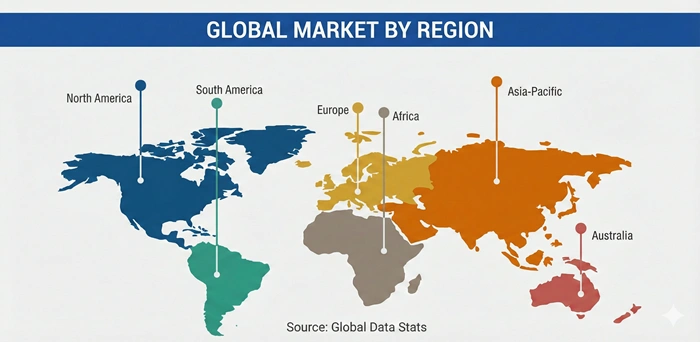
Asia Pacific holds the dominant position within the global x-ray film market, commanding approximately 40% share in 2025, driven by enormous patient volumes and a healthcare delivery model in many countries that still leans heavily on cost-effective film-based imaging rather than expensive digital systems. China and India together account for the majority of regional demand, supported by government healthcare expansion programs that prioritize basic diagnostic access over full technological modernization in rural and semi-urban areas. Key companies serving this region include Fujifilm, Konica Minolta, and regional manufacturers such as Tianjin Media Imaging Materials and China Lucky Film Corp, all of which maintain strong local production and distribution networks.
Japan and South Korea contribute a smaller but steady share of regional demand, primarily through specialty and industrial testing applications rather than general medical imaging, since both countries have largely transitioned their major hospitals to digital radiography. The continued presence of smaller clinics and specialty practices relying on film across the broader region ensures Asia Pacific retains its leadership position through the forecast period. This combination of scale, budget sensitivity, and gradually improving but still uneven healthcare infrastructure keeps the region firmly at the center of the global x-ray film market.
Latin America
Expanding Healthcare Access and Infrastructure Investment Position Latin America as a Fast-Growing Region
Latin America is projected to be among the fastest-growing regions within the x-ray film market through 2033, supported by a CAGR estimated near 6% as governments across the region continue investing in expanding basic healthcare access to underserved rural populations. Brazil accounts for the largest share of regional demand, driven by public healthcare expansion programs that continue to rely on cost-effective film-based imaging in smaller municipal hospitals and clinics. Regional distributors partnering with global manufacturers like Agfa-Gevaert and Carestream Health have played an important role in ensuring reliable film supply reaches these expanding healthcare networks.
Argentina and other countries across the region are following a similar pattern, with healthcare infrastructure investment gradually improving diagnostic imaging access even as budget constraints keep many facilities reliant on film rather than digital alternatives. This steady expansion of basic diagnostic capability across underserved areas continues to support meaningful growth in film demand even as more developed regional markets slowly begin their own digital transition. The combination of expanding access and continued budget sensitivity ensures Latin America remains an important growth contributor to the broader x-ray film market over the coming years.
Customization Available for This Report
Every Region and Country Covered in This Report Can Be Explored in Greater Depth Through a Tailored Version
This report is available in a customized format that can be tailored to any specific region or country, giving clients a sharper, more localized view of demand patterns, competitive dynamics, and regulatory context than a global summary alone can offer.
Clients seeking a more focused breakdown can request a customized version covering any of the following regions and countries, complete with localized market sizing, demand forecasting, and competitor mapping tied directly to the x-ray film keyword focus:
North America
-
U.S. — Detailed review of niche and specialty film demand alongside digital transition trends
-
Canada — Coverage of rural healthcare film reliance and distribution patterns
-
Mexico — Analysis of expanding public healthcare imaging access
Europe
-
U.K. — Review of specialty clinic and veterinary film usage trends
-
Germany — Coverage of industrial testing film demand and regulatory standards
-
France — Insights into healthcare film usage and gradual digital transition patterns
-
Italy — Analysis of regional healthcare film distribution and demand trends
-
Rest of Europe — Country-level view of Eastern European film demand patterns
Asia Pacific
-
China — Coverage of large-scale healthcare film demand and domestic manufacturing strength
-
India — Analysis of rural healthcare expansion and affordable film product demand
-
Japan — Review of specialty and industrial testing film applications
-
South Korea — Assessment of industrial testing demand and manufacturing capacity
-
Australia — Insights into remaining film usage in specialty and rural healthcare settings
-
Rest of Asia Pacific — Country-level breakdown covering Thailand, Vietnam, Indonesia, and Malaysia
Latin America
-
Brazil — Coverage of public healthcare expansion and film distribution networks
-
Argentina — Analysis of healthcare infrastructure investment and film demand trends
-
Rest of Latin America — Country-level sizing across Colombia, Peru, and Chile
Middle East & Africa
-
UAE — Review of healthcare infrastructure investment and film import demand
-
Saudi Arabia — Coverage of expanding diagnostic imaging access and distribution trends
-
Rest of MEA — Country-level view of Sub-Saharan Africa healthcare film access expansion
Top Key Players
-
Fujifilm Holdings Corporation (Japan)
-
Agfa-Gevaert NV (Belgium)
-
Carestream Health Inc (United States)
-
Konica Minolta Inc (Japan)
-
Sony Corporation (Japan)
-
FOMA BOHEMIA spol s r.o (Czech Republic)
-
Ashland Inc (United States)
-
Tianjin Media Imaging Materials Co Ltd (China)
-
China Lucky Film Corporation (China)
-
Kodak Alaris Inc (United States)
-
CPI Medical (United States)
-
Konsept Medical Imaging (India)
Recent Developments
-
In 2025, Fujifilm expanded its industrial radiography film production capacity to meet steady demand from aerospace and pipeline inspection customers
-
In 2026, Agfa-Gevaert strengthened its distribution partnerships across Latin America to support growing public healthcare film demand in the region
-
In 2025, Carestream Health introduced improved chemical processing solutions aimed at reducing environmental compliance costs for hospital film users
-
In 2026, Konica Minolta expanded its specialty film product line targeting veterinary and dental diagnostic applications in developed markets
-
In 2025, China Lucky Film Corporation increased domestic production capacity to serve rising demand from rural healthcare expansion programs across Asia
Market Trends
Budget-Driven Persistence in Emerging Markets and Consolidation Among Manufacturers Define the Current Landscape
One of the clearest trends shaping the x-ray film market is the growing divergence between developed and developing regions, where wealthier healthcare systems continue accelerating their transition to digital radiography while budget-constrained markets maintain steady, sometimes even growing, reliance on conventional film. This divergence is reshaping how manufacturers allocate production capacity and sales focus, with many companies increasingly prioritizing emerging market distribution relationships over investment in developed market film infrastructure that is gradually being phased out.
A second significant trend is the continued consolidation among film manufacturers, as smaller regional producers struggle to compete with the scale and distribution reach of established global players like Fujifilm and Agfa-Gevaert. This consolidation is gradually narrowing the supplier landscape, which in turn is giving remaining manufacturers greater pricing stability even as overall volume growth remains modest. Industrial testing applications continue to provide a valuable secondary growth avenue that is helping offset slower medical film growth, keeping the broader x-ray film market commercially viable well within the forecast period.
Segments Covered in the Report
By Product Type
-
Blue-Sensitive Film
-
Green-Sensitive Film
-
Industrial Radiography Film
-
Dental X-Ray Film
By Application
-
Medical Diagnostic Imaging
-
Dental Imaging
-
Industrial Non-Destructive Testing
-
Veterinary Imaging
By End User
-
Hospitals
-
Diagnostic Imaging Centers
-
Dental Clinics
-
Industrial Testing Facilities
By Region
-
North America (U.S., Canada, Mexico)
-
Europe (U.K., Germany, France, Italy, Rest of Europe)
-
Asia Pacific (China, India, Japan, South Korea, Australia, Rest of Asia Pacific)
-
Latin America (Brazil, Argentina, Rest of Latin America)
-
Middle East & Africa (UAE, Saudi Arabia, Rest of MEA)
❝ Built for Every Level — From Startups to Industry Giants ❞
Here Is Exactly How This Report Works for You
-
For tier 1 manufacturers, investors, and established market leaders, this report delivers detailed competitor revenue breakdowns, supply chain risk mapping, and geopolitical trade context that support confident decisions around production capacity, distribution partnerships, and long-term positioning within the x-ray film space
-
For tier 2 and tier 3 companies, regional distributors, and mid-sized manufacturers, this report highlights the most resilient demand pockets and underserved emerging market opportunities, giving you a practical roadmap to sustain profitable operations as the broader industry gradually transitions toward digital alternatives
-
For every decision maker across the value chain, this report explains exactly how regulatory shifts, healthcare infrastructure investment patterns, and competitor consolidation are shaping market direction through 2033, giving you the intelligence needed to plan capacity, pricing, and market entry decisions with confidence
Frequently Asked Questions
Question 1: How big is the global x-ray film market expected to become by 2033?
Answer: The global x-ray film market was valued at USD 1.98 billion in 2025 and is projected to reach USD 2.94 billion by 2033. Growth remains steady, supported by continued demand in emerging markets and industrial testing applications.
Question 2: What is driving continued demand in the x-ray film market despite digital imaging growth?
Answer: Demand in the x-ray film market is being sustained by budget-constrained healthcare systems in emerging regions that cannot yet afford full digital radiography conversion. Industrial non-destructive testing applications are also providing steady, complementary demand.
Question 3: Which region currently leads the x-ray film market?
Answer: Asia Pacific currently leads the x-ray film market with roughly 40% share, supported by large patient volumes and budget-driven healthcare delivery. Latin America is among the fastest-growing regions, driven by expanding healthcare access.
Question 4: Which product type holds the largest share of the x-ray film market?
Answer: Blue-sensitive film holds the largest share of the x-ray film market, valued for its reliable image quality and lower processing requirements. Medical diagnostic imaging remains the dominant application driving the bulk of overall film consumption.
Question 5: Who are the major companies competing in the x-ray film market?
Answer: Leading companies in the x-ray film market include Fujifilm, Agfa-Gevaert, Carestream Health, Konica Minolta, and Sony. These companies compete through strong distribution networks, industrial testing product lines, and continued support for emerging market healthcare film needs.