
Whole Exome Sequencing Market Overview
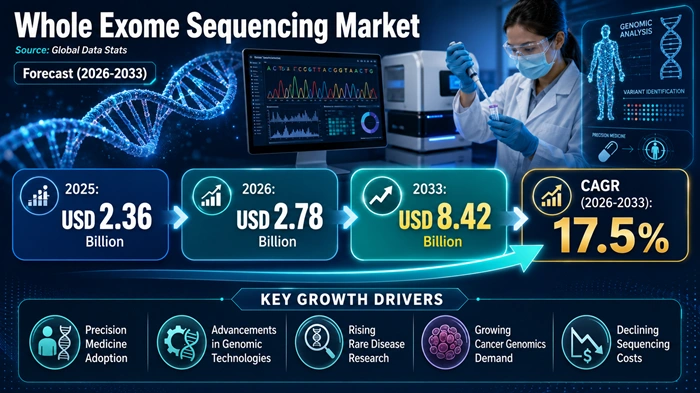
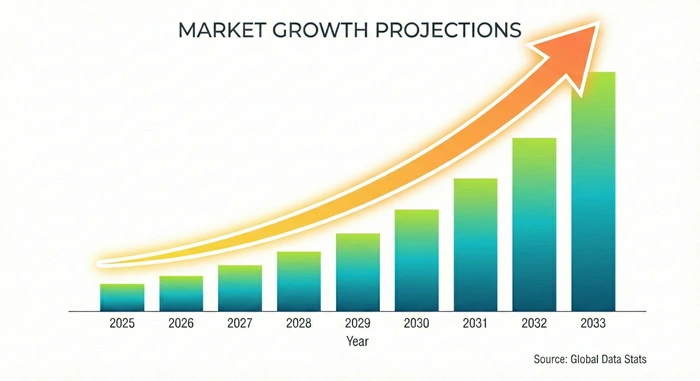
The global whole exome sequencing market size is valued at USD 2.36 billion in 2025 and is predicted to increase from USD 2.78 billion in 2026 to approximately USD 8.42 billion by 2033, growing at a CAGR of 17.5% from 2026 to 2033.
Whole exome sequencing (WES) — a technique that reads the protein-coding regions of the human genome, which make up roughly 1 to 2% of DNA but harbor the majority of known disease-causing mutations — has become one of the fastest-adopted diagnostic technologies in clinical genetics. The market spans exome capture kits, next-generation sequencing instruments, bioinformatics services, and interpretation software used across oncology, rare disease diagnosis, and reproductive health screening. Falling sequencing costs, expanding government-backed genomics programs, and rising physician confidence in exome-based diagnosis are together driving strong, durable growth for exome sequencing across both developed and emerging healthcare systems.
AI Impact on the Whole Exome Sequencing Industry
How Artificial Intelligence Is Reshaping Variant Interpretation, Diagnostic Turnaround Time, and Clinical Decision-Making Across the Whole Exome Sequencing Value Chain
Artificial intelligence has moved from an experimental add-on to a core operational layer within exome sequencing laboratories. AI-based variant calling and annotation platforms can now sift through tens of thousands of genetic variants per patient sample and flag the handful that are clinically relevant, cutting analysis time from several days to a matter of hours. This capability is particularly valuable in time-sensitive oncology and neonatal cases, where a faster diagnosis directly affects treatment decisions. In high-volume clinical laboratories, AI-assisted pipelines are also reducing the burden on scarce, highly trained bioinformaticians, allowing labs to scale patient volume without proportionally scaling headcount.
Beyond speed, AI is improving diagnostic accuracy by cross-referencing patient variants against continuously updated global mutation databases, phenotype-matching algorithms, and family history inputs. This is helping clinicians resolve previously "inconclusive" exome cases that older, rule-based interpretation software could not classify confidently. Sequencing companies are increasingly bundling AI-powered interpretation software with their instruments and kits as a value-added service, creating recurring software revenue streams alongside traditional hardware and consumable sales. This convergence of computational intelligence and genomic diagnostics is expected to remain one of the strongest structural themes shaping the exome sequencing landscape through 2033.
Growth Factors
Falling Sequencing Costs, Expanding Oncology Applications, and Government Genomics Programs Are the Three Most Influential Drivers Sustaining Market Expansion
Declining per-sample sequencing costs are the single most important reason exome testing has moved from a specialized research tool into mainstream clinical diagnostics. What once cost several thousand dollars and took weeks to complete can now be done in days at a fraction of the earlier price, thanks to high-throughput sequencing platforms and more efficient exome capture chemistry. This affordability curve has opened the door for mid-sized hospitals and community diagnostic labs — not just large academic medical centers — to offer exome testing, meaningfully widening the addressable customer base for the whole exome sequencing market.
Rising utilization of exome data in oncology is a second major growth factor, as clinicians increasingly rely on tumor mutation profiling to select targeted therapies and immunotherapy candidates. At the same time, national genomics initiatives in countries such as the United States, United Kingdom, China, and India are funding large-scale population sequencing programs that generate reference datasets, improve diagnostic accuracy, and normalize exome testing as part of routine care. Combined with growing patient and physician awareness of genetic testing benefits, these factors are creating a durable, multi-year demand base for exome sequencing kits, instruments, and interpretation services.
Market Outlook
The Whole Exome Sequencing Market Is Positioned for Sustained High-Growth Through 2033, Driven by Broader Clinical Adoption and Deeper AI Integration
The long-term outlook for exome sequencing remains firmly positive as clinical use cases extend well beyond rare disease diagnosis into oncology, prenatal and reproductive screening, and pharmacogenomics-guided prescribing. As more national health systems and private insurers begin reimbursing exome testing, adoption is expected to accelerate meaningfully among mid-sized diagnostic networks and community hospitals that previously viewed the technology as cost-prohibitive. This reimbursement expansion is likely to be one of the single biggest catalysts for volume growth over the next several years.
Looking further ahead, the exome sequencing industry is likely to see continued consolidation among instrument manufacturers, deeper strategic partnerships between sequencing hardware companies and AI interpretation software developers, and increasing emphasis on data security as genomic databases scale into the hundreds of millions of records. These dynamics point toward a market that is maturing in its core developed-market applications while still expanding rapidly in emerging economies, keeping the overall whole exome sequencing market on a strong growth trajectory well into the next decade.
Expert Speaks
-
"Genomics is moving from a research specialty to a core part of everyday clinical care, and the pace of that shift is accelerating. The organizations that can turn complex exome data into clear, actionable medical answers quickly will define the next phase of growth in this industry." — CEO, Illumina Inc.
-
"Laboratories today want sequencing platforms that combine speed, accuracy, and simplicity without compromising on clinical confidence. Our continued investment in end-to-end genomic workflow solutions reflects how central exome and genome sequencing have become to modern diagnostics." — CEO, Thermo Fisher Scientific Inc.
-
"The shift toward precision medicine is creating durable demand for deeper genomic insight, and whole exome sequencing sits right at the center of that transition. We see this as one of the most important growth areas across our entire diagnostics portfolio." — CEO, Roche Diagnostics
Key Report Takeaways
-
North America leads the whole exome sequencing market with an estimated 40% revenue share in 2025, supported by advanced healthcare infrastructure, strong research funding, and early adoption of genomic diagnostics.
-
Asia Pacific is the fastest-growing region, projected to expand at a CAGR above 20% through 2033, driven by rising healthcare spending and large government genomics programs in China and India.
-
Diagnostic laboratories and hospitals represent the largest customer base, together accounting for close to 45% of end-user revenue as they run the bulk of clinical exome testing for oncology and rare disease cases.
-
Oncology applications contribute the most to overall demand, holding roughly 34% application share, as exome data helps identify actionable mutations that guide targeted cancer therapy selection.
-
Kit-based exome capture workflows remain the most widely used sequencing process due to their cost efficiency and strong compatibility with existing laboratory sequencing equipment.
-
The clinical diagnostics application segment is projected to grow fastest going forward, expected to hold close to 38% market share by 2033 while expanding at a CAGR near 19% during the forecast period.
Market Scope
| Report Coverage Details | Details |
|---|---|
| Dominating Region | North America |
| Fastest Growing Region | Asia Pacific |
| Base Year | 2025 |
| Forecast Period | 2026 to 2033 |
| Segments Covered | By Product, By Workflow, By Application, By End User, By Region |
| Regions Covered | North America, Europe, Asia Pacific, Latin America, Middle East & Africa |
Market Dynamics
Drivers Impact Analysis
Falling Sequencing Costs Combined with Expanding Oncology and Government Genomics Programs Are the Most Commercially Significant Drivers of Market Growth
| Driver | (≈) % Impact on CAGR Forecast | Geographic Relevance | Impact Timeline |
|---|---|---|---|
| Falling exome sequencing costs and shorter turnaround times | ~34% | Global, led by North America and Asia Pacific | Short to long-term |
| Rising use of exome data in oncology mutation profiling | ~29% | North America, Europe | Short to medium-term |
| Government-funded population genomics programs | ~22% | Asia Pacific, Europe | Medium to long-term |
| Growing patient and physician awareness of genetic testing | ~15% | Global | Ongoing |
The steady decline in per-sample sequencing costs remains the single biggest driver of the whole exome sequencing market, as high-throughput platforms and more efficient exome capture chemistries continue to compress laboratory expenses. This affordability trend is allowing mid-tier hospitals and standalone diagnostic labs to run exome panels that were once reserved for major academic research centers, meaningfully broadening the customer base for testing providers.
Growing use of exome data in cancer diagnostics is a second powerful driver, since oncologists increasingly rely on comprehensive mutation profiling to guide targeted therapy and immunotherapy decisions rather than relying solely on smaller gene panels. Combined with expanding national genomics initiatives that fund population-scale sequencing in countries such as China, the United Kingdom, and the United States, these drivers together sustain strong, multi-year demand across both developed and emerging exome sequencing markets.
Restraints Impact Analysis
Data Interpretation Complexity and Bioinformatics Talent Shortages Are the Two Primary Constraints Limiting Faster Market Growth
| Restraint | (≈) % Impact on CAGR Forecast | Geographic Relevance | Impact Timeline |
|---|---|---|---|
| Complexity of variant interpretation and data management | ~38% | Global | Short-term |
| Shortage of trained bioinformaticians and genetic counselors | ~31% | North America, Europe | Short to medium-term |
| Regulatory uncertainty around genomic data privacy | ~19% | Europe, Asia Pacific | Medium to long-term |
| High upfront capital cost of sequencing instruments | ~12% | Latin America, MEA | Ongoing |
Handling the enormous volume of raw genomic data generated by each exome run continues to challenge many laboratories, particularly smaller diagnostic providers lacking dedicated bioinformatics teams or cloud computing infrastructure. Without adequate computational capacity, converting raw sequence reads into clinically actionable reports takes longer, increases turnaround time, and raises overall operating costs for laboratories offering exome-based services.
A persistent shortage of trained bioinformaticians and certified genetic counselors compounds this challenge, especially as testing volumes grow faster than the talent pipeline can supply qualified staff. Regulatory uncertainty around genomic data privacy, particularly in Europe and parts of Asia Pacific, further weighs on cross-border data sharing and multi-site collaborative research. These restraints do not reverse the underlying growth trend but do moderate the near-term pace at which the whole exome sequencing market can scale in resource-constrained settings.
Opportunities Impact Analysis
AI-Assisted Variant Interpretation and Expansion Into Emerging Economies Represent the Most Significant Untapped Growth Opportunities
| Opportunity | (≈) % Impact on CAGR Forecast | Geographic Relevance | Impact Timeline |
|---|---|---|---|
| AI-assisted variant interpretation and reporting software | ~37% | Global | Short to medium-term |
| Expansion of exome testing infrastructure in emerging economies | ~33% | Asia Pacific, Latin America, MEA | Medium to long-term |
| Integration of exome data into pharmacogenomics-guided prescribing | ~30% | North America, Europe | Long-term |
Integrating artificial intelligence into exome data interpretation presents one of the biggest commercial opportunities in the market, allowing companies to deliver faster, more accurate diagnostic reports as a premium, subscription-based service layered on top of one-time hardware sales. Vendors that successfully productize AI interpretation software stand to capture a growing share of recurring revenue independent of instrument sales cycles.
Emerging economies across Asia Pacific and Latin America represent a second major growth avenue as healthcare spending rises, local manufacturing capacity expands, and governments continue investing in domestic genomics infrastructure. Vendors that establish early distribution partnerships and local service capacity in these regions are well positioned to capture outsized share as the whole exome sequencing market matures globally and pharmacogenomics-guided prescribing becomes a mainstream clinical practice in developed markets.
Segment Analysis
By Application
Oncology and Rare Disease Diagnosis Together Anchor the Largest Share Within Whole Exome Sequencing Applications
Oncology applications hold the largest share of the whole exome sequencing market, accounting for roughly 34% of total application revenue with a CAGR near 18% through 2033. Exome-based tumor profiling helps clinicians identify actionable mutations that guide targeted therapy selection, making it an increasingly indispensable part of modern cancer diagnostic pathways. North America leads this segment because of its dense oncology research networks, well-established reimbursement frameworks, and strong integration of exome testing into major cancer center protocols. Leading companies operating in this space include Illumina, Thermo Fisher Scientific, and Foundation Medicine, all headquartered in the United States and each holding substantial installed sequencing capacity across major U.S. oncology centers.
Rare disease diagnosis is the second-largest application contributor, benefiting from exome sequencing's proven ability to detect causal mutations that standard gene panels frequently miss in complex or ambiguous pediatric cases. This application segment is expanding especially quickly across Europe, where several national health systems have formally integrated exome testing into diagnostic pathways for suspected genetic disorders in children. Companies such as Centogene in Germany and Blueprint Genetics in Finland have built strong regional reputations serving this rare disease niche across the continent. Growing physician familiarity with exome-based diagnostic workflows, alongside expanding insurance coverage, continues to reinforce steady demand growth across both of these leading application segments in the exome sequencing market.
By End User
Diagnostic Laboratories and Hospitals Represent the Structural Backbone of Whole Exome Sequencing Demand Worldwide
Diagnostic laboratories and hospitals together account for the largest end-user share in the whole exome sequencing market, holding close to 45% of total demand with steady CAGR expansion above 17% through the forecast period. These facilities perform the bulk of clinical exome testing, ranging from prenatal screening to cancer mutation profiling, and their high-volume, recurring testing operations make them the primary long-term customers for sequencing kits, instruments, and interpretation services. North America dominates this end-user category due to widespread insurance coverage, a dense network of accredited genetic testing laboratories, and strong physician referral pathways into clinical exome testing.
Research and academic institutions form a fast-growing secondary end-user segment, using exome sequencing extensively for population genomics studies, drug discovery research, and large-scale biobank projects. Asia Pacific is emerging as a particular hotspot for this segment, supported by expanding university research budgets, government-funded biobank initiatives, and growing collaboration between academic centers and commercial sequencing providers in China and India. Key players serving this end-user base include BGI Genomics in China and Macrogen in South Korea, both of which have scaled academic sequencing partnerships significantly in recent years. Continued funding for translational genomics research is expected to keep this end-user segment growing steadily as part of the broader exome sequencing market through 2033.
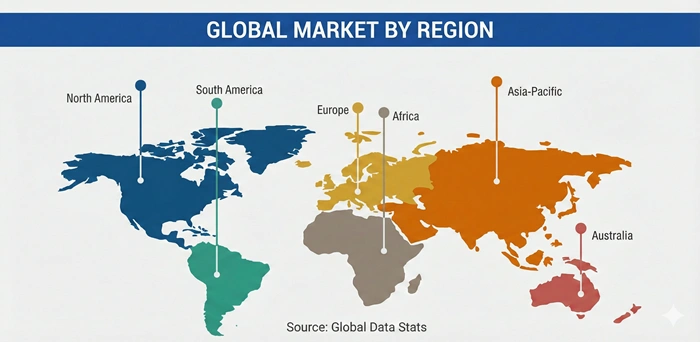
Regional Insights
North America
Established Healthcare Infrastructure, Strong Reimbursement, and Early Genomic Adoption Keep North America at the Top of the Whole Exome Sequencing Market
North America commands the largest share of the global whole exome sequencing market, holding close to 40% of total revenue in 2025 with a regional CAGR near 17% through 2033. Strong government and private research funding, combined with widespread insurance reimbursement for clinical genetic testing, keeps demand consistently high across hospitals, standalone diagnostic labs, and academic medical centers throughout the region. Leading companies such as Illumina and Thermo Fisher Scientific, both headquartered in the United States, dominate exome instrument and consumable kit supply across virtually every major clinical laboratory network in North America.
The region's mature regulatory environment under the FDA, combined with high physician awareness of genomic diagnostics, further reinforces this leadership position within the exome sequencing landscape. Large academic medical centers routinely integrate exome sequencing into standard diagnostic workflows for pediatric genetic disorders and complex oncology cases where smaller panels have failed to identify a causal mutation. This combination of infrastructure depth, sustained funding, and clinical familiarity ensures North America remains the anchor region for whole exome sequencing revenue generation over the coming years.
Asia Pacific
Rising Healthcare Investment and Large-Scale Government Genomics Programs Make Asia Pacific the Fastest-Growing Region in the Whole Exome Sequencing Market
Asia Pacific is the fastest-growing region in the whole exome sequencing market, projected to expand at a CAGR above 20% through 2033 while currently holding around 22% of global revenue share. Rapidly rising healthcare expenditure, expanding diagnostic laboratory infrastructure, and large national genomics initiatives in China and India are together driving this accelerated regional growth. Companies such as BGI Genomics in China and Macrogen in South Korea are scaling local manufacturing and clinical service capacity aggressively to meet surging regional demand for exome-based diagnostic testing.
Growing awareness of genetic testing benefits among patients, combined with government subsidies supporting population-scale sequencing programs, continues to widen the region's overall customer base for exome testing services. Japan and Australia are also contributing meaningfully through strong academic research collaborations and steady clinical adoption within their respective national healthcare systems. As affordability improves further and local players expand their distribution networks across smaller cities, Asia Pacific is expected to narrow its overall revenue gap with North America over the coming several years within the broader exome sequencing market.
Customization Available for This Report
Region-wise and country-wise customized reports are available for organizations seeking deeper geographic insight into the whole exome sequencing market. Our research team can tailor market analysis, competitive intelligence, trends, and growth opportunities specifically for any of the regions and countries listed below, offering detailed information aligned to your selected market and keyword combination.
North America
-
U.S., Canada, Mexico — detailed diagnostic infrastructure, reimbursement landscape, and competitive analysis
Europe
-
U.K., Germany, France, Italy, Rest of Europe — regulatory frameworks, hospital adoption trends, and key player positioning
Asia Pacific
-
China, India, Japan, South Korea, Australia, Rest of Asia Pacific — genomics program funding, local manufacturing capacity, and demand drivers
Latin America
-
Brazil, Argentina, Rest of Latin America — emerging diagnostic infrastructure and affordability trends
Middle East & Africa
-
UAE, Saudi Arabia, Rest of MEA — healthcare investment initiatives and market entry opportunities
Top Key Players
-
Illumina Inc. (United States)
-
Thermo Fisher Scientific Inc. (United States)
-
F. Hoffmann-La Roche AG (Switzerland)
-
BGI Genomics Co. Ltd. (China)
-
Agilent Technologies Inc. (United States)
-
QIAGEN N.V. (Germany)
-
Macrogen Inc. (South Korea)
-
Eurofins Scientific Group (Luxembourg)
-
Bio-Rad Laboratories Inc. (United States)
-
PerkinElmer Inc. (United States)
-
Oxford Nanopore Technologies plc (United Kingdom)
-
Pacific Biosciences of California Inc. (United States)
-
Centogene N.V. (Germany)
-
Foundation Medicine Inc. (United States)
Recent Developments
-
In 2025, Illumina expanded shipments of its NovaSeq X platform significantly, strengthening its position in high-throughput exome sequencing capacity across major clinical laboratory networks worldwide.
-
In 2025, Thermo Fisher Scientific completed several strategic bolt-on acquisitions aimed at broadening its clinical genomics testing and exome interpretation software portfolio.
-
In 2025, BGI Genomics deepened distribution and service partnerships across Asia Pacific to expand population-scale sequencing programs and local laboratory capacity.
-
In 2026, QIAGEN launched updated exome analysis software designed to improve variant interpretation speed and accuracy for high-volume clinical laboratories.
-
In 2026, Agilent Technologies introduced enhanced exome capture kits engineered to improve coverage uniformity for oncology and rare disease diagnostic applications.
Market Trends
Convergence of Artificial Intelligence, Cloud-Based Data Management, and Routine Clinical Genomics Is Reshaping the Whole Exome Sequencing Landscape
One of the clearest trends shaping the exome sequencing landscape is the steady shift toward cloud-based genomic data management, which allows laboratories to scale storage and computational analysis capacity without heavy upfront infrastructure investment. This shift is making exome sequencing more accessible to smaller diagnostic providers that previously lacked the computing resources needed to support large-scale variant analysis pipelines in-house.
A second notable trend is the growing integration of exome sequencing into routine oncology and prenatal workups rather than reserving it strictly for complex or previously unresolved diagnostic cases. As clinicians grow increasingly comfortable interpreting exome data independently, its use is expanding steadily across broader patient populations, reinforcing sustained long-term demand growth for the whole exome sequencing market well beyond its traditional rare disease diagnostic origins.
Segments Covered in the Report
By Product
-
Kits
-
Instruments
-
Services
By Workflow
-
Sample Preparation
-
Sequencing
-
Data Analysis
By Application
-
Oncology
-
Rare Disease Diagnosis
-
Reproductive Health
-
Pharmacogenomics
-
Others
By End User
-
Diagnostic Laboratories
-
Hospitals and Clinics
-
Research and Academic Institutions
-
Pharmaceutical and Biotechnology Companies
By Region
-
North America (U.S., Canada, Mexico)
-
Europe (U.K., Germany, France, Italy, Rest of Europe)
-
Asia Pacific (China, India, Japan, South Korea, Australia, Rest of Asia Pacific)
-
Latin America (Brazil, Argentina, Rest of Latin America)
-
Middle East and Africa (UAE, Saudi Arabia, Rest of MEA)
❝ Built for Every Level — From Startups to Industry Giants ❞
Here Is Exactly How This Report Works for You
-
For tier 1 sequencing corporations and institutional healthcare investors, this report delivers granular competitor revenue analysis across Illumina, Thermo Fisher Scientific, and BGI Genomics, alongside geopolitical supply chain risk assessment that supports confident investment and M&A targeting decisions.
-
For tier 2, tier 3 diagnostic companies, genomics startups, and regional distributors, this report identifies the highest-growth application subsegments and most commercially accessible regional markets, offering an evidence-based roadmap for entering or expanding within the whole exome sequencing market.
-
For all decision-makers across the exome sequencing value chain, this report translates complex supply-demand shifts and regulatory dynamics into clear, actionable strategic intelligence supporting stronger product development and commercialization decisions through 2033.
Frequently Asked Questions
Question 1: What is the current size of the whole exome sequencing market and how large will it grow by 2033?
Answer: The whole exome sequencing market was valued at USD 2.36 billion in 2025. It is projected to reach approximately USD 8.42 billion by 2033 at a CAGR of 17.5%.
Question 2: Which region leads the whole exome sequencing market today?
Answer: North America leads the whole exome sequencing market with roughly 40% revenue share. Strong reimbursement and research funding support this position.
Question 3: Which region is growing the fastest in the whole exome sequencing market?
Answer: Asia Pacific is the fastest-growing region in the whole exome sequencing market. Government genomics programs in China and India are driving this expansion.
Question 4: Who are the leading companies in the whole exome sequencing market?
Answer: Illumina, Thermo Fisher Scientific, and BGI Genomics are top companies in the whole exome sequencing market. They lead through strong instrument and kit portfolios.
Question 5: What applications drive the most revenue in the whole exome sequencing market?
Answer: Oncology applications generate the largest share of the whole exome sequencing market. Rare disease diagnosis is the second-largest contributor to overall demand.