
Web Application Firewall Market Overview
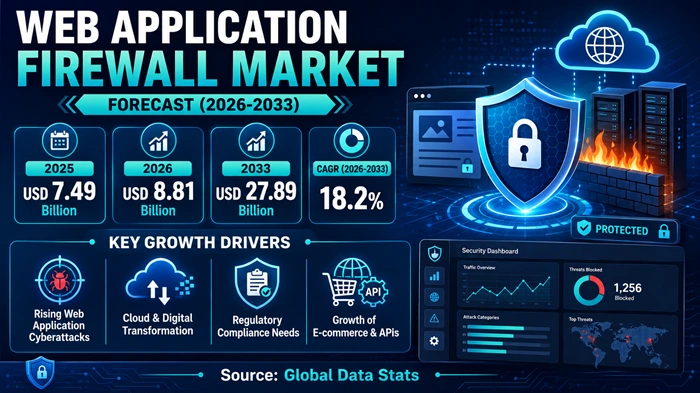
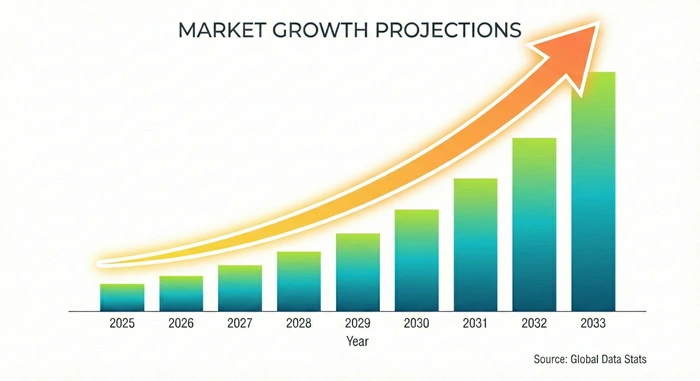
The global web application firewall market size is valued at USD 7.49 billion in 2025 and is predicted to increase from USD 8.81 billion in 2026 to approximately USD 27.89 billion by 2033, growing at a CAGR of 18.2% from 2026 to 2033.
Web application firewalls (WAFs) are security solutions specifically designed to monitor, filter, and block malicious HTTP and HTTPS traffic targeting web applications. As cyber threats grow in both volume and sophistication — spanning SQL injection, cross-site scripting, DDoS attacks, and API abuse — organizations across every industry are prioritizing WAF deployment as a core component of their cybersecurity posture. The transition to cloud-native architectures and the rapid expansion of digital services are further accelerating adoption across enterprises of all sizes.
AI Impact on the Web Application Firewall Industry
Artificial Intelligence Is Fundamentally Redefining How Web Application Firewalls Detect, Adapt, and Respond to the New Generation of Sophisticated and Fast-Evolving Cyber Threats
Artificial intelligence is rapidly becoming the defining technological differentiator in the web application firewall industry. Traditional rule-based WAF systems have long struggled to keep pace with novel and zero-day attack techniques, requiring constant manual rule updates that are slow to deploy and often lag behind attacker innovation. AI-powered WAF platforms address this gap by learning normal application behavior through machine learning models and automatically flagging deviations that match known or novel attack patterns — dramatically reducing both false positives and the time required to detect emerging threats.
Beyond detection, AI is enabling WAF platforms to make autonomous blocking decisions in milliseconds — a capability that is critical in high-traffic environments where manual intervention is simply not feasible. Natural language processing (NLP) is also being embedded in next-generation WAFs to better analyze the semantic content of web requests and identify evasion techniques that manipulate request syntax to bypass conventional filters. As AI capabilities continue to mature, the gap in protection quality between AI-native WAF platforms and legacy rule-based solutions will widen considerably, making AI adoption a strategic necessity for vendors seeking to maintain competitiveness in this high-growth market.
Growth Factors
Escalating Cyber Attack Volumes, the Rapid Expansion of Cloud Applications, and Strengthening Global Data Privacy Regulations Are Driving Exceptional Growth in the Web Application Firewall Market
The primary engine of growth for the web application firewall market is the relentless escalation of web application attacks globally. Research consistently shows that web applications are the vector in over a quarter of all data breaches, and the average enterprise-grade website is subjected to dozens of attacks per day. As organizations deploy more web-facing applications — from customer portals and e-commerce platforms to banking dashboards and healthcare records systems — the attack surface expands proportionally, creating structural and growing demand for WAF solutions across every industry.
The widespread shift to cloud computing and the explosive growth of API-driven architectures are also major catalysts. As organizations migrate workloads to AWS, Microsoft Azure, and Google Cloud, and as microservices and API-first development become standard architectural paradigms, the range of attack surfaces that require web application firewall protection has multiplied. Cloud-native WAF deployments and API security add-ons are now among the fastest-growing product categories in the broader cybersecurity market. Regulatory pressure is equally important — frameworks such as GDPR, PCI DSS, HIPAA, and emerging national cybersecurity laws are mandating stricter web security controls, with WAF deployment frequently specified as a compliance requirement.
Market Outlook
The Web Application Firewall Market Is Entering a Period of Accelerated Expansion, Driven by AI Integration, API Security Convergence, and the Rising Strategic Priority of Cyber Defense Across Public and Private Sectors
The web application firewall market is positioned for one of the strongest growth trajectories in the entire cybersecurity landscape through 2033. Cloud-based WAF deployments are rapidly displacing on-premises hardware appliances as the delivery model of choice, driven by the scalability, ease of management, and lower total cost of ownership that cloud platforms offer. Leading vendors including Cloudflare, Akamai, and AWS Shield are benefiting disproportionately from this shift, as their global network footprints provide inherent advantages in latency, capacity, and threat intelligence aggregation.
The convergence of WAF with broader security platforms — particularly secure access service edge (SASE), extended detection and response (XDR), and API security gateways — is also reshaping the competitive landscape in ways that favor platform vendors. Organizations are increasingly seeking to consolidate their security tooling, and WAF providers that can offer a comprehensive web security platform rather than a standalone filter are gaining commercial advantage. As cybersecurity budgets continue to grow across both enterprise and government sectors, and as the threat landscape grows more complex, the web application firewall market will remain one of the most dynamic and commercially attractive segments in global technology through the forecast period.
Expert Speaks
-
"The threat landscape targeting web applications has evolved dramatically over the last few years. AI-driven attacks, API abuse, and the scale of bot traffic targeting our customers' digital infrastructure mean that modern web application firewall capabilities are no longer optional — they are fundamental to maintaining digital trust and business continuity." — CEO, Cloudflare, Inc.
-
"As enterprises accelerate cloud migration and API-first development, the perimeter that web application firewalls must defend has grown in both complexity and strategic importance. We are investing heavily in AI and machine learning capabilities to ensure our WAF platforms stay ahead of the threat curve and deliver measurable protection for our customers." — CEO, Akamai Technologies, Inc.
-
"Regulatory requirements around data protection and web security are only becoming more stringent globally. Organizations that take a proactive approach to web application security — including robust WAF deployment as a foundation — will be far better positioned to maintain compliance, protect customer data, and avoid the reputational and financial consequences of a breach." — CEO, Fortinet, Inc.
Key Report Takeaways
-
North America leads the web application firewall market with approximately 37% of global market share in 2025, supported by a high density of enterprises with large web application estates, mature cybersecurity investment culture, strong regulatory enforcement, and the presence of most major WAF vendors headquartered in the United States
-
Asia Pacific is the fastest-growing region, expanding at a CAGR of approximately 20.1% from 2026 to 2033, propelled by rapid digital transformation, increasing cyberattack frequency targeting the region's enterprises, growing regulatory requirements for data protection, and a rapidly expanding cloud adoption base across China, India, South Korea, Japan, and Southeast Asia
-
Cloud-based deployment is the dominant and fastest-growing delivery model, accounting for approximately 55% of total WAF revenue in 2025 and growing at a CAGR of approximately 19.8% as enterprises shift from hardware appliances to scalable, managed cloud security platforms that offer superior flexibility and lower operational overhead
-
The BFSI sector contributes the most to the web application firewall market, representing approximately 31% of total end-use revenue in 2025, as financial institutions face the highest concentration of targeted web application attacks and must comply with the most stringent regulatory security standards globally
-
Large enterprises currently dominate WAF purchasing, accounting for approximately 62% of total market revenue in 2025, though SME adoption is growing rapidly as cloud-based WAF services reduce the cost and complexity barriers that previously limited access to enterprise-grade web security
-
API security-integrated WAF solutions are the fastest-growing product segment in the web application firewall market, projected to expand at a CAGR of approximately 22.5% from 2026 to 2033 and capture approximately 25% market share by 2033 as API traffic overtakes traditional web traffic as the primary attack vector in enterprise environments
Market Scope
| Report Coverage | Details |
|---|---|
| Market Size by 2033 | USD 27.89 Billion |
| Market Size by 2025 | USD 7.49 Billion |
| Market Size by 2026 | USD 8.81 Billion |
| Market Growth Rate (2026–2033) | CAGR of 18.2% |
| Dominating Region | North America |
| Fastest Growing Region | Asia Pacific |
| Base Year | 2025 |
| Forecast Period | 2026 – 2033 |
| Segments Covered | Component, Deployment Model, Organization Size, End-Use Industry |
| Regions Covered | North America, Europe, Asia Pacific, Latin America, Middle East & Africa |
Market Dynamics
Drivers Impact Analysis
Rising Web Application Attacks, Accelerating Cloud Adoption, and Mandatory Compliance Frameworks Are the Three Most Powerful Structural Forces Driving Exceptional Growth in the Web Application Firewall Market
| Driver | ≈ % Impact on CAGR Forecast | Geographic Relevance | Impact Timeline |
|---|---|---|---|
| Rapidly escalating volume and sophistication of web application attacks | ~35% | Global | Short to Medium Term |
| Accelerating cloud migration and expansion of API-driven architectures | ~28% | North America, Europe, Asia Pacific | Short to Medium Term |
| Stringent data protection and cybersecurity compliance regulations (GDPR, PCI DSS, HIPAA) | ~22% | North America, Europe | Medium to Long Term |
| Growing enterprise adoption of AI-native security platforms | ~15% | North America, Europe, Asia Pacific | Long Term |
The web application firewall market is being propelled forward by an unprecedented increase in the frequency and complexity of cyberattacks targeting web-facing applications. Web applications now constitute the most common attack entry point in enterprise data breaches, with SQL injection, cross-site scripting, and API abuse representing some of the most frequently exploited vulnerabilities. As organizations continue to digitize more of their customer-facing operations and expose more services through web and mobile interfaces, the risk profile they must defend against becomes broader and more demanding — creating a sustained and growing demand for effective WAF solutions across all sectors.
The migration of enterprise workloads to public cloud platforms has been equally transformative for the market. Cloud-native WAF deployments managed by providers like AWS, Microsoft Azure, and Google Cloud are now the default choice for organizations undergoing cloud transformation, as they offer automated updates, global threat intelligence, and seamless scaling without the complexity of managing physical appliances. This cloud-first shift is compressing the barrier to WAF adoption for mid-market and SME organizations, significantly expanding the total addressable market. Combined with regulatory mandates that increasingly specify WAF as a required security control — particularly in financial services, healthcare, and government — these drivers are creating a commercially powerful and durable growth dynamic.
Restraints Impact Analysis
High False Positive Rates, Integration Complexity, and Total Cost of Ownership Concerns Are the Primary Barriers Limiting Faster Adoption of Web Application Firewall Solutions
| Restraint | ≈ % Impact on CAGR Forecast | Geographic Relevance | Impact Timeline |
|---|---|---|---|
| High false positive rates disrupting legitimate traffic and increasing operational overhead | ~38% | Global | Short Term |
| Complexity of WAF tuning and integration within diverse application environments | ~28% | SME segment, developing markets | Medium Term |
| Total cost of ownership and skilled security personnel availability | ~20% | Latin America, MEA, parts of Asia Pacific | Short to Medium Term |
| Rapidly evolving attack techniques outpacing static rule-based WAF configurations | ~14% | Global | Short to Long Term |
One of the most persistent operational challenges in the web application firewall market is the issue of false positives — legitimate traffic incorrectly identified as malicious and blocked. In environments with complex application logic, high customization, and diverse user populations, poorly tuned WAF rules can generate significant operational disruption by blocking valid users, transactions, or data transfers. Managing these false positives requires skilled security staff who understand both the WAF platform and the underlying application architecture, and this resource requirement can be particularly challenging for smaller organizations or those in markets with cybersecurity talent shortages.
The integration complexity of WAF solutions within hybrid cloud and multi-cloud architectures is also a meaningful restraint. Many enterprises operate applications across on-premises data centers, multiple public clouds, and edge computing environments, and ensuring consistent WAF policy enforcement across all these environments requires sophisticated orchestration capabilities that not all WAF platforms currently deliver effectively. This complexity can delay deployment timelines and increase total cost of ownership in ways that cause decision-makers to defer or downscale their WAF investments, moderating market growth in certain segments and geographies.
Opportunities Impact Analysis
API Security Integration, Managed WAF-as-a-Service, and Emerging Market Cybersecurity Spending Growth Present the Highest-Value Opportunities for Web Application Firewall Market Stakeholders
| Opportunity | ≈ % Impact on CAGR Forecast | Geographic Relevance | Impact Timeline |
|---|---|---|---|
| Growing demand for API security and WAF convergence platforms | ~38% | North America, Europe, Asia Pacific | Short to Medium Term |
| Rapid expansion of managed WAF-as-a-Service for mid-market and SME customers | ~28% | Global | Short to Medium Term |
| Surging cybersecurity investment in Asia Pacific and Latin America | ~20% | China, India, Brazil, Southeast Asia | Medium Term |
| Government and critical infrastructure cybersecurity mandates | ~14% | North America, Europe, MEA | Medium to Long Term |
The convergence of WAF capabilities with API security is the single most strategically significant opportunity in the web application firewall market today. Modern applications are predominantly API-driven, and API endpoints represent one of the most rapidly growing and underprotected attack surfaces in enterprise environments. WAF vendors that can extend their platforms to provide comprehensive API discovery, schema validation, rate limiting, and behavioral anomaly detection are positioning themselves to capture an enormous and fast-growing market segment that legacy WAF architectures were not designed to address. This convergence opportunity is attracting significant R&D investment and is reshaping competitive positioning across the top tier of WAF vendors.
The managed WAF-as-a-service model represents an equally compelling commercial opportunity. Smaller and mid-market enterprises increasingly lack the internal security expertise to deploy and tune WAF solutions effectively, making managed service delivery an attractive alternative that removes operational complexity while providing enterprise-grade protection. Managed security service providers (MSSPs) that offer WAF as part of a broader managed security bundle are experiencing strong growth, and WAF platform vendors that invest in building MSSP partner ecosystems and managed delivery capabilities are significantly expanding their addressable market. This structural shift toward managed security consumption is expected to accelerate meaningfully through 2033.
Segment Analysis
By Deployment Model
Cloud-Based WAF Dominates Deployment Preferences and Is Growing at the Fastest Rate as Organizations Prioritize Scalability, Global Coverage, and Managed Security Delivery Over On-Premises Appliances
Cloud-based deployment holds the largest share within the deployment model segment of the web application firewall market at approximately 55% of total revenue in 2025. This dominance reflects a decisive organizational preference shift away from hardware appliances toward scalable, always-updated cloud security platforms that can protect applications regardless of where they are hosted. Cloud-based WAFs are particularly well-suited to the modern application environment, where workloads are distributed across multiple clouds, development cycles are continuous, and traffic volumes fluctuate significantly. North America leads in cloud WAF adoption, driven by the high concentration of cloud-native enterprises and the dominant market presence of cloud WAF providers including Cloudflare, Inc. (USA), Akamai Technologies, Inc. (USA), and Amazon Web Services (USA). The cloud deployment segment is growing at a CAGR of approximately 19.8% from 2026 to 2033.
On-premises and hybrid deployment models retain significant share within the web application firewall market, particularly in highly regulated industries and government sectors where data sovereignty requirements or security policy mandates prevent full migration to public cloud-managed security services. The on-premises segment is growing more slowly at a CAGR of approximately 12.5% from 2026 to 2033, but continues to generate substantial revenue in Europe and certain Asia Pacific markets where public cloud trust and regulatory constraints remain significant considerations. Key vendors competing in the on-premises segment include F5 Networks, Inc. (USA), Imperva, Inc. (USA), and Barracuda Networks, Inc. (USA), all of which offer both hardware appliance and virtual appliance configurations for deployment within enterprise data centers and private cloud environments.
By End-Use Industry
BFSI Leads as the Most Security-Intensive Vertical While Healthcare Emerges as the Fastest-Growing Industry Segment Driven by Digital Transformation and Rising Targeted Cyberattacks
The BFSI sector holds the largest end-use industry share within the web application firewall market at approximately 31% of total revenue in 2025. Financial institutions are among the most targeted organizations for web application attacks globally — their customer-facing applications process sensitive financial transactions, personal account data, and authentication credentials that represent extremely high-value targets for cybercriminals. Compliance with PCI DSS, SOX, and sector-specific regulatory requirements in major markets frequently mandates WAF deployment as a baseline security control, ensuring consistent and non-discretionary demand for web application firewall solutions from banks, insurance companies, and financial services platforms. The BFSI segment is growing at a CAGR of approximately 17.8% from 2026 to 2033, with North America and Europe accounting for the largest revenue shares. Key WAF providers serving the BFSI vertical include Imperva, Inc. (USA), Radware Ltd. (Israel), and F5 Networks, Inc. (USA) through dedicated financial services product configurations and compliance-aligned deployment frameworks.
Healthcare is the fastest-growing end-use vertical in the web application firewall market, projected to expand at a CAGR of approximately 21.3% from 2026 to 2033. The digitization of healthcare — encompassing electronic health records, patient portals, telehealth platforms, and connected medical devices — has made healthcare organizations among the most frequently targeted and most severely impacted victims of web application attacks. Healthcare data is extraordinarily valuable on criminal marketplaces, driving persistent and intensifying attack campaigns against hospital systems, health insurance platforms, and pharmaceutical companies. HIPAA compliance in the United States and GDPR in Europe both impose data protection requirements that drive WAF adoption in this sector. Cloudflare, Inc. (USA), Fortinet, Inc. (USA), and Palo Alto Networks, Inc. (USA) are among the leading providers delivering healthcare-specific WAF configurations and compliance frameworks.
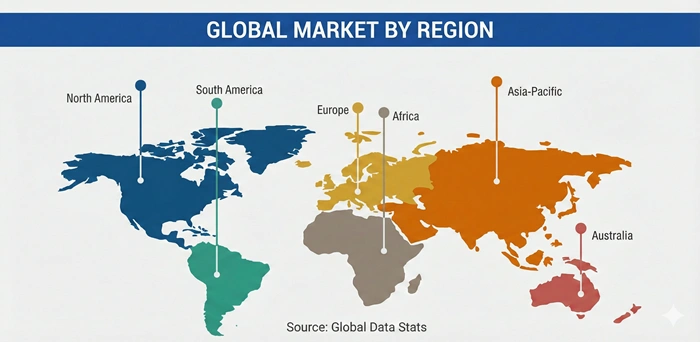
Regional Insights
North America's Cybersecurity Leadership and Asia Pacific's Digital Expansion Are Defining the Geographic Trajectory of the Global Web Application Firewall Market Through 2033
North America
North America Commands the Largest Share of the Web Application Firewall Market Through Its Advanced Cybersecurity Ecosystem, High Attack Exposure, and Mandatory Regulatory Compliance Frameworks
North America holds approximately 37% of global web application firewall market share in 2025, growing at a regional CAGR of approximately 17.5% from 2026 to 2033. The United States is the single largest country market, home to the world's highest density of internet-facing enterprise applications and most of the leading WAF vendors including Cloudflare, Inc. (USA), Akamai Technologies, Inc. (USA), F5 Networks, Inc. (USA), Imperva, Inc. (USA), and Palo Alto Networks, Inc. (USA). Federal cybersecurity mandates, including Executive Orders on improving national cybersecurity and OMB directives on zero-trust architecture, are directly driving WAF adoption within US government agencies and federally regulated industries. The region's large BFSI, healthcare, and e-commerce sectors are among the most intensive consumers of web application firewall solutions globally.
Canada is a growing contributor to North American WAF market revenues, with its financial services and healthcare sectors investing heavily in cybersecurity infrastructure. The broader North American market is also benefiting from a strong venture capital and technology investment ecosystem that is funding the development of next-generation AI-native WAF platforms — many of which are commercializing in North America first before expanding globally. This combination of high attack exposure, regulatory mandate, and technology leadership positions North America to maintain its dominant market share through 2033.
Asia Pacific
Asia Pacific Is the Fastest-Growing Region in the Web Application Firewall Market, Fueled by Rapid Digital Transformation, Rising Cyberattacks, and Tightening Data Protection Regulations
Asia Pacific is the fastest-growing region in the web application firewall market, projected to expand at a CAGR of approximately 20.1% from 2026 to 2033 and holding approximately 28% of global market share in 2025. China is the largest country market within the region, driven by its massive digital economy, extensive e-commerce and financial technology infrastructure, and increasingly sophisticated domestic cybersecurity regulation. India is one of the fastest-growing individual country markets, as its rapidly expanding IT services sector, fintech ecosystem, and government digital infrastructure create enormous and growing demand for web application security. Governments across Southeast Asia are also enacting comprehensive data protection legislation modeled on GDPR, which is driving enterprise WAF adoption across Singapore, Malaysia, Indonesia, and Vietnam.
South Korea and Japan contribute substantial revenue through their highly digitized economies and well-developed cybersecurity investment cultures. Japan in particular is rapidly increasing its national cybersecurity spending following a series of high-profile public sector and financial institution cyberattacks. Key international players competing in Asia Pacific include Akamai Technologies, Inc. (USA), Cloudflare, Inc. (USA), Fortinet, Inc. (USA), and Radware Ltd. (Israel), alongside strong domestic players in China including Alibaba Cloud and Huawei Technologies that offer integrated WAF capabilities within their cloud platforms.
Customization Available by Region and Country
This Web Application Firewall Market Report Is Available With Full Region-Specific and Country-Level Customization to Deliver the Precise Geographic Market Intelligence Your Organization Needs to Make Informed Strategic Decisions
Our web application firewall market report can be customized at the regional and country level, providing clients with targeted market sizing, threat landscape analysis, regulatory environment reviews, vendor landscape assessments, and growth opportunity mapping specific to any geography. Whether you need a focused country analysis or a broad multi-region comparison, the report adapts to your exact intelligence requirements.
-
Customized web application firewall market reports are available for all the following regions and countries:
North America
-
United States, Canada, Mexico — country-level WAF market sizing, regulatory compliance drivers (FCC, CISA, PCI DSS), end-use industry demand breakdown, leading vendor market share, and cloud vs. on-premises deployment trends
Europe
-
United Kingdom, Germany, France, Italy, Rest of Europe — region-specific analysis covering GDPR and NIS2 Directive compliance requirements, financial sector WAF adoption, country-level threat intelligence, and competitive positioning of leading European and global WAF vendors
Asia Pacific
-
China, India, Japan, South Korea, Australia, Rest of Asia Pacific — detailed country breakdowns covering digital economy expansion, national cybersecurity legislation, cloud adoption rates, local vendor landscape, and sub-regional WAF demand growth drivers
Latin America
-
Brazil, Argentina, Rest of Latin America — market sizing, digital transformation activity, regulatory framework development, financial sector cybersecurity investment, and WAF adoption trend analysis for key Latin American markets
Middle East & Africa
-
UAE, Saudi Arabia, Rest of MEA — analysis of national cybersecurity strategy investments, government digital infrastructure programs, BFSI sector security requirements, and market opportunity assessment for WAF solutions across the MEA region
Top Key Players
-
Cloudflare, Inc. (United States)
-
Akamai Technologies, Inc. (United States)
-
F5 Networks, Inc. (United States)
-
Imperva, Inc. (United States)
-
Fortinet, Inc. (United States)
-
Palo Alto Networks, Inc. (United States)
-
Barracuda Networks, Inc. (United States)
-
Radware Ltd. (Israel)
-
Amazon Web Services (AWS) (United States)
-
Microsoft Azure (Microsoft Corporation) (United States)
-
Ergon Informatik AG (Switzerland)
-
Fastly, Inc. (United States)
Recent Developments
-
In 2025, Cloudflare, Inc. launched an enhanced AI-powered WAF ruleset integrated with its Firewall for AI product, enabling real-time detection and blocking of prompt injection attacks and other AI-specific threats targeting organizations deploying large language models in customer-facing web applications.
-
In 2025, Akamai Technologies, Inc. expanded its API Security platform integration within its Web Application and API Protection (WAAP) suite, providing unified policy enforcement and behavioral threat detection across both traditional web application and API traffic channels for enterprise customers globally.
-
In 2024, F5 Networks, Inc. completed the integration of its Distributed Cloud WAF platform with its broader Distributed Cloud Services portfolio, enabling customers to enforce consistent web application security policies across multi-cloud, edge, and on-premises environments through a single management interface.
-
In 2025, Palo Alto Networks, Inc. enhanced its Prisma Cloud web application firewall capabilities with advanced bot management and client-side attack protection features, targeting enterprise customers seeking consolidated application security within a unified cloud security platform.
-
In 2024–2025, Imperva, Inc. advanced its cloud WAF platform with the introduction of ML-driven adaptive protection capabilities that automatically adjust threat detection thresholds based on application-specific behavioral baselines, significantly reducing false positive rates for large enterprise and e-commerce customers.
Market Trends
The Shift to Cloud-Native WAF Architectures and the Integration of API Security With Web Application Firewall Capabilities Are the Two Most Consequential Trends Reshaping the Competitive Landscape
The most significant structural trend in the web application firewall market is the decisive shift from hardware appliance-based to cloud-native and software-defined WAF architectures. Organizations across industries are accelerating their transition away from on-premises WAF hardware, which requires significant capital expenditure, specialist management, and manual update cycles, toward cloud-managed WAF services that deliver continuous protection updates, global scalability, and integration with broader cloud security ecosystems. This transition is fundamentally changing the competitive dynamics of the WAF market — favoring hyperscale cloud providers and pure-play cloud security vendors over traditional hardware-focused incumbents.
The convergence of WAF with API security and bot management into unified Web Application and API Protection (WAAP) platforms is equally transformative. As API traffic now accounts for the majority of web communication for many enterprises, and as sophisticated automated bot attacks represent a growing share of malicious web traffic, organizations are demanding integrated solutions that address the full spectrum of web-layer threats from a single platform. Vendors investing in WAAP convergence — combining WAF, API security, DDoS mitigation, and bot management under a unified policy engine — are gaining market share at the expense of point-solution WAF vendors, and this platform consolidation trend is expected to intensify throughout the 2026–2033 forecast period.
Segments Covered in the Report
-
By Component
-
Solutions (Hardware Appliances, Virtual Appliances, Cloud-Based)
-
Services (Professional Services, Managed Services)
-
-
By Deployment Model
-
Cloud-Based
-
On-Premises
-
Hybrid
-
-
By Organization Size
-
Large Enterprises
-
Small and Medium Enterprises (SMEs)
-
-
By End-Use Industry
-
BFSI
-
Healthcare
-
Government and Defense
-
IT and Telecommunications
-
Retail and E-Commerce
-
Education
-
Other End-Use Industries
-
-
By Region
-
North America (U.S., Canada, Mexico)
-
Europe (U.K., Germany, France, Italy, Rest of Europe)
-
Asia Pacific (China, India, Japan, South Korea, Australia, Rest of Asia Pacific)
-
Latin America (Brazil, Argentina, Rest of Latin America)
-
Middle East & Africa (UAE, Saudi Arabia, Rest of MEA)
-
❝ Built for Every Level — From Startups to Industry Giants ❞
Here Is Exactly How This Report Works for You
-
Whether you are a Tier 1 global cybersecurity vendor benchmarking your WAF platform strategy, a Tier 2 regional security company identifying high-growth vertical opportunities, or a startup building next-generation API security or AI-native WAF capabilities — this report delivers comprehensive competitor revenue analysis, revenue source breakdowns, supply-demand dynamics, and geopolitical risk mapping that enables every stakeholder in the web application firewall market to make high-confidence, data-backed strategic decisions.
-
For investors and mid-level companies evaluating market entry, technology acquisition, or product portfolio expansion, the report provides rigorous analysis of how cloud adoption trends, regulatory enforcement timelines, attack frequency data, and sector-specific security spending patterns across key geographies translate into specific and quantifiable web application firewall revenue opportunities — including detailed insight into how managed service delivery models are disrupting traditional licensing-based revenue streams.
-
For senior executives and strategic planners at cybersecurity vendors, cloud platforms, and enterprise security teams, this report maps how geopolitical cyber tensions, evolving global data sovereignty regulations, and the accelerating WAAP platform consolidation trend are reshaping procurement decisions and competitive positioning — providing the forward-looking intelligence your organization needs to build a winning market strategy through 2033.
Frequently Asked Questions
Question 1: What is the current size and growth forecast of the web application firewall market?
Answer: The web application firewall market is valued at USD 7.49 billion in 2025 and is projected to reach USD 27.89 billion by 2033. It is growing at a CAGR of 18.2% from 2026 to 2033.
Question 2: What are the key factors driving growth in the web application firewall market?
Answer: The primary growth drivers of the web application firewall market include the escalating frequency of web application attacks, accelerating cloud adoption, and tightening data protection regulations globally. The rapid growth of API-driven architectures and the increasing integration of AI capabilities into WAF platforms are also contributing strongly to market expansion.
Question 3: Which deployment model is most popular in the web application firewall market?
Answer: Cloud-based deployment is the dominant model in the web application firewall market, accounting for approximately 55% of total revenue in 2025. Its advantages in scalability, continuous updates, and managed delivery are driving rapid adoption over traditional on-premises hardware appliances.
Question 4: Which region is growing fastest in the web application firewall market?
Answer: Asia Pacific is the fastest-growing region in the web application firewall market, expanding at a CAGR of approximately 20.1% from 2026 to 2033. Rapid digital transformation, rising cyberattacks, and strengthening data protection regulations across China, India, South Korea, and Southeast Asia are fueling this exceptional growth.
Question 5: Who are the leading companies in the web application firewall market?
Answer: The leading companies in the web application firewall market include Cloudflare, Inc., Akamai Technologies, F5 Networks, Imperva, Fortinet, Palo Alto Networks, and Radware, among others. These vendors compete through AI-native threat detection capabilities, cloud delivery scale, API security integration, and global threat intelligence networks.