
Water And Wastewater Pumps Market Overview
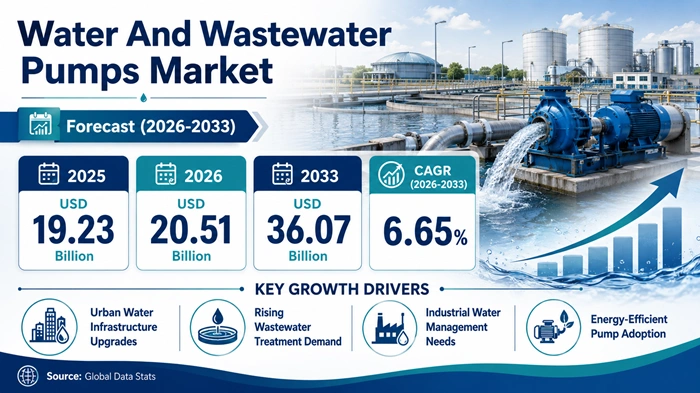
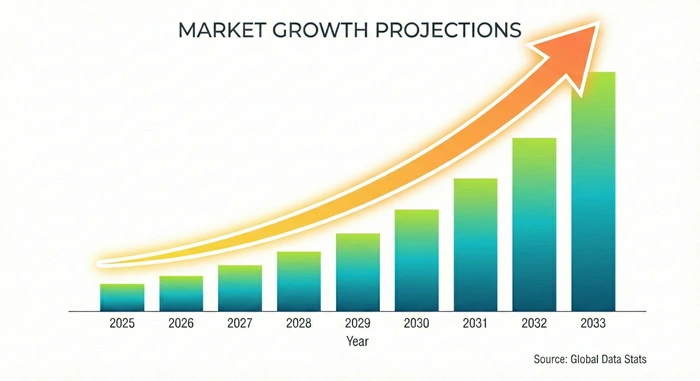
The global water and wastewater pumps market size is valued at USD 19.23 billion in 2025 and is predicted to increase from USD 20.51 billion in 2026 to approximately USD 36.07 billion by 2033, growing at a CAGR of 6.65% from 2026 to 2033.
Water and wastewater pumps represent essential equipment transferring water, wastewater, and other fluids across municipal distribution networks, industrial facilities, agricultural operations, and treatment infrastructure. These mechanical devices utilize centrifugal force, positive displacement, or submersible technologies moving liquids from source points to consumption areas or treatment facilities. The water and wastewater pumps market encompasses diverse applications including potable water supply, sewage collection, irrigation systems, industrial process water, flood control, and wastewater treatment supporting critical infrastructure worldwide delivering public health, environmental protection, and economic development benefits.
AI Impact On The Water And Wastewater Pumps Industry
Enhancing Operational Efficiency And Predictive Maintenance Through Smart Technologies
Artificial intelligence revolutionizes water and wastewater pumps operations by enabling predictive maintenance capabilities detecting potential equipment failures before catastrophic breakdowns occur, reducing unplanned downtime and extending asset lifespans. Machine learning algorithms analyze operational data including vibration patterns, temperature fluctuations, motor current signatures, flow rates, and pressure readings identifying abnormal conditions indicating bearing wear, impeller damage, seal degradation, or cavitation. Digital twin technology creates virtual replicas of pump systems enabling engineers to simulate operational scenarios, optimize control strategies, and validate maintenance procedures without disrupting actual facility operations. The water and wastewater pumps market benefits from AI-powered energy optimization systems adjusting pump speeds, scheduling operations, and coordinating multiple units minimizing electricity consumption while maintaining service requirements across varying demand patterns.
Smart sensors continuously monitor critical parameters transmitting real-time data to cloud-based analytics platforms providing operators instant visibility into system performance, efficiency metrics, and anomaly detection. Computer vision systems inspect equipment during maintenance outages identifying corrosion, erosion, coating failures, and structural issues invisible to human inspection improving quality assurance. The water and wastewater pumps market witnesses enhanced reliability as automated control systems respond to changing conditions within milliseconds implementing protective actions preventing water hammer, surge events, and pressure transients. Natural language processing analyzes maintenance logs, operator notes, and historical records identifying recurring failure patterns informing design improvements and operational best practices. Intelligent dispatch algorithms coordinate pumping operations across distributed networks balancing water levels, pressures, and energy costs optimizing overall system performance while ensuring regulatory compliance and service quality throughout extended operational periods.
Growth Factors
Urbanization And Infrastructure Modernization Driving Market Expansion
Rapid urbanization creates compelling demand for expanded water supply networks, sewage collection systems, and treatment facilities as global urban populations grow from 4.5 billion to projected 6.5 billion by 2050. Emerging economies across Asia Pacific, Africa, and Latin America invest massively in municipal water infrastructure supporting economic development, public health improvements, and quality of life enhancements. The water and wastewater pumps market expands substantially as new cities develop, existing urban areas expand, and informal settlements transition to formal infrastructure with engineered water and sanitation systems. Industrial growth including manufacturing facilities, data centers, food processing plants, and chemical operations drives demand for process water pumps, cooling systems, and wastewater treatment equipment. Agricultural sector modernization adopts efficient irrigation systems replacing flood irrigation with drip, sprinkler, and center-pivot technologies requiring reliable pumping infrastructure optimizing water use while improving crop yields.
Government infrastructure investment programs worldwide allocate substantial funding toward water and wastewater systems addressing aging infrastructure, compliance with environmental regulations, and service expansion. United States Bipartisan Infrastructure Law provides USD 55 billion for water infrastructure improvements while European Union programs fund treatment upgrades, network rehabilitation, and climate adaptation measures. The water and wastewater pumps market benefits from regulatory frameworks establishing discharge standards, drinking water quality requirements, and operational efficiency mandates driving technology adoption and system modernization. Climate change adaptation strategies recognize water infrastructure resilience as critical priority motivating investments in flood control pumping, drought-resistant water supply, and decentralized treatment systems. Population growth increases absolute water demand and wastewater generation requiring capacity expansions across collection networks, pumping stations, and treatment plants. Water scarcity pressures promote reuse and recycling initiatives requiring advanced treatment processes with specialized pumping equipment handling challenging fluid characteristics including high solids content, variable viscosity, and corrosive properties.
Market Outlook
Smart Technologies And Energy Efficiency Shaping Industry Evolution
Digital transformation enables remote monitoring, automated control, and advanced analytics improving operational performance across distributed pump installations. Internet of Things sensors, wireless communication networks, and cloud computing platforms provide real-time visibility into system conditions, performance metrics, and maintenance requirements. The water and wastewater pumps market witnesses growing adoption of variable frequency drives optimizing motor speeds matching instantaneous demand reducing energy consumption 20-50% compared to fixed-speed operation while extending equipment lifespans through reduced mechanical stress. Smart pumps integrate sensors, controllers, and communication capabilities enabling autonomous operation, self-diagnosis, and remote configuration reducing labor requirements while improving reliability and efficiency. Condition-based maintenance strategies replace time-based preventive approaches using continuous monitoring data scheduling interventions only when necessary minimizing costs while maximizing equipment availability.
Advanced materials including composite impellers, ceramic seals, and corrosion-resistant alloys extend operational lifespans in challenging applications handling abrasive solids, corrosive chemicals, and extreme temperatures. Hydraulic designs utilizing computational fluid dynamics achieve higher efficiencies, lower noise emissions, and reduced vibration improving performance and reliability. The water and wastewater pumps market benefits from modular designs enabling rapid installation, simplified maintenance, and flexible capacity adjustments accommodating changing operational requirements. Energy recovery systems capture pressure energy from gravity flows or downhill pipelines generating electricity offsetting operational costs. Solar-powered pumping systems serve remote locations, agricultural applications, and off-grid communities eliminating fuel costs and carbon emissions. Technology convergence with water treatment innovations including membrane systems, advanced oxidation, and nutrient recovery creates integrated solutions addressing complex water quality challenges. Cybersecurity measures protect critical infrastructure from emerging digital threats as increased connectivity creates potential vulnerabilities requiring robust protection strategies safeguarding operational continuity.
Expert Speaks
-
Patrick Decker, President and CEO at Xylem Inc., emphasized through recent investor communications that water infrastructure investment represents generational opportunity as governments worldwide address aging systems, climate resilience, and sustainable water management, noting that Xylem's smart infrastructure solutions including advanced pumping technologies, digital monitoring, and analytical capabilities position the company to serve growing market demand supporting customers achieving operational efficiency and environmental performance objectives.
-
Patrizio Vinciarelli, Founder, Chairman and CEO at Vicor Corporation, highlighted during technology presentations that energy efficiency improvements across industrial equipment including pumping systems deliver substantial operational savings and environmental benefits, emphasizing that advanced power electronics enabling variable-speed drives and intelligent motor controls optimize performance while reducing electricity consumption supporting corporate sustainability commitments and regulatory compliance.
-
Frans van Houten, former CEO at Royal Philips and current board member at Grundfos, noted through industry forums that digitalization transforms traditional equipment into intelligent systems delivering superior performance, predictive maintenance, and operational insights, stating that connected pumping solutions enable utilities and industrial operators optimize water networks, reduce energy costs, and improve service reliability through data-driven decision-making supporting transition toward sustainable water management practices.
Key Report Takeaways
-
Asia Pacific dominates the water and wastewater pumps market capturing approximately 43% regional share valued around USD 8.27 billion in 2025, driven by rapid urbanization, massive infrastructure investment, population growth, industrial expansion, agricultural modernization, and government initiatives improving water access and sanitation across emerging economies.
-
North America emerges as fastest-growing region with projected CAGR exceeding 7.1% through 2033, fueled by infrastructure replacement programs, federal funding allocations, environmental regulations, industrial facility upgrades, smart city initiatives, and technology innovation advancing pumping system efficiency and digital capabilities.
-
Centrifugal pumps represent the largest product type segment accounting for approximately 67% market share due to versatile applications, proven reliability, cost-effectiveness, established manufacturing infrastructure, and technical suitability across water supply, wastewater collection, and industrial process applications.
-
Water supply and distribution applications contribute the most significant demand representing roughly 41% of total market as municipal utilities, industrial facilities, and commercial developments require reliable pumping infrastructure delivering potable water from treatment plants to consumption points across extensive distribution networks.
-
Municipal segment maintains dominant end-user position commanding nearly 54% market share owing to government responsibilities providing water and sanitation services, substantial public infrastructure investment, population growth driving service expansion, and regulatory mandates establishing service quality and environmental protection standards.
-
Medium capacity pumps exhibit fastest growth trajectory projected to expand at 7.2% CAGR through 2033 with market share reaching approximately 46%, driven by urban distribution network expansion, industrial facility development, irrigation system modernization, and optimal balance between performance capabilities and capital costs.
Market Scope
| Report Coverage | Details |
|---|---|
| Market Size by 2033 | USD 36.07 Billion |
| Market Size by 2025 | USD 19.23 Billion |
| Market Size by 2026 | USD 20.51 Billion |
| Market Growth Rate from 2026 to 2033 | CAGR of 6.65% |
| Dominating Region | Asia Pacific |
| Fastest Growing Region | North America |
| Base Year | 2025 |
| Forecast Period | 2026 to 2033 |
| Segments Covered | Product Type, Capacity, Application, End-User, Region |
| Regions Covered | North America, Europe, Asia-Pacific, Latin America, Middle East and Africa |
Market Dynamics
Drivers Impact Analysis
Infrastructure Investment And Regulatory Compliance Accelerating Technology Adoption
| Factor | (≈) % Impact on CAGR Forecast | Geographic Relevance | Impact Timeline |
|---|---|---|---|
| Urbanization and population growth | 25-31% | Emerging economies, developing regions | 2026-2033 |
| Infrastructure modernization programs | 22-28% | North America, Europe, developed markets | 2026-2033 |
| Environmental regulations | 19-25% | Global, particularly developed markets | 2026-2033 |
Global urbanization accelerates as millions migrate from rural areas to cities annually requiring expanded water supply networks, sewage collection systems, and treatment facilities supporting growing urban populations. Emerging economies across Asia Pacific including China, India, Indonesia, Vietnam, and Philippines invest massively in municipal infrastructure as governments prioritize universal water access and improved sanitation addressing public health, economic development, and quality of life objectives. The water and wastewater pumps market expands substantially as new urban developments, informal settlement upgrades, and peri-urban expansions require comprehensive water and sanitation infrastructure with pumping equipment transferring fluids across varying elevations, distances, and system configurations. Industrial sector growth including manufacturing facilities, chemical plants, power generation, food processing, and technology operations drives demand for process water pumps, cooling systems, and wastewater treatment equipment handling diverse applications and fluid characteristics.
Aging infrastructure across developed markets requires replacement and rehabilitation as water mains, pumping stations, and treatment facilities installed decades ago reach end of operational life experiencing increasing failure rates, efficiency degradation, and maintenance costs. United States water infrastructure receives D+ grade from American Society of Civil Engineers with estimated USD 434 billion investment needed over 10 years addressing replacement, rehabilitation, and expansion requirements. The water and wastewater pumps market benefits from government funding programs including Infrastructure Investment and Jobs Act allocating USD 55 billion toward water systems, State Revolving Funds providing low-interest financing, and European Union cohesion funds supporting member state infrastructure modernization. Regulatory frameworks establish stringent discharge standards, drinking water quality requirements, and operational efficiency mandates requiring technology upgrades, treatment process improvements, and monitoring capabilities. Environmental regulations including Clean Water Act, European Union Water Framework Directive, and emerging market standards drive adoption of advanced pumping equipment supporting compliance, reducing environmental impact, and improving operational performance across municipal and industrial applications.
Restraints Impact Analysis
High Capital Costs And Energy Consumption Limiting Adoption Pace
| Factor | (≈) % Impact on CAGR Forecast | Geographic Relevance | Impact Timeline |
|---|---|---|---|
| Capital investment requirements | -14 to -19% | Capital-constrained developing markets | 2026-2033 |
| Energy consumption costs | -11 to -16% | High electricity cost regions | 2026-2033 |
| Skilled workforce shortages | -8 to -13% | Emerging economies, remote locations | 2026-2033 |
Water and wastewater infrastructure projects require substantial capital investment creating financial barriers particularly for developing countries with limited public resources and competing development priorities. Pumping stations, treatment facilities, distribution networks, and associated equipment demand millions to billions in upfront expenditure before delivering service benefits. The water and wastewater pumps market faces adoption challenges as municipalities prioritize immediate needs over long-term infrastructure investment despite lifecycle benefits including improved public health, environmental protection, and economic development. Financing complexity involving grants, loans, public-private partnerships, and international development assistance requires sophisticated financial structuring, creditworthiness assessments, and long-term revenue planning challenging institutional capabilities particularly in least-developed countries. Operation and maintenance costs represent ongoing financial burden including electricity consumption, spare parts, labor, and periodic replacement creating affordability concerns for resource-constrained utilities.
Energy consumption represents significant operational expense as pumping operations account for 2-4% of global electricity use with water utilities typically spending 30-50% of operational budgets on electricity. Inefficient pumps, oversized equipment, fixed-speed motors, and suboptimal system design waste substantial energy increasing costs and carbon emissions. The water and wastewater pumps market confronts efficiency challenges as legacy infrastructure, budget constraints, and technical knowledge gaps limit adoption of energy-saving technologies including variable frequency drives, high-efficiency motors, and optimized hydraulic designs despite attractive payback periods. Electricity price volatility creates operational risk particularly in regions with unreliable grids or diesel backup generation. Technical expertise requirements create workforce challenges as pump operation, maintenance, troubleshooting, and repair demand specialized training, diagnostic capabilities, and mechanical skills increasingly scarce across developing markets and aging workforces in developed economies. Utilities struggle recruiting and retaining qualified personnel capable of maintaining sophisticated equipment, interpreting data analytics, and implementing optimization strategies. Spare parts availability proves problematic particularly for remote locations, proprietary designs, and older equipment with discontinued components creating operational risks and extended downtime during failures.
Opportunities Impact Analysis
Smart Water Management And Decentralized Systems Creating Growth Pathways
| Factor | (≈) % Impact on CAGR Forecast | Geographic Relevance | Impact Timeline |
|---|---|---|---|
| Smart water network deployment | +19 to +25% | Urban centers, developed markets | 2027-2033 |
| Decentralized treatment systems | +17 to +23% | Rural areas, developing regions | 2027-2033 |
| Water reuse and recycling | +15 to +21% | Water-scarce regions globally | 2027-2033 |
Smart water network development creates substantial opportunity as utilities adopt digital technologies including sensors, meters, communication networks, and analytics platforms optimizing system performance, reducing losses, and improving service quality. Advanced metering infrastructure provides granular consumption data enabling demand management, leak detection, and customer engagement. The water and wastewater pumps market captures value from intelligent pumping systems integrating with smart networks adjusting operations based on real-time demand, storage levels, and energy pricing optimizing efficiency while maintaining service reliability. Pressure management systems reduce pipe breaks, extend infrastructure lifespans, and minimize water losses. Geographic information systems enable asset management, maintenance planning, and capital investment optimization. Cybersecurity solutions address growing digital infrastructure threats protecting operational technology systems from malicious attacks, ransomware, and unauthorized access ensuring service continuity and public safety.
Decentralized water and wastewater treatment systems emerge as cost-effective solutions for dispersed communities, rural areas, and developing regions where centralized infrastructure proves economically or technically impractical. Package treatment plants, membrane bioreactors, and nature-based systems serve individual buildings, neighborhood clusters, or small communities requiring compact, reliable pumping equipment suited to smaller capacities and variable flows. The water and wastewater pumps market benefits from off-grid and solar-powered solutions eliminating grid connection requirements, reducing operational costs, and enabling infrastructure deployment in remote locations. Modular designs enable phased capacity additions matching population growth avoiding large upfront investments. Container-based systems accelerate deployment supporting emergency response, temporary installations, and rapid urban development. Water reuse and recycling adoption accelerates across water-scarce regions as treated wastewater supplies non-potable applications including irrigation, industrial cooling, toilet flushing, and landscape maintenance. Advanced treatment technologies produce high-quality reclaimed water suitable for potable reuse addressing supply constraints through diversified water portfolios. Specialized pumps handle reclaimed water characteristics including variable quality, potential fouling, and corrosion considerations ensuring reliable long-term operation.
Segment Analysis
By Product Type: Centrifugal Pumps
Versatility And Cost-Effectiveness Establishing Segment Dominance
Centrifugal pumps dominate the water and wastewater pumps market capturing approximately 67% share valued around USD 12.88 billion in 2025 owing to broad application suitability across water supply, wastewater collection, irrigation, and industrial process applications. Operating principle utilizing rotating impeller imparting kinetic energy converting to pressure delivers reliable performance handling clean water, raw sewage, and process fluids across varying flow rates and pressure requirements. Simple design with fewer moving parts compared to positive displacement alternatives reduces maintenance requirements, extends operational lifespans, and lowers lifecycle costs. The water and wastewater pumps market benefits from established manufacturing infrastructure, competitive supply chains, and extensive installed base creating economies of scale reducing equipment costs while ensuring readily available spare parts and service support across global markets.
North America and Europe maintain substantial centrifugal pump deployment across municipal water systems, industrial facilities, and agricultural operations while Asia Pacific leads market growth as infrastructure expansion drives new installations. Leading manufacturers including Xylem, Grundfos, KSB, Sulzer, and Flowserve offer comprehensive centrifugal pump portfolios spanning standardized designs for common applications through customized solutions addressing specific project requirements. The water and wastewater pumps market sees this segment growing at steady 6.4% CAGR through 2033 as technology evolution improves hydraulic efficiency, reduces energy consumption, and enhances operational reliability. Advanced impeller designs utilizing computational fluid dynamics optimization achieve higher efficiencies minimizing electricity costs. Wear-resistant materials including high-chrome alloys, ceramic coatings, and advanced polymers extend component lifespans in abrasive applications. Variable frequency drive integration enables precise flow control, energy optimization, and soft starting reducing mechanical stress. Submersible configurations simplify installation, reduce land requirements, and eliminate priming challenges particularly for wastewater applications.
By End-User: Municipal
Public Service Responsibility And Government Investment Driving Segment Leadership
Municipal applications represent the largest segment in the water and wastewater pumps market commanding approximately 54% share valued around USD 10.38 billion in 2025, driven by government responsibilities providing potable water supply and sanitation services to urban and rural populations. Public water utilities operate extensive infrastructure networks including raw water intake pumping, treatment facility transfers, distribution boosting stations, sewage collection lift stations, and wastewater treatment processes requiring diverse pumping equipment across varying capacities and applications. The water and wastewater pumps market benefits from municipal sector emphasis on service reliability, public health protection, environmental compliance, and long-term infrastructure planning positioning pumping systems as critical assets requiring robust performance and extended operational lifespans across demanding service conditions.
Asia Pacific leads municipal pump adoption with China, India, Southeast Asia, and emerging economies investing massively in water and sanitation infrastructure supporting urbanization, economic development, and public health improvements. North America and Europe focus on infrastructure replacement, efficiency improvements, and smart technology integration addressing aging systems and evolving regulatory requirements. The water and wastewater pumps market witnesses this segment growing at robust 6.6% CAGR through 2033 driven by population growth, urban expansion, regulatory compliance pressures, and government funding programs. Leading municipal pump suppliers including Xylem, Sulzer, KSB, Grundfos, and Ebara provide engineered solutions, performance guarantees, and lifecycle support services addressing utility requirements for reliability, efficiency, and total cost of ownership. Large infrastructure projects specify custom-engineered pumping stations incorporating multiple units, redundant capacity, variable-speed drives, and advanced controls ensuring continuous operation. Smart city initiatives integrate water infrastructure with digital platforms enabling data-driven management, predictive maintenance, and optimized operations. Climate adaptation strategies drive investment in flood control pumping, drought-resistant water supply, and resilient wastewater systems addressing extreme weather events and changing hydrological patterns.
Regional Insights
Asia Pacific
Population Growth And Infrastructure Development Cementing Regional Market Leadership
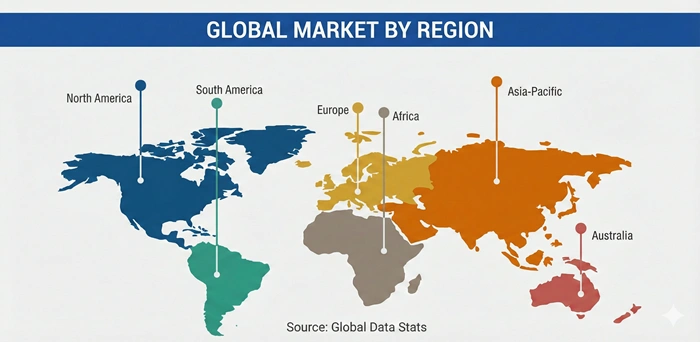
Asia Pacific dominates the water and wastewater pumps market commanding approximately 43% global share valued at USD 8.27 billion in 2025, projected to reach USD 14.82 billion by 2033 growing at 6.7% CAGR. China establishes overwhelming regional leadership through massive infrastructure investment as government programs including Yellow River Ecological Protection, Yangtze River Protection, and urban water system modernization allocate hundreds of billions toward water supply, wastewater treatment, and flood control infrastructure. Urbanization continues rapidly with 300 million additional urban residents expected by 2035 requiring substantial expansion of municipal water and sanitation networks. The water and wastewater pumps market benefits from industrial growth as manufacturing capacity expansion, chemical industry development, and power generation construction drive process water and wastewater treatment equipment demand across diverse applications and challenging service conditions.
India represents major growth opportunity as government programs including Jal Jeevan Mission targeting universal household water connections, Atal Mission for Rejuvenation and Urban Transformation upgrading urban infrastructure, and Namami Gange cleaning Ganges River invest massively in pumping equipment. Southeast Asian nations including Indonesia, Vietnam, Philippines, Thailand, and Malaysia prioritize water infrastructure addressing rapid urbanization, industrial development, and environmental protection. Japan maintains technological leadership through advanced manufacturing capabilities while domestic market focuses on efficiency improvements and disaster resilience. The water and wastewater pumps market witnesses regional manufacturing concentration as Chinese suppliers including Shanghai Kaiquan, Shandong Shuanglun, and Leo Group produce equipment serving domestic and export markets alongside international manufacturers including Grundfos, Xylem, and KSB operating regional facilities. Agricultural sector modernization drives irrigation pump demand as drip and sprinkler systems replace flood irrigation improving water use efficiency. Climate change adaptation including flood control pumping and drought-resistant water supply motivates infrastructure investment. Technology transfer, research collaboration, and workforce development advance regional capabilities supporting market expansion throughout forecast period.
North America
Infrastructure Renewal And Digital Innovation Driving Fastest Regional Growth
North America emerges as fastest-growing region in the water and wastewater pumps market with CAGR exceeding 7.1% from 2026 to 2033, with market value expanding from approximately USD 5.57 billion in 2025 toward USD 9.45 billion by 2033. United States leads regional growth through Infrastructure Investment and Jobs Act allocating USD 55 billion toward water and wastewater systems addressing aging infrastructure, expanding capacity, and improving resilience. Environmental Protection Agency programs including Water Infrastructure Finance and Innovation Act provide low-cost financing for major projects while State Revolving Funds support local infrastructure improvements. The water and wastewater pumps market captures momentum from utility sector modernization replacing equipment installed 50-80 years ago experiencing increasing failure rates, energy inefficiency, and maintenance costs. Regulatory compliance drives investment as Safe Drinking Water Act, Clean Water Act, and state regulations establish stringent standards requiring treatment upgrades, monitoring capabilities, and operational improvements.
Smart water initiatives advance across major utilities as cities including Los Angeles, New York, Chicago, and San Francisco deploy advanced metering infrastructure, pressure management systems, and leak detection technologies requiring intelligent pumping equipment integrating with digital platforms. Industrial sector including manufacturing, food processing, energy production, and technology operations adopts efficient water management addressing corporate sustainability commitments, water cost reduction, and regulatory compliance. Canada implements infrastructure investment programs while Mexican industrial development and urban expansion drive equipment demand. The water and wastewater pumps market benefits from North American technology leadership as manufacturers develop energy-efficient designs, smart connectivity, predictive maintenance capabilities, and advanced materials exported globally. Leading regional players including Xylem, Flowserve, Goulds Pumps, and Vaughan Company supply domestic and international markets. Research institutions, industry associations, and government laboratories advance pump technology through collaborative programs. Technology innovation, infrastructure funding, regulatory frameworks, and operational excellence position North America as primary growth engine for global water and wastewater pumps expansion throughout forecast period.
Top Key Players
-
Xylem Inc. (United States)
-
Grundfos Holding A/S (Denmark)
-
KSB SE & Co. KGaA (Germany)
-
Sulzer Ltd. (Switzerland)
-
Flowserve Corporation (United States)
-
Pentair plc (United Kingdom)
-
ITT Inc. (United States)
-
Ebara Corporation (Japan)
-
Wilo SE (Germany)
-
ANDRITZ AG (Austria)
-
Torishima Pump Mfg. Co., Ltd. (Japan)
-
Tsurumi Manufacturing Co., Ltd. (Japan)
-
Kirloskar Brothers Limited (India)
-
Cornell Pump Company (United States)
-
Vaughan Company, Inc. (United States)
Recent Developments
-
Xylem Inc. (September 2024): Announced acquisition of Evoqua Water Technologies for USD 7.5 billion creating integrated water technology leader combining treatment, transport, and analytics capabilities, expanding product portfolio across water and wastewater pumping, advanced treatment, and digital solutions supporting comprehensive customer offerings addressing complete water cycle requirements from source to reuse applications.
-
Grundfos (August 2024): Launched next-generation intelligent pump series featuring integrated sensors, predictive analytics, and cloud connectivity enabling autonomous operation, remote monitoring, and condition-based maintenance, demonstrating technology leadership advancing smart water infrastructure supporting utility digital transformation initiatives while delivering energy savings exceeding 30% through optimized control algorithms and variable-speed drives.
-
Sulzer (October 2024): Secured major contract supplying centrifugal pumps for wastewater treatment plant expansion in Asia Pacific serving 5 million population, providing customized equipment handling high-solids sewage with corrosion-resistant materials, advanced sealing systems, and efficiency optimization supporting regional infrastructure development addressing rapid urbanization and environmental protection requirements.
-
KSB (July 2024): Introduced modular pumping station system designed for rapid deployment supporting municipal infrastructure projects, featuring factory-assembled components, simplified installation procedures, and standardized configurations reducing on-site construction duration 50% while improving quality control and commissioning efficiency addressing accelerated urbanization requirements across emerging markets.
-
Flowserve (June 2024): Announced RedRaven IoT platform expansion integrating artificial intelligence and machine learning capabilities providing predictive maintenance, performance optimization, and remote diagnostics across distributed pump installations, supporting customers reduce unplanned downtime, extend equipment lifespans, and minimize operational costs through data-driven decision-making and proactive intervention strategies.
Market Trends
Energy Efficiency And Digital Connectivity Reshaping Product Development
Energy efficiency innovations advance pump technology as utilities and industrial operators prioritize operational cost reduction and carbon footprint minimization. High-efficiency motors exceeding IE4 and IE5 standards reduce electricity consumption while variable frequency drives enable precise speed control matching instantaneous demand eliminating energy waste from throttling, bypass, or cycling operation. The water and wastewater pumps market witnesses growing adoption of permanent magnet motors delivering superior efficiency particularly at partial loads typical of water applications with varying demand patterns. Hydraulic optimization utilizing computational fluid dynamics achieves maximum efficiency across operating ranges minimizing losses. System-level approaches including proper sizing, pipeline design, storage optimization, and control strategies deliver greater savings than component efficiency alone. Energy audits, monitoring systems, and benchmarking programs identify improvement opportunities quantifying savings potential motivating investment despite higher upfront costs. Renewable energy integration including solar-powered pumping systems, micro-hydro generation, and energy storage reduces grid dependence while lowering operating expenses and emissions.
Digital connectivity transforms pumps from standalone mechanical devices into intelligent networked assets delivering operational insights, predictive capabilities, and autonomous operation. IoT sensors continuously monitor parameters including vibration, temperature, pressure, flow, power consumption, and bearing condition transmitting data via wireless networks to cloud platforms. The water and wastewater pumps market benefits from analytics software identifying performance degradation, predicting failures, and recommending optimal maintenance timing maximizing equipment availability while minimizing intervention costs. Digital twins enable virtual commissioning, operational simulation, and scenario analysis supporting decision-making before physical implementation. Remote monitoring dashboards provide operators real-time visibility across distributed installations enabling centralized management of complex networks. Mobile applications deliver alerts, performance metrics, and diagnostic information enabling rapid response to emerging issues. Interoperability standards including BACnet, Modbus, and OPC-UA facilitate integration across multi-vendor environments enabling comprehensive system optimization. Blockchain applications support supply chain transparency, asset tracking, and maintenance verification. Cybersecurity measures including encryption, authentication, network segmentation, and intrusion detection protect connected infrastructure from emerging digital threats ensuring operational continuity and public safety.
Segments Covered In The Report
By Product Type
-
Centrifugal Pumps (End Suction, Split Case, Vertical Turbine, Submersible)
-
Positive Displacement Pumps (Rotary, Reciprocating)
-
Others
By Capacity
-
Small Capacity (Up to 500 GPM)
-
Medium Capacity (500 to 2000 GPM)
-
Large Capacity (Above 2000 GPM)
By Application
-
Water Supply and Distribution
-
Wastewater Treatment
-
Irrigation
-
Industrial Process Water
-
Others
By End-User
-
Municipal (Water Utilities, Wastewater Utilities)
-
Industrial (Manufacturing, Oil and Gas, Chemical, Power Generation, Food and Beverage)
-
Agriculture
-
Residential and Commercial
By Region
-
North America (United States, Canada, Mexico)
-
Europe (Germany, United Kingdom, France, Italy, Spain, Netherlands, Rest of Europe)
-
Asia-Pacific (China, India, Japan, South Korea, Indonesia, Thailand, Vietnam, Rest of Asia-Pacific)
-
Latin America (Brazil, Argentina, Chile, Rest of Latin America)
-
Middle East and Africa (Saudi Arabia, UAE, South Africa, Rest of MEA)
Frequently Asked Questions
Question 1: What is the expected size of the water and wastewater pumps market by 2033?
Answer: The global water and wastewater pumps market is projected to reach approximately USD 36.07 billion by 2033, expanding from USD 20.51 billion in 2026. This growth reflects urbanization pressures, infrastructure modernization programs, regulatory compliance requirements, agricultural irrigation expansion, and technology innovations improving energy efficiency and operational capabilities.
Question 2: Which region dominates the water and wastewater pumps market currently?
Answer: Asia Pacific dominates the water and wastewater pumps market with approximately 43% market share due to rapid urbanization, massive infrastructure investment, population growth, industrial expansion, and government initiatives improving water access and sanitation. The region benefits from China's infrastructure programs, India's universal water connection targets, and Southeast Asian development priorities supporting sustained equipment demand.
Question 3: What CAGR will the water and wastewater pumps market experience from 2026 to 2033?
Answer: The water and wastewater pumps market will grow at a compound annual growth rate of 6.65% from 2026 to 2033. This expansion reflects increasing water demand from population growth, aging infrastructure replacement needs, environmental regulations driving treatment upgrades, smart water network deployment, and energy efficiency priorities motivating technology adoption across municipal, industrial, and agricultural applications.
Question 4: Which product type holds the largest share in the water and wastewater pumps market?
Answer: Centrifugal pumps command the largest share at approximately 67% due to versatile applications across water supply, wastewater collection, irrigation, and industrial processes. The water and wastewater pumps market benefits from centrifugal technology's proven reliability, cost-effectiveness, simple maintenance requirements, established manufacturing infrastructure, and technical suitability handling diverse fluids across varying flow and pressure conditions.
Question 5: What are the primary growth drivers for the water and wastewater pumps market?
Answer: Primary drivers include rapid urbanization requiring expanded water and sanitation infrastructure, government investment programs funding system modernization, and environmental regulations establishing stringent discharge and quality standards. The water and wastewater pumps market also benefits from industrial growth driving process water requirements, agricultural irrigation modernization improving efficiency, smart technology adoption enabling digital operations, and water scarcity pressures promoting reuse and recycling initiatives requiring advanced pumping solutions.