
Variable Frequency Drive Market Overview
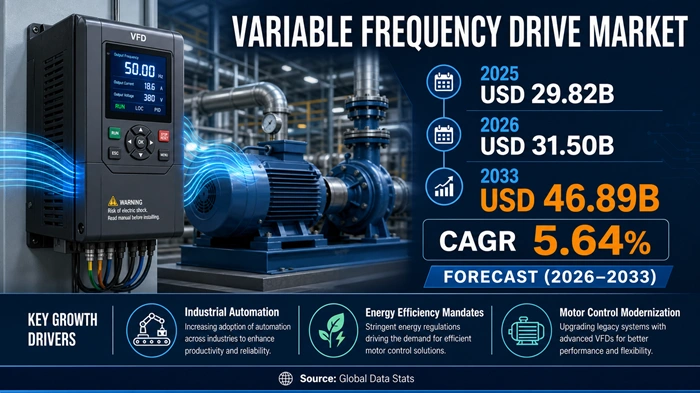
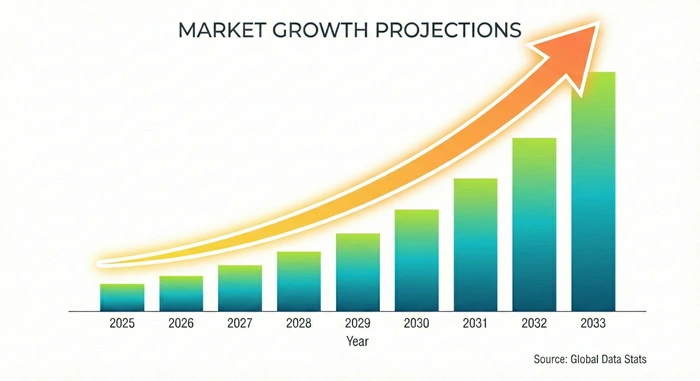
The global variable frequency drive market size is valued at USD 29.82 billion in 2025 and is predicted to increase from USD 31.50 billion in 2026 to approximately USD 46.89 billion by 2033, growing at a CAGR of 5.64% from 2026 to 2033.
The variable frequency drive market encompasses electronic devices that control motor speed and torque by varying input frequency and voltage, delivering precise operational control across industrial, commercial, and residential applications.
Rising demand for energy efficiency, accelerating industrial automation, and growing emphasis on reducing operational costs drive substantial adoption of VFD technology worldwide. Organizations across manufacturing, oil and gas, water treatment, HVAC systems, and power generation sectors increasingly recognize that variable speed control significantly reduces energy consumption compared to traditional fixed-speed motor operations. The market benefits from technological advancements including IoT integration, predictive maintenance capabilities, smart sensors, and advanced communication protocols that enhance system performance and operational reliability.
AI Impact on the Variable Frequency Drive Industry
Intelligent Automation and Predictive Maintenance Transform Motor Control Operations
Artificial intelligence is fundamentally reshaping the variable frequency drive market by introducing intelligent automation, predictive analytics, and adaptive control capabilities that significantly enhance energy efficiency while minimizing equipment downtime. AI algorithms enable VFDs to continuously analyze motor performance data including speed variations, torque fluctuations, power consumption patterns, and temperature changes to identify anomalies indicating potential failures before they occur. Machine learning models study historical operational patterns to predict maintenance requirements, optimize motor performance parameters automatically, and adjust drive settings based on real-time load conditions without human intervention.
The integration of AI with Internet of Things connectivity transforms variable frequency drives into intelligent components of comprehensive industrial automation ecosystems that coordinate with supervisory control and data acquisition systems, programmable logic controllers, and manufacturing execution platforms. AI-powered VFDs provide operators with detailed analytics through cloud-based platforms showing real-time energy consumption, performance efficiency metrics, predictive maintenance alerts, and optimization recommendations that support data-driven decision making. Advanced AI capabilities include digital twin simulations that enable performance modeling before implementation, automated parameter tuning that adapts to changing operational conditions, and intelligent energy management that minimizes power consumption during low-demand periods. Furthermore, AI-driven diagnostics identify root causes of performance issues, recommend corrective actions, and enable remote troubleshooting that reduces maintenance costs and extends equipment lifespan.
Growth Factors
Energy Efficiency Mandates and Industrial Automation Drive Market Expansion
Escalating energy costs and stringent government regulations mandating energy efficiency across industrial operations represent primary drivers propelling variable frequency drive market growth worldwide. Industries consuming substantial electrical power for motor-driven equipment including pumps, fans, compressors, and conveyor systems recognize that VFDs deliver energy savings ranging from 20% to 50% compared to traditional throttling and damper-based flow control methods. Global initiatives targeting carbon footprint reduction, sustainability goals, and compliance with environmental standards compel organizations to adopt variable speed technology that optimizes motor performance while minimizing waste. Government agencies worldwide implement regulations requiring VFD installation in specific applications, creating mandatory adoption drivers that accelerate market penetration across regulated industries.
Rapid industrial automation and smart manufacturing adoption transform production environments, creating substantial demand for sophisticated motor control systems that integrate seamlessly with digital transformation initiatives. Manufacturing facilities implementing Industry 4.0 concepts require intelligent drives offering advanced communication protocols, real-time monitoring capabilities, and integration with enterprise resource planning and manufacturing execution systems. The transition toward flexible manufacturing processes, customized production runs, and just-in-time operations necessitates precise motor control that VFDs deliver through adjustable speed, smooth acceleration profiles, and dynamic torque management. Additionally, aging infrastructure in developed markets creates replacement opportunities as organizations modernize legacy motor control systems with advanced VFD technology offering superior performance, energy efficiency, and smart connectivity features.
Market Outlook
Technological Innovation and Emerging Market Adoption Sustain Growth Momentum
The variable frequency drive market outlook remains exceptionally positive as converging trends including renewable energy integration, electric vehicle infrastructure development, and smart building adoption create expanding application opportunities. Market participants continue investing heavily in research and development to enhance VFD capabilities through wide-bandgap semiconductors, advanced power electronics, compact designs, and improved thermal management that deliver higher efficiency and reliability. The integration of silicon carbide and gallium nitride technologies enables manufacturers to develop next-generation drives offering reduced size, higher switching frequencies, lower losses, and improved power density compared to traditional silicon-based devices.
Smart and connected drives incorporating IoT sensors, cloud connectivity, mobile application interfaces, and advanced analytics represent the fastest-growing product category as customers increasingly value remote monitoring, predictive maintenance, and data-driven optimization capabilities. The renewable energy sector particularly demonstrates strong growth potential with VFDs playing critical roles in wind turbine pitch control, solar tracking systems, and hybrid energy storage management that optimize power generation and grid integration. Emerging markets across Asia Pacific, Latin America, and the Middle East present substantial expansion opportunities as industrialization, infrastructure development, and economic growth drive demand for modern motor control technology. Industry analysts project continued market expansion throughout the forecast period with particularly robust growth anticipated in medium and high power range segments serving heavy industrial applications.
Expert Speaks
-
Peter Blum, CEO of Schneider Electric, emphasized that everything we care about including our planet, people, and technology depends on energy, but today energy must do more by empowering us to innovate, compete, and create a sustainable and resilient future, with Schneider Electric serving as the energy technology partner that electrifies, automates, and digitalizes every industry, business, and home to drive efficiency and sustainability for all.
-
Peter Blum further stated that we cannot just react to changes but must lead, with Schneider Electric's goal being to help partners, customers, and the industry not just adapt but thrive in this new era by inventing technology that makes the new energy landscape possible through a commitment built on nearly two centuries of innovation, partnership, and impact.
-
Shawn Lankton, CEO of EnergyCAP, acknowledged that energy leaders carry heavy responsibilities that are operational, financial, and increasingly regulatory, committing that EnergyCAP will continue building a platform and community that helps save money, keep the lights on, and keep our world working with big things ahead on the product roadmap as they help harness AI and navigate a rapidly changing utility landscape.
Key Report Takeaways
-
Asia Pacific leads the global variable frequency drive market with approximately 34.5% to 40% regional share in 2025, driven by rapid industrialization, substantial manufacturing expansion, increasing electricity demand, and strong government support for energy efficiency initiatives across emerging economies.
-
Asia Pacific represents the fastest-growing regional market, expected to register the highest CAGR exceeding 5.9% from 2026 to 2033, fueled by industrial sector growth in China and India, infrastructure development projects, and rising adoption of automation technologies across manufacturing facilities.
-
AC drives dominate the variable frequency drive market with approximately 63.7% to 70% share in 2025 and projected to maintain leadership through 2033, valued for superior energy efficiency, compact design, lower maintenance requirements, and wide applicability across pumps, fans, conveyors, and compressor applications.
-
The medium power range segment demonstrates fastest growth potential, expected to grow at a CAGR of approximately 6% from 2026 to 2033, driven by strong demand from petrochemical, wastewater treatment, and mining industries requiring better operating flexibility and greater control capabilities.
-
Low voltage VFDs maintain dominant market position with over 80% share in 2025, serving commercial buildings, small industrial facilities, and HVAC applications where equipment operates below 690V, while medium voltage segments show accelerated growth in heavy industries.
-
Pump applications lead end-use demand accounting for substantial market share, followed by fans, HVAC systems, and compressors, with significant energy-saving potential in centrifugal pump and fan operations driving VFD adoption across water treatment, oil and gas, and building management sectors.
Market Scope
| Report Coverage Details | |
|---|---|
| Market Size by 2033 | USD 46.89 Billion |
| Market Size by 2025 | USD 29.82 Billion |
| Market Size by 2026 | USD 31.50 Billion |
| Market Growth Rate from 2026 to 2033 | CAGR of 5.64% |
| Dominating Region | Asia Pacific |
| Fastest Growing Region | Asia Pacific |
| Base Year | 2025 |
| Forecast Period | 2026 to 2033 |
| Segments Covered | Type, Power Range, Voltage Type, Application, End User, Region |
| Regions Covered | North America, Europe, Asia Pacific, Latin America, Middle East & Africa |
Market Dynamics
Drivers Impact Analysis
Energy Efficiency Requirements and Cost Reduction Initiatives Accelerate Adoption
| Factor | (≈) % Impact on CAGR Forecast | Geographic Relevance | Impact Timeline |
|---|---|---|---|
| Energy efficiency mandates | 2.1% | Global, particularly Europe and North America | Immediate and ongoing |
| Industrial automation growth | 1.7% | Asia Pacific, North America | Medium-term |
| Renewable energy integration | 1.2% | Global focus | Medium to long-term |
| Infrastructure modernization | 0.9% | Developed markets | Ongoing |
Rising energy costs and stringent regulatory frameworks mandating energy efficiency across industrial sectors create compelling economic incentives driving variable frequency drive market adoption globally. Organizations operating motor-driven equipment recognize that VFDs deliver substantial operational savings through precise speed control that matches motor output to actual demand rather than running at constant speed regardless of load requirements. Industrial facilities consuming significant electrical power for pumping, ventilation, compression, and material handling applications achieve energy reductions of 20% to 50% after VFD installation, generating rapid return on investment through reduced utility expenses. Government agencies worldwide implement regulations requiring variable speed drives in specific applications including HVAC systems, water treatment facilities, and industrial processes, creating mandatory adoption drivers that accelerate market penetration.
The global transition toward industrial automation and smart manufacturing creates substantial demand for advanced motor control systems that deliver the precision, flexibility, and connectivity required by modern production environments. Manufacturing facilities implementing Industry 4.0 concepts require intelligent drives offering seamless integration with programmable logic controllers, supervisory control and data acquisition systems, manufacturing execution platforms, and enterprise resource planning software through standard industrial communication protocols. The variable frequency drive market benefits from renewable energy sector growth as wind turbines, solar tracking systems, and energy storage installations require sophisticated power conversion and motor control capabilities that VFDs provide for optimizing generation and ensuring grid stability. Additionally, aging industrial infrastructure in developed markets creates replacement opportunities as facilities modernize legacy motor control equipment with advanced VFD technology offering superior energy efficiency, enhanced reliability, smart connectivity features, and predictive maintenance capabilities.
Restraints Impact Analysis
High Initial Costs and Technical Complexity Create Adoption Barriers
| Factor | (≈) % Impact on CAGR Forecast | Geographic Relevance | Impact Timeline |
|---|---|---|---|
| High initial investment costs | -1.3% | Price-sensitive emerging markets | Short to medium-term |
| Technical complexity | -0.8% | Small and medium enterprises globally | Ongoing |
| Harmonics and power quality concerns | -0.6% | Sensitive industrial applications | Medium-term |
| Skilled workforce shortage | -0.5% | Emerging markets | Medium-term |
Substantial upfront costs associated with VFD procurement, installation, system integration, and commissioning create significant barriers to variable frequency drive market adoption, particularly among small and medium-sized enterprises operating with limited capital budgets. Premium VFD systems incorporating advanced features including regenerative braking, active front-end converters, smart sensors, and IoT connectivity command higher prices that may exceed affordability thresholds for price-sensitive customers who struggle to justify investments despite long-term energy savings. Installation expenses including electrical modifications, control panel upgrades, programming services, and system integration add to total project costs, while some applications require additional equipment such as line reactors, harmonic filters, and electromagnetic interference suppression devices that further increase implementation expenses.
Technical complexity surrounding VFD selection, sizing, programming, and optimization requires specialized engineering knowledge that many organizations lack internally, creating dependence on external consultants and system integrators that increase project costs and timelines. The variable frequency drive market faces challenges in applications sensitive to power quality issues, as VFDs generate electrical harmonics that can interfere with other equipment, distort voltage waveforms, and cause heating in transformers and motors without proper mitigation measures. Organizations operating sensitive electronic equipment, precision instrumentation, or critical process controls may hesitate adopting VFDs due to concerns about electromagnetic interference, harmonic distortion, and potential impacts on overall power system quality. Additionally, the shortage of skilled technicians capable of programming, maintaining, and troubleshooting variable frequency drives limits adoption in emerging markets where technical training infrastructure remains underdeveloped and experienced personnel are scarce.
Opportunities Impact Analysis
Emerging Technologies and Market Expansion Create Substantial Growth Prospects
| Factor | (≈) % Impact on CAGR Forecast | Geographic Relevance | Impact Timeline |
|---|---|---|---|
| IoT and smart connectivity integration | 1.4% | Global, particularly developed markets | Medium-term |
| Emerging market industrialization | 1.1% | Asia Pacific, Latin America, Middle East | Long-term |
| Retrofit and replacement demand | 0.9% | North America, Europe | Immediate to medium-term |
| Electric vehicle infrastructure | 0.7% | Global focus | Medium to long-term |
The integration of Internet of Things connectivity and advanced digital technologies creates transformative opportunities within the variable frequency drive market by enabling remote monitoring, predictive maintenance, performance optimization, and data-driven decision making that deliver substantial value beyond basic motor control. IoT-enabled VFDs equipped with sensors, wireless communication, cloud connectivity, and mobile application interfaces allow operators to monitor equipment performance from any location, receive real-time alerts about operational anomalies, track energy consumption patterns, and optimize drive parameters remotely without site visits. Predictive maintenance capabilities powered by machine learning algorithms analyze vibration patterns, temperature trends, power consumption variations, and other performance indicators to forecast component failures before they occur, scheduling maintenance during planned downtime rather than responding to unexpected breakdowns.
Rapid industrialization across emerging markets in Asia Pacific, Latin America, Africa, and the Middle East creates substantial untapped potential as developing economies invest in manufacturing capacity, infrastructure development, and modernization initiatives that require motor control technology. Countries including China, India, Indonesia, Brazil, and Saudi Arabia demonstrate particularly strong growth trajectories driven by government infrastructure programs, foreign direct investment in manufacturing, and economic development policies supporting industrial expansion. The variable frequency drive market benefits from retrofit opportunities in developed markets where aging motor control equipment approaches end of operational life, with facility operators seeking modern replacements offering superior energy efficiency, enhanced reliability, and smart features. Electric vehicle charging infrastructure deployment creates emerging demand for VFD technology in power conversion, battery management, and grid integration applications, while building automation trends drive adoption in smart HVAC systems, elevator controls, and energy management platforms.
Segment Analysis
AC Drives Dominance
Wide Applicability and Superior Efficiency Maintain Market Leadership Position
AC drives command the dominant position within the variable frequency drive market, accounting for approximately 63.7% to 70% of total market share in 2025, as this drive type delivers proven performance across diverse industrial applications requiring precise motor speed control. AC variable frequency drives offer superior energy efficiency compared to mechanical throttling methods, compact and lightweight designs suitable for space-constrained installations, lower maintenance requirements resulting from fewer moving parts, and compatibility with standard three-phase AC motors that dominate industrial equipment. The widespread adoption of AC induction motors across pumping, ventilation, material handling, and processing applications creates natural demand for AC drives that precisely control motor speed by varying frequency and voltage supplied to the stator windings. Technological advancements including vector control algorithms, sensorless speed estimation, and advanced power electronics enhance AC drive performance through improved dynamic response, accurate torque control, and stable operation across wide speed ranges.
Asia Pacific demonstrates particularly strong AC drive adoption with manufacturing facilities, infrastructure projects, and industrial developments across China, India, Japan, and South Korea driving substantial demand, while leading manufacturers including ABB from Switzerland, Siemens from Germany, and Schneider Electric from France dominate the regional market through extensive product portfolios and established distribution networks. North America shows robust AC drive demand with industrial facilities, commercial buildings, and water treatment plants implementing variable speed technology to reduce energy consumption and achieve sustainability objectives, while the market benefits from retrofit opportunities as aging motor control equipment requires replacement. The variable frequency drive market AC segment particularly serves centrifugal load applications including pumps and fans where energy savings prove most dramatic, as power consumption decreases proportionally to the cube of speed reduction enabling substantial utility cost reductions. Industrial automation initiatives and smart factory implementations accelerate AC drive adoption as manufacturers seek motor control solutions offering standard communication protocols, real-time monitoring capabilities, and seamless integration with programmable logic controllers and supervisory systems.
Medium Power Range Growth
Versatility and Industrial Demand Drive Accelerated Segment Expansion
The medium power range segment demonstrates exceptional growth potential within the variable frequency drive market, expected to expand at approximately 6% CAGR from 2026 to 2033, as drives rated between 41 kW and 200 kW deliver optimal balance of performance, flexibility, and cost-effectiveness for diverse industrial applications. Medium power VFDs provide enhanced operating flexibility and superior control precision compared to low power alternatives while avoiding the complexity and expense associated with high power drives serving very large motors. This power range aligns perfectly with equipment commonly deployed in petrochemical processing, wastewater treatment, mining operations, food and beverage production, and general manufacturing where moderate-sized pumps, fans, compressors, and conveyors require variable speed control. Industries operating multiple medium power motors benefit significantly from VFD installation as cumulative energy savings across numerous drives generate substantial operational cost reductions and rapid investment payback periods.
Strong demand from the petrochemical industry particularly drives medium power segment growth as refineries and chemical plants operate extensive arrays of pumps, compressors, and agitators requiring precise flow control, pressure management, and mixing capabilities that VFDs deliver while simultaneously reducing energy consumption. Asia Pacific leads medium power VFD adoption with industrial expansion in emerging economies creating substantial demand for motor control solutions serving manufacturing facilities, mining operations, and infrastructure projects, while companies including Mitsubishi Electric from Japan, Yaskawa Electric from Japan, and Danfoss from Denmark effectively serve regional markets through localized products and technical support. Water and wastewater treatment facilities represent another significant application area for medium power drives as municipal utilities implement variable speed pumping to match water demand fluctuations, optimize treatment processes, reduce energy costs, and extend equipment lifespan through smooth starting and controlled acceleration. The variable frequency drive market medium power segment benefits from technological advancements including improved power electronics, enhanced cooling systems, and compact enclosure designs that enable manufacturers to deliver higher performance within standard physical footprints suitable for existing equipment installations.
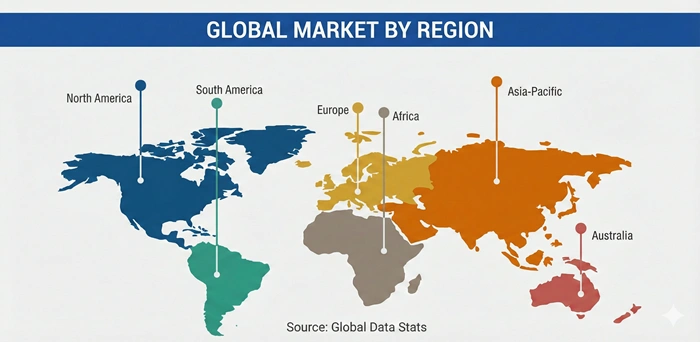
Regional Insights
Asia Pacific Market Leadership
Rapid Industrialization and Manufacturing Growth Drive Regional Dominance
Asia Pacific commands the global variable frequency drive market with approximately 34.5% to 40% regional share in 2025, maintaining leadership through rapid industrialization, substantial manufacturing sector expansion, massive infrastructure development programs, and strong government initiatives promoting energy efficiency across industrial operations. The region encompasses some of the world's fastest-growing economies including China, India, Indonesia, Vietnam, and Thailand where industrial production growth, foreign direct investment inflows, and economic development policies create robust demand for motor control technology. China represents the largest national market within Asia Pacific with extensive manufacturing capacity across automotive, electronics, machinery, textiles, and chemicals driving substantial VFD adoption, while government regulations mandating energy efficiency in industrial operations accelerate market penetration.
India demonstrates particularly strong growth momentum fueled by manufacturing expansion under government initiatives promoting domestic production, infrastructure modernization programs, and increasing adoption of automation technologies across industrial facilities. Leading regional manufacturers including Yaskawa Electric, Mitsubishi Electric, Fuji Electric, and Hitachi from Japan effectively serve local markets through competitive pricing, localized product features, extensive distribution networks, and strong relationships with equipment manufacturers and system integrators. The variable frequency drive market in Asia Pacific benefits from rising electricity costs that motivate industrial operators to implement energy-saving technologies, while growing environmental awareness drives adoption of solutions supporting sustainability objectives. Commercial developments including office complexes, shopping centers, and hospitality facilities increasingly incorporate VFDs in HVAC systems, elevator controls, and building management platforms to reduce energy consumption and operating expenses. Government infrastructure investments in transportation, water treatment, power generation, and urban development create substantial opportunities for VFD suppliers serving pumping stations, ventilation systems, and auxiliary equipment across major construction projects.
North America Technology Innovation Leadership
Advanced Features and Retrofit Opportunities Support Market Development
North America demonstrates exceptional technology adoption characteristics within the variable frequency drive market, representing approximately 30% of global demand in 2025, as the region leads in advanced feature implementation including IoT connectivity, predictive maintenance, and smart manufacturing integration. The United States market shows particularly strong momentum valued at USD 4.08 billion in 2025 and projected to grow at steady CAGR through 2030, driven by industrial automation expansion, energy-saving requirements across manufacturing and infrastructure, and modernization of aging motor control installations. Rising energy costs and corporate sustainability commitments motivate facility operators to implement VFD technology that delivers measurable reductions in power consumption, greenhouse gas emissions, and operating expenses.
Major corporations headquartered throughout North America including Rockwell Automation, Eaton Corporation, and Honeywell International maintain strong market positions through comprehensive product portfolios spanning low to high power ranges, extensive service networks supporting installation and maintenance, and established relationships with original equipment manufacturers and system integrators. The variable frequency drive market in North America particularly emphasizes advanced features with customers preferring drives offering multiple communication protocol options including EtherNet/IP, Modbus TCP, and PROFINET that enable seamless integration with diverse control systems and manufacturing execution platforms. Retrofit and replacement opportunities represent significant demand drivers as industrial facilities upgrade legacy motor starters and mechanical flow controls with modern VFD technology offering superior energy efficiency, enhanced reliability, and smart connectivity. Regulatory developments including energy efficiency standards from the U.S. Department of Energy and state-level initiatives promoting industrial decarbonization support continued VFD adoption across manufacturing, oil and gas, water treatment, and HVAC applications. The region benefits from mature distribution infrastructure including specialized industrial automation distributors, value-added resellers, and direct manufacturer channels that ensure product availability and technical support.
Top Key Players
-
ABB Ltd. (Switzerland)
-
Siemens AG (Germany)
-
Schneider Electric SE (France)
-
Rockwell Automation Inc. (United States)
-
Danfoss Group (Denmark)
-
Mitsubishi Electric Corporation (Japan)
-
Yaskawa Electric Corporation (Japan)
-
Fuji Electric Co. Ltd. (Japan)
-
Hitachi Ltd. (Japan)
-
Eaton Corporation PLC (Ireland)
-
Nidec Corporation (Japan)
-
WEG Industries (Brazil)
-
Delta Electronics Inc. (Taiwan)
-
Toshiba Corporation (Japan)
-
Emerson Electric Co. (United States)
Recent Developments
-
Siemens (2025): In March 2025, Siemens integrated digital twin technology into its SINAMICS VFD systems enabling real-time simulation of motor performance, predictive failure analysis, and preventive maintenance scheduling that significantly reduces unplanned downtime and extends equipment lifespan across industrial applications.
-
ABB (2024): In November 2024, ABB announced a strategic collaboration with Saneago to improve operational efficiency in Brazil's water sector by implementing advanced VFD solutions incorporating energy optimization algorithms and remote monitoring capabilities that reduce pumping costs while ensuring reliable water distribution.
-
Schneider Electric (2024): In October 2024, Schneider Electric expanded its EcoStruxure platform integration with variable frequency drives, enabling seamless connectivity for real-time monitoring, data analytics, and predictive maintenance across distributed industrial facilities through cloud-based management interfaces.
-
Rockwell Automation (2024): In September 2024, Rockwell Automation launched next-generation AC drives featuring enhanced communication protocols, integrated functional safety capabilities, and improved power density that support compact installation footprints while delivering superior performance for demanding industrial applications.
-
Danfoss (2024): In July 2024, Danfoss introduced energy-efficient VFD solutions specifically designed for HVAC applications, incorporating advanced motor control algorithms and intelligent power management features that reduce building energy consumption by up to 40% compared to conventional motor control methods.
Market Trends
IoT Integration and Compact Designs Transform Product Expectations
The rapid integration of Internet of Things connectivity and advanced digital capabilities represents a transformative trend within the variable frequency drive market, as customers increasingly demand devices offering remote monitoring, predictive analytics, cloud-based management, and seamless integration with comprehensive industrial automation ecosystems. IoT-enabled VFDs connect to enterprise networks through industrial Ethernet protocols including EtherNet/IP, Modbus TCP, and PROFINET, enabling real-time data exchange with supervisory control systems, manufacturing execution platforms, and cloud-based analytics services. Smart features including embedded sensors monitoring temperature, vibration, and electrical parameters provide operators with detailed performance insights, while machine learning algorithms analyze operational data to predict maintenance requirements, optimize energy consumption, and identify efficiency improvement opportunities. Mobile application interfaces allow facility managers to monitor VFD performance from smartphones or tablets, receive push notifications about alarms or anomalies, adjust operational parameters remotely, and access historical performance data that supports troubleshooting and optimization efforts.
The trend toward modular, compact, and space-saving VFD designs addresses customer requirements for installations in equipment cabinets with limited physical space while delivering equivalent or superior performance compared to larger predecessors. Manufacturers leverage advances in power electronics including silicon carbide semiconductors, high-frequency switching technologies, and improved thermal management systems to develop drives offering higher power density that fit standard DIN rail mounting or wall-mounted enclosures without requiring specialized installation infrastructure. Customization capabilities allowing VFDs tailored for specific industrial applications through pre-configured parameter sets, industry-specific operating modes, and application-optimized control algorithms simplify commissioning while ensuring optimal performance for pumping, ventilation, material handling, and process control requirements. The variable frequency drive market demonstrates increasing emphasis on regenerative braking capabilities that capture energy during motor deceleration and return it to the power distribution system rather than dissipating it as heat, delivering additional energy savings in applications with frequent start-stop cycles or dynamic load variations.
Segments Covered in the Report
By Type:
-
AC Drives
-
DC Drives
-
Servo Drives
By Power Range:
-
Low Power (Up to 40 kW)
-
Medium Power (41 kW to 200 kW)
-
High Power (Above 200 kW)
By Voltage Type:
-
Low Voltage (Up to 690V)
-
Medium Voltage (Above 690V)
By Application:
-
Pumps
-
Fans
-
Compressors
-
Conveyors
-
HVAC Systems
-
Others
By End User:
-
Oil & Gas
-
Power Generation
-
Water & Wastewater
-
Food & Beverage
-
Chemical & Petrochemical
-
Mining & Metals
-
Manufacturing
-
Automotive
-
Pulp & Paper
-
Cement
-
Others
By Region:
-
North America
-
United States
-
Canada
-
Mexico
-
-
Europe
-
Germany
-
United Kingdom
-
France
-
Italy
-
Spain
-
Rest of Europe
-
-
Asia Pacific
-
China
-
India
-
Japan
-
South Korea
-
Southeast Asia
-
Rest of Asia Pacific
-
-
Latin America
-
Brazil
-
Argentina
-
Rest of Latin America
-
-
Middle East & Africa
-
United Arab Emirates
-
Saudi Arabia
-
South Africa
-
Rest of Middle East & Africa
-
Frequently Asked Questions
Question 1: What is the projected variable frequency drive market size by 2033?
Answer: The global variable frequency drive market is projected to reach USD 46.89 billion by 2033, growing from USD 31.50 billion in 2026 at a CAGR of 5.64%.
Question 2: Which region dominates the variable frequency drive market currently?
Answer: Asia Pacific dominates the variable frequency drive market with approximately 34.5% to 40% share in 2025, driven by rapid industrialization and manufacturing expansion.
Question 3: What are the key drivers of variable frequency drive market growth?
Answer: Key drivers include energy efficiency mandates, industrial automation growth, renewable energy integration, cost reduction initiatives, and government regulations promoting sustainable operations.
Question 4: Which drive type leads the variable frequency drive market?
Answer: AC drives lead with approximately 63.7% to 70% market share in 2025, valued for superior energy efficiency, compact design, and wide industrial applicability.
Question 5: How is IoT technology impacting the variable frequency drive market?
Answer: IoT enables remote monitoring, predictive maintenance, cloud-based management, and data analytics that enhance operational efficiency and reduce downtime across industrial applications.