
Uranium Market Overview
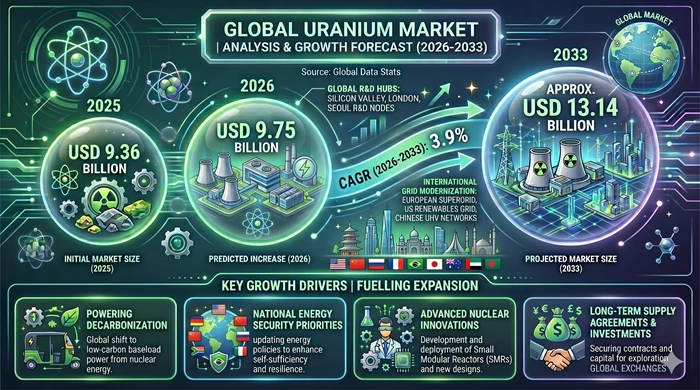
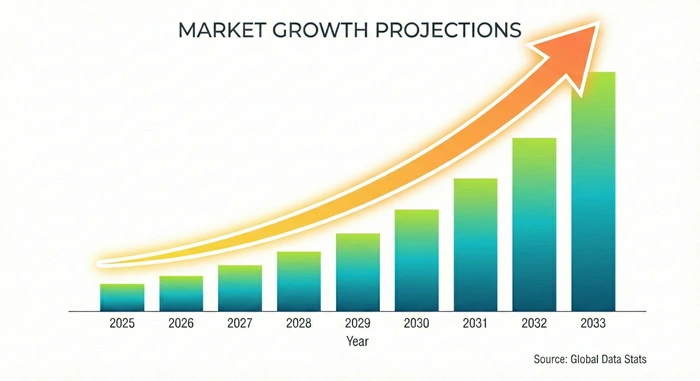
The global uranium market size is valued at USD 9.36 billion in 2025 and is predicted to increase from USD 9.75 billion in 2026 to approximately USD 13.14 billion by 2033, growing at a CAGR of 3.9% from 2026 to 2033.
The uranium market is experiencing renewed momentum as nuclear energy reclaims its role in global decarbonization strategies. Rising electricity demand from data centers, industrial expansion, and electric vehicle charging infrastructure is pushing governments and utilities toward nuclear power as a reliable, low-carbon baseload energy source. Alongside growing reactor construction activity in Asia and the revival of existing plants in North America and Europe, uranium demand is on a clear upward trajectory through 2033.
AI Impact on the Uranium Industry
Artificial Intelligence Is Transforming Uranium Exploration, Mine Operations, Fuel Cycle Management, and Nuclear Reactor Demand Forecasting Across the Global Nuclear Energy Value Chain
Artificial intelligence is steadily reshaping how the uranium industry operates across every major stage of the value chain. In exploration and mining, AI-powered geological modeling tools are enabling uranium producers to identify high-grade deposits more accurately and efficiently, reducing the time and capital required to move from discovery to production. Machine learning algorithms can now analyze vast seismic, geochemical, and drill-core datasets simultaneously — a capability that is particularly valuable in complex geological settings such as the Athabasca Basin in Canada or Kazakhstan's sedimentary roll-front uranium deposits.
At the reactor end of the supply chain, AI-driven demand forecasting platforms are helping utilities predict uranium fuel requirements with greater precision, optimizing long-term purchase contract strategies and inventory management. In nuclear plant operations, AI-based predictive maintenance systems are improving reactor uptime and safety monitoring, which directly supports the economic case for keeping existing plants operational longer. These combined effects are strengthening uranium market fundamentals, as utilities invest with greater confidence in long-term fuel procurement agreements backed by AI-enhanced operational intelligence.
Growth Factors
Nuclear Energy Renaissance Driven by Decarbonization Commitments, AI-Powered Data Center Electricity Demand, and Small Modular Reactor Development Are the Primary Growth Drivers for the Uranium Market
The most powerful growth catalyst reshaping the uranium market is the global nuclear energy renaissance underway across major economies. Net-zero emissions commitments have led governments in the United States, United Kingdom, France, Japan, South Korea, and China to reverse earlier moves toward nuclear phase-outs and instead pursue aggressive reactor construction and life extension programs. The United States has committed to tripling its nuclear capacity by 2050, while China continues to build more nuclear reactors simultaneously than any other country in the world. Each new reactor represents decades of consistent uranium fuel demand, creating a durable and growing long-term consumption base for uranium producers.
The rapid growth of AI-powered data centers is an emerging but increasingly significant demand driver. Technology companies including Microsoft, Google, and Amazon have signed long-term power purchase agreements with nuclear energy operators to secure clean, reliable electricity for their expanding computing infrastructure. This trend is incentivizing the restart of previously shuttered nuclear plants and accelerating the commercial development of small modular reactors (SMRs) — compact, factory-built nuclear units that could dramatically expand the geographic applicability of nuclear energy and require fresh uranium fuel supply. Together, these forces are creating a structural tightening in the uranium supply-demand balance that is expected to support prices and investment activity throughout the forecast period.
Market Outlook
The Uranium Market Is Positioned for Stable Long-Term Growth Through 2033, Supported by Nuclear Fleet Expansion, Supply Concentration Risk Premiums, and Growing Strategic Reserve Accumulation
The long-term outlook for the uranium market through 2033 is fundamentally positive, underpinned by structural demand growth from nuclear capacity expansion across Asia, the Middle East, and Eastern Europe. Global uranium requirements from operating reactors are expected to grow steadily as new plants come online in China, India, and the UAE, while reactor life extensions in the United States, Canada, and France add additional years of consumption to the existing demand base. New long-term supply contracts signed between major utilities and producers are increasingly reflecting tighter market conditions, with floor prices and escalation clauses that support producer investment incentives for new mine development.
On the supply side, the uranium market faces meaningful concentration risk, with Kazakhstan's Kazatomprom and Canada's Cameco together controlling a substantial share of global primary production. Any disruption to Kazakhstani output — whether from operational, regulatory, or geopolitical sources — has an outsized impact on global availability and spot prices. This supply concentration dynamic is driving many utilities and governments to actively pursue supply diversification strategies and build strategic uranium reserves — behaviors that add incremental near-term demand on top of the fuel consumption baseline. With a constructive supply-demand balance and growing institutional interest in uranium as a critical mineral, the market outlook through 2033 remains firmly supportive.
Expert Speaks
-
Timothy Gitzel, President & CEO, Cameco Corporation — "The uranium market is entering a period of structural tightening that we haven't seen in over a decade. Utilities are recognizing the urgency of securing long-term supply agreements, and Cameco is well-positioned to meet that demand from our tier-one assets in Canada."
-
Yerzhan Mukanov, CEO, Kazatomprom — "Global interest in nuclear energy as a clean baseload power source is translating into tangible demand growth for uranium. We are focused on optimizing our production to meet the needs of our long-term utility partners while managing the operational challenges in our Kazakhstan mining operations responsibly."
-
Nick Carter, CEO, Paladin Energy — "The restart of Langer Heinrich and the broader recovery of uranium mine supply are happening against a backdrop of genuine demand growth from new reactor construction and life extensions globally. The fundamentals supporting the uranium market over the next decade are among the strongest we have seen in this industry."
Key Report Takeaways
-
North America leads the uranium market, holding approximately 35% of global revenue in 2025, driven by the United States' large operating nuclear fleet, Canada's world-class uranium mining operations in the Athabasca Basin, and growing domestic enrichment and fuel fabrication infrastructure supporting long-term reactor fuel security
-
Asia-Pacific is the fastest-growing region in the uranium market, projected to expand at a CAGR of over 5.8% through 2033, driven primarily by China's massive nuclear power construction program, India's expanding reactor fleet, Japan's reactor restarts, and South Korea's continued nuclear energy commitment amid rising electricity demand
-
Nuclear power generation is the dominant application segment, accounting for approximately 95% of total uranium consumption globally in 2025, reflecting uranium's near-exclusive use as nuclear reactor fuel across commercial electricity generation, with a small but growing share destined for research reactors and isotope production
-
Uranium oxide (U₃O₈) is the most widely traded product form in the uranium market, as it serves as the standard intermediate product in the nuclear fuel cycle between mine output and conversion/enrichment, and is the primary commodity referenced in spot and term supply contracts between producers and utilities
-
Underground mining is the dominant production method, accounting for the largest share of primary uranium supply globally in 2025, led by the high-grade underground operations in Canada's Athabasca Basin that produce some of the world's richest uranium ore concentrations at substantially lower environmental footprint per pound of output
-
Small modular reactors (SMRs) represent the fastest-growing future demand segment for uranium, with commercial deployments expected to begin materially contributing to fuel demand by the late 2020s and projections suggesting SMRs could account for approximately 14% of incremental uranium demand growth by 2033, growing at an estimated CAGR of 12.4%
Market Scope
| Report Coverage | Details |
|---|---|
| Market Size by 2033 | USD 13.14 Billion |
| Market Size by 2025 | USD 9.36 Billion |
| Market Size by 2026 | USD 9.75 Billion |
| Market Growth Rate (2026–2033) | CAGR of 3.9% |
| Dominating Region | North America |
| Fastest Growing Region | Asia-Pacific |
| Base Year | 2025 |
| Forecast Period | 2026 – 2033 |
| Segments Covered | Product Form, Mining Method, Application, End User |
| Regions Covered | North America, Europe, Asia-Pacific, Latin America, Middle East & Africa |
Market Dynamics
Drivers Impact Analysis
Nuclear Energy Policy Reversals Globally, Rising Clean Electricity Demand From Technology Giants, and Accelerating SMR Development Are the Core Forces Expanding the Uranium Market
| Driver | ≈ % Impact on CAGR Forecast | Geographic Relevance | Impact Timeline |
|---|---|---|---|
| Nuclear energy capacity expansion and reactor life extensions | ~34% | Global, especially USA, China, and France | Short to Long-term |
| AI data center demand driving nuclear power purchase agreements | ~24% | North America, Europe | Short to Medium-term |
| Growing geopolitical focus on uranium supply chain diversification | ~18% | North America, Europe, Japan | Medium to Long-term |
| Small modular reactor (SMR) commercial development | ~14% | North America, Europe, Asia-Pacific | Medium to Long-term |
| Rising uranium spot prices incentivizing new mine investment | ~10% | Canada, Kazakhstan, Australia | Medium to Long-term |
The nuclear energy policy environment has undergone a remarkable transformation over the past few years, reversing decades of decline in many major economies. Countries that previously committed to nuclear phase-outs — including Germany's neighbors in Western Europe, Japan, and several US states — are now reconsidering or extending reactor lifetimes in response to energy security concerns and decarbonization imperatives. This policy shift is directly translating into extended and new uranium fuel procurement requirements that underpin the uranium market's demand growth outlook through 2033.
The role of the technology sector in driving uranium demand is a newer but increasingly impactful factor. Major hyperscale data center operators are entering long-term agreements for nuclear-generated electricity specifically because of its around-the-clock reliability — a quality that intermittent renewables cannot match for mission-critical computing applications. This dynamic is incentivizing nuclear plant restarts and new construction that would not be justified on traditional utility economics alone, creating incremental uranium demand that represents genuine structural expansion of the addressable market.
Restraints Impact Analysis
Supply Concentration Risk in Kazakhstan, High Capital Costs of Uranium Mining, and Public Perception Challenges Around Nuclear Energy Are the Primary Factors Constraining Uranium Market Momentum
| Restraint | ≈ % Impact on CAGR Forecast | Geographic Relevance | Impact Timeline |
|---|---|---|---|
| Extreme geographic concentration of uranium production in Kazakhstan | ~30% | Global | Ongoing |
| High capital and environmental costs of new mine development | ~26% | Global | Medium to Long-term |
| Nuclear energy public acceptance and political opposition | ~22% | Europe, parts of North America | Ongoing |
| Long permitting and regulatory timelines for new mines and reactors | ~14% | North America, Europe, Australia | Medium to Long-term |
| Competition from other clean energy sources for electricity investment | ~8% | Global | Medium to Long-term |
Kazakhstan's Kazatomprom accounts for approximately 45% of global primary uranium production, creating a level of supply concentration that is unparalleled in most critical mineral markets. Any disruption to production from Kazakhstan — whether from technical challenges in mine operations, changes in export policy, or broader geopolitical instability in Central Asia — can rapidly and disproportionately affect global uranium availability and prices. This structural risk is a persistent overhang on the uranium market that influences utility procurement strategies and producer investment decisions globally.
The high capital requirements and long development timelines associated with uranium mining also constrain the market's ability to respond quickly to demand signals. A new uranium mine typically requires 10 to 15 years from discovery to production, meaning that even a strong and sustained demand increase today may not be met by new primary supply until the mid-2030s. This supply inflexibility, combined with strict regulatory oversight in major uranium-producing countries, means that the market must rely heavily on secondary supply sources and inventory drawdowns during periods of rapid demand growth.
Opportunities Impact Analysis
SMR Commercialization, Strategic Uranium Reserve Building by Governments, and Uranium Exploration Revival in Underexplored Jurisdictions Represent the Most Compelling Long-Term Market Opportunities
| Opportunity | ≈ % Impact on CAGR Forecast | Geographic Relevance | Impact Timeline |
|---|---|---|---|
| Commercial deployment of small modular reactors (SMRs) | ~35% | North America, Europe, Asia-Pacific | Medium to Long-term |
| Government strategic uranium reserve accumulation programs | ~26% | USA, China, India, Japan | Short to Medium-term |
| Uranium exploration revival in Canada, Australia, and Africa | ~20% | Canada, Australia, Namibia, Niger | Medium to Long-term |
| Nuclear fuel supply chain domestication initiatives in the USA | ~12% | United States | Short to Medium-term |
| Uranium conversion and enrichment capacity expansion | ~7% | USA, France, United Kingdom | Medium to Long-term |
Small modular reactors represent the single most transformative long-term demand opportunity for the uranium market. Unlike conventional large reactors that require decades of construction and billions of dollars of upfront capital, SMRs offer modular, factory-fabricated designs that can be deployed faster and at lower individual site cost. Multiple commercial SMR designs are advancing through regulatory approval processes in the United States, Canada, and the United Kingdom, and successful commercial deployment could dramatically expand the geographic and economic reach of nuclear energy — creating new uranium demand centers in regions currently too small or capital-constrained for conventional nuclear plant development.
Government-driven uranium supply chain security initiatives also represent a significant near-term market opportunity. Following the disruption of Russian uranium enrichment services following geopolitical tensions, the United States and its allies have accelerated investment in domestic conversion, enrichment, and fuel fabrication capacity. Federal programs supporting uranium mining in the United States — including the establishment of a national uranium reserve — are creating additional demand increments that supplement commercial utility procurement and contribute to more robust uranium market fundamentals through the forecast period.
Segment Analysis
By Product Form
Uranium Oxide (U₃O₈) Dominates the Uranium Market as the Primary Traded Intermediate Product Between Mine Output and Nuclear Fuel Fabrication Worldwide
Uranium oxide (U₃O₈), commonly known as yellowcake, is the dominant product form segment in the uranium market, accounting for approximately 62% of total product-based revenue in 2025. This segment is projected to grow at a CAGR of 4.1% through 2033, driven by its central role as the standard intermediate product in the nuclear fuel cycle — the primary commodity traded between uranium miners and nuclear fuel conversion facilities globally. North America leads this segment with the largest regional revenue share, anchored by Cameco Corporation's McArthur River and Cigar Lake mines in Saskatchewan, Canada — two of the world's highest-grade uranium operations that produce exceptional volumes of U₃O₈ at competitive cost structures. The United States, France, and Japan are the primary consuming markets for Cameco's output, reflecting deep and longstanding commercial relationships with major nuclear utilities in these countries.
Kazakhstan is the second-largest production center for U₃O₈ globally, with Kazatomprom's in-situ leaching operations delivering substantial volumes to long-term utility customers across Asia and Europe. Asia-Pacific is the fastest-growing regional market for uranium oxide consumption within this segment, as China, South Korea, and India expand their nuclear fleets and enter into new long-term procurement contracts with both established and emerging uranium suppliers. Orano (France), BHP (Australia), and Rio Tinto are additional major players contributing to global U₃O₈ supply, with operations spanning multiple continents that collectively provide geographic diversity to the uranium market's production base.
By Mining Method
Underground Mining Leads the Uranium Market by Production Share, While In-Situ Leaching Is the Fastest-Growing Extraction Method Globally
Underground mining is the leading production method in the uranium market, contributing approximately 40% of global primary uranium output in 2025. This method dominates because the world's highest-grade uranium deposits — concentrated primarily in Canada's Athabasca Basin — are located deep underground and require specialized mining techniques capable of handling extremely high-grade ore safely. The segment is projected to sustain a steady CAGR of 3.8% through 2033, led by Cameco's Canadian operations and NexGen Energy's developing Arrow deposit — one of the largest high-grade uranium discoveries in recent decades. North America accounts for the largest share of underground uranium mine production globally, reflecting the Basin's unparalleled grade advantage and Cameco's established processing infrastructure at the Key Lake mill.
In-situ leaching (ISL) — also called in-situ recovery — is the fastest-growing mining method in the uranium market, growing at a CAGR of 5.2% through 2033. Kazakhstan's entire uranium production uses this low-cost, low-surface-disturbance technique, which involves injecting solutions underground to dissolve uranium from ore bodies and pumping the uranium-bearing solution to surface processing facilities. ISL requires significantly lower capital and operating costs than conventional mining, making it the preferred method for new project development globally. Uranium Energy Corp. (USA) and Boss Energy (Australia) are also advancing ISL projects in Texas and South Australia respectively, contributing to geographic diversification of ISL production beyond Kazakhstan's dominant position in the global uranium market.
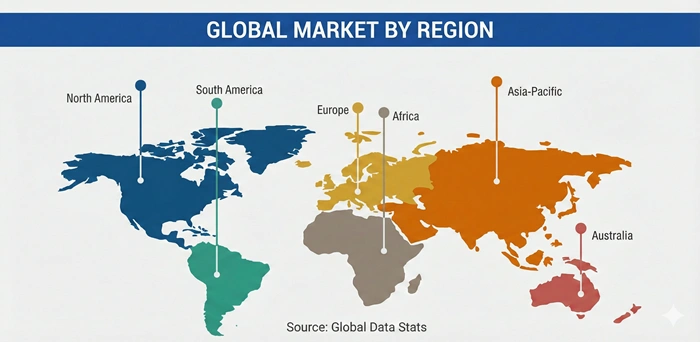
Regional Insights
North America
North America Leads the Global Uranium Market With the Highest Revenue Share, Anchored by Canada's World-Class Mining Assets and the United States' Large Nuclear Fleet Fuel Demand
North America holds the dominant position in the global uranium market, accounting for approximately 35% of total revenue in 2025 and projected to maintain a CAGR of 3.7% through 2033. Canada is the production powerhouse of the region, home to some of the world's richest uranium deposits in Saskatchewan's Athabasca Basin and several of the industry's most cost-competitive mines. Cameco Corporation — headquartered in Saskatoon, Canada — is the region's flagship uranium producer, operating the McArthur River and Cigar Lake mines and supplying long-term utility customers across North America, Europe, and Asia. The United States represents the largest single-country consumption market for uranium fuel globally, with its 93 operating nuclear reactors collectively requiring approximately 40 to 50 million pounds of U₃O₈ equivalent annually to sustain electricity generation. Key companies active in North American uranium include Cameco, Uranium Energy Corp., Energy Fuels Inc., and Denison Mines.
The United States is also investing heavily in rebuilding its domestic uranium fuel supply chain — from mining through conversion and enrichment — in response to energy security concerns following the disruption of historical reliance on Russian nuclear fuel services. The ADVANCE Act and related federal legislation are providing financial incentives for domestic uranium production, fuel fabrication, and advanced reactor development, creating a policy environment that is highly supportive of uranium market growth across the region. The North American SMR development pipeline — led by companies like NuScale Power, TerraPower, and X-energy — is expected to add meaningful incremental uranium demand in the latter part of the 2026 to 2033 forecast period.
Asia-Pacific
Asia-Pacific Is the Fastest-Growing Regional Market for Uranium, Fueled by China's Reactor Construction Program, Japan's Nuclear Restarts, and India's Expanding Nuclear Energy Ambitions
Asia-Pacific is the most dynamic regional market in the global uranium landscape, projected to expand at a CAGR of 5.8% from 2026 to 2033 — the highest growth rate of any global region. The region currently accounts for approximately 28% of global uranium market revenue, with China, Japan, South Korea, and India serving as the largest national demand centers. China alone is building more nuclear reactors simultaneously than the rest of the world combined, with over 20 units currently under construction and ambitious plans to bring total nuclear capacity to 150 GW by 2035 — creating an enormous and growing long-term uranium fuel procurement requirement. Japan is also contributing meaningfully to regional demand growth as reactor restarts continue under the country's revised nuclear energy policy, which now targets nuclear providing 20–22% of national electricity by 2030. Leading companies serving the Asia-Pacific uranium market include Kazatomprom, Cameco, Orano, and CGNPC Uranium Resources, the latter being China's primary uranium procurement and mining entity that is aggressively developing assets in Africa, Central Asia, and Australia.
India's uranium market is growing rapidly as the country pursues its plan to expand nuclear capacity significantly from current levels, relying on long-term uranium import agreements with Canada, Australia, and Kazakhstan to fuel its pressurized heavy water reactors. Australia — home to the world's largest known uranium reserves — is a critical regional supplier despite its domestic no-new-nuclear policy, with major miners including BHP (Olympic Dam) and ERA (Ranger) contributing to the supply base that flows primarily to Asian utility customers. The combination of massive reactor construction activity, strong government energy policy support, and rapidly rising electricity demand from industrialization and urbanization makes Asia-Pacific the most consequential region for uranium market demand growth through 2033.
Top Key Players
-
Cameco Corporation (Canada)
-
Kazatomprom (Kazakhstan)
-
Orano S.A. (France)
-
BHP Group Limited (Australia)
-
Rio Tinto plc (United Kingdom)
-
Uranium Energy Corp. (United States)
-
Energy Fuels Inc. (United States)
-
Paladin Energy Ltd. (Australia)
-
NexGen Energy Ltd. (Canada)
-
Denison Mines Corp. (Canada)
-
CGNPC Uranium Resources Co. Ltd. (China)
-
Boss Energy Ltd. (Australia)
Recent Developments
-
Cameco Corporation (2025) — Ramped McArthur River and Key Lake operations back to full licensed production capacity of 18 million pounds per year following the successful completion of operational restart investments, marking a significant milestone in restoring one of the world's premier uranium production facilities to its peak output capability
-
Kazatomprom (2025) — Revised its annual production guidance downward for the second consecutive year due to sulfuric acid supply constraints and subsoil use agreement challenges, a development that tightened global uranium supply expectations and contributed to upward pressure on term contract pricing across the market
-
Paladin Energy (2025) — Successfully completed the merger with Fission Uranium Corp., significantly expanding its tier-one uranium project portfolio with the addition of the Patterson Lake South (PLS) deposit in Canada's Athabasca Basin, creating a combined company with a substantially larger global resource base and improved geographic diversification
-
NexGen Energy (2025) — Advanced the Arrow Lake deposit development program in Saskatchewan toward a final investment decision, following the receipt of key environmental assessment approvals from Canadian federal authorities, marking a major milestone in advancing what is considered one of the world's highest-grade undeveloped uranium projects toward construction
-
Uranium Energy Corp. (2024) — Completed the acquisition of Rio Tinto's Roughrider project in the Athabasca Basin, adding significant high-grade uranium mineral resources to its portfolio while simultaneously expanding ISL production from its South Texas uranium hub to capitalize on rising spot and term contract market prices
Market Trends
Long-Term Contract Market Tightening, Strategic National Reserve Building, and the Rise of Nuclear Fuel Supply Chain Independence Are the Most Defining Trends Shaping the Uranium Market
One of the most significant trends reshaping the uranium market is the accelerating shift from spot purchasing to long-term contracting by nuclear utilities worldwide. For years following Fukushima, many utilities drew down inventories and deferred procurement, suppressing term market activity. Today, that dynamic has reversed sharply, with utilities actively pursuing multi-year supply agreements at term prices that are significantly above historical lows. This structural normalization of the long-term contracting market is supporting producer investment confidence and incentivizing the development of new mines and the restart of idled production capacity — a dynamic that bodes well for sustained market health through 2033.
The second major trend shaping the uranium market is the growing strategic importance of nuclear fuel supply chain independence among major consuming nations. The disruption of Russian enrichment services following geopolitical developments has catalyzed substantial government investment in domestic uranium conversion, enrichment, and fuel fabrication in the United States, the United Kingdom, France, and Japan. This trend is creating new demand increments beyond commercial utility procurement, as governments build strategic reserves and invest in domestic fuel cycle infrastructure that was previously allowed to atrophy. The result is a more structurally supportive uranium market environment that is increasingly resistant to the sharp price downturns that characterized the post-Fukushima decade.
Segments Covered in the Report
By Product Form:
-
Uranium Oxide (U₃O₈ / Yellowcake)
-
Uranium Hexafluoride (UF₆)
-
Enriched Uranium
-
Uranium Metal
-
Others
By Mining Method:
-
Underground Mining
-
Open Pit Mining
-
In-Situ Leaching (ISL/ISR)
-
By-Product Recovery
-
Others
By Application:
-
Nuclear Power Generation
-
Military and Defense Applications
-
Medical Isotope Production
-
Research Reactors
-
Others
By End User:
-
Nuclear Utilities (Commercial Power Plants)
-
Government and Defense Agencies
-
Research and Academic Institutions
-
Others
By Region:
-
North America (United States, Canada, Mexico)
-
Europe (France, United Kingdom, Germany, Russia, Rest of Europe)
-
Asia-Pacific (China, Japan, South Korea, India, Australia, Rest of Asia-Pacific)
-
Latin America (Brazil, Argentina, Rest of Latin America)
-
Middle East & Africa (UAE, South Africa, Namibia, Niger, Rest of MEA)
Frequently Asked Questions
Question 1: What is the current size of the global uranium market?
Answer: The global uranium market is valued at USD 9.36 billion in 2025 and is projected to reach USD 13.14 billion by 2033. The market is growing at a CAGR of 3.9% from 2026 to 2033, supported by expanding nuclear reactor fleets, SMR development, and growing electricity demand from AI-driven data centers.
Question 2: Which region leads the uranium market globally?
Answer: North America holds the dominant position in the uranium market, accounting for approximately 35% of global revenue in 2025. Canada's world-class Athabasca Basin mining operations and the United States' large operating nuclear fleet are the primary foundations of this regional leadership.
Question 3: What is the fastest-growing region in the uranium market?
Answer: Asia-Pacific is the fastest-growing region in the uranium market, projected to expand at a CAGR of 5.8% through 2033. China's aggressive nuclear reactor construction program and Japan's ongoing reactor restarts are the dominant drivers of this exceptional regional demand growth.
Question 4: Which mining method dominates uranium production in the uranium market?
Answer: Underground mining leads the uranium market in terms of primary production share, representing approximately 40% of global output in 2025. However, in-situ leaching is the fastest-growing method, driven by Kazakhstan's large-scale, cost-efficient ISL operations and new ISL project developments in the United States and Australia.
Question 5: What are the key trends shaping the uranium market through 2033?
Answer: The most important trends in the uranium market are the return to long-term utility contracting after years of spot market reliance, and government-driven efforts to build nuclear fuel supply chain independence. Small modular reactor commercialization and strategic uranium reserve accumulation are also expected to be defining developments that support market demand growth through 2033.