
Underground Wires and Cables Market Overview
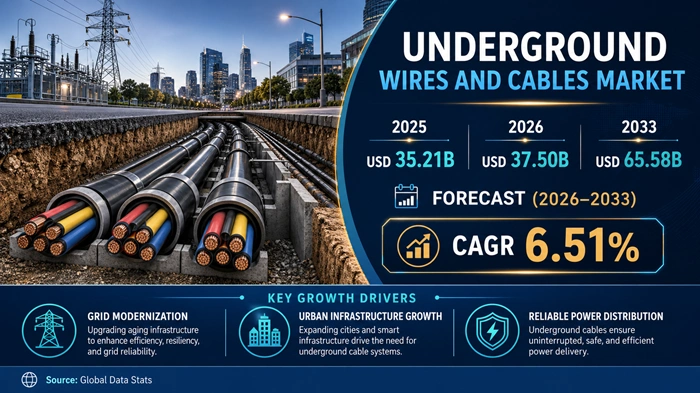
The global underground wires and cables market size is valued at USD 35.21 billion in 2025 and is predicted to increase from USD 37.50 billion in 2026 to approximately USD 65.58 billion by 2033, growing at a CAGR of 6.51% from 2026 to 2033.
The underground wires and cables market encompasses electrical conductors and communication cables installed beneath ground surfaces for power transmission, data communication, and telecommunications applications across utility, infrastructure, and industrial sectors.
Rising investments in reliable power infrastructure, accelerating urbanization requiring aesthetic installations, and growing emphasis on grid resilience against extreme weather events drive substantial demand for underground cabling solutions worldwide. Governments and utilities increasingly recognize that buried cables offer superior protection from environmental hazards including storms, lightning strikes, ice accumulation, and vegetation interference compared to overhead transmission lines. The market benefits from technological advancements including cross-linked polyethylene insulation, fiber optic integration for smart grid applications, and high-voltage direct current cables enabling efficient long-distance transmission.
AI Impact on the Underground Wires and Cables Industry
Intelligent Monitoring and Predictive Maintenance Transform Grid Management
Artificial intelligence is revolutionizing the underground wires and cables market by introducing intelligent monitoring systems, predictive maintenance capabilities, and automated fault detection that significantly enhance infrastructure reliability while reducing operational costs. AI algorithms analyze data from fiber optic sensors embedded within underground cables to continuously monitor temperature variations, partial discharge activity, mechanical stress, and environmental conditions that indicate potential failures before they occur. Machine learning models process historical performance data to predict equipment degradation patterns, optimize maintenance scheduling, and prioritize infrastructure upgrades based on failure probability and criticality. Smart grid applications leverage AI-powered analytics to optimize load distribution across underground networks, automatically reroute power during outages, and coordinate distributed energy resources including renewable generation and battery storage.
The integration of AI with underground cable infrastructure enables real-time fault localization that dramatically reduces outage duration by pinpointing exact failure locations within extensive buried networks, eliminating time-consuming manual inspection processes. AI-driven thermal modeling predicts cable ampacity under varying soil conditions, allowing dynamic rating systems that maximize transmission capacity without compromising safety margins. Autonomous diagnostic systems equipped with artificial intelligence analyze partial discharge patterns, acoustic signatures, and electrical parameters to identify insulation degradation, water ingress, and termination defects requiring intervention. Furthermore, AI-powered design optimization tools simulate multiple cable routing scenarios considering factors including soil thermal conductivity, ambient temperature variations, and future load growth to recommend configurations balancing performance, reliability, and installation costs.
Growth Factors
Grid Modernization and Renewable Energy Integration Drive Market Expansion
Massive grid modernization initiatives worldwide represent the primary driver propelling underground wires and cables market growth as aging overhead transmission infrastructure requires replacement with resilient underground systems capable of supporting bidirectional power flow and digital monitoring. Governments allocate substantial funding for grid upgrades addressing reliability concerns, with programs including the U.S. Department of Energy Grid Resilience and Innovation Partnerships providing competitive grants specifically supporting underground and hardened infrastructure deployment. Extreme weather events causing widespread power outages motivate utilities to underground distribution networks in vulnerable areas, with studies demonstrating that buried cables experience 73.9% fewer outages and 60.5% less downtime compared to overhead lines. Urban aesthetics and property value considerations drive municipalities to mandate underground installations in historic districts, commercial zones, and residential developments where overhead wires prove visually undesirable.
The explosive growth of renewable energy generation creates substantial demand for underground cables connecting wind farms, solar installations, and battery storage facilities to transmission grids, with offshore wind projects particularly requiring submarine and underground export cables. Europe's aggressive renewable energy targets under the EU Green Deal and carbon neutrality objectives by 2050 propel investments in high-voltage underground cables necessary for efficient long-distance transmission from offshore wind farms and remote solar facilities. The underground wires and cables market benefits from data center proliferation driven by artificial intelligence and cloud computing demands, as these facilities require exceptionally reliable power delivery best served by underground distribution and transmission infrastructure minimizing outage risks. Additionally, smart city initiatives incorporating distributed energy resources, electric vehicle charging networks, and intelligent transportation systems necessitate extensive underground cable networks supporting communications, power distribution, and data transmission.

Market Outlook
Technology Innovation and Infrastructure Investment Sustain Growth Momentum
The underground wires and cables market outlook remains exceptionally positive as converging trends including electrification, digitalization, and decarbonization create expanding opportunities across power transmission, renewable energy integration, and telecommunications applications. Market participants continue investing heavily in research and development to enhance cable performance through advanced insulation materials, higher voltage ratings, increased ampacity, improved thermal management, and integration of fiber optic sensing for condition monitoring. The development of high-temperature superconducting cables promises revolutionary improvements in transmission efficiency and capacity, though commercial deployment remains limited pending cost reductions. Innovation in cable installation techniques including horizontal directional drilling, microtunneling, and direct buried plowing reduces deployment costs and minimizes surface disruption.
The transition toward high-voltage direct current transmission for long-distance bulk power transfer creates substantial opportunities as HVDC underground cables deliver lower transmission losses, higher capacity per conductor, and simplified right-of-way requirements compared to alternating current alternatives. Regulatory mandates requiring grid modernization, safety improvements, and renewable energy interconnection support continued market expansion as utilities face compliance deadlines driving infrastructure investments. The 5G telecommunications rollout and fiber-to-the-home initiatives generate growing demand for underground communication cables as municipalities leverage utility trenching to simultaneously deploy fiber optic networks. Industry analysts project robust market growth throughout the forecast period with particularly strong expansion anticipated in Asia Pacific where rapid urbanization, infrastructure development, and industrial growth create substantial underground cabling requirements.
Expert Speaks
-
President Donald Trump, during his Davos address in January 2026, emphasized that supporting America's artificial intelligence ambitions requires more than doubling the nation's current energy generation capacity, stating that his administration aims to transform infrastructure development into a thriving sector by initiating new energy facilities rather than shutting them down, with plans requiring tech companies to cover their own costs for massive power generation expansions.
-
Energy industry leaders responding to India's Union Budget 2025-26 expressed strong support for government measures incentivizing states to drive transmission reforms and expand intrastate transmission capacity, noting that additional borrowing allowances for reform-committed states reflect dedication to long-term stability while investments in power transmission and distribution alongside electricity distribution reforms will modernize the sector ensuring financial stability for distribution companies.
-
Renewable energy executives highlighted that India crossed a major climate milestone in 2025 with half of installed electricity generation capacity now coming from non-fossil sources, noting that capacity surged nearly 200% from 75.52 GW in March 2014 to 262 GW by end of 2025 backed by Rs 2 lakh crore investments, though reaching the 500 GW target will require higher installations driven by stronger budgetary support and long-term policy clarity.
Key Report Takeaways
-
Europe leads the global underground wires and cables market with approximately 49.21% regional share in 2025 valued at USD 17.84 billion, driven by swift expansion in renewable energy initiatives including offshore wind farms, stringent environmental regulations mandating underground installations, and EU Green Deal investments supporting carbon neutrality objectives.
-
Asia Pacific represents the fastest-growing regional market, expected to register exceptional CAGR of 8.5% from 2025 to 2034, fueled by rapid urbanization, massive infrastructure development programs across China and India, growing electricity demand, and substantial investments in smart grid technologies.
-
Power cables dominate market demand accounting for approximately 45% share in 2024 and projected to maintain leadership through 2033, driven by increased investment in transmission and distribution infrastructure with utilities implementing 5-year replacement and reinforcement programs in urban cores spurring high-capacity underground cable demand.
-
Communication cables demonstrate fastest growth potential, expected to expand at CAGR of 7.5% as fiber rollouts for 5G backhaul, urban broadband deployment, and smart city connectivity accelerate with strict urbanization deadlines and municipal IoT initiatives maintaining significant development pace.
-
Low voltage cables maintain dominant position with over 60% market share serving residential, commercial, and small industrial applications typically featuring 2-5 cores with PVC or XLPE insulation and steel tape armoring for direct burial installations.
-
The utilities sector represents the largest end-user segment, driving demand through grid modernization programs, renewable energy interconnection projects, distribution network undergrounding initiatives, and aging infrastructure replacement creating continuous cable procurement requirements.
Market Scope
| Report Coverage Details | |
|---|---|
| Market Size by 2033 | USD 65.58 Billion |
| Market Size by 2025 | USD 35.21 Billion |
| Market Size by 2026 | USD 37.50 Billion |
| Market Growth Rate from 2026 to 2033 | CAGR of 6.51% |
| Dominating Region | Europe |
| Fastest Growing Region | Asia Pacific |
| Base Year | 2025 |
| Forecast Period | 2026 to 2033 |
| Segments Covered | Type, Voltage Type, Application, End User, Region |
| Regions Covered | North America, Europe, Asia Pacific, Latin America, Middle East & Africa |
Market Dynamics
Drivers Impact Analysis
Infrastructure Resilience and Weather Protection Accelerate Underground Adoption
| Factor | (≈) % Impact on CAGR Forecast | Geographic Relevance | Impact Timeline |
|---|---|---|---|
| Grid modernization investments | 2.4% | Global, particularly North America and Europe | Immediate and ongoing |
| Renewable energy integration | 1.8% | Europe, Asia Pacific, North America | Medium to long-term |
| Extreme weather resilience | 1.5% | North America, Europe | Immediate to medium-term |
| Urbanization and aesthetics | 1.2% | Asia Pacific, urban global markets | Ongoing |
Massive infrastructure investments targeting grid modernization and resilience enhancement represent the most significant driver propelling underground wires and cables market expansion as utilities replace aging overhead systems with buried cables offering superior protection from environmental hazards. Government programs including the U.S. Department of Energy Grid Resilience and Innovation Partnerships allocate billions of dollars specifically supporting underground infrastructure deployment that withstands extreme weather events increasingly threatening grid reliability. Documented evidence demonstrates that underground distribution lines experience 73.9% fewer power outages compared to overhead alternatives, resulting in 60.5% less downtime that translates into substantial economic savings for utilities and customers. Federal funding and competitive grant programs accelerate underground installation timelines as utilities leverage financial support to implement projects previously delayed by budget constraints.
The accelerating integration of renewable energy sources including offshore wind farms, solar installations, and distributed generation facilities creates substantial demand for underground cables connecting these resources to transmission grids. Europe's offshore wind expansion under the EU Green Deal necessitates extensive submarine and underground export cable networks transmitting power from offshore installations to onshore substations and ultimately to load centers. The underground wires and cables market benefits from technological mandates requiring smart grid capabilities supporting bidirectional power flow, real-time monitoring, and automated control that underground fiber-optic-equipped cables uniquely enable. Rapid urbanization across Asia Pacific, particularly in China and India, drives municipal requirements for underground installations in dense urban areas where overhead lines prove impractical due to space constraints, aesthetic concerns, and electromagnetic field exposure considerations. Additionally, data center proliferation supporting artificial intelligence and cloud computing demands exceptionally reliable power delivery with underground transmission and distribution infrastructure minimizing outage risks from weather events, vegetation contact, and vehicle collisions.

Restraints Impact Analysis
High Installation Costs and Technical Complexity Create Adoption Barriers
| Factor | (≈) % Impact on CAGR Forecast | Geographic Relevance | Impact Timeline |
|---|---|---|---|
| High capital expenditure | -2.1% | Cost-sensitive emerging markets | Short to medium-term |
| Complex installation requirements | -1.3% | Urban and challenging terrains | Ongoing |
| Maintenance and fault localization | -0.9% | Global | Medium-term |
| Thermal management limitations | -0.7% | High-load applications | Ongoing |
Substantially higher capital costs associated with underground cable systems compared to overhead alternatives create significant barriers to underground wires and cables market adoption, particularly in budget-constrained utilities and emerging markets. Underground installation costs typically range from 5 to 10 times higher than equivalent overhead lines due to trenching expenses, specialized equipment requirements, cable material costs, termination and jointing complexity, and surface restoration obligations. The installation process requires extensive excavation, traffic management during urban construction, coordination with existing underground utilities including water, gas, and telecommunications infrastructure, and compliance with numerous permitting requirements that extend project timelines and inflate costs. Small utilities and rural cooperatives operating on thin margins struggle to justify underground investments despite long-term reliability benefits when upfront capital requirements strain financial resources.
Technical complexity surrounding underground cable design, installation, and maintenance requires specialized engineering expertise that proves scarce in many markets, creating dependencies on external consultants and contractors that increase project expenses. The underground wires and cables market faces adoption challenges in applications where thermal management proves problematic, as buried cables dissipate heat less efficiently than overhead conductors exposed to natural air cooling, potentially limiting ampacity in high-load scenarios. Underground systems require careful soil thermal analysis, adequate cable spacing, and sometimes forced cooling systems maintaining temperature limits, adding design complexity and operational considerations. Fault localization in underground networks proves substantially more difficult than overhead inspections where visual examination quickly identifies damage locations, with buried cable failures requiring sophisticated diagnostic equipment, extensive excavation for repairs, and longer outage durations during fault correction. Additionally, cable joint degradation and termination failures represent common reliability issues requiring preventive maintenance programs and periodic testing that many utilities struggle to implement consistently.
Opportunities Impact Analysis
Renewable Integration and Smart Grid Development Create Growth Prospects
| Factor | (≈) % Impact on CAGR Forecast | Geographic Relevance | Impact Timeline |
|---|---|---|---|
| Offshore wind expansion | 1.9% | Europe, Asia Pacific, North America | Medium to long-term |
| Data center power demands | 1.6% | Global, particularly North America | Immediate to medium-term |
| Electric vehicle infrastructure | 1.3% | Developed markets globally | Medium-term |
| Smart city initiatives | 1.1% | Asia Pacific, Europe, urban markets | Medium to long-term |
The explosive growth of offshore wind energy generation creates exceptional opportunities within the underground wires and cables market as these installations require extensive submarine and underground export cable networks transmitting power from offshore platforms to onshore grid connection points. Europe leads offshore wind development with ambitious capacity targets driving demand for high-voltage AC and DC underground cables capable of efficient long-distance transmission with minimal losses. Strategic partnerships between cable manufacturers and wind farm developers accelerate project execution as integrated engineering, procurement, and construction packages streamline installation processes. Asia Pacific demonstrates accelerating offshore wind interest with China, Taiwan, Japan, and South Korea planning massive capacity additions requiring substantial cable infrastructure investments.
The artificial intelligence revolution and associated data center proliferation create substantial underground cable demand as these facilities require exceptionally reliable power delivery immune to weather-related disruptions that underground systems uniquely provide. Data centers consume enormous energy quantities with projected global demand escalating from 55 gigawatts to 84 gigawatts within two years, necessitating extensive transmission infrastructure upgrades including underground high-voltage direct current lines offering cost-effective bulk power transfer. The underground wires and cables market benefits from electric vehicle charging infrastructure deployment as municipalities install underground distribution networks supporting fast-charging stations in urban areas, highway corridors, and commercial developments. Smart city initiatives integrating distributed energy resources, intelligent transportation systems, environmental sensors, and communication networks drive demand for multi-purpose underground cable installations carrying power, data, and telecommunications services within shared trenches reducing total deployment costs. Additionally, grid interconnector projects linking national transmission systems across borders create opportunities for high-capacity underground cables where overhead lines prove politically or environmentally unacceptable.

Segment Analysis
Power Cables Dominance
Essential Infrastructure Role and Utility Investments Maintain Market Leadership
Power cables command the dominant position within the underground wires and cables market, accounting for approximately 45% of total market share in 2024, as these products form the essential backbone of electrical distribution networks transmitting energy from generation sources through substations to end consumers. This segment encompasses diverse voltage classifications including low-voltage cables below 1 kV serving final distribution to buildings, medium-voltage cables from 1 kV to 35 kV forming urban distribution networks, and high-voltage cables above 35 kV connecting major substations and transmission corridors. Utilities implement extensive 5-year replacement and reinforcement programs particularly in urban cores where aging infrastructure approaches end-of-life, driving continuous high-capacity underground power cable procurement. Cross-linked polyethylene insulation technology dominates modern power cable specifications due to superior thermal performance, higher ampacity ratings, improved dielectric properties, and resistance to water treeing compared to traditional PVC alternatives.
North America demonstrates particularly strong power cable demand with grid modernization initiatives addressing reliability concerns and federal funding supporting underground installation projects, while major manufacturers including Prysmian Group from Italy, Nexans from France, and Southwire from the United States dominate regional supply through extensive manufacturing capacity and established utility relationships. Europe shows robust power cable adoption driven by renewable energy interconnection requirements, with offshore wind export cables and grid reinforcement projects supporting carbon neutrality objectives generating substantial demand. The underground wires and cables market power segment benefits from technological innovation including higher voltage ratings enabling longer transmission distances, improved conductor designs maximizing ampacity, and integrated fiber optic monitoring systems providing real-time condition assessment. Medium-voltage 10 kV specifications account for approximately 70% of the MV segment as these cables form the core of urban distribution networks connecting high-voltage transmission infrastructure to low-voltage distribution serving buildings. Industrial applications demonstrate strong power cable demand as manufacturing facilities, mining operations, petrochemical plants, and data centers implement underground distribution networks providing reliable power delivery immune to external environmental disruptions.
Communication Cables Rapid Growth
5G Deployment and Smart Infrastructure Drive Accelerated Segment Expansion
Communication cables represent the fastest-growing segment within the underground wires and cables market, expected to expand at CAGR of 7.5% through 2034, as fiber optic rollouts for 5G backhaul networks, urban broadband deployment, and smart city connectivity accelerate with strict urbanization deadlines and municipal IoT initiatives. This segment encompasses copper-based communication cables supporting traditional telephone and data services alongside fiber optic cables delivering high-bandwidth telecommunications, internet connectivity, and smart grid communication networks. The explosive growth of fiber-to-the-home initiatives as governments and telecommunications providers target universal broadband access drives extensive underground fiber installation in residential neighborhoods, commercial districts, and rural communities. Smart city programs implementing distributed sensor networks, intelligent transportation systems, and environmental monitoring require extensive underground communication infrastructure supporting data transmission from thousands of connected devices.
Asia Pacific demonstrates exceptional communication cable growth momentum driven by massive 5G infrastructure deployment across China, India, Japan, and South Korea requiring extensive fiber backhaul networks connecting cell towers to core networks, while manufacturers including Furukawa Electric from Japan, LS Cable & System from South Korea, and Sumitomo Electric from Japan effectively serve regional demand through local production facilities. The underground wires and cables market communication segment particularly benefits from coordinated deployment strategies as utilities and municipalities leverage power cable trenching projects to simultaneously install fiber optic infrastructure, reducing total installation costs through shared excavation expenses. Fiber optic cables integrated directly into high-voltage power cables enable smart grid applications including distributed temperature sensing, partial discharge monitoring, and real-time condition assessment supporting predictive maintenance programs. Telecommunications providers demonstrate growing preference for underground installations in urban areas where overhead cables suffer from aesthetic concerns, limited pole space availability, and vulnerability to weather events, with buried fiber delivering superior reliability supporting critical communication services. Data center interconnection demands create additional communication cable opportunities as cloud service providers implement dedicated high-capacity fiber links between facilities supporting data replication, load balancing, and disaster recovery.

Regional Insights
Europe Market Leadership
Renewable Energy Leadership and Environmental Regulations Drive Regional Dominance
Europe commands substantial leadership within the underground wires and cables market, maintaining approximately 49.21% regional share in 2025 valued at USD 17.84 billion projected to reach USD 19.33 billion in 2026, driven by aggressive renewable energy expansion, stringent environmental regulations mandating underground installations, and EU Green Deal investments supporting carbon neutrality by 2050. The region leads global offshore wind development with massive capacity installations in the North Sea, Baltic Sea, and Atlantic Ocean requiring extensive submarine and underground export cable networks transmitting power from offshore platforms to onshore substations and distribution grids. Regulatory frameworks across European nations increasingly mandate underground installations for safety, environmental protection, and urban planning considerations, with authorities requiring buried cables in residential areas, historic districts, and environmentally sensitive zones. Germany, United Kingdom, France, and Nordic countries drive substantial underground cable demand through grid reinforcement projects, renewable energy interconnections, and distribution network modernization programs.
Major manufacturers including Prysmian Group, Nexans, and NKT from Denmark maintain strong European market positions through comprehensive product portfolios spanning low to high voltage power cables, submarine interconnectors, and fiber optic communication cables complemented by engineering, procurement, and construction capabilities. The underground wires and cables market in Europe particularly benefits from cross-border interconnector projects linking national transmission systems enabling renewable energy trading, grid stability support, and energy security enhancement. Offshore wind export cable installations represent a particularly dynamic segment with projects including multi-gigawatt wind farms requiring ultra-high-voltage DC submarine cables transmitting power over hundreds of kilometers from offshore generation sites to onshore grid connection points. Urban undergrounding initiatives gain momentum across major European cities as municipalities prioritize aesthetic improvements, property value enhancement, and reduction of electromagnetic field exposure by replacing overhead distribution networks with buried cable systems. The region demonstrates strong commitment to grid digitalization with utilities implementing smart grid technologies incorporating fiber optic monitoring, automated switching, and distributed energy resource management requiring advanced underground cable infrastructure.
Asia Pacific Fastest Growth
Urbanization and Infrastructure Development Drive Exceptional Regional Expansion
Asia Pacific emerges as the fastest-growing regional underground wires and cables market, expected to register exceptional CAGR of 8.5% from 2025 to 2034, propelled by rapid urbanization, massive infrastructure development programs, surging electricity demand, and substantial investments in smart grid technologies across emerging economies. The region encompasses the world's largest population concentrations with ongoing urban migration creating enormous infrastructure requirements including power distribution networks, telecommunications systems, and transportation electrification supporting expanding cities. China represents the largest national market within Asia Pacific with government initiatives targeting grid modernization, renewable energy integration, and urban undergrounding driving substantial cable procurement across power and communication segments. India demonstrates particularly strong growth potential with documented electricity consumption growth, infrastructure development programs, and smart city initiatives creating expanding opportunities for underground cable installations.
Japan and South Korea show robust underground cable adoption with mature markets emphasizing grid resilience, disaster preparedness, and advanced technology implementation, while leading regional manufacturers including Sumitomo Electric Industries, Furukawa Electric, and LS Cable & System effectively serve local and export markets through advanced manufacturing capabilities. The underground wires and cables market in Asia Pacific benefits from government policies promoting underground installations in urban areas addressing aesthetic concerns, safety considerations, and land use optimization as cities intensify development. Southeast Asian nations including Indonesia, Thailand, Vietnam, and Philippines demonstrate accelerating infrastructure investments with economic development, industrial expansion, and urban electrification driving power distribution network deployment. Renewable energy growth particularly in offshore wind, solar, and hydropower creates substantial cable demand as countries pursue clean energy targets requiring transmission infrastructure connecting generation sites to load centers. The region's substantial manufacturing capacity and competitive labor costs support cost-effective cable production serving domestic demand while enabling exports to other markets.
Top Key Players
-
Prysmian Group (Italy)
-
Nexans S.A. (France)
-
Sumitomo Electric Industries Ltd. (Japan)
-
Furukawa Electric Co. Ltd. (Japan)
-
LS Cable & System Ltd. (South Korea)
-
Southwire Company LLC (United States)
-
NKT A/S (Denmark)
-
General Cable Corporation (United States)
-
Leoni AG (Germany)
-
KEI Industries Limited (India)
-
ZTT Group (China)
-
ABB Ltd. (Switzerland)
-
Jiangsu Zhongtian Technology Co. Ltd. (China)
-
Encore Wire Corporation (United States)
-
Belden Inc. (United States)
Recent Developments
-
Prysmian Group (2025): In May 2025, Prysmian significantly boosted its transmission business capabilities through strategic investments expanding high-voltage cable manufacturing capacity supporting growing demand for grid interconnections, renewable energy integration, and offshore wind export cable installations across European and North American markets.
-
Nexans (2020): In 2020, Nexans launched a comprehensive new range of sustainable cables incorporating recycled materials, reduced carbon footprint manufacturing processes, and enhanced environmental performance addressing utility and industrial customer demands for environmentally responsible infrastructure solutions while maintaining technical performance standards.
-
Sumitomo Electric (2021): In 2021, Sumitomo Electric announced a significant investment program in high-temperature superconducting cable technology development targeting next-generation transmission applications offering revolutionary efficiency improvements and capacity enhancements compared to conventional conductor technologies, though commercial deployment timelines remain subject to cost reduction achievements.
-
ZTT Group (2022): In 2022, ZTT secured a major contract for a large-scale power transmission project demonstrating the company's growing capabilities in engineering, manufacturing, and installation of high-voltage underground cable systems serving critical infrastructure applications across utility and industrial customers.
-
LS Cable & System (2024): LS Cable & System continued expanding its global market presence through capacity investments and technology development initiatives focusing on high-voltage DC cables for offshore wind applications, grid interconnections, and long-distance transmission projects supporting renewable energy integration and grid modernization requirements.
Market Trends
Smart Grid Integration and Sustainable Materials Transform Industry Standards
The rapid integration of fiber optic sensing technologies within underground power cables represents a transformative trend within the underground wires and cables market, enabling smart grid applications including distributed temperature sensing, partial discharge monitoring, real-time condition assessment, and predictive maintenance supporting grid reliability enhancement. Utilities increasingly specify fiber-optic-equipped cables for critical infrastructure installations as continuous monitoring capabilities provide early warning of developing problems including insulation degradation, water ingress, overheating, and external damage before catastrophic failures occur. Smart cables supporting bidirectional communication enable automated grid management including dynamic load balancing, renewable energy integration, distributed energy resource coordination, and rapid fault isolation restoring service faster during outages. The technology convergence of power transmission and telecommunications infrastructure creates opportunities for multi-purpose underground installations carrying electricity, data, and communication services within shared trenches reducing total deployment costs.
Sustainability initiatives emphasizing circular economy principles, carbon footprint reduction, and environmental responsibility transform underground wires and cables market product development and manufacturing processes. Manufacturers introduce cables incorporating recycled copper and aluminum conductors, recyclable insulation materials, and reduced-halogen compounds minimizing environmental impact during production and end-of-life disposal. Life cycle assessment methodologies quantify environmental impacts from raw material extraction through manufacturing, installation, operation, and eventual recycling, enabling utilities to make informed procurement decisions balancing performance, cost, and sustainability. The industry demonstrates growing adoption of cross-linked polyethylene insulation replacing traditional materials due to superior technical performance, longer operational lifespan, and improved recyclability characteristics. High-voltage direct current technology gains momentum for long-distance underground transmission as HVDC systems deliver lower losses, higher capacity, simplified right-of-way requirements, and enhanced grid stability support compared to alternating current alternatives, with technical advances enabling increasingly cost-competitive installations.
Segments Covered in the Report
By Type:
-
Power Cables
-
Low Voltage Power Cables
-
Medium Voltage Power Cables
-
High Voltage Power Cables
-
-
Communication Cables
-
Copper Communication Cables
-
Fiber Optic Cables
-
-
Control Cables
-
Instrumentation Cables
By Voltage Type:
-
Low Voltage (Up to 1 kV)
-
Medium Voltage (1 kV to 35 kV)
-
High Voltage (Above 35 kV)
By Application:
-
Utilities
-
Transmission Networks
-
Distribution Networks
-
-
Infrastructure
-
Transportation Systems
-
Smart Cities
-
-
Industrial
-
Manufacturing Facilities
-
Mining Operations
-
Oil & Gas
-
-
Renewable Energy
-
Offshore Wind
-
Solar Farms
-
Hydropower
-
-
Data Centers
-
Telecommunications
By End User:
-
Residential
-
Commercial
-
Office Buildings
-
Retail Facilities
-
-
Industrial
-
Heavy Industry
-
Process Manufacturing
-
-
Utilities
-
Electric Utilities
-
Municipal Utilities
-
By Region:
-
North America
-
United States
-
Canada
-
Mexico
-
-
Europe
-
Germany
-
United Kingdom
-
France
-
Italy
-
Nordic Countries
-
Rest of Europe
-
-
Asia Pacific
-
China
-
India
-
Japan
-
South Korea
-
Southeast Asia
-
Rest of Asia Pacific
-
-
Latin America
-
Brazil
-
Argentina
-
Rest of Latin America
-
-
Middle East & Africa
-
United Arab Emirates
-
Saudi Arabia
-
South Africa
-
Rest of Middle East & Africa
-
Frequently Asked Questions
Question 1: What is the projected underground wires and cables market size by 2033?
Answer: The global underground wires and cables market is projected to reach USD 65.58 billion by 2033, growing from USD 37.50 billion in 2026 at a CAGR of 6.51%.
Question 2: Which region dominates the underground wires and cables market currently?
Answer: Europe dominates the underground wires and cables market with approximately 49.21% share in 2025, driven by renewable energy expansion and stringent environmental regulations.
Question 3: What are the key drivers of underground wires and cables market growth?
Answer: Key drivers include grid modernization investments, renewable energy integration, extreme weather resilience requirements, urbanization demands, and data center power infrastructure needs.
Question 4: Which cable type leads the underground wires and cables market?
Answer: Power cables lead with approximately 45% market share in 2024, though communication cables demonstrate fastest growth at 7.5% CAGR driven by 5G and broadband deployment.
Question 5: How do underground cables compare to overhead lines for reliability?
Answer: Underground cables experience 73.9% fewer power outages and 60.5% less downtime compared to overhead lines, providing superior protection from weather events and environmental hazards.