
Tokenization Market Overview
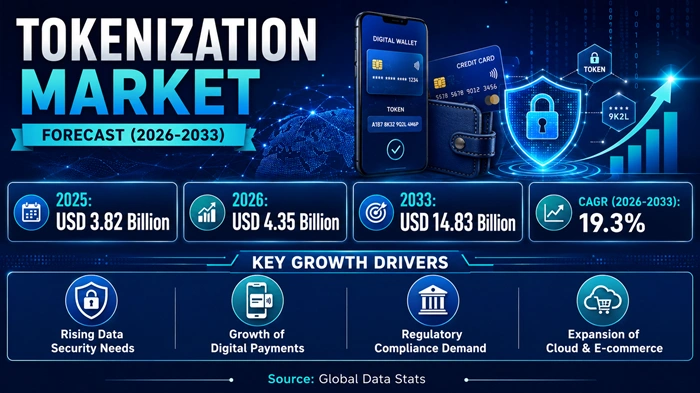
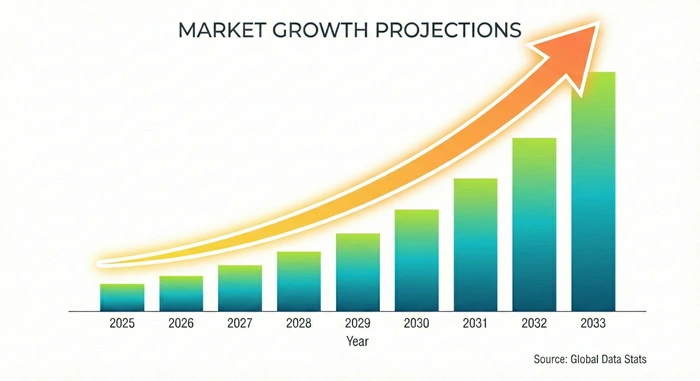
The global tokenization market size is valued at USD 3.82 billion in 2025 and is predicted to increase from USD 4.35 billion in 2026 to approximately USD 14.83 billion by 2033, growing at a CAGR of 19.3% from 2026 to 2033.
Tokenization is a data security process that replaces sensitive information — such as payment card numbers, personally identifiable information (PII), and financial data — with a non-sensitive placeholder called a token, which retains no exploitable value outside the system that generated it. The tokenization market is growing rapidly as organizations across financial services, retail, healthcare, and government sectors prioritize data protection in an environment of escalating cyber threats, tightening data privacy regulations, and accelerating digital payment adoption. The convergence of tokenization with cloud computing, blockchain, and AI is creating a new generation of highly versatile data security applications.
AI Impact on the Tokenization Industry
Artificial Intelligence Is Transforming Tokenization From a Static Data Masking Tool Into an Intelligent, Adaptive Security System Capable of Dynamic Risk Assessment and Real-Time Fraud Prevention
Artificial intelligence is significantly expanding the commercial and technical scope of the tokenization industry. Traditional tokenization systems operated on fixed, rule-based logic — replacing defined sensitive data fields with tokens according to predetermined schemas. AI is enabling tokenization platforms to operate with far greater intelligence, dynamically assessing which data elements require tokenization based on context, risk level, and regulatory environment, and generating tokens with adaptive properties that adjust based on transaction behavior and threat signals. This intelligence layer is transforming tokenization from a compliance-driven data masking tool into a proactive, risk-aware data security capability.
AI-powered fraud detection is deepening the integration of tokenization into real-time payment security workflows. When tokenization is combined with machine learning models that analyze transaction patterns, device behavior, and user history, the resulting fraud prevention capability is substantially stronger than either technology provides alone. Tokens provide a secure data representation layer that prevents raw PAN exposure, while AI analyzes the behavioral context of each tokenized transaction to flag anomalies indicative of fraudulent activity. Major payment networks and fintech platforms are actively investing in this AI-tokenization convergence, which is becoming a key differentiator in competitive payment security offerings.
Growth Factors
Surging Digital Payment Volumes, Tightening Global Data Privacy Regulations, and the Rapid Adoption of Cloud-Based Tokenization Platforms Are the Primary Forces Driving the Tokenization Market Forward
The most fundamental driver of the tokenization market is the extraordinary global growth in digital payment transactions. As contactless payments, mobile wallets, e-commerce, and buy-now-pay-later platforms collectively generate billions of transactions daily — each involving sensitive payment credentials that require protection — the demand for tokenization as the foundational payment security technology is growing in direct proportion. Payment networks including Visa and Mastercard have embedded tokenization as the core security standard for digital payment credentials, ensuring that every participating financial institution, processor, and merchant must integrate tokenization into their payment infrastructure.
Data privacy regulations are providing equally powerful commercial momentum. GDPR in Europe, CCPA and state privacy laws in the United States, and a rapidly expanding landscape of national data protection laws across Asia Pacific and Latin America are compelling organizations in every sector to adopt technical data protection controls that can demonstrably reduce their exposure to regulated data breaches. Tokenization provides a technically robust and legally recognized mechanism for reducing PII sensitivity and breach notification obligations, making it one of the most commercially defensible investments organizations can make in their data protection programs. Cloud adoption is accelerating this further, as cloud-native tokenization platforms enable organizations to deploy centralized data security across distributed application environments at scale and speed.
Market Outlook
The Tokenization Market Is Positioned for Sustained High-Growth Through 2033, Powered by Real-World Asset Tokenization, Expanding Blockchain Applications, and the Global Shift Toward Token-Based Digital Identity
The long-term outlook for the tokenization market is exceptionally positive and is being shaped by an expanding range of use cases that extend far beyond traditional payment card data protection. Real-world asset (RWA) tokenization — the process of representing ownership of physical or financial assets including real estate, securities, commodities, and art as blockchain-based digital tokens — is emerging as one of the most commercially significant new applications in the tokenization landscape. Major financial institutions including JPMorgan, BlackRock, and Goldman Sachs are actively developing RWA tokenization platforms, signaling that institutional capital is flowing into this space at scale.
Digital identity tokenization is another powerful emerging growth vector. As governments, banks, and digital service providers seek to enable secure, privacy-preserving identity verification across digital channels without exposing underlying personal data, tokenized identity credentials are emerging as a technically elegant and regulation-friendly solution. The convergence of tokenization with decentralized identity (DID) frameworks and verifiable credential standards is creating new platform opportunities that extend the tokenization market well beyond its traditional payment security origins. These expanding use cases will sustain the market's high-growth trajectory through 2033 and ensure that tokenization remains one of the most commercially dynamic segments in the global data security landscape.
Expert Speaks
-
"Tokenization is no longer just a payment security technology — it is becoming the fundamental mechanism through which digital assets, digital identity, and sensitive data are managed and protected across the entire digital economy. We are investing significantly in expanding the scope and capabilities of our tokenization platforms to address this much larger opportunity." — CEO, Visa Inc.
-
"The tokenization of real-world assets represents one of the most transformative developments in financial markets in a generation. By enabling fractional ownership, real-time settlement, and programmable asset management through tokenized representations of physical and financial assets, we are fundamentally changing the efficiency and accessibility of capital markets for both institutional and retail participants." — CEO, Mastercard Inc.
-
"Data privacy regulation globally is driving organizations to rethink how they protect sensitive information at rest and in motion. Tokenization provides one of the most technically robust and compliance-aligned mechanisms available for reducing the sensitivity of regulated data, and we see its adoption accelerating rapidly as organizations in every industry build their data protection programs around this foundational technology." — CEO, Thales Group
Key Report Takeaways
-
North America leads the tokenization market with approximately 39% of global market share in 2025, driven by the high density of digital payment transactions, strong PCI DSS compliance enforcement, advanced cloud adoption, and the presence of leading tokenization technology providers and payment networks headquartered in the United States
-
Asia Pacific is the fastest-growing regional market, projected to expand at a CAGR of approximately 22.4% from 2026 to 2033, powered by the explosive growth of mobile payment ecosystems in China and India, rapidly expanding fintech infrastructure, rising government investment in digital identity frameworks, and tightening national data protection regulations across the region
-
Payment security is the dominant application segment, accounting for approximately 42% of total tokenization market revenue in 2025, driven by the universal requirement for payment card data protection in compliance with PCI DSS standards and the global proliferation of digital and contactless payment acceptance
-
The BFSI sector is the largest end-user segment in the tokenization market, representing approximately 38% of total end-use revenue in 2025, as financial institutions are both the most regulated users of sensitive data and the most commercially motivated adopters of tokenization to reduce fraud, compliance costs, and data breach liability
-
Cloud-based tokenization deployment is the dominant and fastest-growing delivery model, holding approximately 60% of total deployment share in 2025 and growing at a CAGR of approximately 21.1%, as enterprises seek scalable, centrally managed tokenization platforms that can protect data across distributed cloud application environments
-
Real-world asset (RWA) tokenization platforms represent the fastest-growing future segment within the tokenization market, projected to expand at a CAGR of approximately 26.5% from 2026 to 2033 and capture approximately 22% of total market share by 2033, as institutional adoption of blockchain-based asset tokenization accelerates across capital markets, real estate, and alternative investment sectors globally
Market Scope
| Report Coverage | Details |
|---|---|
| Market Size by 2033 | USD 14.83 Billion |
| Market Size by 2025 | USD 3.82 Billion |
| Market Size by 2026 | USD 4.35 Billion |
| Market Growth Rate (2026–2033) | CAGR of 19.3% |
| Dominating Region | North America |
| Fastest Growing Region | Asia Pacific |
| Base Year | 2025 |
| Forecast Period | 2026 – 2033 |
| Segments Covered | Component, Deployment Model, Application, Enterprise Type, End-Use Industry |
| Regions Covered | North America, Europe, Asia Pacific, Latin America, Middle East & Africa |
Market Dynamics
Drivers Impact Analysis
Digital Payment Growth, Data Privacy Compliance Mandates, and Cloud-Native Security Adoption Are the Three Most Powerful Structural Drivers Generating Exceptional Growth in the Tokenization Market
| Driver | ≈ % Impact on CAGR Forecast | Geographic Relevance | Impact Timeline |
|---|---|---|---|
| Explosive growth in digital payment transactions requiring payment credential tokenization | ~34% | Global | Short to Medium Term |
| Tightening data privacy regulations (GDPR, CCPA, PCI DSS) compelling data protection investment | ~27% | North America, Europe | Short to Medium Term |
| Rapid cloud adoption driving demand for cloud-native tokenization platforms | ~24% | North America, Europe, Asia Pacific | Medium Term |
| Emerging real-world asset and blockchain tokenization applications expanding the total addressable market | ~15% | North America, Europe | Long Term |
The tokenization market is being driven forward by the unstoppable global shift toward digital payment methods. Mobile wallets, contactless cards, online shopping, and peer-to-peer payment platforms collectively process trillions of dollars in transactions annually, each involving payment credentials that represent valuable targets for fraudsters and cybercriminals. The payment card industry's PCI DSS standards effectively mandate tokenization as a primary security control for any organization that stores, processes, or transmits payment card data — creating non-discretionary and recurring investment in tokenization solutions across the global merchant, issuing bank, and payment processor ecosystem.
Data privacy regulation is providing parallel and reinforcing market momentum across the broader enterprise tokenization space. GDPR enforcement actions in Europe and California's CCPA have demonstrated that regulators are actively willing to impose substantial financial penalties for inadequate data protection practices. Organizations that tokenize sensitive personal data can significantly reduce both their regulatory exposure and the business impact of a data breach — as tokenized data has no intrinsic value to a thief who cannot access the corresponding token vault. This combination of regulatory stick and commercial incentive is creating a compelling and growing market for enterprise tokenization platforms across every industry handling personal or financial data.
Restraints Impact Analysis
Integration Complexity, Token Vault Security Risks, and the Lack of Interoperability Standards Are the Primary Barriers Slowing Faster Growth in the Tokenization Market
| Restraint | ≈ % Impact on CAGR Forecast | Geographic Relevance | Impact Timeline |
|---|---|---|---|
| Complexity of integrating tokenization into existing legacy IT and payment infrastructure | ~36% | Global | Short to Medium Term |
| Token vault concentration creating a high-value single point of failure risk | ~28% | Global | Short to Long Term |
| Lack of standardized tokenization formats and interoperability across platforms | ~22% | Global | Medium Term |
| Limited awareness and technical expertise for tokenization deployment in emerging markets | ~14% | Latin America, MEA, parts of Asia Pacific | Medium to Long Term |
One of the more persistent operational challenges in the tokenization market is the complexity of integrating tokenization capabilities into existing legacy IT and payment infrastructure. Large financial institutions and enterprise organizations typically operate complex, multi-decade-old application stacks that were not designed with modern tokenization architectures in mind. Retrofitting tokenization into these environments requires significant engineering effort, extended implementation timelines, and careful management of performance and compatibility trade-offs that can delay the realization of security and compliance benefits by months or years.
The security of the token vault — the secure system that maintains the mapping between tokens and the original sensitive data — represents a structural design challenge for the tokenization model. While tokenized data has no value without access to the vault, the vault itself becomes an extraordinarily high-value target for attackers. Organizations must implement robust controls to protect token vaults from unauthorized access, ensure their availability for legitimate transaction processing, and manage their disaster recovery and business continuity to prevent disruption to payment or data processing workflows. These requirements add operational complexity and cost that can slow adoption, particularly among smaller organizations.
Opportunities Impact Analysis
Real-World Asset Tokenization, Digital Identity Applications, and Emerging Market Payment Expansion Represent the Three Highest-Value Growth Opportunities in the Tokenization Market Through 2033
| Opportunity | ≈ % Impact on CAGR Forecast | Geographic Relevance | Impact Timeline |
|---|---|---|---|
| Explosive growth of real-world asset tokenization across capital markets and real estate | ~36% | North America, Europe | Medium to Long Term |
| Digital identity tokenization enabling privacy-preserving verification across digital services | ~27% | North America, Europe, Asia Pacific | Medium to Long Term |
| Rapid payment infrastructure expansion in Asia Pacific and Latin America creating new tokenization demand | ~23% | Asia Pacific, Latin America | Short to Medium Term |
| Healthcare and government adoption of data tokenization for patient and citizen data protection | ~14% | North America, Europe | Long Term |
Real-world asset tokenization represents the most transformative commercial opportunity in the tokenization market over the forecast horizon. The ability to represent ownership of illiquid or high-value assets — including commercial real estate, private equity, bonds, commodities, and fine art — as blockchain-based digital tokens enables fractional ownership, 24/7 trading, automated settlement, and programmable compliance logic that fundamentally improves capital market efficiency. McKinsey has estimated the tokenized asset market could reach $16 trillion by 2030, and early institutional adoption by global financial services leaders is validating the technology's commercial potential. Tokenization platform vendors with blockchain integration capabilities are positioning themselves at the center of this enormous emerging opportunity.
Digital identity tokenization is equally promising. As organizations move toward token-based digital identity verification systems that allow users to prove identity attributes without exposing underlying personal data, they are creating demand for tokenization infrastructure that extends into government digital services, healthcare, and financial account onboarding. The European Union's digital identity wallet initiative and similar government digital identity programs in Asia Pacific and the Middle East are creating multi-billion-dollar procurement opportunities for tokenization platform vendors with the right capabilities and certifications to serve public sector digital identity programs.
Segment Analysis
By Application
Payment Security Dominates as the Core Application in the Tokenization Market While Real-World Asset Tokenization Emerges as the Fastest-Growing Application Category Reshaping the Market's Long-Term Revenue Composition
Payment security holds the largest application share within the tokenization market at approximately 42% of total revenue in 2025, a position that reflects the universal and regulatory-mandated requirement for payment card data protection across the global merchant and financial services ecosystem. Every card-present, card-not-present, and digital wallet transaction that is processed through PCI DSS-compliant infrastructure requires tokenization of the underlying payment credential, generating consistent and growing transactional demand for payment tokenization solutions at enormous scale. North America and Europe are the largest regional markets for payment security tokenization, driven by high card transaction volumes and strict PCI DSS enforcement. The payment security segment is growing at a CAGR of approximately 18.1% from 2026 to 2033. Key vendors in this segment include Visa Inc. (USA), Mastercard Inc. (USA), Fiserv, Inc. (USA), and Broadcom Inc. (Symantec) (USA), which collectively provide tokenization infrastructure for a significant share of global digital payment transactions.
Compliance management applications represent the second-largest and fastest-growing traditional application category in the tokenization market, growing at a CAGR of approximately 20.4% from 2026 to 2033 and holding approximately 25% of total application revenue in 2025. Organizations subject to GDPR, HIPAA, CCPA, and sector-specific data protection regulations are adopting enterprise tokenization platforms to create defensible, auditable data protection controls that reduce breach notification obligations and demonstrate proactive compliance governance. Europe is the highest-growth geography for compliance-driven tokenization, where GDPR enforcement intensity and NIS2 Directive requirements are compelling organizations across all industry sectors to implement technical controls that can demonstrably protect personal data throughout its lifecycle. Thales Group (France), IBM Security (USA), and Micro Focus International plc (UK) are among the leading providers of compliance-focused enterprise tokenization platforms.
By End-Use Industry
BFSI Leads the Tokenization Market as the Most Intensive Data Security End User While Retail and E-Commerce Emerge as a High-Growth Segment Driven by Digital Commerce Expansion
The BFSI sector leads end-use industry adoption in the tokenization market at approximately 38% of total revenue in 2025. Financial institutions are the most regulated, most targeted, and most commercially motivated adopters of tokenization technology — managing vast quantities of payment credentials, personal financial data, and account information that are subject to simultaneous regulatory requirements and criminal targeting. Banks, payment processors, and insurance companies invest in tokenization both as a compliance necessity and as a fraud prevention tool, and the sector's investment in tokenization is growing consistently as digital banking and payment volumes expand globally. The BFSI segment is growing at a CAGR of approximately 18.6% from 2026 to 2033, with North America accounting for the largest regional share. Visa Inc. (USA), Mastercard Inc. (USA), Fiserv, Inc. (USA), and JPMorgan Chase & Co. (USA) are among the most significant institutional adopters and commercial providers of BFSI tokenization solutions.
Retail and consumer goods represent the fastest-growing end-use industry segment within the tokenization market, projected to expand at a CAGR of approximately 22.1% from 2026 to 2033. The explosive growth of e-commerce — which requires the storage and repeated use of payment credentials for returning customers — combined with the rapid adoption of buy-now-pay-later platforms, subscription commerce models, and digital loyalty programs, is creating enormous new volumes of sensitive data that require tokenization protection. Asia Pacific is the highest-growth geography for retail tokenization, driven by the dominance of super-app payment ecosystems in China and the rapid digitization of retail commerce across Southeast Asia. Stripe, Inc. (USA), Adyen N.V. (Netherlands), and Braintree (PayPal) (USA) are key payment processing and tokenization vendors serving the global retail sector.
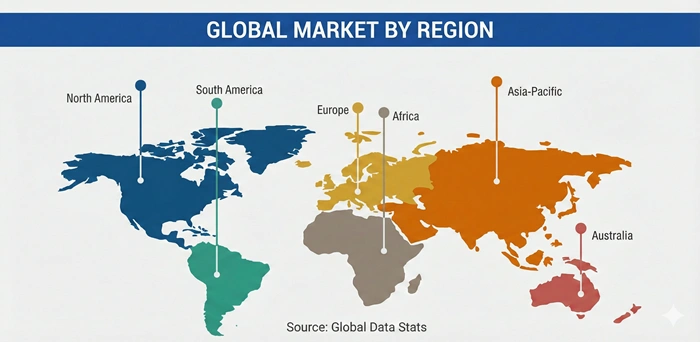
Regional Insights
North America's Payment Infrastructure Leadership and Asia Pacific's Digital Economy Explosion Are the Two Most Defining Regional Forces Shaping the Global Tokenization Market Through 2033
North America
North America Commands the Largest Share of the Tokenization Market Through Its Advanced Payment Ecosystem, Strong Regulatory Enforcement, and Deep Enterprise Adoption of Cloud-Native Data Security Solutions
North America holds approximately 39% of global tokenization market share in 2025, growing at a regional CAGR of approximately 18.2% from 2026 to 2033. The United States is the dominant country market, home to the world's largest digital payment infrastructure, the most stringent enforcement of PCI DSS standards, and the most commercially active ecosystem of tokenization technology vendors. The United States also hosts the headquarters of Visa, Mastercard, Fiserv, and most leading enterprise tokenization platform providers, giving the region a structural advantage in both commercial scale and technology innovation. Key players with dominant North American positions include Visa Inc. (USA), Mastercard Inc. (USA), Fiserv, Inc. (USA), IBM Security (USA), Thales Group (France), and Broadcom Inc. (USA).
Canada contributes meaningfully to North American tokenization revenues through its well-developed banking sector and strong privacy regulation under PIPEDA and provincial privacy laws. The growing interest in real-world asset tokenization among US financial institutions and alternative investment platforms is also positioning North America as the primary commercial battleground for the next generation of tokenization use cases — including tokenized securities, tokenized fund shares, and blockchain-based payment settlement systems. This combination of current payment security demand and future asset tokenization opportunity will sustain North America's market leadership position through 2033 and beyond.
Asia Pacific
Asia Pacific Is the Fastest-Growing Region in the Tokenization Market, Fueled by Its Massive Mobile Payment Ecosystem, Rapid Fintech Growth, and Tightening National Data Protection Regulations
Asia Pacific is the fastest-growing region in the tokenization market, projected to expand at a CAGR of approximately 22.4% from 2026 to 2033 and holding approximately 24% of global market share in 2025. China is the largest country market within the region — home to the world's most active mobile payment ecosystem dominated by Alipay and WeChat Pay, where billions of daily transactions require tokenized payment credential management at extraordinary scale. India is among the fastest-growing individual markets globally, driven by the rapid adoption of UPI-based digital payments, the Reserve Bank of India's progressive tokenization mandates for card-on-file data, and the country's rapidly expanding e-commerce and fintech sectors. Key international vendors active in Asia Pacific include Visa Inc. (USA), Mastercard Inc. (USA), Thales Group (France), and Broadcom Inc. (USA), competing alongside regional platforms including Paytm (India) and Adyen N.V. (Netherlands).
Japan and South Korea contribute significant revenue through their sophisticated digital payment markets and strong enterprise data security standards. Southeast Asia is an important emerging growth frontier, where rapidly expanding digital payment infrastructure in Indonesia, Vietnam, the Philippines, and Malaysia is creating new tokenization demand from both local fintech companies and international payment processors establishing regional operations. The strengthening data protection regulatory landscape across Asia Pacific — including India's DPDP Act, Singapore's PDPA, and Indonesia's PDP Law — is compelling organizations across sectors to invest in tokenization as a cornerstone of their data privacy compliance programs.
Customization Available by Region and Country
This Tokenization Market Report Is Fully Customizable to Deliver Targeted Regional and Country-Level Intelligence Tailored to Your Organization's Specific Strategic Focus Areas, Market Entry Objectives, and Competitive Intelligence Requirements
Our tokenization market report offers complete region-wise and country-wise customization, providing clients with in-depth market sizing, payment ecosystem analysis, regulatory compliance landscape mapping, competitive intelligence, and growth opportunity assessments specific to any geography.
-
Customized tokenization market reports are available for all the following regions and countries:
North America
-
United States, Canada, Mexico — country-level tokenization market sizing, PCI DSS compliance landscape, payment network tokenization adoption trends, enterprise cloud tokenization demand, and competitive positioning of leading vendors in each North American market
Europe
-
United Kingdom, Germany, France, Italy, Rest of Europe — GDPR and PSD2 regulatory impact on tokenization investment, capital markets asset tokenization activity, digital banking sector demand, and country-level competitive landscape for European and international tokenization platform vendors
Asia Pacific
-
China, India, Japan, South Korea, Australia, Rest of Asia Pacific — detailed country breakdowns covering mobile payment tokenization volumes, national data protection mandates, fintech sector activity, local vendor landscape, and sub-regional growth forecast drivers
Latin America
-
Brazil, Argentina, Rest of Latin America — digital payment market expansion, Pix and open banking tokenization implications, data privacy regulation development, and market opportunity analysis for tokenization platform vendors in key Latin American markets
Middle East & Africa
-
UAE, Saudi Arabia, Rest of MEA — government digital economy program impact on tokenization demand, banking sector adoption trends, national cybersecurity regulatory requirements, and market opportunity assessment for tokenization solutions across the MEA region
Top Key Players
-
Visa Inc. (United States)
-
Mastercard Inc. (United States)
-
Fiserv, Inc. (United States)
-
Broadcom Inc. (Symantec Enterprise) (United States)
-
Thales Group (France)
-
IBM Security (IBM Corporation) (United States)
-
Adyen N.V. (Netherlands)
-
Stripe, Inc. (United States)
-
Micro Focus International plc (United Kingdom)
-
TokenEx, LLC (United States)
-
Protegrity USA, Inc. (United States)
-
PayPal Holdings, Inc. (Braintree) (United States)
Recent Developments
-
In 2025, Visa Inc. expanded its Visa Token Service (VTS) globally to support tokenization of payment credentials across new digital commerce categories including embedded finance, IoT payments, and subscription commerce, significantly broadening the range of digital payment experiences that can be secured through its tokenization infrastructure.
-
In 2025, Mastercard Inc. launched its Multi-Token Network (MTN) commercial service, enabling financial institutions to issue and manage tokenized assets and digital currencies on a secure, interoperable infrastructure, positioning Mastercard as a key enabler of the emerging real-world asset tokenization and central bank digital currency ecosystem.
-
In 2024, Thales Group enhanced its CipherTrust Data Security Platform with advanced tokenization capabilities for multi-cloud environments, enabling enterprise clients to apply centralized tokenization policies across AWS, Microsoft Azure, and Google Cloud workloads through a single management interface, simplifying compliance governance for regulated industries.
-
In 2025, Fiserv, Inc. deepened its tokenization capabilities through an expanded partnership with major card networks to integrate issuer-level tokenization directly into its bank and credit union processing platforms, enabling financial institution clients to issue and manage digital tokens for contactless and mobile wallet payments with minimal integration complexity.
-
In 2024–2025, IBM Security advanced its Guardium Data Protection platform with enhanced tokenization and data masking capabilities for hybrid cloud environments, expanding support for structured and unstructured data tokenization across on-premises databases, cloud object storage, and analytics platforms to help organizations meet GDPR and CCPA requirements more efficiently.
Market Trends
The Convergence of Tokenization With Blockchain for Real-World Asset Tokenization and the Expansion of AI-Driven Token Lifecycle Management Are the Two Most Transformative Trends Reshaping the Competitive Landscape
The most commercially significant structural trend reshaping the tokenization market is the convergence of tokenization with blockchain technology for real-world asset representation. Unlike traditional payment tokenization — which replaces sensitive data with a surrogate value within a closed, enterprise-controlled system — blockchain-based tokenization creates programmable digital representations of assets that can be traded, transferred, and settled on open, interoperable networks. This capability is attracting enormous institutional interest from financial services firms seeking to improve capital market efficiency, reduce settlement times, and enable fractional ownership of high-value assets. The distinction between data security tokenization and asset tokenization is blurring, creating both competitive opportunity and definitional complexity within the broader market.
The second major trend is the growing integration of AI and automation into token lifecycle management. As enterprise tokenization environments grow in scale — managing millions or billions of tokens across complex multi-cloud, multi-geography application estates — the operational burden of managing token vaults, policy updates, compliance reporting, and incident response is growing proportionally. AI-powered token lifecycle management platforms that can automatically detect expired or compromised tokens, enforce updated data governance policies, generate compliance reports, and orchestrate token re-issuance without manual intervention are becoming essential for large enterprise tokenization programs. Vendors investing in AI-native tokenization management capabilities are gaining significant competitive advantage and customer retention advantages in this fast-evolving market.
Segments Covered in the Report
-
By Component
-
Solutions
-
Services (Professional Services, Managed Services)
-
-
By Deployment Model
-
Cloud-Based
-
On-Premises
-
Hybrid
-
-
By Application
-
Payment Security
-
User Authentication
-
Compliance Management
-
Real-World Asset Tokenization
-
Other Applications
-
-
By Enterprise Type
-
Large Enterprises
-
Small and Medium Enterprises (SMEs)
-
-
By End-Use Industry
-
BFSI
-
Retail and Consumer Goods
-
IT and Telecommunications
-
Healthcare
-
Energy and Utilities
-
Government
-
Other End-Use Industries
-
-
By Region
-
North America (U.S., Canada, Mexico)
-
Europe (U.K., Germany, France, Italy, Rest of Europe)
-
Asia Pacific (China, India, Japan, South Korea, Australia, Rest of Asia Pacific)
-
Latin America (Brazil, Argentina, Rest of Latin America)
-
Middle East & Africa (UAE, Saudi Arabia, Rest of MEA)
-
❝ Built for Every Level — From Startups to Industry Giants ❞
Here Is Exactly How This Report Works for You
-
Whether you are a Tier 1 global payment network or financial institution evaluating your tokenization platform strategy, a Tier 2 regional fintech or enterprise security company identifying high-growth tokenization application niches, or a startup building next-generation real-world asset or digital identity tokenization platforms — this report delivers comprehensive competitor revenue analysis, revenue source breakdowns, supply-demand dynamics, and geopolitical risk mapping that empowers every stakeholder across the tokenization market to make high-confidence, data-backed strategic decisions.
-
For investors and mid-level companies assessing market entry, product development priorities, or geographic expansion, the report provides rigorous analysis of how digital payment adoption rates, data privacy regulatory enforcement intensity, cloud migration timelines, and blockchain asset tokenization adoption curves across key geographies translate into specific and quantifiable tokenization market revenue opportunities — including how the competitive dynamics between payment network-owned and third-party tokenization platforms are shaping vendor strategy.
-
For senior executives and strategic planners at tokenization platform vendors, payment processors, financial institutions, and enterprise security teams, this report maps how evolving regulatory requirements, geopolitical data sovereignty concerns, central bank digital currency development programs, and the race to capture the real-world asset tokenization opportunity are reshaping technology investment priorities — delivering the forward-looking competitive intelligence your organization needs to win in this rapidly evolving market through 2033.
Frequently Asked Questions
Question 1: What is the current size and growth forecast of the tokenization market?
Answer: The tokenization market is valued at USD 3.82 billion in 2025 and is projected to reach USD 14.83 billion by 2033. It is growing at a CAGR of 19.3% from 2026 to 2033, driven by digital payment growth and expanding data privacy regulations.
Question 2: What are the key growth drivers of the tokenization market?
Answer: The primary growth drivers of the tokenization market include the rapid global adoption of digital payments requiring PCI DSS-compliant payment credential protection, tightening data privacy regulations such as GDPR and CCPA, and the accelerating adoption of cloud-native tokenization platforms. The emerging real-world asset tokenization use case is adding a new and highly significant long-term growth dimension to the market.
Question 3: What is the difference between payment tokenization and real-world asset tokenization in the context of the tokenization market?
Answer: Payment tokenization in the tokenization market replaces sensitive payment card data with a non-sensitive surrogate token to protect financial transactions, while real-world asset tokenization creates blockchain-based digital representations of physical or financial assets to enable fractional ownership and programmable trading. Both applications are growing rapidly but serve fundamentally different use cases and buyer ecosystems.
Question 4: Which region leads the tokenization market and which is growing fastest?
Answer: North America leads the tokenization market with approximately 39% of global market share in 2025, driven by advanced payment infrastructure and regulatory compliance requirements. Asia Pacific is the fastest-growing region, expanding at a CAGR of approximately 22.4% from 2026 to 2033, powered by its massive mobile payment volumes and rapidly tightening data protection regulations.
Question 5: Who are the leading companies in the tokenization market?
Answer: The leading companies in the tokenization market include Visa, Mastercard, Fiserv, Broadcom (Symantec), Thales Group, IBM Security, Adyen, Stripe, and TokenEx, among others. These vendors compete through payment network scale, enterprise data security integration, cloud platform capabilities, and emerging blockchain and digital asset tokenization innovations.