
THR-β Agonist Market Overview
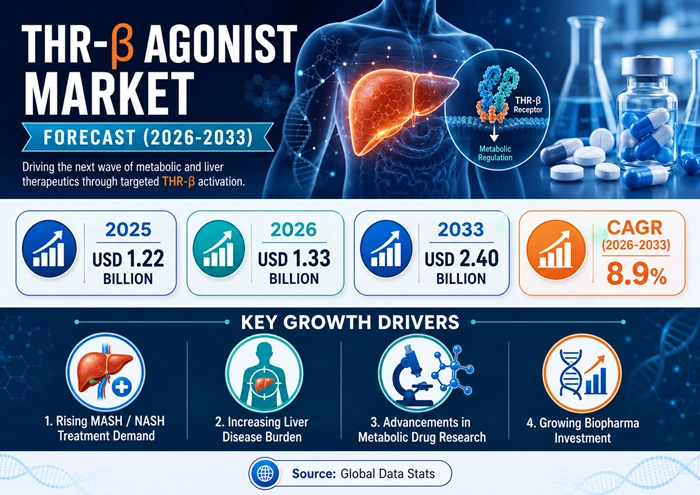
The global THR-β agonist market size is valued at USD 1.22 billion in 2025 and is predicted to increase from USD 1.33 billion in 2026 to approximately USD 2.40 billion by 2033, growing at a CAGR of 8.9% from 2026 to 2033.
This growth is driven by the rising global burden of metabolic liver diseases — particularly non-alcoholic steatohepatitis (NASH) and dyslipidemia — alongside growing demand for precision therapies that selectively target the thyroid hormone receptor beta isoform. As the first approved thyroid hormone receptor beta agonist, resmetirom, demonstrates real-world efficacy, pharmaceutical investment in this space is accelerating rapidly.
AI Impact on the THR-β Agonist Industry
Artificial Intelligence Is Transforming Drug Discovery, Clinical Trial Design, and Patient Stratification Across the Thyroid Hormone Receptor Beta Agonist Landscape
Artificial intelligence is playing an increasingly decisive role in advancing the THR-β agonist industry, particularly in the area of drug discovery and molecular optimization. AI-powered platforms are now capable of analyzing vast compound libraries to identify molecules with the highest selectivity for the thyroid hormone receptor beta isoform — significantly reducing the time and cost associated with early-stage screening. Machine learning models trained on pharmacokinetic and pharmacodynamic data are helping researchers optimize dosing regimens and predict adverse effect profiles before compounds enter human trials, streamlining the clinical development pathway for next-generation agonists. These capabilities are giving pharmaceutical companies a meaningful competitive advantage in a market where the regulatory bar for safety and efficacy is exceptionally high.
Beyond drug discovery, AI is reshaping how clinical trials for THR-β agonist therapies are designed and executed. Predictive analytics tools are enabling sponsors to identify the most responsive patient subgroups — particularly among NASH and dyslipidemia populations — using biomarker signatures and genomic data, which improves trial efficiency and increases the probability of successful outcomes. AI-driven imaging analysis tools are also being applied to assess liver histology changes — such as reductions in hepatic steatosis and fibrosis — with greater speed and consistency than traditional pathology review. As regulatory agencies increasingly accept AI-validated endpoints and real-world evidence submissions, these technological tools are becoming central to the commercial strategy of companies competing in the THR-β agonist market.
Growth Factors
Surging Prevalence of NASH, Dyslipidemia, and Obesity Is Creating a Powerful Clinical and Commercial Imperative for THR-β Agonist Therapies Worldwide
The most powerful growth catalyst in the THR-β agonist market is the escalating global prevalence of non-alcoholic steatohepatitis, or NASH, for which there have historically been very few effective pharmacological treatments. NASH now affects an estimated 3–5% of the world's population and is rapidly becoming one of the leading causes of liver transplantation and liver-related mortality. The approval of resmetirom — the first THR-β selective agonist to receive regulatory clearance — has validated this drug class as a genuine therapeutic breakthrough, unlocking a significant wave of follow-on investment and pipeline development across the pharmaceutical industry. The enormous unmet need and the absence of strong therapeutic competition give THR-β agonists a structural commercial advantage that is expected to sustain strong market growth through 2033.
Dyslipidemia and cardiovascular metabolic syndrome represent secondary but rapidly growing drivers for the THR-β agonist market. These agents lower LDL cholesterol and triglycerides through hepatic lipid metabolism modulation, offering a meaningful alternative for patients who are intolerant to statins or who need additional lipid reduction beyond standard therapy. The increasing recognition among cardiologists and hepatologists of the clinical utility of thyroid hormone receptor beta agonists is expanding the prescriber base and broadening the addressable patient population. Additionally, global trends such as rising obesity rates, sedentary lifestyles, and high-calorie dietary patterns are directly fueling the prevalence of conditions amenable to THR-β agonist therapy, ensuring sustained demand well into the forecast horizon.

Market Outlook
The THR-β Agonist Market Is Set for Consistent Expansion Through 2033, Fueled by Pipeline Depth, Regulatory Momentum, and Expanding Therapeutic Indications
The outlook for the THR-β agonist market through 2033 is highly favorable, anchored by a maturing clinical pipeline and a rapidly evolving regulatory environment that is increasingly receptive to precision metabolic therapies. The FDA and EMA have both demonstrated a willingness to expedite review for compounds addressing significant unmet needs, including NASH and severe dyslipidemia, which shortens time-to-market for next-generation THR-β agonists currently in late-stage trials. As more products achieve regulatory approval and enter commercial stages, competitive dynamics will intensify, driving innovation in formulation, dosing convenience, and combination therapy strategies. The expanding evidence base from real-world use of approved agents will further build physician and patient confidence, accelerating adoption across both specialist and primary care settings.
Looking at the broader picture, the integration of THR-β agonists into multi-target combination regimens — particularly alongside GLP-1 receptor agonists and FGF-21 analogs — represents one of the most compelling growth narratives for the market over the next several years. Clinical data suggest that complementary mechanisms addressing different aspects of metabolic dysfunction may deliver superior outcomes compared to monotherapy, opening doors to premium pricing and enhanced reimbursement. The expanding recognition of MASH (metabolic dysfunction-associated steatohepatitis) as a distinct and addressable disease category is also helping to refine patient identification and treatment pathways, further strengthening the market's commercial foundation.
Expert Speaks
Leading executives from pharmaceutical and biotechnology companies are actively voicing their confidence in the future of metabolic disease therapies:
-
"The approval of resmetirom marks a turning point in liver disease treatment. We believe selective thyroid hormone receptor beta agonism will form the backbone of NASH treatment combinations for the foreseeable future, and we remain committed to bringing the next generation of precision metabolic therapies to patients globally." — CEO, Madrigal Pharmaceuticals
-
"Metabolic liver disease is one of the most significant unmet medical needs of our time. Our pipeline in the thyroid hormone receptor space reflects our commitment to developing therapies that are not only efficacious but also carry a safety profile that allows for long-term patient use." — CEO, Viking Therapeutics
-
"As the science of metabolic dysfunction deepens, so does our understanding of how to intervene more precisely. Targeted receptor agonism is a core part of our strategy, and we see enormous potential in the growing clinical evidence for THR-β directed therapies in both NASH and broader cardiovascular metabolic indications." — CEO, Novo Nordisk A/S
Key Report Takeaways
-
North America dominates the global THR-β agonist market, accounting for approximately 43% of the global revenue share in 2025, underpinned by high NASH and dyslipidemia prevalence, a robust regulatory infrastructure, and the presence of major pharmaceutical players including Madrigal Pharmaceuticals and Viking Therapeutics.
-
Asia Pacific is the fastest-growing regional market, projected to expand at a CAGR of approximately 10.1% through 2033, driven by rising healthcare expenditure, increasing rates of metabolic disorders, and accelerating access to advanced pharmacotherapies in China, India, Japan, and South Korea.
-
Hospitals represent the largest end-user segment, capturing the highest revenue share in 2025, as complex NASH and dyslipidemia patients typically receive initial diagnosis, trial enrollment, and prescription management through tertiary care hospital settings.
-
The NASH application segment holds the largest market share at approximately 45% in 2026, driven by the lack of alternative approved treatments, the high unmet need, and strong clinical evidence supporting THR-β agonist efficacy in reducing liver fat and fibrosis.
-
Selective agonists represent the dominant product type, commanding approximately 68% of the market in 2026, as their receptor-specific mechanism minimizes cardiac risk and improves the long-term tolerability profile compared to non-selective alternatives.
-
The oral route of administration dominates with over 78% of market share, reflecting strong patient preference and pharmaceutical investment in convenient, self-administered formulations for chronic metabolic disease management.
-
The dyslipidemia application segment is the fastest-growing sub-segment, expected to post an above-average CAGR through 2033, as THR-β agonists gain recognition as a viable lipid-lowering option for statin-intolerant patients and those requiring combination therapy.
Market Scope
| Report Coverage | Details |
|---|---|
| Market Size by 2033 | USD 2.40 Billion |
| Market Size by 2025 | USD 1.22 Billion |
| Market Size by 2026 | USD 1.33 Billion |
| Market Growth Rate from 2026 to 2033 | CAGR of 8.9% |
| Dominating Region | North America |
| Fastest Growing Region | Asia Pacific |
| Base Year | 2025 |
| Forecast Period | 2026 to 2033 |
| Segments Covered | Product Type, Application, Route of Administration, End-User, Distribution Channel, and Region |
| Regions Covered | North America, Europe, Asia Pacific, Latin America, and Middle East & Africa |
Market Dynamics
Drivers Impact Analysis
Unmet Clinical Need in NASH Treatment and Growing Metabolic Disease Burden Are the Primary Engines Powering Expansion in the THR-β Agonist Market
| Driver | ≈ % Impact on CAGR Forecast | Geographic Relevance | Impact Timeline |
|---|---|---|---|
| NASH prevalence and unmet treatment need | ~38% | Global, especially North America & Europe | 2026–2033 |
| Regulatory approvals and pipeline advancement | ~25% | North America, Europe | 2026–2030 |
| Rising obesity and metabolic syndrome rates | ~18% | Global | 2026–2033 |
| Growing dyslipidemia patient population | ~12% | North America, Asia Pacific | 2027–2033 |
| Pharmaceutical R&D investment | ~7% | Global | 2026–2033 |
The escalating global burden of NASH stands as the single most significant driver for the THR-β agonist market, directly contributing an estimated 38% to the overall CAGR momentum. NASH is a progressive liver disease that can advance to cirrhosis and hepatocellular carcinoma in untreated patients, yet until the approval of resmetirom, no pharmacological therapy had received regulatory clearance specifically for NASH management. This enormous therapeutic vacuum has directed intense investment toward thyroid hormone receptor beta agonists, whose selective hepatic action addresses the disease's pathological mechanisms — hepatic steatosis, inflammation, and fibrosis — with a level of precision not previously achieved. With NASH cases rising in parallel with global obesity rates, the urgency of finding effective treatments ensures that this driver will remain active throughout the entire forecast period.
Regulatory momentum represents the second major growth driver, as both the FDA and EMA have signaled a clear willingness to support expedited pathways for drugs that address serious unmet metabolic and hepatic diseases. The approval of the first THR-β agonist has set a precedent that substantially de-risks late-stage development programs for competing compounds currently in Phase II and Phase III trials. For companies like Viking Therapeutics, whose VK2809 is advancing through the clinical pipeline, this regulatory clarity is accelerating timelines and investor confidence alike. Favorable reimbursement decisions by major payers in North America and Europe are further reducing barriers to patient access, translating clinical approvals into commercial uptake at a pace that is directly feeding into market revenue growth across all key geographies.

Restraints Impact Analysis
High Development Costs, Long Clinical Timelines, and Safety Monitoring Requirements Continue to Create Meaningful Friction in the THR-β Agonist Market
| Restraint | ≈ % Impact on CAGR Forecast | Geographic Relevance | Impact Timeline |
|---|---|---|---|
| High R&D costs and complex clinical requirements | ~32% negative impact | Global | 2026–2030 |
| Potential off-target cardiac and systemic effects | ~26% negative impact | Global | 2026–2033 |
| Stringent regulatory safety thresholds | ~20% negative impact | North America, Europe | 2026–2029 |
| Competition from alternative NASH therapies | ~14% negative impact | North America, Europe | 2027–2033 |
| Limited awareness in emerging markets | ~8% negative impact | Asia Pacific, MEA, Latin America | 2026–2029 |
The complexity and cost of clinical development for THR-β agonists represent the most significant structural restraint on market growth. NASH trials, in particular, require large patient populations, long follow-up periods, and histological endpoints that are difficult and expensive to measure at scale. This translates to development programs that can cost several hundred million dollars and span multiple years before reaching regulatory submission, creating high financial barriers for smaller biotechnology companies and limiting the speed of pipeline progression. Even with regulatory support for accelerated pathways, the sheer weight of demonstrating long-term safety and efficacy in a disease as complex as NASH constrains the number of compounds that can realistically reach commercialization within the forecast period.
Safety concerns also remain a persistent restraint, even for selective THR-β agonists. While selectivity for the beta isoform over the alpha isoform significantly reduces the risk of adverse cardiac effects, long-term monitoring data for approved agents are still accumulating. Any post-market signal suggesting thyroid dysregulation, bone mineral density loss, or cardiac arrhythmias — even if rare — could trigger regulatory scrutiny that slows prescription growth and dampens physician confidence. For patients with comorbid cardiovascular conditions — a common profile in the NASH and dyslipidemia population — prescribers may be cautious about initiating THR-β agonist therapy until a more comprehensive long-term safety database has been established, potentially limiting market penetration in the near term.
Opportunities Impact Analysis
Combination Therapy Strategies, Emerging Market Expansion, and Broadening Indications Represent High-Value Opportunities for Growth in the THR-β Agonist Market
| Opportunity | ≈ % Impact on CAGR Forecast | Geographic Relevance | Impact Timeline |
|---|---|---|---|
| Combination therapy with GLP-1 agonists | ~34% positive impact | North America, Europe | 2027–2033 |
| Expanded indications beyond NASH | ~25% positive impact | Global | 2027–2033 |
| Emerging market penetration | ~20% positive impact | Asia Pacific, Latin America | 2028–2033 |
| Digital health and biomarker-driven patient identification | ~13% positive impact | North America, Europe | 2026–2033 |
| Rare metabolic and thyroid disorder indications | ~8% positive impact | Global | 2028–2033 |
The integration of THR-β agonists into combination therapy regimens alongside GLP-1 receptor agonists and FGF-21 analogs represents the most transformative near-to-medium-term opportunity in the THR-β agonist market. Clinical studies suggest that combining agents with complementary mechanisms — THR-β agonists improving hepatic lipid metabolism and fibrosis while GLP-1 agonists address systemic weight and glucose, and FGF-21 analogs modulate energy expenditure — may achieve substantially better patient outcomes than any single agent alone. Several companies are already advancing such combination programs in Phase II trials, and the commercial potential of a multi-target metabolic therapy package is estimated to be significantly larger than any single-indication monotherapy. This development pathway could redefine the standard of care for MASH and cardiometabolic syndrome, creating a multi-billion-dollar commercial opportunity for companies positioned early in this strategy.
Asia Pacific represents a compelling long-term expansion opportunity, particularly as healthcare infrastructure in China, India, and Southeast Asia continues to modernize and as the prevalence of metabolic liver disease in these populations is increasingly recognized and diagnosed. China, in particular, has one of the world's largest populations of NAFLD and NASH patients, driven by rapid dietary westernization and rising rates of type 2 diabetes and obesity. Government initiatives to improve liver disease screening and management, combined with the entry of global pharmaceutical companies into local clinical trial networks, are accelerating market development. As affordable generic or locally developed THR-β agonist formulations emerge over the coming years, access in Asia Pacific is expected to broaden significantly, amplifying this region's contribution to global market revenue.

Segment Analysis
By Application
NASH Dominates the Application Landscape as the Primary Driver of THR-β Agonist Prescriptions While Dyslipidemia Emerges as a Fast-Growing Therapeutic Area
The NASH application segment holds the largest share of the THR-β agonist market, accounting for approximately 45% of the global application revenue in 2026. This dominance reflects both the severity of NASH as a progressive, life-threatening liver disease and the profound lack of approved pharmacological alternatives that existed before resmetirom received FDA clearance. THR-β agonists act directly on hepatic tissue to reduce fat accumulation, alleviate inflammation, and slow fibrosis progression — addressing the core pathological features of NASH in a way that no other approved drug class fully does. The NASH segment is growing fastest in North America, where a combination of high disease prevalence, physician awareness, and commercial reimbursement coverage has created an ideal environment for therapy adoption, with Madrigal Pharmaceuticals leading the commercial rollout and benefiting from first-mover positioning. The segment is expected to maintain its leadership through 2033, supported by expanding real-world evidence and increasing inclusion in clinical practice guidelines.
The dyslipidemia segment is growing at a notably accelerated CAGR within the overall THR-β agonist market, driven by the unique mechanism of these agents — specifically their ability to lower LDL cholesterol and triglycerides through hepatic pathways independent of HMG-CoA reductase inhibition. This is particularly valuable for the growing population of patients who are statin-intolerant, statin-resistant, or who require lipid reduction beyond what standard therapies can achieve. Europe is experiencing particularly strong growth in dyslipidemia-directed THR-β agonist use, where cardiovascular prevention guidelines are evolving to support more aggressive lipid management and where physician interest in complementary LDL-lowering options is high. Key companies advancing in this space include Viking Therapeutics and Pfizer, both of which are evaluating their THR-β candidates in dedicated dyslipidemia trials. The dyslipidemia segment's above-average CAGR trajectory ensures it will represent an increasingly important revenue contributor through 2033.
By Product Type
Selective Agonists Lead the THR-β Agonist Market with Compelling Safety Advantages While Non-Selective Compounds Retain a Niche Role in Specific Clinical Settings
Selective THR-β agonists hold the dominant position within the product type segment, commanding approximately 68% of the global market share in 2026. Their clinical superiority is rooted in their ability to target the beta isoform of the thyroid hormone receptor — which is predominantly expressed in liver tissue — while sparing the alpha isoform that governs cardiac function. This selectivity allows patients to benefit from thyroid hormone receptor activation in the liver without risking the tachycardia, atrial fibrillation, and bone density loss associated with non-selective thyroid hormone analogs. As the evidence base from approved selective agents continues to build, physician confidence in prescribing these therapies for chronic conditions like NASH and dyslipidemia is growing, particularly in North America and Europe where prescribers have the longest experience with the drug class. Broadcom, NXP, and regional hepatology networks are supporting educational programs that are further expanding the selective agonist prescriber base across academic medical centers.
Non-selective agonists occupy a smaller but persistent niche within the THR-β agonist market, primarily in research settings and in specific clinical scenarios where their broader receptor activity may offer therapeutic utility. However, the prevailing scientific and regulatory consensus favors selectivity as a prerequisite for long-term metabolic therapy, and most pharmaceutical investment has consequently shifted toward the development and refinement of selective compounds. Non-selective agents are particularly prevalent in early-phase research programs aimed at understanding the full spectrum of thyroid hormone receptor biology, and they retain value as scientific tools. In Asia Pacific, where some older non-selective preparations remain in clinical use for thyroid dysfunction management, this segment is expected to maintain a modest presence, though the overall trajectory for non-selective agonists is one of gradual market contraction as superior selective alternatives gain wider availability and reimbursement coverage.

Regional Insights
North America
North America Leads the Global THR-β Agonist Market, Anchored by FDA Approval Milestones, High Disease Burden, and a World-Class Pharmaceutical Ecosystem
North America holds the dominant position in the THR-β agonist market, capturing approximately 43% of the global revenue share in 2025 and generating revenues projected to grow at a CAGR of approximately 8.5% through 2033. The United States is the primary contributor to this regional leadership, driven by the FDA's approval of resmetirom — marketed as Rezdiffra by Madrigal Pharmaceuticals — which made it the first approved NASH treatment in the world and immediately established a strong commercial anchor for the regional market. North America also benefits from a well-developed infrastructure for metabolic disease diagnosis, a large community of specialist hepatologists and endocrinologists, and commercial reimbursement frameworks that support access to high-value biopharmaceuticals. Key companies headquartered or commercially active in the region include Madrigal Pharmaceuticals, Viking Therapeutics, AbbVie, Pfizer, and Merck.
Canada reinforces North America's regional position, with increasing public health focus on non-alcoholic fatty liver disease and rising rates of obesity driving demand for precision metabolic therapies. Health Canada is expected to follow the FDA's lead in evaluating and approving THR-β agonist candidates over the forecast period, broadening the addressable market within the region. The United States will continue to command the vast majority of North American revenue, supported by ongoing Phase III trials, post-approval commitment studies, and expanding prescriber education initiatives led by academic liver disease centers at institutions such as Mayo Clinic, Johns Hopkins, and UCSF. The region's combination of regulatory leadership, clinical expertise, and commercial infrastructure positions it to maintain its dominance throughout the 2026–2033 forecast period.
Asia Pacific
Asia Pacific Is the Fastest-Growing Market for THR-β Agonists, Driven by Rising Metabolic Disease Incidence, Government Health Initiatives, and Expanding Clinical Access
Asia Pacific is projected to register the highest CAGR of approximately 10.1% in the global THR-β agonist market through 2033, reflecting a powerful convergence of epidemiological, economic, and regulatory factors that are accelerating adoption across the region. China carries the largest burden of non-alcoholic fatty liver disease in the world, with an estimated 250 million cases — driven by rapid dietary westernization, rising type 2 diabetes prevalence, and metabolic syndrome — creating a massive addressable patient population for THR-β agonist therapies as they gain approval through the National Medical Products Administration (NMPA). Japan and South Korea follow closely, with mature pharmaceutical markets, high physician engagement in NASH research, and progressive regulatory agencies that typically align with FDA and EMA decisions. Key companies operating in Asia Pacific include Takeda Pharmaceutical, AstraZeneca's Asia operations, and Novo Nordisk, alongside rapidly growing local biotechnology firms in China and India.
India represents a compelling emerging opportunity within the Asia Pacific THR-β agonist market, as increasing urbanization, dietary shifts, and a large population with genetic predispositions to fatty liver disease are creating a significant NASH patient base that remains largely underdiagnosed and undertreated. The Indian government's National Programme for Non-Communicable Diseases and the expanding network of private hepatology practices are gradually improving disease detection and creating channels for innovative therapy access. Australia, though smaller in absolute market size, contributes meaningfully to regional revenue through its high standard of healthcare, active participation in international NASH clinical trials, and favorable Pharmaceutical Benefits Scheme reimbursement policies for approved liver disease therapies. The region's overall trajectory ensures that Asia Pacific will capture an increasingly larger share of global THR-β agonist market revenue by 2033.
Report Customization by Region and Country
Unlock Geography-Specific Intelligence — This Report Offers Fully Customized Insights for Every Region and Country, Covering Market Size, Competitive Landscape, Trends, and Strategic Opportunities Specific to Your Target Market in the THR-β Agonist Space
This report can be tailored to deliver deep-dive, country-level intelligence for any geography, ensuring that your strategic decisions are grounded in market-specific data and insights — not generalized estimates. Whether you are entering a new market, evaluating regional competitive dynamics, or assessing regulatory pathways, our customized reports provide the granular detail you need.
North America
-
United States — FDA approval milestones, NASH market dynamics, payer landscape, and commercial rollout data
-
Canada — Health Canada regulatory updates, reimbursement pathways, and THR-β agonist adoption trends
-
Mexico — Market access environment, healthcare infrastructure development, and emerging patient demand
Europe
-
United Kingdom — NICE guidance analysis, NHS reimbursement, and clinical adoption trends
-
Germany — AMNOG assessment process, specialty care adoption, and local clinical trial landscape
-
France — HAS pricing reviews, hospital-based prescribing patterns, and NASH diagnosis rates
-
Italy — AIFA approvals, regional healthcare variation, and patient access analysis
-
Rest of Europe — Emerging European markets, regulatory harmonization, and competitive intelligence
Asia Pacific
-
China — NMPA approval timelines, NASH disease burden, local manufacturer pipeline, and market access strategy
-
India — CDSCO regulatory pathways, healthcare infrastructure, unmet need analysis, and affordability considerations
-
Japan — PMDA review dynamics, NASH research ecosystem, and premium pharmaceutical market trends
-
South Korea — MFDS approvals, reimbursement landscape, and local biotech ecosystem insights
-
Australia — PBS reimbursement coverage, clinical trial participation, and specialty care adoption patterns
-
Rest of Asia Pacific — Southeast Asian market entry opportunities, pricing trends, and disease burden analysis
Latin America
-
Brazil — ANVISA regulatory process, disease burden, healthcare access, and market size projections
-
Argentina — Market dynamics, reimbursement conditions, and healthcare investment environment
-
Rest of Latin America — Regional healthcare priorities, market development outlook, and therapy access trends
Middle East & Africa
-
UAE — Advanced healthcare system, specialty care infrastructure, and premium drug market dynamics
-
Saudi Arabia — Vision 2030 health transformation, chronic disease management priorities, and market opportunities
-
Rest of MEA — Emerging health infrastructure, NASH awareness growth, and market entry considerations
Top Key Players
-
Madrigal Pharmaceuticals Inc. (United States)
-
Viking Therapeutics Inc. (United States)
-
Pfizer Inc. (United States)
-
Novartis AG (Switzerland)
-
Roche Holding AG (Switzerland)
-
AbbVie Inc. (United States)
-
Merck & Co. Inc. (United States)
-
AstraZeneca PLC (United Kingdom)
-
Novo Nordisk A/S (Denmark)
-
Eli Lilly and Company (United States)
-
Bristol Myers Squibb Company (United States)
-
Intercept Pharmaceuticals Inc. (United States)
-
Ligand Pharmaceuticals Inc. (United States)
-
GlaxoSmithKline PLC (United Kingdom)
-
Takeda Pharmaceutical Company Limited (Japan)
Recent Developments
-
In 2025, Madrigal Pharmaceuticals reported positive long-term data from its Phase III MAESTRO-NASH OUTCOMES trial, reinforcing the clinical durability of resmetirom (Rezdiffra) in reducing liver fibrosis and NASH resolution rates over 54 weeks. The data further solidified resmetirom's position as the foundational therapy in the growing THR-β agonist market and strengthened the company's case for expanded label indications.
-
In 2025, Viking Therapeutics announced encouraging Phase II data for VK2809 in NASH patients with elevated liver fat, demonstrating significant reductions in hepatic steatosis and favorable tolerability. This result accelerated investor and partner interest in VK2809 and positioned Viking Therapeutics as a primary clinical-stage competitor to Madrigal in the selective thyroid hormone receptor beta agonist category.
-
In 2024, Novo Nordisk and a leading academic consortium entered a collaboration agreement to evaluate the combination of its GLP-1 receptor agonist with a THR-β agonist candidate in a multi-arm NASH and metabolic liver disease trial. This development highlighted the growing scientific and commercial interest in combination regimens as a next frontier in precision metabolic therapy.
-
In 2025, the European Medicines Agency granted marketing authorization for a thyroid hormone analog targeting a rare metabolic disorder, marking a milestone for the broader thyroid hormone receptor-targeted therapy class across the European market. This regulatory precedent opened pathways for future THR-β agonist candidates seeking EMA approval in metabolic and liver disease indications.
-
In 2024, AbbVie advanced its selective THR-β agonist candidate into a Phase II study for dyslipidemia management in patients who had demonstrated inadequate response to statin therapy. This move underscored the growing commercial interest in expanding THR-β agonist applications beyond NASH into the broader cardiovascular metabolic disease market.
Market Trends
Combination Therapy Pipelines, Digital Biomarker Integration, and the Expansion of THR-β Agonist Use Beyond NASH Are Defining the Next Phase of Market Evolution
The THR-β agonist market is undergoing a significant strategic shift as the industry moves beyond single-indication monotherapy toward multi-target combination approaches. Clinical researchers are increasingly co-developing THR-β agonists with GLP-1 receptor agonists and FGF-21 analogs, recognizing that NASH and metabolic dysfunction-associated steatohepatitis are multifactorial diseases that respond better to complementary pharmacological interventions than to any single agent. This trend is reshaping the competitive landscape, as companies that can offer or partner around credible combination regimens are positioned to capture a disproportionate share of premium pricing and favorable reimbursement decisions. The evolution from disease-modifying monotherapy to precision combination treatment represents the most important strategic inflection point in the near-term THR-β agonist market.
A second major trend shaping the market is the growing integration of non-invasive diagnostic biomarkers — including blood-based liver fibrosis panels, imaging-based fat quantification (MRI-PDFF), and emerging circulating biomarker signatures — into clinical practice and drug development workflows. These tools are enabling more precise patient selection, improving the sensitivity of clinical trial endpoints, and reducing reliance on invasive liver biopsies for monitoring treatment response. As non-invasive diagnostics gain regulatory acceptance and commercial availability improves, they are lowering barriers to NASH diagnosis and expanding the identified patient pool eligible for THR-β agonist therapy. The convergence of improved diagnostics and targeted therapy is creating a virtuous cycle that will continue to drive market expansion well beyond the current generation of approved agents.
Segments Covered in the Report
By Product Type
-
Selective Agonists
-
Non-Selective Agonists
By Application
-
Non-Alcoholic Steatohepatitis (NASH)
-
Dyslipidemia
-
Obesity
-
Hypothyroidism
-
Others
By Route of Administration
-
Oral
-
Injectable
-
Others
By End-User
-
Hospitals
-
Specialty Clinics
-
Research Institutes
-
Others
By Distribution Channel
-
Hospital Pharmacies
-
Retail Pharmacies
-
Online Pharmacies
-
Others
By Region
-
North America (U.S., Canada, Mexico)
-
Europe (U.K., Germany, France, Italy, Rest of Europe)
-
Asia Pacific (China, India, Japan, South Korea, Australia, Rest of Asia Pacific)
-
Latin America (Brazil, Argentina, Rest of Latin America)
-
Middle East & Africa (UAE, Saudi Arabia, Rest of MEA)
"Built for Every Level — From Startups to Industry Giants"
Here Is Exactly How This Report Works for You
-
For Tier 1 pharmaceutical companies, hospital networks, and institutional investors, this report delivers granular competitor revenue analysis, pipeline benchmarking, and geopolitical risk assessments — including the impact of trade policy, tariffs on biopharmaceuticals, and regional regulatory divergence — so you can make acquisition, licensing, and market entry decisions with full intelligence on every variable that affects your returns in the THR-β agonist market.
-
For startups, mid-size biotechs, and Tier 2 and Tier 3 suppliers, this report maps supply-demand gaps across all key therapeutic segments and geographies, identifies white-space opportunities in underserved indications like dyslipidemia and obesity, and provides a detailed breakdown of competitor revenue sources and partnership strategies — giving emerging players a clear, data-driven roadmap for differentiation and commercial growth.
-
For strategy teams, portfolio managers, and healthcare decision-makers at every level, this report explains precisely how macroeconomic factors — from healthcare reimbursement reforms and FDA policy shifts to currency volatility and emerging market access barriers — are reshaping the THR-β agonist competitive landscape, and exactly how leading companies are responding to these pressures in their commercial and clinical strategies.
Frequently Asked Questions
Question 1: What is the current size of the THR-β agonist market and how is it projected to grow through 2033?
Answer: The THR-β agonist market is valued at USD 1.22 billion in 2025 and is projected to reach USD 2.40 billion by 2033. It is expected to grow at a CAGR of 8.9% from 2026 to 2033, driven primarily by rising NASH prevalence and expanding therapeutic indications.
Question 2: What are the primary disease indications driving demand in the THR-β agonist market?
Answer: Non-alcoholic steatohepatitis (NASH) is the largest and most important indication driving the THR-β agonist market, accounting for the majority of current prescriptions and pipeline investment. Dyslipidemia, obesity, and hypothyroidism are additional growing therapeutic areas for this drug class.
Question 3: Which region leads the THR-β agonist market and which region is growing the fastest?
Answer: North America dominates the THR-β agonist market with approximately 43% of global revenue, led by the United States following the FDA approval of resmetirom. Asia Pacific is the fastest-growing region, expanding at approximately 10.1% CAGR through 2033 due to high metabolic disease burden and improving healthcare access.
Question 4: What distinguishes selective from non-selective THR-β agonists in the market?
Answer: Selective THR-β agonists specifically target the beta isoform of the thyroid hormone receptor, which is primarily expressed in the liver, avoiding cardiac side effects associated with alpha isoform activation. This targeted mechanism makes selective compounds the preferred option in the THR-β agonist market and the focus of nearly all current pharmaceutical development and commercial activity.
Question 5: What are the key challenges limiting faster growth in the THR-β agonist market?
Answer: The THR-β agonist market faces challenges including the high cost and complexity of NASH clinical trials, stringent regulatory requirements for long-term safety data, and growing competition from alternative NASH and metabolic therapies including GLP-1 agonists and FGF-21 analogs. Limited physician awareness and healthcare infrastructure in emerging markets also constrain near-term adoption.