
Thoracentesis and Paracentesis Market Overview
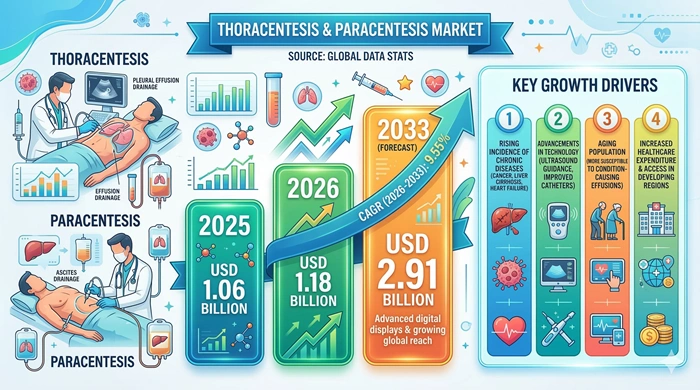
The global thoracentesis and paracentesis market size is valued at USD 1.06 billion in 2025 and is predicted to increase from USD 1.18 billion in 2026 to approximately USD 2.91 billion by 2033, growing at a CAGR of 9.55% from 2026 to 2033. This steady rise reflects increasing use of image‑guided minimally invasive drainage procedures across hospitals and outpatient settings. Demand is also driven by the growing burden of cancer, liver cirrhosis, heart failure, and other chronic conditions that lead to pleural effusion and ascites.
AI Is Quietly Reshaping Fluid Drainage Procedures And Clinical Decision Making
AI is starting to influence how thoracentesis and paracentesis are planned, guided, and monitored across the care pathway. Algorithms integrated into ultrasound and CT platforms can help identify safe needle entry points, optimize catheter placement, and flag anatomical risks in real time, which supports less experienced clinicians and improves procedural safety. Over time, procedure data linked with outcomes can train models to predict complications such as bleeding, infection, or re‑accumulation of fluid, helping teams decide when to intervene and how aggressively to drain.
AI‑enabled workflow tools also reduce documentation and scheduling burden, freeing clinicians to focus more on patient care in the thoracentesis and paracentesis market. In combination with telemedicine, predictive analytics can prioritize high‑risk patients who need urgent drainage while allowing stable cases to be monitored remotely. This combination is particularly relevant for large health systems and value‑based care programs that must balance procedure volumes, bed capacity, and cost containment.
Growth Factors
Rising Burden Of Chronic Disease Is Fueling Demand For Image‑Guided Fluid Drainage
Several clinical trends are driving sustained growth in the thoracentesis and paracentesis market. The rising prevalence of liver cirrhosis, cancer, heart failure, and severe infections is increasing the number of patients who develop recurrent ascites or pleural effusion requiring repeated drainage procedures. Aging populations in North America, Europe, and parts of Asia Pacific further add to procedure volumes as older adults are more likely to present with multi‑morbid conditions that cause fluid build‑up. At the same time, better survival rates in oncology and hepatology mean more patients live long enough to experience chronic complications that call for centesis procedures.
Shift Toward Minimally Invasive, Ultrasound‑Guided Interventions Supports Market Expansion
Healthcare providers are steadily moving away from open surgical procedures toward minimally invasive, image‑guided interventions. Thoracentesis and paracentesis benefit from this shift because they can often be performed using small‑bore centesis catheters and procedure kits under local anesthesia rather than in the operating room. Hospitals and ambulatory surgical centers see these procedures as cost‑effective ways to relieve symptoms quickly while limiting length of stay and resource use. As training in point‑of‑care ultrasound spreads, more clinicians can safely perform these procedures at the bedside or in day‑care settings, boosting utilization of thoracentesis and paracentesis kits and drainage catheters.
Market Outlook
Consistent Double‑Digit Growth Outlook Supported By Procedure Volumes And Device Innovation
From 2026 to 2033, the thoracentesis and paracentesis market is expected to deliver healthy mid‑to‑high single‑digit to low double‑digit growth, underpinned by stable procedure demand and incremental device innovation. Vendors are investing in safer needle and catheter designs, closed drainage systems, and integrated imaging guidance solutions that reduce complications and speed up procedures. This innovation supports premium pricing for advanced kits and catheters while also giving hospitals clear clinical and economic benefits. As a result, average selling prices are likely to remain resilient even as competition intensifies.
Over the forecast period, emerging markets in Asia Pacific, Latin America, and parts of the Middle East are expected to contribute a growing share of global revenues. These regions are expanding access to diagnostic imaging, insurance coverage, and specialist care, which together raise the baseline of centesis procedure rates. While per‑procedure reimbursement can be more constrained outside North America and Western Europe, higher patient volumes and continued investments in hospital infrastructure are likely to offset pricing pressures and create attractive opportunities for both global and regional device manufacturers.
Expert Speaks
-
CEO, Leading Global Medical Device Company (United States) – The chief executive highlighted that demand for thoracentesis and paracentesis solutions is rising in line with the global increase in chronic liver and cardiopulmonary diseases, particularly in aging populations. He also emphasized that hospitals are prioritizing integrated centesis platforms that combine imaging, safety features, and data capture to support quality metrics and reimbursement.
-
CEO, Major Hospital Group (Europe) – This executive noted that standardized thoracentesis and paracentesis pathways have reduced complications and length of stay, making these procedures central to cost‑efficient management of advanced cancer and cirrhosis patients. She pointed out that day‑care and ambulatory settings are now handling more low‑risk cases, which increases flexibility in managing inpatient beds.
-
CEO, Regional Healthcare Network (Asia Pacific) – The CEO stressed that expanding ultrasound access and specialist training is unlocking new capacity for fluid drainage procedures across secondary and tertiary centers. He added that partnerships with device companies around training and bundled procurement have helped make advanced centesis kits more affordable in price‑sensitive markets.
Key Report Takeaways
-
North America leads the market as the region with the highest revenue share, supported by advanced healthcare infrastructure, widespread adoption of minimally invasive image‑guided procedures, and a strong presence of leading thoracentesis and paracentesis device manufacturers. Favorable reimbursement and high awareness among clinicians help keep procedure volumes and device utilization high in the United States and Canada.
-
Asia Pacific is the fastest growing region, driven by rising healthcare expenditure, expanding hospital networks, and large underserved patient populations with liver disease, cancer, and heart failure. Countries such as China, India, and South Korea are rapidly adopting ultrasound‑guided drainage procedures, which supports above‑average CAGR levels for the regional thoracentesis and paracentesis market.
-
Hospitals remain the largest customer group using these drainage procedures, performing the majority of thoracentesis and paracentesis interventions due to better access to imaging, critical care, and specialist teams. Teaching hospitals and large tertiary centers in particular handle complex and high‑risk cases, which often require repeat procedures and sophisticated drainage catheters and kits.
-
The ascites application contributes the most to revenue, as a high proportion of patients with decompensated liver cirrhosis and certain cancers require repeated paracentesis over time. These patients generate ongoing demand for paracentesis kits, drainage systems, and supportive consumables, making ascites management a central driver in the overall thoracentesis and paracentesis market.
-
Paracentesis kits are currently the most popular product category, favored for their sterile, single‑use design, ease of use, and compatibility with ultrasound guidance. Looking ahead, drainage catheters and small‑bore centesis catheters are expected to grow quickly, with some segments projected to capture a rising share of procedures at CAGRs that exceed the overall market as clinicians seek longer‑term drainage options and improved patient comfort.
Market Scope
| Report Coverage | Details |
|---|---|
| Market Size by 2033 | USD 2.91 billion |
| Market Size by 2025 | USD 1.06 billion |
| Market Size by 2026 | USD 1.18 billion |
| Market Growth Rate from 2026 to 2033 | CAGR of 9.55% |
| Dominating Region | North America |
| Fastest Growing Region | Asia Pacific |
| Base Year | 2025 |
| Forecast Period | 2026 to 2033 |
| Segments Covered | Product Type, Indication, End User, Region |
| Regions Covered | North America, Europe, Asia Pacific, Latin America, Middle East and Africa |
Market Dynamics
Drivers Impact Analysis
Clinical Need And Minimally Invasive Techniques Are Key Accelerators Of Market Growth
Rising incidence of pleural effusion and ascites linked to cancer, chronic liver disease, and cardiac conditions is the primary driver of the thoracentesis and paracentesis market. As more patients present with advanced disease and recurrent fluid build‑up, healthcare providers turn to thoracentesis and paracentesis to relieve symptoms, prevent respiratory compromise, and improve quality of life. The ongoing shift toward minimally invasive, image‑guided techniques reinforces this trend because ultrasound‑guided centesis improves safety and accuracy while lowering complication rates. These factors together have a strong positive impact on the forecast CAGR across North America, Europe, and Asia Pacific over the medium term.
Restraints Impact Analysis
Reimbursement Gaps, Training Needs, And Procedure Risks Temper Adoption In Some Settings
Despite attractive growth prospects, several restraints limit the full potential of the thoracentesis and paracentesis market in certain regions. In low‑ and middle‑income countries, uneven access to ultrasound equipment, consumables, and trained specialists constrains procedure volumes, particularly outside major urban centers. In some health systems, reimbursement may not fully cover advanced kits or closed drainage systems, encouraging the continued use of older, lower‑cost devices. There are also concerns about bleeding, infection, and organ injury, especially when procedures are performed without imaging or by less experienced clinicians, which can cause institutions to centralize services and slow broader uptake.
Opportunities Impact Analysis
Emerging Markets, Home‑Based Care, And Product Innovation Create New Growth Pockets
Vendors and providers have meaningful opportunities to expand the thoracentesis and paracentesis market by targeting emerging economies, developing home‑compatible drainage options, and integrating digital tools. In Asia Pacific, Latin America, and parts of the Middle East and Africa, investments in hospital infrastructure and training programs are opening new demand for centesis kits, catheters, and accessories. Longer‑term indwelling catheters and portable drainage systems create possibilities for partial home management of recurrent ascites and pleural effusion in selected patients, reducing readmissions and freeing hospital beds. Digital integration – including decision‑support software and procedure tracking – can further differentiate products and strengthen partnerships with large hospital networks.
Market Dynamics – Impact Matrix
| Factor | ≈ % Impact On CAGR Forecast | Geographic Relevance | Impact Timeline |
|---|---|---|---|
| High burden of chronic disease (driver) | High | North America, Europe, Asia Pacific | Short to medium term |
| Adoption of ultrasound‑guided minimally invasive procedures (driver) | High | Global, especially hospitals and ASCs | Medium to long term |
| Limited access to imaging and specialists (restraint) | Medium | Latin America, Middle East and Africa, parts of Asia | Medium term |
| Reimbursement and cost pressures (restraint) | Medium | North America, Europe | Short to medium term |
| Expansion of hospital infrastructure in emerging markets (opportunity) | High | Asia Pacific, Latin America, Middle East | Medium to long term |
| Innovation in centesis catheters and drainage systems (opportunity) | High | Global | Long term |
Segment Analysis
Product Type – Paracentesis Kits
Integrated Kits Dominate Due To Safety, Convenience, And Procedure Efficiency
Paracentesis kits currently hold the largest share of the thoracentesis and paracentesis market, accounting for an estimated share of more than one third of global revenues and growing at a solid high single‑digit CAGR through 2033. These kits include needles, catheters, tubing, and collection components in a sterile, single‑use format, which reduces infection risk and simplifies inventory management for hospitals and ambulatory centers. They are widely used for managing ascites in patients with liver cirrhosis and cancer, where repeat procedures are common throughout the disease course. North America and Europe are key regions for this segment due to strong guidelines favoring ultrasound‑guided paracentesis and high adoption of branded procedural kits from leading device manufacturers.
As ultrasound training becomes more widespread in Asia Pacific and Latin America, the use of standardized paracentesis kits is expected to climb, further expanding this segment’s contribution to overall market growth. Vendors differentiate their offerings through safety valves, ergonomic catheter design, and compatibility with imaging guidance systems, which encourages hospitals to upgrade from basic sets to premium products. Leading global and regional players are also focusing on value‑based contracts and procedure‑based pricing models to support adoption in cost‑sensitive settings. This combination of clinical, operational, and commercial advantages positions paracentesis kits as a durable growth engine within the thoracentesis and paracentesis market.
Product Type – Drainage Catheters And Small‑Bore Centesis Catheters
Longer‑Term Drainage Options Poised For Faster‑Than‑Average Growth
Drainage catheters and small‑bore centesis catheters represent a high‑growth segment that is expected to outpace the overall market CAGR between 2026 and 2033. These products enable more controlled and sometimes longer‑term drainage of pleural effusion or ascites, which can be particularly valuable for patients who require frequent repeat procedures or palliative care. Clinicians value smaller diameters and flexible materials that minimize patient discomfort while maintaining adequate drainage flow. Adoption is strongest in North America and Europe, where guidelines increasingly support indwelling catheters in selected patients to reduce hospital visits and admissions.
In Asia Pacific, awareness of these advanced drainage options is growing rapidly as tertiary centers adopt best practices from Western markets. As reimbursement policies evolve and local clinical evidence accumulates, the share of drainage catheters in the thoracentesis and paracentesis market is projected to rise steadily. Leading companies are investing in designs that integrate with vacuum bottles or closed drainage systems, as well as accessories that simplify placement and management in both hospital and outpatient settings. This innovation, combined with strong clinical need in oncology, hepatology, and cardiology, supports robust long‑term growth prospects for this segment.
Regional Insights
North America
High Procedure Volumes, Technology Adoption, And Reimbursement Support Leadership
North America currently dominates the thoracentesis and paracentesis market, capturing the largest share of global revenues and maintaining a healthy mid‑single‑digit to high‑single‑digit CAGR over the forecast period. The region benefits from advanced hospital infrastructure, widespread availability of ultrasound and CT imaging, and a large pool of trained interventional radiologists, pulmonologists, and hepatologists. The high prevalence of chronic liver disease, cancer, and heart failure in the United States and Canada contributes to substantial procedure volumes for both thoracentesis and paracentesis. Leading global device companies are strongly present in this region, offering comprehensive portfolios of centesis catheters, kits, and drainage systems.
Reimbursement structures in North America typically cover image‑guided drainage procedures and associated devices, which supports ongoing investment in advanced technologies. Hospitals increasingly favor closed drainage systems and premium safety features to reduce complications and improve staff efficiency, which further boosts value per procedure. Clinical guidelines and quality initiatives encourage the use of ultrasound guidance for thoracentesis and paracentesis, consolidating demand for integrated solutions. These combined factors ensure that North America remains the benchmark region for the thoracentesis and paracentesis market through 2033.
Asia Pacific
Expanding Access And Infrastructure Drive Above‑Average CAGR
Asia Pacific is projected to be the fastest growing region in the thoracentesis and paracentesis market, with a CAGR that outpaces the global average from 2026 to 2033. Large populations, rising rates of liver disease, cancer, and heart failure, and expanding healthcare coverage are all contributing to increased need for fluid drainage procedures. Governments and private providers are investing in new hospitals, diagnostic centers, and training programs that improve access to ultrasound and interventional services across China, India, Southeast Asia, and developed markets like Japan and South Korea.
As clinical capabilities expand, more patients can receive timely thoracentesis and paracentesis, which drives procedural and device volumes. International manufacturers are forming partnerships with local distributors and health systems to provide centesis kits and drainage catheters at price points adapted to regional budgets. Local companies are also entering the field, particularly in China and India, adding competitive dynamics that can accelerate innovation and adoption. With supportive demographics and increasing awareness of minimally invasive care, Asia Pacific is expected to be a key engine of incremental growth for the global thoracentesis and paracentesis market.
Top Key Players
-
BD Becton Dickinson and Company (United States)
-
Teleflex Incorporated (United States)
-
Cardinal Health (United States)
-
Smiths Medical Now Part Of ICU Medical (United States)
-
Cook Medical (United States)
-
B Braun Melsungen AG (Germany)
-
AngioDynamics Inc (United States)
-
Merit Medical Systems Inc (United States)
-
Fujifilm Holdings Corporation (Japan)
-
Nipro Corporation (Japan)
Recent Developments
-
2025 – BD Becton Dickinson and Company introduced enhancements to its centesis catheter and drainage portfolio, focusing on improved kink resistance and smoother insertion profiles to support image‑guided thoracentesis and paracentesis procedures. The company also expanded training collaborations with leading hospitals to standardize best practices in fluid drainage.
-
2025 – Teleflex Incorporated announced clinical data from multi‑center studies demonstrating reduced complication rates with its small‑bore centesis catheters for pleural effusion and ascites management. Teleflex used these results to support broader adoption in North American and European hospitals and to accelerate regulatory submissions in Asia Pacific.
-
2024 – B Braun Melsungen AG expanded its portfolio of drainage systems and accessories to support thoracic and abdominal fluid management, integrating safety valves and closed collection options. The company emphasized infection‑prevention benefits and workflow efficiencies in intensive care and oncology settings.
-
2024 – AngioDynamics Inc reported progress on next‑generation drainage catheter platforms designed for longer‑term use in oncology and hepatology patients with recurrent effusions. Early clinical adoption in select centers suggested strong physician interest in more comfortable and reliable indwelling solutions.
-
2024 – Merit Medical Systems Inc expanded its centesis product distribution network in Asia Pacific and Latin America, supported by training programs focused on ultrasound‑guided thoracentesis and paracentesis. This initiative aims to capture growing demand from emerging markets and broaden the company’s global footprint.
Market Trends
Evolving Care Pathways And Device Design Are Shaping Future Market Direction
Several structural trends are influencing how the thoracentesis and paracentesis market will evolve through 2033. One key trend is the shift of suitable procedures from inpatient wards to day‑care or ambulatory settings, enabling health systems to manage bed capacity while still addressing patient needs promptly. This makes portability, ease of use, and streamlined workflows more important features in centesis kits and drainage catheters. Another trend is the broader use of ultrasound at the point of care, which is becoming standard for safe fluid drainage in emergency departments, intensive care units, and oncology wards.
Manufacturers are also responding to rising expectations around infection prevention and occupational safety. Closed, vacuum‑assisted, and low‑exposure drainage systems are gaining traction to protect both patients and staff from fluid contact and contamination. At the same time, interest in digital integration is growing, with hospitals exploring how to link procedure data, imaging findings, and outcomes into electronic health record systems. These trends collectively support continued product differentiation and help sustain the long‑term growth trajectory of the thoracentesis and paracentesis market.
Segments Covered In The Report
-
By Product Type: Paracentesis Kits; Thoracentesis Kits; Drainage Catheters; Small‑Bore Centesis Catheters; Accessories
-
By Indication: Ascites; Pleural Effusion; Other Fluid Accumulation Disorders
-
By End User: Hospitals; Ambulatory Surgical Centers; Specialty Clinics; Others
-
By Region: North America; Europe; Asia Pacific; Latin America; Middle East and Africa
Frequently Asked Questions
Question 1: What Is The Thoracentesis And Paracentesis Market And How Is It Expected To Grow By 2033?
Answer: The thoracentesis and paracentesis market includes devices, kits, and catheters used to drain fluid from the pleural and abdominal cavities. It is projected to reach about USD 2.91 billion by 2033, supported by growing chronic disease burdens and wider adoption of minimally invasive procedures.
Question 2: Which Regions Will Lead The Thoracentesis And Paracentesis Market During The Forecast Period?
Answer: North America is expected to remain the leading region in the thoracentesis and paracentesis market due to high procedure volumes and advanced infrastructure. Asia Pacific will likely be the fastest growing region as access to imaging and specialist care continues to improve.
Question 3: Which Product Types Dominate The Thoracentesis And Paracentesis Market?
Answer: Paracentesis kits currently account for a major share of the thoracentesis and paracentesis market because they are convenient, sterile, and widely used in ascites management. Drainage catheters and small‑bore centesis catheters are also growing quickly as clinicians look for longer‑term and patient‑friendly drainage options.
Question 4: Who Are The Key End Users In The Thoracentesis And Paracentesis Market?
Answer: Hospitals are the primary end users in the thoracentesis and paracentesis market, performing most image‑guided drainage procedures. Ambulatory surgical centers and specialty clinics are gaining share as more low‑risk cases shift to outpatient settings.
Question 5: What Are The Main Drivers Of The Thoracentesis And Paracentesis Market From 2026 To 2033?
Answer: Key drivers of the thoracentesis and paracentesis market include rising chronic disease prevalence, aging populations, and growing use of ultrasound‑guided minimally invasive procedures. Product innovation in centesis catheters, drainage systems, and integrated imaging solutions further supports steady CAGR through 2033.