
Technical Textile Market Overview
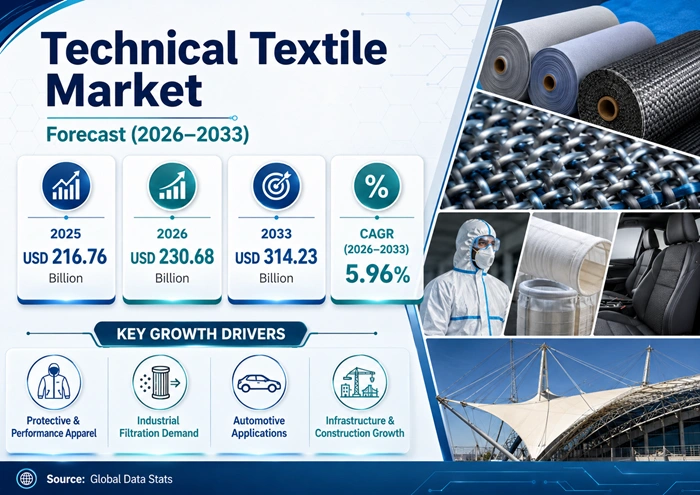
The global technical textile market size is valued at USD 216.76 billion in 2025 and is predicted to increase from USD 230.68 billion in 2026 to approximately USD 314.23 billion by 2033, growing at a CAGR of 5.96% from 2026 to 2033. The technical textile market is witnessing remarkable growth driven by expanding applications across automotive, healthcare, construction, and industrial sectors worldwide. These specialized fabrics are engineered with advanced materials and functional properties that go beyond traditional aesthetic purposes, delivering performance characteristics such as strength, durability, flame resistance, and specialized functionalities.
The increasing focus on lightweight materials in transportation, rising demand for protective equipment in industrial settings, and growing infrastructure development in emerging economies are fueling market expansion. Innovation in fiber technology, smart textiles integration, and sustainable manufacturing practices are reshaping the competitive landscape as manufacturers respond to evolving end-user requirements and stringent regulatory standards across different application segments.
AI Impact on the Technical Textile Industry
Revolutionary Integration of Intelligence and Connectivity Transforming Traditional Manufacturing Paradigms
Artificial intelligence is fundamentally transforming the technical textile market by enabling smart fabric development, predictive quality control, and automated manufacturing processes that enhance production efficiency and product innovation. AI-powered systems are revolutionizing textile design through generative algorithms that can create complex fiber patterns and material combinations optimized for specific performance requirements. Machine learning models analyze vast datasets from production lines to identify defects in real time, reducing waste by up to 20 percent while ensuring consistent quality standards. These intelligent systems can predict equipment maintenance needs, optimize energy consumption, and adjust manufacturing parameters automatically to maintain optimal production conditions across different fabric specifications.
The integration of AI with Internet of Things sensors is accelerating the development of intelligent textiles that can monitor physiological signals, environmental conditions, and structural integrity in real-world applications. Smart medical textiles equipped with embedded sensors can track patient vital signs continuously, alerting healthcare providers to potential complications before they become critical. In automotive applications, AI-enhanced technical textiles are being developed to adjust airbag deployment based on passenger size and impact severity, improving safety outcomes significantly. Leading manufacturers are investing heavily in AI research facilities and digital twin technologies that simulate fabric behavior under various conditions, reducing development cycles from months to weeks while enabling unprecedented levels of customization for specialized industrial applications.
Growth Factors
Accelerating Industrialization and Performance Material Demand Drive Sustained Market Expansion
The technical textile market is propelled by rapid industrialization across emerging economies where manufacturing sectors require high-performance materials for diverse applications ranging from filtration systems to protective equipment. Automotive industry transformation toward electric vehicles is creating substantial demand for lightweight composite materials that reduce vehicle weight while maintaining structural integrity and safety standards. Technical textiles used in battery separators, interior components, and thermal management systems are becoming critical enablers of electric mobility adoption. Healthcare sector expansion, particularly in developing regions with improving medical infrastructure, is driving consumption of disposable medical textiles including surgical gowns, masks, and wound care products that meet stringent hygiene and safety requirements.
Government infrastructure investment programs worldwide are generating sustained demand for geotextiles used in road construction, erosion control, and soil stabilization applications. Climate change concerns and extreme weather events are accelerating adoption of technical textiles in protective clothing for emergency responders, military personnel, and industrial workers exposed to hazardous conditions. Stringent workplace safety regulations across manufacturing sectors mandate use of flame-resistant fabrics, chemical-protective materials, and high-visibility textiles that comply with international safety standards. Agricultural modernization in developing countries is expanding applications for agrotech products including crop protection covers, greenhouse materials, and soil enhancement textiles that improve yield productivity and resource efficiency.
Market Outlook
Technological Convergence and Sustainability Priorities Shaping Industry Evolution
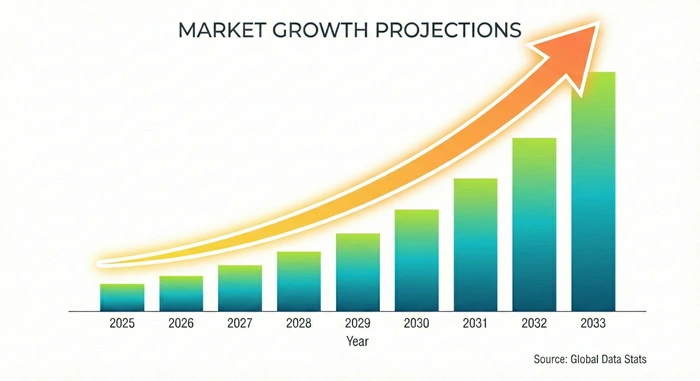
The technical textile market outlook remains exceptionally positive as manufacturers embrace digital manufacturing technologies, sustainable material innovations, and functional integration capabilities that address evolving market demands. Smart textile development represents a transformative growth trajectory with applications spanning wearable health monitors, adaptive clothing systems, and embedded sensor networks for industrial monitoring. Nanotechnology integration is enabling creation of fabrics with self-cleaning properties, enhanced barrier protection, and antimicrobial characteristics that extend product lifespan and reduce maintenance requirements. Phase change materials and thermoregulatory fibers are gaining traction in performance apparel and building applications where temperature management delivers comfort and energy efficiency benefits.
Sustainability considerations are driving fundamental shifts in raw material selection and manufacturing processes as brands respond to consumer preferences and regulatory pressures for environmentally responsible products. Bio-based fibers derived from agricultural waste, recycled polymer systems, and closed-loop manufacturing processes are transitioning from niche applications to mainstream production as cost competitiveness improves. Circular economy principles are influencing product design with increased emphasis on recyclability, biodegradability, and material recovery at end-of-life. Regional market dynamics reveal significant growth potential in Asia-Pacific territories where expanding middle-class populations, urbanization trends, and manufacturing capacity investments create favorable conditions for sustained market expansion across multiple application segments.
Expert Speaks
-
Akihiro Nikkaku, President and CEO of Toray Industries, emphasized the strategic importance of advanced materials innovation in addressing global sustainability challenges, noting that technical textiles play a critical role in enabling carbon neutrality goals across transportation, energy, and construction sectors through lightweight composites and high-performance functional fabrics.
-
Frank Heislitz, CEO of Freudenberg Performance Materials, highlighted the accelerating digital transformation within technical textile manufacturing, stating that Industry 4.0 technologies combined with sustainable material development are creating unprecedented opportunities for customized solutions that meet specific customer performance requirements while reducing environmental impact.
-
Ashish Bharat Ram, Chairman and Managing Director of SRF Limited, discussed the expanding role of technical textiles in emerging markets, explaining that government support programs and infrastructure development initiatives are driving rapid adoption of geotextiles, protective fabrics, and industrial textiles that enhance productivity and safety standards across developing economies.
Key Report Takeaways
-
Asia-Pacific dominates the technical textile market with the largest regional share exceeding 49 percent in 2025, driven by massive manufacturing capacity in China and India, robust automotive and construction sectors, cost-competitive production capabilities, and substantial government investments supporting domestic technical textile industry development across the region.
-
North America represents the fastest-growing regional market with a projected CAGR of 6.8 percent from 2026 to 2033, fueled by strong demand for advanced medical textiles, aerospace applications, defense requirements, and leading innovation in smart textile technologies supported by extensive research and development infrastructure.
-
Automotive industry accounts for the largest end-user segment as mobiltech applications including airbags, seat belts, interior trim, tire reinforcement, and filtration systems consume approximately 21 percent of global technical textile production driven by vehicle safety standards and lightweighting requirements.
-
Mobiltech product segment contributes the highest revenue share representing approximately 23 percent of total market value, with applications spanning automotive, aerospace, and railway sectors requiring high-strength lightweight materials that meet stringent performance and safety specifications.
-
Nonwoven manufacturing process dominates production methods with market share exceeding 45 percent and CAGR of 6.3 percent, favored for cost-effective production of disposable medical textiles, filtration media, geotextiles, and hygiene products serving high-volume applications.
-
Meditech segment will experience the fastest growth among product categories with projected CAGR of 7.2 percent through 2033 as aging populations, healthcare infrastructure expansion in emerging markets, and increased focus on infection control drive sustained demand for surgical textiles, implantable materials, and wound care products.
Market Scope
| Report Coverage | Details |
|---|---|
| Market Size by 2033 | USD 314.23 Billion |
| Market Size by 2025 | USD 216.76 Billion |
| Market Size by 2026 | USD 230.68 Billion |
| Market Growth Rate from 2026 to 2033 | CAGR of 5.96% |
| Dominating Region | Asia-Pacific |
| Fastest Growing Region | North America |
| Base Year | 2025 |
| Forecast Period | 2026 to 2033 |
| Segments Covered | Product Type, Material, Manufacturing Process, End-Use Industry, Region |
| Regions Covered | North America, Europe, Asia-Pacific, Latin America, Middle East & Africa |
Market Dynamics
Drivers Impact Analysis
Expanding Industrial Applications and Performance Requirements Fuel Sustained Growth
| Impact Factor | ≈ Impact on CAGR Forecast | Geographic Relevance | Impact Timeline |
|---|---|---|---|
| Automotive Lightweighting Demand | +1.4% | Global (highest in Europe, North America) | 2026-2033 |
| Healthcare Infrastructure Expansion | +1.2% | Asia-Pacific, Latin America, Middle East | 2026-2033 |
| Infrastructure Development Programs | +1.1% | Asia-Pacific, Middle East, Africa | 2026-2030 |
| Safety Regulation Stringency | +0.9% | Global (led by developed markets) | 2026-2033 |
Automotive industry transformation represents the most significant driver propelling the technical textile market as manufacturers seek lightweight high-strength materials that reduce vehicle weight by 15 to 25 percent while maintaining crashworthiness and passenger safety standards. Electric vehicle adoption is intensifying this trend as battery weight requires aggressive mass reduction in other vehicle components to preserve driving range and performance characteristics. Technical textiles provide critical solutions for interior trim, acoustic insulation, filtration systems, and composite structural components that deliver weight savings impossible with traditional materials. Regulatory mandates for improved fuel efficiency and emissions reduction across major automotive markets create sustained demand for mobiltech applications that help manufacturers meet increasingly stringent standards.
Healthcare sector expansion in developing markets with growing middle-class populations and improving medical infrastructure is generating substantial demand for technical textiles across surgical applications, patient care products, and medical device components. Aging demographic trends in developed economies require increased healthcare services and disposable medical textiles that prevent cross-contamination and hospital-acquired infections. The COVID-19 pandemic permanently elevated awareness regarding protective equipment quality and availability, sustaining elevated demand levels for medical-grade nonwoven materials used in masks, gowns, and isolation products. Infrastructure development programs across Asia-Pacific, Middle East, and African regions are driving geotextile consumption for road construction, railway projects, and erosion control applications where technical fabrics provide cost-effective solutions for soil stabilization and drainage management that extend infrastructure lifespan and reduce maintenance requirements.
Restraints Impact Analysis
High Production Costs and Technical Complexity Challenge Market Accessibility
| Restraint Factor | ≈ Impact on CAGR Forecast | Geographic Relevance | Impact Timeline |
|---|---|---|---|
| Raw Material Price Volatility | -0.9% | Global (acute in developing markets) | 2026-2033 |
| High Production Investment Requirements | -0.7% | Emerging markets, SME manufacturers | 2026-2029 |
| Limited Technical Expertise Availability | -0.6% | Africa, parts of Asia, Latin America | 2026-2030 |
| Complex Certification Requirements | -0.5% | Global (varied by application) | 2026-2033 |
Raw material price volatility significantly impacts the technical textile market as these specialized products depend on petroleum-derived synthetic polymers whose costs fluctuate with crude oil prices and geopolitical supply disruptions. High-performance fibers including aramids, carbon fiber, and specialized polyesters command premium pricing that limits adoption in cost-sensitive applications and emerging market segments. Manufacturers face margin pressure when raw material costs spike unexpectedly, particularly for long-term supply contracts with fixed pricing that cannot accommodate input cost increases. This price volatility creates uncertainty in project planning for end-users considering technical textile adoption, potentially delaying investment decisions or driving selection of lower-performance conventional alternatives.
Substantial capital investment required for advanced manufacturing equipment represents a significant barrier for smaller manufacturers and new market entrants seeking to compete in specialized technical textile segments. Modern production facilities incorporating automation, quality control systems, and clean room environments for medical textiles can require investments exceeding 50 million USD before achieving commercial production volumes. The technical complexity of specialized applications demands extensive research and development capabilities, testing infrastructure, and certification processes that strain resources of smaller companies. Limited availability of skilled technical personnel with expertise in polymer science, textile engineering, and specialized manufacturing processes constrains production capacity expansion, particularly in emerging markets where technical education infrastructure may be underdeveloped. Complex certification and compliance requirements across different application sectors create additional barriers as products must meet industry-specific standards for automotive safety, medical device regulations, and construction material specifications that vary significantly across geographic markets.
Opportunities Impact Analysis
Smart Textiles and Sustainable Innovations Create Transformative Growth Pathways
| Opportunity Area | ≈ Impact on CAGR Forecast | Geographic Relevance | Impact Timeline |
|---|---|---|---|
| Smart Textile Integration | +1.5% | North America, Europe, developed Asia | 2027-2033 |
| Sustainable Material Development | +1.3% | Global (led by Europe, North America) | 2026-2033 |
| Emerging Market Expansion | +1.2% | Asia-Pacific, Middle East, Africa | 2026-2030 |
| Advanced Composite Applications | +1.0% | Aerospace, automotive, wind energy | 2027-2033 |
Smart textile development presents transformative opportunities for the technical textile market as convergence of textile engineering with electronics, sensors, and connectivity enables entirely new application categories. Wearable health monitoring systems incorporating technical textiles with embedded biosensors can track vital signs continuously, enabling early disease detection and chronic condition management that reduces healthcare costs while improving patient outcomes. Military and first responder applications for smart textiles that monitor physiological stress, detect environmental hazards, and provide real-time communication capabilities are attracting substantial government research funding. As production costs decline through manufacturing scale and technology maturation, smart textiles are expected to transition from niche high-value applications to mainstream consumer products including athletic wear, work uniforms, and home healthcare solutions.
Sustainable material innovation creates substantial market opportunities as brands and end-users prioritize environmental responsibility in procurement decisions and regulatory frameworks increasingly mandate recycled content and circular economy principles. Bio-based technical textiles derived from agricultural waste streams, algae cultivation, and bacterial fermentation offer performance characteristics comparable to petroleum-derived alternatives while dramatically reducing carbon footprint. Recycling technologies enabling recovery of high-value fibers from post-consumer technical textiles and industrial waste are attracting significant investment from major chemical companies seeking to establish closed-loop material systems. Emerging market expansion in Africa, Southeast Asia, and Latin America offers substantial untapped potential as these regions undergo rapid urbanization, infrastructure development, and manufacturing capacity growth that creates demand for geotextiles, industrial textiles, and protective fabrics supporting economic development priorities.
Segment Analysis
By Product Type - Mobiltech
Transportation Sector Demand and Safety Standards Drive Segment Leadership
Mobiltech technical textiles represent the largest product segment within the global market, commanding approximately 23 percent market share in 2025 and projected to grow at a CAGR of 6.2 percent through 2033. This segment encompasses technical fabrics used in automotive, aerospace, railway, and marine transportation applications where safety, weight reduction, and durability requirements drive material selection. North America and Europe collectively account for over 55 percent of mobiltech consumption, driven by stringent vehicle safety regulations mandating advanced airbag systems, seat belt designs, and interior materials meeting flammability standards. Leading manufacturers including DuPont, Toray Industries, and Hyosung Corporation dominate this segment through continuous innovation in aramid fibers, polyester tire cords, and composite materials that deliver superior strength-to-weight ratios essential for modern vehicle design.
The mobiltech segment benefits significantly from automotive industry electrification trends as manufacturers seek lightweight materials that offset battery weight while maintaining vehicle performance and driving range. Technical textiles used in battery separators, thermal barriers, and lightweight interior components are becoming critical enablers of electric vehicle adoption across global markets. Asia-Pacific markets particularly China, India, and South Korea are experiencing rapid mobiltech growth with regional CAGR exceeding 7.1 percent as domestic automotive production expands and vehicle safety standards converge with international requirements. The segment is witnessing increased demand for sustainable materials as automotive brands commit to carbon neutrality targets, driving research into bio-based fibers and recycled polymer systems that maintain performance specifications. Aerospace applications for mobiltech products including cabin textiles, composite reinforcements, and filtration systems represent high-value opportunities as commercial aircraft production recovers and space exploration programs expand research into advanced lightweight materials capable of extreme environment performance.
By Manufacturing Process - Nonwoven
Cost Efficiency and Versatile Applications Support Process Dominance
Nonwoven manufacturing processes dominate the technical textile market, accounting for approximately 45 percent of production volume in 2025 with projected CAGR of 6.3 percent through 2033, driven by cost-effective production methods suitable for disposable applications and high-volume industrial uses. This segment includes technical fabrics produced through mechanical bonding, thermal bonding, and chemical bonding processes that create fabric structures without traditional weaving or knitting. Asia-Pacific leads nonwoven production with regional share exceeding 52 percent, reflecting extensive manufacturing capacity in China, India, and Southeast Asian countries where labor costs and production scale provide competitive advantages. Major producers including Berry Global, Freudenberg Performance Materials, Ahlstrom-Munksjö, and Avgol Industries operate large-scale facilities producing medical-grade nonwovens, filtration media, and industrial textiles serving global markets.
The nonwoven segment experiences particularly strong growth in medical textile applications where single-use products prevent cross-contamination and meet stringent hygiene requirements for surgical procedures, patient care, and infection control. Healthcare infrastructure expansion in emerging markets creates sustained demand for affordable medical-grade nonwoven materials that balance performance requirements with cost constraints typical of resource-limited healthcare systems. Filtration applications across automotive, industrial, and HVAC sectors drive nonwoven consumption as air quality regulations tighten and end-users demand higher efficiency particulate removal. North America demonstrates strong growth momentum with regional CAGR of 6.7 percent as manufacturers invest in advanced production technologies including spunbond, meltblown, and electrospinning processes that create specialized fiber structures for high-performance applications. The segment benefits from rapid production speeds and material flexibility that enable customization for specific application requirements without extensive capital investment in specialized weaving or knitting equipment typical of traditional textile manufacturing.
Regional Insights
Asia-Pacific
Manufacturing Scale and Diverse End-Use Demand Cement Regional Market Dominance
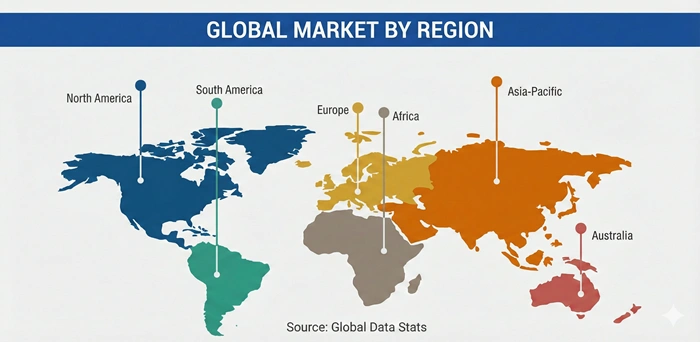
Asia-Pacific dominates the global technical textile market with commanding 49.2 percent regional share in 2025, growing at a projected CAGR of 6.4 percent through 2033, driven by massive manufacturing capacity, cost-competitive production, and rapidly expanding end-use industries across automotive, construction, and healthcare sectors. China leads regional production accounting for over 40 percent of Asia-Pacific technical textile output, supported by integrated supply chains, advanced manufacturing infrastructure, and government policies prioritizing technical textile development as strategic industry. India represents the fastest-growing market within the region with annual growth rates exceeding 8 percent as domestic consumption increases and export-oriented manufacturing capacity expands under government support programs including Production Linked Incentive schemes targeting technical textile sector development.
Leading manufacturers active in the Asia-Pacific technical textile market include Toray Industries (Japan), Asahi Kasei Corporation (Japan), Teijin Limited (Japan), Hyosung Corporation (South Korea), SRF Limited (India), and Welspun India (India), which collectively command approximately 35 percent regional market share through vertical integration, technology leadership, and extensive distribution networks. These companies have invested heavily in research and development facilities developing advanced fiber technologies, smart textile integration, and sustainable material systems that serve both domestic and international markets. The region demonstrates particularly strong growth in geotextile applications driven by infrastructure development programs across transportation, water management, and urban development projects requiring soil stabilization and erosion control solutions. Healthcare sector expansion supporting growing populations and rising middle-class incomes drives meditech consumption for disposable medical textiles, surgical products, and hygiene applications where improving healthcare standards create sustained demand for quality technical textile materials.
North America
Innovation Leadership and High-Value Applications Drive Fastest Regional Growth
North America represents the fastest-growing regional technical textile market with projected CAGR of 6.8 percent from 2026 to 2033 and market share of approximately 22 percent in 2025, fueled by strong demand for advanced technical textiles in aerospace, defense, medical, and automotive applications where performance requirements justify premium pricing. The region's sophisticated end-user industries demand cutting-edge material technologies including smart textiles, nano-enhanced fabrics, and high-performance composites that deliver superior functionality for specialized applications. United States dominates North American consumption with market share exceeding 75 percent, driven by extensive aerospace manufacturing, advanced healthcare infrastructure, and large defense budget supporting development of protective fabrics and advanced material systems.
DuPont (United States), Berry Global (United States), Milliken & Company (United States), 3M Company (United States), and Johns Manville (United States) lead the North American technical textile market with combined share approaching 45 percent through proprietary technologies, strong intellectual property portfolios, and established relationships with major OEM customers across multiple industries. These manufacturers maintain competitive advantages through continuous innovation in aramid fibers, fluoropolymers, and specialty coatings that address evolving performance requirements for extreme environment applications. The region demonstrates highest per-capita consumption globally for medical technical textiles as advanced healthcare delivery models and aging demographics drive demand for surgical products, wound care materials, and implantable textiles meeting FDA regulatory requirements. Automotive sector transformation toward electric vehicles creates substantial opportunities for lightweight technical textiles as manufacturers seek materials reducing vehicle mass while maintaining safety performance, with regional automotive technical textile market growing at 7.4 percent CAGR through 2033.
Top Key Players
-
Toray Industries Inc. (Japan)
-
DuPont de Nemours Inc. (United States)
-
Freudenberg Group (Germany)
-
Asahi Kasei Corporation (Japan)
-
Berry Global Inc. (United States)
-
Teijin Limited (Japan)
-
Ahlstrom-Munksjö Oyj (Finland)
-
Milliken & Company (United States)
-
Johns Manville (United States)
-
SRF Limited (India)
-
Hyosung Corporation (South Korea)
-
Low & Bonar PLC (United Kingdom)
Recent Developments
-
October 2023 - COISNE et LAMBERT completed the strategic acquisition of Infinity Group to strengthen its position in the European technical textiles market, expanding capabilities in technical knitted fabrics for professional clothing and personal protective equipment sectors while enhancing customer service and solution offerings across multiple industrial segments.
-
November 2024 - Freudenberg Group acquired remaining shares of a joint venture to strengthen its technical textiles and filtration businesses, consolidating full operational control and enabling accelerated innovation in sustainable materials and advanced filtration solutions serving automotive, industrial, and healthcare applications globally.
-
March 2024 - Toray Industries announced substantial investment in expanding carbon fiber production capacity to meet growing demand from aerospace and automotive sectors, incorporating advanced manufacturing automation and developing next-generation composite materials for electric vehicle structural applications and renewable energy infrastructure.
-
August 2024 - DuPont launched innovative flame-resistant fabric technology incorporating bio-based fibers that meet stringent safety standards while reducing environmental impact, targeting industrial protective clothing markets where sustainability considerations increasingly influence procurement decisions alongside traditional performance requirements.
-
June 2024 - Teijin Limited established a strategic partnership with leading technology companies to develop smart textile platforms integrating sensors, conductive fibers, and connectivity capabilities for wearable health monitoring, industrial safety applications, and adaptive clothing systems responding to environmental conditions and user physiological signals.
Market Trends
Digital Integration and Circular Economy Principles Reshaping Industry Practices
The technical textile market is undergoing fundamental transformation driven by smart textile integration combining traditional fabric engineering with electronic components, sensors, and data connectivity that enable entirely new functionality categories. Conductive yarns woven into fabric structures can serve as antennae, power transmission pathways, and sensor networks that monitor environmental conditions or physiological parameters without requiring separate electronic devices. Phase change materials integrated into technical textiles provide dynamic thermal regulation by absorbing or releasing heat based on ambient temperature changes, delivering comfort and energy efficiency benefits for protective clothing, building materials, and automotive interiors. Nanotechnology applications are creating fabrics with self-cleaning surfaces, enhanced barrier properties, and antimicrobial characteristics that extend product lifespan while reducing maintenance requirements across medical, industrial, and consumer applications.
Sustainability considerations are driving profound shifts in material selection, manufacturing processes, and end-of-life management as the technical textile market responds to circular economy principles and regulatory mandates for environmental responsibility. Bio-based alternatives to petroleum-derived synthetic fibers are gaining commercial viability as agricultural waste valorization, algae cultivation, and microbial fermentation processes achieve cost competitiveness with conventional materials. Mechanical and chemical recycling technologies enable recovery of high-value polymer feedstocks from post-consumer technical textiles and manufacturing waste, reducing virgin material consumption and diverting textiles from landfills. Manufacturers are redesigning products for disassembly and material recovery, eliminating mixed-fiber constructions and chemical treatments that complicate recycling processes. Blockchain technology and digital product passports are being implemented to track material composition, origin, and lifecycle history, facilitating sorting and recycling while providing transparency demanded by environmentally conscious brands and end-users prioritizing sustainable procurement practices.
Segments Covered in the Report
By Product Type
-
Mobiltech
-
Indutech
-
Sportech
-
Buildtech
-
Meditech
-
Protech
-
Geotech
-
Agrotech
-
Hometech
-
Packtech
-
Clothtech
-
Oekotech
By Material
-
Natural Fibers
-
Synthetic Polymers
-
Mineral Fibers
-
Regenerated Fibers
By Manufacturing Process
-
Woven
-
Knitted
-
Nonwoven
-
Others
By End-Use Industry
-
Automotive
-
Healthcare
-
Construction
-
Agriculture
-
Sports
-
Industrial
-
Defense
-
Aerospace
-
Others
By Region
-
North America (United States, Canada, Mexico)
-
Europe (Germany, United Kingdom, France, Italy, Spain, Rest of Europe)
-
Asia-Pacific (China, India, Japan, South Korea, Australia, Southeast Asia, Rest of Asia-Pacific)
-
Latin America (Brazil, Argentina, Rest of Latin America)
-
Middle East & Africa (GCC Countries, South Africa, Rest of MEA)
Frequently Asked Questions
Question 1: What is the expected technical textile market size by 2033?
Answer: The global technical textile market is projected to reach approximately USD 314.23 billion by 2033, growing from USD 230.68 billion in 2026. This substantial expansion reflects increasing adoption across automotive, healthcare, construction, and industrial applications driven by performance requirements and technological innovations.
Question 2: Which region dominates the global technical textile market?
Answer: Asia-Pacific dominates the technical textile market with over 49 percent regional share, driven by massive manufacturing capacity in China and India, cost-competitive production capabilities, and rapidly expanding automotive, construction, and healthcare sectors. Government support programs and infrastructure investments further strengthen regional market leadership.
Question 3: What are the primary growth drivers for the technical textile market?
Answer: Automotive lightweighting requirements, healthcare infrastructure expansion, infrastructure development programs, and stringent safety regulations represent the primary growth drivers for the technical textile market. These factors create compelling demand for high-performance materials across multiple end-use industries worldwide.
Question 4: Which technical textile market segment is growing fastest?
Answer: Meditech represents the fastest-growing technical textile market segment with projected CAGR of 7.2 percent through 2033, driven by aging populations, healthcare infrastructure expansion in emerging markets, and increased focus on infection control. Disposable medical textiles, surgical products, and implantable materials demonstrate particularly strong growth momentum.
Question 5: Who are the leading companies in the technical textile market?
Answer: Toray Industries, DuPont, Freudenberg Group, Asahi Kasei Corporation, and Berry Global lead the global technical textile market through technological innovation and extensive product portfolios. These manufacturers command significant market share through proprietary fiber technologies, specialized manufacturing capabilities, and strong relationships with major OEM customers across multiple industries.