
System on Chip Market Overview
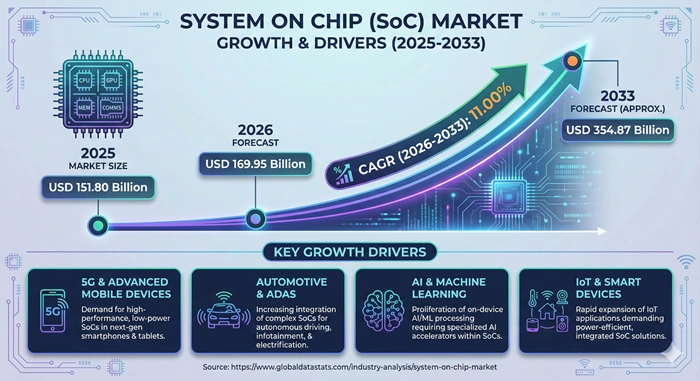
The global system on chip market size is valued at USD 151.80 billion in 2025 and is predicted to increase from USD 169.95 billion in 2026 to approximately USD 354.87 billion by 2033, growing at a CAGR of 11.00% from 2026 to 2033. A system on chip represents an integrated circuit that consolidates all essential electronic components of a computer or other electronic system onto a single microchip, including central processing units, graphics processing units, memory interfaces, input/output ports, and specialized communication modules. This revolutionary approach enables compact device designs, reduces power consumption dramatically, improves overall system performance, and lowers manufacturing costs compared to traditional multi-chip architectures used in conventional electronic products.
The system on chip market continues transforming how industries approach product development across consumer electronics, automotive systems, telecommunications infrastructure, medical devices, and industrial automation applications. Modern SoC designs integrate increasingly sophisticated capabilities including artificial intelligence accelerators, neural processing units for machine learning workloads, advanced connectivity modules supporting 5G networks, and specialized security features protecting against cyber threats. The technology enables smartphones that fit in pockets while delivering computing power rivaling desktop systems, autonomous vehicles processing sensor data in real time, and Internet of Things devices operating for years on tiny batteries while maintaining constant connectivity.
AI Impact on the System on Chip Industry
Revolutionizing Processing Architectures and Enabling Edge Computing Capabilities
Artificial intelligence fundamentally transforms the system on chip market by driving demand for specialized processing architectures optimized for machine learning workloads rather than general-purpose computing tasks. Traditional SoC designs focused primarily on sequential instruction processing through central processing units, whereas AI applications require massive parallel computations analyzing millions of data points simultaneously to recognize patterns, make predictions, and generate intelligent responses. This paradigm shift compels semiconductor companies to integrate dedicated neural processing units and AI accelerators within SoC architectures, enabling on-device processing of complex AI models without relying on cloud infrastructure. Smartphones now perform real-time language translation, advanced photography enhancements, and voice recognition entirely on-device through AI-optimized SoCs that deliver superior performance while maintaining privacy and conserving battery life.
Furthermore, AI-powered design tools revolutionize how engineers develop SoC architectures by automating complex tasks that previously required months of manual effort from specialized teams. Machine learning algorithms analyze historical design data to suggest optimal component placements minimizing signal interference, predict thermal hotspots before physical prototyping, and identify potential manufacturing defects during early design stages when corrections cost substantially less than post-production fixes. Natural language models assist engineers by translating high-level design specifications into detailed technical implementations, while generative AI creates multiple architecture variations exploring solution spaces too vast for human designers to analyze manually. These AI capabilities reduce development timelines, improve design quality, and enable smaller companies to compete with established semiconductor giants by leveling the technical expertise playing field through intelligent automation.
Growth Factors
5G Deployment and IoT Proliferation Drive Unprecedented Demand
The system on chip market experiences robust growth driven by global 5G network deployment creating massive demand for advanced SoCs capable of processing high-speed wireless data while maintaining energy efficiency in mobile devices. Fifth-generation cellular technology delivers data speeds exceeding one gigabit per second, supports ultra-low latency enabling real-time applications, and provides connectivity for millions of devices per square kilometer compared to thousands supported by previous generations. These capabilities require fundamentally new SoC architectures integrating sophisticated modem technologies, advanced signal processing capabilities, and enhanced power management systems that prevent rapid battery depletion despite dramatically increased data throughput. Smartphone manufacturers compete intensely to offer 5G-enabled devices across all price segments, driving unprecedented SoC volumes while telecommunications infrastructure providers deploy millions of base stations worldwide equipped with specialized networking SoCs.
The explosive growth of Internet of Things deployments across smart homes, industrial automation, agricultural monitoring, healthcare applications, and smart city infrastructure creates sustained demand for system on chip solutions optimized for specific use cases. IoT devices span enormous performance ranges from simple sensors monitoring temperature that transmit occasional readings to sophisticated industrial controllers managing complex manufacturing processes with millisecond precision. This diversity drives SoC market expansion as manufacturers develop specialized chip families targeting distinct segments rather than offering one-size-fits-all solutions. Battery-powered sensors require ultra-low-power SoCs operating for years on coin-cell batteries, industrial systems demand rugged designs withstanding extreme temperatures and vibrations, while edge AI devices need processing capabilities rivaling traditional computers compressed into compact form factors enabling deployment in space-constrained locations.
Market Outlook
Strong Growth Trajectory Supported by Automotive Transformation and Advanced Manufacturing
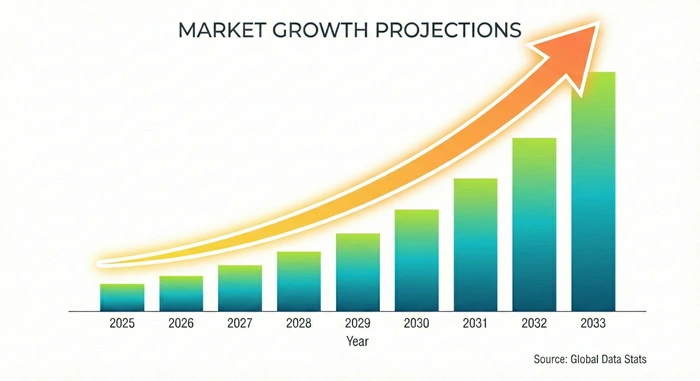
The system on chip market demonstrates exceptional growth prospects through the forecast period, supported by automotive industry transformation toward electric vehicles and autonomous driving systems requiring orders of magnitude more computing power than conventional cars. Modern vehicles incorporate dozens of SoCs managing powertrain control, battery systems, advanced driver assistance features, infotainment platforms, and vehicle-to-everything communication capabilities that enable coordination with traffic infrastructure and other vehicles. The transition from human-driven internal combustion vehicles to software-defined electric platforms represents one of the largest technology disruptions in history, creating multi-billion-dollar opportunities for semiconductor companies providing automotive-grade SoCs meeting stringent safety, reliability, and longevity requirements. Tesla, General Motors, Volkswagen, and other major automakers establish dedicated silicon development teams designing custom SoCs optimized for their specific vehicle architectures rather than relying exclusively on third-party suppliers.
Investment in the system on chip market spans venture capital funding for innovative startups developing specialized architectures, strategic acquisitions by established semiconductor vendors seeking to expand capabilities or enter new market segments, and massive capital expenditures building advanced fabrication facilities producing chips at cutting-edge technology nodes. The industry transitions toward three-nanometer manufacturing processes and explores two-nanometer roadmaps that pack billions of transistors onto chips smaller than fingernails, delivering unprecedented performance and energy efficiency while creating enormous barriers to entry due to fabrication costs exceeding twenty billion dollars per facility. Geopolitical considerations drive government investments supporting domestic semiconductor manufacturing through initiatives like the United States CHIPS Act and China's Made in China 2025 program, recognizing SoC production as critical national infrastructure essential for economic competitiveness and technological sovereignty.
Expert Speaks
-
Cristiano Amon, CEO of Qualcomm, stated that "Intel's production technology isn't currently good enough for the maker of mobile phone processors to use as a supplier. If Intel is able to advance its manufacturing techniques to produce more efficient chips, then Qualcomm would consider becoming a customer".
-
Industry analysts observe that "the rise of AI-optimized SoCs with NPUs for on-device processing in smartphones and AI PCs is boosting demand by increasing performance while conserving battery life, fundamentally transforming how consumers interact with mobile technology".
-
Technology experts emphasize that "ADAS and autonomous driving integrations in automobiles are creating a significant appetite for automotive-grade SoCs capable of high-speed, sensor-fusion workloads, representing one of the most substantial growth opportunities in the semiconductor industry".
Key Report Takeaways
-
Asia Pacific leads the system on chip market with the largest regional share of 41% in 2024, driven by concentrated semiconductor manufacturing in Taiwan, South Korea, and China, massive consumer electronics production, and strong government support for chip industry development
-
North America emerges as the fastest-growing region during the forecast period, fueled by automotive innovation, high-performance computing demands, substantial R&D investments, and government initiatives supporting domestic semiconductor manufacturing capabilities
-
The digital segment dominates the type category with the largest market share in 2024, driven by widespread adoption in consumer electronics requiring advanced digital processing for smartphones, tablets, smart TVs, and other connected devices
-
Octa-core SoCs hold the largest core count segment share and demonstrate the highest growth rate, aligning with consumer demand for high-performance mobile devices capable of handling resource-intensive applications including gaming, AI processing, and multitasking
-
Consumer electronics represents the largest end-use segment dominating SoC adoption through smartphones, tablets, wearables, and smart home devices, while automotive and transportation exhibits the fastest growth rate driven by electric vehicle adoption and autonomous driving technology
-
ARM architecture commands the largest core architecture share at approximately 60% in 2023, while RISC-V based SoCs demonstrate the highest projected CAGR due to open-source licensing, customization flexibility, and adoption across AI, 5G, IoT, and networking applications
Market Scope
| Report Coverage | Details |
|---|---|
| Market Size by 2033 | USD 354.87 Billion |
| Market Size by 2025 | USD 151.80 Billion |
| Market Size by 2026 | USD 169.95 Billion |
| Market Growth Rate from 2026 to 2033 | CAGR of 11.00% |
| Dominating Region | Asia Pacific |
| Fastest Growing Region | North America |
| Base Year | 2025 |
| Forecast Period | 2026 to 2033 |
| Segments Covered | Type, Core Architecture, Core Count, Application, End Use, Region |
| Regions Covered | North America, Europe, Asia Pacific, Latin America, Middle East & Africa |
Market Dynamics
Drivers Impact Analysis
Miniaturization Demands and Energy Efficiency Requirements Accelerate Adoption
The increasing demand for compact, lightweight electronic devices across consumer, industrial, and medical applications drives system on chip market expansion as manufacturers seek to integrate maximum functionality within minimum physical footprints. Modern smartphones pack computational capabilities exceeding desktop computers from just a decade ago into devices measuring millimeters thick, requiring SoC solutions that consolidate processors, memory, graphics, communications, and sensors onto single chips. Wearable devices including smartwatches, fitness trackers, and augmented reality glasses impose even stricter size constraints while demanding sophisticated processing for health monitoring, navigation, and real-time communication features. Medical implants represent the ultimate miniaturization challenge, requiring SoCs smaller than rice grains that operate reliably for years inside human bodies while performing life-critical monitoring and therapy delivery functions.
Energy efficiency represents another critical driver as battery-powered devices proliferate across consumer electronics, industrial IoT deployments, and mobile computing applications where power consumption directly impacts usability and operational costs. System on chip architectures deliver superior energy efficiency compared to multi-chip solutions by eliminating power-hungry interconnects between separate components, optimizing voltage levels across different functional blocks, and implementing sophisticated power management that selectively activates only required circuitry for specific tasks. Smartphones leverage these capabilities to deliver full-day battery life despite continuously running multiple applications, streaming video content, and maintaining network connections, while IoT sensors achieve multi-year operation from coin-cell batteries through ultra-low-power SoC designs that spend most time in sleep modes awakening only for brief measurement and transmission cycles. The relentless push toward smaller devices with longer battery life creates sustained demand for increasingly efficient SoC solutions.
| Driver | ≈ Impact on CAGR Forecast | Geographic Relevance | Impact Timeline |
|---|---|---|---|
| Miniaturization and Compact Device Demands | High (+3-4%) | Global, particularly Asia Pacific and North America | Immediate to Long-term (2026-2033) |
| Energy Efficiency and Battery Life Requirements | High (+2-3%) | Global, particularly consumer electronics and IoT sectors | Immediate to Long-term (2026-2033) |
Restraints Impact Analysis
High Development Costs and Design Complexity Limit Market Entry
The extremely high costs associated with designing and manufacturing advanced system on chip solutions represent significant restraints affecting market participation and innovation pace. Developing competitive SoCs at current technology nodes requires investments exceeding hundreds of millions of dollars spanning multi-year development cycles employing hundreds of specialized engineers with expertise across digital design, analog circuits, power management, packaging, and software integration. Semiconductor companies must amortize these enormous upfront costs across projected sales volumes, creating substantial financial risks when targeting unproven market segments or facing uncertain demand forecasts. Small and medium-sized companies often lack capital resources necessary for cutting-edge SoC development, forcing them to target niche applications using older manufacturing processes or partner with larger firms trading independence for access to advanced capabilities.
Manufacturing costs escalate dramatically as chip geometries shrink toward nanometer scales requiring extraordinarily expensive fabrication equipment and facilities. Building semiconductor fabs capable of producing chips at five-nanometer or three-nanometer nodes demands capital investments exceeding twenty billion dollars for single facilities, with operational costs running billions annually for materials, utilities, maintenance, and highly skilled workforce compensation. These astronomical expenses create oligopolistic market structures where only handful of companies including TSMC, Samsung, and Intel possess capabilities to manufacture most advanced chips, giving them tremendous leverage over system on chip market participants who depend on their fabrication services. The precision required to achieve acceptable manufacturing yields where majority of chips function correctly adds further complexity and expense, as minor process variations can render entire wafer batches unusable resulting in massive financial losses.
| Restraint | ≈ Impact on CAGR Forecast | Geographic Relevance | Impact Timeline |
|---|---|---|---|
| High Development and Manufacturing Costs | Medium (-2-3%) | Global, particularly affecting new entrants and SMEs | Immediate to Long-term (2026-2033) |
| Design Complexity and Technical Challenges | Medium (-1-2%) | Global, particularly advanced node development | Immediate to Medium-term (2026-2030) |
Opportunities Impact Analysis
RISC-V Architecture Adoption and Edge AI Applications Create Expansion Avenues
The emergence of RISC-V as an open-source instruction set architecture presents transformative opportunities for the system on chip market by enabling companies to design custom processors without paying licensing fees to proprietary architecture owners. Traditional SoC development required licensing ARM or x86 architectures at costs reaching millions of dollars annually plus royalties on every chip sold, creating substantial barriers particularly for startups and companies targeting price-sensitive markets. RISC-V eliminates these expenses while providing flexibility to customize processor designs for specific applications, driving adoption across AI accelerators, IoT devices, networking equipment, and storage controllers where tailored architectures deliver superior performance compared to general-purpose alternatives. Major technology companies including Google, NVIDIA, and Western Digital invest heavily in RISC-V development, while governments in China and India promote the architecture as pathway to technological independence from Western semiconductor vendors.
The explosive growth of edge AI applications requiring on-device processing of machine learning workloads creates enormous opportunities for system on chip vendors developing specialized AI-optimized architectures. Cloud-based AI processing faces fundamental limitations including network latency preventing real-time responsiveness, privacy concerns transmitting sensitive data to remote servers, reliability issues when connectivity proves intermittent, and operational costs from continuous data transmission and cloud computing charges. Edge AI solves these challenges by performing inference directly on end devices using SoCs integrating neural processing units, tensor accelerators, and optimized memory architectures delivering performance rivaling data center GPUs while consuming mere watts of power. Applications span autonomous vehicles requiring split-second decision making, industrial quality inspection systems analyzing thousands of products per minute, smart cameras detecting security threats instantly, and voice assistants responding to commands without internet connectivity.
| Opportunity | ≈ Impact on CAGR Forecast | Geographic Relevance | Impact Timeline |
|---|---|---|---|
| RISC-V Architecture Adoption and Open-Source Innovation | High (+3-4%) | Global, particularly Asia Pacific and emerging markets | Medium to Long-term (2027-2033) |
| Edge AI Processing and On-Device Machine Learning | High (+4-5%) | Global, particularly North America, Europe, Asia Pacific | Immediate to Long-term (2026-2033) |
Segment Analysis
Type Analysis
Digital SoCs Lead Market While Mixed-Signal Demonstrates Robust Growth
The digital segment dominates the system on chip market with the largest share in 2024, driven by ubiquitous adoption across consumer electronics requiring advanced digital processing capabilities for smartphones, tablets, laptops, smart televisions, and gaming consoles. Digital SoCs integrate microprocessors, digital signal processors, memory controllers, and logic circuits that manipulate binary data enabling the computational functions defining modern electronics. The segment benefits from continuous demand for higher performance enabling more sophisticated applications, with consumers expecting devices to handle multiple simultaneous tasks including high-definition video streaming, complex gaming, artificial intelligence features, and real-time communications without perceptible lag. Smartphone manufacturers release new models annually featuring progressively more powerful digital SoCs that deliver improved benchmark scores, longer battery life, and enhanced AI capabilities attracting upgrade-minded consumers willing to pay premium prices for cutting-edge technology.
The mixed-signal segment exhibits substantial projected growth during the forecast period as applications increasingly require SoCs that bridge physical analog sensors with digital processing systems. Mixed-signal designs integrate analog-to-digital converters, digital-to-analog converters, amplifiers, filters, and radio frequency circuits alongside digital logic enabling single chips to interface directly with real-world phenomena including sound, light, temperature, pressure, and electromagnetic signals. The system on chip market segment proves critical for automotive systems where dozens of sensors monitor engine parameters, battery conditions, tire pressures, and environmental factors requiring precise analog measurement converted to digital format for processing by vehicle computers. Industrial automation, medical devices, and smart infrastructure similarly demand mixed-signal capabilities, with Asia Pacific leading adoption driven by massive electronics manufacturing in China, advanced automotive production in Japan and South Korea, and rapidly expanding IoT deployments across the region supported by government smart city initiatives and 5G infrastructure investments.
Application Analysis
Consumer Electronics Dominates While Automotive Exhibits Fastest Expansion
The consumer electronics segment holds the largest share in the 2024 system on chip market, accounting for substantial majority of unit volumes through smartphones, tablets, personal computers, smart wearables, gaming devices, and smart home products. Smartphones alone represent over one billion unit sales annually worldwide, with each device incorporating advanced SoCs integrating octa-core processors, high-performance graphics, AI accelerators, 5G modems, image processors for multi-camera systems, and sophisticated power management enabling all-day operation. The segment benefits from rapid replacement cycles averaging two to three years as consumers upgrade to access improved cameras, faster processors, enhanced displays, and new software features that older hardware cannot support adequately. Leading SoC vendors including Qualcomm, MediaTek, Apple, and Samsung compete intensely to deliver performance leadership, with flagship smartphone chips incorporating billions of transistors manufactured at most advanced process nodes rivaling complexity of data center processors while operating within thermal and power budgets measured in single-digit watts.
The automotive application segment demonstrates the fastest projected CAGR during the forecast period as vehicles transform from mechanical systems with minimal electronics into software-defined platforms incorporating hundreds of microprocessors managing every function from powertrain control to entertainment. Modern electric and autonomous vehicles require specialized system on chip solutions processing sensor fusion combining cameras, radars, lidars, and ultrasonics to perceive surroundings; running deep neural networks that identify obstacles and predict behaviors; planning safe trajectories through complex traffic scenarios; and controlling steering, braking, and acceleration with millisecond precision. Advanced driver assistance systems including adaptive cruise control, lane keeping, automatic emergency braking, and self-parking capabilities increasingly come standard across vehicle segments, driving SoC adoption beyond luxury brands into mass-market models. North America leads automotive SoC growth through Tesla's vertical integration developing custom silicon, General Motors' Ultium platform standardizing electric powertrains, and substantial venture capital investment in autonomous vehicle startups, while established semiconductor companies including NVIDIA, Intel, and Qualcomm establish dedicated automotive divisions targeting this multi-billion-dollar opportunity.
Regional Insights
Asia Pacific
Manufacturing Dominance and Government Support Drive Regional Leadership
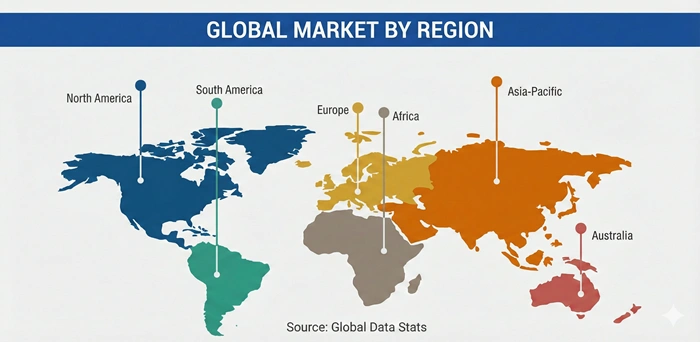
Asia Pacific commands the dominant position in the global system on chip market with 41% market share in 2024, supported by concentrated semiconductor manufacturing capabilities, massive consumer electronics production, and strong government policies promoting chip industry development as strategic national priority. The region benefits from presence of world's leading semiconductor foundries including Taiwan Semiconductor Manufacturing Company controlling over 50% of global chip production capacity, Samsung Foundry in South Korea, and rapidly expanding Chinese manufacturers supported by billions in government subsidies. This manufacturing infrastructure attracts fabless semiconductor companies worldwide that design SoCs but outsource production, creating ecosystem where proximity to fabrication facilities accelerates development cycles and enables close collaboration addressing manufacturing challenges. The Asia Pacific system on chip market was valued at USD 75.66 billion in 2025 and projects reaching USD 159.85 billion by 2034 at CAGR of 8.65%.
The regional system on chip market thrives due to enormous consumer electronics manufacturing concentrated in China, Vietnam, India, and Southeast Asian nations where companies including Apple, Samsung, Xiaomi, OPPO, and Vivo produce hundreds of millions of smartphones annually alongside tablets, laptops, televisions, and IoT devices. China represents the world's largest consumer electronics market with over 1.4 billion population increasingly adopting smartphones, smart home products, and wearable devices as rising middle class expands and e-commerce platforms make latest technology accessible even in rural areas. Government initiatives including Made in China 2025 prioritize semiconductor self-sufficiency through massive investments in domestic chip design and manufacturing capabilities, reducing dependence on foreign suppliers for technologies considered critical to economic competitiveness and national security. Key regional players including HiSilicon, MediaTek, and emerging Chinese SoC vendors drive innovation through development of AI-optimized processors, integration of advanced connectivity features, and aggressive pricing strategies targeting cost-sensitive market segments.
North America
Innovation Leadership and Automotive Transformation Fuel Fastest Regional Growth
North America emerges as the fastest-growing region for the system on chip market during the forecast period, driven by leadership in automotive innovation, cutting-edge research and development, substantial venture capital investments in semiconductor startups, and government initiatives supporting domestic chip manufacturing. The region demonstrates particular strength in automotive SoC development as Detroit automakers and Silicon Valley technology companies collaborate developing electric and autonomous vehicles requiring computing capabilities orders of magnitude beyond conventional cars. Tesla pioneered vertical integration in automotive silicon, designing custom SoCs optimized for their Full Self-Driving computer enabling sophisticated autonomous capabilities, while General Motors partners with Qualcomm deploying Snapdragon automotive platforms across vehicle lineup. The United States market benefits from substantial R&D spending by technology giants including Intel, AMD, NVIDIA, and Qualcomm that collectively invest tens of billions annually in next-generation processor development.
The North American system on chip market expansion accelerates through government support including the CHIPS and Science Act providing over fifty billion dollars in subsidies and tax incentives encouraging domestic semiconductor manufacturing. These investments aim to reduce dependence on Asian foundries for critical chips, addressing supply chain vulnerabilities exposed during recent shortages that idled automotive production and constrained consumer electronics availability. Intel commits billions building new fabrication facilities in Arizona and Ohio positioned to manufacture chips for both internal designs and external customers, while TSMC and Samsung establish U.S. operations accessing government incentives and serving customers preferring domestic supply sources. The region leads in high-performance computing applications including data centers deploying specialized SoCs for AI training, cloud gaming, and scientific computing, while defense and aerospace sectors demand ruggedized chips meeting stringent reliability requirements for military systems, satellites, and avionics driving premium-priced specialty SoC segments.
Top Key Players
-
Qualcomm Technologies Inc. (United States)
-
MediaTek Inc. (Taiwan)
-
Apple Inc. (United States)
-
Samsung Electronics Co. Ltd. (South Korea)
-
Broadcom Inc. (United States)
-
Intel Corporation (United States)
-
Advanced Micro Devices Inc. (United States)
-
NVIDIA Corporation (United States)
-
NXP Semiconductors NV (Netherlands)
-
Microchip Technology Inc. (United States)
-
STMicroelectronics NV (Switzerland)
-
Texas Instruments Inc. (United States)
-
Renesas Electronics Corporation (Japan)
-
Infineon Technologies AG (Germany)
-
HiSilicon Technologies Co. Ltd. (China)
Recent Developments
-
February 2025: Silicon Labs announced the launch of the MG26 wireless system-on-chip family specifically designed with increased memory and flash storage capacities optimized for supporting smart home applications including intelligent lighting, security systems, and connected appliances requiring robust local processing
-
January 2025: Renesas Electronics Corporation and Honda Motor Co. Ltd. signed a strategic agreement for collaborative development of advanced system-on-chip solutions specifically designed for software-defined vehicles enabling flexible over-the-air updates, advanced safety features, and personalized in-vehicle experiences
-
November 2024: Renesas Electronics Corporation launched its next generation of automotive fusion system-on-chips designed to consolidate in-vehicle infotainment, advanced driver assistance systems, and gateway applications on single-chip platforms reducing system complexity while improving performance and reliability
-
June 2024: Intel Corporation announced development plans for its next processor series featuring SoCs offering greater than 50% improvement in processing capacity compared to current Core and Core Ultra processors, delivering enhanced power efficiency through compact designs and faster memory access capabilities
-
March 2024: Qualcomm Technologies Inc. launched the Snapdragon 8s Gen 3 Mobile Platform built on octa-core processor architecture delivering premium smartphone experiences through powerful on-device generative AI, hyper-realistic mobile gaming, breakthrough connectivity, always-sensing image processing, and lossless high-definition audio
Market Trends
Chiplet Architecture and Heterogeneous Integration Transform Design Approaches
The system on chip market demonstrates clear trends toward chiplet-based architectures where complex SoCs comprise multiple smaller chips (chiplets) interconnected using advanced packaging technologies rather than monolithic designs integrating all functions onto single silicon die. This modular approach delivers substantial advantages including improved manufacturing yields since smaller chiplets prove easier to fabricate without defects compared to massive single chips, flexibility to mix process technologies optimizing each chiplet for its specific function, and ability to reuse proven chiplet designs across multiple product generations reducing development costs and time-to-market. Companies including AMD successfully deploy chiplet strategies in high-performance processors, while startups explore novel architectures combining chiplets from different vendors through standardized interconnect protocols, potentially disrupting traditional vertically-integrated SoC development models favoring larger companies with comprehensive design capabilities.
Advanced packaging technologies including 2.5D and 3D integration enable system on chip solutions that stack multiple chips vertically or arrange them horizontally on silicon interposers, achieving performance approaching monolithic integration while maintaining chiplet architecture benefits. These techniques dramatically reduce distances signals travel between components compared to traditional printed circuit boards, enabling faster data transfer while consuming less power and occupying smaller footprints. High-bandwidth memory stacks place DRAM chips directly atop processors delivering terabytes-per-second bandwidth impossible with conventional memory architectures, while through-silicon vias create vertical electrical connections enabling chip stacking densities supporting highly compact designs. The convergence of chiplet architectures and advanced packaging transforms SoC economics by enabling smaller companies to compete through innovative combinations of commercial chiplets rather than requiring capabilities to design every component from scratch, potentially accelerating innovation pace across the industry.
Segments Covered in the Report
By Type
-
Digital
-
Analog
-
Mixed Signal
By Core Architecture
-
ARM-Based
-
x86 Architecture
-
RISC-V
-
MIPS
-
PowerPC
-
Others
By Core Count
-
Single-Core
-
Dual-Core
-
Quad-Core
-
Hexa-Core
-
Octa-Core
-
Deca-Core and Above
By Application
-
Consumer Electronics (Smartphones, Tablets, Laptops, Smart TVs, Gaming Consoles, Wearables)
-
Automotive (ADAS, Infotainment, Powertrain Control, Telematics)
-
Telecommunications (5G Infrastructure, Networking Equipment, Routers)
-
Industrial (Automation, Robotics, IoT Devices)
-
Medical Devices (Diagnostic Equipment, Monitoring Systems, Implants)
-
Aerospace & Defense (Avionics, Satellites, Military Systems)
By End Use
-
Smartphones
-
Tablets and Laptops
-
Wearable Devices
-
Automotive Systems
-
IoT and Connected Devices
-
Data Centers and Servers
-
Smart Home Products
-
Industrial Equipment
By Region
-
North America (United States, Canada, Mexico)
-
Europe (Germany, United Kingdom, France, Italy, Spain)
-
Asia Pacific (China, Japan, South Korea, Taiwan, India, Southeast Asia)
-
Latin America (Brazil, Argentina, Chile)
-
Middle East & Africa (UAE, Saudi Arabia, South Africa)
Frequently Asked Questions
Question 1: What is the system on chip market size and projected growth?
Answer: The global system on chip market is valued at USD 151.80 billion in 2025 and is predicted to reach USD 354.87 billion by 2033, growing at a CAGR of 11.00% from 2026 to 2033. This growth reflects increasing adoption across consumer electronics, automotive systems, and IoT applications worldwide.
Question 2: Which region dominates the system on chip market currently?
Answer: Asia Pacific leads the system on chip market with 41% market share in 2024, supported by concentrated semiconductor manufacturing and massive consumer electronics production. North America demonstrates the fastest growth rate driven by automotive innovation and government support for domestic chip manufacturing.
Question 3: What applications drive the system on chip market expansion?
Answer: Consumer electronics holds the largest application share through smartphones, tablets, and wearables requiring advanced processing capabilities, while automotive exhibits the fastest growth rate. Electric vehicles and autonomous driving systems create unprecedented demand for specialized automotive-grade SoCs.
Question 4: How does the system on chip market benefit from AI integration?
Answer: The system on chip market leverages AI through integration of neural processing units and dedicated AI accelerators enabling on-device machine learning. These capabilities support real-time language translation, advanced photography, voice recognition, and autonomous decision-making without cloud connectivity requirements.
Question 5: What challenges affect system on chip market adoption rates?
Answer: The system on chip market faces challenges including extremely high development costs exceeding hundreds of millions of dollars and complex design processes requiring specialized expertise. Manufacturing expenses at advanced nodes create barriers to entry, while rapid technological obsolescence demands continuous innovation investments.