
Starch Derivatives Market Overview
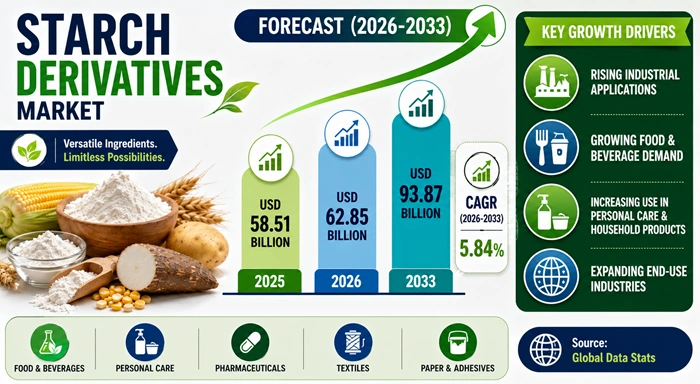
The global starch derivatives market size is valued at USD 58.51 billion in 2025 and is predicted to increase from USD 62.85 billion in 2026 to approximately USD 93.87 billion by 2033, growing at a CAGR of 5.84% from 2026 to 2033.
Rising demand for processed foods and clean-label ingredients drives unprecedented growth for modified starch products delivering functional benefits including thickening, stabilizing, binding, and texturizing across diverse industrial applications. Starch derivatives extracted primarily from corn, wheat, potato, and cassava through physical, chemical, or enzymatic modification serve as essential ingredients in food processing, pharmaceutical formulations, paper manufacturing, textile finishing, and biodegradable packaging supporting both traditional and emerging sustainability-focused applications worldwide.
AI Impact on the Starch Derivatives Industry
Artificial Intelligence Revolutionizing Production Optimization and Quality Consistency
Artificial intelligence is fundamentally transforming the starch derivatives market by enabling precision process control, predictive quality assurance, real-time optimization of modification parameters, supply chain efficiency enhancement, and formulation development acceleration that improve production yields while ensuring consistent product specifications and reducing waste. Machine learning algorithms analyze production data including temperature profiles, pH levels, enzymatic reaction kinetics, moisture content, molecular weight distributions, and viscosity measurements predicting optimal processing conditions maximizing conversion efficiency, achieving targeted functional properties like cold-water solubility or high freeze-thaw stability, reducing batch-to-batch variation that previously plagued modified starch production, and minimizing energy consumption through optimized heating and cooling cycles saving 15-20% operational costs particularly important for commodity products with thin margins. AI-powered sensors monitor real-time production parameters detecting deviations from specification within seconds, automatically adjusting enzyme dosing, temperature controls, and reaction times preventing off-spec batches that require reprocessing or disposal, and ensuring pharmaceutical-grade purity levels critical for medical applications.
Computer vision systems inspect raw material quality assessing starch granule size distribution, detecting foreign material contamination, verifying moisture levels affecting processing efficiency, and predicting final product characteristics from input corn, wheat, or potato starch enabling procurement optimization. Natural language processing technologies analyze customer feedback, food scientist discussions, regulatory documentation updates, and competitive product launches identifying emerging preferences for non-GMO starches, clean-label demands avoiding chemical modification, application-specific functional requirements like high shear stability for salad dressings, and innovation opportunities in plant-based meat analogs requiring novel binding properties.
The starch derivatives market benefits from AI-driven formulation development platforms testing thousands of virtual modification combinations predicting functional performance, stability profiles, cost implications, and regulatory compliance accelerating new product development from 18-24 months to 6-9 months enabling faster response to customer needs. Predictive analytics forecast demand patterns across glucose syrup, maltodextrin, and modified starch by analyzing food production trends, sweetener consumption cycles, pharmaceutical manufacturing schedules, paper industry capacity utilization, and agricultural harvest yields enabling producers to optimize production scheduling, raw material procurement timing capitalizing on seasonal price variations, and inventory management reducing working capital requirements.
Growth Factors
Processed Food Expansion and Clean-Label Preferences Drive Market Growth
The starch derivatives market is experiencing robust growth driven by escalating processed food consumption globally, rising clean-label ingredient preferences replacing synthetic additives, increasing pharmaceutical applications requiring excipients and binders, expanding paper industry demand for surface sizing and coating agents, and growing textile sector utilization for fabric finishing and printing paste formulations. Processed food industry expansion represents fundamental growth driver with global convenience food market exceeding USD 300 billion annually requiring starch derivatives as functional ingredients providing texture modification in sauces and gravies, moisture retention in baked goods extending shelf life, fat replacement in low-calorie products maintaining mouthfeel, emulsion stabilization in dressings and dairy products, and binding properties in processed meats and reformed seafood creating massive volume demand particularly as urbanization drives ready-to-eat meal consumption in emerging markets where traditional cooking declines.
Clean-label movement transforms ingredient selection criteria with consumers increasingly scrutinizing labels avoiding artificial additives and unfamiliar chemical names, preferring recognizable ingredients like "corn starch" or "tapioca starch" over modified starches with complex nomenclature, demanding non-GMO verification particularly in North America and Europe, seeking organic certification commanding premium pricing, and expecting minimal processing creating opportunities for physically-modified and enzymatically-modified starches perceived as more natural than chemically-modified alternatives despite similar functionality. The starch derivatives market benefits from pharmaceutical industry growth utilizing modified starches as tablet binders enabling compression, disintegrants facilitating drug release, coating agents masking taste and controlling release profiles, capsule materials providing vegetarian alternatives to gelatin, and excipients in liquid formulations with global pharmaceutical excipient market exceeding USD 8 billion creating stable high-value segment less price-sensitive than food applications.
Paper industry consumption including surface sizing improving printability and strength, coating formulations enhancing gloss and smoothness, and corrugating adhesives binding paperboard layers maintains substantial volume demand though growth rates lag food applications as digitalization reduces paper consumption in developed markets while emerging market industrialization sustains demand. Biodegradable plastics and packaging applications emerge as significant growth opportunity with starch-based bioplastics offering renewable alternatives to petroleum-based polymers, compostable packaging meeting sustainability regulations, and edible films extending produce shelf life creating environmentally-conscious segment growing 15% annually as corporate sustainability commitments and regulatory pressures drive adoption.
Market Outlook
Enzymatic Modification and Non-GMO Premiums Define Future Evolution
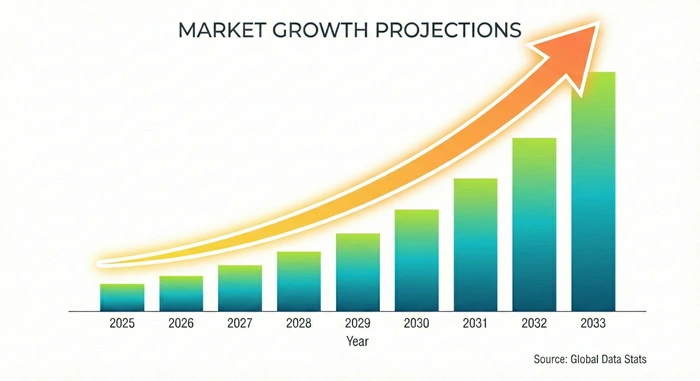
The starch derivatives market is positioned for sustained expansion through 2033 as manufacturers invest heavily in enzymatic modification technologies, expand non-GMO and organic product lines, develop application-specific customized solutions, leverage sustainability positioning for bio-based products, and address emerging markets requiring localized production and technical support. Enzymatic modification using amylases, pullulanases, and transglucosidases creates clean-label alternatives to chemical modification through selective bond cleavage and formation, produces identical functional properties without declarable chemical treatment, appeals to natural ingredient preferences, enables precise molecular weight control, and generates premium pricing despite higher production costs with enzymatically-modified starches commanding 20-30% premiums reflecting consumer willingness to pay for perceived naturalness.
Non-GMO starch derivatives sourced from identity-preserved corn, certified organic potatoes, and non-GMO cassava address consumer concerns about genetic modification particularly strong in European markets where GMO foods face resistance, command 15-25% price premiums over conventional products, require segregated supply chains preventing commingling, demand rigorous testing and certification, and capture growing market share as retailers like Whole Foods and European supermarket chains mandate non-GMO ingredients. The starch derivatives market witnesses application-specific innovation including cold-water-soluble starches eliminating cooking requirements for instant products, high-temperature stable varieties withstanding retort processing and hot-fill applications, shear-stable formulations surviving pump transfer and homogenization, freeze-thaw stable starches maintaining texture through frozen storage cycles, and acid-stable versions performing in low-pH beverages creating targeted solutions commanding premiums over commodity grades.
Sustainability positioning emphasizes renewable sourcing from agricultural crops versus petroleum derivatives, biodegradability reducing plastic waste, carbon footprint advantages with starch production emitting 50-70% less CO2 than synthetic polymers, and circular economy compatibility through compostability appealing to environmentally-conscious consumers, sustainability-focused corporations, and regulatory frameworks increasingly restricting single-use plastics. Emerging market localization requires building production capacity closer to growing demand centers including India, Southeast Asia, Africa, and Latin America reducing logistics costs, ensuring fresh inventory, enabling technical service responsiveness, adapting products to local taste preferences and processing conditions, and navigating import duties favoring domestic production.
Expert Speaks
-
Juan Luciano, Chairman and Chief Executive Officer of Archer Daniels Midland Company, emphasized that starch derivatives represent core strategic business with growing customer demand for functional ingredients, sustainable solutions, and application-specific innovations driving continuous investment in production capacity expansion, enzymatic technology development, and non-GMO product lines, with ADM leveraging agricultural sourcing expertise and global manufacturing footprint serving food, pharmaceutical, and industrial customers requiring reliable supply and technical support.
-
David MacLennan, Former Chairman and Chief Executive Officer of Cargill, highlighted that modified starches and sweeteners demonstrate sustained relevance despite market maturity with innovation in clean-label alternatives, customized functionality, and sustainability positioning creating differentiation opportunities, requiring substantial R&D investments, customer collaboration understanding application requirements, and manufacturing excellence ensuring consistent quality supporting long-term customer partnerships across diverse industries from food processing to pharmaceuticals.
-
James Zallie, President and Chief Executive Officer of Ingredion Incorporated, stated that specialty starches represent higher-growth higher-margin segment compared to commodity native starches with customer need for texture improvement, processing tolerance, and clean-label solutions driving demand for application-specific innovations, justifying premium pricing reflecting development investments, technical service value, and functional performance advantages enabling manufacturers to create differentiated products commanding retail premiums in competitive markets.
Key Report Takeaways
-
Asia Pacific leads the starch derivatives market with approximately 42% market share in 2025, driven by enormous food processing industry growth particularly in China and India, expanding pharmaceutical manufacturing capacity, growing paper production supporting regional consumption, abundant raw material availability from corn and cassava cultivation, competitive manufacturing costs, and rising middle-class populations demanding processed convenience foods.
-
North America is growing steadily with a projected CAGR of 6.20% from 2026 to 2033, fueled by advanced food processing industry, strong clean-label and non-GMO preferences, substantial pharmaceutical sector, innovation leadership in specialty starches, corn abundance as primary raw material, established manufacturing infrastructure, and sustainability-driven bioplastics adoption particularly in packaging applications.
-
Glucose syrup dominates with approximately 38% market share as most widely used starch derivative providing sweetness in confectionery and beverages, serving as fermentation substrate for bioethanol and amino acids, offering lower cost than sucrose, providing moisture retention and freeze-point depression, and maintaining established food industry acceptance across diverse applications from soft drinks to baked goods.
-
The food and beverages application contributes the most to overall market revenue with approximately 48% share in 2025, reflecting processed food industry expansion, convenience meal growth, bakery product proliferation, beverage production including sports drinks and functional beverages, dairy applications requiring stabilizers, and confectionery manufacturing utilizing sweeteners and texture modifiers creating sustained high-volume demand.
-
Corn dominates raw material segment with approximately 62% market share as most economically viable starch source particularly in Americas, offers highest starch yield per acre, benefits from extensive cultivation infrastructure, provides consistent quality and functionality, and enjoys established processing technologies with decades of optimization though cassava gains share in tropical regions and potato serves premium European applications.
-
The pharmaceuticals segment will grow quickly with an estimated CAGR of 7.40% as generic drug manufacturing expands particularly in emerging markets, oral solid dosage forms require binders and disintegrants, controlled-release formulations utilize specialized starches, vegetarian capsule demand increases, and injectable formulations need pharmaceutical-grade excipients commanding premium pricing reflecting stringent purity and regulatory requirements.
Market Scope
| Report Coverage | Details |
|---|---|
| Market Size by 2033 | USD 93.87 Billion |
| Market Size by 2025 | USD 58.51 Billion |
| Market Size by 2026 | USD 62.85 Billion |
| Market Growth Rate from 2026 to 2033 | CAGR of 5.84% |
| Dominating Region | Asia Pacific |
| Fastest Growing Region | North America |
| Base Year | 2025 |
| Forecast Period | 2026 to 2033 |
| Segments Covered | Type, Raw Material, Application, Region |
| Regions Covered | North America, Europe, Asia Pacific, Latin America, Middle East and Africa |
Market Dynamics
Driver Impact Analysis
Rising Processed Food Consumption and Functional Ingredient Requirements Propel Market Growth
The escalating global processed food consumption combined with growing requirements for functional ingredients delivering specific texture, stability, and sensory properties represents the most powerful driver propelling the starch derivatives market toward sustained expansion across all geographic regions and application segments. Processed food industry growth creates fundamental demand with global market exceeding USD 3 trillion annually encompassing convenience meals, frozen foods, bakery products, snacks, confectionery, sauces, dressings, dairy products, and processed meats all requiring starch derivatives as essential functional ingredients providing thickening for gravies and soups creating desired consistency, stabilization preventing separation in salad dressings and ice cream, binding holding processed meat products together, moisture retention extending bakery product shelf life preventing staling, fat replacement in reduced-calorie products maintaining creamy mouthfeel consumers expect, and texture modification creating smooth versus chunky versus crispy characteristics defining product identity and consumer acceptance.
Urbanization drives processed food adoption with rural-to-urban migration concentrating populations in cities where space and time constraints limit traditional cooking from raw ingredients, working women and dual-income households lacking hours for meal preparation, smaller living spaces reducing kitchen equipment and storage, and food delivery services proliferating making restaurant-quality convenience meals accessible creating massive volume growth particularly across Asia Pacific and Latin America where hundreds of millions enter middle-class with disposable income affording packaged foods previously unattainable. The starch derivatives market benefits from functionality requirements that native unmodified starches cannot meet including cold-water solubility enabling instant puddings and gravies reconstituted without heating, high-temperature stability withstanding retort sterilization for shelf-stable meals and canned soups, acid stability maintaining viscosity in fruit-filled products and low-pH beverages, shear stability surviving pump transfer, filling equipment, and homogenization without viscosity breakdown, and freeze-thaw stability maintaining texture through frozen storage and microwave reheating eliminating syneresis and phase separation.
Clean-label reformulation drives specialty starch adoption as manufacturers replace synthetic additives like carrageenan, xanthan gum, and artificial emulsifiers with modified starches declared as "corn starch" or "tapioca starch" appealing to label-reading consumers, using physically-modified or enzymatically-modified starches avoiding chemical names, and obtaining non-GMO verification meeting retailer requirements particularly Whole Foods, Trader Joe's, and European chains mandating cleaner formulations. Texture innovation creates competitive differentiation with manufacturers using specialized starches achieving indulgent creaminess in low-fat dairy mimicking full-fat versions, crispy coatings on baked versus fried snacks meeting health trends, smooth versus chunky sauce variations, firm versus soft bakery textures, and novel plant-based meat analogs requiring specialized binding and texturizing beyond traditional applications.
| Driver | ≈ % Impact on CAGR Forecast | Geographic Relevance | Impact Timeline |
|---|---|---|---|
| Processed Food Industry Expansion | +2.00% | Global, strongest in emerging markets | 2026-2033 |
| Functional Ingredient Requirements | +1.60% | Food manufacturers, product developers | 2026-2033 |
| Clean-Label Reformulation Trends | +1.40% | North America, Europe, urban populations | 2026-2033 |
| Urbanization and Convenience Demand | +1.20% | Asia Pacific, Latin America, Africa | 2026-2033 |
Restraints Impact Analysis
Raw Material Price Volatility and Competition from Alternatives Limit Market Growth
The starch derivatives market confronts significant barriers related to raw material price volatility affecting profitability margins, intense competition from alternative hydrocolloids and synthetic polymers, regulatory constraints on modification methods and additive usage, commodity product pricing pressures limiting premium positioning, and sustainability concerns about agricultural land use and water consumption constraining growth potential. Raw material price volatility represents persistent challenge with corn, wheat, potato, and cassava prices fluctuating 20-40% based on weather patterns affecting harvest yields, competing demand from animal feed and bioethanol industries, geopolitical trade policies impacting exports, and speculation in agricultural commodity markets creating unpredictable input costs that starch processors struggle to pass through to customers on fixed-price contracts particularly problematic for thin-margin commodity grades.
Competition from alternative functional ingredients challenges market share with hydrocolloids including xanthan gum, carrageenan, guar gum, and pectin offering superior functionality in specific applications like acid stability and shear resistance, synthetic polymers providing consistent performance and lower costs in industrial applications, protein-based alternatives like gelatin serving pharmaceutical capsules, and novel ingredients like konjac and chia gaining traction in clean-label formulations creating substitution threats particularly as relative pricing shifts. The starch derivatives market suffers from commodity pricing dynamics with native starches and basic modifications like acid-thinned starches facing intense price competition, limited differentiation among suppliers, customer price sensitivity particularly large food manufacturers commanding volume discounts, and margin pressures from retailer private-label products using lowest-cost ingredients creating race-to-bottom dynamics benefiting only largest most efficient producers achieving economies of scale.
Regulatory constraints vary across markets with European Union restrictions on certain chemical modification methods requiring reformulation for export, China's food additive regulations limiting approved starch types, organic certification standards prohibiting chemical modification restricting product options, and labeling requirements demanding disclosure deterring some manufacturers from modified starches and changing regulatory landscapes requiring ongoing compliance investments. Environmental concerns about agricultural sustainability including water consumption particularly for rice and potato cultivation, land use competition with food production, fertilizer runoff creating water pollution, pesticide usage in conventional farming, and carbon footprint from processing energy use create criticism particularly as climate consciousness increases though starch sources generally compare favorably to petroleum-based alternatives.
| Restraint | ≈ % Impact on CAGR Forecast | Geographic Relevance | Impact Timeline |
|---|---|---|---|
| Raw Material Price Volatility | -1.40% | Global markets, commodity producers | 2026-2033 |
| Competition from Alternative Ingredients | -1.20% | Food applications, price-sensitive segments | 2026-2033 |
| Commodity Pricing Pressures | -1.00% | Native starch, basic modifications | 2026-2033 |
| Regulatory Constraints and Complexity | -0.80% | International trade, organic products | 2026-2033 |
Opportunities Impact Analysis
Specialty Starch Innovations and Bio-Based Packaging Create Growth Avenues
The development of application-specific specialty starches combined with expanding bio-based packaging applications presents enormous opportunities for the starch derivatives market by creating premium differentiation, addressing sustainability demands, capturing emerging applications, enabling higher margins, and reducing commodity cyclicality through value-added positioning. Specialty starch innovations tailored for specific applications including cold-water-soluble varieties eliminating cooking requirements for instant products, ultra-high viscosity grades achieving texture with minimal usage rates, highly-branched structures providing freeze-thaw stability, acetylated starches offering superior clarity and stability, and cross-linked varieties withstanding extreme processing conditions command 30-60% premiums over commodity starches reflecting development investments, application testing, technical service, and functional performance advantages enabling customer product differentiation.
Bio-based packaging utilizing thermoplastic starch creates environmentally-friendly alternatives to petroleum-based plastics addressing corporate sustainability commitments, regulatory restrictions on single-use plastics proliferating globally, and consumer demand for compostable packaging particularly for fresh produce and food service, with starch-based films, trays, and foams offering biodegradability, renewable sourcing, and similar performance at competitive costs representing market projected to reach USD 5 billion by 2030 growing 20% annually. The starch derivatives market benefits from resistant starch as functional fiber ingredient offering prebiotic benefits supporting digestive health, providing satiety without calories supporting weight management, reducing glycemic response benefiting diabetic populations, and enabling fiber fortification in products from bread to beverages with market for dietary fiber exceeding USD 4 billion and consumer awareness about gut health driving functional food innovation.
Pharmaceutical applications expanding beyond traditional tablet binders include controlled-release matrices enabling once-daily dosing, implantable medical devices utilizing biocompatible starch scaffolds, wound dressings incorporating hemostatic starches, and drug nano-carriers using cyclodextrins for solubility enhancement representing high-value applications commanding pharmaceutical-grade pricing and stable long-term contracts less susceptible to commodity cycles. Plant-based meat analogs requiring specialized binding, texturizing, and fat-mimicking properties create emerging application with market exceeding USD 5 billion growing 15% annually, though functionality requirements differ substantially from traditional applications requiring dedicated innovation programs.
| Opportunity | ≈ % Impact on CAGR Forecast | Geographic Relevance | Impact Timeline |
|---|---|---|---|
| Specialty Starch Premiumization | +1.80% | Developed markets, value-added applications | 2026-2033 |
| Bio-Based Packaging Growth | +1.60% | Europe, North America, sustainability-focused | 2027-2033 |
| Resistant Starch as Functional Fiber | +1.40% | Health-conscious consumers, functional foods | 2027-2033 |
| Pharmaceutical Applications Expansion | +1.30% | Generic drug markets, advanced formulations | 2026-2033 |
Segment Analysis
Glucose Syrup
Dominant Type Driven by Sweetener Demand and Versatile Food Applications
The glucose syrup segment dominates the starch derivatives market with approximately 38% share in 2025 and steady CAGR of 5.60% from 2026 to 2033, driven by the segment's widespread use as sweetener in confectionery and beverages, lower cost compared to sucrose providing economical formulation option, functional properties including moisture retention and freeze-point depression, fermentation substrate for bioethanol and biochemical production, and established food industry acceptance across diverse applications from soft drinks to ice cream. Glucose syrup produced through enzymatic or acid hydrolysis of starch contains varying dextrose equivalent (DE) levels from 20 DE for low sweetness and bodying to 95 DE for high sweetness approaching pure glucose, with different grades serving specific applications including confectionery requiring 42-65 DE for texture and shelf life, baking using 38-42 DE for browning and moisture retention, beverages utilizing high-DE syrups for sweetness and fermentability, and industrial fermentation preferring high-glucose content for microbial conversion efficiency. Product applications span candy manufacturing providing texture, preventing crystallization, and extending shelf life, soft drink production though high-fructose corn syrup dominates sweetener usage in North America, ice cream formulations reducing freezing point enabling scoopability, bakery products contributing browning and moisture retention, and beer brewing supplementing malt as fermentable sugar source.
Asia Pacific shows particularly strong glucose syrup consumption with approximately 45% regional market share and CAGR of 6.40%, driven by enormous confectionery production particularly in China producing 40% of global candy output, rapidly expanding beverage industry with soft drink consumption growing 8% annually, growing ice cream market, increasing bakery product consumption with westernization of diets, and substantial bioethanol production using glucose as fermentation feedstock. Leading companies serving the starch derivatives market including Archer Daniels Midland Company, Cargill Incorporated, Ingredion Incorporated, Tate & Lyle, Roquette Frères, AGRANA Beteiligungs-AG, Beneo GmbH, Gulshan Polyols, and Tereos compete through glucose syrup production capacity, diverse DE range offerings, organic and non-GMO certifications, technical service supporting customer formulation, and vertical integration from corn wet milling through syrup production.
The segment continues evolving through high-maltose syrups offering different sweetness profiles and fermentation characteristics, organic glucose syrups commanding premiums for natural products, crystalline glucose and dextrose monohydrate serving pharmaceutical applications requiring high purity, and tapioca-based glucose syrups appealing to non-GMO and allergen-free positioning particularly important as corn allergies increase though rare. Competition from high-fructose corn syrup particularly in North American beverage applications and from alternative sweeteners including stevia and sucralose in diet products creates pressure though glucose syrup maintains advantages in functionality beyond sweetness including texture, browning, and fermentation supporting sustained demand across food and industrial applications throughout forecast period.
Food and Beverages Application
Largest Segment Capitalizing on Processed Food Growth and Functional Ingredient Needs
The food and beverages application represents the largest segment in the starch derivatives market with approximately 48% share and projected CAGR of 6.10% from 2026 to 2033, driven by processed food industry expansion, convenience meal proliferation, bakery product growth, beverage production including sports and functional drinks, dairy applications requiring stabilizers and texture modifiers, confectionery manufacturing utilizing sweeteners, and meat processing using binders creating sustained high-volume demand. Starch derivatives serve essential functional roles including thickening agents in soups, sauces, and gravies achieving desired consistency and mouthfeel, stabilizers preventing separation and syneresis in salad dressings and ice cream throughout shelf life, binding ingredients in processed meats holding reformed products together and improving sliceability, moisture retention in bakery products preventing staling and extending freshness, fat replacers in reduced-calorie products maintaining creamy texture without lipids, coating agents providing crispy textures and reducing oil absorption in snacks, and sweeteners in beverages, confectionery, and bakery products replacing or supplementing sugar. Product innovations include clean-label starches declared simply as "corn starch" replacing synthetic additives, non-GMO certified ingredients meeting retailer requirements and consumer preferences, organic starches commanding premiums, gluten-free formulations serving celiac and sensitivity populations, and specialized functional starches achieving specific textures and processing tolerances.
North America demonstrates substantial food application growth with CAGR exceeding 6.80%, driven by massive processed food industry with USD 900 billion market size, strong clean-label preferences with 73% of consumers checking ingredient lists, extensive bakery sector producing bread, cookies, and snacks, growing health-conscious reformulations reducing fat and sugar while maintaining indulgence, substantial meat processing industry, expanding plant-based meat alternatives requiring novel binding solutions, and convenience food consumption driven by busy lifestyles and food delivery proliferation. Leading companies serving food applications including Archer Daniels Midland, Cargill, Ingredion, Tate & Lyle, Roquette, Grain Processing Corporation, SMS Corporation, and regional suppliers compete through application-specific product development, technical service supporting customer formulation challenges, quality consistency critical for food safety and sensory attributes, competitive pricing particularly for commodity grades, and innovation in clean-label and sustainable alternatives.
The segment continues evolving through resistant starch incorporation providing fiber fortification and health benefits, texturally-optimized starches creating indulgent sensory experiences in reduced-calorie products, cold-water-soluble varieties enabling instant products, encapsulation applications protecting flavors and nutrients, and plant-based meat formulations utilizing starch for binding and fat-mimicking supporting sustained rapid growth throughout forecast period with favorable processed food trends, clean-label reformulation requirements, and functional performance demands creating premium opportunities beyond commodity pricing dynamics affecting basic starch products.
Regional Insights
Asia Pacific
Market Leadership Through Manufacturing Scale and Emerging Consumer Demand
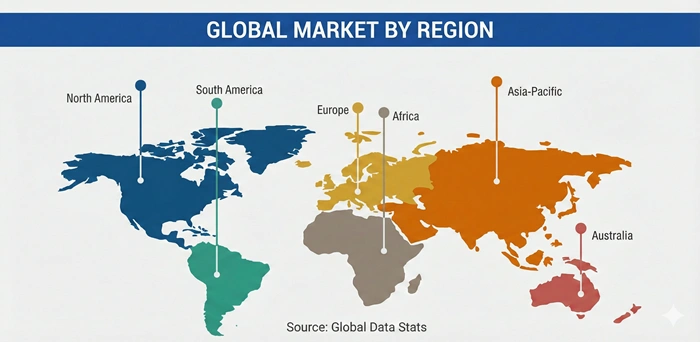
Asia Pacific maintains its position as the dominant region in the starch derivatives market, commanding approximately 42% of global market share in 2025 with an estimated value of USD 24.57 billion, projected to reach USD 39.82 billion by 2033 growing at a CAGR of 6.15%. The region's leadership stems from enormous food processing industry particularly in China, India, and Southeast Asia, expanding pharmaceutical manufacturing capacity serving domestic and export markets, growing paper production supporting regional consumption, abundant raw material availability from corn cultivation in China and cassava growing across tropical regions, competitive manufacturing costs enabling exports, and rising middle-class populations demanding processed convenience foods as urbanization accelerates. China dominates regional production with approximately 55% share driven by massive starch processing capacity exceeding 30 million tons annually, vertically integrated companies controlling corn wet milling through derivative production, substantial domestic consumption across food applications, growing pharmaceutical sector producing generic drugs, and government policies supporting agricultural processing and value-added manufacturing creating favorable business environment despite environmental regulations tightening.
Leading companies serving the Asia Pacific starch derivatives market include Ingredion Incorporated with regional manufacturing facilities, Cargill expanding presence, Roquette investing in China, local giants like Shandong Xiwang Sugar Holdings, Cargill (China), Global Bio-Chem Technology Group, Grain Processing Corporation, Tereos FKS Indonesia, and numerous regional producers compete through cost competitiveness leveraging local corn and cassava sourcing, proximity to growing food industry customers, technical service adapted to regional applications and taste preferences, and government relationships navigating complex regulatory environments. The region benefits from rapid urbanization concentrating populations in cities adopting processed food consumption patterns, expanding middle class with disposable income affording packaged foods, growing quick-service restaurant chains utilizing standardized ingredients, increasing pharmaceutical demand serving 4.5 billion population with improving healthcare access, and substantial textile industry particularly in India, Bangladesh, and Vietnam utilizing starches for sizing and finishing.
India shows explosive growth potential with CAGR exceeding 7.80% driven by population exceeding 1.4 billion, rapidly growing food processing industry with government Make in India initiatives, expanding pharmaceutical sector becoming global generic drug supplier, substantial textile manufacturing heritage, and improving infrastructure enabling efficient distribution though fragmented market structure and price sensitivity limit premium product penetration. The region witnesses cassava-based starch production expansion particularly in Thailand, Vietnam, and Indonesia leveraging tropical climate suitability, tapioca starch exports serving global clean-label and allergen-free demand, government support for agricultural value-addition, and sustainable cultivation practices supporting sustained rapid expansion throughout forecast period with favorable demographics, industrialization trajectories, and agricultural abundance.
North America
Fast-Growing Region Through Innovation Leadership and Clean-Label Premiums
North America represents a fast-growing region in the starch derivatives market with a projected CAGR of 6.20% from 2026 to 2033, with market value expected to increase from USD 15.36 billion in 2025 to USD 23.78 billion by 2033, capturing growing global revenue share. The region's exceptional growth trajectory stems from advanced food processing industry demanding sophisticated functional ingredients, strong clean-label and non-GMO preferences commanding premium pricing, substantial pharmaceutical sector with stringent quality requirements, innovation leadership in specialty starches and enzymatic modifications, corn abundance as primary raw material with United States producing 30% of global corn enabling competitive input costs, established manufacturing infrastructure with over 25 industrial starch plants, and sustainability-driven bioplastics adoption particularly in packaging applications addressing corporate environmental commitments. United States dominates regional demand with approximately 88% share driven by processed food market exceeding USD 900 billion annually, influential clean-label movement with consumers scrutinizing ingredient lists and demanding recognizable components, massive pharmaceutical industry producing both branded and generic drugs requiring excipients, substantial paper industry though declining due to digitalization, and growing bioeconomy utilizing starch for biodegradable plastics and biochemical production.
Leading companies serving the North American starch derivatives market include Archer Daniels Midland Company headquartered in Chicago with extensive corn wet milling capacity, Cargill Incorporated with multiple production facilities, Ingredion Incorporated specializing in specialty starches, Tate & Lyle with sweetener and texturizer expertise, Grain Processing Corporation focusing on specialty products, Roquette America, and regional suppliers competing through innovation excellence. The region benefits from innovation culture with substantial R&D investments developing application-specific solutions, technical service expertise supporting customer formulation challenges, non-GMO and organic product proliferation commanding 20-30% premiums, regulatory clarity providing predictable compliance environment though FDA scrutiny of novel modifications requires GRAS determination, and sustainability leadership with companies investing in renewable energy, water conservation, and circular economy initiatives.
Canada contributes approximately 10% of North American revenue through similar industry structure, substantial wheat-based starch production leveraging prairie agriculture, food processing industry, and pharmaceutical manufacturing though smaller market size limits investment scale. The region witnesses specialty starch premium segment expansion with cold-water-soluble varieties, clean-label enzymatic modifications, resistant starch for fiber fortification, pharmaceutical-grade products, and customized solutions commanding higher margins than commodity starches, bioplastics adoption accelerating with corporate sustainability commitments from major brands, plant-based meat formulations requiring novel functionality, and consolidation creating efficiency through scale supporting sustained above-average growth throughout forecast period with favorable trends toward premiumization, sustainability, and functional innovation.
Top Key Players
-
Archer Daniels Midland Company (United States)
-
Cargill Incorporated (United States)
-
Ingredion Incorporated (United States)
-
Tate & Lyle PLC (United Kingdom)
-
Roquette Frères (France)
-
AGRANA Beteiligungs-AG (Austria)
-
Beneo GmbH (Germany)
-
Grain Processing Corporation (United States)
-
Gulshan Polyols Limited (India)
-
Tereos Group (France)
-
Avebe U.A. (Netherlands)
-
SMS Corporation (Thailand)
-
Global Bio-Chem Technology Group (China)
-
Emsland Group (Germany)
-
KMC (Denmark)
Recent Developments
-
Ingredion Incorporated (2025): Launched clean-label enzymatically-modified starch portfolio in March 2025 utilizing proprietary enzyme combinations creating functional properties matching chemically-modified starches while enabling simple "corn starch" declaration, targeting North American and European customers reformulating for clean labels, commanding 25% premium pricing over conventional modified starches, and positioning for growth in premium food applications where consumers scrutinize ingredient lists supporting margin expansion strategy.
-
Cargill Incorporated (2024): Invested USD 200 million in corn wet milling facility expansion in November 2024 increasing North American starch and derivatives capacity by 20%, implementing advanced process controls optimizing yields and reducing energy consumption, adding specialty starch production lines serving pharmaceutical and premium food applications, and positioning for growing demand particularly clean-label and non-GMO products supporting market leadership and customer supply security.
-
Archer Daniels Midland (2025): Acquired specialty starch producer in June 2025 for USD 450 million expanding portfolio beyond commodity starches into high-margin application-specific products, gaining proprietary modification technologies and formulation expertise, accessing established relationships with pharmaceutical and nutraceutical customers, and accelerating specialty segment growth trajectory projected at 8-10% annually versus 4-5% for commodity products supporting strategic shift toward value-added positioning.
-
Roquette Frères (2024): Launched pea starch-based derivatives line in September 2024 leveraging plant protein expansion creating starch byproduct, targeting allergen-free and plant-based applications where corn and wheat starches face sensitivities, obtaining non-GMO and organic certifications, commanding premium pricing reflecting novel source and clean-label positioning, and serving growing vegetarian, vegan, and allergen-conscious consumer segments particularly strong in Europe supporting diversification beyond traditional corn and wheat sources.
-
Tate & Lyle (2025): Formed strategic partnership with biotech company in January 2025 developing next-generation enzymatic modification technologies enabling novel functionalities unachievable through conventional methods, targeting texture innovation for plant-based foods, controlled-release pharmaceutical applications, and sustainable packaging materials, investing USD 50 million over five years in joint research, and positioning for emerging applications requiring advanced starch chemistry supporting innovation leadership and premium positioning.
Market Trends
Clean-Label Reformulation and Sustainable Sourcing Reshape Industry Standards
The starch derivatives market is experiencing transformative shifts driven by clean-label ingredient demands replacing synthetic additives, non-GMO and organic certifications commanding premiums, enzymatic modification technologies enabling natural declarations, sustainable packaging applications utilizing bio-based starches, and specialty formulations targeting specific functional requirements creating premiumization opportunities. Clean-label movement fundamentally transforms product development with consumers increasingly scrutinizing ingredient lists avoiding chemical names they don't recognize, preferring simple declarations like "corn starch" or "tapioca starch" over modified starches with complex nomenclature like "hydroxypropyl distarch phosphate," demanding minimal processing perceived as more natural though functionally similar to conventional modifications, and expecting transparency about sourcing and processing driving manufacturers to reformulate products replacing synthetic thickeners, stabilizers, and emulsifiers with modified starches declared more simply creating substantial market opportunity as major brands reformulate thousands of SKUs.
Enzymatic modification using food-grade enzymes like amylases and pullulanases creates clean-label alternatives to chemical modification achieving identical functional properties through biological catalysis rather than chemical treatment, enabling ingredient declarations as "corn starch" or "enzymatically modified corn starch" perceived more favorably than chemically-modified alternatives, and commanding 20-30% premium pricing reflecting higher production costs and consumer willingness to pay for perceived naturalness though scientific community emphasizes functional equivalence and safety of both approaches. The starch derivatives market witnesses non-GMO certification proliferation with consumers particularly in North America and Europe expressing concern about genetic modification despite scientific consensus on safety, retailers including Whole Foods and European supermarket chains mandating non-GMO ingredients, identity-preserved supply chains segregating non-GMO corn and other materials preventing commingling, and premium pricing of 15-25% over conventional products reflecting segregation costs and testing requirements with non-GMO market share exceeding 30% in premium retail channels.
Sustainable packaging utilizing thermoplastic starch creates biodegradable alternatives to petroleum-based plastics addressing corporate sustainability commitments from major brands, regulatory restrictions on single-use plastics proliferating globally particularly European Union directives, and consumer demand for compostable packaging particularly for fresh produce and food service with starch-based films, trays, cutlery, and foams offering renewable sourcing, home compostability, and similar performance to conventional plastics at competitive costs. Specialty starch premiumization creates higher-margin segment with application-specific innovations including cold-water-soluble varieties for instant products, ultra-high viscosity for low-usage-rate formulations, freeze-thaw stable starches for frozen foods, shear-resistant modifications for pump transfer, and targeted pharmaceutical grades commanding 40-80% premiums over commodity native starches reflecting development investments, application testing, technical service value, and functional performance enabling customer product differentiation.
Segments Covered in the Report
By Type
-
Glucose Syrup
-
Maltodextrin
-
Modified Starch
-
Physically Modified
-
Chemically Modified
-
Enzymatically Modified
-
-
Cyclodextrin
-
Hydrolysates
-
Others
By Raw Material
-
Corn
-
Wheat
-
Potato
-
Cassava (Tapioca)
-
Others
By Application
-
Food and Beverages
-
Bakery and Confectionery
-
Beverages
-
Dairy Products
-
Processed Foods
-
Others
-
-
Pharmaceuticals
-
Excipients
-
Drug Delivery Systems
-
Others
-
-
Paper and Corrugation
-
Surface Sizing
-
Coating
-
Adhesives
-
-
Textiles
-
Fabric Finishing
-
Sizing
-
Printing
-
-
Animal Feed
-
Others
By Form
-
Powder
-
Liquid
-
Others
By Region
-
North America
-
United States
-
Canada
-
Mexico
-
-
Europe
-
Germany
-
France
-
United Kingdom
-
Italy
-
Spain
-
Rest of Europe
-
-
Asia Pacific
-
China
-
India
-
Japan
-
Thailand
-
Indonesia
-
Rest of Asia Pacific
-
-
Latin America
-
Brazil
-
Argentina
-
Rest of Latin America
-
-
Middle East and Africa
-
Saudi Arabia
-
United Arab Emirates
-
South Africa
-
Rest of Middle East and Africa
-
Frequently Asked Questions
Question 1: What is the projected starch derivatives market size by 2033?
Answer: The starch derivatives market is projected to reach USD 93.87 billion by 2033, growing from USD 62.85 billion in 2026. This represents steady expansion driven by processed food industry growth, clean-label reformulation trends, pharmaceutical applications expansion, bio-based packaging adoption, and specialty starch innovations commanding premium pricing particularly in developed markets.
Question 2: Which region dominates the global starch derivatives market share?
Answer: Asia Pacific dominates the global starch derivatives market with approximately 42% market share in 2025, valued at USD 24.57 billion. This leadership position reflects enormous food processing industry particularly in China and India, expanding pharmaceutical manufacturing, growing paper production, abundant raw materials from corn and cassava cultivation, and rising middle-class consumption.
Question 3: What factors are driving the starch derivatives market growth?
Answer: Key factors driving starch derivatives market growth include escalating processed food consumption with urbanization, clean-label ingredient preferences replacing synthetic additives, pharmaceutical industry expansion requiring excipients and binders, functional ingredient requirements for texture and stability, non-GMO and organic certification premiums, and bio-based packaging applications. Specialty starch innovation also contributes significantly.
Question 4: Which type segment holds the largest share in the starch derivatives market?
Answer: The glucose syrup segment holds the largest share in the starch derivatives market with approximately 38% in 2025. This dominance reflects widespread use as sweetener in confectionery and beverages, lower cost than sucrose, functional properties including moisture retention, fermentation substrate applications, and established food industry acceptance across diverse applications.
Question 5: What are the emerging trends in the starch derivatives market?
Answer: Emerging trends in the starch derivatives market include clean-label reformulation using enzymatically-modified starches declared simply as "corn starch," non-GMO and organic certification commanding 15-30% premiums, sustainable bio-based packaging utilizing thermoplastic starch, specialty formulations targeting specific functionalities, resistant starch as functional fiber ingredient, and pharmaceutical applications expansion. Application-specific customization also gains significant traction.