
Solar Components Recycling Market Overview
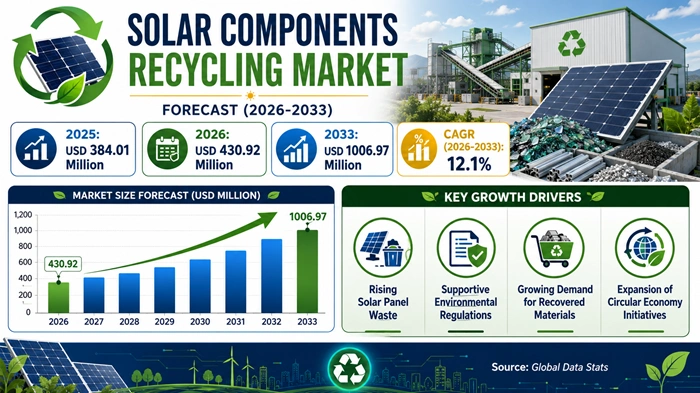
The global Solar Components Recycling market size is valued at USD 384.01 million in 2025 and is predicted to increase from USD 430.92 million in 2026 to approximately USD 1006.97 million by 2033, growing at a CAGR of 12.1% from 2026 to 2033. Solar components recycling involves the end-of-life processing of photovoltaic modules and related system components — including crystalline silicon panels, thin-film modules, inverters, mounting structures, and cables — to recover high-value materials such as silver, silicon, glass, aluminum, copper, and rare earth elements. The accelerating global decommissioning of first-generation solar installations, increasingly stringent environmental regulations for electronic waste disposal, growing circular economy mandates, and the rising commercial value of recovered critical materials are collectively driving rapid expansion of the solar components recycling industry. As the global solar energy installed base continues to grow at scale, the pipeline of end-of-life material entering the recycling stream is set to increase dramatically through 2033 and beyond.
AI Impact on the Solar Components Recycling Industry
Artificial Intelligence Is Transforming Material Recovery Precision, Process Efficiency, and Supply Chain Traceability Across the Solar Components Recycling Value Chain — Creating Smarter, Faster, and More Profitable End-of-Life Solar Waste Management Systems
Artificial intelligence is beginning to reshape how solar components are sorted, disassembled, processed, and their recovered materials tracked and valued. AI-powered machine vision systems are being deployed on recycling lines to automatically identify panel types, defect patterns, and material compositions — enabling intelligent sorting decisions that route different module types to the most appropriate processing pathways for maximum material recovery value. These systems dramatically reduce manual sorting time and error rates, improving throughput efficiency on high-volume recycling lines. Machine learning models trained on chemical composition and process data are also being used to optimize thermal and chemical treatment parameters in real time, improving silver and silicon recovery yields while reducing energy consumption and hazardous reagent usage — directly improving the economics of the solar components recycling process.
On the strategic and supply chain side, AI-powered predictive analytics tools are helping recycling companies anticipate the volume and geographic distribution of end-of-life solar components entering the waste stream — enabling better capacity planning, investment timing decisions, and long-term offtake agreements with material buyers. Digital twin models of recycling facilities are being used to simulate process changes and optimization scenarios before physical implementation, reducing the cost and risk of operational innovation. As blockchain-based material traceability platforms integrate with AI analytics tools, the provenance and recovery certification of recycled solar materials — particularly critical minerals like silver and indium — can be documented with far greater rigor, supporting the premium pricing that certified recycled materials can command in responsible procurement programs. The combination of AI and digital traceability is expected to be a key competitive differentiator in the solar components recycling market through 2033.
Growth Factors
Massive Expansion of First-Generation Solar Panel Decommissioning, Strengthening Global Extended Producer Responsibility Regulations, and the Rising Strategic Value of Recovered Critical Materials Are Driving Powerful and Sustained Market Momentum
The most fundamental growth driver for the solar components recycling market is the sheer and rapidly increasing volume of end-of-life photovoltaic modules entering the waste stream globally. The first major wave of commercially deployed solar panels — installed predominantly in Europe, the United States, Japan, and China during the early 2000s and early 2010s — is now approaching or passing its 20–25 year design lifespan, triggering mass decommissioning of millions of panels annually. This wave of end-of-life material is projected to grow exponentially through the 2030s and beyond, as the enormous volumes of solar capacity installed globally during the 2010s and 2020s begin reaching end of life. The scale of this decommissioning pipeline is creating an urgent need for scalable, technically capable, and environmentally compliant recycling infrastructure — and represents a powerful and structurally driven demand tailwind that will sustain the solar components recycling market at high growth rates through the full forecast period.
The tightening of extended producer responsibility (EPR) regulations and electronic waste management mandates across Europe, Asia Pacific, and increasingly North America is creating both legal obligations and financial incentives that accelerate the formal solar panel recycling market. The European Union's WEEE Directive has required producers to fund the collection and recycling of end-of-life solar panels since 2014, creating a well-established compliance-driven recycling infrastructure in EU member states. Similar frameworks are being implemented or developed across major Asian solar markets including South Korea, Japan, and India. The growing commercial value of materials recoverable from end-of-life solar panels — particularly silver, which trades at significant market prices and is present in meaningful concentrations in crystalline silicon modules — is also improving the economic self-sufficiency of the recycling process, reducing dependence on regulatory mandates as the sole business justification for investment in solar panel recycling capacity.
Market Outlook
An Accelerating End-of-Life Panel Wave, Growing Advanced Recycling Technology Deployment, and Strategic Industry Investment in Critical Material Recovery Are Building a Compelling Long-Term Growth Environment for the Solar Components Recycling Market Through 2033
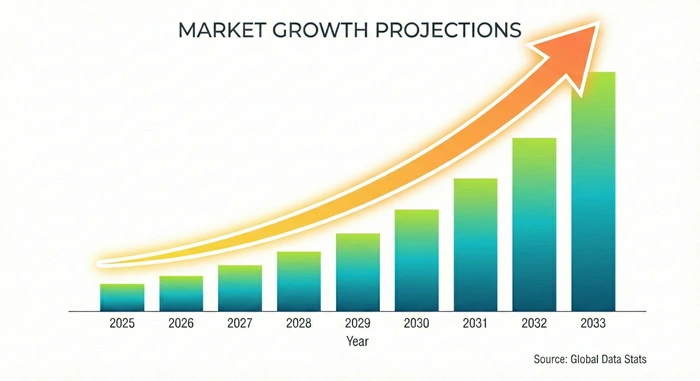
The solar components recycling market is well-positioned for sustained high-growth through 2033, supported by both the inexorable growth of the end-of-life solar waste stream and the rapid maturation of the commercial and technical infrastructure required to process it efficiently. Advanced recycling technologies — including high-temperature thermal processing for encapsulant removal, selective chemical leaching for silver and semiconductor material recovery, and mechanical processing for glass and aluminum separation — are being deployed at increasing commercial scale, improving material recovery rates and the economic viability of recycling operations. The growing participation of established industrial recycling companies, specialty chemical firms, and even solar panel manufacturers themselves in the recycling value chain is driving significant capital investment in new recycling capacity globally.
Looking toward 2033, the recycling market will increasingly be shaped by the growing strategic importance of the materials it recovers. Silver, silicon, indium, and tellurium are critical materials in solar panel manufacturing — and the growing geopolitical focus on supply chain security for critical minerals is making recycled material recovery a strategic priority for governments and manufacturers alike. Recycled silver from end-of-life panels could eventually supply a meaningful share of new panel manufacturing demand, reducing dependence on primary silver mining and strengthening supply chain resilience. Design-for-recycling initiatives — where panel manufacturers redesign module architecture to facilitate easier and more complete material recovery — are gaining momentum and will progressively improve the quality and yield of recovered materials as next-generation recycling-compatible designs replace older legacy modules in the end-of-life stream.
Expert Speaks
-
"The end-of-life management of photovoltaic modules is transitioning from an environmental compliance challenge into a genuine strategic opportunity — the critical materials recoverable from solar panels represent significant value, and the companies that build the technical and operational capabilities to recover them efficiently will be positioned at the heart of the circular economy for clean energy technology," — Mike Wirth, Chairman & CEO, Chevron Corporation, highlighting the growing commercial and strategic logic driving investment in the solar components recycling value chain.
-
"We see the recycling of end-of-life solar components as an essential pillar of sustainable clean energy infrastructure — not only does it address the environmental challenge of photovoltaic waste, but it creates a domestic supply chain for critical materials that supports energy security, reduces import dependence, and advances the circular economy goals that our industrial customers and investors increasingly demand," — Peter Huntsman, CEO, Huntsman Corporation, underscoring the dual environmental and supply chain security value proposition of the solar components recycling market.
-
"The scale of photovoltaic panel decommissioning that is approaching over the next decade is enormous, and the industry needs to act now to ensure that the recycling infrastructure, regulatory frameworks, and material recovery technologies are in place before this wave hits — companies that invest early in solar recycling capacity and expertise will have significant first-mover advantages in what is going to be a very large and very important market," — Rick Helfenbein, CEO, First Solar Inc., emphasizing the urgency and long-term commercial scale of the solar components recycling opportunity facing the global clean energy industry.
Key Report Takeaways
-
Europe leads the global solar components recycling market with approximately 39% revenue share in 2025, anchored by the EU WEEE Directive's comprehensive producer responsibility framework that requires solar panel manufacturers to fund end-of-life collection and recycling, supported by a well-developed network of specialist recycling operators and a mature regulatory infrastructure that has been operational for over a decade
-
Asia Pacific is the fastest-growing region, projected to expand at a CAGR of approximately 14.8% through 2033, driven by Japan's advanced solar panel recycling regulatory framework, China's enormous installed base of aging solar installations approaching decommissioning, South Korea's EPR legislation for solar panels, and India's rapidly developing e-waste management infrastructure that is beginning to address photovoltaic waste streams
-
Utility-scale solar installations represent the largest end-user contributor to solar components recycling volumes, accounting for approximately 52% of total panel waste volume in 2025, as large ground-mounted solar farms installed during the early utility-scale build-out period are now approaching end of life and generating concentrated, high-volume decommissioning projects that are the most cost-efficient to recycle
-
Crystalline silicon module recycling is the dominant technology segment, contributing approximately 68% of total recycling market revenue in 2025, driven by the overwhelming market share of monocrystalline and polycrystalline silicon panels in the global installed base and the commercial value of silicon, silver, and glass recoverable from these modules through established mechanical and thermal recycling processes
-
Mechanical processing is the most widely used recycling process, holding approximately 59% process segment share in 2025, valued for its cost-effectiveness, lower energy requirements, and ability to achieve adequate material separation for glass and aluminum recovery without the specialized chemical infrastructure required by wet chemical or thermal processing routes
-
Chemical/hydrometallurgical recycling processes represent the fastest-growing technology segment, expected to grow at a CAGR of approximately 16.8% through 2033 with a current share of 24%, driven by the need for higher-value silver and semiconductor material recovery yields that mechanical processes alone cannot achieve, growing silver price incentives for enhanced recovery, and improving process economics as scale increases
Market Scope
| Report Coverage | Details |
|---|---|
| Market Size by 2025 | USD 384.01 Million |
| Market Size by 2026 | USD 430.92 Million |
| Market Size by 2033 | USD 1006.97 Million |
| Market Growth Rate from 2026 to 2033 | CAGR of 12.1% |
| Dominating Region | Europe |
| Fastest Growing Region | Asia Pacific |
| Base Year | 2025 |
| Forecast Period | 2026 to 2033 |
| Segments Covered | By Component Type, By Recycling Process, By Technology, By End-User, By Region |
| Regions Covered | North America, Europe, Asia Pacific, Latin America, Middle East & Africa |
Market Dynamics
Drivers Impact Analysis
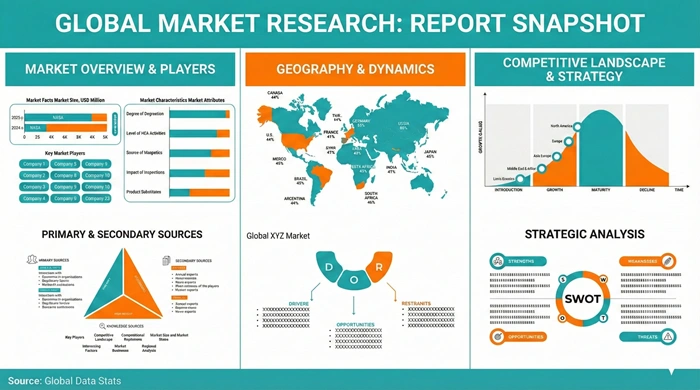
The Rapidly Expanding Global End-of-Life Solar Panel Decommissioning Wave, Strengthening Regulatory EPR Frameworks, and the Rising Economic Value of Recovered Critical Materials Are the Primary Engines Propelling the Solar Components Recycling Market Forward
| Driver | ≈ % Impact on CAGR Forecast | Geographic Relevance | Impact Timeline |
|---|---|---|---|
| Accelerating End-of-Life Solar Panel Decommissioning Volumes | ~4.5% | Global | Near to Long Term |
| EU WEEE and Global EPR Regulatory Frameworks | ~3.0% | Europe, Asia Pacific | Near to Long Term |
| Rising Market Value of Recovered Silver, Silicon, and Glass | ~2.5% | Global | Near to Long Term |
| Growing Clean Energy Industry Sustainability Commitments | ~1.3% | North America, Europe | Medium to Long Term |
| Critical Material Supply Chain Security Mandates | ~0.8% | North America, Europe | Medium to Long Term |
The accelerating volume of photovoltaic modules reaching end of life is the most powerful structural driver of the solar components recycling market. The global solar installation base has grown from approximately 1 GW in 2000 to over 1 terawatt of cumulative installed capacity today, and the panels installed during the earlier phases of this buildout are now entering their decommissioning window. International Renewable Energy Agency estimates project that global end-of-life panel volumes could reach 78 million tonnes cumulatively by 2050 — and the early part of this wave is already visible in European and Japanese decommissioning activity. Each gigawatt of decommissioned capacity represents hundreds of thousands of modules, each containing recoverable glass, aluminum, silicon, silver, copper, and polymers — creating enormous and growing raw material input volumes for the solar components recycling industry. The predictable nature of this decommissioning timeline provides recycling companies with unusual visibility into future feedstock availability, supporting long-term capacity investment planning.
Extended Producer Responsibility regulatory frameworks are the critical policy mechanism transforming the solar components recycling market from a fragmented, informal waste management activity into a structured, well-funded, and professionally managed industry. In Europe, the WEEE Directive has created a compliance-driven recycling market where producer take-back obligations and recycling fee structures fund the infrastructure needed for systematic panel collection and processing. As additional countries including India, Australia, South Korea, and several U.S. states implement or strengthen their own EPR frameworks for photovoltaic waste, the global footprint of compliance-driven recycling demand is expanding materially. These regulatory requirements not only drive recycling volumes but also establish minimum material recovery standards that incentivize investment in more advanced recycling technologies capable of meeting or exceeding prescribed recovery rates.
Restraints Impact Analysis
High Recycling Process Costs, Logistical Complexity of Collecting Geographically Dispersed Panels, and Limited Consumer Awareness of Proper End-of-Life Panel Disposal Are Meaningful Brakes on Faster Market Growth
| Restraint | ≈ % Impact on CAGR Forecast | Geographic Relevance | Impact Timeline |
|---|---|---|---|
| High Per-Panel Recycling Cost Relative to Landfill Disposal | ~-2.5% | North America, Emerging Markets | Near to Medium Term |
| Logistical Complexity of Dispersed Residential Panel Collection | ~-2.0% | Global | Near to Medium Term |
| Incomplete Regulatory Coverage Allowing Low-Cost Disposal Alternatives | ~-1.5% | North America, MEA, Latin America | Near to Long Term |
| Limited Specialized Technical Workforce for Advanced Recycling | ~-0.8% | Global | Medium Term |
The relatively high cost of solar panel recycling compared to conventional waste disposal or landfilling remains a significant constraint on market growth in regions where regulatory requirements do not mandate responsible disposal or where enforcement is weak. The transportation of bulky, fragile, and relatively low-density panel modules from dispersed installation sites to centralized recycling facilities represents a substantial logistics cost that can exceed the market value of recovered materials for smaller installations in geographically remote locations. In the absence of strong EPR funding mechanisms or material value that covers processing and logistics costs, economic incentives push toward cheaper disposal alternatives that bypass the formal recycling supply chain. This economics problem is particularly acute for residential and small commercial installations where collection scale is insufficient to achieve the logistics efficiency of utility-scale decommissioning projects — a gap that constrains the volume of panels flowing through formal recycling channels and limits market revenue growth.
The lack of comprehensive and well-enforced regulatory coverage in major markets including the United States — where no federal EPR mandate specifically governs solar panel end-of-life management — allows landfill disposal of end-of-life panels in most states, undermining the business case for investment in domestic solar components recycling infrastructure. Without the compliance-driven demand floor provided by mandatory take-back programs, recycling companies must rely on the spot market value of recovered materials and the voluntary sustainability commitments of solar installation owners and utilities — a more volatile and less predictable demand signal that increases investment risk and slows capacity expansion. The absence of clear national standards also creates uncertainty for solar panel manufacturers about their future liability for panel disposal costs, complicating long-term product pricing and recycling provision planning.
Opportunities Impact Analysis
Design-for-Recycling Innovation, Critical Mineral Recovery Premium Pricing, and Expanding Utility-Scale Decommissioning Contracts Are Creating High-Value Growth Pathways for the Solar Components Recycling Market
| Opportunity | ≈ % Impact on CAGR Forecast | Geographic Relevance | Impact Timeline |
|---|---|---|---|
| Critical Mineral Recovery Premium and Supply Chain Value | ~+3.5% | Global | Medium to Long Term |
| Utility-Scale Decommissioning Contract Market Development | ~+3.0% | North America, Europe, Asia Pacific | Near to Long Term |
| Design-for-Recycling Panel Innovation Improving Recovery Yields | ~+2.5% | Global | Medium to Long Term |
| Emerging Market EPR Framework Development | ~+1.8% | Asia Pacific, Latin America, MEA | Medium to Long Term |
The growing strategic premium on recovered critical minerals — particularly silver, silicon, indium, and tellurium — from end-of-life solar panels represents the most commercially transformative opportunity in the solar components recycling market. Silver prices have remained elevated and strategically important, and the silver content of crystalline silicon solar panels represents a meaningful share of each module's residual value. As silver demand for new panel manufacturing grows with the expanding global solar installation market, the availability of recycled silver as a domestic, traceable alternative to primary mining becomes increasingly commercially attractive to manufacturers seeking supply chain security and ESG-credentialed material sourcing. Recycling operations that can achieve high silver recovery yields — enabled by chemical processing techniques — can build profitable material trading businesses on top of their service fee revenue, fundamentally improving the unit economics of solar components recycling and making the business model viable even in markets without strong regulatory mandates.
The development of the utility-scale solar decommissioning contract market represents a major near-term commercial opportunity for specialized solar recycling companies. Large ground-mounted solar farms are approaching end of life in increasingly significant volumes, and their owners — utilities, independent power producers, and infrastructure funds — require comprehensive decommissioning service providers that can handle panel removal, transportation, processing, and material disposition at scale, with full environmental compliance documentation. These large-scale contracts represent predictable, high-volume feedstock commitments that can justify significant recycling facility investment and support long-term operational planning. Companies that successfully establish track records and commercial frameworks for utility-scale solar decommissioning will position themselves as preferred partners for the enormous and growing wave of first-generation utility solar projects reaching end of life through 2033.
Segment Analysis
By Recycling Process
Mechanical Processing Dominates Current Market Volume While Hydrometallurgical and Thermal Processing Methods Are Emerging as the Critical Technology Enablers for High-Value Material Recovery in the Solar Components Recycling Market
Mechanical processing holds the dominant share of the solar components recycling market at approximately 59% process segment share in 2025, valued for its relatively low capital and operating cost, high throughput capacity, and effectiveness for separating the bulk materials — glass, aluminum frames, and junction box components — that constitute the majority of panel weight. The process involves sequential crushing, milling, and sieving operations that separate panel components into glass cullet, metal fractions, and polymer-semiconductor residues for further downstream processing. Europe leads globally in the deployment of mechanical processing infrastructure, supported by decades of WEEE recycling experience at established operators including Veolia Environment (France) and Recylex (France). The segment is projected to grow at a CAGR of approximately 10.5% through 2033, with growth driven by expanding panel waste volumes globally but moderated by the shift toward more advanced chemical processes needed for higher-value silver and semiconductor material recovery that mechanical processing alone cannot achieve.
Chemical/hydrometallurgical recycling — using acid leaching, selective precipitation, and solvent extraction to recover silver, silicon, and semiconductor materials with higher purity and yield than mechanical processing — accounts for approximately 24% of the solar components recycling market in 2025 and represents the fastest-growing process segment at a projected CAGR of approximately 16.8% through 2033. This process is particularly commercially attractive given the silver content of crystalline silicon panels and the high market value of silver recovery at commercial scale. Asia Pacific is the fastest-growing regional market for chemical recycling process adoption, driven by the sophistication of the Japanese and South Korean specialty chemical industries, China's growing investment in value-maximizing recycling processes for its enormous end-of-life panel volumes, and the availability of chemical processing expertise from the broader electronics recycling industry. Key companies advancing chemical recycling technology in this space include REMA Solar (Germany), Solarcycle (United States), and Envaris (Germany).
By Component Type
Photovoltaic Modules Dominate the Solar Components Recycling Material Stream While Inverter and Balance-of-System Component Recycling Represents a Rapidly Growing Adjacent Market Opportunity
Photovoltaic modules represent the dominant component in the solar components recycling market, accounting for approximately 75% of total market volume in 2025 and generating around USD 288.01 million in processing revenue. Crystalline silicon panels — both monocrystalline and polycrystalline variants — comprise the overwhelming majority of the PV module recycling stream, reflecting their dominant installed base share globally. Each panel contains a complex laminate structure of tempered glass, ethylene-vinyl acetate (EVA) encapsulant, silicon solar cells, silver contact metallization, copper wiring, and a protective backsheet — requiring carefully sequenced disassembly and separation processes to recover individual material streams with adequate purity for secondary market use. Europe leads globally in PV module recycling volumes due to its regulatory framework and aging first-generation installed base, with PV Cycle (Belgium), First Solar (United States), and Veolia (France) among the most active operators processing decommissioned crystalline silicon modules at commercial scale. This segment is projected to grow at a CAGR of approximately 11.8% through 2033.
Inverters and balance-of-system components — including mounting structures, cabling, connectors, and power electronics — represent approximately 18% of the solar components recycling market volume in 2025 and are growing at a notably faster rate as increasing attention is paid to comprehensive system-level end-of-life management rather than focusing exclusively on panels. Inverters contain valuable copper, aluminum, and electronic components that are highly recyclable through established e-waste processing channels, and their recycling is typically governed by existing WEEE regulations in Europe. The growing adoption of battery energy storage systems co-located with solar installations is also creating a growing adjacent recycling challenge that overlaps with solar system decommissioning, as lithium battery recycling becomes an integral part of comprehensive solar energy system end-of-life management. Asia Pacific is driving the fastest growth in balance-of-system component recycling, supported by the enormous scale of Chinese solar system deployment and the growing sophistication of Chinese e-waste recycling infrastructure. SUEZ (France) and Umicore (Belgium) are among the key players active in this growing segment.
Regional Insights
Europe
Europe's Regulatory Leadership Under the WEEE Directive, Mature Recycling Industry Infrastructure, and High Concentration of Aging First-Generation Solar Installations Make It the Dominant Force in the Global Solar Components Recycling Market
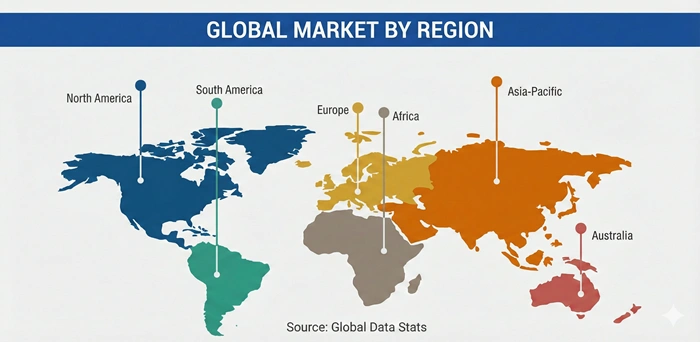
Europe commands the largest share of the global solar components recycling market at approximately 39% in 2025, generating around USD 149.76 million in annual recycling service revenue, and is projected to grow at a CAGR of 11.2% through 2033. The European Union's WEEE Directive has created a structurally sound compliance framework that mandates manufacturer-funded collection and recycling of end-of-life solar panels, with producer responsibility organizations like PV Cycle coordinating the collection and processing of millions of modules annually across EU member states. Germany, Italy, Spain, and France collectively account for the majority of European solar panel recycling volumes, reflecting their status as the continent's largest solar markets during the early installation growth period — and therefore the geographies generating the highest near-term decommissioning volumes. Key recycling operators active across Europe include Veolia Environment (France), REMA Solar (Germany), Envaris (Germany), and Recylex (France).
The German market is particularly advanced in terms of both regulatory compliance and technical sophistication, with the country's world-class mechanical engineering and specialty chemical industries having developed several of the most technically capable solar panel recycling process technologies in operation globally. The EU's growing focus on critical raw material security — codified in the Critical Raw Materials Act of 2024 — is adding policy momentum to investment in advanced silver and semiconductor material recovery from end-of-life solar panels, supporting the development of new chemical processing capabilities that will improve the economics of European solar components recycling operations. Europe's recycling infrastructure advantage provides it with a durable competitive lead over other regions, though Asia Pacific is rapidly closing the gap in both regulatory framework development and technical capability.
Asia Pacific
Asia Pacific's Rapidly Growing Solar Panel Decommissioning Pipeline, Progressive EPR Regulatory Development, and World-Class Industrial Recycling Infrastructure Position It as the Most Dynamically Growing Region in the Solar Components Recycling Market
Asia Pacific is the fastest-growing regional market for solar components recycling with approximately 28% market share in 2025 and a projected CAGR of approximately 14.8% through 2033 — the highest of any region globally. Japan was among the earliest Asian markets to develop comprehensive solar panel recycling regulations, with the country's national government introducing specific photovoltaic waste management guidelines that are progressively moving toward mandatory EPR requirements, and major Japanese industrial companies including Sharp Corporation and Panasonic having developed advanced panel recycling capabilities. China, as the world's largest solar manufacturing and installation market, is generating an enormous and rapidly growing volume of end-of-life panels — and is investing heavily in domestic recycling infrastructure to manage this material sustainably, driven by both environmental policy objectives and the strategic value of recovered critical materials.
South Korea has implemented producer responsibility regulations for solar panel waste that are driving formal recycling industry development, while India — with one of the fastest-growing solar installation bases globally — is beginning to address photovoltaic waste through its evolving e-waste management rules. The combination of enormous installed base decommissioning volumes, progressive regulatory development, abundant industrial recycling expertise, and growing critical material recovery commercial incentives makes Asia Pacific the most commercially dynamic region in the solar components recycling market. Key companies operating in the region include ENEOS Holdings (Japan), SK Ecoplant (South Korea), Jinko Solar recycling initiatives (China), and CERO Recycling (India), alongside international operators expanding into regional markets.
Report Customization: Region-Wise and Country-Wise Insights Available on Request
This Report Is Fully Customizable for All Major Regions and Countries — Delivering Locally Specific Solar Components Recycling Market Intelligence, Regulatory Analysis, Competitive Landscape Assessments, and Investment Opportunity Insights That Match Your Exact Geographic and Strategic Focus
Customized versions of this report are available for all major regions and countries listed below, providing in-depth market analysis, regulatory framework assessments, end-of-life panel volume projections, competitive landscape profiles, and material recovery opportunity analysis tailored to the solar components recycling market in each selected geography.
North America
-
U.S. — state-level EPR framework landscape, federal regulatory outlook for PV waste management, utility-scale decommissioning market pipeline, key recycling operator profiles, and critical material recovery commercial opportunity analysis
-
Canada — provincial regulatory environment, domestic panel decommissioning timeline analysis, and key market participant profiles in solar waste management
-
Mexico — environmental regulation framework, growing solar installation base decommissioning outlook, and import/export dynamics for recyclable solar materials
Europe
-
U.K. — post-Brexit WEEE implementation status, domestic solar decommissioning volumes, key operator profiles, and regulatory alignment outlook with EU frameworks
-
Germany — leading solar recycling technology landscape, REMA Solar and Envaris competitive analysis, regulatory compliance framework, and critical material recovery market development
-
France — Veolia and Recylex competitive positioning, French EPR compliance market analysis, government-supported circular economy program impacts on solar recycling
-
Italy — high solar installation density and decommissioning timeline analysis, Italian EPR compliance framework, and recycling capacity investment landscape
-
Rest of Europe — Nordic and Eastern European EPR framework development, WEEE compliance market analysis, and emerging solar decommissioning opportunity pipeline
Asia Pacific
-
China — domestic production-based decommissioning volumes, government circular economy policy impacts, capacity investment analysis for domestic recycling infrastructure, and critical material recovery strategic landscape
-
India — e-waste regulation evolution for PV waste, growing decommissioning pipeline, domestic recycling capacity development, and CERO Recycling competitive analysis
-
Japan — regulatory framework maturity analysis, Sharp and Panasonic recycling program assessment, domestic decommissioning timeline, and advanced recycling technology landscape
-
South Korea — EPR regulation implementation analysis, SK Ecoplant and other operator profiles, and Korea's critical material recovery policy landscape for solar components
-
Australia — COAG framework for solar panel waste, growing decommissioning volumes from early adoption installations, and market development analysis for domestic recycling infrastructure
-
Rest of Asia Pacific — Southeast Asian regulatory development landscape, regional decommissioning volume forecasts, and market entry opportunity assessment for recycling operators
Latin America
-
Brazil — CONAMA environmental regulation framework, solar expansion decommissioning outlook, and domestic recycling industry development analysis
-
Argentina — national waste management regulatory landscape, solar decommissioning pipeline, and recycling infrastructure investment opportunity analysis
-
Rest of Latin America — regional regulatory development trends, growing solar installation base decommissioning outlook, and market entry opportunity assessment
Middle East & Africa
-
UAE — ESMA regulatory framework, government sustainability program impacts on solar waste management, and decommissioning pipeline from early large-scale desert solar installations
-
Saudi Arabia — Vision 2030 solar expansion decommissioning outlook, national waste management framework development, and recycling industry investment opportunity analysis
-
Rest of MEA — Sub-Saharan African solar expansion decommissioning pipeline, MEA regulatory development landscape, and strategic market entry opportunity analysis for solar recycling operators
Top Key Players
-
Veolia Environment SA (France)
-
PV Cycle AISBL (Belgium)
-
First Solar Inc. (United States)
-
REMA Solar GmbH (Germany)
-
Envaris GmbH (Germany)
-
Umicore SA (Belgium)
-
SUEZ SA (France)
-
Solarcycle Inc. (United States)
-
ENEOS Holdings Inc. (Japan)
-
SK Ecoplant Co. Ltd. (South Korea)
-
Recylex SA (France)
-
CERO Recycling Pvt. Ltd. (India)
-
Covanta Holding Corporation (United States)
-
Enel Green Power SpA (Italy)
-
Jinko Solar Co. Ltd. (China)
Recent Developments
-
In 2025, Solarcycle Inc. secured a significant long-term offtake and processing partnership with a major U.S. utility for the decommissioning and recycling of approximately 1 million end-of-life solar panels from aging utility-scale solar farms across the southwestern United States, marking one of the largest single solar components recycling contracts executed in the North American market and demonstrating the growing scale of the utility decommissioning market.
-
In 2025, Veolia Environment SA expanded its dedicated photovoltaic panel recycling capabilities in France with the installation of a new high-throughput mechanical and thermal processing line at its Angers facility, increasing annual solar panel processing capacity by 40% to meet growing demand from French EPR compliance programs and cross-border European decommissioning projects.
-
In 2026, First Solar Inc. announced the commercial launch of its advanced closed-loop recycling program for its CdTe thin-film modules, enabling recovery of over 90% of glass and semiconductor materials from end-of-life panels for direct reincorporation into new panel manufacturing — representing a significant technical advancement in circular economy performance for the solar components recycling sector.
-
In 2025, SK Ecoplant Co. Ltd. (South Korea) entered into a joint venture agreement with a Chinese recycling technology company to develop and operate dedicated solar panel recycling facilities in South Korea and Southeast Asia, targeting the growing regional wave of end-of-life panel decommissioning and positioning the partnership as a leading solar waste management operator across the Asia Pacific region.
-
In 2024, Umicore SA completed a strategic acquisition of a European specialist in hydrometallurgical precious metal recovery from photovoltaic waste streams, significantly strengthening its silver and semiconductor material extraction capabilities for solar components recycling and positioning the company to benefit from growing demand for high-purity recovered silver from both panel manufacturers and the secondary precious metals market.
Market Trends
The Convergence of Critical Mineral Recovery Commercial Opportunity and Design-for-Recycling Industry Transformation Is Defining the Next Phase of Growth and Innovation in the Solar Components Recycling Market
One of the most commercially significant trends reshaping the solar components recycling market is the growing recognition of end-of-life panels as a valuable secondary resource rather than simply a waste management problem. As silver prices remain elevated, silicon semiconductor demand grows, and geopolitical focus on critical mineral supply chain security intensifies, the materials recoverable from decommissioned solar panels are increasingly viewed as strategically important domestic resources. This perspective shift is driving investment in more advanced chemical and hydrometallurgical recycling technologies that can achieve higher silver and semiconductor recovery yields — and is attracting new entrants to the solar recycling market from the precious metals refining, specialty chemical, and critical minerals industries who see the growing panel waste stream as a valuable feedstock for their existing material processing capabilities.
A second defining trend is the accelerating adoption of design-for-recycling principles by solar panel manufacturers, driven by regulatory requirements, sustainability commitments, and the commercial logic of facilitating higher-value material recovery from their own products. Initiatives including the elimination of problematic backsheet materials, the development of more easily removed encapsulant formulations, and the standardization of module construction to simplify disassembly are progressively improving the recyclability of new-generation solar panels. The International Energy Agency and the EU Solar Energy Industry Association are both actively promoting design-for-recycling standards that, if widely adopted, will meaningfully improve the recovery economics of the solar components recycling industry in the medium to long term. As these next-generation recyclable panels begin to enter the decommissioning stream in the 2030s and 2040s, the overall economics and material recovery quality of the solar recycling value chain will improve substantially.
Segments Covered in the Report
By Component Type
-
Photovoltaic Modules
-
Monocrystalline Silicon Panels
-
Polycrystalline Silicon Panels
-
Thin-Film Modules (CdTe, CIGS, a-Si)
-
-
Inverters and Power Electronics
-
Mounting Structures and Racking (Aluminum, Steel)
-
Cables, Connectors, and Wiring
-
Battery Energy Storage Components (Co-located)
By Recycling Process
-
Mechanical Processing
-
Crushing and Milling
-
Sieving and Separation
-
-
Chemical/Hydrometallurgical Processing
-
Acid Leaching
-
Solvent Extraction and Precipitation
-
-
Thermal Processing
-
High-Temperature Encapsulant Removal
-
Pyrolysis
-
-
Combined/Hybrid Process Technologies
By Technology
-
Monocrystalline Silicon Recycling
-
Polycrystalline Silicon Recycling
-
Thin-Film (CdTe/CIGS) Recycling
By End-User
-
Utility-Scale Solar Installations
-
Commercial and Industrial Solar Installations
-
Residential Solar Installations
-
Government and Institutional Solar Programs
By Region
-
North America (U.S., Canada, Mexico)
-
Europe (U.K., Germany, France, Italy, Rest of Europe)
-
Asia Pacific (China, India, Japan, South Korea, Australia, Rest of Asia Pacific)
-
Latin America (Brazil, Argentina, Rest of Latin America)
-
Middle East & Africa (UAE, Saudi Arabia, Rest of MEA)
❝ Built for Every Level — From Startups to Industry Giants ❞
Here Is Exactly How This Report Works for You
-
For Tier 1 industrial recycling companies, renewable energy developers, utility operators, and large-scale solar panel manufacturers planning solar system decommissioning programs or recycling infrastructure investment, this report delivers detailed competitor revenue analysis, processing capacity benchmarking, and material recovery economics across Europe, Asia Pacific, and North America — alongside a structured geopolitical risk assessment covering how U.S. domestic content policies, EU Critical Raw Materials Act mandates, and China's export restrictions on critical minerals are reshaping supply chain strategies and creating both risks and high-value opportunities in the solar components recycling market that forward-looking operators need to understand and plan for now.
-
For Tier 2 and Tier 3 regional recycling operators, specialty chemical companies, precious metals refiners, and e-waste management businesses evaluating strategic entry or expansion into the solar components recycling market, this report maps detailed supply-demand dynamics across all major component types, recycling processes, end-user segments, and geographies — identifying where regulatory frameworks, decommissioning volume pipelines, and material recovery commercial opportunities are creating the most attractive entry points for companies with adjacent technical capabilities in waste processing, chemical recovery, or industrial material separation.
-
For private equity investors, infrastructure fund managers, clean technology venture capital firms, and corporate development teams evaluating investment opportunities in the rapidly emerging solar waste management and critical mineral recovery value chain, this report provides rigorous market size and CAGR forecasts by segment, a comprehensive review of recent M&A activity and technology partnerships, and a forward-looking analysis of how the convergence of regulatory tightening, utility-scale decommissioning contract market development, silver recovery premium economics, and design-for-recycling innovation are creating compelling investment return dynamics in the solar components recycling market through 2033 and well beyond.
Frequently Asked Questions
Question 1: What is the current market size of the solar components recycling market and what will it be worth by 2033?
Answer: The solar components recycling market is valued at USD 384.01 million in 2025 and is projected to reach approximately USD 1006.97 million by 2033. The market is expanding at a CAGR of 12.1% from 2026 to 2033, driven by the accelerating wave of end-of-life photovoltaic panel decommissioning and tightening global regulatory mandates for responsible solar waste management.
Question 2: What materials can be recovered through solar components recycling?
Answer: The solar components recycling process enables recovery of several valuable materials including tempered glass (comprising approximately 75% of panel weight), aluminum frames, copper wiring, silicon semiconductor material, and silver — which is present in crystalline silicon panels as contact metallization and represents the highest unit-value recoverable material. Thin-film panels also contain recoverable cadmium, tellurium, and indium that are critical materials for new panel manufacturing.
Question 3: Which region dominates the solar components recycling market and why?
Answer: Europe leads the solar components recycling market with approximately 39% market share in 2025, driven by the EU WEEE Directive's mandatory producer responsibility framework that requires solar panel manufacturers to fund collection and recycling programs across all EU member states. The region benefits from decades of established recycling infrastructure, advanced processing technology, and mature industry operators that have been systematically processing end-of-life photovoltaic modules since the mid-2010s.
Question 4: What are the main challenges facing the solar components recycling market today?
Answer: The most significant challenges include the relatively high cost of solar panel recycling compared to conventional landfill disposal in markets without strong regulatory mandates, and the logistical complexity of collecting bulky and fragile panels from geographically dispersed residential and commercial installation sites. The absence of comprehensive federal EPR legislation in the United States — the world's second-largest solar market — also limits the pace of formal recycling market development in North America compared to Europe and Japan.
Question 5: How is the solar components recycling market expected to grow as solar panel decommissioning volumes increase?
Answer: The solar components recycling market is projected to more than double from USD 430.92 million in 2026 to approximately USD 1006.97 million by 2033, driven by exponentially growing end-of-life panel volumes as first- and second-generation solar installations reach their 20–25 year design lifespan. The continued maturation of advanced chemical recycling technologies for higher-value silver and semiconductor material recovery, combined with expanding regulatory frameworks globally, is expected to sustain strong double-digit growth rates throughout the forecast period.