
Sodium-Ion Battery Market Overview
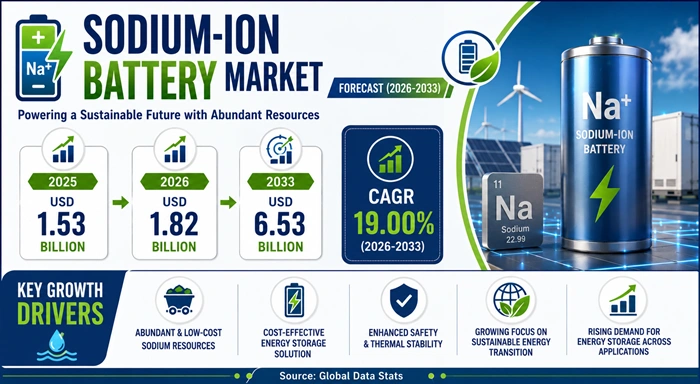
The global sodium-ion battery market size is valued at USD 1.53 billion in 2025 and is predicted to increase from USD 1.82 billion in 2026 to approximately USD 6.53 billion by 2033, growing at a CAGR of 19.00% from 2026 to 2033.
Sodium-ion batteries represent emerging energy storage technology utilizing abundant sodium ions as charge carriers instead of scarce lithium, offering cost-effective and sustainable alternatives for stationary storage and transportation applications. These electrochemical devices operate through reversible intercalation of sodium ions between anode and cathode materials during charge-discharge cycles, delivering comparable performance to lithium-ion systems while eliminating supply chain vulnerabilities associated with lithium, cobalt, and nickel. The sodium-ion battery market encompasses diverse applications including grid-scale energy storage, electric vehicles, consumer electronics, and industrial equipment where abundant raw materials, enhanced safety characteristics, and favorable environmental profiles position sodium technology as compelling solution addressing energy transition requirements and resource sustainability challenges.
AI Impact On The Sodium-Ion Battery Industry
Accelerating Material Discovery And Manufacturing Optimization Through Computational Intelligence
Artificial intelligence revolutionizes sodium-ion battery development by enabling accelerated material discovery identifying optimal electrode compositions, electrolyte formulations, and cell architectures achieving superior performance characteristics including energy density, cycle life, and charging rates. Machine learning algorithms analyze vast datasets from computational simulations, laboratory experiments, and commercial operations predicting material properties, degradation mechanisms, and failure modes guiding research priorities toward most promising candidates. High-throughput screening utilizing AI evaluates thousands of potential material combinations identifying candidates with desired electrochemical properties, structural stability, and manufacturing feasibility reducing development timelines from years to months. The sodium-ion battery market benefits from AI-driven optimization of manufacturing processes including electrode coating uniformity, electrolyte filling precision, and cell formation protocols improving product quality, yield rates, and production efficiency while minimizing waste and energy consumption across gigafactory-scale production facilities.
Digital twin technology creates virtual replicas of battery cells, modules, and systems enabling engineers to simulate operational scenarios, validate thermal management strategies, and optimize control algorithms without physical prototyping reducing development costs and time-to-market. Predictive analytics forecast battery degradation based on usage patterns, environmental conditions, and operational stresses enabling intelligent battery management systems maximizing lifespan and performance. The sodium-ion battery market witnesses enhanced safety as AI-powered monitoring systems detect thermal runaway precursors, internal short circuits, and abnormal electrochemical conditions implementing protective actions preventing catastrophic failures. Computer vision systems inspect electrode surfaces, separator alignment, and cell assembly detecting manufacturing defects invisible to human inspection improving quality assurance. Natural language processing analyzes scientific literature, patent databases, and technical reports identifying emerging trends, competitive developments, and breakthrough innovations informing strategic planning and research directions. Robotic automation guided by machine learning optimizes handling procedures, assembly sequences, and quality control processes achieving precision and repeatability impossible with manual operations supporting scalable manufacturing infrastructure.
Growth Factors
Lithium Supply Concerns And Cost Advantages Driving Market Expansion
Lithium supply constraints create compelling drivers for sodium-ion battery adoption as electric vehicle proliferation, grid storage deployment, and consumer electronics demand strain available lithium resources potentially creating shortages and price volatility. Lithium prices fluctuated dramatically from USD 7000 per ton to over USD 80000 per ton between 2020-2022 demonstrating supply vulnerability and cost unpredictability. Sodium abundance eliminates resource constraints as sodium reserves exceed lithium by over 1000-fold enabling sustainable long-term scaling without geopolitical concentration or environmental degradation associated with lithium extraction. The sodium-ion battery market expands rapidly as manufacturers develop cost-effective alternatives reducing material expenses 30-50% compared to lithium-ion equivalents through elimination of expensive cobalt, nickel, and lithium compounds. Automotive manufacturers including BYD, Chery, and JAC Motors announce sodium-ion vehicle launches targeting cost-sensitive market segments where affordable pricing proves more critical than maximum energy density or premium performance characteristics.
Government policies worldwide establish frameworks promoting diverse battery chemistries reducing dependence on single technologies vulnerable to supply disruptions or geopolitical tensions. China's 14th Five-Year Plan identifies sodium-ion batteries as strategic technology receiving research funding, manufacturing incentives, and commercialization support. European Union Critical Raw Materials Act promotes alternative battery chemistries reducing reliance on imported lithium and cobalt. The sodium-ion battery market benefits from environmental sustainability advantages as sodium extraction proves less environmentally intensive than lithium mining while battery recycling achieves higher material recovery rates and simpler processing compared to complex lithium-ion recycling. Safety improvements including elimination of thermal runaway risks, tolerance to full discharge without degradation, and operational stability across wide temperature ranges address critical concerns limiting lithium-ion deployment in certain applications. Grid storage applications particularly favor sodium technology as stationary systems prioritize cost-effectiveness and safety over maximum energy density while benefiting from sodium batteries' ability to discharge to zero volts enabling complete utilization and simplified logistics.

Market Outlook
Commercial Production And Technology Maturation Shaping Industry Evolution
Commercial production scale-up accelerates as leading manufacturers transition from pilot facilities to gigawatt-hour scale manufacturing capacity. CATL operates first-generation sodium-ion production lines targeting 2026 commercial deployment in electric vehicles and energy storage systems. HiNa Battery Technology completes 1 GWh production facility while Natron Energy expands North American manufacturing serving data center and industrial applications. The sodium-ion battery market witnesses growing technology maturation as cathode materials including Prussian blue analogs, layered oxides, and polyanionic compounds achieve energy densities approaching 160 Wh/kg rivaling lithium iron phosphate systems. Anode innovations utilizing hard carbon, soft carbon, and titanium-based materials improve cycling stability, rate capability, and low-temperature performance addressing initial technical limitations constraining commercial viability.
Hybrid lithium-sodium configurations emerge optimizing cost-performance tradeoffs by combining lithium-ion and sodium-ion cells within single battery packs balancing energy density, power capability, cost, and safety. Fast-charging capabilities advance as electrode designs, electrolyte formulations, and thermal management systems enable 10-15 minute charging times suitable for electric vehicle applications competing with lithium-ion convenience. The sodium-ion battery market benefits from standardization initiatives as industry consortia develop common specifications, testing protocols, and safety standards facilitating market acceptance and regulatory approval. Second-life applications create additional value as sodium batteries removed from automotive service after performance degradation continue operating in stationary storage applications extending total useful life and improving economic returns. Technology convergence with renewable energy systems positions sodium-ion batteries as enabling infrastructure supporting solar, wind, and grid stabilization applications where cost-effectiveness, long cycle life, and safety characteristics prove more critical than maximum energy density. Manufacturing automation reduces production costs through economies of scale, process optimization, and yield improvements making sodium technology increasingly competitive across broader application spectrum.
Expert Speaks
-
Robin Zeng, Founder and Chairman at Contemporary Amperex Technology Co. Limited (CATL), emphasized through recent announcements that sodium-ion batteries represent next-generation energy storage solution addressing lithium supply constraints and cost challenges, noting that CATL's first-generation sodium-ion battery achieving 160 Wh/kg energy density with room-temperature charging capability positions technology for commercial deployment in electric vehicles and stationary storage supporting global energy transition and sustainable transportation objectives.
-
Elon Musk, CEO at Tesla, mentioned during investor presentations that while lithium remains optimal for maximum performance applications, alternative battery chemistries including sodium-ion technology offer compelling value propositions for cost-sensitive market segments and stationary storage applications, emphasizing that diverse battery technologies addressing different use cases strengthen overall ecosystem resilience and accelerate sustainable energy adoption globally.
-
Herbert Diess, former CEO at Volkswagen Group, highlighted through industry forums that automotive manufacturers actively explore multiple battery technologies ensuring supply chain diversification and cost optimization, stating that sodium-ion batteries potentially serve entry-level electric vehicle segments and commercial applications where operational cost proves more critical than maximum driving range supporting broader market electrification and emissions reduction targets.
Key Report Takeaways
-
Asia Pacific dominates the sodium-ion battery market capturing approximately 58% regional share valued around USD 0.89 billion in 2025, driven by Chinese manufacturers leading commercialization efforts, substantial government research funding, established battery manufacturing infrastructure, massive electric vehicle market, and grid storage deployment supporting renewable energy integration.
-
North America emerges as fastest-growing region with projected CAGR exceeding 20.5% through 2033, fueled by federal funding for advanced battery research, lithium supply chain concerns, grid modernization initiatives, data center energy storage requirements, and technology innovation advancing manufacturing capabilities and commercial applications.
-
Energy storage systems represent the largest application segment accounting for approximately 61% market share due to grid-scale installations prioritizing cost-effectiveness over energy density, long cycle life requirements, safety advantages for large installations, and government incentives supporting renewable integration and grid stability.
-
Non-aqueous sodium-ion batteries contribute the most significant demand representing roughly 73% of total market as organic electrolyte systems deliver superior energy density, wider operating temperature ranges, better cycling stability, and established manufacturing infrastructure compared to aqueous alternatives.
-
Utilities segment maintains dominant end-user position commanding nearly 52% market share owing to grid storage investments, renewable energy integration requirements, cost-sensitivity favoring economical storage solutions, and regulatory frameworks promoting energy storage deployment supporting grid resilience and decarbonization objectives.
-
Automotive application exhibits fastest growth trajectory projected to expand at 21.8% CAGR through 2033 with market share reaching approximately 28%, driven by electric vehicle cost reduction priorities, entry-level EV segment development, commercial fleet applications, and manufacturers' commitments launching sodium-powered vehicles addressing mass-market affordability requirements.
Market Scope
| Report Coverage | Details |
|---|---|
| Market Size by 2033 | USD 6.53 Billion |
| Market Size by 2025 | USD 1.53 Billion |
| Market Size by 2026 | USD 1.82 Billion |
| Market Growth Rate from 2026 to 2033 | CAGR of 19.00% |
| Dominating Region | Asia Pacific |
| Fastest Growing Region | North America |
| Base Year | 2025 |
| Forecast Period | 2026 to 2033 |
| Segments Covered | Battery Type, Application, End-User, Region |
| Regions Covered | North America, Europe, Asia-Pacific, Latin America, Middle East and Africa |
Market Dynamics
Drivers Impact Analysis
Resource Abundance And Cost Economics Accelerating Technology Adoption
| Factor | (≈) % Impact on CAGR Forecast | Geographic Relevance | Impact Timeline |
|---|---|---|---|
| Lithium supply concerns and price volatility | 26-32% | Global, particularly import-dependent regions | 2026-2033 |
| Cost reduction versus lithium-ion | 23-29% | Price-sensitive markets, emerging economies | 2026-2033 |
| Grid storage deployment | 20-26% | Renewable-heavy grids, deregulated markets | 2026-2033 |
Sodium abundance fundamentally transforms battery economics as global sodium reserves distributed across oceans, salt deposits, and mineral formations eliminate supply constraints, geopolitical dependencies, and price volatility affecting lithium markets. Sodium extraction from seawater or evaporative salt production proves environmentally benign and economically scalable supporting unlimited long-term growth. Manufacturing cost advantages emerge as sodium-ion batteries eliminate expensive materials including lithium carbonate, cobalt oxide, and nickel compounds reducing raw material expenses 40-60% compared to conventional lithium-ion cells. The sodium-ion battery market expands substantially as cost-sensitive applications including grid storage, low-speed electric vehicles, backup power systems, and developing market transportation prioritize affordability over maximum performance characteristics. Production scaling drives additional cost reductions through manufacturing learning curves, process optimization, and supply chain development achieving cost parity or advantages versus lithium iron phosphate batteries projected within 3-5 years.
Grid-scale energy storage deployment accelerates globally supporting renewable energy integration, grid stability, frequency regulation, and peak demand management. Stationary storage applications prioritize cost-effectiveness, long cycle life, and safety over maximum energy density making sodium technology ideally suited. The sodium-ion battery market benefits from government incentives including investment tax credits, accelerated depreciation, and capacity payments supporting energy storage economics. Renewable portfolio standards, carbon pricing, and grid reliability requirements drive substantial storage capacity additions. Sodium batteries' unique advantage discharging to zero volts without degradation enables complete utilization and simplifies logistics versus lithium-ion systems requiring maintained charge states. Safety characteristics including thermal stability, minimal fire risk, and non-toxic materials reduce installation costs, insurance premiums, and regulatory barriers particularly for large-scale installations near populated areas. Climate goals establish aggressive energy storage deployment targets with projections indicating 1000+ GWh annual installations by 2030 creating enormous market opportunity where sodium technology captures substantial share particularly in cost-optimized applications.

Restraints Impact Analysis
Energy Density Limitations And Technology Immaturity Limiting Adoption Pace
| Factor | (≈) % Impact on CAGR Forecast | Geographic Relevance | Impact Timeline |
|---|---|---|---|
| Lower energy density versus lithium-ion | -15 to -20% | Performance-critical applications | 2026-2033 |
| Limited commercial track record | -12 to -17% | Risk-averse adopters, regulated industries | 2026-2030 |
| Manufacturing infrastructure gaps | -9 to -14% | Regions lacking battery production | 2026-2029 |
Energy density limitations create performance challenges as current sodium-ion batteries deliver 120-160 Wh/kg compared to 180-280 Wh/kg for lithium-ion equivalents reducing vehicle driving range, requiring larger battery packs, and limiting suitability for space-constrained applications. Weight penalties affect vehicle efficiency, handling characteristics, and payload capacity particularly problematic for long-range passenger vehicles and commercial transportation. The sodium-ion battery market faces adoption barriers in premium automotive segments, portable electronics, and aerospace applications where maximum energy density proves critical. Volumetric energy density disadvantages create packaging challenges particularly for consumer electronics and compact vehicle designs. Performance gaps versus established lithium technology require substantial improvements through continued research and development before achieving competitiveness across full application spectrum.
Limited commercial operating history creates market acceptance challenges as customers require proven long-term reliability, cycle life validation, and field performance data before committing to large-scale deployments. Warranty obligations, liability concerns, and regulatory approvals prove more difficult without extensive operational track records. The sodium-ion battery market confronts skepticism from conservative adopters particularly in safety-critical, mission-essential, or long-lifetime applications including medical equipment, telecommunications infrastructure, and utility-scale installations. Standardization gaps create integration complexity as battery management systems, charging infrastructure, and safety protocols require adaptation supporting sodium-specific characteristics. Supply chain immaturity limits component availability, manufacturing capacity, and cost competitiveness as specialized materials, production equipment, and quality control processes remain under development. Recycling infrastructure proves underdeveloped creating end-of-life management uncertainty and potential regulatory barriers. Workforce expertise shortages challenge manufacturing scale-up as specialized knowledge regarding sodium chemistry, production processes, and application engineering remains concentrated among limited organizations requiring training programs and knowledge transfer supporting industry growth.
Opportunities Impact Analysis
Emerging Applications And Manufacturing Localization Creating Growth Pathways
| Factor | (≈) % Impact on CAGR Forecast | Geographic Relevance | Impact Timeline |
|---|---|---|---|
| Two-wheeler and three-wheeler electrification | +18 to +24% | Asia, developing markets | 2027-2033 |
| Data center backup power | +16 to +22% | Digital infrastructure hubs | 2027-2033 |
| Manufacturing localization | +14 to +20% | Import-dependent regions | 2027-2033 |
Electric two-wheeler and three-wheeler markets create substantial opportunity as hundreds of millions of motorcycles, scooters, auto-rickshaws, and delivery vehicles operate across Asia, Africa, and Latin America where cost-effectiveness proves more critical than maximum performance. Sodium-ion batteries' lower cost enables affordable electrification addressing mass-market transportation needs while delivering adequate range for typical urban commuting and commercial delivery applications. The sodium-ion battery market captures growing demand from manufacturers including Hero Electric, Ola Electric, and Ather Energy developing economical electric two-wheelers targeting price-sensitive consumers. Swappable battery systems benefit from sodium technology's safety characteristics and full discharge tolerance simplifying battery-as-a-service business models. Commercial fleet applications including food delivery, postal services, and last-mile logistics prioritize operational cost over maximum range making sodium batteries optimal choice.
Data center energy storage emerges as high-value application as hyperscale facilities, edge computing infrastructure, and telecommunications networks require reliable backup power and demand management capabilities. Sodium batteries' safety characteristics, long cycle life, and cost-effectiveness prove ideal for mission-critical applications operating continuously within controlled environments. The sodium-ion battery market benefits from data center proliferation supporting artificial intelligence, cloud computing, and digital services. Uninterruptible power supply applications demand reliable energy storage tolerating frequent cycling and partial state-of-charge operation where sodium technology delivers advantages. Manufacturing localization opportunities emerge as governments promote domestic battery production reducing import dependence, creating employment, and strengthening industrial capabilities. United States Inflation Reduction Act provides tax credits supporting domestic advanced battery manufacturing. European Battery Alliance promotes regional production capacity. Sodium technology's reduced reliance on imported materials enables truly localized supply chains from raw material extraction through cell production and recycling supporting strategic independence and economic development objectives across multiple regions.

Segment Analysis
By Application: Energy Storage Systems
Grid Requirements And Cost Economics Establishing Segment Dominance
Energy storage systems dominate the sodium-ion battery market capturing approximately 61% share valued around USD 0.93 billion in 2025 owing to grid-scale installations prioritizing cost-effectiveness, long cycle life, and safety over maximum energy density. Stationary storage applications including frequency regulation, peak shaving, renewable integration, and transmission deferral benefit from sodium technology's economic advantages delivering levelized cost of storage 20-40% lower than lithium-ion alternatives. Utility-scale projects spanning 10-300 MWh capacity deploy sodium batteries achieving 4000-8000 cycle lifetimes supporting 10-15 year operational periods. The sodium-ion battery market benefits from grid modernization investments, renewable energy mandates, and electricity market reforms creating value streams supporting energy storage economics including capacity payments, ancillary services, and demand charge management.
Asia Pacific leads energy storage sodium-ion deployment with China installing grid-scale systems supporting wind and solar integration while India develops storage infrastructure addressing peak demand and grid reliability. Europe adopts sodium technology for residential and commercial energy storage complementing rooftop solar installations. North America witnesses growing installations supporting grid resilience, renewable firming, and demand flexibility. The sodium-ion battery market sees this segment maintaining robust 18.5% CAGR through 2033 as technology maturation improves performance while cost reductions enhance economic competitiveness. Leading energy storage developers including Fluence, Wartsila Energy Storage, and Powin Energy evaluate sodium-ion technology for specific applications. CATL supplies sodium-ion systems for Chinese grid operators while Natron Energy targets North American commercial and industrial customers. Technology focus includes container-based deployments, modular scalability, intelligent battery management, and integration with renewable generation supporting comprehensive energy storage solutions addressing diverse grid requirements and customer applications.
By End-User: Utilities
Grid Modernization And Renewable Integration Driving Segment Leadership
Utilities represent the largest segment in the sodium-ion battery market commanding approximately 52% share valued around USD 0.80 billion in 2025, driven by electric power companies investing in grid-scale storage supporting renewable integration, grid stability, transmission upgrades, and ancillary services. Vertically-integrated utilities deploy storage systems optimizing generation portfolios, managing peak demands, and deferring infrastructure investments through non-wires alternatives. Renewable energy developers co-locate storage with wind and solar projects enhancing dispatchability, firming intermittent generation, and qualifying for capacity payments. The sodium-ion battery market benefits from utility sector emphasis on cost-effectiveness, operational reliability, and long-term performance positioning sodium technology as compelling alternative to lithium-ion systems for specific applications where energy density proves less critical than economics.
North America leads utility sodium-ion adoption as independent system operators establish energy storage mandates, capacity markets, and frequency regulation programs creating revenue opportunities. European utilities invest in storage supporting renewable targets and grid balancing. Asia Pacific power companies deploy substantial capacity addressing load growth, renewable integration, and grid reliability. The sodium-ion battery market witnesses this segment growing at steady 18.7% CAGR through 2033 driven by renewable energy expansion, grid modernization programs, and regulatory frameworks supporting storage deployment. Leading utility operators including Duke Energy, National Grid, and State Grid Corporation evaluate sodium-ion technology for pilot projects and commercial deployments. Technology providers develop utility-specific solutions including megawatt-scale inverters, grid-forming capabilities, and advanced controls enabling seamless integration with existing infrastructure. Safety certifications, insurance approvals, and regulatory compliance prove critical for utility acceptance requiring extensive testing, performance validation, and standards development supporting market penetration across conservative industry characterized by long asset lifetimes and stringent reliability requirements.

Regional Insights
Asia Pacific
Manufacturing Leadership And Government Support Cementing Regional Market Dominance
Asia Pacific dominates the sodium-ion battery market commanding approximately 58% global share valued at USD 0.89 billion in 2025, projected to reach USD 3.71 billion by 2033 growing at 19.5% CAGR. China establishes overwhelming regional and global leadership through government strategic planning identifying sodium-ion batteries as critical technology receiving research funding, commercialization support, and industrial policy backing. Leading manufacturers including CATL, HiNa Battery Technology, and Faradion (acquired by Reliance Industries) operate production facilities and development programs advancing technology maturation and commercial deployment. The sodium-ion battery market benefits from China's complete battery manufacturing ecosystem spanning raw materials, electrode production, cell assembly, and pack integration supporting rapid scaling and cost reduction. Automotive manufacturers including BYD, Chery, and SAIC Motor announce vehicle platforms utilizing sodium-ion batteries targeting cost-sensitive market segments.
Japan contributes technological innovation through materials research, cell design, and manufacturing process development led by institutions and companies including NIMS and Toshiba. India emerges as major growth opportunity as government programs including Production Linked Incentive scheme promote domestic battery manufacturing while electric vehicle adoption and renewable energy deployment create substantial storage demand. Southeast Asian nations including Indonesia, Vietnam, and Thailand develop battery industries targeting regional electric vehicle and energy storage markets. The sodium-ion battery market witnesses regional collaboration as technology transfer agreements, joint ventures, and supply chain partnerships accelerate capabilities across multiple countries. Research institutions, national laboratories, and industry consortia advance fundamental science, applied engineering, and commercialization pathways. Government policies including import tariffs, local content requirements, and technology standards shape market development. Manufacturing automation, production scaling, and continuous improvement drive cost reductions positioning Asia Pacific as dominant global supplier throughout forecast period.
North America
Innovation Focus And Supply Chain Security Driving Fastest Regional Growth
North America emerges as fastest-growing region in the sodium-ion battery market with CAGR exceeding 20.5% from 2026 to 2033, with market value expanding from approximately USD 0.39 billion in 2025 toward USD 1.49 billion by 2033. United States leads regional growth through federal programs including Department of Energy funding supporting advanced battery research, manufacturing demonstrations, and commercialization initiatives. Inflation Reduction Act provides tax credits for domestic battery production and clean energy storage driving investment in manufacturing capacity and technology development. The sodium-ion battery market captures momentum from national security concerns regarding lithium supply chains concentrated in geopolitical competitors motivating diversification toward domestically-sourced alternatives. Critical minerals strategy identifies sodium abundance and domestic availability as strategic advantages supporting supply chain resilience.
Innovation ecosystem including national laboratories, research universities, and technology startups advances sodium-ion science and engineering. Natron Energy operates commercial production targeting data center and industrial applications while Altris AB establishes North American presence. Automotive manufacturers evaluate sodium technology for specific vehicle platforms and market segments. Energy storage developers incorporate sodium-ion systems into project portfolios targeting cost-optimized applications. The sodium-ion battery market benefits from North American technology leadership in battery management systems, thermal management, manufacturing automation, and system integration. Venture capital funding, government grants, and corporate partnerships support startup companies and research programs. Industry associations, standards organizations, and regulatory bodies develop frameworks supporting safe deployment and market acceptance. Workforce development initiatives including training programs and academic curricula build human capital supporting industry growth. Technology innovation, strategic priorities, funding availability, and market opportunities position North America as primary growth engine for global sodium-ion battery expansion throughout forecast period.
Top Key Players
-
Contemporary Amperex Technology Co. Limited (CATL) (China)
-
HiNa Battery Technology Co., Ltd. (China)
-
Natron Energy, Inc. (United States)
-
Faradion Limited (United Kingdom, acquired by Reliance Industries)
-
Altris AB (Sweden)
-
Tiamat Energy (France)
-
Novonix Limited (Australia)
-
NGK Insulators, Ltd. (Japan)
-
Samsung SDI Co., Ltd. (South Korea)
-
Panasonic Holdings Corporation (Japan)
-
BYD Company Limited (China)
-
AMTE Power plc (United Kingdom)
-
Liaoning Xingkong New Energy Technology Co., Ltd. (China)
-
Jiangsu Zoolnasm Energy Technology Co., Ltd. (China)
-
Northvolt AB (Sweden)
Recent Developments
-
CATL (July 2024): Announced first-generation sodium-ion battery achieving 160 Wh/kg energy density with capability charging to 80% capacity in 15 minutes at room temperature, demonstrating commercial viability for electric vehicle and energy storage applications with planned 2026 mass production supporting automotive customers including Chery and JAC Motors developing affordable electric vehicles targeting cost-sensitive market segments.
-
Natron Energy (September 2024): Inaugurated 600 MWh annual production facility in Michigan representing first large-scale sodium-ion battery manufacturing plant in United States, utilizing Prussian blue electrode technology delivering exceptional power density, cycle life exceeding 50000 cycles, and fast-charging capabilities targeting data center backup power, material handling equipment, and grid services applications.
-
HiNa Battery Technology (August 2024): Secured major commercial contract supplying sodium-ion battery systems for grid-scale energy storage project in China totaling 100 MWh capacity, demonstrating technology readiness for utility applications with layered oxide cathode chemistry delivering cost advantages while meeting performance requirements for renewable integration and grid stability services.
-
Reliance Industries through Faradion (October 2024): Announced plans establishing gigawatt-hour scale sodium-ion battery manufacturing facility in India targeting domestic electric vehicle market and energy storage applications, leveraging acquired Faradion technology and intellectual property supporting India's battery manufacturing ambitions and electric mobility goals with initial production commencing 2026.
-
Altris AB (June 2024): Completed Series A funding round raising USD 12 million supporting commercialization of Prussian white cathode material technology offering superior sustainability profile through iron-based chemistry eliminating need for nickel and cobalt while delivering competitive performance for stationary storage applications, with pilot production facility operational in Sweden.
Market Trends
Automotive Integration And Manufacturing Scaling Reshaping Technology Development
Automotive applications advance rapidly as manufacturers announce concrete vehicle programs utilizing sodium-ion batteries addressing cost-sensitive market segments including entry-level passenger cars, commercial vehicles, and electric two-wheelers. BYD develops sodium-powered vehicles for Chinese domestic market while international brands evaluate technology for specific platforms and regions. Vehicle integration strategies include hybrid lithium-sodium configurations combining both technologies within single battery pack optimizing cost-performance characteristics where sodium cells handle lower-power continuous operation while lithium cells provide peak acceleration and fast-charging capabilities. The sodium-ion battery market witnesses automotive validation driving technology improvements including energy density increases through advanced cathode materials, enhanced low-temperature performance supporting cold-climate operation, and fast-charging capabilities approaching lithium-ion benchmarks. Battery management system development addresses sodium-specific characteristics including voltage profiles, state-of-charge estimation algorithms, and thermal management requirements. Crash safety testing, electromagnetic compatibility certification, and regulatory approval processes validate sodium technology meeting automotive standards supporting commercial deployment across diverse vehicle categories and global markets.
Manufacturing scaling accelerates as multiple companies transition from pilot production toward gigawatt-hour annual capacity installations. Equipment suppliers develop specialized machinery for sodium-ion cell production adapting lithium-ion manufacturing infrastructure through electrode coating modifications, electrolyte handling systems, and formation process adjustments. The sodium-ion battery market benefits from manufacturing learning curves reducing costs through process optimization, yield improvements, and automation deployment. Supply chain development establishes dedicated sources for sodium-specific materials including hard carbon anodes, Prussian blue cathodes, and specialized electrolytes. Quality control systems ensure consistent performance across high-volume production. Recycling infrastructure emerges as companies develop processes recovering valuable materials and supporting circular economy principles. Second-life applications create additional value streams as automotive batteries reaching 70-80% capacity continue operating in stationary storage extending total useful life. Technology standardization initiatives promote interchangeability, reduce development costs, and accelerate market acceptance through common form factors, electrical interfaces, and communication protocols enabling component sourcing across multiple suppliers supporting competitive markets and customer choice.
Segments Covered In The Report
By Battery Type
-
Aqueous Sodium-Ion Battery
-
Non-Aqueous Sodium-Ion Battery
By Application
-
Energy Storage Systems (Grid Storage, Renewable Integration, UPS)
-
Automotive (Electric Vehicles, Two-Wheelers, Commercial Vehicles)
-
Consumer Electronics (Portable Devices, Power Tools)
-
Industrial (Material Handling, Telecommunications, Medical Equipment)
By End-User
-
Utilities
-
Automotive Manufacturers
-
Electronics Companies
-
Industrial Facilities
-
Commercial Enterprises
By Region
-
North America (United States, Canada, Mexico)
-
Europe (Germany, France, United Kingdom, Sweden, Spain, Rest of Europe)
-
Asia-Pacific (China, India, Japan, South Korea, Australia, Southeast Asia, Rest of Asia-Pacific)
-
Latin America (Brazil, Argentina, Rest of Latin America)
-
Middle East and Africa (Saudi Arabia, UAE, South Africa, Rest of MEA)
Frequently Asked Questions
Question 1: What is the expected size of the sodium-ion battery market by 2033?
Answer: The global sodium-ion battery market is projected to reach approximately USD 6.53 billion by 2033, expanding from USD 1.82 billion in 2026. This substantial growth reflects lithium supply concerns, cost advantages of sodium technology, grid storage deployment acceleration, automotive adoption for entry-level vehicles, and manufacturing capacity expansion supporting commercial scaling.
Question 2: Which region dominates the sodium-ion battery market currently?
Answer: Asia Pacific dominates the sodium-ion battery market with approximately 58% market share due to Chinese manufacturers leading commercialization efforts, substantial government research funding and industrial policy support, established battery manufacturing infrastructure, and massive electric vehicle and energy storage markets. The region benefits from complete supply chain ecosystems and technology leadership.
Question 3: What CAGR will the sodium-ion battery market experience from 2026 to 2033?
Answer: The sodium-ion battery market will grow at a compound annual growth rate of 19.00% from 2026 to 2033. This robust expansion reflects increasing commercial production capacity, automotive platform launches, grid storage deployments prioritizing cost-effectiveness, technology maturation improving performance characteristics, and manufacturing cost reductions enhancing competitiveness versus lithium-ion alternatives.
Question 4: Which application holds the largest share in the sodium-ion battery market?
Answer: Energy storage systems command the largest share at approximately 61% due to grid-scale installations prioritizing cost-effectiveness over energy density, long cycle life requirements, safety advantages for large deployments, and economic benefits for renewable integration and grid services. The sodium-ion battery market benefits from stationary applications where technology characteristics align optimally with operational requirements.
Question 5: What are the primary growth drivers for the sodium-ion battery market?
Answer: Primary drivers include lithium supply constraints and price volatility motivating alternative chemistries, sodium abundance eliminating resource limitations, material cost advantages reducing battery expenses 30-50%, and grid storage deployment supporting renewable integration. The sodium-ion battery market also benefits from automotive manufacturers launching affordable electric vehicles, safety improvements versus lithium-ion technology, government funding supporting commercialization, and manufacturing scaling driving cost reductions through economies of scale and learning curves.