
Soda Ash Market Overview
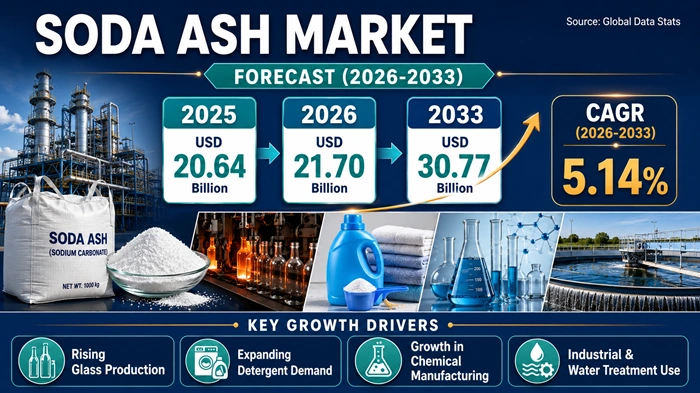
The global soda ash market size is valued at USD 20.64 billion in 2025 and is predicted to increase from USD 21.70 billion in 2026 to approximately USD 30.77 billion by 2033, growing at a CAGR of 5.14% from 2026 to 2033.
Soda ash, also known as sodium carbonate, is a key industrial alkali chemical used primarily as a raw material in glass manufacturing, detergent production, and various chemical processing applications. It occurs naturally as trona ore in regions like Wyoming and can also be manufactured synthetically through the Solvay process, giving producers flexibility depending on regional resource availability. Growing demand for flat and container glass, expanding detergent and cleaning product consumption, and rising investment in energy-efficient construction glazing are together sustaining steady, long-term growth for this foundational industrial chemical.
AI Impact on the Soda Ash Industry
How Digital Process Optimization and Predictive Maintenance Are Improving Efficiency Across Soda Ash Production Facilities
Artificial intelligence and advanced process automation are gradually reshaping how soda ash producers manage large-scale mining and manufacturing operations. Predictive maintenance systems powered by machine learning can now monitor equipment vibration, temperature, and pressure data in real time, allowing producers to identify potential mechanical failures before they cause costly unplanned shutdowns at trona mining and processing facilities. This capability is particularly valuable in the soda ash industry, where continuous, high-volume production runs are essential to meeting steady demand from glass and detergent manufacturers.
Beyond maintenance, digital process optimization tools are helping producers fine-tune energy consumption and chemical inputs across the Solvay process used in synthetic soda ash manufacturing, reducing both operating costs and carbon emissions per ton produced. Producers are increasingly using data analytics platforms to optimize logistics and rail transportation scheduling, particularly important given the bulky, high-volume nature of soda ash shipments from mining regions to end-use manufacturing hubs. As producers in the soda ash market continue investing in these digital efficiency tools, the industry is gradually becoming more cost-competitive and environmentally sustainable without requiring entirely new production technology.
Growth Factors
Rising Glass Manufacturing Demand, Growing Detergent Consumption, and Sustainable Chemical Feedstock Trends Are the Three Most Influential Growth Drivers
Expanding global glass manufacturing, particularly for flat glass used in construction and automotive applications, remains one of the most powerful growth factors sustaining long-term soda ash demand. Soda ash acts as a critical fluxing agent that lowers the melting point of silica sand during glass production, making it an essential and non-substitutable input for virtually all commercial glass manufacturing processes. As construction activity and electric vehicle production continue expanding globally, demand for energy-efficient architectural glass and lightweight automotive glazing is directly translating into stronger soda ash consumption across major manufacturing regions.
Growing consumption of detergents and household cleaning products represents a second significant driver, as rising urbanization and disposable incomes in developing economies increase demand for packaged cleaning products that rely on soda ash as a key raw material. The broader industry shift toward more sustainable, lower-carbon chemical feedstocks is also supporting demand for naturally mined soda ash, which requires significantly less energy to produce compared to synthetic manufacturing routes. Combined with steady growth in industrial chemical applications including water treatment and metallurgy, these factors continue to reinforce durable, multi-year demand growth across the global soda ash market.
Market Outlook
The Soda Ash Market Is Positioned for Stable, Long-Term Growth Through 2033 as Producers Balance Capacity Expansion With Sustainability Goals
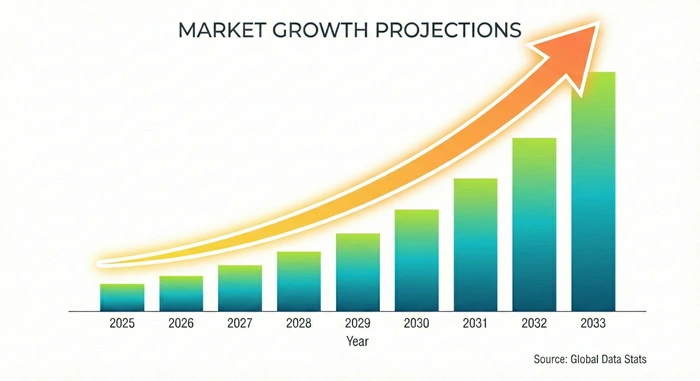
The long-term outlook for soda ash remains steady and positive, reflecting the chemical's fundamental role as an irreplaceable input across glass, detergent, and broader industrial chemical manufacturing. As producers with access to natural trona reserves continue expanding extraction capacity, particularly in North America and Turkey, the industry is expected to see a gradual shift in production mix favoring lower-cost, lower-emission natural soda ash over energy-intensive synthetic manufacturing routes. This transition is likely to reshape competitive dynamics between regions with strong natural resource access and those relying primarily on synthetic production.
Looking further ahead, continued investment in low-carbon production technology, including cleaner evaporative crystallization processes, is expected to help major producers meet tightening environmental regulations without sacrificing production volume. Growing export flows from resource-rich regions to fast-growing manufacturing hubs in Asia Pacific are also expected to reshape global trade patterns over the coming years. These dynamics point toward a maturing but still steadily expanding soda ash market, with sustainability-driven production shifts and export growth serving as key themes through 2033.
Expert Speaks
-
"Our continued investment in natural soda ash extraction reflects the growing global preference for lower-carbon, resource-efficient production methods, and we see strong long-term demand from both glass and chemical manufacturing customers." — CEO, Solvay S.A.
-
"Demand for soda ash from the glass industry remains remarkably resilient, and our expanding trona operations in Wyoming are well positioned to serve growing export demand from Asia and beyond." — CEO, Genesis Alkali.
-
"We continue to see steady growth across our global soda ash operations, supported by rising construction glazing demand and the ongoing shift toward more sustainable industrial chemical feedstocks." — CEO, Tata Chemicals Ltd.
Key Report Takeaways
-
Asia Pacific leads the soda ash market with an estimated 39% revenue share in 2025, supported by expanding glass, detergent, and chemical manufacturing infrastructure across China and India.
-
North America is the fastest-growing region, projected to expand at a CAGR near 6.9% through 2033, driven by robust export growth and advanced natural trona extraction techniques.
-
Glass manufacturers represent the largest customer base, relying on soda ash as an essential fluxing agent for flat, container, and solar glass production.
-
Glass industry applications contribute the most to overall demand, accounting for close to half of total soda ash consumption globally.
-
Natural soda ash production remains the most widely used process, valued for its lower energy requirements and cost advantages compared to synthetic manufacturing.
-
The synthetic soda ash segment is projected to grow fastest going forward in Asia-based manufacturing hubs, expected to hold a meaningful share by 2033 while expanding at a CAGR near 7.3% during the forecast period.
Market Scope
| Report Coverage Details | Details |
|---|---|
| Dominating Region | Asia Pacific |
| Fastest Growing Region | North America |
| Base Year | 2025 |
| Forecast Period | 2026 to 2033 |
| Segments Covered | By Type, By Grade, By Application, By End Use, By Region |
| Regions Covered | North America, Europe, Asia Pacific, Latin America, Middle East & Africa |
Market Dynamics
Drivers Impact Analysis
Expanding Glass Manufacturing and Rising Detergent Demand Are the Most Commercially Significant Drivers of Market Growth
| Driver | (≈) % Impact on CAGR Forecast | Geographic Relevance | Impact Timeline |
|---|---|---|---|
| Expanding flat and container glass manufacturing | ~35% | Global, led by Asia Pacific | Short to long-term |
| Rising detergent and household cleaning product consumption | ~27% | Asia Pacific, Latin America | Medium-term |
| Growing preference for sustainable, natural soda ash feedstocks | ~23% | North America, Europe | Medium to long-term |
| Increasing industrial chemical and water treatment applications | ~15% | Global | Ongoing |
Expanding flat and container glass manufacturing remains the single most powerful driver behind sustained demand growth in the soda ash market, since soda ash acts as an essential, non-substitutable fluxing agent across nearly all commercial glass production processes. As construction activity and automotive glazing needs continue rising globally, this fundamental industrial relationship ensures durable demand regardless of short-term economic fluctuations.
Rising detergent and household cleaning product consumption is a second significant driver, particularly across fast-urbanizing economies in Asia Pacific and Latin America where rising disposable incomes are expanding packaged consumer goods markets. Combined with the growing industry preference for naturally mined, lower-carbon soda ash over energy-intensive synthetic production, these drivers together sustain steady, long-term demand growth across the global soda ash market well into the next decade.
Restraints Impact Analysis
Energy-Intensive Synthetic Production and Environmental Regulations Are the Two Primary Constraints Limiting Faster Market Growth
| Restraint | (≈) % Impact on CAGR Forecast | Geographic Relevance | Impact Timeline |
|---|---|---|---|
| High energy consumption associated with synthetic Solvay process production | ~33% | Asia Pacific, Europe | Short to medium-term |
| Tightening environmental regulations around emissions and effluent discharge | ~30% | Europe, North America | Medium-term |
| Limited natural trona reserves outside North America and Turkey | ~22% | Asia Pacific, Latin America | Long-term |
| Price volatility tied to energy and raw material input costs | ~15% | Global | Ongoing |
The high energy consumption associated with synthetic soda ash manufacturing through the Solvay process remains a persistent cost and environmental challenge for producers without access to natural trona reserves, particularly across Asia Pacific and parts of Europe. This energy intensity directly exposes synthetic producers to volatile fuel and electricity pricing, creating margin pressure during periods of energy market instability.
Tightening environmental regulations around emissions and effluent discharge, particularly across Europe and North America, are also pushing producers to invest heavily in cleaner production technology, adding to capital expenditure requirements. The geographic concentration of high-quality natural trona reserves in a limited number of regions further restricts the ability of many countries to shift toward lower-cost natural production, keeping these restraints meaningful even as the broader soda ash market continues to expand steadily.
Opportunities Impact Analysis
Expansion of Natural Trona Extraction Capacity and Growing Export Demand From Asia Represent the Most Significant Untapped Growth Opportunities
| Opportunity | (≈) % Impact on CAGR Forecast | Geographic Relevance | Impact Timeline |
|---|---|---|---|
| Expansion of natural trona extraction capacity in North America | ~36% | North America | Medium to long-term |
| Growing export demand from Asia Pacific manufacturing hubs | ~33% | Asia Pacific | Short to medium-term |
| Investment in low-carbon evaporative crystallization technology | ~31% | Europe, North America | Medium to long-term |
Expanding natural trona extraction capacity in resource-rich regions like Wyoming presents a significant opportunity for producers to capture growing global demand while offering a lower-cost, lower-emission alternative to synthetic soda ash. Companies investing early in expanded extraction and rail logistics infrastructure are well positioned to serve rising export demand from fast-growing manufacturing economies.
Growing glass and chemical manufacturing capacity across Asia Pacific represents a second major opportunity, as regional producers increasingly rely on imported natural soda ash to supplement limited local resource availability. Continued investment in low-carbon evaporative crystallization and other cleaner production technologies also positions established European and North American producers to meet tightening environmental standards while maintaining competitive cost structures within the broader soda ash market.
Segment Analysis
By Type
Natural Soda Ash Dominates While Synthetic Production Expands Rapidly Across Asian Manufacturing Hubs
Natural soda ash holds the largest share of the soda ash market, accounting for roughly 63% of total type-based revenue in 2025, supported by substantial trona ore reserves concentrated in the United States and Turkey. This dominant position reflects the significant cost and energy advantages of natural extraction compared to synthetic manufacturing processes, making natural soda ash the preferred choice wherever high-quality reserves are accessible. North America leads this segment given its extensive trona deposits in Wyoming, and leading companies operating here include Genesis Alkali, Ciner Resources Corporation, and Solvay, each maintaining substantial extraction and processing capacity serving both domestic and export markets.
Synthetic soda ash, meanwhile, is expected to grow at a CAGR near 7.3% through 2033, driven by rising industrial development and expanding glass manufacturing capacity across regions lacking access to natural trona reserves. Asia Pacific is the primary growth region for this segment, as countries including China and India continue building synthetic production capacity through the Solvay process to meet rapidly expanding domestic glass and detergent manufacturing demand. Companies such as Shandong Haihua Group and Tata Chemicals maintain strong positions serving this growing synthetic production base, reinforcing the broader soda ash market's dual-track growth pattern across both natural and synthetic production routes.
By Application
Glass Industry Applications Anchor the Largest Share Within Soda Ash Market Consumption
The glass industry accounts for the largest share of soda ash market consumption, holding close to 49% of total application-based revenue in 2025 with steady CAGR growth supported by expanding flat, container, and solar glass production worldwide. Soda ash serves as an irreplaceable fluxing agent in virtually all commercial glass manufacturing processes, making this application segment fundamentally tied to broader construction and automotive industry growth trends. Asia Pacific leads this segment given its massive construction and automotive manufacturing base, with companies including Şişecam Group and various regional glass manufacturers maintaining strong soda ash sourcing relationships across the region.
Detergents and soaps represent the second-largest application segment, expanding steadily as rising urbanization and disposable incomes across developing economies increase demand for packaged household cleaning products. This segment is showing particularly strong growth momentum across Latin America and parts of Asia Pacific, where expanding consumer goods manufacturing continues to drive incremental soda ash demand. Companies such as Nirma Ltd. and GHCL Ltd. in India have built strong positions supplying soda ash to regional detergent manufacturers, reinforcing steady demand growth across both leading application categories within the global soda ash market.
Regional Insights
Asia Pacific
Expanding Glass and Chemical Manufacturing Infrastructure Keeps Asia Pacific at the Top of the Soda Ash Market
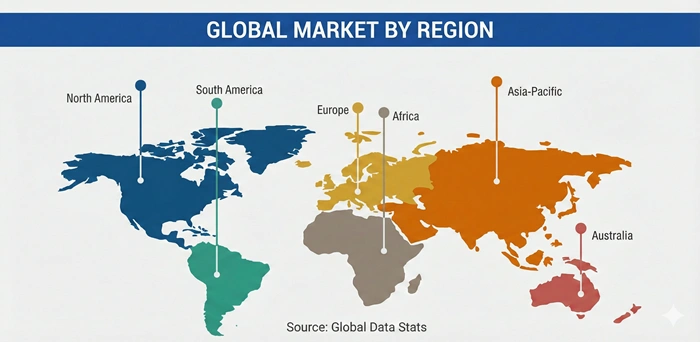
Asia Pacific commands the largest share of the global soda ash market, holding close to 39% of total revenue in 2025 with a regional CAGR near 5% through 2033. Rapidly expanding glass, detergent, and industrial chemical manufacturing infrastructure across China and India keeps demand consistently strong throughout the region, supported by substantial investments in modern processing facilities and resource integration. Leading companies such as Shandong Haihua Group in China and Tata Chemicals and Nirma in India maintain significant production and supply positions serving this large and growing regional demand base.
The region's massive construction and automotive manufacturing sectors, combined with rising consumer demand for packaged household cleaning products, further reinforce this leadership position within the broader industrial chemical landscape. Continued urbanization across China, India, and Southeast Asia is expected to sustain steady soda ash consumption growth as both glass and detergent manufacturing capacity continues expanding. This combination of manufacturing scale, resource investment, and consumer demand growth ensures Asia Pacific remains the anchor region for soda ash market revenue generation over the coming years.
North America
Robust Export Growth and Advanced Trona Extraction Techniques Make North America the Fastest-Growing Region
North America is the fastest-growing region in the soda ash market, projected to expand at a CAGR near 6.9% through 2033 while currently holding a substantial share of global natural soda ash production. Extensive trona reserves in Wyoming, combined with advanced extraction techniques and sustainability-focused processing innovations, are together driving robust export growth to fast-growing manufacturing economies in Asia and beyond. Companies such as Genesis Alkali and Ciner Resources Corporation are scaling extraction operations and expanding rail logistics infrastructure to meet this surging export demand.
Growing global preference for lower-carbon natural soda ash over energy-intensive synthetic production continues to widen North America's competitive advantage, as producers benefit from both lower production costs and reduced environmental compliance burden compared to synthetic manufacturers. This combination of resource abundance, cost efficiency, and expanding export infrastructure is expected to help North America continue narrowing its overall production gap with larger Asia Pacific manufacturing hubs over the coming years within the broader soda ash market.
Customization Available for This Report
Region-wise and country-wise customized reports are available for organizations seeking deeper geographic insight into the soda ash market. Our research team can tailor market analysis, competitive intelligence, trends, and growth opportunities specifically for any of the regions and countries listed below, offering detailed information aligned to your selected market and keyword combination.
North America
-
U.S., Canada, Mexico — detailed trona extraction trends, export logistics, and competitive positioning
Europe
-
U.K., Germany, France, Italy, Rest of Europe — environmental regulation impact, production technology trends, and key player analysis
Asia Pacific
-
China, India, Japan, South Korea, Australia, Rest of Asia Pacific — glass and detergent manufacturing capacity, synthetic production trends, and local vendor analysis
Latin America
-
Brazil, Argentina, Rest of Latin America — emerging detergent and consumer goods demand trends
Middle East & Africa
-
UAE, Saudi Arabia, Rest of MEA — construction glass demand and regional supply chain opportunities
Top Key Players
-
WE Soda Ltd. (United Kingdom)
-
Ciner Resources Corporation (United States)
-
Solvay S.A. (Belgium)
-
Şişecam Group (Turkey)
-
Tata Chemicals Ltd. (India)
-
Nirma Ltd. (India)
-
DCW Ltd. (India)
-
Genesis Alkali (United States)
-
OCI Company Ltd. (South Korea)
-
GHCL Ltd. (India)
-
Shandong Haihua Group Co. Ltd. (China)
-
Kazan Soda Elektrik (Turkey)
-
Eti Soda (Turkey)
-
Tronox Holdings plc (United States)
Recent Developments
-
In 2025, WE Soda announced plans for a new greenfield soda ash facility in Kazakhstan, expanding its total production capacity while strengthening its long-term low-carbon strategy.
-
In 2025, Ciner Resources Corporation expanded its trona extraction operations in Wyoming, boosting export capacity through new rail infrastructure connections to Asian markets.
-
In 2025, Solvay committed to upgrading its Rosignano production facility in Italy with new low-carbon evaporative crystallization units aimed at meaningfully reducing plant emissions.
-
In 2026, Tata Chemicals continued expanding its domestic soda ash production capacity in India to meet rising demand from glass and detergent manufacturers across the region.
-
In 2026, Genesis Alkali advanced investment in modernized extraction and processing technology at its Wyoming operations, improving output efficiency and reducing per-ton production costs.
Market Trends
Sustainability-Driven Production Shifts and Expanding Export Trade Flows Are Reshaping the Soda Ash Landscape
One of the clearest trends shaping the industry is the accelerating shift toward natural soda ash production as manufacturers and end users increasingly prioritize lower-carbon, resource-efficient chemical feedstocks over energy-intensive synthetic manufacturing. This is encouraging expanded investment in trona extraction capacity across resource-rich regions, while producers relying on synthetic methods face growing pressure to modernize their production technology to remain cost-competitive.
A second notable trend is the growing importance of export trade flows connecting resource-rich producing regions like North America and Turkey with fast-growing manufacturing hubs across Asia Pacific that lack sufficient domestic natural reserves. As global glass and detergent manufacturing capacity continues expanding faster in import-dependent regions than in resource-abundant ones, this trade relationship is expected to deepen further, reinforcing steady, long-term demand growth across the global soda ash market.
Segments Covered in the Report
By Type
-
Natural
-
Synthetic
By Grade
-
Dense Soda Ash
-
Light Soda Ash
By Application
-
Glass Industry
-
Detergents and Soaps
-
Chemicals
-
Metallurgy
-
Others
By End Use
-
Construction and Architecture
-
Automotive
-
Household and Industrial Cleaning
-
Others
By Region
-
North America (U.S., Canada, Mexico)
-
Europe (U.K., Germany, France, Italy, Rest of Europe)
-
Asia Pacific (China, India, Japan, South Korea, Australia, Rest of Asia Pacific)
-
Latin America (Brazil, Argentina, Rest of Latin America)
-
Middle East and Africa (UAE, Saudi Arabia, Rest of MEA)
❝ Built for Every Level — From Startups to Industry Giants ❞
Here Is Exactly How This Report Works for You
-
For tier 1 chemical producers and institutional investors, this report delivers granular competitor revenue analysis across Solvay, Ciner Resources, and Tata Chemicals, alongside geopolitical trade risk assessment supporting confident investment and capacity expansion decisions.
-
For tier 2, tier 3 companies, regional producers, and mid-level manufacturers, this report identifies the highest-growth application segments and most commercially accessible export markets, offering an evidence-based roadmap for entering or expanding within the soda ash market.
-
For all decision-makers across the industrial chemical value chain, this report translates complex supply-demand shifts and evolving trade dynamics into clear, actionable strategic intelligence supporting stronger production and export decisions through 2033.
Frequently Asked Questions
Question 1: What is the current size of the soda ash market and how large will it grow by 2033?
Answer: The soda ash market was valued at USD 20.64 billion in 2025. It is projected to reach approximately USD 30.77 billion by 2033 at a CAGR of 5.14%.
Question 2: Which region leads the soda ash market today?
Answer: Asia Pacific leads the soda ash market with roughly 39% revenue share. Expanding glass and detergent manufacturing infrastructure supports this position.
Question 3: Which region is growing the fastest in the soda ash market?
Answer: North America is the fastest-growing region in the soda ash market. Robust export growth and advanced trona extraction techniques are driving this expansion.
Question 4: Who are the leading companies in the soda ash market?
Answer: Solvay, Ciner Resources Corporation, and Tata Chemicals are top companies in the soda ash market. They lead through strong natural extraction and synthetic production capabilities.
Question 5: Which application segment generates the most demand in the soda ash market?
Answer: The glass industry generates the largest share of demand in the soda ash market. Detergents and soaps form the second-largest application segment.