
Smart Locks Market Overview
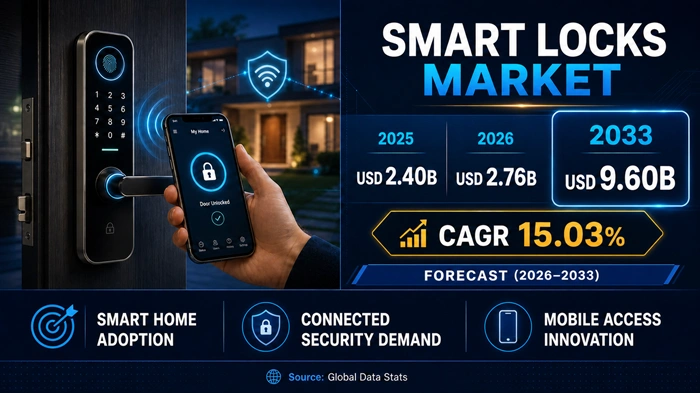
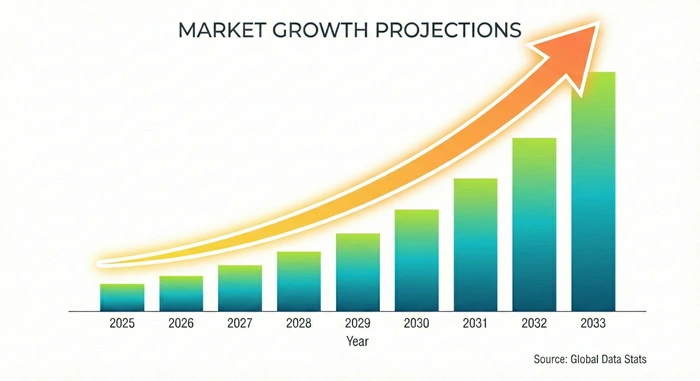
The global smart locks market size is valued at USD 2.40 billion in 2025 and is predicted to increase from USD 2.76 billion in 2026 to approximately USD 9.60 billion by 2033, growing at a CAGR of 15.03% from 2026 to 2033.
The smart locks market encompasses electronic locking devices enabling keyless entry through various authentication methods including smartphones, biometric scanning, PIN codes, and wireless connectivity protocols, offering enhanced security and convenience compared to traditional mechanical locks.
Rising smart home adoption, growing security concerns, and increasing integration with home automation ecosystems drive substantial market expansion worldwide. Homeowners and businesses increasingly recognize that smart locking systems deliver superior access control, remote monitoring capabilities, and operational efficiency compared to conventional key-based mechanisms requiring physical presence for management. The market benefits from technological advancements including biometric authentication, artificial intelligence integration, cloud-based management platforms, and seamless compatibility with voice assistants that transform door locks from simple security devices into intelligent access control solutions.
AI Impact on the Smart Locks Industry
Intelligent Authentication and Predictive Security Transform Access Control
Artificial intelligence is fundamentally reshaping the smart locks market by enabling advanced authentication methods, predictive security alerts, and automated access management that significantly enhance protection beyond traditional electronic locking systems. AI-powered smart locks leverage machine learning algorithms to analyze entry patterns, recognize authorized users through behavioral biometrics, detect anomalous access attempts, and generate real-time security alerts when suspicious activities occur. Facial recognition capabilities integrated with AI enable touchless operation as users simply approach their doors, with sophisticated algorithms validating identities within milliseconds while maintaining high accuracy even under varying lighting conditions or when users wear accessories. Advanced AI systems continuously learn from usage patterns, automatically adjusting access permissions based on time schedules, user locations detected through geofencing, and contextual information including vacation modes or emergency situations requiring temporary access grants.
The integration of AI with smart lock platforms enables predictive maintenance through monitoring hardware performance metrics, battery levels, and mechanical component wear patterns that forecast potential failures before they occur. AI-driven voice assistants including Amazon Alexa, Google Assistant, and Apple Siri provide hands-free lock control, enabling users to unlock doors, check lock status, or grant temporary access through simple voice commands integrated with broader smart home automation scenarios. Natural language processing capabilities allow smart locks to understand context-aware commands like unlocking doors when specific family members arrive or automatically securing premises when all authorized users leave the geofenced perimeter. Furthermore, AI-powered access analytics generate insights from entry patterns, identifying peak usage times, most frequent visitors, and unusual activity that security-conscious homeowners and property managers leverage for optimizing security protocols and monitoring property access.
Growth Factors
Smart Home Ecosystem Integration and Security Concerns Propel Market Expansion
The explosive growth of smart home adoption represents the primary driver propelling smart locks market expansion as consumers embrace connected living environments integrating security, convenience, and automation through unified platforms. Smart home ecosystems including Amazon Alexa, Google Home, Apple HomeKit, and Samsung SmartThings create seamless integration opportunities where smart locks serve as critical entry points controlling access while coordinating with cameras, alarms, lighting, and thermostats. Homeowners value integrated experiences enabling scenarios like automatically unlocking doors when recognized residents approach, disarming alarm systems, turning on lights, and adjusting climate control through single authentication events. The convenience of managing home access remotely through smartphone applications proves particularly appealing for families coordinating children's arrivals, granting temporary access to service providers, or monitoring vacation home security from distant locations.
Escalating security concerns driven by rising crime rates in urban areas create urgent demand for smart locks market products offering superior protection compared to traditional mechanical locks vulnerable to lock picking and unauthorized key duplication. Digital door locks providing activity monitoring, real-time notifications, and comprehensive access logs enable homeowners to maintain awareness of exactly who enters their properties and when these events occur. Advanced security features including automatic locking after specified periods, tamper alerts detecting forced entry attempts, and multi-factor authentication combining PIN codes with biometric verification deliver protection levels that conventional locks cannot match. The shift toward keyless entry eliminates risks associated with lost or stolen keys, hidden spare keys discovered by intruders, and unauthorized key copying by former occupants or service providers. Additionally, government initiatives promoting smart city development, building code updates mandating enhanced security standards, and insurance companies offering premium discounts for smart security installations accelerate adoption across residential and commercial segments.
Market Outlook
Biometric Authentication and Hospitality Adoption Transform Industry Landscape
The smart locks market outlook remains exceptionally positive as converging trends including biometric technology maturity, hospitality industry digital transformation, and multi-tenant property management automation create opportunities for sophisticated access control solutions. Biometric locking systems incorporating fingerprint recognition maintain the largest segment share with strong consumer preference for advanced security features that eliminate memorizing PIN codes or carrying access cards. Market participants invest heavily in research and development to enhance smart lock capabilities through improved battery life extending operational periods beyond two years, weather-resistant designs suitable for exterior installations, and retrofitting solutions compatible with existing deadbolt mechanisms avoiding complete lock replacements. Strategic partnerships between smart lock manufacturers, telecommunications providers offering connectivity services, and real estate developers integrating access control into new construction projects accelerate market penetration.
North America maintains market leadership with the United States smart lock market valued at USD 1.08 billion in 2025 projected to reach USD 5.58 billion by 2034 at 20.02% CAGR driven by high smart home adoption rates, security awareness, and technology-savvy consumers. The level handler segment demonstrates fastest growth expected to witness CAGR over 17% from 2025 to 2030 as commercial buildings, multi-unit residential properties, and hospitality facilities prioritize ergonomic designs supporting ADA compliance and high-traffic accessibility. The smart locks market benefits from hospitality industry transformation as hotels implement keyless entry systems eliminating plastic key cards, enabling mobile check-in experiences, and integrating with property management systems for automated guest access management. Commercial buildings including offices, coworking spaces, and educational institutions deploy smart locks supporting flexible access schedules, temporary credentials for visitors, and centralized management across distributed facilities. Industry analysts project Asia Pacific will demonstrate fastest regional growth at 24.0% CAGR from 2025 to 2033 driven by rapid urbanization, rising disposable incomes, smart city government initiatives, and increasing smart home awareness across China, India, Japan, and South Korea.
Expert Speaks
-
Jack Narcotta, Principal Industry Analyst at Strategy Analytics, stated that ASSA ABLOY family of brands is effectively the default standard for smart locks globally, noting that Schlage as the sole remaining independent Power Player and Tier 2 and Tier 3 companies now find themselves with an even steeper hill to climb to compete against the smart lock market's juggernaut after ASSA ABLOY's acquisition expanding market share to 35%.
-
Paul Routledge, Country Manager for UK and Ireland at D-Link, emphasized that it is easy to dismiss smart home and IoT attacks as improbable scenarios, but that is what we all tell ourselves until it happens, warning that smart home and IoT hackers are more sophisticated than ever and more willing to probe smart home devices for the smallest weaknesses, making security paramount in connected living environments.
-
Krystian Zajac, Cofounder and CEO at Philips Hiro, highlighted that smart tech is vital to home protection as over the years we have seen criminals get more and more cunning with their methods using new equipment and even social-engineering techniques to gain access to our homes, fortunately smart tech can help even the odds by proactively protecting stuff that matters to us most through intelligent security solutions.
Key Report Takeaways
-
North America leads the global smart locks market with over 40.9% regional share in 2024-2025, driven by high smart home technology adoption rates, strong security awareness among American consumers, robust distribution networks, and the United States market valued at USD 1.08 billion in 2025 projected to reach USD 5.58 billion by 2034 at 20.02% CAGR.
-
Asia Pacific represents the fastest-growing regional market, expected to expand at exceptional 24.0% CAGR from 2025 to 2033, fueled by rapid urbanization with China reaching 64.7% urbanization rate in 2023, rising disposable incomes driving smart home adoption, and government smart city initiatives supporting security solution integration.
-
Biometric smart locks dominate market demand representing the largest technology segment, reflecting strong consumer preference for advanced fingerprint recognition and facial identification security features that eliminate password memorization while providing superior authentication accuracy.
-
Level handler locks demonstrate fastest growth with CAGR exceeding 17% from 2025 to 2030, driven by commercial building adoption, multi-unit residential deployments requiring ADA compliance, and hospitality facilities prioritizing ergonomic designs supporting high-traffic accessibility and touchless operation.
-
Smartphone-controlled locks emerge as high-growth segment, particularly in Asia Pacific, driven by smartphone proliferation enabling remote access management, integration with mobile payment ecosystems, and consumer preferences for app-based control over traditional keypads.
-
Hospitality sector accelerates adoption as hotels implement keyless entry systems eliminating plastic key cards, enabling mobile check-in experiences, automating guest access management through property management system integration, and enhancing security monitoring through cloud-based centralized control platforms.
Market Scope
| Report Coverage Details | |
|---|---|
| Market Size by 2033 | USD 9.60 Billion |
| Market Size by 2025 | USD 2.40 Billion |
| Market Size by 2026 | USD 2.76 Billion |
| Market Growth Rate from 2026 to 2033 | CAGR of 15.03% |
| Dominating Region | North America |
| Fastest Growing Region | Asia Pacific |
| Base Year | 2025 |
| Forecast Period | 2026 to 2033 |
| Segments Covered | Product Type, Technology, End User, Distribution Channel, Region |
| Regions Covered | North America, Europe, Asia Pacific, Latin America, Middle East & Africa |
Market Dynamics
Drivers Impact Analysis
Smart Home Integration and Enhanced Security Drive Adoption Acceleration
| Factor | (≈) % Impact on CAGR Forecast | Geographic Relevance | Impact Timeline |
|---|---|---|---|
| Smart home ecosystem growth | 5.2% | Global, particularly North America | Immediate and ongoing |
| Rising security concerns | 4.8% | Urban areas globally | Immediate to medium-term |
| Keyless convenience demand | 3.1% | Developed markets | Ongoing |
| IoT technology advancement | 2.4% | Technology-forward regions | Medium-term |
The phenomenal expansion of smart home ecosystems represents the most significant driver propelling smart locks market growth as consumers embrace connected living environments integrating security, lighting, climate control, and entertainment through unified platforms. Smart home adoption accelerates globally with Amazon Alexa, Google Home, Apple HomeKit, and Samsung SmartThings creating seamless integration opportunities where smart locks serve as critical entry points coordinating access control with broader automation scenarios. Homeowners value experiences enabling automatic door unlocking when recognized residents arrive detected through geofencing, simultaneous alarm disarming, lighting activation, and climate adjustment through single authentication events. Remote access management through smartphone applications proves particularly valuable for families coordinating children's schedules, granting temporary access to cleaning services or delivery personnel, and monitoring vacation home security from distant locations.
Escalating security concerns driven by urban crime rates create urgent demand for smart locks market products offering superior protection compared to traditional mechanical locks vulnerable to lock picking, bumping, and unauthorized key duplication. Digital door lock systems providing activity monitoring, real-time notifications when doors unlock, and comprehensive access logs enable homeowners to maintain complete awareness of property access events. Advanced security features including automatic locking after specified periods preventing accidentally unlocked doors, tamper alerts detecting forced entry attempts, and multi-factor authentication combining PIN codes with biometric verification deliver protection levels traditional locks cannot match. Keyless entry convenience eliminates risks associated with lost or stolen keys, hidden spare keys discovered by intruders, unauthorized key copying by former occupants, and the inconvenience of physically distributing keys to family members or service providers. Additionally, IoT technology advancement enabling Bluetooth Low Energy connectivity, Wi-Fi integration, NFC support, and cloud-based management platforms expands smart lock capabilities while reducing power consumption extending battery life beyond two years of operation.
Restraints Impact Analysis
High Costs and Cybersecurity Concerns Create Adoption Barriers
| Factor | (≈) % Impact on CAGR Forecast | Geographic Relevance | Impact Timeline |
|---|---|---|---|
| High upfront costs | -2.8% | Price-sensitive markets | Ongoing |
| Cybersecurity vulnerabilities | -2.4% | Technology-savvy consumers | Ongoing |
| Compatibility limitations | -1.9% | Older building infrastructure | Medium-term |
| Battery dependency concerns | -1.5% | All markets | Ongoing |
Substantial upfront costs associated with smart lock installations create significant barriers to smart locks market adoption, particularly in price-sensitive markets and among budget-conscious consumers comparing investments against traditional mechanical locks costing fraction of electronic alternatives. Premium smart lock systems featuring biometric authentication, multiple connectivity protocols, and advanced security features command price points ranging from USD 200 to USD 500 or more, substantially exceeding USD 50 to USD 100 expenditures for conventional deadbolts. Installation complexity requiring professional assistance for proper configuration, network setup, and integration with existing smart home systems adds labor costs that budget-constrained homeowners find difficult to justify despite long-term security and convenience benefits. Small businesses and rental property owners managing multiple units face compounded cost challenges when multiplying per-unit expenses across entire portfolios.
Cybersecurity vulnerabilities and hacking concerns create hesitation around smart locks market adoption as technology-aware consumers worry about potential digital intrusions exploiting wireless connectivity, cloud server breaches exposing access credentials, or malicious actors remotely unlocking doors. High-profile demonstrations of smart lock vulnerabilities including Bluetooth signal interception, Wi-Fi network exploitation, and cloud service compromises heighten consumer anxiety around connected security devices. The inherent tension between connectivity enabling remote access convenience and security risks associated with network exposure requires manufacturers to implement robust encryption, regular firmware updates, and multi-factor authentication that some consumers find too complex to properly configure. Compatibility limitations surrounding smart lock integration with existing door hardware, particularly in older buildings with non-standard configurations, create technical obstacles requiring costly door modifications or complete hardware replacements. Additionally, battery dependency concerns emerge as consumers worry about lockouts during power failures, forgetting battery replacement schedules, or encountering situations requiring emergency access when smart systems malfunction.
Opportunities Impact Analysis
Hospitality Industry and Retrofit Solutions Create Growth Prospects
| Factor | (≈) % Impact on CAGR Forecast | Geographic Relevance | Impact Timeline |
|---|---|---|---|
| Hospitality digital transformation | 4.2% | Tourism destinations globally | Medium-term |
| Retrofit market expansion | 3.7% | Existing residential stock | Medium to long-term |
| Voice assistant integration | 3.3% | Smart speaker adoption markets | Medium-term |
| Subscription service models | 2.8% | Recurring revenue opportunities | Long-term |
Hospitality industry digital transformation creates exceptional opportunities within the smart locks market as hotels, resorts, vacation rentals, and short-term accommodation providers implement keyless entry systems eliminating plastic key card expenses while enhancing guest experiences. Hotels deploying smart locks enable mobile check-in allowing guests to bypass front desk queues, receive digital room keys on smartphones, and access rooms immediately upon arrival. Property management system integration automates guest access credential creation during reservation, automatic activation at check-in time, and credential expiration at checkout without manual intervention. Vacation rental operators managing Airbnb, VRBO, and similar properties particularly benefit from remote access management enabling temporary codes generated for specific guests, automated code changes between bookings, and emergency access capabilities without physical key exchanges.
Retrofit market expansion creates substantial opportunities for smart locks market vendors developing solutions compatible with existing deadbolt mechanisms, enabling upgrades without complete lock replacements or door modifications. Retrofit adapter systems replacing interior thumb turns while preserving exterior key cylinders appeal to renters unable to make permanent modifications, homeowners wanting to retain existing keys, and cost-conscious consumers seeking smart functionality without premium replacement lock expenses. Voice assistant integration through Amazon Alexa, Google Assistant, and Apple Siri expands smart lock appeal as consumers already owning smart speakers embrace hands-free control, voice-activated unlocking, and integrated automation scenarios. The proliferation of voice-enabled devices in homes creates natural extensions for smart lock functionality supporting commands like checking lock status, unlocking doors for arriving family members, or securing homes at bedtime. Additionally, subscription service models offering cloud-based access management, activity history storage, advanced analytics, and premium support create recurring revenue opportunities for manufacturers transitioning from one-time hardware sales to ongoing service relationships.
Segment Analysis
Deadbolt Smart Locks Dominance
Security Standards and Residential Preference Drive Segment Leadership
Deadbolt smart locks command the dominant position within the smart locks market, representing the most popular product type as residential consumers and security-conscious property owners prioritize robust locking mechanisms offering superior protection against forced entry compared to lever handle or padlock alternatives. These full-replacement devices remove existing deadbolt hardware entirely, installing integrated systems combining electronic authentication with heavy-duty bolt mechanisms that meet or exceed ANSI Grade 1 and BHMA AAA security standards. Modern smart deadbolts feature multiple authentication options including keypads accepting PIN codes, biometric fingerprint readers, smartphone Bluetooth connectivity, NFC card readers, and traditional key cylinders providing backup access during power failures. Homeowners value deadbolt configurations for primary entry points where maximum security proves essential, with leading models incorporating tamper alerts, automatic locking, and built-in Wi-Fi enabling remote management without additional bridge devices.
North America demonstrates particularly strong deadbolt adoption with United States consumers prioritizing Grade 1 security ratings for front door applications, driving demand for premium models from Schlage, Yale, and August commanding market leadership. Leading manufacturers including Schlage with Encode Smart WiFi Deadbolt, Yale with Assure Lock 2, and Aqara with Smart Lock U100 collectively capture significant market share through comprehensive feature sets combining robust hardware, reliable mechanisms, and seamless smart home integration. The segment benefits from insurance company recognition with some providers offering premium discounts for homes equipped with certified smart deadbolts demonstrating superior security compared to conventional locks. Europe shows accelerating adoption driven by retrofitting initiatives in older buildings, with manufacturers developing adaptable solutions compatible with European cylinder standards and multi-point locking systems common in continental markets. The smart locks market deadbolt segment particularly advantages from biometric technology integration as fingerprint readers positioned on exterior faceplates enable touchless unlocking preferred by consumers managing groceries, children, or packages.
Residential End-User Leadership
Home Security Prioritization and Smart Home Integration Drive Sectoral Dominance
Residential applications represent the largest end-user segment within the smart locks market, capturing majority share as homeowners embrace connected security solutions protecting families, valuables, and properties while enabling convenient access management. Single-family homes, condominiums, and apartments increasingly adopt smart locks as primary security measures, with consumers valuing remote monitoring capabilities checking lock status from work or vacation, receiving instant notifications when children arrive from school, and granting temporary access to trusted service providers. Home security integration with comprehensive systems including cameras, video doorbells, motion sensors, and alarm monitoring creates compelling ecosystems where smart locks serve as intelligent access control points coordinating with broader protection strategies. Modern residential smart locks support family member profiles with individualized access codes or biometric registrations enabling activity tracking identifying exactly who enters the home and when these events occur.
North America leads residential smart lock adoption with suburban homeowners demonstrating particular enthusiasm for connected security solutions, reflected in United States market growth from USD 887.6 million in 2024 to projected USD 2168.4 million by 2030 at 16.1% CAGR. Technology-forward consumers in metropolitan areas including San Francisco, Seattle, Austin, and New York drive early adoption of advanced features including voice control integration, geofencing automation, and artificial intelligence-powered access management. The residential segment benefits from declining prices as competition intensifies and manufacturing scales improve, with reliable smart deadbolts now available under USD 200 making technology accessible to mass market consumers beyond early adopter demographics. Asia Pacific demonstrates explosive residential growth particularly in China, India, and Southeast Asian markets where rapid urbanization, rising middle class incomes, and smartphone penetration exceeding 70% create favorable conditions for smart home security adoption. Government smart city initiatives across Singapore, Seoul, and Tokyo include residential security components encouraging smart lock deployment through subsidies, building code updates, and public awareness campaigns promoting digital security solutions.
Regional Insights
North America Market Leadership
Technology Adoption and Security Awareness Drive Regional Dominance
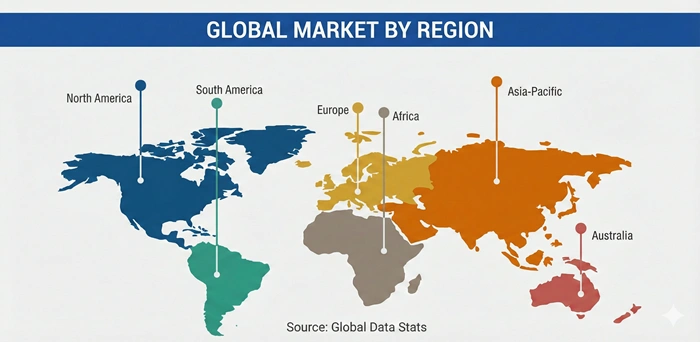
North America commands substantial leadership within the smart locks market, maintaining over 40.9% regional share in 2024-2025, driven by high smart home technology adoption rates, strong security awareness among American consumers, robust distribution networks, and the United States market valued at USD 1.08 billion in 2025 projected to reach USD 5.58 billion by 2034. The United States demonstrates particularly strong momentum with technology-savvy homeowners in suburban and metropolitan areas prioritizing connected security solutions offering remote access management, activity monitoring, and seamless integration with Amazon Alexa, Google Home, and Apple HomeKit ecosystems. Major smart lock manufacturers including Schlage owned by Allegion, Yale and August under ASSA ABLOY, and Kwikset maintain strong North American presence through extensive retail partnerships with Home Depot, Lowe's, and Amazon plus professional locksmith distribution channels. Canada shows growing adoption driven by similar security concerns, cold climate conditions favoring electronic locks avoiding frozen key cylinders, and cross-border technology trends mirroring United States consumer preferences.
The region benefits from mature e-commerce infrastructure enabling convenient online purchasing through Amazon, manufacturer direct websites, and specialty smart home retailers offering detailed product comparisons, customer reviews, and installation guidance. Professional installation services widely available through locksmiths, home security companies, and general contractors reduce technical barriers helping mainstream consumers overcome complexity concerns. The smart locks market in North America particularly advantages from insurance industry recognition with some carriers offering premium discounts for certified smart security installations, creating financial incentives beyond convenience and peace-of-mind benefits. Regulatory support through building code updates in California, New York, and other progressive jurisdictions encourages smart lock adoption in new construction and major renovation projects. Market projections indicate sustained North American leadership through the forecast period despite rapid Asia Pacific growth, supported by continued innovation, replacement cycles upgrading first-generation products, and multi-dwelling unit deployments in apartment complexes.
Asia Pacific Fastest Growth
Urbanization and Smart City Initiatives Drive Regional Acceleration
Asia Pacific emerges as the fastest-growing regional smart locks market, expected to expand at exceptional 24.0% CAGR from 2025 to 2033, propelled by rapid urbanization with China reaching 64.7% urbanization rate in 2023, rising disposable incomes driving smart home adoption, and government smart city initiatives supporting security solution integration. China represents the largest regional market with massive urban populations, expanding middle class demonstrating strong appetite for connected home technologies, and domestic manufacturers including Xiaomi, Huawei, and specialized smart lock producers offering competitively priced products. Government policies supporting smart city development in tier-one cities including Beijing, Shanghai, Shenzhen, and Guangzhou create favorable environments for smart security adoption through infrastructure investments, technology subsidies, and public awareness campaigns. India demonstrates exceptional growth potential driven by rapid smartphone penetration, increasing security awareness in urban centers, and growing disposable incomes enabling technology purchases beyond basic necessities.
Japan and South Korea show mature smart home markets with government smart city initiatives directly fostering smart lock integration into urban development projects. South Korean consumers particularly embrace advanced biometric technologies, mobile payment integration, and cutting-edge authentication methods that domestic manufacturers including Samsung develop for local markets before global expansion. The smart locks market in Asia Pacific particularly benefits from mobile-first consumer behaviors as regional populations skip desktop computing in favor of smartphone-centric lifestyles, making app-controlled locks natural extensions of digital-first preferences. Southeast Asian nations including Singapore, Thailand, Malaysia, and Indonesia show accelerating adoption driven by tourism industry investments in hospitality smart locks, urban residential development integrating connected security, and growing awareness of home automation benefits. Regional market dynamics favor aggressive pricing strategies with Chinese manufacturers offering feature-rich smart locks at price points substantially below Western equivalents, expanding addressable markets to price-sensitive consumers while pressuring global competitors.
Top Key Players
-
ASSA ABLOY Group (Sweden)
-
Allegion plc (Ireland)
-
Spectrum Brands Holdings Inc. (United States)
-
dormakaba Group (Switzerland)
-
Samsung Electronics Co. Ltd. (South Korea)
-
Honeywell International Inc. (United States)
-
Xiaomi Corporation (China)
-
August Home Inc. (United States)
-
Schlage (Allegion) (United States)
-
Yale (ASSA ABLOY) (Sweden)
-
Kwikset (Spectrum Brands) (United States)
-
Godrej & Boyce Manufacturing Company Limited (India)
-
Haier Group Corporation (China)
-
Panasonic Corporation (Japan)
-
Vivint Inc. (United States)
Recent Developments
-
ASSA ABLOY (September 2024): ASSA ABLOY acquired Level Lock Inc. for an undisclosed amount to strengthen its position in the smart lock market and broaden its portfolio of innovative access solutions, with Level Lock Inc. being a United States-based technology company specializing in smart lock solutions for both residential and commercial properties offering minimalist designs and seamless smart home integration.
-
Fortune Brands Home & Security (July 2023): Fortune Brands Home & Security completed acquisition of Yale, August, Emtek, and Schaub brands from ASSA ABLOY for approximately USD 800 million following Department of Justice antitrust concerns, with the transaction reshaping competitive dynamics as ASSA ABLOY divested major smart lock brands while retaining significant market presence through other subsidiaries.
-
August Home (May 2024): August Home raised USD 70 million in Series D funding round led by Comcast Ventures and Meritech Capital Partners, with the investment supporting the company's expansion into new markets and development of advanced features for their smart lock products including enhanced biometric capabilities and deeper smart home ecosystem integration.
-
Master Lock Company (January 2024): Master Lock Company introduced the new Master Lock Smart Key System integrating Bluetooth technology and mobile app control for their smart locks, enabling users to secure and monitor their locks remotely while enhancing convenience and security through cloud-based management platforms and temporary access credential generation.
-
Google and Samsung (March 2024): Google and Samsung announced strategic partnership to integrate Google Smart Locks into Samsung's SmartThings platform, enabling seamless control of Google Smart Locks through the SmartThings app, expanding the reach of Google's smart lock technology and increasing compatibility with various smart home ecosystems through unified management interfaces.
Market Trends
Voice Control Integration and Biometric Authentication Reshape User Experiences
The rapid integration of voice control capabilities represents a transformative trend within the smart locks market, fundamentally changing how consumers interact with home security through hands-free operation via Amazon Alexa, Google Assistant, and Apple Siri. Voice-activated smart locks enable users to check lock status, unlock doors for arriving family members, or secure homes at bedtime through simple spoken commands integrated with broader smart home automation routines. Natural language processing advancements allow context-aware interactions where homeowners issue commands like unlocking doors when specific people arrive detected through smartphone geofencing or automatically locking all entry points at specified times. Voice assistant integration particularly appeals to accessibility-conscious consumers including elderly populations with mobility limitations, individuals with disabilities affecting manual dexterity, and parents managing multiple tasks while simultaneously supervising children. The convergence of smart locks with voice ecosystems creates seamless experiences where single commands trigger cascading automation including door unlocking, alarm disarming, light activation, and climate adjustment.
Biometric authentication advancement demonstrates accelerating adoption as fingerprint recognition and facial identification technologies mature, delivering superior security while eliminating password memorization burdens. Modern fingerprint readers featuring FBI-certified capacitive sensors achieve identification accuracy with false rejection rates of 0.01% and false acceptance rates of 0.0001%, ensuring reliable performance even with dry, wet, or rough fingers. The smart locks market shows growing emphasis on multimodal authentication combining biometric verification with PIN codes or smartphone proximity for enhanced security addressing concerns around single-factor vulnerabilities. Facial recognition systems integrated with AI enable touchless operation as users simply approach doors with cameras validating identities within milliseconds, particularly valuable during pandemic conditions heightening hygiene awareness. Additionally, geofencing automation leveraging GPS and RFID creates virtual boundaries around homes that trigger automatic locking when all authorized users leave and unlocking as residents approach, delivering hands-free convenience while maintaining security through location-based access control.
Segments Covered in the Report
By Product Type:
-
Deadbolt Locks
-
Electronic Deadbolts
-
Smart Deadbolts with Keypads
-
Biometric Deadbolts
-
-
Lever Handle Locks
-
Commercial Grade Levers
-
Residential Lever Handles
-
ADA Compliant Levers
-
-
Padlocks
-
Smart Padlocks
-
Bluetooth Padlocks
-
Combination Padlocks
-
By Technology:
-
Bluetooth
-
Bluetooth Low Energy
-
Bluetooth 5.0
-
-
Wi-Fi
-
Built-in Wi-Fi
-
Wi-Fi Bridge Connected
-
-
NFC (Near Field Communication)
-
Card-Based NFC
-
Smartphone NFC
-
-
Biometric
-
Fingerprint Recognition
-
Facial Recognition
-
By End User:
-
Residential
-
Single-Family Homes
-
Apartments
-
Condominiums
-
-
Commercial
-
Offices
-
Retail Stores
-
Coworking Spaces
-
-
Hospitality
-
Hotels
-
Vacation Rentals
-
Resorts
-
-
Government
-
Government Buildings
-
Educational Institutions
-
Healthcare Facilities
-
By Distribution Channel:
-
Online
-
E-commerce Platforms
-
Manufacturer Websites
-
Online Specialty Retailers
-
-
Offline
-
Hardware Stores
-
Home Improvement Centers
-
Specialty Security Retailers
-
By Region:
-
North America
-
United States
-
Canada
-
Mexico
-
-
Europe
-
Germany
-
United Kingdom
-
France
-
Italy
-
Spain
-
Rest of Europe
-
-
Asia Pacific
-
China
-
India
-
Japan
-
South Korea
-
Southeast Asia
-
Australia
-
Rest of Asia Pacific
-
-
Latin America
-
Brazil
-
Argentina
-
Rest of Latin America
-
-
Middle East & Africa
-
United Arab Emirates
-
Saudi Arabia
-
South Africa
-
Rest of Middle East & Africa
-
Frequently Asked Questions
Question 1: What is the projected smart locks market size by 2033?
Answer: The global smart locks market is projected to reach USD 9.60 billion by 2033, growing from USD 2.76 billion in 2026 at a CAGR of 15.03%.
Question 2: Which region dominates the smart locks market currently?
Answer: North America dominates the smart locks market with over 40.9% regional share in 2024-2025, driven by high smart home adoption rates and strong security awareness.
Question 3: What are the key drivers of smart locks market growth?
Answer: Key drivers include smart home ecosystem integration, rising security concerns in urban areas, keyless entry convenience demand, and IoT technology advancement enabling Bluetooth, Wi-Fi, and biometric authentication.
Question 4: Which technology segment shows fastest growth in the smart locks market?
Answer: Smartphone-controlled locks emerge as the fastest-growing technology segment particularly in Asia Pacific, driven by mobile proliferation enabling remote access management and consumer preferences for app-based control.
Question 5: How is the hospitality industry impacting the smart locks market?
Answer: The hospitality industry accelerates smart locks market adoption through implementing keyless entry systems eliminating plastic key cards, enabling mobile check-in experiences, and integrating with property management systems for automated guest access.