
Smart Glass Market Overview
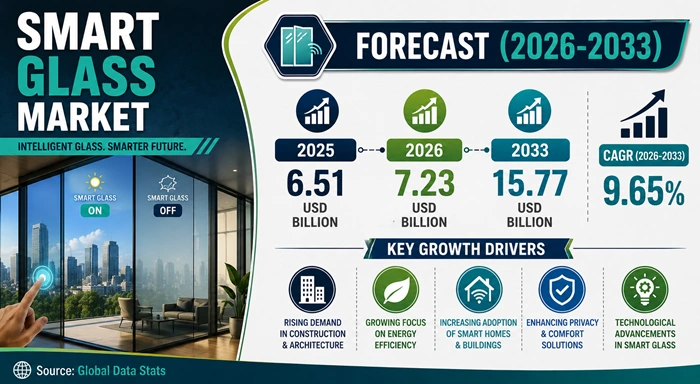
The global smart glass market size is valued at USD 6.51 billion in 2025 and is predicted to increase from USD 7.23 billion in 2026 to approximately USD 15.77 billion by 2033, growing at a CAGR of 9.65% from 2026 to 2033. The intelligent glass technology revolution is transforming how buildings, vehicles, and electronic devices manage light transmission, energy efficiency, and privacy control. Switchable glass solutions are becoming essential components in modern architecture and automotive design as industries prioritize sustainability and occupant comfort.
AI Impact on the Smart Glass Industry
Artificial Intelligence Transforms Adaptive Glass Technology and Energy Management
Artificial intelligence is revolutionizing the smart glass market by enabling predictive automation, intelligent energy optimization, and seamless integration with comprehensive building and vehicle management systems. Machine learning algorithms analyze vast datasets containing weather patterns, solar angles, occupancy schedules, and user preferences to automatically adjust glass transparency levels before environmental conditions change, maximizing energy efficiency while maintaining optimal lighting conditions. AI-powered sensors continuously monitor multiple parameters including sunlight intensity, ambient temperature, indoor air quality, and human presence to make real-time decisions about glass tinting that balance energy conservation with occupant comfort preferences. Computer vision systems integrated with smart glass installations can detect glare conditions, identify approaching weather patterns, and recognize individual users to apply personalized transparency settings that adapt to specific needs and preferences.
Predictive maintenance algorithms monitor electrical systems, conductive coatings, and control mechanisms within smart glass installations, identifying potential failures before they impact performance and scheduling preventive maintenance during optimal windows to minimize disruption. Natural language processing enables voice-controlled adjustments to smart glass settings, allowing building occupants or vehicle passengers to modify transparency, privacy levels, or energy modes through simple spoken commands without physical interaction with control interfaces. AI-driven energy management platforms integrate smart glass data with HVAC systems, lighting controls, and renewable energy sources to orchestrate comprehensive building automation strategies that reduce overall energy consumption by 30-40% compared to conventional systems. The smart glass market benefits from AI's ability to continuously learn from operational data, refining algorithms over time to deliver progressively better performance, energy savings, and user satisfaction across diverse applications and environmental conditions.
Growth Factors
Green Building Initiatives and Automotive Innovation Drive Market Expansion
The smart glass market is experiencing accelerating growth driven by stringent energy efficiency regulations, sustainable building certifications, and automotive industry innovations prioritizing passenger comfort and vehicle efficiency. Governments worldwide are implementing increasingly rigorous building codes requiring energy-efficient glazing solutions, with programs like LEED certification in North America and BREEAM in Europe mandating advanced window technologies that reduce heating and cooling loads. The construction industry's shift toward net-zero energy buildings creates strong demand for dynamic glazing systems that automatically optimize solar heat gain, dramatically reducing HVAC energy consumption while maintaining comfortable indoor environments throughout varying weather conditions. Smart city initiatives across urban centers invest billions in intelligent infrastructure incorporating responsive building facades, adaptive transportation systems, and connected public spaces where smart glass plays crucial roles in energy management and aesthetic design.
The luxury automotive segment increasingly adopts smart glass for panoramic sunroofs, privacy partitions, and side windows that enhance passenger experiences while reducing cabin cooling requirements and extending electric vehicle driving ranges. Growing consumer environmental consciousness drives preference for sustainable products and technologies, with smart glass positioned as premium green solution delivering tangible energy savings, reduced carbon footprints, and improved quality of life benefits that justify higher initial costs. Technological advancements continuously reduce manufacturing expenses while improving performance characteristics including switching speed, transparency range, durability, and power efficiency, making smart glass increasingly cost-competitive with traditional glazing solutions. The expanding commercial real estate sector particularly in emerging markets creates massive opportunities for smart glass adoption in office buildings, hotels, retail centers, and healthcare facilities where energy costs represent significant operating expenses and occupant comfort directly impacts productivity and satisfaction throughout the smart glass market.
Market Outlook
Technology Maturation and Cost Reduction Enable Mass Market Penetration
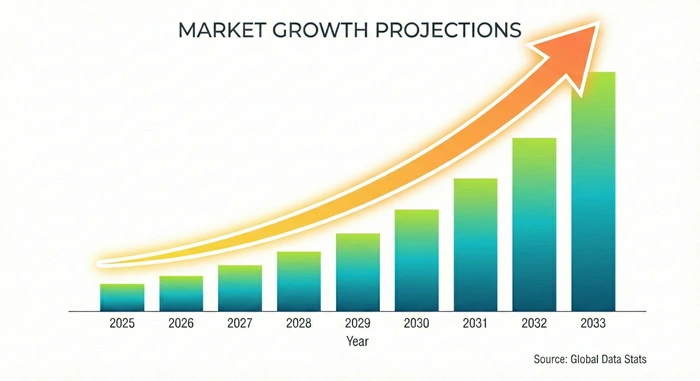
The smart glass market is positioned for sustained expansion through 2033 as technological maturation, manufacturing scale economies, and growing mainstream acceptance drive adoption beyond luxury applications into mid-market residential and commercial segments. Electrochromic technology continues dominating the market due to superior energy efficiency, wide transparency range, and compatibility with large architectural installations, though suspended particle device and polymer dispersed liquid crystal technologies gain share in automotive and privacy applications requiring faster switching speeds. Manufacturing innovations including roll-to-roll processing, improved electrode materials, and automated assembly techniques reduce production costs by 25-35%, making smart glass economically viable for broader building types and vehicle categories beyond premium segments. Integration with IoT platforms and smart building ecosystems creates comprehensive value propositions where smart glass functions as intelligent sensors and actuators within larger automation strategies that optimize energy, security, and occupant experiences.
The residential smart glass segment emerges as significant growth driver as declining costs bring technology within reach of affluent homeowners seeking differentiated aesthetics, enhanced privacy, and reduced energy bills that generate attractive returns on investment over 5-7 year payback periods. Retrofit market opportunities expand as building owners modernize aging properties with energy-efficient technologies to meet updated building codes, reduce operating expenses, and improve tenant satisfaction in competitive rental markets. Emerging applications in consumer electronics, healthcare, hospitality, and transportation infrastructure create new revenue streams beyond traditional architectural and automotive segments that have dominated the smart glass market historically. Sustainability reporting requirements and corporate ESG commitments drive large organizations to invest in smart glass and other energy-efficient technologies that demonstrate measurable environmental impact reductions while enhancing corporate reputations among stakeholders.
Expert Speaks
-
Denis Machuel, Chief Executive Officer of Saint-Gobain, emphasized that intelligent building materials including smart glass represent critical components of the company's sustainable construction strategy, noting that demand for energy-efficient glazing solutions continues accelerating as regulations tighten and building owners recognize significant operational cost savings achievable through advanced window technologies.
-
Takuya Takahashi, President and CEO Representative Director of AGC Inc., highlighted that the glass industry's transformation toward high-value-added products like smart glass reflects broader trends toward sustainability and digitalization, with the company investing substantially in research and development of next-generation electrochromic and thermochromic technologies serving architectural, automotive, and electronics applications worldwide.
-
Yoshio Osaki, President and Chief Executive Officer of Corning Incorporated, stated that specialty materials innovation including advanced glass substrates for smart windows represents strategic growth priorities, with emerging applications in automotive displays, architectural solutions, and consumer electronics creating substantial opportunities as industries converge around intelligent, connected glass technologies.
Key Report Takeaways
-
North America leads the smart glass market with approximately 33% market share in 2025, driven by stringent energy efficiency regulations, advanced construction practices, strong automotive industry presence, high technology adoption rates, and presence of major manufacturers and research institutions advancing switchable glass innovations.
-
Asia Pacific is growing the fastest with a projected CAGR of 11.85% from 2026 to 2033, fueled by rapid urbanization, massive infrastructure investments, expanding automotive production, government smart city initiatives, and growing environmental awareness driving adoption of energy-efficient building technologies across China, India, Japan, and Southeast Asian markets.
-
Architectural applications represent the primary market segment for smart glass, accounting for approximately 46% of consumption as commercial and residential buildings adopt dynamic glazing for energy savings, occupant comfort, aesthetic differentiation, and compliance with green building certification requirements in developed and emerging markets.
-
The electrochromic technology segment contributes the most to overall market revenue with approximately 59% share in 2025, reflecting superior energy efficiency, wide tint range, architectural scalability, and strong performance characteristics that make electrochromic glass preferred choice for large-scale building installations requiring precise light control.
-
Remote control systems are the most rapidly adopted control mode with a projected CAGR of 10.20%, as building automation integration, smartphone applications, and IoT connectivity enable convenient wireless adjustment of glass transparency from centralized dashboards or mobile devices without physical switch access.
-
The transportation segment will grow quickly with an estimated CAGR of 12.30% and market share expanding from 29% to 34% by 2033, driven by luxury automotive adoption, electric vehicle integration, aircraft cabin modernization, and railway applications where smart glass enhances passenger comfort while reducing energy consumption.
Market Scope
| Report Coverage | Details |
|---|---|
| Market Size by 2033 | USD 15.77 Billion |
| Market Size by 2025 | USD 6.51 Billion |
| Market Size by 2026 | USD 7.23 Billion |
| Market Growth Rate from 2026 to 2033 | CAGR of 9.65% |
| Dominating Region | North America |
| Fastest Growing Region | Asia Pacific |
| Base Year | 2025 |
| Forecast Period | 2026 to 2033 |
| Segments Covered | Technology, Application, Control Mode, Region |
| Regions Covered | North America, Europe, Asia Pacific, Latin America, Middle East and Africa |
Market Dynamics
Driver Impact Analysis
Stringent Energy Efficiency Regulations and Green Building Standards Propel Market Growth
Government-mandated energy efficiency standards and voluntary green building certification programs represent the most powerful drivers propelling the smart glass market toward sustained expansion across residential, commercial, and institutional construction sectors worldwide. Building energy consumption accounts for approximately 40% of global energy usage and 30% of greenhouse gas emissions, making buildings critical targets for climate change mitigation strategies implemented by governments through increasingly rigorous energy codes. The United States Department of Energy estimates that smart glass installations can reduce building energy consumption by 20-40% through dynamic solar heat gain management, decreased HVAC loads, and optimized natural daylighting that reduces artificial lighting requirements. European Union directives mandate near-zero energy buildings for new construction, creating regulatory push for advanced glazing technologies including electrochromic and thermochromic glass that actively manage thermal performance.
LEED certification requirements award credits for daylighting, glare control, and energy efficiency that smart glass delivers simultaneously, incentivizing architects and developers to specify dynamic glazing in commercial projects pursuing prestigious sustainability credentials. Asia Pacific markets including China, India, Japan, and South Korea implement green building standards and energy conservation codes that increasingly mandate or incentivize high-performance glazing technologies as urbanization accelerates and energy security concerns intensify. The smart glass market benefits from utility incentive programs and tax credits offered by governments and energy providers to offset initial cost premiums associated with energy-efficient building technologies that reduce peak electricity demand and defer expensive grid infrastructure expansions. Growing corporate sustainability commitments drive major technology companies, financial institutions, and multinational corporations to construct headquarters and regional offices featuring cutting-edge environmental technologies including smart glass facades that serve as visible demonstrations of ESG leadership while delivering measurable operational cost reductions.
| Driver | ≈ % Impact on CAGR Forecast | Geographic Relevance | Impact Timeline |
|---|---|---|---|
| Energy Efficiency Regulations | +2.80% | Global, strongest in North America and Europe | 2026-2033 |
| Green Building Certifications | +2.30% | Developed markets worldwide | 2026-2033 |
| Automotive Industry Innovation | +1.90% | Global, particularly Asia and North America | 2026-2033 |
| Smart City Initiatives | +1.65% | Asia Pacific, Middle East | 2026-2033 |
Restraints Impact Analysis
High Initial Costs and Complex Installation Requirements Limit Market Penetration
The smart glass market confronts significant barriers related to premium pricing, complex installation procedures, and long payback periods that constrain adoption particularly in cost-sensitive emerging markets and residential applications where budget considerations dominate purchasing decisions. Smart glass installations typically cost 3-5 times more than conventional glazing solutions, with electrochromic windows ranging from USD 50-100 per square foot installed compared to USD 15-25 for standard low-emissivity glass, creating substantial upfront capital requirements that many building owners find prohibitive despite long-term energy savings. Installation complexity requiring specialized expertise, precise electrical connections, sophisticated control systems, and careful handling of delicate electrochromic coatings increases labor costs while limiting the pool of qualified contractors capable of properly installing smart glass systems. Maintenance and repair challenges emerge when smart glass components fail, with limited technician availability, expensive replacement parts, and potential need to replace entire glass units rather than simple repairs creating operational risk concerns among building owners.
Awareness gaps persist among architects, developers, building owners, and consumers regarding smart glass capabilities, benefits, and total cost of ownership economics, with many stakeholders unfamiliar with technology or skeptical about performance claims and durability. The smart glass market faces competition from alternative energy-efficient glazing technologies including triple-pane windows, low-emissivity coatings, and static tinted glass that deliver partial benefits at significantly lower costs with simpler installation and proven track records. Long payback periods ranging from 7-15 years for smart glass investments exceed comfort thresholds of many building owners particularly in markets with uncertain energy prices, frequent property transactions, or short-term investment horizons that discourage expensive building envelope upgrades. Aesthetic concerns arise regarding color neutrality, haze levels, and appearance consistency across large facades, with some electrochromic technologies exhibiting slight blue or yellow tints in various states that may conflict with architectural design intentions.
| Restraint | ≈ % Impact on CAGR Forecast | Geographic Relevance | Impact Timeline |
|---|---|---|---|
| High Initial Costs | -1.95% | Global, particularly emerging markets | 2026-2033 |
| Installation Complexity | -1.20% | Markets with limited technical expertise | 2026-2030 |
| Limited Awareness | -0.90% | Emerging markets, residential segments | 2026-2030 |
Opportunities Impact Analysis
Residential Market Penetration and Retrofit Applications Create Growth Avenues
The emerging residential smart glass segment presents substantial opportunities for market expansion as declining costs, growing environmental consciousness, and desire for premium home features bring technology within reach of affluent homeowners and luxury residential developers. High-end residential applications including panoramic windows, conservatories, glass roofs, and privacy partitions offer significant market potential as homeowners seek differentiated aesthetics, enhanced comfort, and tangible energy savings that justify premium pricing in competitive real estate markets. Smart glass shower enclosures, interior partitions, and decorative applications create additional residential revenue streams beyond traditional window retrofits, with privacy control features particularly appealing for urban properties with close neighboring structures. The residential segment benefits from declining manufacturing costs, streamlined installation procedures, and growing consumer familiarity with smart home technologies that make dynamic glass more accessible and less intimidating to mainstream buyers.
Retrofit and renovation opportunities in existing buildings represent enormous untapped potential as aging commercial real estate portfolios require energy efficiency upgrades to meet updated building codes, reduce escalating operating costs, and remain competitive in markets where tenants increasingly demand sustainable workspaces. Window replacement projects provide ideal opportunities to introduce smart glass as energy-efficient alternative to conventional glazing, particularly in buildings with extensive glass facades experiencing high cooling loads and glare complaints. The smart glass market benefits from emerging applications in healthcare facilities requiring dynamic privacy and lighting control, hospitality venues creating ambiance flexibility, retail environments optimizing product presentation, and transportation infrastructure including airports and train stations enhancing passenger experiences. Autonomous vehicle development creates future opportunities for advanced automotive glazing with integrated displays, dynamic tinting, and transparent electronics that transform windows into multifunctional surfaces combining transparency control with information presentation capabilities.
| Opportunity | ≈ % Impact on CAGR Forecast | Geographic Relevance | Impact Timeline |
|---|---|---|---|
| Residential Market Expansion | +2.40% | North America, Europe, Urban Asia | 2027-2033 |
| Retrofit Applications | +2.10% | Global, particularly aging urban centers | 2026-2033 |
| Emerging Applications | +1.75% | Healthcare, hospitality, retail sectors | 2027-2033 |
| Automotive Innovation | +1.45% | Global automotive markets | 2028-2033 |
Segment Analysis
Electrochromic Technology
Market Leadership Through Superior Performance and Architectural Scalability
The electrochromic technology segment dominates the smart glass market with approximately 59% share in 2025, reflecting fundamental advantages including precise light transmission control, wide dynamic range, excellent color neutrality, and proven scalability for large architectural installations. Electrochromic glass operates through voltage-induced electrochemical reactions that cause ions to migrate between electrode layers, gradually changing the glass from clear to deeply tinted states with precise intermediate steps enabling fine-tuned light control. This technology's ability to reduce solar heat gain by 80% while maintaining excellent visibility positions it as optimal solution for energy-efficient building design, particularly in hot climates where cooling loads dominate energy consumption. The segment benefits from continuous technological improvements including faster switching speeds, extended operational lifespans exceeding 20 years, reduced power consumption during both switching and hold states, and improved manufacturing yields that lower production costs.
North America leads electrochromic adoption with approximately 36% regional segment share and CAGR of 9.45%, driven by stringent energy codes, established manufacturer presence including View Inc. and SageGlass, and widespread architectural acceptance in commercial office buildings, hospitals, and government facilities. Major smart glass market players including Saint-Gobain, AGC Inc., and Gentex Corporation invest heavily in electrochromic research and production capacity expansion, developing next-generation formulations with improved performance characteristics and reduced manufacturing costs. The technology's compatibility with large-format glass panels up to 60 square feet enables floor-to-ceiling window installations and continuous glass facades without visible joints or mullions that would compromise aesthetic design intentions. Electrochromic glass integration with building management systems allows coordinated control of entire facades responding to solar position, occupancy patterns, and HVAC system states to optimize whole-building energy performance while maintaining occupant comfort and access to natural daylight throughout daily cycles.
Suspended Particle Device (SPD)
Fastest Growing Technology Segment Driven by Rapid Switching and Privacy Applications
The suspended particle device segment represents the fastest-growing technology in the smart glass market with a projected CAGR of 12.00% from 2026 to 2033, driven by superior switching speed, instant privacy control, and expanding automotive and marine applications requiring dynamic transparency. SPD technology operates through microscopic rod-shaped particles suspended in liquid film between glass or plastic substrates, with particles randomly aligned to block light in the unpowered state and instantly aligning when voltage is applied to allow light transmission. This instant-on capability enabling transitions from dark to clear in under one second makes SPD ideal for privacy applications, automotive sunroofs, and marine windows where occupants require immediate opacity control rather than gradual tinting. The technology delivers exceptional light blockage in the dark state, reducing light transmission to less than 1% compared to 3-5% for electrochromic alternatives, providing superior privacy and solar control capabilities.
Europe shows particularly strong SPD adoption growth with CAGR exceeding 12.50%, driven by luxury automotive manufacturers including Mercedes-Benz, BMW, and Porsche incorporating SPD sunroofs and partition glass in flagship vehicle models. The smart glass market for SPD technology benefits from expanding applications in yacht construction, luxury residential projects, office partitions, and healthcare facilities where instant privacy switching provides critical functionality unavailable from slower-transitioning electrochromic systems. Key manufacturers including Gauzy Ltd., Research Frontiers Inc., and Vision Systems advance SPD technology through improved particle formulations, enhanced UV stability, broader temperature operating ranges, and reduced power consumption that address historical limitations. The segment's growth accelerates as manufacturing scale increases and costs decline, making SPD economically competitive with alternative technologies in applications prioritizing switching speed and maximum light blockage over gradual dimming capabilities valued in architectural energy management applications.
Regional Insights
North America
Market Dominance Through Technology Leadership and Regulatory Frameworks
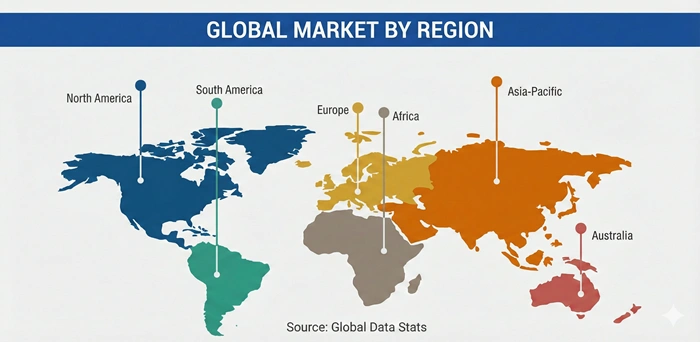
North America maintains its position as the dominant region in the smart glass market, commanding approximately 33% of global market share in 2025 with an estimated value of USD 2.15 billion, projected to reach USD 4.84 billion by 2033 growing at a CAGR of 9.45%. The region's leadership stems from stringent energy efficiency regulations including California Title 24 building standards and federal tax incentives for energy-efficient commercial buildings that mandate or encourage advanced glazing technologies. The United States accounts for approximately 78% of North American revenue with market size of USD 1.68 billion in 2025, driven by massive commercial real estate sector, strong automotive industry, and presence of leading smart glass manufacturers and technology innovators concentrated in California, Michigan, and Massachusetts.
Government initiatives including the Infrastructure Investment and Jobs Act allocate billions for federal building energy efficiency upgrades that specifically target window replacement with advanced technologies including smart glass and dynamic facades. The smart glass market in North America benefits from mature construction industry familiar with advanced glazing specifications, established distribution networks, experienced installation contractors, and comprehensive building automation ecosystems that facilitate smart glass integration. Leading companies dominating the regional market including View Inc., SageGlass (Saint-Gobain), Gentex Corporation, and Corning Incorporated maintain headquarters, research facilities, and manufacturing operations creating regional competitive advantages through proximity to customers, technical support capabilities, and continuous innovation pipelines addressing North American market requirements.
Asia Pacific
Explosive Growth Fueled by Urbanization and Infrastructure Investment
Asia Pacific represents the fastest-growing region in the smart glass market with a projected CAGR of 11.85% from 2026 to 2033, with market value expected to increase from USD 1.76 billion in 2025 to USD 4.63 billion by 2033, capturing expanding global revenue share. The region's exceptional growth trajectory stems from unprecedented urbanization concentrating hundreds of millions of people in cities requiring modern sustainable infrastructure, government smart city initiatives investing trillions in intelligent building systems, and rapidly expanding automotive production particularly in electric vehicle segment. China dominates the Asia Pacific market with approximately 45% regional share driven by massive construction volumes, government mandates for energy-efficient buildings, and domestic manufacturers including Xinyi Glass Holdings and Shenzhen Ruitoptel Electronics developing competitive smart glass technologies.
India shows particularly explosive growth with CAGR exceeding 12.50%, fueled by Smart Cities Mission targeting 100 urban centers for comprehensive infrastructure modernization, expanding commercial real estate sector in technology hubs including Bengaluru, Mumbai, and Delhi, and growing automotive industry adopting premium features in domestic and export vehicles. Key international manufacturers serving the Asia Pacific smart glass market including AGC Inc., Nippon Sheet Glass, Saint-Gobain, and Corning Incorporated operate manufacturing facilities and technical centers throughout the region, developing products specifically adapted to local climate conditions, architectural preferences, and price sensitivities. The region benefits from favorable demographics including large middle classes with rising incomes, young populations open to technology adoption, and increasing environmental awareness driving demand for sustainable building solutions that reduce energy consumption and enhance quality of life in densely populated urban environments.
Top Key Players
-
Saint-Gobain S.A. (France)
-
AGC Inc. (Japan)
-
Gentex Corporation (United States)
-
Corning Incorporated (United States)
-
Nippon Sheet Glass Co., Ltd. (Japan)
-
View, Inc. (United States)
-
Gauzy Ltd. (Israel)
-
Xinyi Glass Holdings Limited (China)
-
Research Frontiers Inc. (United States)
-
Smartglass International Limited (Ireland)
-
PPG Industries, Inc. (United States)
-
Guardian Industries (United States)
-
ChromoGenics AB (Sweden)
-
Kinestral Technologies, Inc. (United States)
-
RavenWindow (United States)
Recent Developments
-
Gauzy Ltd. (2025): Unveiled revolutionary suspended particle device smart glass technology at Consumer Electronics Show in January 2025, featuring enhanced SPD formulation transitioning from clear to fully opaque in under one second while blocking over 99% visible light, with improved temperature regulation and energy efficiency targeting automotive, architectural, and aerospace applications across global markets.
-
View, Inc. (2024): Secured USD 150 million strategic investment from investors including Artal Capital Partners in November 2024 to accelerate electrochromic smart window commercialization and expand manufacturing capacity, with funds supporting technology development, production scaling, and market penetration in commercial real estate and residential segments throughout North America and international markets.
-
elstar Dynamics (2024): Raised EUR 2 million in Series A funding in July 2024 from European investors to advance commercialization of proprietary sustainable adaptive glass technology featuring enhanced energy efficiency and lower manufacturing costs compared to conventional electrochromic alternatives, targeting European architectural and automotive markets with environmentally friendly smart glazing solutions.
-
Apple Inc. (2024): Launched internal 'Atlas' research study in November 2024 gathering employee feedback on smart glasses technology and wearable devices, signaling strategic focus on augmented reality and advanced eyewear products incorporating smart glass displays, optical technologies, and integrated electronics for consumer and enterprise applications expected in coming years.
-
Saint-Gobain (2023): Expanded SageGlass electrochromic production capacity through multimillion-dollar investment in Minnesota manufacturing facility completed in December 2023, increasing annual production capability by 40% to meet growing North American and international demand for dynamic glazing in commercial buildings, healthcare facilities, and institutional projects requiring energy-efficient facade solutions.
Market Trends
IoT Integration and Building Automation Drive Technology Evolution
The smart glass market is experiencing transformative shifts driven by comprehensive IoT integration, artificial intelligence optimization, and convergence with broader building automation ecosystems that position dynamic glazing as critical component of intelligent infrastructure strategies. Modern smart glass installations incorporate extensive sensor networks measuring indoor and outdoor conditions including temperature, light intensity, UV radiation, occupancy patterns, and user preferences to inform automated transparency adjustments optimizing energy efficiency while maintaining occupant comfort. Cloud-based management platforms enable centralized control of distributed smart glass installations across multiple buildings, campuses, or corporate real estate portfolios, providing facility managers with comprehensive visibility into performance metrics, energy savings, and system health status accessible through web browsers or mobile applications. Predictive algorithms analyze historical weather data, solar position calculations, and building usage patterns to proactively adjust glass tinting before environmental conditions change, maximizing energy efficiency while preventing uncomfortable glare or excessive heat gain.
Sustainability reporting and environmental social governance commitments drive corporate adoption of smart glass and other energy-efficient technologies that deliver measurable carbon footprint reductions, energy consumption decreases, and operational cost savings supporting climate action goals while enhancing corporate reputations among stakeholders including investors, employees, and customers. The circular economy focus influences product development strategies with manufacturers designing smart glass for disassembly, component recycling, and material recovery at end of useful life, addressing environmental concerns while potentially creating new business models around glass refurbishment and component remanufacturing. Aesthetic innovations including frameless installations, curved glass panels, and ultra-thin profiles expand architectural design possibilities while maintaining or enhancing functional performance characteristics, enabling dramatic floor-to-ceiling transparent facades that transform building appearances while delivering energy efficiency benefits throughout the smart glass market.
Segments Covered in the Report
By Technology
-
Electrochromic
-
Polymer Dispersed Liquid Crystal (PDLC)
-
Suspended Particle Devices (SPD)
-
Thermochromic
-
Photochromic
-
Others
By Application
-
Architectural
-
Commercial Buildings
-
Residential Buildings
-
Institutional Buildings
-
-
Transportation
-
Automotive
-
Aircraft
-
Marine
-
Railway
-
-
Consumer Electronics
-
Smartphones
-
Tablets
-
Wearables
-
-
Power Generation
-
Solar Panels
-
Energy Management
-
By Control Mode
-
Dimmers
-
Switches
-
Remote Control
-
Mobile Applications
-
Automated Systems
By Region
-
North America
-
United States
-
Canada
-
Mexico
-
-
Europe
-
Germany
-
United Kingdom
-
France
-
Italy
-
Spain
-
Rest of Europe
-
-
Asia Pacific
-
China
-
India
-
Japan
-
South Korea
-
Australia
-
Rest of Asia Pacific
-
-
Latin America
-
Brazil
-
Argentina
-
Rest of Latin America
-
-
Middle East and Africa
-
United Arab Emirates
-
Saudi Arabia
-
South Africa
-
Rest of Middle East and Africa
-
Frequently Asked Questions
Question 1: What is the projected smart glass market size by 2033?
Answer: The smart glass market is projected to reach USD 15.77 billion by 2033, growing from USD 7.23 billion in 2026. This robust expansion represents CAGR of 9.65% driven by energy efficiency regulations, green building adoption, automotive innovation, and declining manufacturing costs making technology accessible to broader markets.
Question 2: Which region dominates the global smart glass market share?
Answer: North America dominates the global smart glass market with approximately 33% market share in 2025, valued at USD 2.15 billion. This leadership position reflects stringent energy efficiency regulations, mature construction industry, presence of leading manufacturers, and strong government support for sustainable building technologies throughout the United States and Canada.
Question 3: What factors are driving the smart glass market growth?
Answer: Key factors driving smart glass market growth include stringent energy efficiency building codes, LEED and green building certification requirements, automotive industry adoption for luxury vehicles and EVs, smart city infrastructure investments, and growing environmental consciousness among consumers and corporations. Technological improvements and cost reductions also accelerate market penetration across applications.
Question 4: Which technology segment holds the largest share in the smart glass market?
Answer: The electrochromic technology segment holds the largest share in the smart glass market with approximately 59% in 2025. This dominance reflects superior energy efficiency, wide transparency range, precise light control, excellent color neutrality, and proven scalability for large architectural installations in commercial buildings, offices, and institutional facilities.
Question 5: What are the emerging trends in the smart glass market?
Answer: Emerging trends in the smart glass market include comprehensive IoT integration with building automation systems, AI-powered predictive transparency control, mobile application interfaces for user customization, residential market penetration as costs decline, and sustainability focus through recyclable materials and circular economy principles. Automotive applications including EVs and autonomous vehicles also gain significant traction.