
Smart Drugs Market Overview
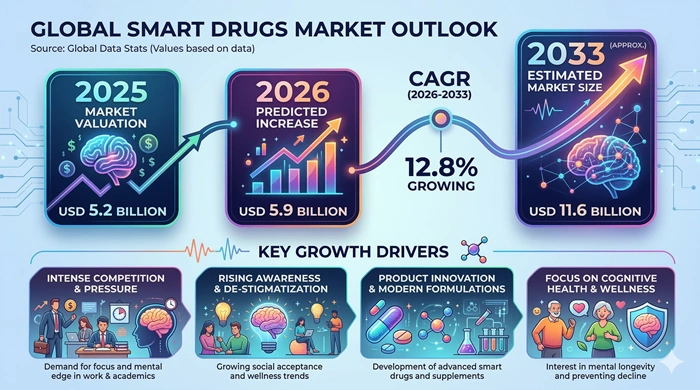
The global smart drugs market size is valued at USD 5.2 billion in 2025 and is predicted to increase from USD 5.9 billion in 2026 to approximately USD 11.6 billion by 2033, growing at a CAGR of 12.8% from 2026 to 2033.
Smart drugs, also referred to as nootropics or cognitive enhancers, are substances that improve mental performance including memory, focus, creativity, and executive function. Growing competitive pressure in professional and academic environments, rising awareness of cognitive health, and the increasing availability of science-backed formulations are collectively driving strong demand. Both prescription-based compounds and consumer-oriented non-prescription supplements are contributing to this market's remarkable expansion across multiple regions.
AI Impact on the Smart Drugs Industry
Artificial Intelligence Is Accelerating the Discovery of New Nootropic Compounds, Personalizing Cognitive Enhancement Regimens, and Transforming How Users Track Mental Performance
Artificial intelligence is reshaping the smart drugs market at every stage of the value chain, from molecule discovery to end-user personalization. Pharmaceutical companies and biotech startups are leveraging AI-powered drug discovery platforms to analyze neurochemical pathways and identify novel compounds that can improve cognition with fewer side effects. This approach is significantly reducing the time and cost associated with developing next-generation cognitive enhancement agents, opening the door to a broader range of effective and safe formulations.
On the consumer side, AI-driven apps and wearable integration are enabling users to track cognitive performance metrics in real time and adjust their smart drug stacks accordingly. Personalized recommendation engines analyze sleep quality, stress levels, productivity patterns, and biomarker data to suggest optimized nootropic regimens. This intersection of digital health and cognitive enhancement is creating a compelling new product category that combines pharmacology with precision wellness, attracting interest from both healthcare investors and mainstream consumers.
Growth Factors
Intensifying Academic and Professional Competition, Growing Mental Health Awareness, and Expanding Product Accessibility Are the Primary Engines Driving Market Expansion
The most significant driver behind the growth of the smart drugs market is the intensifying demand for cognitive performance in high-pressure environments. Students preparing for competitive exams, corporate professionals managing complex workloads, and aging adults seeking to preserve mental acuity are all turning to cognitive enhancers in growing numbers. This cultural shift toward mental optimization, sometimes referred to as biohacking, has normalized the use of both prescription and non-prescription nootropic compounds across diverse demographic groups.
Simultaneously, the rise of e-commerce and direct-to-consumer health brands has dramatically improved product accessibility. Consumers in markets where certain compounds are not locally regulated can now access a wide range of nootropic stacks through international online platforms. Social media influencers, productivity bloggers, and wellness communities have further amplified awareness and reduced the stigma associated with cognitive enhancement, creating a self-reinforcing demand cycle. Major supplement brands are also entering this space with clinically formulated products, lending credibility and attracting health-conscious mainstream consumers who may have previously avoided smart drugs.
Market Outlook
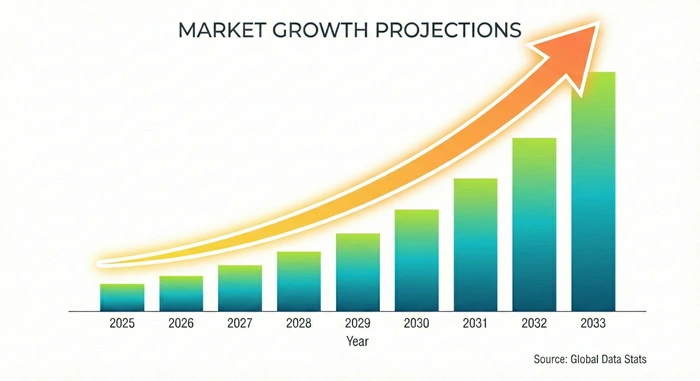
With a Deepening Research Base, Rising Consumer Health Consciousness, and a Broadening Product Portfolio, the Smart Drugs Market Is on Track for Robust Double-Digit Growth Through 2033
The long-term outlook for the smart drugs market is highly favorable. A robust and growing body of clinical research is validating the efficacy of several nootropic compounds, which is gradually shifting the conversation from anecdotal experimentation to evidence-based cognitive health management. As more peer-reviewed studies confirm the benefits of compounds like modafinil, racetams, and lion's mane mushroom extract, both physicians and consumers will become more confident in their use, expanding the prescription and self-directed segments simultaneously.
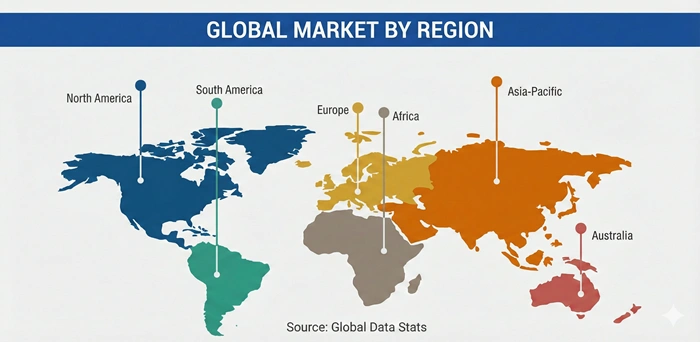
From a geographic standpoint, North America will maintain leadership due to its advanced supplement regulatory framework and high consumer spending on wellness. However, Asia Pacific is expected to post the strongest growth trajectory, powered by rising urban middle-class populations, growing awareness of cognitive health, and a long cultural tradition of using herbal adaptogens for mental clarity. As pharmaceutical companies launch new smart drug formulations specifically targeting the elderly population for conditions like mild cognitive impairment, the market will gain an additional clinical dimension that drives long-term revenue growth.
Expert Speaks
-
Nik Rasmussen, Co-CEO, Natrol (Nestlé Health Science) — "Consumer interest in cognitive health supplements has grown substantially over the past two years, and we are seeing strong demand across all age groups for products that support focus, memory, and mental clarity. The nootropics and smart supplement space is evolving quickly from a niche category into a mainstream wellness staple."
-
Albert Bourla, CEO, Pfizer — "Neurological health represents one of the most underfunded and underserved areas in medicine. We see meaningful opportunity in developing science-backed cognitive health interventions that can address both clinical conditions and the growing consumer interest in everyday mental performance optimization."
-
Paul Hudson, CEO, Sanofi — "The convergence of neuroscience, digital health, and consumer wellness is creating entirely new market dynamics in the cognitive therapeutics space. We believe companies that invest in clinically validated smart drug research today will be positioned as leaders in the next generation of brain health management."
Key Report Takeaways
-
North America dominates the smart drugs market with approximately 38% of global revenue in 2026, supported by high consumer awareness, a well-regulated supplement industry, and strong prescription nootropic usage among students and working professionals
-
Asia Pacific is the fastest-growing region, projected to expand at a CAGR of approximately 15.3% through 2033, driven by urbanization, competitive academic cultures in China, Japan, and South Korea, and growing interest in herbal adaptogen-based cognitive supplements
-
Working professionals represent the largest end-user segment, accounting for nearly 35% of total market consumption in 2026, as productivity demands in corporate environments fuel consistent demand for focus and memory-enhancing compounds
-
Memory enhancement is the leading application segment, holding approximately 32% of market share in 2026, as both aging consumers and young professionals prioritize recall, learning speed, and cognitive longevity
-
Prescription smart drugs, particularly modafinil and methylphenidate-based compounds, remain the most clinically trusted product category, commanding the highest average revenue per unit sold
-
Online pharmacies and e-commerce platforms are the fastest-growing distribution sub-segment with a projected CAGR of over 17% through 2033, reflecting strong consumer preference for discreet, convenient purchasing of nootropic and cognitive health products
Market Scope
| Report Coverage | Details |
|---|---|
| Market Size by 2033 | USD 11.6 Billion |
| Market Size by 2025 | USD 5.2 Billion |
| Market Size by 2026 | USD 5.9 Billion |
| Market Growth Rate (2026–2033) | CAGR of 12.8% |
| Dominating Region | North America |
| Fastest Growing Region | Asia Pacific |
| Base Year | 2025 |
| Forecast Period | 2026 – 2033 |
| Segments Covered | Product Type, Application, Distribution Channel, End User |
| Regions Covered | North America, Europe, Asia Pacific, Latin America, Middle East & Africa |
Market Dynamics
Drivers Impact Analysis
Rising Cognitive Performance Demands, Growing Biohacking Culture, and Clinical Validation of Key Nootropic Compounds Are the Core Forces Propelling Market Growth
| Driver | ≈ % Impact on CAGR Forecast | Geographic Relevance | Impact Timeline |
|---|---|---|---|
| Increasing academic and professional performance pressure | ~30% | Global, especially North America & Asia Pacific | Near to Long Term |
| Growing consumer interest in biohacking and brain optimization | ~27% | North America, Europe | Near to Mid Term |
| Clinical validation of nootropic compounds | ~24% | Global | Mid to Long Term |
| Expansion of e-commerce and DTC supplement brands | ~19% | Global | Near Term |
The smart drugs market is fundamentally driven by a global culture of performance optimization. In North America and Europe, the concept of biohacking — deliberately using nutrition, supplementation, and lifestyle choices to maximize cognitive output — has moved from niche online communities into mainstream wellness discourse. This shift has encouraged millions of consumers to experiment with nootropics, creating a self-sustaining demand cycle that grows with every new product launch, positive user review, and media feature.
Clinical research is playing an increasingly important role in legitimizing the market. As universities and pharmaceutical institutions publish peer-reviewed studies confirming the cognitive benefits of compounds like phosphatidylserine, bacopa monnieri, and pharmaceutical-grade racetams, both healthcare providers and consumers gain the confidence to explore these options more seriously. This growing evidence base is particularly important for the prescription segment, where physician endorsement remains critical to driving adoption among older demographics and patients managing early-stage cognitive decline.
Restraints Impact Analysis
Regulatory Inconsistency Across Markets, Safety Concerns Around Long-Term Use, and Stigma in Clinical Settings Are Slowing Full Market Potential From Being Realized
| Restraint | ≈ % Impact on CAGR Forecast | Geographic Relevance | Impact Timeline |
|---|---|---|---|
| Fragmented regulatory landscape across regions | ~32% | Global, especially Asia Pacific & MEA | Near to Long Term |
| Safety and dependency concerns for prescription nootropics | ~28% | Global | Near to Mid Term |
| Lack of standardized clinical guidelines for smart drug use | ~24% | Global | Mid Term |
| High cost of premium nootropic formulations | ~16% | Emerging markets | Mid to Long Term |
One of the most significant obstacles facing the smart drugs market is the inconsistency of regulations across different countries. Compounds like modafinil are prescription-only in some nations but freely available over the counter in others, creating legal uncertainty for consumers, retailers, and manufacturers. This regulatory fragmentation makes it difficult for brands to build globally scalable products and forces them to navigate complex country-specific compliance processes.
Concerns about the long-term safety of regular smart drug use also persist in the medical community. Some prescription nootropics carry risks of dependency, cardiovascular side effects, or mood disturbances with prolonged use, which makes physicians cautious about off-label recommendations. The lack of standardized clinical guidelines for cognitive enhancement in healthy individuals means that most usage remains self-directed, which increases the risk of misuse and limits market penetration among risk-averse consumer segments.
Opportunities Impact Analysis
Aging Population Demanding Cognitive Longevity Solutions, Natural Nootropic Innovation, and Emerging Market Penetration Present Significant Untapped Growth Potential
| Opportunity | ≈ % Impact on CAGR Forecast | Geographic Relevance | Impact Timeline |
|---|---|---|---|
| Growing geriatric population seeking cognitive health solutions | ~34% | Global, especially North America & Europe | Mid to Long Term |
| Innovation in natural and plant-based nootropic formulations | ~28% | Asia Pacific, North America | Near to Mid Term |
| Penetration in emerging markets with rising health awareness | ~23% | Asia Pacific, Latin America | Mid to Long Term |
| Corporate wellness programs integrating cognitive health products | ~15% | North America, Europe | Mid Term |
The aging global population represents one of the most compelling long-term opportunities for the smart drugs market. With the number of people aged 60 and above expected to double by 2050, demand for products that support cognitive longevity, prevent memory decline, and manage early-stage dementia will grow substantially. Pharmaceutical companies are already pivoting their cognitive health pipelines to target age-related cognitive impairment, a segment that combines clinical necessity with massive commercial scale.
Corporate wellness programs are another emerging growth avenue. A growing number of employers in technology, finance, and consulting sectors are incorporating cognitive health into their employee wellness benefits, with some companies offering curated nootropic supplement subscriptions as part of their benefits packages. This trend is particularly prominent in North America and Northern Europe and is expected to accelerate as productivity-focused workplace cultures continue to prioritize mental performance alongside physical health.
Segment Analysis
By Product Type
Prescription Smart Drugs Lead the Product Type Segment in Revenue, While Non-Prescription Nootropics Are Growing Faster Driven by Consumer Wellness Trends
The prescription smart drugs sub-segment holds the dominant revenue share within the smart drugs market, accounting for approximately 52% of total market revenue in 2026 and growing at a CAGR of around 10.4% through 2033. Modafinil, Adderall, and Ritalin remain the most widely used prescription cognitive enhancers, primarily prescribed for ADHD and narcolepsy but increasingly used off-label for performance enhancement. North America is the clear leader in this sub-segment, where high ADHD diagnosis rates and established prescribing cultures have created a large and consistent demand base. Key companies in this space include Teva Pharmaceutical, Pfizer, Novartis, and Shire (now part of Takeda), all of which maintain strong distribution networks in the U.S. and Canada.
Non-prescription smart drugs, including racetams, cholinergics, herbal adaptogens, and multi-ingredient nootropic stacks, hold approximately 48% of market share in 2026 but are growing at a faster CAGR of approximately 15.2% through 2033. This acceleration is driven by growing consumer preference for natural and self-directed cognitive health solutions. Asia Pacific is the most dynamic growth region for non-prescription nootropics, where a strong cultural familiarity with herbal adaptogens like ashwagandha, ginkgo biloba, and rhodiola rosea provides a favorable foundation for market development. Companies such as Onnit, Natural Stacks, and Nootrobox are gaining significant traction in this sub-segment through direct-to-consumer e-commerce strategies.
By Application
Memory Enhancement Commands the Largest Application Share, While Attention and Focus Supplements Gain Ground Rapidly Among Younger Professional Demographics
Memory enhancement is the leading application segment within the smart drugs market, capturing approximately 32% of revenue in 2026 and growing at a CAGR of around 11.8% through 2033. The demand is spread across two primary demographics: older adults seeking to preserve cognitive function and younger professionals aiming to accelerate learning and retention. North America leads this application segment, driven by both clinical demand related to age-associated memory impairment and a strong consumer wellness culture among adults aged 30 to 55. Brands like Jarrow Formulas, Life Extension, and Natrol are key players in the memory enhancement sub-segment, offering clinically referenced formulations based on compounds like phosphatidylserine, bacopa monnieri, and lion's mane mushroom.
The attention and focus application segment is growing at the fastest CAGR within the category, projected at approximately 14.6% through 2033, driven largely by demand from students and corporate professionals. Europe is emerging as a strong market for this sub-segment, particularly in the UK, Germany, and the Netherlands, where productivity-focused consumer behavior and a growing acceptance of nootropic supplementation are driving retail and online sales. Companies such as Mind Lab Pro, Alpha Brain (Onnit), and pharmaceutical firms producing modafinil generics are actively capturing this growth through multi-channel distribution and targeted digital marketing campaigns.
Regional Insights
North America
North America Leads the Smart Drugs Market With the Highest Revenue Contribution, Fueled by Strong Consumer Spending, ADHD Diagnosis Rates, and a Thriving Wellness Industry
North America holds the dominant position in the smart drugs market, commanding approximately 38% of global revenue in 2026 and growing at a CAGR of around 11.5% through 2033. The United States is the single largest national market, driven by a combination of high ADHD diagnosis rates that fuel prescription nootropic demand, a deeply embedded wellness and biohacking culture that sustains the non-prescription segment, and a highly developed e-commerce ecosystem that facilitates product discovery and purchase. Key players leading the North American market include Pfizer, Teva Pharmaceutical, Shire/Takeda, Onnit, and Natural Stacks. The region also benefits from a relatively permissive supplement regulatory environment under the Dietary Supplement Health and Education Act, which allows a wide range of non-prescription nootropics to reach consumers without extensive pre-market approval.
Canada contributes meaningfully to North America's smart drug revenue, with growing consumer interest in natural nootropics and a well-developed natural health product regulatory framework that provides clearer pathways for bringing cognitive health supplements to market. The region's strong university culture and high rates of graduate-level education also contribute to sustained demand for focus and memory-enhancement products among students. North America is expected to remain the global revenue leader through 2033, supported by continued product innovation, expanding telehealth-based prescribing of cognitive health therapies, and the growing integration of smart drugs into corporate wellness programs.
Asia Pacific
Asia Pacific Is the Fastest-Growing Regional Market for Smart Drugs, Powered by Competitive Academic Cultures, Urbanization, and Rising Demand for Herbal Cognitive Supplements
Asia Pacific is the fastest-growing region in the smart drugs market, estimated to hold approximately 22% of global market share in 2026 and projected to expand at a CAGR of approximately 15.3% through 2033. China leads the regional market, driven by an intensely competitive educational environment where students routinely seek cognitive performance support during high-stakes examinations. Japan and South Korea are also significant contributors, with well-developed health supplement industries and aging populations that are actively seeking products to support memory retention and cognitive longevity. Prominent regional players include Eisai Co. (Japan), Otsuka Pharmaceutical (Japan), and a growing number of Chinese nutraceutical companies developing herbal nootropic formulations based on traditional medicine ingredients.
India is emerging as one of the most exciting growth markets within Asia Pacific for the genitourinary syndrome of cognitive enhancement supplement segment, as rising disposable incomes, growing health literacy, and a large young urban population create ideal conditions for market expansion. The genitourinary syndrome of the region's herbal medicine tradition — featuring potent adaptogens like ashwagandha, brahmi, and shatavari — gives Indian companies a natural product development advantage that global brands are beginning to license and incorporate. Government support for nutraceutical manufacturing under initiatives like Make in India is further strengthening the regional supply chain, which will help keep product prices competitive and support broader market accessibility through 2033.
Top Key Players
-
Pfizer Inc. (United States)
-
Teva Pharmaceutical Industries Ltd. (Israel)
-
Takeda Pharmaceutical Company Ltd. / Shire (Japan / Ireland)
-
Novartis AG (Switzerland)
-
Eisai Co., Ltd. (Japan)
-
Otsuka Pharmaceutical Co., Ltd. (Japan)
-
Cephalon Inc. (United States)
-
Onnit Labs (United States)
-
Natural Stacks LLC (United States)
-
Jarrow Formulas (United States)
-
Life Extension Foundation (United States)
-
Nootrobox (HVMN Inc.) (United States)
Recent Developments
-
Pfizer Inc. (2025): Launched a dedicated cognitive health research initiative focused on identifying next-generation oral compounds that target age-related cognitive decline, signaling a strategic expansion beyond its existing CNS drug portfolio into the broader smart drug and brain health market segment.
-
Teva Pharmaceutical (2024): Expanded its generic modafinil distribution network across five new Asia Pacific markets including Vietnam, Thailand, and the Philippines, significantly increasing its addressable patient and consumer base in one of the fastest-growing regions for prescription cognitive enhancers.
-
Takeda Pharmaceutical (2025): Entered into a co-development agreement with a U.S.-based neuroscience startup to advance a novel non-stimulant ADHD and cognitive enhancement compound through Phase 2 clinical trials, broadening its pipeline beyond traditional methylphenidate-class medications.
-
Eisai Co., Ltd. (2024): Following the success of its Alzheimer's drug lecanemab, Eisai announced plans to investigate its cognitive benefit potential in non-clinical populations with mild memory complaints, exploring a pathway into the broader smart drug and cognitive longevity market.
-
Onnit Labs (2025): Launched an updated Alpha Brain formula backed by two new clinical studies demonstrating statistically significant improvements in verbal memory and processing speed, reinforcing its position as the most credible consumer-facing brand in the non-prescription smart drugs segment.
Market Trends
The Convergence of Personalized Nutrition, Natural Nootropic Science, and Corporate Cognitive Wellness Is Defining the Most Important Trends in the Smart Drugs Landscape
One of the most significant trends in the smart drugs market is the shift toward clinically validated, natural ingredient-based formulations. Consumers are increasingly skeptical of synthetic compounds with limited safety data and are gravitating toward products built around ingredients like lion's mane mushroom, bacopa monnieri, and phosphatidylserine that have robust peer-reviewed research behind them. This preference is pushing both established pharmaceutical players and emerging supplement brands to invest in clinical trials for natural nootropics, which is elevating quality standards across the entire industry.
Personalized cognitive supplementation is another defining trend reshaping how smart drug products are developed and marketed. Companies are launching at-home cognitive assessment tools and genetic testing kits that analyze an individual's neurotransmitter profile, lifestyle factors, and cognitive performance data to recommend tailored nootropic regimens. This personalization approach commands premium pricing and builds strong consumer loyalty, creating a subscription-based revenue model that is increasingly attractive to investors. As consumer data platforms become more sophisticated, personalized smart drug stacking is expected to become the dominant go-to-market strategy for premium cognitive health brands through 2033.
Segments Covered in the Report
By Product Type
-
Prescription Smart Drugs
-
Modafinil
-
Adderall (Amphetamine Salts)
-
Ritalin (Methylphenidate)
-
Donepezil
-
-
Non-Prescription Smart Drugs
-
Racetams (Piracetam, Aniracetam)
-
Cholinergics (Alpha-GPC, CDP-Choline)
-
Adaptogens (Ashwagandha, Rhodiola Rosea)
-
Herbal Nootropics (Lion's Mane, Bacopa Monnieri, Ginkgo Biloba)
-
By Application
-
Memory Enhancement
-
Mood & Depression Management
-
Attention & Focus
-
Longevity & Anti-Aging
-
Sleep & Recovery
By Distribution Channel
-
Hospital Pharmacies
-
Retail Pharmacies
-
Online Pharmacies & E-Commerce
-
Specialty Health Stores
By End User
-
Students
-
Working Professionals
-
Geriatric Population
-
Athletes
By Region
-
North America
-
Europe
-
Asia Pacific
-
Latin America
-
Middle East & Africa
Frequently Asked Questions
Question 1: What is the projected size of the smart drugs market by 2033 and what is the expected growth rate?
Answer: The smart drugs market is projected to reach approximately USD 11.6 billion by 2033, growing at a CAGR of 12.8% from 2026 to 2033. This strong growth reflects rising global demand for cognitive enhancement solutions among students, professionals, and aging populations.
Question 2: Which product type dominates the smart drugs market and why?
Answer: Prescription smart drugs currently dominate the smart drugs market with approximately 52% of total revenue in 2026, led by compounds like modafinil, Adderall, and Ritalin. Their clinical validation and strong physician-driven demand, particularly in North America, continue to support their market leadership.
Question 3: Which region leads the smart drugs market and which is expected to grow the fastest?
Answer: North America holds the largest share of the smart drugs market at approximately 38% of global revenue in 2026, driven by high consumer awareness and established prescribing culture. Asia Pacific is the fastest-growing region, projected at a CAGR of 15.3% through 2033, fueled by competitive academic environments and rising demand for herbal nootropics.
Question 4: Are smart drugs safe for long-term use?
Answer: Safety profiles for smart drugs vary significantly depending on the compound, dosage, and individual health factors, with prescription nootropics carrying higher risks of dependency and side effects than natural alternatives. The smart drugs market continues to see investment in long-term safety research, and consumers are advised to consult healthcare professionals before starting any cognitive enhancement regimen.
Question 5: What are the key factors driving growth in the smart drugs market over the forecast period?
Answer: The primary drivers of growth in the smart drugs market include rising academic and professional performance pressures, growing consumer interest in biohacking and brain optimization, and the expanding availability of clinically validated non-prescription nootropics. Favorable e-commerce growth and increasing corporate wellness program adoption are also expected to sustain double-digit market expansion through 2033.