
Semiconductor Manufacturing Equipment Market Overview
The global semiconductor manufacturing equipment market size is valued at USD 118.58 billion in 2025 and is predicted to increase from USD 127.76 billion in 2026 to approximately USD 224.63 billion by 2033, growing at a CAGR of 8.10% from 2026 to 2033.
The semiconductor manufacturing equipment market encompasses critical machinery and tools used in the production of integrated circuits, microprocessors, memory chips, and other semiconductor devices that power modern electronics across all industries. This sophisticated equipment includes lithography systems, deposition tools, etching machines, inspection instruments, and packaging equipment that enable chipmakers to fabricate increasingly complex semiconductors at nanometer scale. The market's impressive expansion reflects accelerating digital transformation initiatives, surging demand for artificial intelligence computing power, proliferation of connected devices, and strategic government investments to strengthen domestic semiconductor manufacturing capabilities across multiple regions.
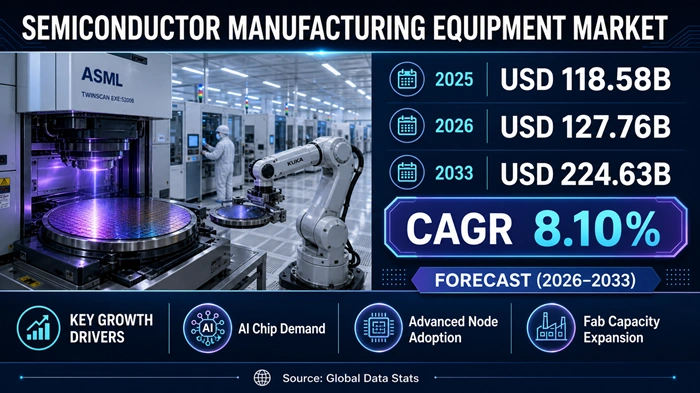
Powering the Digital Revolution Through Advanced Fabrication Technologies and Process Innovation
Semiconductor manufacturers worldwide are investing billions of dollars annually to expand production capacity and acquire next-generation equipment that enables fabrication of advanced chips with smaller transistor dimensions and higher performance characteristics. The transition toward extreme ultraviolet lithography, atomic layer deposition, and advanced packaging technologies is driving substantial equipment spending as chipmakers compete to deliver cutting-edge products for data centers, smartphones, automotive electronics, and emerging applications. As geopolitical considerations reshape global supply chains and nations prioritize technological sovereignty, significant public and private capital is flowing into semiconductor fabrication infrastructure, creating unprecedented growth opportunities for equipment suppliers throughout the ecosystem.
AI Impact on the Semiconductor Manufacturing Equipment Industry
Transforming Chip Production Through Intelligent Process Control and Predictive Maintenance Systems
Artificial intelligence is revolutionizing the semiconductor manufacturing equipment market by introducing sophisticated algorithms that optimize production yields, reduce defect rates, and accelerate time-to-market for new semiconductor technologies. Machine learning models analyze vast datasets generated by fabrication equipment to identify subtle process variations that impact chip quality, enabling real-time adjustments to deposition rates, etching parameters, and lithography exposure settings. These AI-powered systems can detect anomalies invisible to human operators, predicting equipment failures before they occur and automatically scheduling maintenance interventions to minimize costly production downtime. Leading equipment manufacturers are embedding artificial intelligence directly into lithography systems, metrology tools, and process control platforms, creating self-optimizing fabrication environments that continuously improve performance based on accumulated production data.
The integration of AI technology extends beyond individual equipment optimization to encompass comprehensive factory-level orchestration that coordinates hundreds of manufacturing tools across complex semiconductor fabrication facilities. Advanced analytics platforms aggregate sensor data from lithography systems, chemical vapor deposition chambers, and inspection equipment to create digital twins of entire fabrication processes, enabling engineers to simulate process changes virtually before implementing them in production. This predictive capability dramatically reduces the experimental cycles traditionally required to develop new manufacturing processes, accelerating innovation timelines while minimizing waste. Additionally, artificial intelligence is enhancing equipment design methodologies, with neural networks analyzing performance data to suggest design modifications that improve throughput, reduce energy consumption, and extend component lifespan, fundamentally transforming how semiconductor manufacturing equipment is conceived and optimized.
Growth Factors
Explosive AI Computing Demand and Automotive Electrification Driving Equipment Investments
The unprecedented growth in artificial intelligence applications is creating insatiable demand for advanced semiconductors optimized for machine learning workloads, driving massive equipment investments across the semiconductor manufacturing equipment market. Training large language models, powering autonomous systems, and enabling real-time inference at scale require specialized chips with enormous compute density and memory bandwidth that push the boundaries of manufacturing technology. Data center operators and cloud service providers are procuring AI accelerators at unprecedented volumes, compelling semiconductor manufacturers to dramatically expand production capacity for graphics processors, tensor processing units, and application-specific integrated circuits. This AI-driven demand cycle is generating record orders for extreme ultraviolet lithography systems, high-bandwidth memory production equipment, and advanced packaging tools capable of integrating multiple chiplets into single high-performance modules. The sustained nature of AI infrastructure buildout ensures multi-year visibility for equipment spending as chipmakers continuously add capacity to meet growing computational requirements.
The automotive industry's transformation toward electric vehicles and advanced driver assistance systems represents another fundamental growth driver for the semiconductor manufacturing equipment market. Modern electric vehicles incorporate dozens of microcontrollers, power management chips, sensor processors, and battery management semiconductors that enable efficient operation and safety-critical functions. The transition from internal combustion engines to electric powertrains increases semiconductor content per vehicle by several multiples, creating structural demand growth that extends across multiple chip categories including power electronics, analog components, and embedded processors. Autonomous driving technologies amplify this trend further, requiring sophisticated sensor fusion chips, high-performance computing platforms, and redundant safety systems that dramatically increase semiconductor usage. As global automotive production shifts toward electrification and automation, sustained equipment investments are necessary to build specialized fabrication capacity for automotive-grade chips that meet stringent reliability and temperature tolerance specifications.
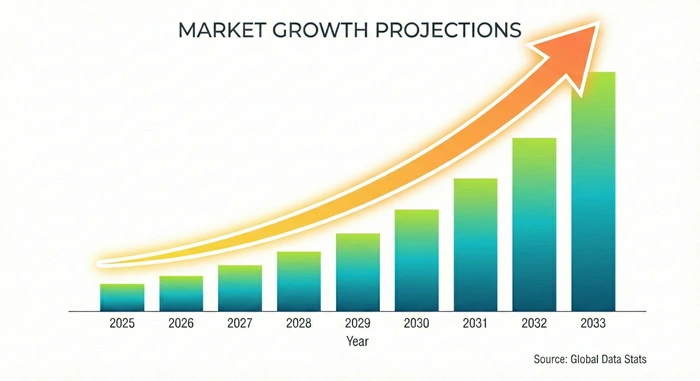
Market Outlook
Robust Growth Trajectory Supported by Technology Transitions and Geopolitical Supply Chain Restructuring
The semiconductor manufacturing equipment market outlook remains exceptionally strong as the industry navigates multiple technology transitions that necessitate substantial capital investments in advanced fabrication capabilities. The migration toward smaller process nodes below 3 nanometers requires entirely new classes of manufacturing equipment including high numerical aperture extreme ultraviolet lithography systems costing hundreds of millions of dollars per unit. Memory manufacturers are investing heavily in vertical NAND flash architectures exceeding 300 layers and transitioning to next-generation DRAM technologies that enable higher bandwidth and capacity. These technological transitions create sustained equipment demand that extends beyond cyclical replacement patterns, as chipmakers must continuously upgrade their manufacturing arsenals to remain competitive in delivering cutting-edge products that meet market performance expectations.
Geopolitical factors are fundamentally reshaping semiconductor supply chains and creating additional growth momentum for manufacturing equipment suppliers. Governments across North America, Europe, and Asia are implementing strategic initiatives to strengthen domestic semiconductor production capabilities through substantial financial incentives, tax credits, and direct subsidies. These programs are catalyzing construction of dozens of new fabrication facilities that require comprehensive equipment installations encompassing lithography, deposition, etching, inspection, and packaging tools. The diversification of semiconductor manufacturing capacity across multiple geographic regions reduces supply chain concentration risks while creating parallel demand streams that stabilize equipment markets during regional economic fluctuations. This policy-driven capacity expansion represents a multi-year investment cycle that will sustain elevated equipment spending levels well beyond traditional market dynamics, providing visibility and confidence for equipment manufacturers planning capacity expansions and technology development roadmaps.
Expert Speaks
-
Ajit Manocha, President and CEO of SEMI, stated that following strong growth in recent years, global semiconductor manufacturing equipment sales are forecast to expand significantly and set new industry records, driven by AI-fueled demand for chip innovations that is propelling investments in capacity expansions and leading-edge production capabilities across all major semiconductor manufacturing regions.
-
Gary Dickerson, President and CEO of Applied Materials, emphasized that the company is experiencing unprecedented demand for advanced semiconductor manufacturing solutions as the industry transitions toward new architectures optimized for AI workloads, with significant opportunities emerging in atomic-scale materials engineering and advanced packaging technologies that enable higher performance and energy efficiency.
-
Christophe Fouquet, CEO of ASML, highlighted that extreme ultraviolet lithography technology has become essential for manufacturing the most advanced semiconductors, with growing customer investments in both current-generation EUV systems and next-generation high numerical aperture platforms that will enable continuation of Moore's Law scaling and support the industry's transition to smaller process nodes.
Key Report Takeaways
-
Asia Pacific dominates the semiconductor manufacturing equipment market with an overwhelming 69% market share valued at approximately USD 88.2 billion in 2026, driven by massive fabrication capacity concentration in Taiwan, South Korea, China, and Japan where leading foundries and memory manufacturers operate state-of-the-art production facilities serving global electronics supply chains.
-
North America represents the fastest-growing regional market with a projected CAGR of 6.6%, fueled by substantial government incentives through the CHIPS Act, aggressive capacity expansion by domestic chipmakers, significant investments in advanced logic fabrication, and strategic initiatives to reduce dependence on offshore semiconductor production.
-
Front-end equipment dominates product segment revenue accounting for approximately 73.8% of total market value, reflecting the technological complexity and capital intensity of wafer fabrication processes including lithography, deposition, etching, and cleaning that require sophisticated tools costing millions of dollars per unit.
-
Semiconductor fabrication plant and foundry applications contribute the most significant revenue representing roughly 47.1% of total market value, as dedicated chip manufacturers and integrated device manufacturers invest billions in expanding production capacity to meet surging global demand for semiconductors across all application categories.
-
3D dimension segment is experiencing the fastest growth with a projected CAGR of 10.7%, gaining rapid adoption for advanced chip architectures that stack multiple semiconductor layers vertically to achieve higher performance, greater functionality, and improved power efficiency for AI computing and high-performance applications.
-
Front-end process segment will exhibit the strongest expansion trajectory expected to grow at a CAGR of 8.6% with market share exceeding 74%, driven by continuous investments in advanced lithography systems, atomic layer deposition tools, and plasma etching equipment necessary for manufacturing cutting-edge semiconductors at sub-5 nanometer process nodes.
Market Scope
| Report Coverage | Details |
|---|---|
| Market Size by 2033 | USD 224.63 Billion |
| Market Size by 2025 | USD 118.58 Billion |
| Market Size by 2026 | USD 127.76 Billion |
| Market Growth Rate from 2026 to 2033 | CAGR of 8.10% |
| Dominating Region | Asia Pacific |
| Fastest Growing Region | North America |
| Base Year | 2025 |
| Forecast Period | 2026 to 2033 |
| Segments Covered | Process, Dimension, Application, Region |
| Regions Covered | North America, Europe, Asia Pacific, Latin America, Middle East & Africa |
Market Dynamics
Drivers Impact Analysis
Accelerating Technology Node Transitions and Memory Architecture Evolution Propelling Equipment Demand
| Driver | (≈) % Impact on CAGR Forecast | Geographic Relevance | Impact Timeline |
|---|---|---|---|
| AI computing infrastructure expansion and data center buildout | +2.3% | Global | 2026-2033 |
| Advanced process node migration and EUV lithography adoption | +2.0% | Asia Pacific, North America | 2026-2033 |
| Government incentives and semiconductor supply chain localization | +1.7% | North America, Europe, Asia Pacific | 2026-2030 |
The semiconductor industry's relentless progression toward smaller process geometries is creating extraordinary demand for advanced manufacturing equipment capable of fabricating chips at 3-nanometer nodes and below. Traditional deep ultraviolet lithography systems cannot achieve the resolution required for these advanced nodes, necessitating adoption of extreme ultraviolet technology that utilizes 13.5-nanometer wavelength light to pattern features measuring just a few nanometers. Each EUV lithography system costs over USD 150 million and requires extensive supporting infrastructure including specialized photoresists, advanced metrology equipment, and precision environmental controls. The transition to high numerical aperture EUV systems capable of even finer patterning represents the next technology inflection, with leading-edge chipmakers already placing orders for next-generation platforms expected to cost upwards of USD 300 million per unit. This technology migration creates sustained multi-year equipment demand that extends across the entire fabrication process, as deposition, etching, and cleaning tools must also advance to maintain compatibility with shrinking device dimensions and increasingly complex material stacks.
Memory manufacturers are driving substantial equipment investments through architectural transitions that fundamentally change production requirements across the semiconductor manufacturing equipment market. The NAND flash industry is aggressively pursuing vertical scaling strategies that stack memory cells in structures exceeding 300 layers, creating unprecedented challenges for deposition and etching processes that must maintain dimensional uniformity across extreme aspect ratios. These tall structures require specialized atomic layer deposition systems capable of conformally coating deep trenches and advanced reactive ion etching equipment that can precisely remove material from narrow channels without damaging adjacent features. Similarly, the DRAM industry is adopting extreme ultraviolet lithography to enable continued scaling while transitioning to high-bandwidth memory architectures that stack multiple memory dies with through-silicon vias connecting them vertically. These architectural evolutions necessitate comprehensive equipment upgrades encompassing wafer bonding systems, through-silicon via drilling tools, and advanced inspection equipment capable of detecting defects in three-dimensional structures, creating sustained capital expenditure requirements that support long-term market growth.
Restraints Impact Analysis
Extreme Capital Intensity and Extended Lead Times Limiting Market Accessibility
| Restraint | (≈) % Impact on CAGR Forecast | Geographic Relevance | Impact Timeline |
|---|---|---|---|
| Massive capital investment requirements and financial barriers | -1.3% | Emerging Markets, Small Players | 2026-2029 |
| Equipment complexity and specialized technical expertise requirements | -0.9% | Global | 2026-2033 |
| Geopolitical tensions and export control restrictions | -0.7% | China, Restricted Markets | 2026-2028 |
The extraordinary capital intensity of semiconductor manufacturing creates formidable barriers to market entry and capacity expansion, particularly for smaller chipmakers and emerging market players with limited access to capital. A comprehensive advanced logic fabrication facility equipped with state-of-the-art manufacturing equipment requires investments exceeding USD 20 billion, with individual lithography systems, deposition tools, and metrology equipment costing tens to hundreds of millions of dollars. These massive upfront expenditures must be justified through detailed financial projections spanning multiple years, requiring confidence in sustained demand and favorable pricing dynamics that can be difficult to predict given rapid technology transitions and competitive market conditions. The concentration of equipment spending among a small number of leading foundries and integrated device manufacturers creates customer concentration risks for equipment suppliers while limiting market opportunities for specialized tool providers targeting niche applications. Additionally, the extended payback periods associated with semiconductor capital investments make chipmakers cautious about committing to new capacity during periods of economic uncertainty, potentially dampening equipment demand during cyclical downturns.
The technical complexity of modern semiconductor manufacturing equipment demands highly specialized engineering expertise that many regions and organizations lack internally, constraining market growth potential. Operating extreme ultraviolet lithography systems requires deep understanding of plasma physics, optical engineering, and photochemistry, while maintaining atomic layer deposition tools necessitates expertise in materials science, chemical kinetics, and surface reactions. Organizations must invest extensively in training programs and recruit scarce technical talent capable of optimizing equipment performance and troubleshooting complex process issues. The shortage of qualified semiconductor engineers and technicians in many regions creates bottlenecks that limit how quickly new fabrication capacity can be brought online even when financial resources are available. This skills gap is particularly acute in emerging semiconductor manufacturing regions attempting to build domestic capabilities, as experienced personnel tend to concentrate in established industry hubs where career opportunities and knowledge networks are most developed. The resulting competition for technical talent drives up operational costs while potentially extending project timelines and increasing execution risks.
Opportunities Impact Analysis
Heterogeneous Integration and Advanced Packaging Creating New Equipment Categories
| Opportunity | (≈) % Impact on CAGR Forecast | Geographic Relevance | Impact Timeline |
|---|---|---|---|
| Advanced packaging and chiplet architecture adoption | +1.5% | Asia Pacific, North America | 2027-2033 |
| Compound semiconductor manufacturing for power electronics | +1.1% | Europe, North America | 2026-2033 |
| Emerging market semiconductor ecosystem development | +0.9% | Southeast Asia, Latin America | 2028-2033 |
The semiconductor industry's shift toward heterogeneous integration and advanced packaging architectures is creating substantial growth opportunities for new categories of manufacturing equipment beyond traditional wafer fabrication tools. Chiplet-based designs that combine multiple specialized dies into single packages require sophisticated hybrid bonding equipment, through-silicon via drilling systems, and redistribution layer lithography tools that enable high-density interconnections between components. These advanced packaging technologies offer economic alternatives to monolithic system-on-chip designs by allowing manufacturers to integrate dies fabricated using different process nodes and even different materials into optimized configurations. The explosive growth of artificial intelligence computing is accelerating advanced packaging adoption as chip designers stack high-bandwidth memory directly on processing dies to minimize data transfer latency and maximize computational efficiency. This architectural trend is driving unprecedented investments in back-end equipment including wafer-to-wafer bonding systems, micro-bump placement tools, and non-destructive inspection platforms capable of verifying interconnect integrity in three-dimensional structures. Equipment suppliers developing innovative solutions for these emerging packaging approaches can capture significant market share in high-growth segments that complement traditional front-end equipment businesses.
The proliferation of electric vehicles and renewable energy systems is driving substantial demand for wide-bandgap semiconductor devices fabricated from silicon carbide and gallium nitride materials that enable efficient power conversion. These compound semiconductors offer superior performance compared to silicon for high-voltage and high-temperature applications, but they require specialized manufacturing equipment adapted to handle different material properties and processing requirements. Crystal growth systems for producing large-diameter silicon carbide wafers, ion implantation tools optimized for wide-bandgap materials, and metrology equipment capable of characterizing unique defect types represent significant equipment opportunities in the semiconductor manufacturing equipment market. As automotive manufacturers transition toward 800-volt electrical architectures that improve charging speed and reduce system weight, demand for silicon carbide power semiconductors is projected to grow exponentially. Equipment suppliers establishing leadership positions in compound semiconductor processing tools can benefit from secular growth trends in electrification while diversifying their customer bases beyond traditional silicon-based integrated circuit manufacturers. The relatively nascent state of compound semiconductor manufacturing infrastructure creates opportunities for innovative equipment solutions that improve yields, reduce costs, and enable scaling toward high-volume production.
Segment Analysis
Front-End Equipment Process
Market Dominance Through Critical Role in Advanced Chip Fabrication and Technology Leadership
Front-end equipment dominates the semiconductor manufacturing equipment market with a commanding 73.8% revenue share, reflecting the extraordinary technological complexity and capital intensity of wafer fabrication processes that create the transistors, interconnects, and functional structures comprising integrated circuits. This equipment category encompasses lithography systems that pattern nanometer-scale features, chemical vapor deposition tools that build up atomic layers of materials, plasma etching equipment that precisely removes unwanted material, and cleaning systems that maintain pristine surface conditions throughout processing. The front-end segment's market leadership stems from the astronomical costs of cutting-edge lithography equipment, with extreme ultraviolet systems manufactured by ASML commanding prices exceeding USD 150 million per unit and next-generation high numerical aperture platforms projected to cost over USD 300 million. Asia Pacific represents the largest regional market for front-end equipment, accounting for approximately 70% of segment revenue, driven by massive fabrication capacity operated by TSMC in Taiwan, Samsung and SK Hynix in South Korea, and numerous foundries throughout China. Leading equipment suppliers including Applied Materials, Lam Research, Tokyo Electron, and ASML generate the majority of their revenues from front-end tool sales, continuously investing billions in research and development to advance lithography resolution, improve deposition uniformity, and enhance etching selectivity.
The front-end segment is projected to maintain robust growth with a CAGR of 8.6% through 2033 as semiconductor manufacturers pursue aggressive process node scaling and technology transitions that demand continuous equipment upgrades. The industry's migration from deep ultraviolet to extreme ultraviolet lithography represents a multi-decade technology inflection that will sustain equipment demand for years as chipmakers gradually convert their production lines and adopt successive generations of EUV tools with improving resolution and throughput. Memory manufacturers are driving substantial front-end equipment investments through architectural changes including vertical NAND flash structures approaching 400 layers and high-bandwidth memory designs requiring advanced through-silicon via processing. North America is emerging as a particularly strong growth market for front-end equipment as domestic chipmakers including Intel, Micron, and Texas Instruments execute major capacity expansion projects supported by government incentives, with the United States expected to add over 20 new semiconductor fabrication facilities by 2030. The segment benefits from ongoing innovation in deposition technologies including selective atomic layer deposition that enables precise material placement, advanced plasma sources that improve etching performance, and artificial intelligence-powered process control systems that optimize equipment productivity while minimizing defect rates.
3D Dimension Technology
Experiencing Fastest Growth Through Advanced Packaging and Vertical Integration Innovations
The 3D dimension segment is experiencing the fastest growth trajectory in the semiconductor manufacturing equipment market with a projected CAGR of 10.7%, driven by accelerating adoption of three-dimensional chip architectures that stack multiple semiconductor layers vertically to achieve performance improvements impossible through conventional planar scaling. This technology enables chipmakers to overcome physical limitations of transistor miniaturization by vertically integrating processing logic, memory, and specialized accelerator dies into compact high-performance packages connected through dense arrays of through-silicon vias and micro-bumps. The artificial intelligence computing boom is accelerating 3D packaging adoption as system designers stack high-bandwidth memory directly atop graphics processors to minimize data transfer latency and maximize computational throughput for training large neural networks. These advanced architectures require specialized equipment including wafer thinning systems that reduce die thickness to enable vertical stacking, hybrid bonding tools that create direct copper-to-copper connections between layers, and metrology platforms capable of measuring alignment accuracy to submicron precision across entire wafer surfaces. Asia Pacific leads 3D equipment adoption with approximately 65% market share, concentrated in Taiwan and South Korea where leading foundries and memory manufacturers are aggressively developing heterogeneous integration capabilities to serve data center and mobile computing markets.
The 3D segment is attracting substantial investments from equipment manufacturers developing innovative solutions for emerging packaging architectures including fan-out wafer-level packaging and system-in-package configurations. Companies including Applied Materials, Tokyo Electron, and BESI are introducing advanced deposition systems for redistribution layer formation, thermocompression bonding equipment for chiplet attachment, and automated inspection platforms that verify interconnect integrity using advanced imaging and electrical testing methodologies. North America represents a rapidly growing market for 3D equipment as domestic chip designers increasingly adopt chiplet-based architectures that decompose monolithic processors into specialized components connected through high-speed interfaces, enabling flexible product configurations and improved manufacturing economics. The segment benefits from growing industry recognition that heterogeneous integration offers a cost-effective path to continued performance scaling as traditional transistor miniaturization approaches fundamental physical limits. Leading semiconductor equipment suppliers view 3D technology as a strategic growth opportunity, allocating significant research and development resources toward developing next-generation bonding, metrology, and inspection tools that will enable increasingly complex multi-die integration schemes supporting future computing platforms.
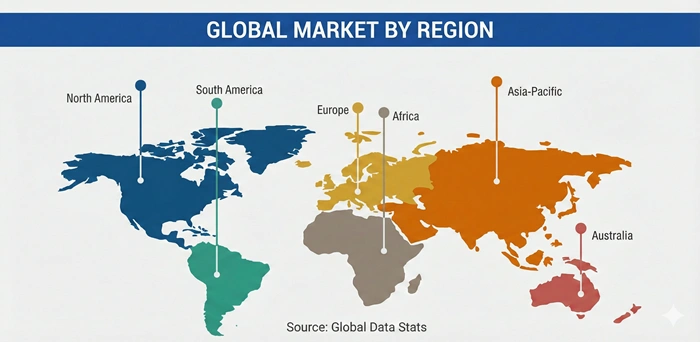
Regional Insights
Asia Pacific
Commanding Market Leadership Through Concentrated Fabrication Capacity and Technology Leadership
Asia Pacific dominates the global semiconductor manufacturing equipment market with an overwhelming 69% share valued at approximately USD 88.2 billion in 2026, reflecting the region's extraordinary concentration of semiconductor fabrication capacity and its central role in global electronics supply chains. Taiwan represents the single most important market within the region, driven by TSMC's position as the world's leading dedicated semiconductor foundry operating multiple state-of-the-art fabrication facilities producing chips for Apple, NVIDIA, AMD, and hundreds of other fabless chip designers worldwide. South Korea contributes massive equipment demand through Samsung's integrated device manufacturing operations spanning logic and memory chips plus SK Hynix's leadership in DRAM and NAND flash production. China has emerged as a significant equipment market despite technology restrictions, with domestic chipmakers including SMIC, Hua Hong Semiconductor, and Yangtze Memory Technologies investing billions in capacity expansion to serve the country's enormous electronics manufacturing base. Japan maintains substantial equipment demand through its advanced semiconductor industry including Sony, Kioxia, and numerous compound semiconductor manufacturers. The region's semiconductor manufacturing equipment market is projected to continue growing at a CAGR of 6.8% through 2033 as fabrication capacity expands to meet escalating chip demand from artificial intelligence, automotive electronics, and consumer devices.
The concentration of leading equipment suppliers throughout Asia Pacific creates distinct ecosystem advantages including proximity to major customers, extensive local engineering support capabilities, and comprehensive supply chains supporting rapid equipment installation and service. Companies including Tokyo Electron, SCREEN Semiconductor Solutions, Advantest, and Disco Corporation operate substantial manufacturing and research facilities throughout Japan, continuously innovating in areas such as deposition, etching, testing, and dicing technologies. The region benefits from abundant technical talent with deep semiconductor engineering expertise and strong university research programs that feed innovation pipelines across the industry. Government policies throughout Asia Pacific actively support semiconductor industry development through financial incentives, research funding, and infrastructure investments that strengthen manufacturing competitiveness. Taiwan's semiconductor ecosystem encompasses not only leading foundries but also comprehensive networks of material suppliers, equipment component manufacturers, and specialized service providers that collectively enable efficient high-volume chip production. South Korea's memory manufacturers drive continuous equipment innovation through aggressive technology roadmaps that push the boundaries of vertical scaling and material engineering, creating sustained demand for cutting-edge deposition and etching systems capable of processing ever-taller structures with maintained dimensional control.
North America
Experiencing Fastest Growth Through Strategic Capacity Expansion and Government Support Programs
North America represents the fastest-growing regional market for semiconductor manufacturing equipment with a projected CAGR of 6.6% from 2026 to 2033, propelled by unprecedented government support through the CHIPS and Science Act alongside strategic initiatives by domestic chipmakers to strengthen supply chain resilience. The United States accounts for approximately 85% of North American equipment demand, driven by major capacity expansion projects announced by Intel, Micron Technology, Texas Instruments, GlobalFoundries, and TSMC's Arizona facilities. The CHIPS Act's USD 52 billion funding allocation is catalyzing construction of over 20 new semiconductor fabrication facilities across multiple states, creating massive demand for comprehensive equipment installations encompassing lithography, deposition, etching, metrology, and packaging tools. Intel alone has committed over USD 100 billion to domestic manufacturing expansion including new fabrication facilities in Ohio, Arizona, and New Mexico equipped with leading-edge process technologies. The region currently captures approximately 22% of global market share valued near USD 28.1 billion in 2026, with growth trajectory expected to accelerate as new fabrication facilities complete construction and begin equipment installation phases.
The presence of leading equipment manufacturers throughout North America creates competitive advantages including close collaboration with domestic chipmakers during technology development, rapid deployment of engineering resources for customer support, and proximity to research institutions advancing semiconductor manufacturing science. Companies including Applied Materials, Lam Research, KLA Corporation, and Teradyne operate extensive manufacturing, research, and service operations throughout the United States, employing tens of thousands of engineers continuously developing next-generation equipment capabilities. The region's semiconductor manufacturing equipment market benefits from strong intellectual property protections, deep capital markets that fund equipment research and development, and comprehensive ecosystems of component suppliers supporting equipment manufacturing. Canada contributes additional demand through its emerging semiconductor industry focused on photonics, compound semiconductors, and specialized packaging technologies, with government programs providing incentives for advanced manufacturing investments. The North American market exhibits particularly strong demand for leading-edge logic fabrication equipment as domestic chipmakers prioritize advanced process node capabilities to compete in high-performance computing and artificial intelligence applications where technological leadership determines market success. Equipment suppliers view North America as a strategic growth priority, increasing local manufacturing capacity and engineering presence to support the region's semiconductor industry renaissance.
Top Key Players
-
Applied Materials Inc. (United States)
-
ASML Holding NV (Netherlands)
-
Tokyo Electron Limited (Japan)
-
Lam Research Corporation (United States)
-
KLA Corporation (United States)
-
SCREEN Semiconductor Solutions Co. Ltd. (Japan)
-
Advantest Corporation (Japan)
-
Teradyne Inc. (United States)
-
ASM International NV (Netherlands)
-
Hitachi High-Tech Corporation (Japan)
-
Disco Corporation (Japan)
-
Kulicke & Soffa Industries Inc. (United States)
-
Veeco Instruments Inc. (United States)
-
Plasma-Therm LLC (United States)
-
Onto Innovation Inc. (United States)
Recent Developments
-
ASML (June 2024) announced its technological roadmap for next-generation Hyper-NA EUV lithography systems targeting a numerical aperture of 0.75 around 2030, which would enable semiconductor patterning down to approximately 0.2 nanometer scale dimensions, far beyond current High-NA EUV systems with 0.55 numerical aperture, promising much finer transistor features and higher chip density that could extend Moore's Law for another decade.
-
KLA Corporation (December 2024) updated its integrated circuit substrate product portfolio enhancing advanced semiconductor packaging capabilities with focus on improving connectivity, introducing key innovations including the Corus direct imaging platform, Serena lithography system, and Lumina inspection system featuring AI-based defect detection designed to optimize yield and manufacturing efficiency for evolving packaging demands including smaller feature sizes and new materials.
-
Applied Materials (2024) expanded its Semiconductor Products Group portfolio with new atomic layer deposition systems optimized for high-aspect-ratio feature filling in advanced memory devices, introducing precision temperature control and novel precursor delivery mechanisms that enable superior film conformality and reduced defect density in vertical NAND structures exceeding 300 layers, addressing critical manufacturing challenges as memory manufacturers pursue continued vertical scaling.
-
Lam Research (June 2023) launched the Coronus DX as the industry's first bevel deposition solution capable of applying protective films to both sides of a wafer's edge in a single operation, addressing critical manufacturing challenges in next-generation logic, 3D NAND, and advanced packaging applications where edge defects can compromise device performance and yield, representing significant innovation in semiconductor wafer processing technology.
-
Tokyo Electron (2024) introduced the LEXIA-EX advanced sputtering system specifically designed for next-generation memory device manufacturing, offering improved film uniformity, higher throughput capabilities, and reduced equipment footprint that aligns with demands of 3D integrated circuit manufacturing, demonstrating continued innovation in physical vapor deposition technologies essential for producing high-performance semiconductor devices with increasingly complex material stacks.
Market Trends
Extreme Ultraviolet Lithography Transformation and Chiplet Architecture Adoption Reshaping Industry
The semiconductor manufacturing equipment market is experiencing a profound technological transformation as extreme ultraviolet lithography transitions from emerging technology to essential mainstream manufacturing capability for advanced logic and memory production. Leading chipmakers have now installed over 200 EUV lithography systems worldwide, utilizing this revolutionary patterning technology to fabricate transistors at 7-nanometer nodes and below where traditional deep ultraviolet lithography cannot achieve required resolution. The industry is entering the next phase of this evolution with high numerical aperture EUV systems beginning deployment, offering improved resolution that enables continued scaling toward 2-nanometer process nodes and beyond. This lithography transformation is driving complementary equipment innovations across deposition, etching, and metrology categories, as supporting processes must advance in parallel to maintain compatibility with shrinking device dimensions and increasingly complex material stacks. Equipment suppliers are investing billions in developing next-generation platforms optimized for EUV workflows, including advanced resist coating systems, precision overlay metrology tools, and specialized cleaning equipment that maintains the pristine surface conditions required for successful EUV patterning. The sustained multi-decade adoption curve for extreme ultraviolet technology provides exceptional visibility for equipment demand as chipmakers gradually convert their manufacturing capacity and continuously upgrade to successive generations of improved EUV platforms.
The semiconductor industry's embrace of chiplet architectures and heterogeneous integration is fundamentally changing equipment requirements and creating new growth opportunities beyond traditional wafer fabrication tools. Major chip designers including AMD, Intel, and Apple have adopted chiplet-based processor designs that decompose monolithic silicon into specialized components connected through high-speed interfaces, enabling flexible product configurations and improved manufacturing economics. This architectural shift is driving explosive demand for advanced packaging equipment including hybrid bonding systems that create direct interconnections between dies, through-silicon via drilling tools that enable vertical integration of multiple components, and sophisticated inspection platforms capable of verifying complex three-dimensional structures. The convergence of logic processing and high-bandwidth memory in artificial intelligence accelerators is accelerating heterogeneous integration adoption, with system designers pursuing ever-tighter integration to minimize data movement bottlenecks that limit computational performance. Equipment manufacturers are responding by developing comprehensive advanced packaging solutions that integrate multiple process steps into cohesive platforms, offering customers turnkey capabilities for implementing sophisticated chiplet-based designs without requiring extensive internal packaging expertise. This trend toward heterogeneous integration represents a fundamental industry inflection that will sustain equipment demand growth for decades as the benefits of specialized integration extend across all semiconductor categories.
Segments Covered in the Report
By Process
-
Front-End Equipment (Deposition, Lithography, Etching, Cleaning, Testing)
-
Back-End Equipment (Packaging, Testing)
By Dimension
-
2D Technology
-
2.5D Technology
-
3D Technology
By Application
-
Semiconductor Electronics Manufacturing
-
Semiconductor Fabrication Plant/Foundry
-
Testing and Inspection
By Region
-
North America (United States, Canada, Mexico)
-
Europe (Germany, United Kingdom, France, Italy, Spain, Netherlands, Rest of Europe)
-
Asia Pacific (China, Japan, South Korea, Taiwan, India, Malaysia, Singapore, Rest of Asia Pacific)
-
Latin America (Brazil, Argentina, Rest of Latin America)
-
Middle East & Africa (Israel, Saudi Arabia, South Africa, UAE, Rest of Middle East & Africa)
Frequently Asked Questions
Question 1: What is the expected semiconductor manufacturing equipment market size by 2033?
Answer: The global semiconductor manufacturing equipment market is projected to reach approximately USD 224.63 billion by 2033. This substantial growth from the 2026 baseline reflects accelerating demand driven by artificial intelligence computing infrastructure, automotive electrification, and strategic government investments in domestic semiconductor manufacturing capacity.
Question 2: Which region currently dominates the semiconductor manufacturing equipment market?
Answer: Asia Pacific dominates the semiconductor manufacturing equipment market with approximately 69% market share. However, North America is experiencing the fastest growth rate with a CAGR of 6.6%, fueled by government incentives through the CHIPS Act and major capacity expansion projects by domestic chipmakers.
Question 3: What are the primary applications driving semiconductor manufacturing equipment market growth?
Answer: Semiconductor fabrication plants and foundries represent the largest application segment accounting for 47.1% of market revenue. Semiconductor electronics manufacturing is experiencing rapid growth with a CAGR of 7.8%, driven by advancements in artificial intelligence, high-bandwidth memory, and integrated circuit technologies.
Question 4: How is extreme ultraviolet lithography impacting the semiconductor manufacturing equipment market?
Answer: Extreme ultraviolet lithography has become essential for manufacturing advanced semiconductors at process nodes below 7 nanometers. EUV systems cost over USD 150 million per unit, with next-generation high numerical aperture platforms expected to exceed USD 300 million, driving substantial equipment spending as chipmakers transition their production capabilities.
Question 5: What factors are restraining semiconductor manufacturing equipment market expansion?
Answer: Extreme capital intensity requiring multi-billion dollar facility investments and specialized technical expertise requirements represent primary market restraints. Additionally, geopolitical tensions creating export control restrictions and equipment delivery lead times extending over 12 months for complex lithography systems challenge market growth.