
Security Advisory Services Market Overview
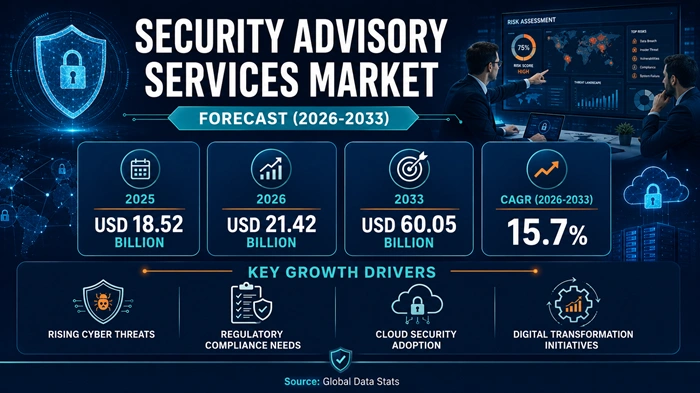
The global security advisory services market size is valued at USD 18.52 billion in 2025 and is predicted to increase from USD 21.42 billion in 2026 to approximately USD 60.05 billion by 2033, growing at a CAGR of 15.7% from 2026 to 2033.
This extraordinary growth reflects the escalating complexity of the global cybersecurity threat landscape — where ransomware, advanced persistent threats (APTs), supply chain attacks, and regulatory compliance pressures are collectively overwhelming the internal security capabilities of organizations across every industry. As businesses in banking, healthcare, government, and critical infrastructure simultaneously accelerate their digital transformation journeys and face increasingly sophisticated adversaries, the demand for specialized external security consulting and advisory expertise has reached a structural, non-discretionary level.
AI Impact on the Security Advisory Services Industry
Artificial Intelligence Is Fundamentally Reshaping How Security Advisory Services Are Delivered, Enabling Faster Threat Detection, Smarter Risk Assessment, and More Predictive Security Strategy Development
Artificial intelligence is becoming one of the most disruptive forces in the security advisory services market, simultaneously transforming the nature of the threats that advisors help clients defend against and the tools that advisors use to deliver their services. On the threat side, AI-powered attack tools — including machine learning-driven phishing generators, autonomous malware propagation frameworks, and adversarial AI systems designed to evade traditional security controls — are creating a new generation of threats that conventional security frameworks were not designed to handle. Advisory firms that want to remain relevant and credible must now have deep working knowledge of AI-enabled attack methodologies, meaning that technical expertise requirements for security advisors have risen substantially and will continue to rise as AI-native attack tools proliferate.
On the service delivery side, AI is enabling security advisory firms to dramatically enhance the quality and speed of their core offerings. AI-powered threat intelligence platforms can now process millions of global threat indicators in real time to identify patterns and emerging attack vectors that human analysts would take weeks to discover, enabling advisors to deliver more current and actionable risk assessments to their clients. Machine learning models embedded in penetration testing and vulnerability assessment tools are enabling automated detection of security gaps at a scale and depth that manual testing cannot achieve, while natural language processing tools are accelerating the development of security policy documentation, compliance gap analysis reports, and board-level risk communication materials. These AI-enhanced capabilities are expanding the service breadth and commercial competitiveness of leading advisory firms and are progressively raising the quality benchmark that all providers in the security advisory services market must meet.
Growth Factors
Escalating Cybersecurity Threats, Expanding Regulatory Compliance Mandates, and Rapid Digital Transformation Are the Three Most Powerful Growth Pillars Driving the Security Advisory Services Market
The single most powerful growth driver for the security advisory services market is the relentless escalation in the frequency, sophistication, and financial impact of cyberattacks globally. Ransomware attacks against hospitals, financial institutions, critical infrastructure, and government agencies have reached record levels, with average ransom demands growing year over year and threat actors increasingly deploying double and triple extortion techniques that compound the business impact of a successful breach. According to Cybersecurity Ventures, global cybercrime costs are projected to reach USD 10.5 trillion annually by 2025 — a figure that far exceeds the GDP of most nations and underscores the enormous financial stakes driving enterprise investment in security advisory expertise. This threat environment creates an urgent and continuous demand for external advisors who can assess organizational vulnerabilities, design resilient security architectures, and guide executive teams through strategic security investment decisions.
Regulatory compliance has emerged as an equally powerful and in many ways more predictable commercial driver for the security advisory services market. The EU's General Data Protection Regulation (GDPR), the NIS2 Directive, the U.S. SEC cybersecurity disclosure rules, the Digital Operational Resilience Act (DORA) for financial services, HIPAA in healthcare, and PCI-DSS for payment card processing all impose specific and demanding security requirements on the organizations they govern — and most organizations lack the internal expertise to navigate these complex regulatory landscapes without professional guidance. Each new regulation that takes effect, each existing regulation that is updated, and each new sector brought under mandatory cybersecurity compliance frameworks adds to the aggregate demand for security advisory and consulting services. The regulatory pipeline is exceptionally full through 2033, and advisory firms with deep compliance consulting capabilities are positioned to capture a sustained stream of new engagement revenue as organizations work to meet evolving legal obligations.
Market Outlook
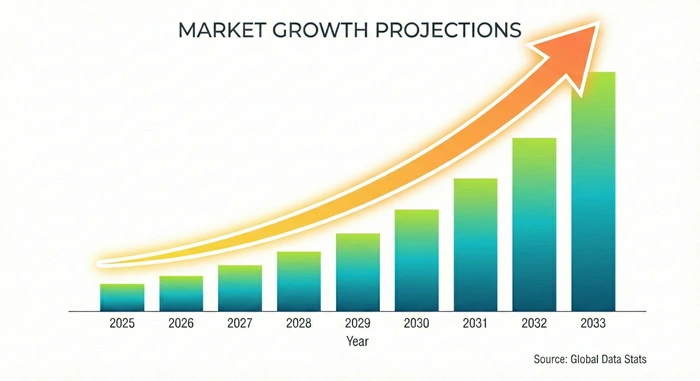
The Security Advisory Services Market Is Poised for Exceptional Long-Term Growth Through 2033, Powered by AI Threat Complexity, CISO Advisory Demand, and Cloud Security Transformation Engagements
The long-term outlook for the security advisory services market is among the most compelling of any professional services segment globally. The converging forces of digital transformation, cloud migration, AI-native threat actors, and an expanding regulatory environment ensure that the demand for specialized external security expertise will remain structurally elevated well beyond the 2026–2033 forecast period. Organizations in every sector are undergoing rapid IT architecture transitions — from on-premises to cloud and hybrid environments — and these transitions introduce complex new attack surfaces, access management challenges, and data security risks that require expert advisory guidance to manage securely. The sheer pace of this transformation, combined with a persistent global shortage of experienced cybersecurity professionals, means that most organizations will continue to rely on external advisory partners for years to come.
The CISO advisory and strategic security consulting segment is expected to be the fastest-growing service category, as boards of directors and C-suites increasingly demand dedicated cybersecurity strategic leadership at the executive level — a demand that many organizations, particularly in the small-to-mid-market, cannot satisfy through in-house hiring alone. Virtual CISO (vCISO) and CISO-as-a-service offerings are gaining particularly strong traction, delivering executive-level security strategy, board communication, and regulatory program management at a fraction of the cost of a full-time senior hire. As companies recognize that cybersecurity is not merely a technical function but a fundamental business risk management discipline requiring C-suite engagement, the commercial opportunity for advisory firms offering strategic security leadership services will continue to grow rapidly throughout the forecast period.
Expert Speaks
Leading executives from global technology and professional services companies are consistently emphasizing the transformative urgency of strategic security advisory investment:
-
"Cybersecurity has moved from being an IT concern to a board-level strategic priority, and organizations that try to navigate today's threat landscape without specialized external advisory support are taking an enormous risk. Our security advisory practice has never seen higher demand, and we are investing aggressively in AI-augmented advisory capabilities that will allow us to serve clients at a scale and quality that was simply not possible five years ago." — CEO, IBM Corporation
-
"The complexity of the modern regulatory and threat environment has fundamentally changed the value equation for security advisory services. No organization — regardless of size or industry — can realistically maintain all the specialized expertise required to stay ahead of today's adversaries and compliance requirements without some form of external advisory support, and we see this driving sustained double-digit growth in demand for our security consulting engagements." — CEO, Accenture PLC
-
"The rise of AI-powered cyberattacks is the most significant threat evolution we have seen in a generation, and it is creating an urgent need for organizations to fundamentally reassess their security architectures and response capabilities with expert advisory guidance. At Deloitte, we are committed to helping our clients navigate this new threat reality — combining deep technical expertise with strategic advisory capabilities to build cyber resilience that genuinely matches the sophistication of today's adversaries." — CEO, Deloitte
Key Report Takeaways
-
North America leads the global security advisory services market, holding approximately 38% of global revenue share in 2025, driven by the highest concentration of cyber threat activity, the most comprehensive and demanding regulatory compliance frameworks in the world, and the dominant commercial presence of leading advisory firms including IBM, Accenture, Deloitte, PwC, and Cisco.
-
Asia Pacific is the fastest-growing regional market, projected to expand at a CAGR of approximately 16.79% through 2033, driven by rapid digitalization, a surge in cyberattacks targeting government and financial institutions, and growing regulatory enforcement of cybersecurity standards across China, India, Japan, South Korea, and Australia.
-
Large enterprises represent the largest end-user segment, capturing approximately 64% of global revenue in 2025, as they engage security advisory firms for comprehensive programs spanning risk assessments, compliance consulting, penetration testing, incident response planning, and ongoing strategic security governance.
-
BFSI (Banking, Financial Services, and Insurance) is the largest industry vertical, accounting for approximately 29% of global market revenue in 2025, driven by stringent sector-specific regulations, high-value digital asset protection requirements, and the critical reputational consequences of security breaches in financial services.
-
Penetration testing dominates the service type segment, holding approximately 32% of global service revenue in 2026, as organizations across all industries prioritize proactive vulnerability identification through simulated attack exercises as a foundational element of their cybersecurity programs.
-
CISO advisory and support is the fastest-growing service type, projected to expand at a CAGR of approximately 18.6% through 2033, as demand for virtual CISO services, board-level security communication, and strategic cybersecurity program governance accelerates among both large enterprises and the rapidly growing SME segment.
-
SMEs are the fastest-growing enterprise size segment, expected to grow at a CAGR of approximately 16.1% through 2033, as small and medium businesses increasingly recognize their vulnerability to cyberattacks and seek affordable external advisory support to compensate for limited in-house security expertise.
Market Scope
| Report Coverage | Details |
|---|---|
| Market Size by 2033 | USD 60.05 Billion |
| Market Size by 2025 | USD 18.52 Billion |
| Market Size by 2026 | USD 21.42 Billion |
| Market Growth Rate from 2026 to 2033 | CAGR of 15.7% |
| Dominating Region | North America |
| Fastest Growing Region | Asia Pacific |
| Base Year | 2025 |
| Forecast Period | 2026 to 2033 |
| Segments Covered | Service Type, Deployment Mode, Enterprise Size, Industry Vertical, and Region |
| Regions Covered | North America, Europe, Asia Pacific, Latin America, and Middle East & Africa |
Market Dynamics
Drivers Impact Analysis
The Exploding Volume and Cost of Cyberattacks Combined with Mandatory Regulatory Compliance Burdens Are the Dominant Growth Engines Accelerating the Security Advisory Services Market
| Driver | ≈ % Impact on CAGR Forecast | Geographic Relevance | Impact Timeline |
|---|---|---|---|
| Escalating cybersecurity threats and attack sophistication | ~37% | Global | 2026–2033 |
| Expanding regulatory compliance requirements | ~28% | North America, Europe, Asia Pacific | 2026–2033 |
| Digital transformation and cloud migration security needs | ~18% | Global | 2026–2033 |
| Cybersecurity talent shortage driving external advisory demand | ~11% | Global | 2026–2030 |
| AI-enabled threat evolution requiring specialized advisory | ~6% | Global | 2027–2033 |
The global cybersecurity threat environment has undergone a fundamental transformation over the past five years, with threat actors — ranging from nation-state-sponsored groups to financially motivated criminal enterprises — deploying increasingly sophisticated and automated attack techniques that have dramatically expanded the attack surface for organizations in every sector. Ransomware-as-a-service ecosystems have lowered the barrier to entry for cybercriminals, while AI-enabled phishing, business email compromise, and deepfake social engineering attacks have made human error a more exploitable vulnerability than ever before. Organizations that previously relied on basic perimeter defenses and reactive security operations are finding these approaches wholly inadequate against modern threat actors, creating urgent demand for advisory firms that can help them design, implement, and validate modern security architectures appropriate for the current threat environment. This driver is not cyclical — it is structural, and it will intensify throughout the forecast period as AI-native attack tooling continues to evolve.
The global expansion of cybersecurity regulation is the second most powerful driver, and its influence is uniquely consistent and predictable compared to other commercial growth factors. The EU's NIS2 Directive — which expanded mandatory cybersecurity requirements to over 160000 organizations across 18 sectors in all EU member states — took effect in late 2024 and is driving a massive wave of compliance consulting engagements as organizations assess their gaps, redesign their security governance frameworks, and prepare for national regulatory enforcement. In the United States, the SEC's new cybersecurity disclosure rules require publicly traded companies to report material cybersecurity incidents within four business days and to disclose annual details of their cybersecurity risk management programs — requirements that have significantly elevated the strategic importance of security advisory engagements at the C-suite and board level. These regulatory developments are expanding the security advisory services market not just in depth within existing client organizations but also in breadth across new industry sectors that were previously exempt from mandatory cybersecurity requirements.
Restraints Impact Analysis
Cybersecurity Talent Scarcity, Engagement Cost Sensitivity Among SMEs, and Inconsistent Regulatory Enforcement Create Meaningful Friction in the Security Advisory Services Market
| Restraint | ≈ % Impact on CAGR Forecast | Geographic Relevance | Impact Timeline |
|---|---|---|---|
| Global cybersecurity talent shortage limiting delivery capacity | ~32% negative impact | Global | 2026–2033 |
| Cost sensitivity and budget constraints among SMEs | ~26% negative impact | Asia Pacific, Latin America, MEA | 2026–2030 |
| Inconsistent regulatory enforcement across geographies | ~19% negative impact | Latin America, MEA, Asia Pacific | 2026–2029 |
| Client reluctance to share sensitive information with external advisors | ~14% negative impact | Global | 2026–2033 |
| Fragmented advisory service quality and certification standards | ~9% negative impact | Global | 2026–2030 |
The most significant structural restraint on the security advisory services market is the persistent and worsening global shortage of qualified cybersecurity professionals. The cybersecurity workforce gap — estimated by industry bodies at over 3.5 million unfilled positions globally — creates a fundamental supply constraint that limits the delivery capacity of advisory firms, inflates the cost of specialized security talent, and extends engagement timelines. Advisory firms competing aggressively for a limited pool of certified penetration testers, cloud security architects, threat intelligence analysts, and compliance specialists are experiencing wage inflation that pressures margins and can translate into higher engagement costs for clients. This talent scarcity is particularly acute for specialized advisory capabilities including operational technology (OT) security, AI/ML security assessments, and zero-trust architecture design — areas where qualified practitioners are exceptionally rare.
Budget constraints among small and medium enterprises represent a second meaningful restraint, as many SMEs recognize the importance of professional security advisory support but struggle to justify or fund comprehensive advisory engagements within tight IT budgets. The traditional professional services billing model — often involving day rates for senior consultants ranging from hundreds to thousands of dollars per day — creates an accessibility barrier that prevents many SMEs from engaging the quality of advisory support they need. This dynamic has created market opportunity for lower-cost virtual CISO and subscription-based security advisory offerings, but until these models achieve broader commercial maturity and client trust, budget sensitivity will continue to moderate growth rates among the SME segment in the security advisory services market.
Opportunities Impact Analysis
Virtual CISO Services, SME Market Penetration, Cloud Security Advisory, and Emerging Market Expansion Represent the Highest-Value Growth Opportunities in the Security Advisory Services Market
| Opportunity | ≈ % Impact on CAGR Forecast | Geographic Relevance | Impact Timeline |
|---|---|---|---|
| Virtual CISO and subscription security advisory models | ~35% positive impact | North America, Europe, Asia Pacific | 2026–2033 |
| SME cybersecurity advisory market penetration | ~26% positive impact | Global | 2026–2033 |
| Cloud and multi-cloud security transformation advisory | ~20% positive impact | North America, Europe | 2026–2033 |
| Emerging market regulatory compliance advisory | ~12% positive impact | Asia Pacific, Latin America, MEA | 2028–2033 |
| OT/ICS and critical infrastructure security advisory | ~7% positive impact | North America, Europe | 2027–2033 |
Virtual CISO (vCISO) services represent the single most compelling commercial growth opportunity in the security advisory services market, combining the fastest-growing buyer segment (SMEs) with the fastest-growing service category (CISO advisory) in a subscription-based model that aligns advisory firm revenue with long-term client retention rather than one-time project engagements. The vCISO model provides organizations with access to senior-level cybersecurity strategic leadership, board reporting capabilities, regulatory compliance program management, and security roadmap development at a monthly retainer cost that is a fraction of a full-time CISO salary and benefits package. The commercial appeal of this model is particularly strong in the SME and mid-market segment, where organizations often have complex security challenges but lack both the budget and the available talent to address them through in-house hiring. Advisory firms that build scalable vCISO delivery models with technology-augmented service platforms are positioned to capture a rapidly growing and highly recurring revenue stream throughout the forecast period.
Cloud security advisory represents a massive and rapidly expanding opportunity as organizations globally continue their migration from on-premises IT infrastructure to cloud and hybrid cloud architectures. Cloud environments introduce fundamentally different security challenges — including misconfiguration vulnerabilities, identity and access management complexity, multi-tenancy risks, and shared responsibility model ambiguity — that require specialized advisory expertise most organizations do not possess internally. The migration to cloud is happening across all organization sizes and industry sectors simultaneously, creating a broad and urgent demand for cloud security architecture review, zero-trust implementation advisory, DevSecOps integration consulting, and cloud compliance assessment services. Advisory firms with certified cloud security practitioners and established methodologies for major cloud platforms — AWS, Microsoft Azure, and Google Cloud — are well-positioned to build large, high-growth practices around this opportunity throughout the 2026–2033 forecast period.
Segment Analysis
By Service Type
Penetration Testing Leads the Security Advisory Services Market by Service Type While CISO Advisory Emerges as the Fastest-Growing and Most Strategically Important Category
Penetration testing holds the dominant position within the security advisory services market by service type, commanding approximately 32% of global service revenue in 2026. This leadership position reflects penetration testing's status as the most universally practiced and broadly required security advisory engagement — mandated or recommended by virtually every major cybersecurity regulation and framework, from PCI-DSS and HIPAA to NIST CSF and ISO 27001. Organizations across all industries engage penetration testers on an annual or even quarterly basis to identify exploitable vulnerabilities in their web applications, networks, cloud environments, and physical security controls before malicious actors can exploit them. The BFSI and healthcare sectors in North America and Europe represent the largest regional demand sources for penetration testing services, where regulatory requirements and the catastrophic financial and reputational consequences of successful breaches drive the highest investment intensity and most frequent testing cycles. Key companies dominating this segment include IBM Security, NCC Group, Rapid7, Trustwave, and Bishop Fox, all of which maintain large certified penetration testing teams operating across global client portfolios. The penetration testing segment will remain the market's volume anchor through 2033, though its share will gradually moderate as CISO advisory and incident response services grow at faster rates.
CISO advisory and support represents the fastest-growing service type within the security advisory services market, projected to expand at a CAGR of approximately 18.6% through 2033, significantly outpacing the overall market growth rate. This acceleration is driven by a powerful combination of demand-side and supply-side factors: boards and executive committees are demanding dedicated cybersecurity leadership as cyber risk has become one of the top three concerns in corporate risk registers globally, while the shortage of qualified CISOs available for hire — combined with multi-hundred-thousand-dollar total compensation packages for senior cybersecurity executives — makes the vCISO model an increasingly rational alternative for organizations outside the Fortune 500. Asia Pacific is the most dynamic regional growth market for CISO advisory services, as organizations in China, India, and Southeast Asia that have undergone rapid digital transformation are now recognizing that their security governance structures are not commensurate with the risk exposures their digitalized operations have created. Leading providers including Deloitte, PwC, KPMG, and EY are rapidly building out their vCISO and strategic security advisory practices across the Asia Pacific region to capture this surging demand.
By Industry Vertical
BFSI Dominates Industry Vertical Revenue in the Security Advisory Services Market While Healthcare Records the Highest CAGR as Digital Health Transformation Drives Security Urgency
The BFSI sector holds the largest share among all industry verticals in the security advisory services market, accounting for approximately 29% of the global industry vertical revenue in 2025. Financial services organizations face the most demanding combination of regulatory compliance requirements, high-value target attractiveness to cybercriminals, and reputational risk sensitivity of any industry — factors that collectively drive the highest per-organization investment in security advisory services globally. Banks, insurance companies, asset managers, and payment processors engage advisory firms for a comprehensive range of services spanning regulatory compliance consulting under PCI-DSS, DORA, and SOX frameworks, penetration testing of trading platforms and digital banking applications, third-party vendor risk assessments, and strategic security architecture reviews. North America and Europe dominate BFSI sector advisory spending, with Goldman Sachs, JPMorgan Chase, HSBC, and major European banking groups among the world's most active consumers of top-tier security advisory services, engaging global Big Four advisory firms and specialist boutiques simultaneously. The BFSI segment's regulatory density and the high cost of security failures will sustain its revenue leadership throughout the forecast period, even as other sectors close the investment gap.
Healthcare is the fastest-growing industry vertical in the security advisory services market, projected to expand at a CAGR of approximately 17.8% through 2033, driven by the rapid digitalization of healthcare delivery systems and the high value of protected health information (PHI) that makes healthcare organizations uniquely attractive targets for cybercriminals and ransomware actors. The accelerating adoption of electronic health records, telemedicine platforms, connected medical devices, and AI-powered clinical decision support systems has dramatically expanded the attack surface of healthcare organizations while simultaneously raising the potential harm — including patient safety risks — of a successful cyberattack. Regulatory pressure from HIPAA in the U.S. and equivalent data protection legislation in Europe and Asia Pacific is compelling healthcare organizations to systematically close the security gaps exposed by their digital transformation journeys, creating high-demand professional services opportunities for advisory firms with healthcare cybersecurity specialization. Asia Pacific is an exceptionally strong regional growth market within this segment, where the rapid build-out of digital health infrastructure across China, India, and Southeast Asia is creating large-scale demand for security advisory expertise that significantly outstrips locally available supply.
Regional Insights
North America
North America Commands the Global Security Advisory Services Market Through Its Unmatched Regulatory Environment, Cybersecurity Ecosystem Depth, and World-Leading Advisory Firms
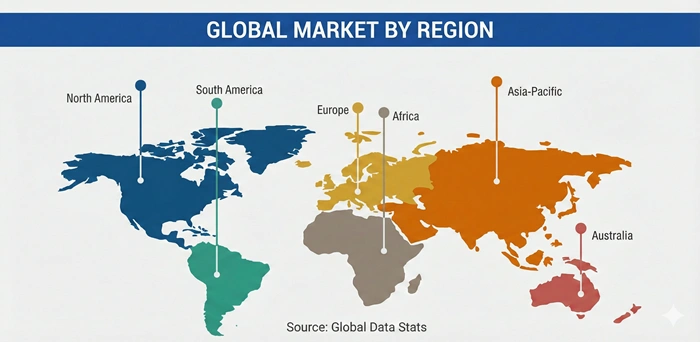
North America maintains its dominant position in the security advisory services market, accounting for approximately 38% of global market revenue in 2025 and growing at a CAGR of approximately 14.5% through 2033. The United States is the market's unambiguous epicenter, where the combination of the most active cyberthreat environment globally, the most sophisticated and extensive regulatory compliance framework, and the deepest concentration of cybersecurity talent creates structural conditions for the highest per-organization advisory spending in the world. U.S. federal government agencies, financial services firms, healthcare providers, and critical infrastructure operators collectively represent a massive and consistently growing buyer base for all categories of security advisory services. Key companies headquartered and commercially dominant in North America include IBM Corporation, Accenture, Deloitte, PricewaterhouseCoopers (PwC), Cisco Systems, Rapid7, Mandiant (now part of Google Cloud), and Trustwave, each maintaining large security advisory practices that serve both domestic and international clients.
Canada contributes meaningfully to the regional market, with the Canadian Centre for Cyber Security playing an increasingly active role in setting national cybersecurity standards that drive organizational compliance investment across government and critical private sector entities. The 2026 passage of Canada's Bill C-26 — establishing mandatory cybersecurity requirements for critical infrastructure sectors — has created a new wave of compliance advisory demand for Canadian government and regulated industry clients. Mexico is an emerging growth market within North America, as multinational manufacturers, financial institutions, and the growing digital services sector are progressively engaging security advisory partners to meet both domestic regulatory requirements and the security expectations of their U.S. and European parent companies and business partners.
Asia Pacific
Asia Pacific Is the Fastest-Growing Security Advisory Services Market Region, Driven by Digital Transformation Speed, Rising Regulatory Enforcement, and Surging Cyberattack Activity
Asia Pacific is the fastest-growing regional market in the security advisory services sector, projected to expand at a CAGR of approximately 16.79% through 2033 — the highest of any region globally. The region's exceptional growth rate reflects the convergence of several powerful trends: the simultaneous digital transformation of some of the world's largest economies, a dramatic rise in cyberattack activity targeting Asian organizations across government, financial, and manufacturing sectors, and the progressive tightening of cybersecurity regulatory frameworks by national authorities across China, India, Japan, South Korea, and Australia. China's National Cybersecurity Law, India's Digital Personal Data Protection Act, Singapore's Cybersecurity Act, and Australia's Security Legislation Amendment all impose increasingly specific security requirements on organizations operating in these markets — requirements that are actively driving procurement of external security advisory expertise. Key companies driving growth in Asia Pacific include local subsidiaries and practices of IBM, Accenture, Deloitte, Tata Consultancy Services (TCS), Infosys, and regional specialists such as NTT Security and CrowdStrike Asia Pacific.
India deserves particular attention as one of the region's most dynamic growth stories — where a massive IT and digital services sector, one of the world's fastest-growing digital payments and fintech ecosystems, and a rapidly professionalizing enterprise cybersecurity culture are creating exceptional demand for security advisory expertise. Indian-headquartered advisory and consulting firms including TCS, Infosys, Wipro, and HCL Technologies are simultaneously growing their domestic security advisory practices and exporting cybersecurity consulting capabilities to global markets, positioning India as both a major consumer and an important talent production hub for the global security advisory services market. Japan and South Korea maintain highly mature security advisory demand profiles, driven by advanced manufacturing, financial services, and government sector buyers with sophisticated requirements and a cultural preference for rigorous, process-oriented security consulting approaches.
Report Customization by Region and Country
Fully Customized Region-Wise and Country-Level Intelligence Is Available — This Report Can Be Tailored to Deliver Targeted Security Advisory Services Market Insights for Any Geography Listed Below
This report is available in customized, geography-specific editions providing granular market intelligence — including market sizing, competitive landscape, regulatory environment, service type demand breakdown, and strategic growth opportunities — tailored specifically to the security advisory services industry in your chosen region or country.
North America
-
United States — SEC cybersecurity rules, CISA advisory demand, BFSI and healthcare sector spending, and key player commercial strategies by service type
-
Canada — Bill C-26 compliance advisory demand, federal agency cybersecurity programs, and regional market size by enterprise size
-
Mexico — Regulatory development landscape, multinational security advisory procurement, and commercial market growth trajectory
Europe
-
United Kingdom — NCSC framework adoption, financial services cyber advisory demand, post-Brexit regulatory alignment, and market size
-
Germany — BSI standards, NIS2 implementation timeline, industrial and manufacturing sector advisory demand, and competitive landscape
-
France — ANSSI regulatory environment, government and defense sector advisory demand, and major advisory firm market positions
-
Italy — ACN cybersecurity framework, industrial cybersecurity advisory growth, and regional market development analysis
-
Rest of Europe — Eastern European market development, Scandinavian regulatory leadership, and pan-European compliance advisory trends
Asia Pacific
-
China — MLPS 2.0 compliance advisory demand, national cybersecurity law impact, and domestic vs. international advisory firm competition
-
India — DPDP Act compliance advisory, IT sector security demand, government program advisory, and market size by service type
-
Japan — METI cybersecurity guidelines, financial and manufacturing sector demand, and NTT/Fujitsu competitive positioning
-
South Korea — ISMS-P certification advisory, financial sector regulatory demand, and domestic market competition analysis
-
Australia — ASD Essential Eight advisory demand, Critical Infrastructure Act compliance, and market size by industry vertical
-
Rest of Asia Pacific — ASEAN regulatory developments, digital transformation security advisory demand, and emerging market growth
Latin America
-
Brazil — LGPD compliance advisory demand, financial sector cybersecurity investment, and CERT.br program impact on market development
-
Argentina — Data protection regulatory environment, enterprise security advisory demand, and market growth trajectory
-
Rest of Latin America — Regional regulatory development, multinational compliance advisory, and market entry opportunities
Middle East & Africa
-
UAE — Dubai Cyber Security Strategy, ADIO cybersecurity investment, financial hub advisory demand, and premium security consulting market
-
Saudi Arabia — NCA regulatory framework, Vision 2030 digital transformation security advisory, and government sector demand
-
Rest of MEA — Emerging regulatory environments, infrastructure cybersecurity advisory, and international firm market entry dynamics
Top Key Players
-
IBM Corporation (United States)
-
Accenture PLC (Ireland)
-
Deloitte Touche Tohmatsu Limited (United Kingdom)
-
PricewaterhouseCoopers (PwC) (United Kingdom)
-
KPMG International Cooperative (Netherlands)
-
Ernst & Young Global Limited (EY) (United Kingdom)
-
Cisco Systems Inc. (United States)
-
Mandiant (Google Cloud) (United States)
-
Rapid7 Inc. (United States)
-
NCC Group PLC (United Kingdom)
-
Trustwave Holdings Inc. (United States)
-
Tata Consultancy Services (TCS) (India)
-
Capgemini SE (France)
-
DXC Technology (United States)
-
eSentire Inc. (Canada)
Recent Developments
-
In March 2025, Deloitte announced a strategic collaboration with Google Cloud to deepen its cloud security and risk advisory capabilities, integrating Google's Chronicle SIEM platform and Mandiant threat intelligence into Deloitte's managed security advisory service delivery framework. This partnership significantly enhanced Deloitte's ability to provide AI-powered threat detection advisory and cloud security transformation engagements to its global enterprise client base.
-
In February 2025, IBM launched its expanded X-Force Red adversarial security advisory services portfolio, adding new AI security testing capabilities that assess the robustness of clients' machine learning models and AI systems against adversarial manipulation and data poisoning attacks. The expansion positioned IBM X-Force Red as the first major advisory firm to offer structured AI security testing as a mainstream commercial service.
-
In January 2025, Accenture completed its acquisition of Morphus, a leading Brazilian cybersecurity consulting and threat intelligence firm, significantly expanding Accenture's security advisory presence in the high-growth Latin American market. The deal added over 200 specialized cybersecurity professionals to Accenture's security practice and established a dedicated Latin America security advisory delivery center.
-
In November 2024, PwC launched a new dedicated SME cybersecurity advisory program across its UK and European practices, offering modular, subscription-based virtual CISO services, rapid security health assessment packages, and regulatory compliance advisory specifically designed for the pricing and complexity needs of small and medium enterprises. The program was designed to capture the rapidly growing SME security advisory demand segment that traditional Big Four engagement models had historically underserved.
-
In September 2024, NCC Group acquired a specialist operational technology (OT) and industrial control system (ICS) security consulting firm, significantly expanding its advisory capabilities in critical infrastructure sectors including energy, utilities, and manufacturing. The acquisition positioned NCC Group to compete for the growing volume of OT security advisory engagements being driven by the EU's NIS2 Directive and the U.S. TSA pipeline and water system security directives.
Market Trends
The Security Advisory Services Market Is Being Defined by the Rise of AI-Augmented Advisory Delivery, Subscription-Based vCISO Models, and the Convergence of Physical and Cyber Security Consulting
The most significant trend reshaping the security advisory services market is the integration of AI and automation into advisory service delivery workflows, enabling firms to deliver faster, deeper, and more scalable security assessments and strategic engagements than traditional labor-intensive consulting models can achieve. AI-powered penetration testing platforms, automated threat modeling tools, and machine learning-enhanced risk quantification frameworks are becoming standard components of leading advisory firms' service methodologies — enabling analysts to spend less time on manual data collection and more time on high-value strategic interpretation and client communication. The most forward-thinking advisory firms are building proprietary AI platforms that combine real-time threat intelligence feeds, client-specific vulnerability data, and industry benchmarking datasets into integrated advisory dashboards that deliver continuous, always-on security posture assessment rather than the point-in-time snapshots that traditional annual assessment engagements produce. This shift toward continuous advisory models is expanding the recurring revenue base of leading advisory firms and raising the switching costs for clients embedded in their advisory ecosystems.
A second major and commercially significant trend is the evolution of subscription-based and outcome-linked security advisory service models that are expanding market access beyond the large enterprise segment that traditional professional services pricing has always dominated. Virtual CISO subscriptions, security-as-a-retainer agreements, and modular advisory packages with transparent fixed monthly pricing are making professional security advisory services accessible to the mid-market and SME segment in ways that hourly or day-rate engagement models never could. This commercial model evolution is not only expanding the addressable market for advisory firms but also creating more predictable revenue streams, deeper client relationships, and higher retention rates than project-based engagements alone can sustain. As competition intensifies and technology platforms reduce the cost of advisory service delivery, the market is likely to see further experimentation with performance-based and risk-aligned pricing structures that directly tie advisory firm compensation to measurable improvements in client security posture and risk reduction.
Segments Covered in the Report
By Service Type
-
Penetration Testing
-
Risk and Compliance Assessment
-
Incident Response Advisory
-
CISO Advisory and Support (Virtual CISO)
-
Security Architecture and Design
-
Threat Intelligence Advisory
-
Others
By Deployment Mode
-
On-Premise
-
Cloud-Based
-
Hybrid
By Enterprise Size
-
Large Enterprises
-
Small and Medium Enterprises (SMEs)
By Industry Vertical
-
Banking, Financial Services, and Insurance (BFSI)
-
Healthcare and Life Sciences
-
Government and Defense
-
IT and Telecommunications
-
Retail and E-Commerce
-
Energy and Utilities
-
Manufacturing
-
Others
By Region
-
North America (U.S., Canada, Mexico)
-
Europe (U.K., Germany, France, Italy, Rest of Europe)
-
Asia Pacific (China, India, Japan, South Korea, Australia, Rest of Asia Pacific)
-
Latin America (Brazil, Argentina, Rest of Latin America)
-
Middle East & Africa (UAE, Saudi Arabia, Rest of MEA)
"Built for Every Level — From Startups to Industry Giants"
Here Is Exactly How This Report Works for You
-
For Tier 1 global advisory firms, enterprise CISOs, and institutional investors, this report provides granular competitor revenue analysis — breaking down service line revenue, geographic market share, client retention rates, and M&A activity for all major security advisory firms — alongside a detailed assessment of how geopolitical factors including nation-state threat escalation, cross-border data transfer regulations, and government procurement policies are reshaping competitive dynamics in the security advisory services market, so your strategic investment, acquisition, and market expansion decisions are built on the most complete intelligence available.
-
For startups, boutique security consultancies, Tier 2 and Tier 3 advisory providers, and mid-market investors, this report identifies supply-demand imbalances across service type segments and geographies — pinpointing which advisory categories are underserved in which markets, how subscription and vCISO models are disrupting traditional engagement economics, and what competitive positioning strategies are proving most effective for firms challenging incumbent Big Four and global consultancy dominance — providing a data-driven roadmap for differentiation, pricing strategy, and client acquisition.
-
For C-suite executives, board members, compliance officers, and every decision-maker responsible for cybersecurity investment, this report delivers a clear-eyed analysis of how the evolving regulatory landscape — including NIS2, DORA, SEC disclosure rules, and emerging AI governance legislation — combined with AI-powered threat escalation and a structural cybersecurity talent shortage are collectively reshaping security advisory service demand, and how the world's most sophisticated security buyers are making strategic decisions about which advisory partners to engage, at what investment levels, and for what outcomes.
Frequently Asked Questions
Question 1: What is the current market value of the security advisory services market and how large will it be by 2033?
Answer: The security advisory services market is valued at USD 18.52 billion in 2025 and is projected to reach USD 60.05 billion by 2033. The market is expected to grow at a CAGR of 15.7% from 2026 to 2033, driven by escalating cyber threats, expanding regulatory compliance requirements, and growing demand for specialized external security expertise.
Question 2: What are the key service types driving demand in the security advisory services market?
Answer: Penetration testing is the dominant service type in the security advisory services market, accounting for approximately 32% of global service revenue in 2026, driven by mandatory compliance requirements across major cybersecurity frameworks. CISO advisory and virtual CISO services are the fastest-growing category, expanding at a CAGR of approximately 18.6% through 2033 as organizations seek executive-level security leadership without the cost of a full-time hire.
Question 3: Which industries are the biggest buyers in the security advisory services market?
Answer: The BFSI sector is the largest industry vertical in the security advisory services market, representing approximately 29% of global revenue in 2025, driven by stringent financial sector regulations and the high value of digital assets requiring protection. Healthcare is the fastest-growing vertical, expanding at a CAGR of approximately 17.8% through 2033 as digital health transformation dramatically expands organizations' cybersecurity exposure.
Question 4: Which region is growing the fastest in the security advisory services market?
Answer: Asia Pacific is the fastest-growing region in the security advisory services market, projected to expand at a CAGR of approximately 16.79% through 2033, driven by rapid digital transformation, surging cyberattack activity, and tightening regulatory cybersecurity frameworks across China, India, Japan, South Korea, and Australia. The region's combination of rapid enterprise digitalization and under-resourced internal security teams is creating exceptional demand for external advisory expertise.
Question 5: How is the shift to cloud computing impacting the security advisory services market?
Answer: Cloud migration is creating one of the most significant waves of new security advisory demand in the security advisory services market, as organizations transitioning to AWS, Microsoft Azure, and Google Cloud encounter complex new attack surfaces, identity management challenges, and shared security responsibility frameworks that require specialized advisory guidance to navigate securely. Advisory firms with certified cloud security architects and proven cloud security transformation methodologies are among the fastest-growing practices in the sector, as demand for zero-trust architecture advisory, DevSecOps integration consulting, and cloud compliance assessment continues to accelerate globally.