
Robotic Process Automation in Healthcare Market Overview
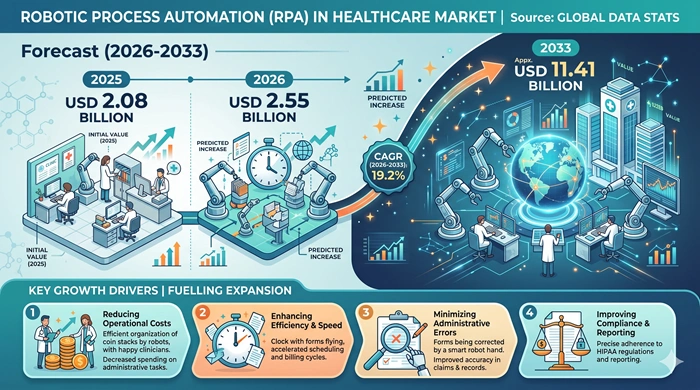
The global robotic process automation in healthcare market size is valued at USD 2.08 billion in 2025 and is predicted to increase from USD 2.55 billion in 2026 to approximately USD 11.41 billion by 2033, growing at a CAGR of 19.2% from 2026 to 2033.
Robotic process automation (RPA) in healthcare refers to the deployment of software bots that mimic rule-based human actions to automate repetitive, high-volume administrative and operational tasks across hospitals, insurance companies, pharmaceutical organizations, and clinical laboratory environments — without requiring changes to existing IT infrastructure. The sector is experiencing strong growth momentum driven by escalating healthcare administrative cost pressures, rapid adoption of electronic health records, growing regulatory compliance requirements, and the powerful efficiency and accuracy improvements that automated workflows deliver across claims processing, patient scheduling, billing, medical coding, and prior authorization workflows. As healthcare organizations globally prioritize digital transformation programs that reduce operational costs while improving care quality, the robotic process automation in healthcare market is emerging as one of the most commercially compelling segments within the broader health IT automation landscape.
AI Impact on the Robotic Process Automation in Healthcare Industry
Artificial Intelligence Is Transforming Robotic Process Automation in Healthcare Through Intelligent Document Processing, AI-Enhanced Claims Adjudication Automation, Cognitive RPA for Unstructured Clinical Data Handling, and Generative AI-Powered Conversational Automation Platforms
Artificial intelligence is fundamentally expanding what robotic process automation in healthcare can accomplish — transforming it from a tool for simple, rule-based task repetition into a platform for intelligent, judgment-involving workflow automation that was previously reserved for human operators. Traditional RPA systems excel at automating structured, deterministic processes where inputs and decision rules are clearly defined — such as copying patient demographic data between systems or submitting standardized insurance claims forms. But the majority of healthcare administrative workflows involve unstructured or semi-structured data — clinical notes, scanned documents, handwritten forms, complex insurance policy language, and non-standard communication formats — that classical RPA bots cannot interpret without human preprocessing. AI integration — specifically natural language processing, optical character recognition, and machine learning classification models — is solving this limitation by enabling intelligent document processing that extracts, classifies, and validates information from unstructured clinical and administrative documents before feeding it into downstream RPA automation workflows, dramatically expanding the scope of automatable healthcare processes.
The emergence of generative AI as a component within cognitive RPA platforms is creating a new generation of healthcare automation capabilities that extend beyond document processing into conversational automation, clinical documentation assistance, and AI-driven prior authorization decision support. Healthcare RPA platforms that integrate generative AI can now automatically draft appeal letters for denied insurance claims, generate pre-populated documentation templates from partial clinical data inputs, and provide conversational patient intake experiences through AI chatbot front-ends that feed structured data directly into EHR systems — all within automated workflows that require minimal human intervention. These generative AI-enhanced healthcare automation capabilities are attracting significant investment from both established RPA platform vendors and specialized healthcare IT companies, and are expected to be the primary driver of premium product differentiation and above-baseline CAGR within the robotic process automation in healthcare market through 2033.
Growth Factors
Escalating Healthcare Administrative Cost Crisis Driving Automation Urgency, Rapid EHR Adoption Creating Automation-Ready Data Infrastructure, Growing Complexity of Insurance Prior Authorization and Claims Management, and Healthcare Workforce Shortage Amplifying Automation ROI Are the Core Growth Drivers
The healthcare industry globally is facing a severe and worsening administrative cost burden — estimated to consume approximately 25–35% of total healthcare spending in the United States alone, representing hundreds of billions of dollars annually devoted to billing, coding, claims management, regulatory compliance documentation, and coordination-of-care administration that adds no direct clinical value. Healthcare organizations are under intense financial pressure from multiple directions — declining reimbursement rates, rising labor costs, increasing regulatory compliance requirements, and growing competitive pressure in many markets — that collectively make cost reduction through process automation not merely desirable but existentially important for financial sustainability. Robotic process automation in healthcare delivers demonstrated, measurable cost reduction and efficiency improvement in precisely the administrative domains where healthcare spending is most wasteful — creating a compelling and well-documented business case that is driving investment in RPA adoption across hospital systems, payer organizations, and revenue cycle management companies globally.
The widespread adoption of electronic health record systems across developed healthcare markets has created a foundational digital data infrastructure that makes robotic process automation in healthcare practically achievable at scale in ways that were not possible when clinical and administrative data existed primarily in paper form. EHR systems, practice management platforms, laboratory information systems, and payer portals collectively generate structured digital data that RPA bots can access, manipulate, and transfer between systems using established APIs and screen interaction automation — without the document scanning and data extraction preprocessing steps that paper-based processes require. As EHR adoption deepens in emerging markets and as interoperability standards progressively improve data exchange between previously siloed healthcare IT systems, the addressable scope of automation within the robotic process automation in healthcare market expands further — making the global market's growth trajectory increasingly broad-based across both developed and developing healthcare economies.
Market Outlook
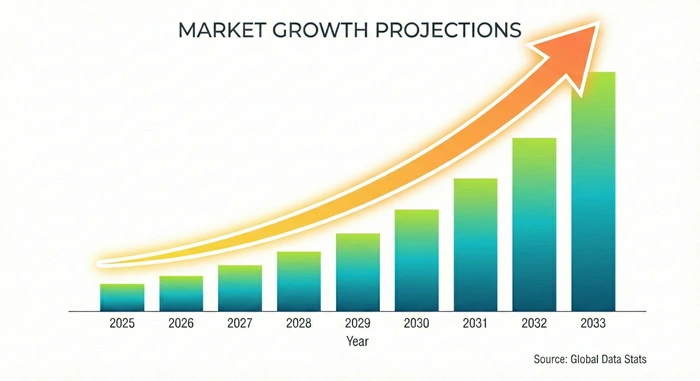
The Robotic Process Automation in Healthcare Market Is Positioned for Sustained High-Growth Through 2033 as Intelligent Automation Adoption Deepens Across Revenue Cycle Management, Clinical Workflow Support, Regulatory Compliance, and Population Health Management Operations
The commercial outlook for the robotic process automation in healthcare market through 2033 is exceptionally strong, supported by multiple reinforcing trends that are simultaneously expanding the addressable automation opportunity, improving the ROI of RPA deployments, and lowering the technical and organizational barriers to adoption. The shift from traditional RPA toward intelligent automation platforms — combining RPA with AI, process mining, analytics, and workflow orchestration into integrated hyperautomation suites — is progressively increasing the value that healthcare organizations can extract per automation deployment, extending RPA from narrow task automation into comprehensive end-to-end process transformation. This value expansion is sustaining growing healthcare RPA investment even in organizations that have already deployed initial RPA programs, as expanded intelligent automation capabilities create new automation opportunities in more complex processes that earlier-generation RPA tools could not address.
The US healthcare market's ongoing struggle with prior authorization complexity, claims denial management, and revenue cycle efficiency represents one of the most powerful and persistent commercial demand engines for the robotic process automation in healthcare market. The American Medical Association reports that physicians spend an average of 43 hours per week on administrative tasks — largely driven by insurance-related workflows — creating an enormous productivity drain that healthcare organizations are actively seeking to address through automation. Federal policy pressure on insurance companies to streamline prior authorization processes, combined with growing health system investment in revenue cycle automation platforms, is creating a well-funded and urgently motivated procurement environment for healthcare RPA solutions that will sustain the market's strong growth trajectory through the forecast period.
Expert Speaks
-
Andrew Wilson, CEO, Accenture — "The convergence of artificial intelligence with robotic process automation is creating a new category of intelligent healthcare automation that goes well beyond the simple task bots of the first generation of RPA — enabling healthcare organizations to automate complex, judgment-intensive workflows that require reading clinical documents, interpreting insurance policies, and making nuanced compliance determinations. The robotic process automation in healthcare market is entering a phase of accelerating adoption as health system leaders recognize that intelligent automation is not just an IT efficiency play but a strategic capability that directly enables better patient care by freeing clinical staff from administrative burden."
-
Arun Chandrasekaran, CEO, UiPath — "Healthcare has become one of our fastest-growing vertical markets, and it is not difficult to understand why — the administrative complexity of healthcare operations, the high cost of manual processing errors, and the urgency of reducing operational costs without compromising care quality create a perfect commercial environment for enterprise automation platforms. We see robotic process automation in healthcare evolving rapidly from departmental RPA deployments into enterprise-wide intelligent automation programs that span the full spectrum of administrative, clinical support, and compliance workflows across large health system operations."
-
Malcolm Frank, President, Cognizant Digital Business — "Healthcare organizations that are successfully scaling their digital transformation programs are consistently finding that robotic process automation is the foundational capability that makes their broader technology investments more productive — by creating automated data pipelines that connect disparate systems, eliminating manual rework that compromises data quality, and freeing healthcare workers to focus their skills on the patient-facing, relationship-driven aspects of care that automation cannot replicate. The commercial opportunity in the robotic process automation in healthcare market is far from mature — the majority of automatable healthcare administrative processes remain unautomated today, representing a multi-decade growth runway for platforms that can deliver reliable, compliant, and scalable healthcare workflow automation."
Key Report Takeaways
-
North America leads the robotic process automation in healthcare market, holding approximately 46.2% of global revenue in 2025, driven by the world's most complex and costly healthcare administrative landscape, the highest concentration of large hospital systems and insurance organizations with the scale and IT maturity to deploy enterprise RPA programs, strong venture capital investment in healthcare IT automation startups, and the headquarters presence of leading global RPA platform vendors including UiPath, Blue Prism, Automation Anywhere, and IBM
-
Asia-Pacific is the fastest-growing regional market, projected to expand at a CAGR of over 21.4% through 2033, driven by rapidly expanding healthcare digitization programs across China, India, Japan, South Korea, and Southeast Asia, growing government investment in health IT modernization, increasing payer-provider administrative complexity as healthcare insurance markets mature, and the progressive adoption of cloud-based RPA platforms that reduce upfront deployment costs for healthcare organizations in developing markets
-
Software dominates the component segment, accounting for approximately 78.6% of total component revenue in 2025, reflecting the primary commercial value of licensed or subscription-based RPA platform software — including bot development environments, process orchestration tools, analytics dashboards, and AI/ML integration frameworks — that organizations require to design, deploy, and manage healthcare automation programs, while services represent the fastest-growing component at a CAGR of approximately 14.3%
-
Claims management is the dominant application segment, contributing approximately 32.8% of total application revenue in 2025, driven by the enormous volume and complexity of insurance claims processing workflows across health systems and payer organizations — including claim submission, status checking, denial management, appeals processing, and payment posting — which collectively represent some of the most time-consuming, error-prone, and high-value administrative activities within healthcare operations
-
Cloud-based deployment dominates the deployment segment, accounting for approximately 74.6% of total deployment revenue in 2025, driven by the scalability, cost efficiency, rapid deployment timelines, automatic software updates, and reduced IT infrastructure management burden that cloud-native RPA platforms deliver compared to on-premises installations — particularly attractive to mid-sized healthcare organizations that lack the IT staff and capital for on-premises enterprise software management
-
Intelligent automation / hyperautomation platforms are the fastest-growing technology integration segment in the robotic process automation in healthcare market, projected to grow at a CAGR of approximately 22.3% through 2033 and expected to account for approximately 55% of total new healthcare RPA deployment revenue by 2033, driven by the healthcare industry's growing need to automate complex, judgment-involving processes that exceed classical rule-based RPA's capability and require AI integration for practical deployment
Market Scope
| Report Coverage | Details |
|---|---|
| Market Size by 2033 | USD 11.41 Billion |
| Market Size by 2025 | USD 2.08 Billion |
| Market Size by 2026 | USD 2.55 Billion |
| Market Growth Rate (2026–2033) | CAGR of 19.2% |
| Dominating Region | North America |
| Fastest Growing Region | Asia-Pacific |
| Base Year | 2025 |
| Forecast Period | 2026 – 2033 |
| Segments Covered | Component, Deployment, Application, End User, Organization Size |
| Regions Covered | North America, Europe, Asia-Pacific, Latin America, Middle East & Africa |
Market Dynamics
Drivers Impact Analysis
Escalating Healthcare Administrative Cost Burden Creating Automation Urgency, EHR Digitization Enabling RPA Deployment at Scale, Workforce Shortages Amplifying Automation ROI, and Complex Insurance Prior Authorization Processes Driving Dedicated Healthcare RPA Investment Are the Core Drivers
| Driver | ≈ % Impact on CAGR Forecast | Geographic Relevance | Impact Timeline |
|---|---|---|---|
| Escalating healthcare administrative cost burden driving operational efficiency investment | ~29% | North America, Europe | Short to Long-term |
| Widespread EHR adoption creating automation-ready digital data infrastructure | ~24% | North America, Europe, Asia-Pacific | Short to Long-term |
| Healthcare workforce shortages amplifying automation ROI and necessity | ~22% | Global | Short to Long-term |
| Growing insurance prior authorization and claims management complexity | ~17% | North America | Ongoing |
| Cloud RPA platform adoption reducing deployment cost and complexity barriers | ~8% | Emerging markets, mid-sized organizations | Short to Medium-term |
The healthcare workforce shortage — a global challenge that has intensified significantly in the post-pandemic period, with hundreds of thousands of unfilled nursing, physician, allied health, and healthcare administrative positions across the United States, United Kingdom, Germany, and Canada — is dramatically amplifying the ROI of healthcare administrative automation. When experienced healthcare administrative staff are scarce and costly to recruit and retain, the economic case for deploying software bots to handle routine billing, scheduling, and documentation tasks becomes compellingly superior to continuing to staff these functions with human employees. Healthcare organizations that have deployed RPA for revenue cycle management and prior authorization workflows consistently report bot productivity equivalent to multiple full-time employees per deployed process — a compelling labor substitution economics argument that is driving accelerating RPA adoption investment among health system CFOs and COOs managing labor cost challenges within the robotic process automation in healthcare market.
The growing regulatory compliance complexity facing healthcare organizations — encompassing HIPAA privacy and security requirements, ICD-10 medical coding standards, CMS quality reporting mandates, value-based care performance measurement requirements, and evolving state insurance regulations — is creating a growing demand for automated compliance monitoring and documentation workflows that RPA platforms are well-suited to address. Manual compliance management processes are both labor-intensive and error-prone — creating both cost and risk exposure that motivates healthcare compliance teams to invest in RPA-based process automation. The consistent ability of healthcare RPA deployments to improve compliance documentation completeness, reduce human coding errors, and generate automated audit trails is an important secondary benefit that supports the business case for robotic process automation in healthcare investment beyond the primary labor cost reduction argument.
Restraints Impact Analysis
Complex Healthcare IT Integration Requirements, HIPAA and Data Privacy Compliance Management, High Implementation Cost for Smaller Organizations, Change Management Resistance, and RPA Maintenance Burden After System Upgrades Are the Primary Restraints
| Restraint | ≈ % Impact on CAGR Forecast | Geographic Relevance | Impact Timeline |
|---|---|---|---|
| Complex healthcare IT integration challenges with legacy EHR and billing systems | ~32% | Global | Ongoing |
| HIPAA and healthcare data privacy compliance requirements for RPA deployments | ~26% | North America, Europe | Ongoing |
| High implementation cost and complexity for smaller healthcare organizations | ~22% | Emerging markets, small practices, rural health | Ongoing |
| Change management and clinical staff resistance to automation adoption | ~13% | Global | Short to Medium-term |
| RPA maintenance burden after EHR or system interface updates | ~7% | Global | Ongoing |
Healthcare IT environments are among the most complex and heterogeneous in any industry — comprising multiple EHR platforms, legacy billing systems, laboratory information systems, radiology picture archiving systems, insurance payer portals, and third-party clinical applications that were often implemented at different times by different vendors and may have limited interoperability. Deploying RPA bots in this environment requires extensive integration mapping, robust exception handling for system interface variability, and careful process design to ensure that bots maintain function after routine system updates or interface changes. The complexity and cost of healthcare RPA implementation — particularly in large health systems with dozens of disparate IT systems across multiple care sites — creates a significant barrier to rapid deployment scale and makes successful healthcare RPA programs highly dependent on experienced implementation partners and internal RPA centers of excellence.
HIPAA compliance requirements create specific regulatory obligations for how software bots that access, process, or transmit protected health information must be designed, deployed, and audited within robotic process automation in healthcare programs. Every RPA bot that interacts with patient data must be properly authorized, its access logged and audited, and its data handling validated to comply with the HIPAA Security Rule's technical safeguard requirements — creating implementation complexity and compliance management overhead that goes beyond what is required for RPA in less regulated industries. Healthcare organizations that lack dedicated compliance and legal resources to properly oversee RPA deployment may face elevated risk exposure or may proceed more cautiously with automation expansion than their business case would otherwise support, representing a meaningful pacing constraint on the broader healthcare RPA market.
Opportunities Impact Analysis
Intelligent Automation and Hyperautomation Platform Adoption, Revenue Cycle Management Automation Expansion, AI-Powered Prior Authorization Automation, and Emerging Market Healthcare Digitization Programs Are the Most Compelling Growth Opportunities
| Opportunity | ≈ % Impact on CAGR Forecast | Geographic Relevance | Impact Timeline |
|---|---|---|---|
| Intelligent automation / hyperautomation platform adoption beyond classical RPA | ~32% | North America, Europe | Short to Long-term |
| End-to-end revenue cycle management automation expansion | ~26% | North America | Short to Long-term |
| AI-powered prior authorization and claims denial automation | ~22% | North America, Europe | Short to Medium-term |
| Emerging market healthcare digitization enabling first-wave RPA adoption | ~14% | Asia-Pacific, Latin America | Medium to Long-term |
| Population health management data automation programs | ~6% | North America, Europe | Medium to Long-term |
The transition from traditional task-level RPA toward comprehensive healthcare hyperautomation platforms — integrating RPA with process mining to identify automation opportunities, AI/ML for intelligent decision-making, low-code development tools for rapid bot deployment, and advanced analytics for automation performance measurement — represents the most commercially transformative near-term opportunity in the robotic process automation in healthcare market. Healthcare organizations that mature beyond siloed departmental RPA deployments toward enterprise hyperautomation programs achieve fundamentally greater value from their automation investments — addressing more complex and higher-value processes, reducing maintenance overhead through more resilient AI-enhanced bot architectures, and generating data-driven insights that continuously identify new automation opportunities across the operational landscape. Platform vendors including UiPath, Automation Anywhere, Blue Prism, and ServiceNow are all investing heavily in healthcare-specific hyperautomation capabilities that are positioning the robotic process automation in healthcare market for sustained above-average growth through 2033.
The prior authorization process — which requires clinical staff and administrative teams to manually gather patient clinical information, prepare documentation packages, submit requests to insurance payers through multiple different portal interfaces, and then follow up on pending decisions — represents one of the most costly, time-consuming, and clinically disruptive administrative processes in US healthcare. Federal regulatory pressure to require electronic prior authorization and automate approval decisions for routine procedures is creating a policy environment that will both mandate and enable RPA-based prior authorization automation at scale. Healthcare organizations and technology vendors that invest in building sophisticated AI-enhanced prior authorization automation capabilities within the robotic process automation in healthcare market framework — combining RPA for portal submission and status tracking with AI for clinical criteria matching and documentation assembly — are positioned to capture a large and highly motivated commercial market as the regulatory and technological conditions for prior authorization automation converge.
Segment Analysis
By Component
Software Dominates the Robotic Process Automation in Healthcare Market as the Primary Commercial Revenue Driver While Services Emerge as the Fastest-Growing Component Driven by Implementation Complexity and Managed Automation Demand
The software segment is the dominant component category in the robotic process automation in healthcare market, accounting for approximately 78.6% of total component revenue in 2025 and projected to maintain a strong CAGR of 18.7% through 2033. Software encompasses the full range of RPA platform licenses and cloud subscriptions — including bot development and management studios, process orchestration engines, AI and ML model integration frameworks, analytics and reporting dashboards, and healthcare-specific process automation templates — that healthcare organizations require to design, deploy, scale, and monitor their automation programs. North America is the dominant region for healthcare RPA software revenue, where the largest hospital systems, health insurance companies, and pharmacy benefit managers are deploying enterprise RPA platforms from UiPath, Automation Anywhere, Blue Prism, and Microsoft Power Automate at scale. Asia-Pacific is the fastest-growing software revenue region, driven by rapidly accelerating healthcare digitization investment in China, India, and Japan that is creating first-wave demand for cloud-delivered RPA platform subscriptions within the robotic process automation in healthcare market.
The services segment — encompassing professional implementation and integration services, training and change management programs, managed automation services, and ongoing RPA support and maintenance — is the fastest-growing component, projected to grow at a CAGR of approximately 19.8% through 2033. The complexity of healthcare IT environments and the specialized knowledge required to implement HIPAA-compliant RPA deployments effectively is creating strong demand for experienced healthcare automation implementation consultants from firms including Accenture, Deloitte, Cognizant, and Infosys, as well as from RPA platform vendors' own professional services organizations. Key companies leading healthcare RPA software include UiPath (United States), Automation Anywhere (United States), Blue Prism (United Kingdom), Microsoft (United States), and IBM (United States).
By Application
Claims Management Leads Application Revenue in the Robotic Process Automation in Healthcare Market While Patient Scheduling and Registration Emerges as the Fastest-Growing Application Driven by Front-Office Automation Demand
Claims management is the dominant application segment in the robotic process automation in healthcare market, contributing approximately 32.8% of total application revenue in 2025 and projected to maintain a strong CAGR of 18.4% through 2033. This segment encompasses the full claims lifecycle automation workflow — including charge capture, claim scrubbing and editing, electronic submission to payers, real-time status monitoring, denial identification and routing, automated appeals documentation, and payment posting — representing one of the most labor-intensive and error-prone revenue cycle processes that healthcare organizations manage. North America is overwhelmingly the dominant region for claims management automation, where the extreme complexity of multi-payer insurance billing in the US creates the world's highest per-encounter administrative cost and the strongest commercial incentive for automated claims processing within the robotic process automation in healthcare market. Key companies active in healthcare claims automation include Change Healthcare (now Optum), Olive AI, Waystar, and the healthcare-specific implementations of major RPA platforms.
Patient scheduling and registration is the fastest-growing application in the robotic process automation in healthcare market, projected to grow at a CAGR of approximately 22.8% through 2033, driven by growing patient and provider demand for automated online appointment booking, automated insurance eligibility verification at the point of registration, and AI-enhanced patient intake workflows that populate EHR demographic and insurance fields from digital intake forms without manual data entry. Asia-Pacific is the fastest-growing region for patient scheduling automation, where the combination of rapidly growing outpatient clinic volumes, expanding telemedicine platforms that require automated scheduling integration, and growing consumer expectations for digital-first healthcare access experiences is creating strong demand for front-office automation tools within the broader healthcare RPA market ecosystem.
Regional Insights
North America
North America Leads the Global Robotic Process Automation in Healthcare Market With the Dominant Revenue Share, Driven by the World's Most Complex and Costly Healthcare Administrative Landscape, Enterprise-Scale IT Infrastructure, and Headquarters Concentration of Leading RPA Platform Vendors
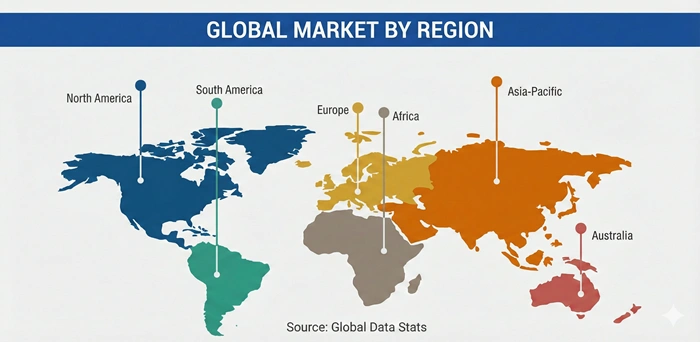
North America holds the dominant position in the global robotic process automation in healthcare market, accounting for approximately 46.2% of total global revenue in 2025 and projected to maintain a CAGR of 18.5% through 2033. The United States is the primary national market — characterized by the world's most administratively complex multi-payer healthcare system, where the interactions between thousands of insurance products, hundreds of hospital billing departments, and dozens of government payer programs create extraordinary administrative burden and commensurately powerful demand for RPA-based automation. Major US health systems including Mayo Clinic, HCA Healthcare, CommonSpirit Health, and Ascension are all active investors in enterprise RPA and intelligent automation programs, with revenue cycle management and prior authorization automation representing the highest-priority deployment areas. Leading RPA platform vendors headquartered in North America — including UiPath, Automation Anywhere, and Microsoft (Power Automate) — dominate the robotic process automation in healthcare market globally through both direct enterprise sales and partner-delivered healthcare automation implementations.
Canada is the second-largest North American market for healthcare RPA, where provincial health systems are investing in administrative automation programs focused on electronic health record data management, claims submission to provincial payers, and healthcare operational reporting automation. The Canadian healthcare system's universal payer structure — while simpler than the US multi-payer environment — still generates substantial administrative volume that represents meaningful automation opportunity, and Canadian health organizations are increasingly adopting the same leading RPA platforms and implementation approaches as their US counterparts within the robotic process automation in healthcare market.
Asia-Pacific
Asia-Pacific Is the Fastest-Growing Regional Market for Robotic Process Automation in Healthcare, Driven by Rapid Healthcare Digitization, Growing Administrative Complexity as Insurance Markets Mature, and Aggressive Government Investment in Health IT Modernization Programs
Asia-Pacific is the most rapidly expanding regional market in the global robotic process automation in healthcare landscape, projected to grow at a CAGR of 21.4% from 2026 to 2033. The region currently accounts for approximately 18.7% of global robotic process automation in healthcare market revenue in 2025, with China, Japan, India, South Korea, and Australia as the primary national markets. China is the largest and fastest-growing national market within Asia-Pacific, driven by the Chinese government's Healthy China 2030 program that is funding large-scale hospital information system modernization, EHR digitization, and health insurance claims management platform upgrades that collectively create the digital infrastructure foundation for healthcare RPA deployment at scale. Japan has the most technically mature healthcare IT environment in Asia-Pacific, with established hospital information system digitization and growing investment in healthcare workflow automation from technology companies including Fujitsu, NEC, and Hitachi that are building Japanese healthcare automation platform capabilities. Key RPA companies active across Asia-Pacific include UiPath, Automation Anywhere, and regional players including Kofax and Appian, alongside Asian technology conglomerates expanding into healthcare automation.
India is emerging as both an important healthcare RPA market and a major delivery center for healthcare automation services, where the combination of a large English-speaking technology services workforce, established IT outsourcing infrastructure, and rapidly expanding domestic private healthcare sector is creating a dual role as both RPA buyer and RPA implementation service provider within the robotic process automation in healthcare market. Indian IT services giants including Infosys, Tata Consultancy Services, Wipro, and HCL Technologies are all actively building and deploying healthcare RPA solutions for both domestic Indian healthcare clients and global healthcare organizations through their outsourcing relationships — positioning India as a strategically important and commercially significant participant in the global healthcare automation value chain.
Top Key Players
-
UiPath Inc. (United States)
-
Automation Anywhere Inc. (United States)
-
Blue Prism Group plc (United Kingdom)
-
Microsoft Corporation (Power Automate) (United States)
-
IBM Corporation (United States)
-
Pegasystems Inc. (United States)
-
Kofax Inc. (United States)
-
ServiceNow Inc. (United States)
-
Olive AI Inc. (United States)
-
Waystar Health (United States)
-
Change Healthcare / Optum (United States)
-
Appian Corporation (United States)
Recent Developments
-
UiPath (2025) — Released significant healthcare-specific enhancements to its UiPath Healthcare Automation Suite, including new HIPAA-compliant bot templates for prior authorization workflow automation, AI-powered clinical document processing integration with major EHR platforms including Epic and Cerner, and new healthcare-specific process mining capabilities that help health system operations teams automatically identify and prioritize high-value RPA deployment opportunities across revenue cycle, supply chain, and patient access workflows within the robotic process automation in healthcare market
-
Automation Anywhere (2025) — Expanded its healthcare automation portfolio with new AI-native automation agents designed specifically for healthcare revenue cycle operations — integrating large language model processing for unstructured clinical documentation with traditional RPA bot execution for structured EHR and billing system tasks — and reported strong enterprise healthcare customer adoption growth driven by health systems seeking to address persistent claims denial rates and prior authorization processing backlogs that are creating measurable negative impacts on clinical operations and financial performance
-
Microsoft / Power Automate (2025) — Accelerated healthcare automation adoption through deep integration of Microsoft Power Automate with Microsoft Azure Health Data Services and Copilot Studio healthcare conversational AI capabilities — enabling healthcare organizations that have standardized on Microsoft technology ecosystems to deploy AI-enhanced RPA workflows for clinical documentation, appointment management, and insurance verification using familiar Microsoft development tools and governance frameworks within the broader robotic process automation in healthcare market
-
Olive AI (2025) — Refocused its healthcare automation platform strategy on prior authorization and revenue integrity automation following a strategic restructuring, deploying new AI-powered prior authorization prediction and appeal automation capabilities that are demonstrating significant reduction in prior authorization denial rates and associated administrative rework costs for its health system clients — and established new partnership agreements with Epic, Cerner, and Meditech for deeper EHR integration that improves bot reliability and deployment speed across its customer base
-
Waystar (2025) — Continued commercial expansion of its AI-enhanced revenue cycle automation platform following its IPO in 2024, launching new automated claim status inquiry and payment variance detection capabilities that leverage RPA and AI to reduce revenue cycle staff workload in denial management and underpayment identification — reporting strong new customer acquisition among mid-sized US health systems and specialty care groups seeking scalable, cloud-delivered revenue cycle automation within the robotic process automation in healthcare market
Market Trends
The Accelerating Transition From Traditional RPA to Intelligent Hyperautomation Platforms and the Rapid Expansion of AI-Powered Prior Authorization Automation Are the Two Most Commercially Transformative Trends Shaping the Robotic Process Automation in Healthcare Market
The robotic process automation in healthcare market is undergoing a fundamental evolution from first-generation, single-process RPA bot deployments toward enterprise hyperautomation programs that integrate RPA with process intelligence, AI/ML capabilities, natural language processing, low-code development tools, and advanced workflow orchestration into unified automation platforms. Healthcare organizations that began their automation journey with targeted RPA pilots — automating a single claims submission workflow or a specific eligibility verification process — are progressively maturing into enterprise hyperautomation programs that apply intelligent process automation tools systematically across the full administrative and clinical support operation. This maturation trajectory is increasing average deal sizes for RPA platform vendors, creating growing services revenue from ongoing program expansion and optimization work, and generating progressively stronger competitive differentiation between vendors that offer genuinely intelligent healthcare automation capabilities versus those limited to classical RPA bot execution.
AI-powered clinical document understanding — the ability to extract, interpret, and act on information from clinical notes, physician letters, diagnostic reports, and other unstructured clinical documents using natural language processing and medical AI models — is enabling a new generation of healthcare automation use cases within the robotic process automation in healthcare market that were previously blocked by the inability of classical RPA to handle non-standardized text documents. Medical coding automation, clinical prior authorization criteria matching, discharge summary-triggered workflow initiation, and quality measure data extraction from clinical documentation are all healthcare automation applications that require clinical document understanding capability — and the rapid improvement of specialized healthcare NLP models is making these previously intractable automation opportunities commercially viable. As clinical document processing AI matures and integrates with leading RPA platforms, the scope of automated healthcare workflows will expand substantially beyond purely administrative processes into clinical support and quality improvement applications.
Segments Covered in the Report
By Component:
-
Software (RPA Platform Licenses, Cloud SaaS Subscriptions, Bot Development Environments, AI Integration Frameworks)
-
Services (Implementation and Integration, Training and Change Management, Managed Automation Services, Support and Maintenance)
By Deployment:
-
Cloud-Based
-
On-Premises
-
Hybrid
By Application:
-
Claims Management and Processing
-
Patient Scheduling and Registration
-
Medical Billing and Coding
-
Prior Authorization Management
-
Clinical Documentation and Transcription
-
Supply Chain and Inventory Management
-
Regulatory Compliance and Reporting
-
Others
By End User:
-
Hospitals and Health Systems
-
Health Insurance / Payer Organizations
-
Pharmaceutical and Biotech Companies
-
Clinical Laboratories
-
Ambulatory Care Centers and Clinics
-
Others
By Organization Size:
-
Large Enterprises
-
Small and Medium-Sized Healthcare Organizations
By Region:
-
North America (United States, Canada, Mexico)
-
Europe (Germany, United Kingdom, France, Netherlands, Rest of Europe)
-
Asia-Pacific (China, Japan, India, South Korea, Australia, Rest of Asia-Pacific)
-
Latin America (Brazil, Argentina, Rest of Latin America)
-
Middle East & Africa (UAE, Saudi Arabia, South Africa, Rest of MEA)
Frequently Asked Questions
Question 1: What is the current size of the robotic process automation in healthcare market?
Answer: The global robotic process automation in healthcare market is valued at USD 2.08 billion in 2025 and is projected to reach USD 11.41 billion by 2033. The market is growing at a CAGR of 19.2% from 2026 to 2033, driven by escalating healthcare administrative costs, rapid EHR adoption, growing workforce shortages, and expanding intelligent automation platform capabilities that extend RPA beyond simple task bots into complex clinical and administrative workflow automation.
Question 2: What processes benefit most from robotic process automation in healthcare?
Answer: Claims management, prior authorization processing, medical billing and coding, patient scheduling and registration, insurance eligibility verification, and regulatory compliance documentation are the most commonly automated processes in the robotic process automation in healthcare market — representing high-volume, rule-based workflows where bot deployment delivers the greatest productivity gain and error reduction. Claims management alone accounts for approximately 32.8% of total healthcare RPA application revenue, reflecting the enormous administrative complexity and labor intensity of multi-payer insurance billing that makes it the highest-priority automation target for US hospital systems and health insurance organizations.
Question 3: Which region leads the robotic process automation in healthcare market?
Answer: North America leads the robotic process automation in healthcare market, accounting for approximately 46.2% of global revenue in 2025, driven by the world's most administratively complex healthcare system, the highest concentration of enterprise RPA deployments in large hospital systems and insurance organizations, and the headquarters presence of major RPA platform vendors including UiPath, Automation Anywhere, and Microsoft. Asia-Pacific is the fastest-growing regional market, projected to expand at a CAGR of 21.4% through 2033, driven by healthcare digitization programs in China, India, and Japan.
Question 4: How does AI enhance robotic process automation in healthcare?
Answer: AI enhances robotic process automation in healthcare by extending bot capability beyond structured, deterministic tasks into intelligent document processing, natural language understanding, and judgment-involving workflow automation — enabling bots to extract and interpret clinical and administrative information from unstructured documents like physician notes, insurance letters, and scanned forms that classical RPA cannot handle. Generative AI integration is further expanding healthcare RPA capabilities by enabling automated drafting of claim appeal letters, clinical documentation templates, and conversational patient intake experiences that feed structured data directly into EHR systems — substantially increasing the breadth of healthcare processes that can be effectively automated.
Question 5: What are the main challenges in adopting robotic process automation in healthcare?
Answer: The primary challenges facing robotic process automation in healthcare adoption include complex IT environment integration requirements across heterogeneous legacy EHR and billing systems, strict HIPAA compliance obligations for any bot that handles protected health information, high implementation costs that create barriers for smaller healthcare organizations, and staff change management resistance that can slow adoption even when the business case for automation is compelling. RPA maintenance burden — particularly the need to update bots after EHR system upgrades or payer portal interface changes — is also a significant ongoing operational challenge that makes experienced implementation partners and internal RPA competency centers important investments for healthcare organizations seeking to scale their automation programs sustainably within the robotic process automation in healthcare market.