
Real-Time Spectrum Analysis Market Overview
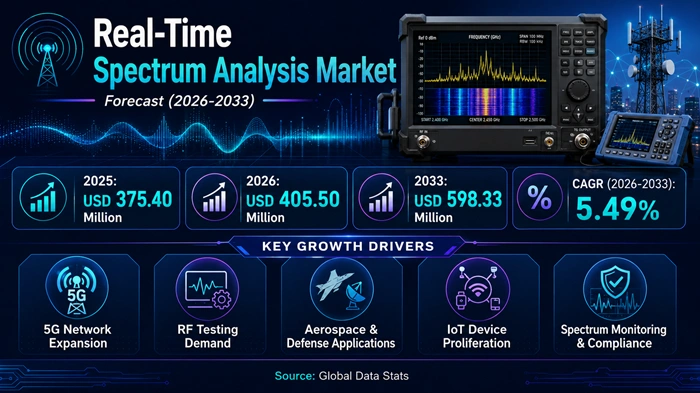
The global real-time spectrum analysis market size is valued at USD 375.40 million in 2025 and is predicted to increase from USD 405.50 million in 2026 to approximately USD 598.33 million by 2033, growing at a CAGR of 5.49% from 2026 to 2033. This consistent growth trajectory reflects the accelerating demand for sophisticated radio frequency monitoring solutions as wireless communication networks become increasingly complex and congested with the proliferation of 5G technology, Internet of Things devices, and connected systems requiring precise spectrum management. Real-time spectrum analysis encompasses advanced measurement instruments capable of capturing, analyzing, and displaying radio frequency signals instantaneously, enabling engineers and technicians to detect transient signals, identify interference sources, and optimize wireless network performance with unprecedented accuracy and speed.
The real-time spectrum analysis market represents critical infrastructure supporting modern wireless communication ecosystems where traditional swept-tuned analyzers cannot adequately monitor fast-changing RF environments. These sophisticated instruments utilize advanced digital signal processing, field-programmable gate arrays, and high-speed data acquisition systems to provide continuous visibility across wide frequency ranges, capturing brief signal events and frequency-hopping transmissions that conventional spectrum analyzers miss entirely. Growing complexity of RF environments driven by deployment of advanced wireless technologies including 5G networks, Wi-Fi 6E, satellite communications, and military electronic warfare systems is creating unprecedented demand for real-time spectrum analysis capabilities across telecommunications, defense, aerospace, automotive, and industrial applications worldwide.
AI Impact on the Real-Time Spectrum Analysis Industry
Revolutionizing Signal Detection and Automated Interference Management Through Intelligent Analytics
Artificial intelligence is fundamentally transforming the real-time spectrum analysis market by enabling unprecedented levels of automated signal classification, predictive interference detection, and intelligent spectrum optimization that dramatically enhance operational efficiency while reducing dependence on highly skilled RF engineers. AI-powered spectrum analyzers continuously process vast quantities of RF data captured across multiple frequency bands, applying machine learning algorithms that automatically identify signal types, classify modulation schemes, detect anomalies indicating interference or unauthorized transmissions, and predict potential spectrum conflicts before they disrupt communications. Neural networks trained on extensive databases of known signal characteristics can recognize complex waveforms in milliseconds, distinguishing legitimate communications from interference sources with accuracy exceeding human analysts while operating continuously without fatigue or attention lapses. Computer vision techniques applied to spectrograms enable pattern recognition identifying subtle signal characteristics that indicate specific transmitter types, helping military and intelligence applications locate and classify electronic emissions.
The integration of AI extends throughout the entire spectrum monitoring ecosystem from automated data collection through intelligent analysis and predictive maintenance, creating comprehensive RF situational awareness platforms that optimize spectrum utilization across diverse applications. Predictive analytics models forecast spectrum occupancy patterns based on historical usage data, time of day, geographic location, and external factors including weather conditions and special events, enabling proactive spectrum management that prevents congestion and optimizes channel assignments. AI-driven automation coordinates complex spectrum monitoring networks deployed across multiple geographic locations, aggregating data from distributed sensors to create unified spectrum awareness supporting regulatory enforcement, military operations, and commercial network management. Machine learning algorithms continuously improve detection accuracy through experience, adapting to evolving RF environments and emerging signal types without requiring manual reconfiguration. This technological transformation is democratizing access to sophisticated spectrum analysis capabilities, making advanced RF monitoring viable for organizations previously unable to afford specialized engineering expertise or justify investments in traditional high-end test equipment.
Growth Factors
Explosive 5G Network Deployment and IoT Proliferation Drive Unprecedented Spectrum Management Demands
The global transition to fifth-generation wireless networks represents the fundamental driver propelling real-time spectrum analysis market expansion as 5G technology introduces unprecedented complexity requiring sophisticated monitoring capabilities for successful deployment and optimization. 5G networks utilize diverse frequency bands spanning sub-6 GHz traditional cellular spectrum through millimeter-wave frequencies exceeding 50 GHz, employ advanced technologies including massive MIMO antenna arrays and beamforming that create dynamic spatial signal patterns, and support network slicing enabling multiple virtual networks sharing common physical infrastructure. This complexity creates spectrum management challenges far exceeding previous wireless generations, with potential interference between different 5G frequency bands, conflicts with existing 4G LTE networks continuing operations during transition periods, and interactions with non-cellular systems including satellite communications and radar installations. The real-time spectrum analysis market benefits enormously from telecommunications operators' recognition that successful 5G deployment depends on comprehensive spectrum monitoring identifying interference sources, verifying proper network operation, and optimizing performance across diverse deployment scenarios.
The explosive proliferation of Internet of Things devices creating massive numbers of low-power wireless transmitters operating across numerous frequency bands is driving sustained demand for spectrum analysis capabilities managing increasingly crowded RF environments. Industry analysts project over seventy-five billion IoT devices will be deployed globally by 2025, spanning applications including smart homes, industrial automation, agricultural monitoring, healthcare sensors, and smart city infrastructure, with these devices utilizing diverse wireless technologies including cellular IoT, LoRaWAN, Sigfox, Bluetooth, Wi-Fi, and proprietary protocols operating across licensed and unlicensed spectrum. This proliferation creates RF environments where hundreds or thousands of transmitters operate simultaneously within confined geographic areas, generating interference potential threatening reliable communications and requiring continuous monitoring ensuring all devices function properly without degrading network performance. The real-time spectrum analysis market expansion is accelerated by growing recognition among device manufacturers, network operators, and regulatory agencies that maintaining reliable IoT connectivity requires sophisticated monitoring tools capable of detecting brief transmissions from low-power devices operating intermittently across wide frequency ranges.

Market Outlook
Defense Modernization and Automotive Connectivity Expansion Shape Robust Growth Trajectory
The real-time spectrum analysis market outlook through 2033 remains exceptionally positive as defense sector investments in electronic warfare capabilities, automotive industry adoption of connected vehicle technologies, and continued wireless communication evolution drive sustained demand for advanced RF monitoring solutions. Military organizations worldwide are modernizing electronic warfare systems replacing Cold War-era equipment with software-defined architectures capable of detecting, analyzing, and responding to rapidly evolving electronic threats including sophisticated radar systems, encrypted communications, and frequency-agile jammers. Real-time spectrum analyzers serve as essential tools supporting electronic warfare development, testing, deployment, and operational use, providing capabilities for signal intelligence gathering, electromagnetic compatibility validation, and spectrum situational awareness enabling military forces to maintain electronic superiority. Defense procurement budgets increasingly allocate substantial funding for spectrum monitoring infrastructure supporting both traditional military communications and emerging capabilities including unmanned systems, battlefield networks, and beyond-line-of-sight communications all requiring sophisticated RF management.
Looking toward the forecast period conclusion in 2033, market dynamics will be increasingly influenced by automotive industry transformation as connected and autonomous vehicles require extensive wireless communications creating new spectrum management challenges and opportunities. Modern vehicles incorporate dozens of wireless systems including cellular connectivity for infotainment and telematics, dedicated short-range communications enabling vehicle-to-vehicle and vehicle-to-infrastructure interactions, radar sensors supporting autonomous driving features, and internal wireless networks connecting electronic control units replacing heavy wire harnesses. This proliferation of automotive RF systems creates electromagnetic compatibility challenges requiring comprehensive testing ensuring proper operation without mutual interference, with real-time spectrum analyzers providing essential capabilities for automotive development and production validation. The real-time spectrum analysis market is evolving toward portable and cloud-connected solutions enabling field monitoring, remote diagnostics, and collaborative analysis supporting distributed engineering teams, making advanced RF monitoring accessible beyond traditional laboratory environments into deployment scenarios including cell site commissioning, interference hunting, and regulatory enforcement operations conducted in diverse locations worldwide.
Expert Speaks
-
Satish Dhanasekaran, President and Chief Operating Officer at Keysight Technologies, emphasized during fiscal year 2025 results that Keysight maintains leadership in next-generation wireless technologies including 5G and emerging 6G research, with the company's advanced signal analysis platforms supporting spectrum research across ultra-high frequencies up to 300 GHz, positioning Keysight as the trusted partner enabling communications industry innovation and helping customers accelerate development cycles while ensuring product performance and regulatory compliance.
-
Christian Leicher, Chief Technology Officer at Rohde & Schwarz, noted in fiscal year 2024 commentary that the company's test and measurement business demonstrates resilience through diversified portfolio serving trending future technologies including Beyond 5G and 6G mobile communications generations, artificial intelligence integration, and sensor technology convergence with communications systems, with research and development customers consistently relying on Rohde & Schwarz equipment to drive technological advancement in increasingly complex RF environments.
-
Mahesh Kumar Basavaraju, Market Segment Manager for Wireless Communication at Rohde & Schwarz, highlighted in telecommunications industry analysis that the company's focus spans the entire value chain from chipset development for emerging technologies through conformance testing and production validation, with growing momentum in India around local testing and certification creating increased demand for advanced test systems as regulatory bodies mandate comprehensive testing, aligning with capabilities for end-to-end device and network testing supporting domestic telecommunications infrastructure development.
Key Report Takeaways
-
North America dominates the global real-time spectrum analysis market with approximately 32% market share driven by substantial defense and aerospace investments, leadership in 5G network deployment, presence of major telecommunications equipment manufacturers and test instrument companies, and sophisticated regulatory framework requiring comprehensive spectrum monitoring ensuring efficient allocation and interference-free operations across diverse wireless applications.
-
Asia-Pacific emerges as the fastest-growing regional market with projected CAGR exceeding 6.8% through 2033, fueled by massive 5G infrastructure buildout across China, India, Japan, and South Korea, rapid IoT adoption supporting smart city initiatives and industrial automation, substantial government investments in telecommunications modernization, and growing domestic manufacturing capabilities for wireless communications equipment requiring extensive testing and validation.
-
Portable analyzer segment leads product type categorization accounting for approximately 45% of global real-time spectrum analysis market revenue as these compact instruments provide essential field monitoring capabilities for applications including cell site commissioning, interference hunting, regulatory enforcement, and military operations where laboratory-grade benchtop analyzers cannot be practically deployed, with portable units offering balance between performance, size, and cost meeting diverse customer requirements.
-
IT and telecommunications applications dominate market consumption representing around 43% of total real-time spectrum analysis deployments as wireless network operators, equipment manufacturers, and service providers require continuous spectrum monitoring for network planning, interference mitigation, performance optimization, and regulatory compliance ensuring wireless infrastructure delivers reliable connectivity supporting growing data traffic from smartphones, tablets, and connected devices.
-
Benchtop analyzer segment captures substantial market share accounting for approximately 35% of revenue as these high-performance instruments provide maximum measurement capabilities for research and development laboratories, manufacturing test operations, and calibration facilities where superior specifications including widest frequency coverage, finest resolution bandwidth, and fastest analysis speeds justify larger size and higher cost compared to portable alternatives.
-
Aerospace and defense segment exhibits highest growth potential expected to expand at CAGR exceeding 7.2% through 2033 as military modernization programs invest heavily in electronic warfare capabilities, radar system development, secure communications infrastructure, and spectrum situational awareness platforms supporting operations across increasingly contested electromagnetic environments where spectrum dominance provides decisive tactical advantages requiring sophisticated real-time monitoring and analysis capabilities.
Market Scope
| Report Coverage Details | |
|---|---|
| Market Size by 2033 | USD 598.33 Million |
| Market Size by 2025 | USD 375.40 Million |
| Market Size by 2026 | USD 405.50 Million |
| Market Growth Rate from 2026 to 2033 | CAGR of 5.49% |
| Dominating Region | North America |
| Fastest Growing Region | Asia-Pacific |
| Base Year | 2025 |
| Forecast Period | 2026 to 2033 |
| Segments Covered | Product Type, Application, Region |
| Regions Covered | North America, Europe, Asia-Pacific, Latin America, Middle East and Africa |
Market Dynamics
Drivers Impact Analysis
Accelerating Wireless Technology Complexity and Spectrum Congestion Demand Advanced Monitoring Solutions
| Factor | Details |
|---|---|
| ≈ % Impact on CAGR Forecast | +2.2% to +2.7% |
| Geographic Relevance | Global, particularly strong in North America, Europe, Asia-Pacific |
| Impact Timeline | Immediate to Long-term (2026-2033) |
The escalating complexity of modern wireless communication systems represents the most powerful driver propelling real-time spectrum analysis market growth as RF environments evolve from relatively simple cellular networks into dense ecosystems supporting multiple wireless technologies operating simultaneously across overlapping frequency bands. Traditional spectrum analyzers utilizing swept-tuned architectures cannot adequately monitor contemporary RF environments where signals may last only microseconds, frequency-hop rapidly across wide bandwidths, or occur sporadically making detection probability low with conventional measurement approaches. 5G networks exemplify this complexity challenge, employing dynamic spectrum sharing between 4G and 5G systems, utilizing beamforming technologies creating spatially variable signal patterns, and supporting network slicing enabling multiple logical networks sharing common spectrum resources, all creating monitoring requirements that only real-time spectrum analyzers can satisfy. The real-time spectrum analysis market benefits from telecommunications industry recognition that successful advanced network deployment depends on comprehensive visibility into actual spectrum conditions, identifying interference that degrades performance, verifying proper equipment operation, and optimizing configurations maximizing capacity and coverage.
Spectrum congestion reaching critical levels in major metropolitan areas and across key frequency bands is driving urgent demand for sophisticated monitoring capabilities managing limited spectrum resources with maximum efficiency. Wireless data traffic continues exponential growth driven by video streaming, cloud services, social media, and emerging applications including augmented reality and industrial automation, placing unprecedented demands on finite spectrum capacity. Unlicensed spectrum bands including 2.4 GHz and 5 GHz ranges hosting Wi-Fi networks face severe congestion as billions of consumer devices, enterprise wireless systems, and IoT sensors compete for available channels, creating interference that degrades performance and frustrates users. The real-time spectrum analysis market expansion is accelerated by growing recognition among network operators, facility managers, regulatory agencies, and device manufacturers that maintaining reliable wireless connectivity requires continuous monitoring identifying interference sources, detecting unauthorized transmissions, and ensuring regulatory compliance. Industry associations and government spectrum management authorities increasingly mandate spectrum monitoring requirements for specific applications and frequency bands, creating baseline demand for real-time analysis capabilities independent of voluntary adoption driven purely by operational benefits.

Restraints Impact Analysis
High Equipment Costs and Technical Complexity Limit Broader Market Adoption
| Factor | Details |
|---|---|
| ≈ % Impact on CAGR Forecast | -0.9% to -1.3% |
| Geographic Relevance | Developing regions, small-medium enterprises globally |
| Impact Timeline | Short to Medium-term (2026-2029) |
The real-time spectrum analysis market faces significant adoption barriers related to substantial equipment costs as high-performance analyzers incorporating advanced digital signal processing, wide instantaneous bandwidth, and sophisticated analysis capabilities require premium pricing that limits accessibility particularly for small and medium-sized organizations and developing market users. Entry-level real-time spectrum analyzers capable of monitoring modest bandwidths across limited frequency ranges cost tens of thousands of dollars, while high-end instruments providing wideband coverage extending into millimeter-wave frequencies with maximum analysis capabilities exceed one hundred thousand dollars per unit representing major capital investments that must compete with alternative business priorities. Many potential users including small wireless internet service providers, emerging market telecommunications operators, educational institutions, and development-stage technology companies struggle to justify these investments without clear revenue generation or compelling operational requirements, delaying adoption and limiting market expansion. Used equipment markets provide some access to more affordable real-time spectrum analyzers, but older instruments often lack software updates supporting current wireless standards, miss frequency band coverage for contemporary applications, and cannot match performance specifications of latest-generation products.
Technical complexity associated with operating real-time spectrum analyzers effectively and interpreting measurement results creates additional barriers requiring specialized expertise that many organizations lack internally. Successful spectrum analysis demands comprehensive understanding of RF engineering principles, wireless communication standards, signal processing concepts, and measurement techniques, knowledge typically acquired through formal electrical engineering education and years of practical experience working with RF systems. Real-time spectrum analyzers offer hundreds of configuration parameters and measurement options that must be properly set for specific applications, with incorrect settings producing misleading results or missing signals of interest. The real-time spectrum analysis market struggles with limited availability of skilled RF engineers capable of utilizing advanced analysis instruments effectively, forcing organizations to either invest heavily in training existing personnel, hire experienced specialists commanding premium salaries, or engage expensive consultants providing temporary expertise. This skills gap represents particular challenge for organizations in developing markets where technical education infrastructure may be limited and experienced RF engineers often emigrate to developed economies offering better compensation. Vendors increasingly incorporate automated measurement routines, guided workflows, and AI-assisted signal classification reducing expertise requirements, but fundamental RF knowledge remains essential for meaningful spectrum analysis interpretation.
Opportunities Impact Analysis
Software-Defined Architecture and Cloud-Based Analysis Platforms Create New Market Pathways
| Factor | Details |
|---|---|
| ≈ % Impact on CAGR Forecast | +1.6% to +2.1% |
| Geographic Relevance | Global, particularly North America, Europe, Asia-Pacific |
| Impact Timeline | Medium to Long-term (2027-2033) |
The evolution toward software-defined spectrum analysis architectures creates transformative opportunities for the real-time spectrum analysis market as modular hardware platforms combined with flexible software enable cost-effective solutions serving diverse applications while future-proofing investments against rapid wireless technology evolution. Software-defined analyzers separate core RF hardware providing signal acquisition and digitization from analysis algorithms and user interfaces implemented in upgradeable software, allowing users to add new wireless standards support, enhanced measurement capabilities, and improved performance through software updates without replacing expensive hardware. This architecture dramatically reduces total ownership costs compared to traditional instruments requiring complete hardware replacement for major capability upgrades, making real-time spectrum analysis accessible to price-sensitive users previously unable to justify traditional analyzer investments. Vendors can develop application-specific analysis packages optimized for particular use cases including 5G testing, IoT monitoring, or radar analysis, offering targeted functionality at price points below general-purpose analyzers while addressing specialized customer requirements.
Cloud-based spectrum monitoring platforms leveraging distributed sensor networks create substantial opportunities as organizations transition from standalone instruments toward integrated RF awareness systems providing enterprise-wide visibility into spectrum conditions. Modern approaches deploy multiple low-cost RF sensors at strategic locations throughout facilities or geographic areas, streaming captured data to centralized cloud platforms performing sophisticated analysis using powerful server computing resources and presenting results through web-based dashboards accessible from any location. This architecture enables spectrum monitoring at scales impractical with traditional instruments, supporting applications including campus-wide interference hunting, metropolitan spectrum enforcement, and national security signals intelligence. The real-time spectrum analysis market benefits from growing recognition that spectrum management increasingly requires continuous monitoring across multiple locations rather than periodic spot checks with portable instruments, with cloud-based platforms offering centralized administration, automated alerting, historical data analysis, and collaborative workflows supporting distributed teams. Opportunities continue expanding as 5G network densification creates thousands of small cell installations requiring monitoring, smart city initiatives deploy extensive IoT sensor networks generating spectrum management requirements, and regulatory agencies seek cost-effective solutions for comprehensive spectrum enforcement replacing limited manual inspection programs.

Segment Analysis
By Product Type: Portable Analyzer Segment
Field Deployment Versatility and Balanced Performance-Cost Ratio Drive Market Leadership
The portable analyzer segment maintains commanding market dominance within the real-time spectrum analysis market landscape, capturing approximately 45% of global revenue driven by these instruments' essential versatility supporting diverse field applications where benchtop analyzers cannot be practically deployed while providing performance specifications satisfying most operational requirements at accessible price points. Portable real-time spectrum analyzers typically weigh five to fifteen pounds with integrated batteries enabling several hours of untethered operation, compact form factors fitting backpacks or carry cases for convenient transportation, and ruggedized construction withstanding environmental conditions encountered during field work including temperature extremes, humidity, dust, and moderate physical impacts. These characteristics make portable analyzers indispensable tools for telecommunications field engineers commissioning cell sites, conducting drive testing, and investigating interference complaints, regulatory agency inspectors enforcing spectrum allocation compliance and detecting unauthorized transmitters, military personnel performing electronic warfare missions and communications security operations, and broadcast engineers maintaining transmitter facilities and resolving reception problems. North America leads portable analyzer adoption with extensive deployments across telecommunications operators including AT&T, Verizon, and T-Mobile conducting network monitoring, Federal Communications Commission field offices enforcing spectrum regulations, and Department of Defense installations supporting communications and radar operations.
The portable segment growth trajectory remains robust throughout the forecast period supported by 5G network densification requiring extensive field testing, expanding IoT deployments creating interference investigation needs, and technological advances improving portable instrument capabilities while reducing costs. Leading manufacturers serving the real-time spectrum analysis market including Keysight Technologies, Rohde & Schwarz, Anritsu, Tektronix, and emerging specialists including ThinkRF and Signal Hound continuously advance portable analyzer technologies through wider instantaneous bandwidth enabling faster spectrum scanning, improved sensitivity detecting weaker signals, extended frequency coverage supporting millimeter-wave 5G bands, and integrated GPS enabling location-tagged measurements supporting drive testing and interference geolocation. The segment benefits from growing preference for compact form factors as wireless technologies proliferate beyond traditional cellular applications into industrial IoT, smart cities, and connected vehicles creating monitoring requirements across diverse locations and environments. Market opportunities continue expanding as 5G small cell deployment creates thousands of installation sites requiring commissioning and periodic testing, electric utilities deploy private LTE networks supporting smart grid operations requiring spectrum management, and public safety agencies modernize radio systems incorporating sophisticated features demanding comprehensive validation. Software-defined portable analyzers enable field upgrades adding new wireless standard support without equipment replacement, improving investment longevity and total value proposition.
By Application: IT and Telecommunication Segment
Network Complexity and Service Quality Requirements Establish Dominant Market Position
The IT and telecommunication application segment maintains overwhelming market dominance accounting for approximately 43% of real-time spectrum analysis deployments as wireless network operators, telecommunications equipment manufacturers, and service providers require sophisticated spectrum monitoring capabilities supporting network planning, deployment, optimization, and maintenance operations ensuring reliable connectivity for billions of users worldwide. Telecommunications operators utilize real-time spectrum analyzers throughout network lifecycles from initial planning identifying suitable spectrum for new deployments through post-launch optimization resolving coverage gaps and interference issues degrading service quality. Network planning teams employ spectrum analysis determining existing signal occupancy and interference levels at proposed cell site locations, validating that planned frequencies will provide adequate coverage without excessive interference from neighboring sites or external sources. Deployment teams use real-time analyzers during base station commissioning verifying proper transmitter operation, appropriate signal levels throughout coverage areas, and absence of interference affecting performance. Maintenance organizations rely on spectrum monitoring for ongoing network health assessment, investigating customer complaints about poor service quality, and identifying illegal amplifiers or unauthorized transmitters creating interference. Asia-Pacific leads telecommunications spectrum analysis adoption with massive network infrastructure in China, India, and Southeast Asian nations where operators including China Mobile, Bharti Airtel, and Singtel invest heavily in monitoring capabilities supporting rapid 5G deployment and maintaining service quality for enormous subscriber bases.
The IT and telecommunication segment exhibits sustained growth momentum through 2033 driven by 5G network expansion, spectrum refarming initiatives repurposing legacy frequencies for modern technologies, and dense urban deployment creating complex RF environments requiring continuous monitoring. Companies operating in the real-time spectrum analysis market including Rohde & Schwarz, Keysight Technologies, Anritsu, and Viavi Solutions demonstrate telecommunications segment leadership through comprehensive solution portfolios encompassing portable field testing instruments, drive testing systems, fixed monitoring networks, and sophisticated analysis software supporting diverse operator requirements. The segment benefits from telecommunications equipment manufacturers including Ericsson, Nokia, Samsung, and Huawei incorporating spectrum analysis capabilities into base station products and network management systems, creating embedded monitoring augmenting standalone instruments. Market dynamics favor large telecommunications operators where substantial subscriber revenues justify comprehensive monitoring investments, though growing availability of cloud-based monitoring platforms utilizing low-cost sensors is enabling smaller operators and private network deployments to implement cost-effective spectrum management. Emerging opportunities include Open RAN deployments requiring extensive testing of multivendor interoperability, private 5G networks supporting industrial applications and enterprise campuses requiring spectrum coordination with public networks, and non-terrestrial networks utilizing satellites and high-altitude platforms creating new interference scenarios requiring sophisticated monitoring capabilities addressing three-dimensional RF propagation and highly dynamic signal conditions.

Regional Insights
North America
Defense Leadership and Advanced Telecommunications Infrastructure Establish Regional Market Dominance
North America maintains commanding leadership in the global real-time spectrum analysis market with approximately 32% share, propelled by the region's substantial defense and aerospace investments supporting military modernization programs, leadership in advanced wireless technology deployment including extensive 5G networks and emerging 6G research, and presence of major test instrument manufacturers and telecommunications equipment companies driving innovation and early adoption. The United States dominates regional consumption with massive Department of Defense procurement supporting electronic warfare capabilities, signals intelligence operations, and radar system development requiring sophisticated spectrum analysis for development testing, production validation, and operational deployment. Major defense contractors including Lockheed Martin, Raytheon, Northrop Grumman, and Boeing maintain extensive RF laboratories equipped with real-time spectrum analyzers supporting programs including F-35 fighter electronic warfare systems, Aegis radar modernization, satellite communications development, and tactical radio equipment production. North American telecommunications operators including Verizon, AT&T, and T-Mobile deploy comprehensive spectrum monitoring infrastructure supporting 5G network rollout, investigating interference affecting service quality, and ensuring regulatory compliance with Federal Communications Commission requirements.
The regional real-time spectrum analysis market exhibits projected CAGR around 5.2% through 2033 as adoption expands from traditional defense and telecommunications applications into emerging areas including automotive connectivity testing, industrial IoT monitoring, and smart infrastructure deployment supporting connected cities. Major companies serving North America including Keysight Technologies based in California, Tektronix subsidiary of Fortive Corporation, Anritsu Company, and Rohde & Schwarz USA maintain strong market presence through extensive product portfolios, established distribution channels, comprehensive technical support, and close relationships with key customers in defense, telecommunications, and aerospace sectors. The market demonstrates unique characteristics including strong preference for high-performance instruments offering maximum capabilities even at premium pricing, emphasis on vendor stability and long-term support given lengthy product lifecycles in defense applications, and sophisticated procurement processes requiring extensive documentation and compliance with government security requirements. Regional opportunities continue expanding as Federal Communications Commission initiatives promote spectrum sharing between commercial and federal government users requiring interference monitoring, satellite constellations including SpaceX Starlink deploy thousands of satellites creating terrestrial interference concerns requiring validation, and automotive manufacturers establish extensive testing facilities in Michigan supporting connected and autonomous vehicle development programs depending on reliable wireless communications across diverse spectrum bands.
Asia-Pacific
Massive 5G Deployment and Manufacturing Scale Drive Fastest Regional Growth
Asia-Pacific emerges as the fastest-growing regional market for real-time spectrum analysis with projected CAGR exceeding 6.8% through 2033, driven by enormous 5G infrastructure investments across China, India, Japan, and South Korea, explosive IoT adoption supporting industrial automation and smart city initiatives, substantial government programs promoting domestic telecommunications equipment manufacturing, and rapidly developing technical capabilities among regional instrument manufacturers. China dominates regional activity as home to world's largest telecommunications market with over one billion mobile subscribers served by operators including China Mobile, China Telecom, and China Unicom deploying millions of 5G base stations requiring extensive testing and monitoring capabilities. Chinese government industrial policies promote domestic production of telecommunications test equipment through programs including Made in China 2025, encouraging development of indigenous spectrum analyzer capabilities reducing dependence on imported instruments from established Western and Japanese manufacturers. India represents enormous growth potential as the country's telecommunications sector expands under government programs promoting digital connectivity, with operators including Reliance Jio, Bharti Airtel, and Vodafone Idea deploying extensive 4G networks and initiating 5G rollout requiring spectrum analysis for network planning and optimization.
The regional market demonstrates approximately 38% global consumption characterized by rapid adoption growth as telecommunications infrastructure modernizes and domestic technical capabilities mature. Leading international companies including Rohde & Schwarz, Keysight Technologies, Anritsu, and Tektronix maintain strong regional presence through local subsidiaries, regional manufacturing facilities, and extensive distribution partnerships providing sales and technical support across diverse markets. Emerging domestic manufacturers including Siglent Technologies, Rigol Technologies, and China Electronics Technology Group develop competitive spectrum analyzer offerings serving price-sensitive market segments while gradually improving technical capabilities challenging international suppliers in mid-range performance categories. The market exhibits unique characteristics including strong price sensitivity driving demand for cost-effective solutions balancing adequate performance with accessible pricing, rapid adoption of software-defined architectures enabling field upgrades supporting rapidly evolving wireless standards, and growing preference for integrated platforms combining spectrum analysis with network testing capabilities reducing total solution costs. Regional opportunities continue expanding as Southeast Asian nations including Vietnam, Thailand, Indonesia, and Philippines modernize telecommunications infrastructure attracting foreign investment, massive manufacturing capacity for consumer electronics and telecommunications equipment requires extensive production testing capabilities, and government spectrum management agencies establish monitoring networks detecting unauthorized transmissions and enforcing license compliance across expanding wireless ecosystems supporting economic development objectives.
Top Key Players
-
Keysight Technologies (United States)
-
Rohde & Schwarz GmbH & Co KG (Germany)
-
Anritsu Corporation (Japan)
-
Tektronix Inc (United States)
-
ThinkRF Corporation (Canada)
-
Signal Hound LLC (United States)
-
Aaronia AG (Germany)
-
Stanford Research Systems (United States)
-
Micronix Corporation (Japan)
-
Viavi Solutions Inc (United States)
-
Giga-tronics Incorporated (United States)
-
LP Technologies Inc (United States)
-
Berkeley Nucleonics Corporation (United States)
-
Avcom of Virginia Inc (United States)
Recent Developments
-
January 2025: Anritsu Corporation introduced enhanced Signal Analyzer models MS2830A, MS2840A, and MS2850A featuring software-driven millimeter-wave measurement capabilities extending performance into mmWave frequency bands through VDI and Eravant external mixers, specifically designed for bolstering applications in automotive radar testing, medical imaging systems, and security screening equipment requiring precise spectrum analysis at frequencies exceeding 100 GHz where traditional analyzers provide limited coverage.
-
January 2025: Yokogawa Test & Measurement unveiled the AQ6377E Optical Spectrum Analyzer optimized for fast and precise mid-wave infrared assessments, demonstrating continued innovation in specialized spectrum analysis applications beyond traditional RF monitoring, with the instrument receiving CE marking certification enabling sales throughout European markets and addressing growing demand for optical spectrum analysis supporting photonics research, fiber optic communications, and emerging quantum technology applications.
-
March 2025: Aaronia AG showcased new SPECTRAN V6 series USB-powered real-time spectrum analyzer devices at IWCE Las Vegas conference, featuring revolutionary sweep speeds exceeding 1 terahertz per second and real-time analysis bandwidths up to 490 MHz making these compact instruments ideal for mission-critical communications monitoring, interference hunting, and signal intelligence applications requiring portable form factors without sacrificing high-performance specifications previously available only in benchtop analyzers.
-
November 2024: Keysight Technologies and MediaTek announced collaboration advancing pre-6G research and development, highlighting Keysight's industry leadership in next-generation wireless technology validation with test solutions supporting spectrum analysis across ultra-high frequency bands up to 300 GHz, positioning both companies at forefront of sixth-generation mobile communications development requiring sophisticated spectrum monitoring capabilities for sub-terahertz propagation characterization and wideband signal analysis supporting future wireless standards.
-
August 2024: Keysight Technologies and NTT announced achievement of world record wireless data transmission rate of 280 Gbps in J-band spectrum ranging from 220 to 325 GHz, demonstrating breakthrough ultra-high-speed wireless backhaul capabilities enabling future 6G networks, with successful demonstration requiring sophisticated real-time spectrum analysis validating signal quality and characterizing propagation at frequencies where atmospheric absorption and limited hardware capabilities create significant technical challenges demanding advanced measurement solutions.
Market Trends
Integration of Cloud Connectivity and Artificial Intelligence Transform Traditional Measurement Paradigms
The real-time spectrum analysis market is experiencing fundamental transformation as cloud connectivity and artificial intelligence capabilities become standard features enabling distributed monitoring architectures, collaborative analysis workflows, and automated intelligence extraction from vast RF datasets. Modern spectrum analyzers increasingly incorporate wireless networking enabling remote access to instruments, automatic data upload to cloud storage platforms, and real-time collaboration allowing multiple engineers to simultaneously view measurement results and discuss findings regardless of physical location. Cloud-based spectrum monitoring platforms deploy networks of distributed sensors streaming RF data to centralized servers performing sophisticated analysis using scalable computing resources, enabling enterprise-wide spectrum awareness supporting applications including campus interference management, metropolitan spectrum enforcement, and national signals intelligence operations. Machine learning algorithms automatically classify detected signals identifying specific transmitter types, modulation schemes, and communication protocols without requiring manual analysis, dramatically reducing time requirements for spectrum surveys and enabling continuous monitoring generating automatic alerts when anomalous signals appear. This connectivity revolution is democratizing access to sophisticated spectrum monitoring capabilities, enabling smaller organizations to implement comprehensive RF awareness programs leveraging cloud platforms that would be economically impractical using traditional standalone instruments requiring substantial capital investment and specialized personnel.
Miniaturization and portability improvements are driving market evolution toward pocket-sized spectrum analyzers and software-defined radio platforms providing real-time analysis capabilities in form factors comparable to smartphones. Recent technological advances including system-on-chip integration combining RF front-ends with digital signal processing, efficient lithium battery technologies enabling extended untethered operation, and high-resolution touchscreen displays providing intuitive user interfaces enable handheld instruments delivering performance specifications matching benchtop analyzers from previous generations. These compact analyzers serve applications including personal interference troubleshooting for wireless network administrators, field inspection for regulatory enforcement officers conducting vehicle-based surveys, and tactical signals intelligence for military personnel requiring covert spectrum monitoring without conspicuous equipment. The real-time spectrum analysis market witnesses growing emphasis on modular architectures separating RF acquisition hardware from analysis software, enabling users to start with basic configurations and expand capabilities through software licenses and accessory hardware additions as requirements evolve rather than committing to comprehensive solutions exceeding immediate needs. This flexibility reduces initial investment barriers encouraging adoption among price-sensitive users while providing upgrade pathways supporting long-term customer relationships benefiting both users and vendors through sustained engagement throughout equipment lifecycles.
Segments Covered in the Report
By Product Type:
-
Handheld Analyzer
-
Battery-Powered Compact Units
-
Ruggedized Field Instruments
-
Pocket-Sized Mini Analyzers
-
-
Benchtop Analyzer
-
High-Performance Laboratory Instruments
-
Wideband Research Platforms
-
Production Test Systems
-
-
Portable Analyzer
-
Battery-Operated Field Units
-
Transportable Systems
-
Vehicle-Mounted Platforms
-
By Application:
-
Healthcare
-
Medical Device Testing
-
Hospital Wireless Network Monitoring
-
Electromagnetic Compatibility Validation
-
-
Automotive
-
Vehicle Connectivity Testing
-
Radar Sensor Validation
-
Wireless Communication Integration
-
-
Energy and Power
-
Smart Grid Communications
-
Substation Monitoring
-
Renewable Energy System Testing
-
-
Aerospace and Defense
-
Electronic Warfare Systems
-
Radar Development
-
Secure Communications
-
Signals Intelligence
-
-
IT and Telecommunication
-
5G Network Deployment
-
Interference Investigation
-
Spectrum Management
-
Network Optimization
-
-
Semiconductor and Electronics
-
Wireless Chip Testing
-
Production Validation
-
Electromagnetic Compatibility
-
-
Industrial
-
Factory Automation
-
IoT Device Testing
-
Wireless Sensor Networks
-
-
Others
-
Broadcasting
-
Public Safety
-
Academic Research
-
By Region:
-
North America
-
United States
-
Canada
-
Mexico
-
-
Europe
-
Germany
-
United Kingdom
-
France
-
Italy
-
Spain
-
Rest of Europe
-
-
Asia-Pacific
-
China
-
Japan
-
India
-
South Korea
-
Australia
-
Southeast Asia
-
Rest of Asia-Pacific
-
-
Latin America
-
Brazil
-
Mexico
-
Rest of Latin America
-
-
Middle East and Africa
-
Saudi Arabia
-
UAE
-
South Africa
-
Rest of Middle East and Africa
-
Frequently Asked Questions
Question 1: What is the projected size of the real-time spectrum analysis market by 2033?
Answer: The global real-time spectrum analysis market is expected to reach approximately USD 598.33 million by 2033, growing from USD 405.50 million in 2026. This substantial expansion reflects accelerating deployment of 5G wireless networks requiring sophisticated spectrum monitoring, explosive IoT device proliferation creating increasingly complex RF environments, and growing defense investments in electronic warfare capabilities demanding advanced signal analysis for military communications and radar systems supporting national security operations.
Question 2: Which region currently dominates the real-time spectrum analysis market?
Answer: North America leads the global real-time spectrum analysis market with approximately 32% market share, driven by substantial Department of Defense procurement supporting military modernization programs, advanced telecommunications infrastructure with extensive 5G network deployment, and presence of major test instrument manufacturers including Keysight Technologies and Tektronix. The region benefits from sophisticated regulatory framework requiring comprehensive spectrum monitoring and decades of experience with RF management driving continued equipment adoption across defense, telecommunications, and aerospace applications.
Question 3: What are the primary drivers of real-time spectrum analysis market growth?
Answer: The real-time spectrum analysis market growth is primarily driven by explosive 5G network deployment introducing unprecedented RF environment complexity requiring sophisticated monitoring capabilities, massive IoT proliferation creating crowded spectrum conditions demanding continuous interference management, and accelerating defense modernization programs investing heavily in electronic warfare systems. Growing spectrum congestion in metropolitan areas, regulatory compliance requirements, and automotive industry adoption of connected vehicle technologies further accelerate adoption across commercial and military applications worldwide.
Question 4: Which product type holds the largest share in the real-time spectrum analysis market?
Answer: Portable analyzers represent the dominant product segment accounting for approximately 45% of the global real-time spectrum analysis market. This leadership reflects these instruments' essential versatility supporting diverse field applications including cell site commissioning, drive testing, interference investigation, and regulatory enforcement where benchtop analyzers cannot be practically deployed. Portable units provide balance between performance capabilities, compact form factors, and accessible pricing meeting requirements for telecommunications operators, military organizations, and regulatory agencies conducting field operations.
Question 5: What is the expected CAGR for the real-time spectrum analysis market from 2026 to 2033?
Answer: The real-time spectrum analysis market is projected to grow at a CAGR of 5.49% from 2026 to 2033. This robust growth rate reflects sustained expansion driven by continued 5G network buildout worldwide, emerging 6G research requiring ultra-high frequency spectrum analysis, expanding IoT deployments creating spectrum management challenges, and defense sector investments in sophisticated electronic warfare capabilities. Technological improvements including software-defined architectures, AI integration, and cloud-based monitoring platforms support continued market penetration across diverse applications and geographic regions.