
Programmable Logic Controller Market Overview
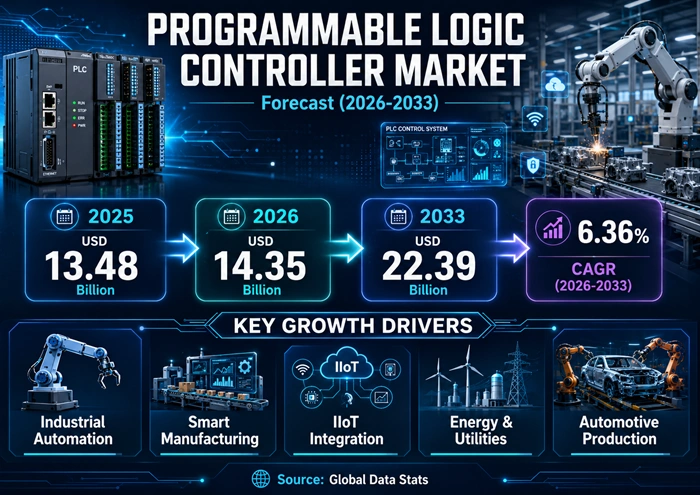
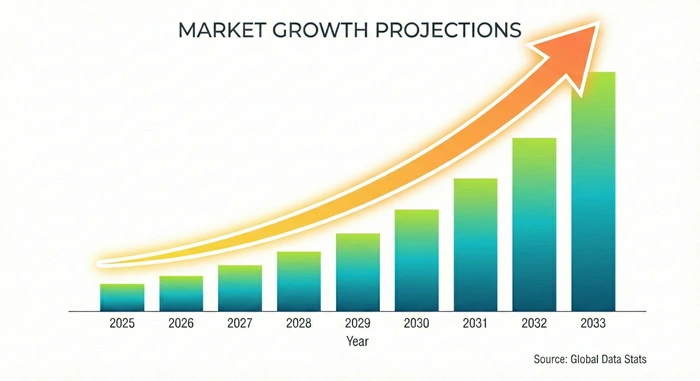
The global programmable logic controller market size is valued at USD 13.48 billion in 2025 and is predicted to increase from USD 14.35 billion in 2026 to approximately USD 22.39 billion by 2033, growing at a CAGR of 6.36% from 2026 to 2033. This steady and sustained expansion is driven by the rapid adoption of Industry 4.0 principles, the accelerating shift toward smart manufacturing and factory automation, growing deployment of electric vehicles requiring advanced assembly line control systems, and rising investment in energy and utility infrastructure modernization across developed and developing markets worldwide.
PLCs have been the backbone of industrial automation for decades, and their role is now expanding significantly beyond simple sequential control logic. As factories become increasingly connected and data-driven, programmable controllers are evolving into intelligent edge computing nodes that bridge the physical and digital layers of the modern industrial enterprise.
AI Impact on the Programmable Logic Controller Industry
Artificial Intelligence and Machine Learning Integration into PLC Architecture Is Reshaping Industrial Automation From Rule-Based Control to Adaptive, Self-Optimizing Manufacturing Ecosystems
Artificial intelligence is fundamentally transforming the way programmable logic controllers operate in modern industrial environments. Traditional PLCs execute fixed, rule-based ladder logic or function block programs that respond to predefined input conditions — a model that works reliably for stable processes but has significant limitations when conditions vary, process anomalies occur, or optimization beyond the original design parameters is desired. AI and machine learning algorithms embedded at the controller level — or tightly coupled with edge computing nodes running alongside traditional PLC hardware — can now analyze real-time process data, predict equipment failures before they cause downtime, dynamically adjust process parameters to optimize throughput or energy efficiency, and even generate and modify control logic automatically for new production configurations. This capability is transforming the programmable logic controller market from a hardware replacement cycle into a much broader industrial intelligence platform adoption wave.
A particularly significant application of AI in the PLC space is predictive maintenance. By combining vibration, temperature, current, and process data streams captured through PLC I/O with machine learning models trained on historical failure patterns, industrial operators can predict bearing failures, motor degradation, and valve wear events weeks in advance — enabling planned maintenance interventions that avoid unplanned production stops. Rockwell Automation's 10th Annual State of Smart Manufacturing Report from June 2025 noted that manufacturing organizations investing in generative and causal AI technologies grew by 12% year-over-year, reflecting the industry's decisive shift toward AI-augmented automation strategies. As AI-native PLC firmware and supporting edge computing hardware become commercially mainstream, the distinction between traditional PLC control logic and intelligent adaptive process management will continue to blur across the forecast period.
Growth Factors
The Global Industry 4.0 Revolution, Rapid Expansion of EV and Automotive Manufacturing, and Growing Industrial Infrastructure Investment in Emerging Markets Are the Three Defining Growth Engines of the Programmable Logic Controller Market
Industry 4.0 adoption is the most powerful structural driver in the programmable logic controller market today. As manufacturers worldwide transition from isolated machine control toward interconnected industrial ecosystems — where machines, sensors, controllers, MES platforms, and cloud analytics systems exchange data continuously — the demand for modern PLCs capable of handling complex logic, supporting open communication protocols (OPC-UA, MQTT, EtherNet/IP), and providing cybersecurity-compliant connectivity is growing substantially. According to Rockwell Automation's 2024 State of Smart Manufacturing Report, 95% of manufacturers are currently using or actively evaluating smart manufacturing technology — creating an enormous pull for modern PLC infrastructure that can serve as the real-time control and data acquisition foundation for these digital transformation initiatives.
The electric vehicle revolution is adding a particularly dynamic demand vector to the programmable logic controller market that is distinct from the more gradual pace of industrial automation adoption in other sectors. Battery cell manufacturing, module and pack assembly, EV powertrain component production, and battery testing all require extremely precise, high-speed automation with tight process control tolerances that modern modular PLCs are uniquely well positioned to deliver. As EV production volumes scale globally — particularly in China, Germany, and the United States — the demand for advanced controller infrastructure to support new and retooled assembly lines is generating sustained procurement programs that are contributing meaningfully to market growth. Combined with continued investment in energy and utility grid modernization, water and wastewater infrastructure upgrades, and chemical plant safety system renewals across Asia Pacific, the Middle East, and North America, the drivers supporting PLC demand are both broad and durable.
Market Outlook
Software-Defined PLC Architectures, Cloud-Connected Control Systems, and the Expansion of Industrial Cybersecurity Requirements Will Define the Evolution of the Programmable Logic Controller Market Through 2033
Looking ahead through 2033, the programmable logic controller market is entering a new phase of evolution driven not just by volume growth but by fundamental architectural transformation. The most consequential shift is the emergence of software-defined and virtual PLC platforms that decouple control software from proprietary, vendor-locked hardware — allowing manufacturers to run PLC logic on standard industrial PC hardware, edge servers, or cloud platforms under open standards such as IEC 61499. This transition gives industrial operators significantly greater flexibility in sourcing, reduces hardware obsolescence risk, enables remote software updates, and allows DevOps-style IT practices to be applied to automation software development for the first time. Major automation vendors including Siemens, Beckhoff, and Codesys are actively investing in software-defined automation platforms, and enterprise adoption is accelerating as the cost and risk advantages of the approach become clear.
Industrial cybersecurity requirements are adding a new and growing layer of procurement complexity — and opportunity — to the market. As PLC systems become increasingly connected to enterprise IT networks and cloud platforms, their exposure to cyber threats grows proportionally. Regulatory frameworks including the EU's NIS2 Directive, the U.S. NIST Industrial Control System Security standards, and IEC 62443 are driving industrial operators to replace legacy unsecured PLCs with security-hardened modern equivalents. This compliance-driven upgrade cycle is providing an important additional source of demand for the programmable controller market that is less dependent on organic production capacity growth and more driven by regulatory timelines — creating a relatively predictable, multi-year procurement backlog across European and North American industrial sectors.
Expert Speaks
-
"We are living through the most significant transformation in manufacturing technology since the introduction of the assembly line. At Siemens, our industrial automation and digitalization platforms — including our PLC and edge computing portfolio — are at the center of how factories worldwide are making that transformation happen efficiently and reliably." — CEO, Siemens AG
-
"Rockwell Automation has been a trusted partner to manufacturers for over a century, and the demand we are seeing for smart, connected control systems today is unlike anything we have experienced before. The pace at which manufacturers are investing in AI-enabled automation and intelligent PLC platforms confirms that industrial digital transformation is accelerating, not slowing, even in challenging macroeconomic conditions." — CEO, Rockwell Automation Inc.
-
"At Schneider Electric, we believe that the future of industrial automation is open, software-defined, and sustainable. Our EcoStruxure platform and modular controller portfolio are designed to give industrial operators the flexibility and intelligence they need to run more efficient, more resilient, and lower-carbon operations — and market demand for these capabilities is growing strongly across every sector we serve." — CEO, Schneider Electric SE
Key Report Takeaways
-
Asia Pacific dominates the programmable logic controller market with approximately 38% of global revenue share in 2025, driven by China's massive manufacturing sector, Japan's advanced robotics and electronics production ecosystem, rapid EV and semiconductor factory expansion across the region, and strong government investment in industrial modernization programs
-
Asia Pacific is also the fastest-growing region, projected to expand at a CAGR of approximately 7.8% from 2026 to 2033, led by China's continued factory automation investment and India's rapidly expanding manufacturing base driven by the government's Make in India and PLI scheme initiatives
-
Automotive is the leading end-use industry, accounting for approximately 28% of market revenue in 2025, sustained by massive global retooling of vehicle assembly lines for EV production, high-precision battery manufacturing, and the replacement of aging legacy control infrastructure with modern modular PLC systems across major OEM facilities worldwide
-
Modular PLCs are the dominant type, holding approximately 45% of market share in 2025, preferred for their scalability, flexible I/O configuration, and suitability across a wide range of application complexities from simple machine control to complex multi-axis production line management in automotive and process industries
-
Hardware is the leading component segment, representing approximately 62% of market revenue in 2025, reflecting the continued strong demand for physical controller modules, I/O expansion cards, communication processors, and associated panel hardware as factories expand and modernize their automation infrastructure
-
The software segment is expected to grow the fastest, projected to expand at a CAGR of approximately 9.5% from 2026 to 2033, capturing an increasing market share as PLC vendors invest in programming tools, simulation platforms, AI-enabled logic generation, and cloud-based remote monitoring and configuration management applications that are becoming essential to modern industrial automation deployments
Market Scope
| Report Coverage | Details |
|---|---|
| Market Size by 2033 | USD 22.39 Billion |
| Market Size by 2025 | USD 13.48 Billion |
| Market Size by 2026 | USD 14.35 Billion |
| Market Growth Rate from 2026 to 2033 | CAGR of 6.36% |
| Dominating Region | Asia Pacific |
| Fastest Growing Region | Asia Pacific |
| Base Year | 2025 |
| Forecast Period | 2026 – 2033 |
| Segments Covered | Type, Component, Application, End-Use Industry, Region |
| Regions Covered | North America, Europe, Asia Pacific, Latin America, Middle East & Africa |
Market Dynamics
Drivers Impact Analysis
Industry 4.0 Adoption, Electric Vehicle Manufacturing Expansion, and Energy Infrastructure Modernization Are the Three Primary Forces Accelerating Demand Across the Global Programmable Logic Controller Market
| Driver | ≈ % Impact on CAGR Forecast | Geographic Relevance | Impact Timeline |
|---|---|---|---|
| Industry 4.0 and smart factory adoption | ~30% | Global, strongest in Asia Pacific & Europe | Short to Long Term |
| EV and automotive assembly line modernization | ~25% | Asia Pacific, Europe, North America | Short to Medium Term |
| Energy, utility, and oil & gas infrastructure upgrades | ~20% | Middle East, North America, Asia Pacific | Medium to Long Term |
| Food & beverage and chemical process automation | ~15% | Global | Medium Term |
| Cybersecurity-driven PLC replacement programs | ~10% | North America, Europe | Medium to Long Term |
The programmable logic controller market is experiencing broad-based demand growth primarily because the industrial sectors that rely most heavily on automated production and process control are simultaneously undergoing significant capacity expansion, product line transitions, and digital transformation programs. In automotive manufacturing alone, the scale of capital investment being directed toward EV production line construction and legacy ICE line retooling is generating procurement programs for modern PLC infrastructure at a level not seen since the major automotive capacity expansions of the early 2000s. The specificity of EV battery cell and pack assembly processes — with their extreme temperature, pressure, and chemical parameter control requirements — demands PLC capabilities significantly beyond what most legacy factory installations currently provide.
In the energy sector, aging electrical generation and distribution infrastructure across North America, Europe, and the Middle East is reaching end-of-life at the same time that grid operators are integrating large amounts of variable renewable generation and battery storage that require sophisticated real-time control. This combination of asset replacement necessity and new functional requirements for flexibility and grid intelligence is driving a sustained cycle of PLC procurement for substation automation, distributed energy resource management, and industrial utility applications. Similarly, investments in oil and gas upstream and downstream infrastructure — particularly in the Gulf Cooperation Council region, driven by Saudi Aramco, ADNOC, and QatarEnergy capital programs — are generating strong demand for explosion-proof, SIL-rated PLC systems for process control and safety instrumented system applications.
Restraints Impact Analysis
Skilled Workforce Shortages, Cybersecurity Integration Complexity, and High Switching Costs From Legacy Proprietary PLC Systems Are the Primary Factors Constraining Faster Growth in the Programmable Logic Controller Market
| Restraint | ≈ % Impact on CAGR Forecast | Geographic Relevance | Impact Timeline |
|---|---|---|---|
| Shortage of PLC programming and maintenance expertise | ~-28% | Emerging markets, small manufacturers | Ongoing |
| Vendor lock-in and proprietary system migration complexity | ~-24% | Global | Ongoing |
| High integration cost for legacy brownfield upgrades | ~-22% | North America, Europe | Medium Term |
| Industrial cybersecurity integration complexity | ~-16% | Global | Medium Term |
| Supply chain disruptions for semiconductor and electronic components | ~-10% | Global | Short to Medium Term |
The most significant single restraint on the programmable logic controller market is the persistent and widening shortage of qualified PLC programmers and industrial automation technicians. As factories adopt increasingly sophisticated automation systems — involving complex multi-axis motion control, vision inspection, advanced process control, and OT/IT network integration — the technical depth required of the workforce that programs, commissions, and maintains these systems is growing substantially. In emerging markets especially, the shortage of engineers with IEC 61131-3 programming expertise and industrial networking knowledge is directly causing automation investment decisions to be deferred or scaled back, as manufacturers recognize that deploying new PLC infrastructure without adequate in-house technical capability creates operational risk.
Vendor lock-in represents a structural restraint that affects upgrade and replacement decisions across the installed base globally. Most major PLC brands — including Siemens (with its STEP 7 and TIA Portal software ecosystem), Rockwell Automation (with its Studio 5000 and ControlLogix platform), and Mitsubishi Electric (with its GX Works environment) — use proprietary programming environments, communication protocols, and hardware architectures that make migrating between vendors technically complex and expensive. Many industrial operators, even when motivated by newer technology capabilities or more favorable pricing from alternative vendors, choose to stay with their incumbent PLC supplier simply to avoid the engineering costs, revalidation effort, and production risk associated with a platform migration. This lock-in dynamic dampens competitive switching and moderates the overall pace of procurement cycle acceleration that would otherwise be expected from the strength of Industry 4.0 adoption trends.
Opportunities Impact Analysis
Software-Defined PLC Platforms, Edge-AI Integration, and Expanding Demand From Pharmaceutical, Semiconductor, and Renewable Energy Sectors Present the Highest-Value Growth Opportunities in the Programmable Logic Controller Market
| Opportunity | ≈ % Impact on CAGR Forecast | Geographic Relevance | Impact Timeline |
|---|---|---|---|
| Software-defined and virtual PLC adoption | ~+28% | North America, Europe, Asia Pacific | Short to Medium Term |
| Edge AI and industrial IoT integration | ~+25% | Global | Medium to Long Term |
| Semiconductor and pharmaceutical manufacturing expansion | ~+22% | Asia Pacific, North America | Medium Term |
| Renewable energy and grid modernization projects | ~+16% | Global | Medium to Long Term |
| Emerging market factory automation greenfield projects | ~+9% | India, Southeast Asia, MEA | Long Term |
The transition toward software-defined and virtual PLC architectures is one of the most strategically important opportunities in the market today, with the potential to fundamentally expand the vendor landscape and accelerate technology adoption cycles. By enabling control logic to run on standard industrial hardware or in cloud environments under open software frameworks, virtual PLC platforms reduce the total cost of ownership for automation, enable faster logic deployment through DevOps toolchains, and allow manufacturers to update and extend their automation capabilities without hardware replacement cycles. Codesys, Beckhoff's TwinCAT, and Siemens' new Industrial Edge portfolio are all moving aggressively in this direction, and the large base of industrial operators frustrated by proprietary hardware dependencies represents an enormous addressable market for open, software-defined alternatives.
The rapid expansion of semiconductor fabrication capacity — driven by government CHIPS Act investments in the United States, similar programs in Europe and Japan, and massive private investment by TSMC, Samsung, and Intel — is creating a specialized but extremely high-value demand channel for advanced PLC and industrial control systems. Semiconductor cleanroom manufacturing environments require control systems of extraordinary precision, reliability, and contamination management compliance that commands premium pricing and creates long-term platform relationships between fabs and automation vendors. Similar dynamics apply in pharmaceutical GMP manufacturing environments, where regulatory compliance requirements drive sustained investment in validated, documentation-rich automation platforms. These premium industrial segments add significant value-per-unit that supports healthy margin structures for PLC vendors even as competition intensifies in more commoditized industrial segments.
Segment Analysis
By Type
Modular PLCs Maintain Dominant Market Leadership While Compact PLCs Experience the Fastest Growth, Driven by Rising Automation Adoption in Small and Mid-Sized Manufacturing Operations
Modular PLCs hold approximately 45% of the total programmable logic controller market share in 2025 and are projected to maintain their leading position at a CAGR of approximately 5.8% through 2033. Modular systems offer the highest degree of scalability and configurability — allowing engineers to combine CPU, I/O, communication, and motion control modules in exactly the configuration required by each application — making them the preferred choice for large-scale process automation, automotive body and paint shop lines, chemical plant distributed control, and power plant management systems. Asia Pacific is the primary growth geography for modular PLCs, driven by China's enormous manufacturing sector expansion, Japan's continued industrial robotics investment, and India's rapidly growing automotive and chemicals manufacturing base; Siemens AG (Germany), Mitsubishi Electric (Japan), and Rockwell Automation (USA) collectively account for the majority of modular PLC revenue in this region, competing primarily on processing speed, communication capability, and integration depth with MES and SCADA platforms.
Compact PLCs represent approximately 35% of the market in 2025 and are growing at a slightly higher CAGR of approximately 7.2% through 2033, driven by the rapid expansion of machine automation in small and mid-sized manufacturing operations, food and beverage processing facilities, water treatment plants, and building automation applications where a self-contained, cost-effective controller with sufficient I/O capacity in a single housing is the most practical solution. The compact PLC segment is growing particularly fast in Southeast Asia, India, and Latin America, where the manufacturing base is expanding rapidly and the demand for affordable, reliable automation solutions is strong. Key suppliers competing actively in this segment include Omron Corporation (Japan), Schneider Electric (France), ABB Ltd. (Switzerland), and Panasonic Corporation (Japan), all of which offer compact controller product lines specifically designed to provide modern connectivity and programming features at price points accessible to mid-market industrial operators in emerging economies.
By End-Use Industry
Automotive Leads End-Use Industry Revenue While Food & Beverage Emerges as the Fastest-Growing Sector Driving Significant New PLC Procurement Volumes in Emerging Markets
Automotive is the dominant end-use industry in the programmable logic controller market, contributing approximately 28% of total market revenue in 2025 and growing at a CAGR of approximately 6.5% through 2033. The sector's dominance reflects both the sheer scale of automated production infrastructure in automotive manufacturing globally and the current extraordinary pace of EV-driven plant modernization that is generating massive PLC procurement programs across North America, Europe, and Asia Pacific. Battery cell gigafactories being built by CATL, BYD, Panasonic, LG Energy Solution, and their partners require thousands of PLC nodes to manage electrode mixing, cell assembly, formation cycling, and module assembly processes — creating a concentrated and growing demand source that is meaningfully larger than the replacement cycle demand from traditional ICE manufacturing. Siemens AG (Germany) and Rockwell Automation (USA) are the dominant PLC suppliers to the global automotive sector, with Mitsubishi Electric (Japan) and Fanuc (Japan) holding strong positions with Asian automotive OEMs and their supplier networks.
Food and beverages is the fastest-growing end-use industry in the programmable logic controller market, expected to expand at a CAGR of approximately 8.3% from 2026 to 2033, as food processing and packaging companies globally accelerate their investment in automated production to manage rising labor costs, improve hygienic processing standards, reduce food waste, and achieve the throughput consistency that modern retail and quick-service restaurant supply chains demand. The food and beverage sector has historically been a lower-intensity adopter of advanced automation relative to automotive or chemicals, meaning there remains significant greenfield automation opportunity — particularly in developing markets across Southeast Asia, India, Latin America, and Africa where processed food consumption is growing rapidly and manufacturing capacity is being built from scratch. Omron Corporation (Japan), Rockwell Automation (USA), and Schneider Electric (France) are particularly active in this segment, offering food-grade, IP69K-rated compact and modular PLC systems designed for hygienic processing environments.
Regional Insights
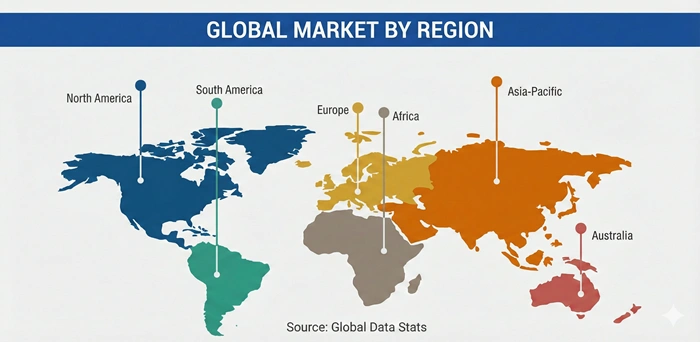
Asia Pacific's Manufacturing Dominance and North America's Technology Innovation Leadership Define the Two Most Strategically Important Geographies in the Global Programmable Logic Controller Market
Asia Pacific
Asia Pacific's Unmatched Manufacturing Scale, Aggressive EV and Semiconductor Factory Investment, and Government-Backed Industrial Modernization Programs Cement Its Position as the Dominant Region in the Programmable Logic Controller Market
Asia Pacific holds the dominant position in the programmable logic controller market, accounting for approximately 38% of global revenue in 2025, with China contributing the single largest country share globally. The region's leadership is grounded in the sheer scale of its manufacturing base — spanning electronics, automotive, chemicals, food processing, and consumer goods — combined with the Chinese government's active investment in factory automation through programs like Made in China 2025 and its successor national manufacturing modernization initiatives. China's semiconductor fab expansion programs, massive EV battery manufacturing ecosystem centered around CATL, BYD, and SVOLT, and aggressive capital investment by its chemical and petrochemical sector are all generating strong and sustained PLC procurement volumes. The regional CAGR is projected at approximately 7.8% from 2026 to 2033, making Asia Pacific simultaneously the largest and fastest-growing regional market.
Japan, South Korea, India, and Australia each contribute meaningfully to the regional total. Japan remains a global center of advanced manufacturing automation, with companies including Mitsubishi Electric (Japan), Keyence Corporation (Japan), and Omron Corporation (Japan) supplying both the domestic and global markets with high-performance PLC solutions. India is emerging as the most exciting growth story in the region, with rapidly expanding automotive, pharmaceutical, textile, and electronics manufacturing sectors supported by government Production Linked Incentive (PLI) schemes that are attracting hundreds of billions of rupees in industrial investment and creating corresponding demand for modern factory automation infrastructure including programmable controller systems.
North America
North America's Deep Industrial Automation Expertise, Strong Defense and Energy Sector PLC Demand, and Active EV Manufacturing Investment Position It as a Critical Revenue Region in the Programmable Logic Controller Market
North America holds the second-largest regional position in the programmable logic controller market, accounting for approximately 27% of global revenue in 2025 and growing at a CAGR of approximately 5.9% from 2026 to 2033. The United States is the primary demand driver, supported by its large and technologically sophisticated manufacturing base spanning automotive, aerospace, oil and gas, food processing, pharmaceuticals, and defense industries — all of which maintain significant installed bases of PLC infrastructure requiring both maintenance procurement and ongoing modernization investment. The reshoring trend in U.S. manufacturing — accelerated by pandemic supply chain disruptions, CHIPS Act semiconductor incentives, Inflation Reduction Act clean energy manufacturing provisions, and bipartisan industrial policy support — is generating new greenfield factory construction that requires modern PLC-based automation systems from the ground up.
Key companies with dominant North American market presence include Rockwell Automation (USA), Honeywell International (USA), Emerson Electric (USA), and Siemens (Germany, with substantial North American operations), which together capture the majority of regional PLC revenue across process, discrete, and hybrid manufacturing segments. Canada contributes meaningful demand through its automotive manufacturing corridor, mining and energy sector automation programs, and expanding food and beverage processing industry. Mexico is an increasingly important market, serving as both a significant automotive manufacturing location and a growing electronics assembly hub where PLC-based automation investment is rising as manufacturers seek to improve competitiveness and reduce labor cost exposure.
Report Customization Available by Region and Country
This report is fully customizable to deliver targeted programmable logic controller market intelligence for specific regions, countries, and geographies, providing localized market sizing, competitive landscape analysis, end-use sector demand analysis, technology adoption trends, and strategic growth opportunity assessments tailored to your precise focus area.
Customized versions of this report are available for every major global region and their constituent countries, ensuring that your business development, investment, and market entry decisions are based on granular, locally relevant intelligence. Whether you need a single-country deep-dive or a cross-regional competitive intelligence briefing, the report can be configured to deliver exactly the geographic market clarity your organization requires.
North America
-
United States — Second-largest global PLC market with dominant presence of Rockwell Automation and Honeywell, strong automotive, energy, and defense automation demand
-
Canada — Active automotive manufacturing and mining sector automation market with growing cleantech manufacturing investment
-
Mexico — Expanding automotive assembly and electronics manufacturing market driving growing PLC procurement volumes
Europe
-
United Kingdom — Established industrial automation market with strong pharmaceutical, food and beverage, and defense sector PLC demand
-
Germany — Europe's largest PLC market, home to Siemens AG and Bosch Rexroth, with world-leading automotive and chemicals manufacturing automation ecosystem
-
France — Growing automation investment in aerospace, nuclear energy, and food processing sectors with strong Schneider Electric presence
-
Italy — Active machine tool, packaging, and food processing automation market with significant PLC demand from SME manufacturing sector
-
Rest of Europe — Includes Sweden, Poland, Netherlands, and Czech Republic as active manufacturing automation markets with growing PLC adoption
Asia Pacific
-
China — World's largest PLC market by volume with dominant EV, semiconductor, and consumer electronics manufacturing automation demand
-
India — Fastest-growing emerging market with PLI-driven manufacturing expansion creating strong new PLC demand across automotive, pharma, and electronics sectors
-
Japan — Advanced automation market home to Mitsubishi Electric, Keyence, and Omron with deep robotics and precision manufacturing PLC expertise
-
South Korea — Strong semiconductor, electronics, and automotive PLC demand driven by Samsung, Hyundai, and LG manufacturing ecosystems
-
Australia — Active mining, food processing, and utilities automation market with growing adoption of modern PLC systems
-
Rest of Asia Pacific — Includes Taiwan, Vietnam, Thailand, and Indonesia as rapidly expanding manufacturing automation markets
Latin America
-
Brazil — Largest Latin American industrial automation market with active automotive, food processing, and oil and gas PLC demand
-
Argentina — Developing industrial automation sector with growing food and beverage processing and energy infrastructure PLC adoption
-
Rest of Latin America — Includes Colombia, Chile, and Peru as emerging manufacturing automation markets with increasing PLC investment activity
Middle East & Africa
-
UAE — Advanced industrial economy with active oil and gas processing, utilities, and smart manufacturing PLC procurement programs
-
Saudi Arabia — Massive industrial diversification investment through Vision 2030 creating significant new demand for process industry and manufacturing PLC systems
-
Rest of MEA — Includes South Africa, Egypt, and Turkey as growing industrial automation markets with increasing PLC adoption in manufacturing and utilities sectors
Top Key Players
-
Siemens AG (Germany)
-
Rockwell Automation Inc. (United States)
-
ABB Ltd. (Switzerland)
-
Mitsubishi Electric Corporation (Japan)
-
Schneider Electric SE (France)
-
Honeywell International Inc. (United States)
-
Omron Corporation (Japan)
-
Emerson Electric Co. (United States)
-
Beckhoff Automation GmbH & Co. KG (Germany)
-
Keyence Corporation (Japan)
-
Robert Bosch GmbH / Bosch Rexroth (Germany)
-
Panasonic Corporation (Japan)
-
Delta Electronics Inc. (Taiwan)
-
Hitachi Ltd. (Japan)
-
General Electric Co. / GE Vernova (United States)
Recent Developments
-
In 2025, Siemens AG reported a net income of 10.4 billion euros for fiscal year 2025 — a 16% year-over-year increase — driven substantially by strong growth in its industrial software and digital automation segments, including its SIMATIC PLC and TIA Portal ecosystem, validating its long-term investment in integrated software-defined automation platforms
-
In 2024, Rockwell Automation deepened its strategic partnership with Microsoft to integrate its FactoryTalk industrial software suite with Microsoft Azure IoT and AI services, enabling manufacturers running Rockwell PLC infrastructure to leverage cloud-based AI analytics and digital twin capabilities through a seamless connected platform
-
In 2025, Schneider Electric launched the next generation of its Modicon M580 ePlus PLC platform, featuring enhanced native cybersecurity capabilities aligned with IEC 62443 Level 2 requirements and expanded edge computing performance — directly addressing growing customer demand for security-hardened controllers suitable for NIS2-compliant industrial operations
-
In 2024, ABB Ltd. completed the acquisition of a specialist industrial cybersecurity firm to strengthen the security capabilities embedded in its automation and PLC product lines, positioning the company to address the rapidly growing market demand for secure-by-design industrial control systems across energy, water, and process industry customers
-
In 2025, Mitsubishi Electric expanded its MELSEC iQ-R Series PLC product family with new AI-enabled edge computing modules that enable predictive maintenance and real-time process optimization at the controller level, targeting the fast-growing demand for intelligent edge automation in automotive battery manufacturing and semiconductor production applications
Market Trends
The Emergence of Software-Defined and Virtual PLC Architectures and the Deep Integration of AI-Powered Predictive Control Capabilities Are the Two Most Consequential Technology Trends Reshaping the Programmable Logic Controller Market Through 2033
The most transformative trend reshaping the programmable logic controller market is the accelerating adoption of software-defined and virtual PLC architectures that decouple industrial control logic from proprietary hardware constraints. Platforms like Beckhoff TwinCAT, Codesys-based virtual controllers, and Siemens Industrial Edge are enabling manufacturers to run PLC programs on standard industrial PC hardware and edge servers — reducing dependency on specialized proprietary controller modules, enabling remote logic updates, and allowing IT-native development practices such as version control, continuous integration, and automated testing to be applied to OT programming environments for the first time. This architectural transformation is creating new competitive dynamics in the market, lowering the barriers for software-centric entrants and motivating traditional hardware-focused PLC vendors to accelerate their transition toward service-based and subscription software business models.
Simultaneously, the integration of AI and machine learning capabilities at the controller level is moving from experimental pilots to production deployment across a growing number of industrial facilities. AI-augmented PLCs can now autonomously adjust process parameters in response to raw material variability, predict component failure events before they cause downtime, and generate or optimize control logic for new product configurations with minimal human programming intervention. This capability is particularly valuable in industries with frequent product changeovers — such as food and beverage, pharmaceuticals, and consumer electronics — where the time and cost of reprogramming traditional PLCs for new production runs has historically been a significant constraint on manufacturing agility. As more PLC vendors embed AI frameworks directly into their controller operating systems and programming tools, the intelligence gap between traditional and next-generation programmable controllers will become a decisive factor in procurement decisions across the forecast period.
Segments Covered in the Report
-
By Type
-
Modular PLC
-
Compact PLC
-
Rack-Mounted PLC
-
Nano/Micro PLC
-
-
By Component
-
Hardware
-
Software
-
Services
-
-
By Application
-
Discrete Manufacturing
-
Process Automation
-
Motion Control
-
Others
-
-
By End-Use Industry
-
Automotive
-
Oil & Gas
-
Food & Beverages
-
Chemical & Petrochemical
-
Energy & Utilities
-
Aerospace & Defense
-
Paper & Pulp
-
Water & Wastewater
-
Others
-
-
By Region
-
North America
-
U.S.
-
Canada
-
Mexico
-
-
Europe
-
U.K.
-
Germany
-
France
-
Italy
-
Rest of Europe
-
-
Asia Pacific
-
China
-
India
-
Japan
-
South Korea
-
Australia
-
Rest of Asia Pacific
-
-
Latin America
-
Brazil
-
Argentina
-
Rest of Latin America
-
-
Middle East & Africa
-
UAE
-
Saudi Arabia
-
Rest of MEA
-
-
❝ Built for Every Level — From Startups to Industry Giants ❞
Here Is Exactly How This Report Works for You
-
For tier-1 industrial automation corporations, global manufacturing conglomerates, and institutional investors evaluating the programmable logic controller landscape, this report delivers precise market sizing, competitor revenue analysis by product line and geography, supply-demand balance assessments, and geopolitical risk intelligence — including how U.S.-China technology decoupling, EU industrial sovereignty initiatives, and rare earth supply chain dynamics are impacting hardware procurement strategies and reshaping competitive positioning across the global PLC market
-
For mid-market automation system integrators, OEM machine builders, and Tier-2 component suppliers, the report provides segment-level demand forecasts, end-use industry procurement driver analysis, and top vendor technology roadmap intelligence — giving sales teams and product strategists the evidence-based insights needed to identify which PLC platforms are winning the most design-ins, how pricing pressure is evolving across hardware versus software segments, and which regional markets offer the strongest near-term growth opportunity for targeted business development investment
-
Startups developing next-generation software-defined PLC platforms, industrial AI applications, or edge computing solutions for manufacturing environments will find the report's technology adoption curve analysis, partner ecosystem mapping, customer willingness-to-pay benchmarking, and competitive white-space identification invaluable for refining product-market fit, building investor narratives grounded in real market data, and making informed go-to-market prioritization decisions in the rapidly evolving programmable logic controller market
Frequently Asked Questions
Question 1: What is the projected market size of the programmable logic controller market by 2033?
Answer: The programmable logic controller market is projected to reach approximately USD 22.39 billion by 2033, growing from USD 14.35 billion in 2026. It is expected to expand at a CAGR of 6.36% from 2026 to 2033, driven by Industry 4.0 adoption, EV manufacturing expansion, and industrial infrastructure modernization globally.
Question 2: Which industries drive the highest demand in the programmable logic controller market?
Answer: Automotive is the leading end-use industry in the programmable logic controller market, contributing approximately 28% of total revenue in 2025, driven by EV assembly line retooling and battery manufacturing automation. Food and beverage is the fastest-growing industry, expanding at a CAGR of approximately 8.3% through 2033 as global food processing automation investment accelerates.
Question 3: Which region dominates the programmable logic controller market?
Answer: Asia Pacific dominates the programmable logic controller market with approximately 38% of global revenue share in 2025, driven by China's massive manufacturing base and rapid EV and semiconductor factory expansion. The region also leads in growth rate, projected to expand at a CAGR of approximately 7.8% from 2026 to 2033.
Question 4: What are the key trends shaping the programmable logic controller market today?
Answer: The programmable logic controller market is being shaped by two transformative trends — the shift toward software-defined and virtual PLC architectures that decouple control logic from proprietary hardware, and the integration of AI and machine learning into controller logic for predictive maintenance and adaptive process optimization. Both trends are expanding the addressable market and accelerating technology replacement cycles.
Question 5: Who are the leading companies in the programmable logic controller market?
Answer: The programmable logic controller market is led by Siemens AG, Rockwell Automation, ABB Ltd., Mitsubishi Electric, and Schneider Electric, which together account for the majority of global revenue. Omron, Honeywell, Beckhoff Automation, Keyence, and Emerson Electric are also significant players with strong positions in specific regional and application markets.