
Private Equity Market Overview
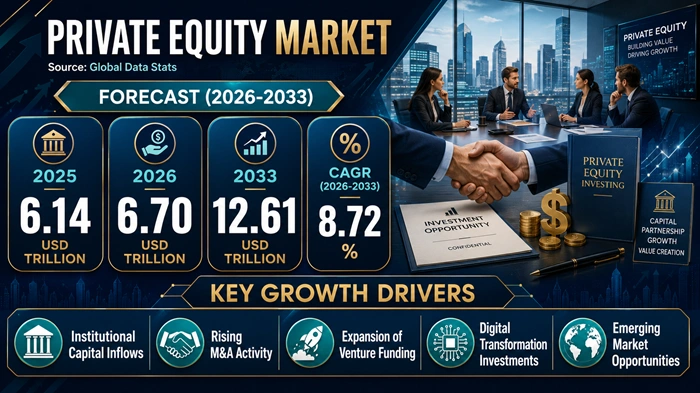
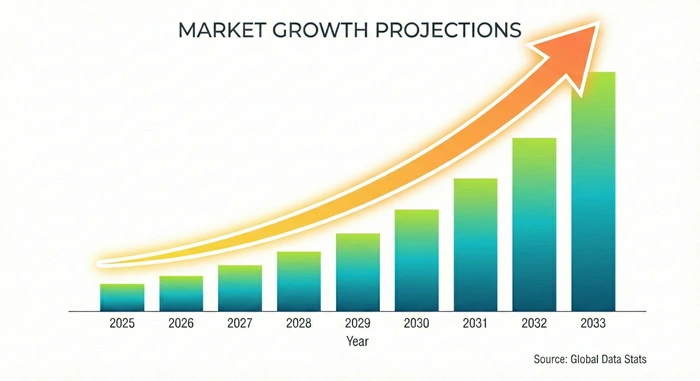
The global private equity market size is valued at USD 6.14 trillion in 2025 and is predicted to increase from USD 6.70 trillion in 2026 to approximately USD 12.61 trillion by 2033, growing at a CAGR of 8.72% from 2026 to 2033.
This sustained expansion reflects growing institutional allocation toward alternative assets, rising dry powder among sponsors, and expanding fundraising activity across buyout, growth equity, and venture-adjacent strategies. Increasing participation from pension funds, sovereign wealth funds, and family offices continues to strengthen capital inflows into private equity investment vehicles worldwide.
AI Impact on the Private Equity Industry
Artificial Intelligence Is Quietly Reshaping How Fund Managers Source Deals, Create Value, and Exit Portfolio Companies
Artificial intelligence is beginning to transform how private equity firms identify targets, conduct due diligence, and drive operational value creation within portfolio companies. Machine learning tools are helping deal teams screen thousands of potential targets far faster than traditional analyst-driven processes, while natural language processing tools accelerate document review during due diligence, cutting weeks off deal timelines. Sponsors are also deploying AI-based operational dashboards across portfolio companies to identify margin improvement opportunities, a capability increasingly viewed as a genuine differentiator in competitive fundraising and exit conversations.
Beyond deal execution, AI is simultaneously disrupting legacy technology assets that many private equity funds hold, particularly software companies whose recurring revenue models face pressure from AI-native alternatives. This dual dynamic is forcing general partners to rethink exit timing for older technology holdings while accelerating investment in AI-enabled operational improvement across industrials, healthcare, and business services portfolios. Firms that can demonstrate measurable AI-driven value creation are finding this advantage translates directly into stronger fundraising outcomes and more favorable exit conversations with strategic buyers.
Growth Factors
Rising Institutional Allocation and Expanding Dry Powder Are Accelerating Capital Deployment Across Global Private Markets
One of the strongest growth drivers for the private equity market is the steady increase in institutional allocation toward alternative assets as pension funds and sovereign wealth funds seek returns beyond traditional public equity and fixed income. This structural shift toward private markets has been building for over a decade and shows no signs of reversing, particularly as institutional investors seek diversification and higher long-term yield potential. Growing acceptance of private equity as a core portfolio component among family offices and high-net-worth individuals is further widening the capital base available to fund managers.
At the same time, record levels of uncommitted capital, often referred to as dry powder, continue to accumulate within existing funds, creating pressure on general partners to deploy capital even amid selective market conditions. This dynamic is particularly visible in sectors with strong strategic tailwinds such as healthcare and business services, where take-private transactions and buy-and-build platforms continue at a steady pace. Growing sophistication in fund structures, including continuation vehicles and GP-led secondaries, is also expanding the toolkit available to sponsors managing liquidity across their portfolios.
Market Outlook
Selective Dealmaking and Realized Returns Are Setting the Stage for a More Disciplined but Resilient Growth Trajectory
Looking ahead, the private equity industry is positioned for continued expansion, though the nature of that growth is becoming more selective and concentrated among top-performing managers. Limited partners are increasingly prioritizing distributions to paid-in capital over unrealized paper marks, meaning general partners without credible realized performance face growing fundraising headwinds. This bifurcation is expected to persist through the forecast period, rewarding firms that can demonstrate genuine value creation rather than relying solely on multiple expansion.
Emerging markets and sector-specific strategies will be key battlegrounds for growth through 2033, particularly in regions with expanding middle-class wealth and growing institutional investment infrastructure. Continued adoption of AI-driven operational improvement, combined with more active use of continuation vehicles to manage exit timing, is expected to support sustained fundraising momentum even amid periods of subdued traditional exit activity. Analysts expect the private equity market to remain resilient overall, supported by both structural capital inflows and evolving deal structures.
Expert Speaks
-
"The firms winning today aren't waiting for markets to normalize. They're creating their own exit opportunities through value creation, operational transformation and AI enablement." — Partner, PwC Deals
-
"Private equity remains one of the most durable sources of long-term value creation for institutional portfolios, even as the industry adapts to a more disciplined capital deployment environment." — CEO, Blackstone Inc.
-
"We continue to see strong conviction from limited partners in managers who can demonstrate consistent distributions, and that trend will define fundraising success across the industry going forward." — CEO, KKR & Co. Inc.
Key Report Takeaways
-
North America leads the global private equity market, holding the largest regional share in 2025, supported by deep capital markets, a mature institutional investor base, and a high concentration of established fund managers.
-
Asia Pacific is the fastest-growing regional market, expected to expand at a CAGR exceeding 10% through 2033, driven by rising institutional wealth, expanding family office activity, and growing domestic buyout activity in China and India.
-
Pension funds and sovereign wealth funds represent the dominant limited partner category, accounting for the largest share of committed capital due to their long investment horizons and appetite for illiquidity premiums.
-
Buyout strategies contribute the largest share of overall deal value, reflecting continued sponsor preference for control transactions and platform consolidation across mature industries.
-
Take-private transactions remain the most active deal structure in the current environment, as sponsors target undervalued public companies with strong operational improvement potential.
-
The continuation vehicles and secondaries segment is expected to grow fastest going forward, holding an estimated 15% share of total transaction value by 2033 and expanding at a CAGR above 14%, driven by persistent exit bottlenecks and growing LP demand for liquidity solutions.
Market Scope
| Report Coverage | Details |
|---|---|
| Market Size by 2033 | USD 12.61 Trillion |
| Market Size by 2025 | USD 6.14 Trillion |
| Market Size by 2026 | USD 6.70 Trillion |
| Market Growth Rate from 2026 to 2033 | CAGR of 8.72% |
| Dominating Region | North America |
| Fastest Growing Region | Asia Pacific |
| Base Year | 2025 |
| Forecast Period | 2026 to 2033 |
| Segments Covered | Fund Type, Investment Strategy, Sector, Fund Size, Region |
| Regions Covered | North America, Europe, Asia Pacific, Latin America, Middle East & Africa |
Market Dynamics
Drivers Impact Analysis
Institutional Capital Growth and Expanding Dry Powder Are the Two Most Powerful Forces Propelling This Market Forward
| Driver | (≈) % Impact on CAGR Forecast | Geographic Relevance | Impact Timeline |
|---|---|---|---|
| Rising institutional allocation to alternatives | ~35% | Global, especially North America & Europe | Short to long-term |
| Growing dry powder and capital deployment pressure | ~28% | Global | Medium-term |
| Expansion of family office and HNWI participation | ~22% | North America, Europe, Asia Pacific | Long-term |
| Increasing use of continuation vehicles for liquidity | ~15% | Global | Medium to long-term |
The steady rise in institutional allocation toward alternative assets is without question the single most powerful demand driver in the private equity market. Pension funds, sovereign wealth funds, and insurance companies continue to shift capital away from traditional public market instruments in search of higher long-term returns, and this structural reallocation shows no sign of slowing. As institutional investors deepen their exposure to private markets, fund managers benefit from a broader and more stable capital base to support new fund launches.
Growing dry powder represents the second critical driver reshaping this market. As uncommitted capital accumulates within existing funds, sponsors face increasing pressure to deploy capital, which is fueling continued deal activity even in selective market conditions. This dynamic is particularly strong in sectors offering clear strategic tailwinds, ensuring the global private equity market maintains steady transaction volume despite broader macroeconomic uncertainty.
Restraints Impact Analysis
Exit Bottlenecks and Valuation Gaps Continue to Present Real-World Barriers to Full Capital Realization
| Restraint | (≈) % Impact on CAGR Forecast | Geographic Relevance | Impact Timeline |
|---|---|---|---|
| Persistent exit bottlenecks and narrow IPO windows | ~38% | Global | Short to medium-term |
| Valuation gaps between buyers and sellers | ~30% | North America, Europe | Short-term |
| Geopolitical tensions affecting deal certainty | ~20% | Middle East, Asia Pacific | Medium-term |
| Rising LP skepticism around unrealized valuations | ~12% | Global | Ongoing |
The most significant structural restraint in the private equity market is the ongoing exit bottleneck, as narrow IPO windows and cautious strategic buyer appetite continue to limit traditional liquidity paths for sponsors. This has forced many fund managers to rely on continuation vehicles and secondaries as functional but imperfect alternatives, which in turn has increased scrutiny from limited partners concerned about potential conflicts of interest in these structures.
Valuation gaps between buyers and sellers further complicate dealmaking, particularly in the middle market where neither party is willing to bridge pricing expectations shaped by different rate environments. Escalating geopolitical tensions in key regions have added further uncertainty to deal timing and cross-border transaction structuring. Combined with growing limited partner demand for realized distributions rather than paper marks, these restraints are moderating the pace of capital deployment across the global private equity market.
Opportunities Impact Analysis
AI-Driven Value Creation and Emerging Market Expansion Represent the Most Commercially Significant Growth Opportunities
| Opportunity | (≈) % Impact on CAGR Forecast | Geographic Relevance | Impact Timeline |
|---|---|---|---|
| AI-enabled operational value creation | ~40% | Global, led by North America, Europe | Medium to long-term |
| Expansion into emerging market buyout activity | ~33% | Asia Pacific, Latin America, MEA | Medium to long-term |
| Growth of continuation vehicles and secondaries market | ~27% | Global | Short to medium-term |
The integration of artificial intelligence into portfolio company operations represents one of the most commercially attractive opportunities within the private equity sector today. Sponsors that can demonstrate measurable margin improvement through AI-enabled processes are increasingly differentiating themselves in both fundraising and exit conversations, creating a durable competitive advantage for early adopters across multiple industry sectors.
Expanding buyout activity in emerging markets, particularly across Asia Pacific and Latin America, is also opening substantial new opportunities as domestic institutional capital pools grow and local regulatory environments become more favorable to private capital. Meanwhile, the growing acceptance of continuation vehicles and GP-led secondaries as legitimate liquidity mechanisms is creating an entirely new sub-market within private equity, positioning firms that build strong secondaries capabilities to capture a growing share of transaction volume across the global private equity market.
Segment Analysis
By Investment Strategy
Buyout Strategies Dominate the Category, Driven by Sponsor Preference for Control Transactions and Platform Consolidation
Buyout strategies hold the dominant position in the private equity market, accounting for the largest share of total deal value given their long track record of delivering control-oriented value creation across mature industries. This dominance is deeply rooted in the ability of buyout sponsors to implement direct operational improvements, cost restructuring, and strategic repositioning once they hold majority ownership of a portfolio company. North America remains the leading region for this segment, supported by a deep bench of experienced buyout managers and abundant institutional capital willing to commit to large control transactions. Leading firms such as Blackstone, KKR, and Apollo Global Management continue to dominate large-cap buyout activity through scale advantages and established sourcing networks.
Asia Pacific is emerging as a fast-growing region for buyout strategies, expanding rapidly at a CAGR exceeding 11% through 2033, supported by growing domestic capital pools and improving regulatory frameworks that make control transactions easier to execute in China and India. The region's expanding pool of domestically trained deal professionals, combined with rising corporate willingness to sell non-core divisions, is creating a growing pipeline of buyout targets. Companies such as CVC Capital Partners and Baring Private Equity Asia have strengthened their regional footprints through dedicated Asia-focused funds and local deal teams, positioning the region to capture a growing share of global buyout volume within the broader private equity market.
By Fund Type
Growth Equity Funds Gain Momentum, Supported by Rising Demand for Minority-Stake Growth Capital in Scaling Businesses
Growth equity funds represent one of the fastest-expanding categories within the private equity market, as sponsors increasingly seek minority-stake opportunities in profitable, scaling businesses that do not require full buyout control to generate strong returns. This approach appeals to founders who want growth capital and strategic support without ceding majority ownership, making growth equity an increasingly attractive middle ground between venture capital and traditional buyouts. North America continues to lead this segment, supported by a deep pipeline of technology-enabled and healthcare services businesses seeking expansion capital. Firms such as General Atlantic and TA Associates have built strong reputations in this space through consistent sector specialization and long-term partnership approaches with management teams.
Europe is also witnessing accelerating growth equity activity, particularly across fintech, healthcare, and industrial technology sectors where founders are increasingly comfortable partnering with institutional growth investors. This segment is expected to expand at a CAGR near 10% through 2033, outpacing traditional buyout growth rates as more companies choose growth capital over full-scale acquisition. Growing investor appetite for lower-risk, non-control private equity exposure is reinforcing this segment's expanding relevance across the global private equity market landscape.
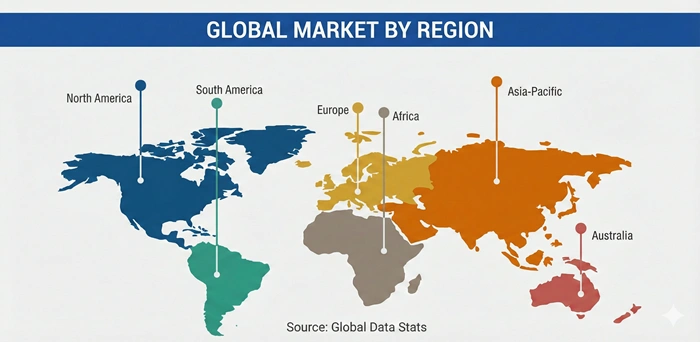
Regional Insights
North America
Deep Capital Markets and a Mature Institutional Base Have Positioned North America as the Clear Market Leader
North America commands the largest share of the global private equity market, supported by the world's deepest capital markets, the highest concentration of experienced fund managers, and a long-standing culture of institutional allocation toward alternative assets. The United States drives the vast majority of regional activity, home to leading firms including Blackstone, KKR, Apollo Global Management, and Carlyle Group, all of which maintain substantial deal origination networks and long track records across multiple economic cycles. This region currently holds an estimated 55% share of global commitments, driven by unmatched access to pension fund and endowment capital.
Growing use of continuation vehicles and secondaries transactions among North American sponsors is helping address exit bottlenecks while maintaining investor confidence during periods of muted traditional exit activity. Canada also contributes meaningfully to regional performance, with its large pension funds increasingly acting as direct co-investors alongside traditional general partners. With continued institutional capital growth expected through 2033, North America is projected to maintain its leadership position at a steady CAGR near 8% within the global private equity market.
Asia Pacific
Expanding Domestic Capital Pools and Improving Regulatory Clarity Are Driving Rapid Growth Across Key Regional Markets
Asia Pacific stands out as the fastest-growing region within the private equity market, fueled by rapidly expanding domestic institutional capital, growing family office activity, and improving regulatory clarity around cross-border and domestic buyout transactions. Countries including China, India, and Japan are witnessing accelerating deal activity, supported by firms such as CVC Capital Partners, Baring Private Equity Asia, and PAG establishing strong regional platforms. This region is expected to grow at a CAGR exceeding 10% through 2033, outpacing all other geographies globally.
Rising corporate carve-out activity, combined with growing willingness among Asian family-owned businesses to accept institutional capital, is generating a substantial and expanding deal pipeline across the region. India in particular has emerged as a standout market, with domestic private equity and growth capital deployment reaching record levels amid strong economic expansion. As institutional capital pools continue to deepen across the region, Asia Pacific is positioned to capture a growing share of the global private equity market over the coming years.
Region-Wise and Country-Wise Report Customization
Tailored Regional Breakdowns Allow Decision-Makers to Focus Their Strategy on the Specific Geographies That Matter Most to Their Business
This report can be customized to provide detailed, country-specific insights covering market analysis, trends, opportunities, and competitive positioning across the following regions and countries:
North America
-
U.S., Canada, Mexico
Europe
-
U.K., Germany, France, Italy, Rest of Europe
Asia Pacific
-
China, India, Japan, South Korea, Australia, Rest of Asia Pacific
Latin America
-
Brazil, Argentina, Rest of Latin America
Middle East & Africa
-
UAE, Saudi Arabia, Rest of MEA
Customized versions of this report deliver granular, geography-specific data tailored to your chosen market and keyword combination, helping businesses make informed regional decisions with greater precision.
Top Key Players
-
Blackstone Inc. (United States)
-
KKR & Co. Inc. (United States)
-
Apollo Global Management Inc. (United States)
-
Carlyle Group Inc. (United States)
-
TPG Inc. (United States)
-
CVC Capital Partners (United Kingdom)
-
EQT AB (Sweden)
-
Baring Private Equity Asia (Hong Kong)
-
General Atlantic (United States)
-
Warburg Pincus (United States)
-
Advent International (United States)
-
Bain Capital (United States)
Recent Developments
-
In 2025, Blackstone Inc. expanded its private equity secondaries platform through continued fundraising for one of the largest continuation vehicle strategies in the industry, reinforcing its leadership in liquidity solutions.
-
In 2025, KKR & Co. Inc. completed several large take-private transactions across healthcare and business services sectors, deploying significant capital amid a more selective but active dealmaking environment.
-
In 2024, Apollo Global Management strengthened its credit and private equity integration strategy, expanding hybrid capital solutions for portfolio companies facing tighter traditional financing markets.
-
In 2025, EQT AB raised a new flagship buyout fund focused on technology and healthcare platforms across Europe and North America, reflecting sustained investor confidence in sector-specialist strategies.
-
In 2024, CVC Capital Partners expanded its Asia Pacific presence through new regional hires and dedicated fund vehicles targeting growing domestic buyout opportunities in China and India.
Market Trends
The Private Equity Market Is Rapidly Shifting Toward AI-Driven Value Creation and Expanded Use of Continuation Vehicles
Two of the most consequential trends reshaping the private equity landscape are the growing integration of artificial intelligence into portfolio operations and the mainstreaming of continuation vehicles as a legitimate liquidity mechanism. Sponsors are increasingly building dedicated internal teams focused on identifying AI-driven margin improvement opportunities across portfolio companies, treating this capability as a genuine competitive differentiator in both fundraising and exit conversations rather than a peripheral initiative.
The second major trend is the continued evolution of exit strategy amid persistent IPO market softness, with general partners relying more heavily on GP-led secondaries and continuation funds to deliver partial liquidity to limited partners without fully exiting attractive assets. This shift is creating an entirely new specialized sub-market within private equity, and firms that build credible secondaries capabilities are increasingly viewed favorably by institutional allocators seeking flexible liquidity solutions across their private markets exposure.
Segments Covered in the Report
By Fund Type
-
Buyout Funds
-
Growth Equity Funds
-
Venture Capital-Adjacent Funds
-
Distressed and Special Situations Funds
-
Secondaries and Continuation Vehicle Funds
By Investment Strategy
-
Large-Cap Buyouts
-
Middle-Market Buyouts
-
Growth Capital Investments
-
Take-Private Transactions
-
Buy-and-Build Platforms
By Sector
-
Healthcare
-
Technology and Software
-
Industrials and Business Services
-
Financial Services
-
Consumer and Retail
By Fund Size
-
Mega Funds (Above USD 5 Billion)
-
Large Funds (USD 1 Billion to 5 Billion)
-
Mid-Market Funds (USD 250 Million to 1 Billion)
-
Small Funds (Below USD 250 Million)
By Region
-
North America (U.S., Canada, Mexico)
-
Europe (U.K., Germany, France, Italy, Rest of Europe)
-
Asia Pacific (China, India, Japan, South Korea, Australia, Rest of Asia Pacific)
-
Latin America (Brazil, Argentina, Rest of Latin America)
-
Middle East & Africa (UAE, Saudi Arabia, Rest of MEA)
❝ Built for Every Level — From Startups to Industry Giants ❞
Here Is Exactly How This Report Works for You
-
For tier 1 fund managers, institutional investors, and high-level decision-makers, this report delivers competitor revenue analysis, detailed fund performance benchmarking, geopolitical risk assessments, and capital flow dynamics that enable confident fundraising strategy, LP targeting, and portfolio construction decisions in the private equity space.
-
For tier 2 and tier 3 fund managers, emerging managers, and startups, this report provides a practical roadmap of the most commercially viable sectors, regional opportunities, and fund structuring priorities, helping you compete effectively against established players and identify white spaces before they become crowded.
-
For all decision-makers across the private capital value chain, this report explains exactly how regulatory shifts, exit market dynamics, LP allocation trends, and competitor positioning are converging to shape market direction through 2033, giving you the intelligence framework to make proactive, evidence-based decisions rather than reactive ones.
Frequently Asked Questions
Question 1: What is the current size of the global private equity market and how is it expected to grow?
Answer: The global private equity market was valued at USD 6.14 trillion in 2025 and is projected to reach USD 12.61 trillion by 2033. This growth is driven by rising institutional allocation and expanding dry powder across global fund managers.
Question 2: Which factors are driving growth in the private equity market?
Answer: The primary drivers of the private equity market include increasing institutional allocation to alternative assets and growing dry powder pressure on sponsors. Rising family office and high-net-worth participation is also accelerating capital inflows.
Question 3: Which region holds the largest share in the private equity market?
Answer: North America currently dominates the private equity market, supported by deep capital markets and a mature institutional investor base. Asia Pacific is the fastest-growing region, driven by expanding domestic capital pools and improving regulatory clarity.
Question 4: What are the key fund type segments driving activity in the private equity market?
Answer: Buyout funds account for the largest share of deal value in the private equity market, reflecting sponsor preference for control transactions. Growth equity funds are also gaining significant momentum among scaling businesses.
Question 5: Who are the leading firms operating in the private equity market?
Answer: Leading players in the private equity market include Blackstone, KKR, Apollo Global Management, Carlyle Group, and TPG. These firms compete through scale advantages, sector specialization, and strong institutional investor relationships.