
Post Quantum Cryptography (PQC) Market Overview
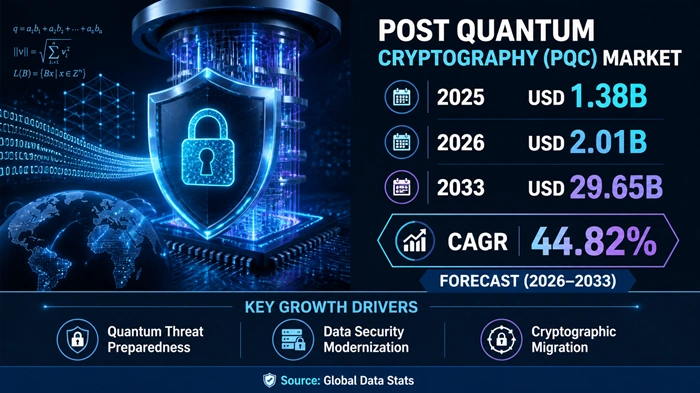
The global post quantum cryptography market size is valued at USD 1.38 billion in 2025 and is predicted to increase from USD 2.01 billion in 2026 to approximately USD 29.65 billion by 2033, growing at a CAGR of 44.82% from 2026 to 2033.
Post quantum cryptography represents a revolutionary approach to data security designed to protect digital communications and sensitive information from the emerging threats posed by quantum computing capabilities. As quantum computers advance toward breaking traditional encryption methods like RSA and Elliptic Curve Cryptography, organizations across government, defense, financial services, healthcare, and technology sectors are urgently transitioning to quantum-resistant algorithms that can withstand attacks from both classical and quantum computers. The National Institute of Standards and Technology released the first three finalized PQC standards in August 2024, providing quantum-resistant encryption algorithms that secure data against future quantum attacks and establishing a foundation for global adoption.
AI Impact on the Post Quantum Cryptography Industry
Accelerating Algorithm Development and Enhancing Security Through Intelligent Automation
Artificial intelligence is fundamentally transforming the post quantum cryptography industry by assisting in both developing and optimizing quantum-resistant algorithms, automating key management processes, and enhancing overall security frameworks across digital infrastructure. AI algorithms analyze complex mathematical structures to design and optimize PQC algorithms, improving their computational efficiency, reducing key sizes where possible, and enhancing security properties without compromising quantum resistance. Machine learning models can evaluate the strength of cryptographic protocols by simulating potential attack vectors from both classical and quantum computing perspectives, identifying vulnerabilities in PQC implementations before deployment and allowing researchers to refine algorithms proactively. AI-powered tools streamline the deployment of PQC solutions by automating tasks such as cryptographic inventory management, migration planning, and key rotation schedules, reducing human error while accelerating the transition timeline from legacy encryption to quantum-safe alternatives.
The integration of AI capabilities enables organizations to analyze threat landscapes continuously, identifying emerging quantum computing capabilities and potential vulnerabilities in existing PQC implementations that require immediate attention. AI-driven security platforms can monitor network traffic patterns, detect anomalies that may indicate quantum-enabled attacks or harvest-now-decrypt-later activities, and trigger automated responses that protect sensitive data in real-time. The overall capability of artificial intelligence to analyze massive datasets, recognize patterns invisible to human analysts, identify cryptographic weaknesses, and automate complex security tasks makes it an invaluable asset for navigating the challenging transition to quantum-safe cryptography. Organizations leveraging AI in their PQC implementations report significantly faster migration timelines, reduced implementation costs, and improved security postures compared to traditional manual approaches.
Growth Factors
Imminent Quantum Computing Threats and Government Standardization Driving Urgent Adoption
The post quantum cryptography market is experiencing explosive growth driven by the imminent threat quantum computing poses to existing cryptographic systems that secure global digital communications and protect sensitive data. Quantum computers, once developed to sufficient computational power, will break current encryption methods including RSA and ECC by rapidly solving mathematically complex problems that underpin modern cybersecurity infrastructure. This existential threat to data security, compounded by government initiatives and regulatory pressures worldwide, is driving urgent adoption of quantum-safe encryption across all sectors handling sensitive information. The "harvest now, decrypt later" threat represents a particularly concerning scenario where adversaries collect encrypted data today with the intention of decrypting it once quantum computers become available, making immediate PQC adoption critical even before quantum computers reach full capability.
Rising cyber threats and the increasing frequency of sophisticated cyberattacks targeting critical infrastructure, financial systems, healthcare records, and government databases are accelerating demand for quantum-resistant security solutions. Organizations recognize that traditional cybersecurity measures will become obsolete in the quantum era, creating urgency to implement PQC solutions that provide long-term data protection and ensure business continuity. Government-backed standardization efforts, particularly NIST's release of finalized PQC standards in August 2024, have fostered confidence and accelerated adoption by providing validated quantum-resistant algorithms that organizations can implement with regulatory assurance. Growing investments in PQC research from both public and private sectors, combined with expanding digital infrastructure including cloud computing, Internet of Things devices, 5G networks, and blockchain applications, are creating massive demand for quantum-safe encryption that protects the expanding attack surface.
Market Outlook
Sustained Expansion Across All Sectors as Quantum Threat Timeline Accelerates
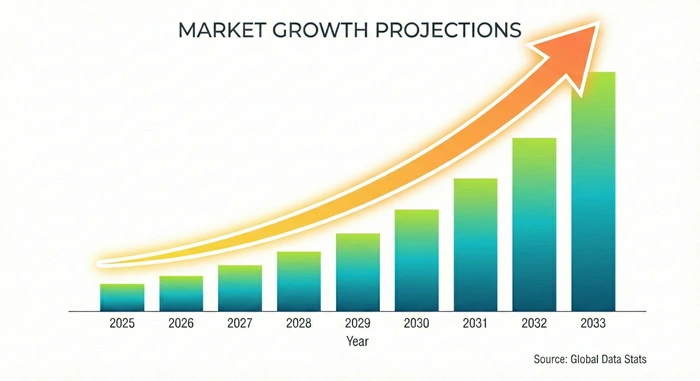
The post quantum cryptography market demonstrates exceptional growth prospects through 2033, with market valuations projected to increase more than 14-fold from current levels as organizations worldwide transition to quantum-resistant security frameworks. North America dominates the global market landscape with the largest regional share of 38% in 2024, driven by proactive government initiatives, substantial investments in cybersecurity solutions, developed technology infrastructure, and the presence of major technology companies including IBM, Microsoft, Google, Amazon, and specialized cybersecurity firms. The United States leads regional adoption, with government agencies like NIST actively developing and standardizing PQC algorithms, while the federal government mandates quantum-safe cryptography adoption across agencies and critical infrastructure sectors. The region's technology giants are investing billions in quantum computing research while simultaneously developing quantum-resistant security solutions, creating a unique ecosystem that accelerates both the threat and the defense mechanisms.
Asia Pacific is projected to register the fastest growth rate with a CAGR of 44.83% during the forecast period from 2026 to 2033, propelled by rapid digital transformation, rising cyberattacks targeting the region's expanding digital infrastructure, and increasing government investments in quantum-safe encryption to secure national digital assets. Governments across China, Japan, India, and South Korea are investing heavily in PQC development and deployment to protect critical infrastructure and sensitive data from future quantum attacks, with national initiatives focusing on quantum technology advancement including post quantum cryptography capabilities. The growing reliance on digital infrastructure by both private and public sectors necessitates robust cybersecurity solutions, making quantum-resistant encryption essential for protecting against quantum attacks while ensuring interoperability with existing systems. Europe represents a significantly growing market driven by stringent data privacy regulations like GDPR, strong government support for PQC research and development, and the presence of leading research institutions actively engaged in quantum-safe algorithm development.
Expert Speaks
-
Andrew Cheung, CEO of 01 Quantum: "We made significant progress in our PQC initiatives during 2025. Our work with partners, the expansion of our product verticals, and the technical milestones reached during the year demonstrate the versatility of our technology and the commitment of our team. As we enter 2026, we believe the Company is well positioned to capitalize on the growing interest in quantum-resilient cybersecurity solutions."
-
Carlos Moreira, CEO of SEALSQ: "Security is the backbone of the quantum era. AI agents, IoT devices, satellites, our entire digital world depends on trusted identities and safe communications. Without quantum-resistant safeguards, critical data and infrastructure could be at risk. At SEALSQ, we're not just anticipating the challenge, we're addressing it head-on through our Post-Quantum Technology hardware and software solutions."
-
Manju Naglapur, Senior Vice President at Unisys: "Through our holistic set of services, we empower organizations to address the challenges of post-quantum cryptography head-on, help them navigate the complexities, and create a program designed to protect their IT estate from cyber threats now and in the future. The cryptographic posture assessment is part of a comprehensive rollout of offerings designed to help organizations prepare for and defend against future quantum threats."
Key Report Takeaways
-
North America leads the post quantum cryptography market with the largest regional share of 38% in 2024, driven by proactive government initiatives, substantial cybersecurity investments, developed technology infrastructure, NIST standardization efforts, and the presence of major technology companies including IBM, Microsoft, Amazon, and specialized security firms
-
Asia Pacific represents the fastest-growing region for PQC adoption with the highest CAGR of 44.83% during the forecast period from 2026 to 2033, experiencing accelerated growth due to rapid digital transformation, rising cyberattacks, increasing government investments in quantum-safe encryption, and national initiatives protecting critical infrastructure
-
Large enterprises dominate the enterprise size segment with the largest market share of 74% in 2024, as they possess significant financial resources, complex IT infrastructure, massive datasets requiring protection, and face stringent regulatory requirements that mandate quantum-resistant security implementations
-
Lattice-based cryptography captured the dominant position among cryptographic types with a major revenue share of 49% in 2024, owing to its robust security properties, efficient performance characteristics, widespread standardization by NIST, and suitability for various applications including key exchange and digital signatures
-
Solutions segment holds the largest share in the offering category as enterprises prioritize immediate deployment of quantum-safe technologies including encryption products, cryptographic libraries, and quantum-resistant hardware to secure data against emerging quantum threats
-
Government and defense sector shows the highest adoption with the dominant vertical position in 2024 and is expected to maintain leadership, driven by heightened demand for secure communications, national security requirements, critical infrastructure protection, and early adoption mandates for quantum-resistant encryption across military and intelligence operations
Market Scope
| Report Coverage Details | |
|---|---|
| Market Size by 2033 | USD 29.65 Billion |
| Market Size by 2025 | USD 1.38 Billion |
| Market Size by 2026 | USD 2.01 Billion |
| Market Growth Rate from 2026 to 2033 | CAGR of 44.82% |
| Dominating Region | North America |
| Fastest Growing Region | Asia Pacific |
| Base Year | 2025 |
| Forecast Period | 2026 to 2033 |
| Segments Covered | Service, Type, Solution, Enterprise Size, Vertical, Region |
| Regions Covered | North America, Europe, Asia Pacific, Latin America, Middle East & Africa |
Market Dynamics
Drivers Impact Analysis
Quantum Computing Advancement and Regulatory Mandates Accelerating Market Expansion
| Aspect | Details |
|---|---|
| ≈ % Impact on CAGR Forecast | High Impact (40-45%) |
| Geographic Relevance | Global, with strongest impact in North America, Europe, and Asia Pacific |
| Impact Timeline | Immediate to Long-term (2026-2033) |
The primary driver accelerating post quantum cryptography market growth is the imminent threat of quantum computing to existing cryptographic systems including RSA, DSA, and Elliptic Curve Cryptography algorithms that secure digital communications, financial transactions, healthcare records, and government databases worldwide. Quantum computers with sufficient computational power will break these encryption methods by solving mathematically complex problems in hours or days rather than the thousands of years required by classical computers, rendering current security infrastructure obsolete. This existential threat has created urgency across all sectors handling sensitive data, with organizations recognizing that waiting until quantum computers achieve full capability would leave them vulnerable to catastrophic security breaches and compliance violations. The "harvest now, decrypt later" attack vector represents an immediate concern, where adversaries collect encrypted data today knowing they can decrypt it retroactively once quantum computers become available, making PQC adoption urgent even before quantum computing reaches maturity.
Government initiatives and regulatory pressures worldwide are driving accelerated adoption of quantum-resistant encryption across critical infrastructure and regulated industries. The National Institute of Standards and Technology released the first three finalized PQC standards in August 2024, including FIPS 203, FIPS 204, and FIPS 205, providing validated quantum-resistant algorithms that organizations can implement with confidence. Federal mandates in the United States require government agencies to transition to quantum-safe cryptography, while similar initiatives in Europe, China, and other nations are establishing timelines for PQC adoption across public and private sectors. Growing investments in PQC research from governments, technology companies, and venture capital firms are accelerating algorithm development, reducing implementation costs, and expanding the ecosystem of quantum-safe solutions available to enterprises.
Restraints Impact Analysis
High Implementation Costs and Complexity Creating Adoption Barriers
| Aspect | Details |
|---|---|
| ≈ % Impact on CAGR Forecast | Moderate Impact (15-20%) |
| Geographic Relevance | Global, particularly affecting developing markets and SMEs |
| Impact Timeline | Short to Medium-term (2026-2029) |
A significant restraint limiting post quantum cryptography market growth is the high implementation cost associated with transitioning from legacy encryption systems to quantum-safe infrastructure. Organizations face substantial expenses including hardware upgrades, software development, cryptographic infrastructure replacement, network modifications, and specialized expertise hiring to manage the complex migration process. The total cost of PQC implementation can range from hundreds of thousands to millions of dollars depending on organization size and infrastructure complexity, creating financial barriers particularly for small and medium-sized enterprises that lack capital reserves for major security overhauls. Integrating PQC algorithms into existing systems requires extensive testing and validation to ensure compatibility with legacy applications, maintain performance standards, and avoid disrupting business operations during the transition period.
The lack of standardized algorithms and evolving cryptographic standards creates hesitation among organizations uncertain about which quantum-resistant algorithms to adopt. While NIST has released initial standards, the PQC landscape continues evolving as researchers discover new vulnerabilities and develop improved algorithms, making early adopters concerned about implementing solutions that may require replacement or modification. Significantly large key sizes associated with many quantum-safe algorithms increase computational overhead, impact processing efficiency, and strain network performance, creating challenges for resource-constrained environments and Internet of Things devices with limited processing power. The shortage of skilled professionals with expertise in post quantum cryptography, quantum computing, and advanced cryptographic mathematics limits implementation capabilities, as organizations struggle to find and retain talent capable of managing complex PQC migrations while maintaining operational security.
Opportunities Impact Analysis
Early Market Entry and Government Contracts Creating Competitive Advantages
| Aspect | Details |
|---|---|
| ≈ % Impact on CAGR Forecast | High Impact (30-35%) |
| Geographic Relevance | Global, with exceptional opportunities in North America and Asia Pacific |
| Impact Timeline | Medium to Long-term (2027-2033) |
A major opportunity in the post quantum cryptography market lies in early development of innovative products and services that provide competitive advantages for vendors leading the transition to quantum-safe security. Companies pioneering PQC hardware solutions, quantum-resistant encryption products, migration services, and consulting offerings can capture significant early market share, secure lucrative government and enterprise contracts, and influence emerging global standards that define the quantum-safe era. Government and defense contracts represent particularly attractive opportunities, as national security agencies, military organizations, and critical infrastructure operators prioritize quantum-resistant security implementations and allocate substantial budgets for PQC solutions that protect classified information and sensitive communications from quantum threats. Organizations establishing thought leadership through early standardization participation, successful large-scale deployments, and proven migration methodologies position themselves as preferred vendors as the market expands.
The development and deployment of PQC solutions for quantum-safe hardware and software, including industry-specific applications tailored for BFSI, healthcare, telecommunications, and energy sectors, creates substantial growth opportunities. Cloud-based PQC solutions and managed security services enable smaller organizations to access quantum-resistant protection without massive capital investments, expanding the addressable market beyond large enterprises to include SMEs concerned about quantum threats. The surge in demand for critical technologies including secure cloud computing, blockchain applications, Internet of Things devices, and 5G networks creates opportunities for integrating quantum-resistant encryption into next-generation digital infrastructure from the ground up rather than retrofitting legacy systems. Hybrid encryption approaches combining classical and quantum-resistant algorithms provide interim solutions that enable organizations to begin their quantum-safe transition while maintaining compatibility with existing infrastructure, representing a massive market opportunity for vendors offering crypto-agility frameworks.
Segment Analysis
Lattice-Based Cryptography
Mathematical Complexity and NIST Standardization Establishing Market Leadership
Lattice-based cryptography dominated the post quantum cryptography market by type, capturing the largest revenue share of 49% in 2024 and maintaining a leadership trajectory throughout the forecast period. The dominance of lattice-based approaches stems from their robust security properties based on the computational difficulty of solving lattice problems, which remain secure against both classical and quantum computing attacks. These algorithms offer strong security guarantees supported by decades of mathematical research, with no known efficient quantum algorithms capable of breaking well-designed lattice-based cryptographic systems. Lattice-based cryptography provides versatile applications spanning key exchange, digital signatures, and encryption, making it suitable for protecting diverse use cases across enterprise, government, and consumer environments.
The widespread standardization of lattice-based algorithms by NIST significantly accelerates adoption, as organizations gain confidence implementing cryptographic solutions validated by the world's leading standards body. NIST's selection of lattice-based algorithms including CRYSTALS-Kyber for key exchange and CRYSTALS-Dilithium for digital signatures as primary PQC standards reinforces market leadership for this cryptographic approach. Lattice-based cryptography experiences particularly strong adoption across North America and Europe, where government agencies, financial institutions, and technology companies prioritize NIST-standardized algorithms for compliance and interoperability. Leading companies including IBM, Microsoft, Thales, and specialized cryptography vendors are integrating lattice-based PQC into their security platforms, hardware security modules, and cloud services, driving mainstream adoption across industries. The efficient performance characteristics of modern lattice-based schemes, combined with ongoing research reducing key sizes and computational overhead, position this segment for sustained dominance as organizations worldwide transition to quantum-resistant security.
Solutions Segment
Immediate Deployment Priorities and Comprehensive Product Portfolios Driving Dominance
Solutions dominated the post quantum cryptography market by offering type, holding the largest market share of approximately 65% in 2024 and projected to sustain leadership throughout the forecast period from 2026 to 2033. The commanding position of the solutions segment reflects enterprises' prioritization of immediate deployment of quantum-safe technologies including quantum-resistant hardware, encryption products, cryptographic libraries, VPN solutions, and authentication systems that protect data against emerging quantum threats. Organizations recognize that quantum-resistant infrastructure forms the foundation of long-term data security, driving investments in comprehensive solution portfolios that address multiple attack vectors simultaneously. Hardware-backed cryptography including quantum-safe hardware security modules provides root-of-trust protection that ensures cryptographic keys remain secure even if software layers are compromised, making hardware solutions particularly valuable for financial services, government, and critical infrastructure sectors handling highly sensitive data.
The solutions segment experiences exceptional growth across all regions, with North America leading adoption as enterprises prioritize quantum-safe technologies driven by regulatory requirements and competitive pressures to secure customer data. Cloud-based PQC solutions capture approximately 70% of software deployments in 2024, offering scalability, remote accessibility, centralized key management, and automatic updates that reduce operational complexity while enabling rapid deployment across geographically distributed organizations. Leading solution providers including NXP Semiconductor, Thales, IDEMIA, Palo Alto Networks, IBM, Microsoft, and AWS are expanding their PQC portfolios through strategic acquisitions, partnerships, and internal development initiatives that integrate quantum-resistant algorithms into existing products. The solutions segment enables organizations to implement quantum-safe encryption across diverse use cases including secure communications, data-at-rest protection, blockchain security, IoT device authentication, and digital identity verification, creating comprehensive security postures that address the multifaceted quantum threat landscape.
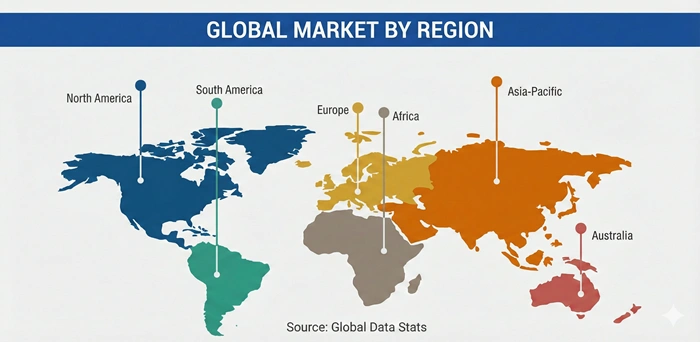
Regional Insights
North America
Government Leadership and Technology Innovation Establishing Regional Dominance
North America holds the dominant position in the post quantum cryptography market with the largest regional share of 38% in 2024, valued at approximately USD 532 million in 2025, and projected to reach USD 11.23 billion by 2033 at a robust CAGR. The region's commanding market leadership stems from proactive government initiatives led by NIST, substantial private and public investments in cybersecurity solutions, highly developed technology infrastructure, and the concentration of major technology companies driving quantum computing and quantum-resistant security innovation simultaneously. The United States leads global PQC adoption, with federal agencies including the Department of Defense, National Security Agency, and intelligence community prioritizing quantum-safe cryptography implementations to protect classified information and critical communications from quantum threats.
NIST's release of finalized PQC standards in August 2024 represents a watershed moment that accelerated adoption across both government and private sectors by providing validated quantum-resistant algorithms that organizations can implement with regulatory confidence. The presence of technology giants including IBM, Microsoft, Amazon, Google, and specialized cybersecurity firms including Palo Alto Networks, DigiCert, and Entrust creates a robust ecosystem that drives innovation in quantum-safe solutions while accelerating commercialization timelines. The BFSI sector in North America shows particularly strong adoption driven by stringent regulatory requirements, high exposure to financial crimes, and the need to protect trillions of dollars in transactions from quantum-enabled attacks. Leading North American companies are investing heavily in PQC research and development, forming strategic partnerships with government agencies and academic institutions, and developing comprehensive migration services that help customers transition to quantum-safe infrastructure.
Asia Pacific
Digital Transformation and Government Investments Driving Fastest Regional Growth
Asia Pacific is projected to register the fastest growth rate in the post quantum cryptography market with a CAGR of 44.83% during the forecast period from 2026 to 2033, experiencing exceptional expansion due to rapid digital transformation, rising cyberattacks targeting the region's expanding digital infrastructure, and increasing government investments in quantum-safe encryption to secure national digital assets. Governments across China, Japan, India, and South Korea are investing heavily in quantum technology research and development including post quantum cryptography capabilities to protect critical infrastructure, sensitive data, and strategic communications from future quantum attacks. China leads the region with massive investments in quantum computing research while simultaneously developing indigenous quantum-resistant cryptographic solutions to ensure technological sovereignty and protect national security interests.
India plays a distinctive role in the regional post quantum cryptography market through initiatives like the National Quantum Mission aimed at advancing quantum technologies including PQC, with the Indian Army's Quantum Lab emphasizing research and training in quantum computing and communication. The Centre for Development of Telematics has developed quantum-safe products including the Compact Encryption Module and Quantum Secure Smart Video IP Phone, highlighting government support for quantum-resistant security deployment. Key industries across Asia Pacific including banking, healthcare, telecommunications, and e-commerce are actively adopting PQC solutions to comply with emerging regulatory requirements, address cybersecurity concerns, and protect customer data from quantum threats. Leading regional technology companies, multinational corporations, and specialized security vendors are forming strategic partnerships to accelerate PQC deployment across diverse industry verticals, creating a dynamic market environment characterized by rapid innovation and accelerating adoption timelines.
Top Key Players
-
IBM Corporation (United States)
-
Microsoft Corporation (United States)
-
Thales Group (France)
-
NXP Semiconductor (Netherlands)
-
Palo Alto Networks (United States)
-
IDEMIA (France)
-
DigiCert Inc. (United States)
-
Amazon Web Services (United States)
-
PQShield Ltd. (United Kingdom)
-
Entrust Corporation (United States)
-
Quantinuum Ltd. (United Kingdom)
-
ID Quantique (Switzerland)
-
QuintessenceLabs (Australia)
-
Utimaco GmbH (Germany)
-
SEALSQ Corp. (Switzerland)
Recent Developments
-
Unisys Corporation (2025): Unisys launched in March 2025 the first of several new Post-Quantum Cryptography capabilities and services within its cybersecurity portfolio, including cryptographic posture assessment designed to help organizations prepare for and defend against future quantum threats by providing complete inventory and analysis of cryptographic environments
-
Utimaco GmbH (2025): Utimaco announced in April 2025 the launch of Quantum Protect, the Post-Quantum Cryptography application package for its u.trust General Purpose Hardware Security Modules Se-Series, providing quantum-resistant protection for cryptographic operations and key management
-
Korean Quantum Computing (2025): KQC partnered with Crypto4A in July 2025 to commercialize PQC solutions, advancing quantum security and AI infrastructure capabilities with the partnership aiming to strengthen Korea's sovereignty in security technology and position it as a quantum security hub in Asia
-
Vodafone Group (2025): Vodafone partnered with IBM in March 2025 to integrate Post-Quantum Cryptography products into Vodafone Secure Net, protecting users from future quantum threats by testing quantum-resistant encryption across mobile networks and products while supporting industry-wide PQC adoption
-
General Dynamics Information Technology (2024): GDIT announced in December 2024 that it joined the National Institute of Standards and Technology's Migration to Post-Quantum Cryptography Building Block Consortium as the first systems integrator, focusing on addressing quantum computing threats by developing practical solutions and tools that assist organizations in migrating to PQC
Market Trends
Hybrid Encryption Approaches and Crypto-Agility Frameworks Reshaping Security Strategies
The post quantum cryptography market is witnessing transformative trends as hybrid encryption mechanisms gain significant traction, enabling organizations to combine classical cryptographic algorithms with quantum-resistant alternatives during the transition period. Hybrid approaches provide backward compatibility with existing systems while adding quantum-safe protection layers, allowing enterprises to begin their PQC journey without disrupting current operations or requiring immediate infrastructure replacement. These mechanisms prove particularly valuable for large organizations with complex legacy systems that cannot be upgraded simultaneously, as hybrid encryption enables phased migration strategies that balance security improvements against operational continuity requirements. Leading technology companies including IBM, Microsoft, and AWS are developing hybrid encryption solutions that automatically negotiate between classical and quantum-resistant algorithms based on endpoint capabilities, simplifying deployment and ensuring interoperability across diverse environments.
Crypto-agility frameworks are emerging as critical strategic priorities, enabling organizations to swap cryptographic algorithms rapidly without major infrastructure changes when new vulnerabilities are discovered or improved quantum-resistant algorithms become available. Crypto-agile architectures separate cryptographic algorithm selection from application logic, allowing security teams to update encryption methods centrally without modifying individual applications or requiring extensive development cycles. This flexibility proves essential given the evolving nature of quantum computing threats and the ongoing research that may reveal vulnerabilities in current PQC algorithms. Organizations are increasingly investing in comprehensive cryptographic inventories and Software Bill of Materials that identify all encryption implementations across their digital estates, enabling them to assess quantum vulnerability exposure and plan prioritized migration roadmaps. The convergence of artificial intelligence with post quantum cryptography is creating intelligent security platforms that continuously monitor for quantum threats, automatically adjust cryptographic protections, and optimize key management processes without human intervention.
Segments Covered in the Report
By Service
-
Design, Implementation, and Consulting
-
Migration Services
-
Quantum Risk Assessment
By Type
-
Lattice-Based Cryptography
-
Code-Based Cryptography
-
Multivariate Cryptography
-
Hash-Based Cryptography
-
Isogeny-Based Cryptography
-
Others
By Solution
-
Quantum-Resistant Algorithms
-
Quantum-Safe Cryptographic Libraries
-
Quantum-Safe Authentication Solutions
-
Quantum-Resistant Encryption Solutions
-
Quantum-Safe VPN, Email, Messaging
-
Quantum-Safe Blockchain Solutions
-
Quantum-Safe Hardware
-
Hardware Security Modules (HSM)
By Enterprise Size
-
Large Enterprises
-
Small & Medium Enterprises (SMEs)
By Vertical
-
BFSI
-
Government and Defense
-
Healthcare
-
IT & ITES
-
Telecommunications
-
Retail & E-commerce
-
Energy & Utilities
-
Manufacturing
-
Others
By Region
-
North America
-
United States
-
Canada
-
Mexico
-
-
Europe
-
United Kingdom
-
Germany
-
France
-
Italy
-
Spain
-
Netherlands
-
Rest of Europe
-
-
Asia Pacific
-
China
-
India
-
Japan
-
South Korea
-
Australia
-
Southeast Asia
-
Rest of Asia Pacific
-
-
Latin America
-
Brazil
-
Argentina
-
Rest of Latin America
-
-
Middle East & Africa
-
UAE
-
Saudi Arabia
-
South Africa
-
Rest of Middle East & Africa
-
Frequently Asked Questions
Question 1: What is the expected post quantum cryptography market size by 2033?
Answer: The global post quantum cryptography market is projected to reach approximately USD 29.65 billion by 2033, growing from USD 2.01 billion in 2026. This exceptional growth is driven by quantum computing threats and widespread adoption of quantum-resistant security solutions.
Question 2: Which region dominates the post quantum cryptography market currently?
Answer: North America dominates the post quantum cryptography market with the largest share of 38% in 2024, driven by proactive government initiatives led by NIST, substantial cybersecurity investments, and the presence of major technology companies. The United States leads regional adoption through federal mandates and standardization efforts.
Question 3: What are the primary drivers of post quantum cryptography market growth?
Answer: The primary drivers include the imminent threat of quantum computing to existing encryption systems, government-backed standardization efforts, rising cyberattacks, regulatory mandates requiring quantum-safe security, and the "harvest now, decrypt later" threat. NIST's release of finalized PQC standards in August 2024 accelerated global adoption.
Question 4: Which cryptographic type shows the highest adoption in post quantum cryptography market?
Answer: Lattice-based cryptography captured the dominant position with a market share of 49% in 2024, owing to its robust security properties, efficient performance, and NIST standardization. NIST selected lattice-based algorithms including CRYSTALS-Kyber and CRYSTALS-Dilithium as primary PQC standards.
Question 5: What opportunities exist for post quantum cryptography market expansion?
Answer: Major opportunities include early development of innovative PQC products and services, government and defense contracts, cloud-based solutions enabling SME adoption, hybrid encryption approaches, and industry-specific applications for BFSI, healthcare, and telecommunications. Crypto-agility frameworks represent substantial growth opportunities as organizations seek flexible migration strategies.