
Polypropylene Market Overview
Versatile Thermoplastic Polymer Revolutionizes Packaging, Automotive, and Consumer Goods Through Lightweight Durability
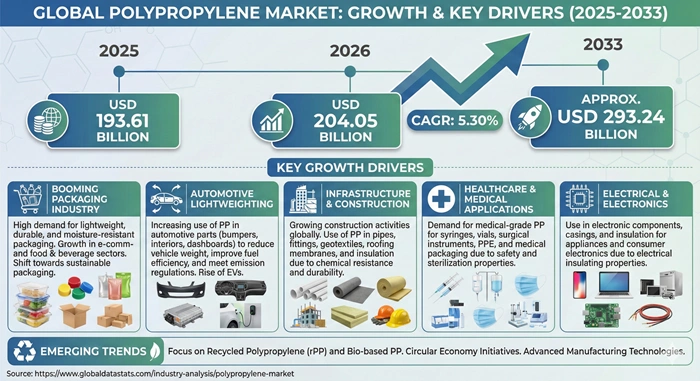
The global polypropylene market size is valued at USD 193.61 billion in 2025 and is predicted to increase from USD 204.05 billion in 2026 to approximately USD 293.24 billion by 2033, growing at a CAGR of 5.30% from 2026 to 2033. This industry encompasses a versatile thermoplastic polymer derived from propylene monomers through polymerization processes, delivering exceptional mechanical properties, chemical resistance, and cost-effectiveness that enable widespread adoption across packaging, automotive components, textiles, medical devices, and consumer products. Polypropylene exists in homopolymer, copolymer, and random copolymer configurations, each offering distinct characteristics optimized for specific manufacturing processes and end-use applications.
The polypropylene market addresses escalating demand for lightweight, durable materials that reduce transportation costs, enhance fuel efficiency, and support sustainability initiatives through recyclability. This thermoplastic demonstrates superior moisture resistance, excellent clarity for transparent applications, and processing versatility through injection molding, blow molding, extrusion, and thermoforming operations. Major production regions including Asia Pacific, North America, and Europe maintain integrated petrochemical complexes converting propylene feedstock into polypropylene resins serving diverse manufacturing sectors requiring affordable performance materials.
AI Impact on the Polypropylene Industry
Machine Learning Optimization and Predictive Analytics Transform Production Efficiency and Quality Control Across Manufacturing
Artificial intelligence revolutionizes the polypropylene market through advanced process control systems that optimize polymerization parameters including temperature profiles, catalyst feeding rates, and monomer ratios to maximize yield while minimizing energy consumption. Machine learning algorithms analyze thousands of production variables across reactor operations, catalyst performance, and downstream processing to identify optimal conditions that reduce cycle times and improve product consistency. These AI-powered systems continuously adapt to feedstock quality variations, automatically adjusting parameters to maintain target melt flow rates, impact resistance, and clarity specifications despite propylene purity fluctuations. Predictive maintenance applications monitor equipment performance data including extruder temperatures, die pressures, and motor vibrations to forecast mechanical failures before costly unplanned downtime disrupts production schedules.
Deep learning accelerates new product development within the polypropylene market by simulating molecular architectures and predicting mechanical properties before expensive pilot-scale trials. Computational modeling powered by artificial intelligence evaluates thousands of copolymer formulations combining propylene with ethylene or other monomers to identify optimal compositions delivering specific stiffness-toughness balances for automotive applications. Computer vision systems integrated into quality control operations perform automated defect detection on extruded films and molded parts, identifying contamination, surface imperfections, and dimensional variations at production speeds impossible through manual inspection. Natural language processing extracts insights from decades of technical literature and customer feedback data, revealing correlations between processing conditions, resin properties, and end-use performance that guide formulation priorities across packaging, automotive, and specialty applications.
Growth Factors
E-Commerce Packaging Surge and Automotive Lightweighting Mandates Drive Unprecedented Polypropylene Adoption
The polypropylene market experiences robust growth propelled by e-commerce expansion generating demand for flexible packaging, rigid containers, and protective materials that leverage polypropylene's moisture barrier properties, cost efficiency, and recyclability. Online retail sales exceeding 6 trillion dollars annually create sustained packaging material consumption as retailers and logistics providers specify polypropylene films for flexible pouches, woven sacks for industrial goods, and injection-molded containers for food delivery. The material's exceptional strength-to-weight ratio reduces shipping costs by 20-30% compared to alternative packaging while maintaining product protection throughout distribution networks. Consumer brands increasingly adopt polypropylene packaging incorporating recycled content and monomaterial structures that simplify recycling compared to multi-layer laminates, supporting corporate sustainability commitments addressing consumer environmental concerns.
Automotive industry lightweighting initiatives drive polypropylene market expansion through requirements for materials reducing vehicle mass to improve fuel efficiency and comply with stringent emissions regulations. Polypropylene-based components including bumpers, instrument panels, door panels, battery casings, and under-hood parts enable weight reductions exceeding 10-15% compared to traditional materials while maintaining impact resistance and dimensional stability. Electric vehicle manufacturers particularly value polypropylene's electrical insulation properties for battery enclosures and thermal management systems, with material consumption per vehicle increasing as electrification accelerates. Automotive polypropylene applications incorporate long fiber reinforcement, mineral fillers, and elastomer modification delivering performance properties approaching engineering thermoplastics at costs enabling mass-market vehicle applications. These converging automotive trends create sustained demand growth throughout the forecast period.
Market Outlook
Circular Economy Initiatives and Advanced Recycling Technologies Position Industry for Sustained Long-Term Growth
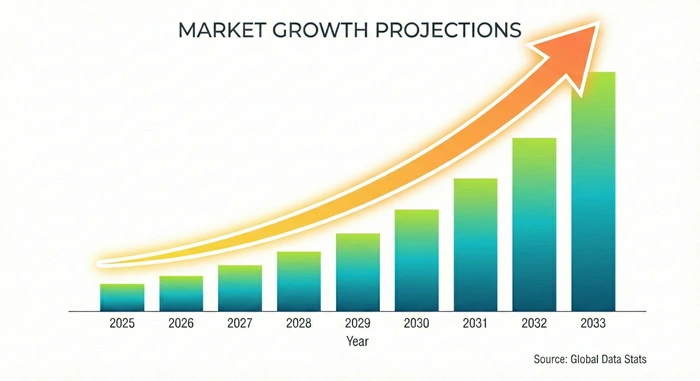
The polypropylene market outlook remains exceptionally positive as manufacturers invest substantially in mechanical and chemical recycling infrastructure addressing end-of-life challenges while meeting corporate sustainability targets and regulatory mandates. LyondellBasell, SABIC, ExxonMobil, and other major producers launch circular polypropylene grades incorporating recycled content ranging from 25-100% through mass balance approaches and dedicated processing lines. Advanced recycling technologies including pyrolysis convert mixed plastic waste into propylene monomers enabling virgin-equivalent polymer production that addresses contamination limitations constraining mechanical recycling. European Union Single-Use Plastics Directive and similar regulations mandate minimum recycled content percentages in packaging applications, creating market pull for recycled polypropylene while incentivizing collection infrastructure investments.
Investment trends within the polypropylene market reflect growing confidence in long-term demand fundamentals as Asia Pacific capacity expansions target domestic consumption growth across China, India, and Southeast Asian nations. Reliance Industries' 5.2 million ton per year facility in Jamnagar represents single largest capacity addition scheduled for 2030 commissioning, serving India's rapidly expanding packaging, automotive, and construction sectors. Middle Eastern producers leverage advantaged propane feedstock economics to export polypropylene into Europe and Asia despite freight costs. Bio-based polypropylene development utilizing renewable propylene from plant sugars or biomass gasification creates premium positioning opportunities for brands pursuing fossil-free materials, though commercial viability awaits production scale-up reducing cost premiums below 30%. These favorable dynamics position the market for sustained expansion through 2033.
Expert Speaks
-
Peter Vanacker, Chief Executive Officer of LyondellBasell Industries, emphasized strategic priorities: "Our Cash Improvement Plan is on track to achieve our 600 million dollar target in 2025 and a minimum of 1.1 billion dollars by the end of 2026, by reducing fixed costs, managing working capital and optimizing capital investment to strengthen free cash flow. Our strategy is resilient and we remain confident in our ability to create long-term value for investors through disciplined execution and market-aligned growth initiatives".
-
Abdulrahman Al-Fageeh, Chief Executive Officer of SABIC, articulated sustainability vision: "We have aligned our circularity and carbon-neutrality ambitions with the Saudi Green Initiative, an extension of Vision 2030 that addresses renewable energy, forestation, the production of clean hydrogen, and carbon capture and storage. We made a public commitment to process at least one million metric tons of TRUCIRCLE products from bio-based or recycled feedstock annually by 2030, ensuring sustainability remains integrated into our strategy".
-
Thomas Gangl, Chief Executive Officer of Borealis, highlighted circular economy transformation: "The increase in circular product production comes from a variety of mechanically recycled, chemically recycled and green feedstocks. We aim to increase our share of renewables used in polyolefins and hydrocarbon production to 40% by 2025 and 100% by 2030, while more than halving Scope 1 and 2 emissions to under 2 million metric tons by 2030".
Key Report Takeaways
-
Asia Pacific dominates the polypropylene market with commanding share exceeding 56%, driven by concentrated manufacturing capacity across China, India, and Japan where packaging, automotive, and textile industries consume substantial polymer volumes supported by integrated petrochemical infrastructure and cost-competitive production.
-
North America emerges as the fastest-growing regional market with projected CAGR approaching 5.8% through 2033, propelled by reshoring manufacturing, substantial food and beverage packaging demand, automotive lightweighting requirements, and medical device applications leveraging material sterilizability and biocompatibility.
-
Packaging applications represent the dominant end-use segment accounting for approximately 45% market share due to polypropylene's moisture resistance, clarity, cost efficiency, and compatibility with flexible films, rigid containers, and caps-closures across food, beverage, personal care, and industrial product packaging.
-
Injection molding dominates processing technology constituting approximately 41% of market volume, reflecting versatility producing complex geometries for automotive components, consumer goods, medical devices, and durable products requiring tight dimensional tolerances and consistent mechanical properties.
-
Homopolymer polypropylene maintains material segment leadership representing approximately 52% market share, delivering optimal stiffness, heat resistance, and chemical resistance for applications including woven sacks, fibers, food containers, and automotive battery casings where crystallinity and rigidity requirements favor homopolymer formulations.
-
Electrical and electronics applications exhibit highest growth trajectory with anticipated CAGR exceeding 6.2% through 2033, attributed to exceptional electrical insulation properties enabling cable insulation, capacitor films, connector housings, and consumer electronics components across expanding 5G infrastructure and smart device markets.
Market Scope
| Report Coverage Details | |
|---|---|
| Market Size by 2033 | USD 293.24 Billion |
| Market Size by 2025 | USD 193.61 Billion |
| Market Size by 2026 | USD 204.05 Billion |
| Market Growth Rate from 2026 to 2033 | CAGR of 5.30% |
| Dominating Region | Asia Pacific |
| Fastest Growing Region | North America |
| Base Year | 2025 |
| Forecast Period | 2026 to 2033 |
| Segments Covered | Product Type, Process, Application, End-Use Industry, Region |
| Regions Covered | North America, Europe, Asia Pacific, Latin America, Middle East & Africa |
Market Dynamics
Drivers Impact Analysis
Packaging Demand Surge and Sustainability Initiatives Accelerate Polypropylene Integration Across Multiple Industries
| Impact Factor | (≈) % Impact on CAGR Forecast | Geographic Relevance | Impact Timeline |
|---|---|---|---|
| E-Commerce Packaging Growth | +1.8% | Global, Led by Asia Pacific | 2026-2033 |
| Automotive Lightweighting | +1.4% | North America, Europe, China | 2026-2033 |
| Circular Economy Adoption | +1.2% | Europe, North America | 2026-2033 |
| Medical Applications Expansion | +0.9% | North America, Europe | 2027-2033 |
The polypropylene market benefits substantially from explosive e-commerce growth generating sustained packaging material demand as online retail penetration exceeds 25% in developed markets and accelerates across emerging economies. Flexible polypropylene films used for pouches, overwrap, and protective packaging deliver moisture barrier performance protecting products during extended distribution cycles while reducing package weight by 40-60% compared to rigid alternatives. Corrugated box manufacturers incorporate polypropylene-based adhesives, tapes, and strapping materials ensuring shipment integrity throughout logistics networks. Food delivery services expanding across Asia Pacific and Latin America specify polypropylene containers offering microwave compatibility, leak resistance, and stackability supporting operational efficiency. Consumer brands increasingly adopt monomaterial polypropylene packaging structures replacing multi-layer laminates to improve recyclability, responding to retailer mandates and consumer preferences for environmentally responsible materials.
Automotive manufacturers' aggressive lightweighting targets drive polypropylene market expansion through material substitution programs replacing heavier metals and engineering plastics across interior and exterior components. Polypropylene bumper systems incorporating ethylene-propylene copolymers achieve impact resistance meeting safety standards at weights 50% below steel equivalents, directly improving fuel economy. Instrument panel substrates combining polypropylene with mineral fillers and long glass fibers deliver stiffness supporting airbag deployment while enabling complex geometries housing electronics and HVAC systems. Electric vehicle battery enclosures specify flame-retardant polypropylene grades providing thermal stability, electrical insulation, and chemical resistance to electrolytes at costs enabling mainstream market adoption. Leading automotive suppliers including Magna International, Faurecia, and Adient specify certified recycled polypropylene grades addressing sustainability targets while maintaining performance specifications throughout the forecast period.
Restraints Impact Analysis
Volatile Feedstock Costs and Environmental Concerns Challenge Market Economics and Growth Trajectory
| Restraint Factor | (≈) % Impact on CAGR Forecast | Geographic Relevance | Impact Timeline |
|---|---|---|---|
| Propylene Price Volatility | -0.9% | Global Supply Chain | 2026-2033 |
| Single-Use Plastic Regulations | -0.7% | Europe, North America | 2026-2030 |
| Alternative Materials Competition | -0.5% | Packaging Applications | 2026-2033 |
| Recycling Infrastructure Gaps | -0.4% | Emerging Markets | 2026-2031 |
The polypropylene market faces growth constraints from significant propylene feedstock price volatility driven by crude oil market fluctuations, refinery operating rates, and competing demand from chemical intermediates. Propylene prices vary 40-60% annually based on naphtha cracker economics, propane dehydrogenation capacity utilization, and seasonal gasoline demand affecting refinery fluid catalytic cracker production. These price swings create margin pressures for polypropylene producers unable to pass costs to customers operating under fixed-price contracts, particularly affecting converters serving price-sensitive packaging markets. On-purpose propylene production through propane dehydrogenation offers partial supply diversification but requires substantial capital investment and advantaged propane feedstock access concentrated in Middle Eastern and North American regions.
Environmental regulations restricting single-use plastics constrain polypropylene market growth in developed regions despite material recyclability advantages over multi-material alternatives. European Union directives ban specific single-use items including straws, stirrers, and cutlery previously manufactured from polypropylene, eliminating established market segments. Extended producer responsibility schemes mandate packaging producers fund collection and recycling infrastructure, increasing total system costs by 15-25% that smaller converters struggle to absorb. Consumer perception challenges persist despite polypropylene's technical recyclability, with surveys indicating 60% of consumers view all plastics negatively regardless of recycling capabilities. These regulatory and reputational pressures drive brand owners toward paper, aluminum, and glass alternatives in visible consumer applications, though performance and total environmental footprint analyses often favor polypropylene through lifecycle assessments accounting for production energy, transportation impacts, and end-of-life disposal.
Opportunities Impact Analysis
Advanced Recycling Technologies and Bio-Based Alternatives Create Substantial Growth Avenues Beyond Traditional Markets
| Opportunity Factor | (≈) % Impact on CAGR Forecast | Geographic Relevance | Impact Timeline |
|---|---|---|---|
| Chemical Recycling Commercialization | +1.3% | Europe, North America, Asia | 2027-2033 |
| Bio-Based Polypropylene Development | +0.9% | Global Specialty Markets | 2028-2033 |
| Healthcare Applications Expansion | +0.8% | North America, Europe | 2026-2033 |
| Infrastructure Development | +0.7% | Asia Pacific, Middle East | 2026-2033 |
The polypropylene market stands to capture substantial value from chemical recycling technologies commercializing pyrolysis processes that convert mixed plastic waste into propylene monomers enabling virgin-equivalent polymer production. ExxonMobil's Exxtend technology, BASF's ChemCycling, and LyondellBasell's MoReTec process chemically depolymerize contaminated polypropylene unsuitable for mechanical recycling, addressing quality degradation limiting closed-loop applications. These technologies accept diverse waste streams including automotive shredder residue, carpet backing, and multi-layer packaging that represent 70% of polypropylene waste currently landfilled or incinerated. Certified circular polypropylene grades command 20-40% price premiums over virgin material, creating favorable economics as production scales reduce processing costs while regulatory mandates and corporate commitments ensure demand. SABIC's partnership with Plastic Energy and ExxonMobil's collaboration with Cyclyx demonstrate industry commitment to establishing circular supply chains throughout the forecast period.
Bio-based polypropylene development utilizing renewable propylene from plant sugars, biomass gasification, or captured carbon dioxide presents exceptional growth opportunities for the market as brands pursue fossil-free materials. Borealis' Bornewables portfolio achieves 120% greenhouse gas emissions reduction compared to fossil-based polypropylene through renewable feedstock substitution, addressing corporate net-zero commitments. While bio-based production costs currently exceed conventional routes by 30-50%, technology maturation and carbon pricing mechanisms projected to reach 100-150 dollars per ton by 2030 improve relative economics. Food packaging brands including Unilever, Nestlé, and Danone publicly commit to increasing renewable content percentages, creating market pull supporting commercial scale-up. Healthcare applications including syringes, IV components, diagnostic devices, and pharmaceutical packaging exhibit strong growth as polypropylene's sterilizability, chemical resistance, and transparency address expanding medical device manufacturing across emerging markets throughout the forecast period.
Segment Analysis
By Product Type: Homopolymer Polypropylene
Optimal Stiffness and Heat Resistance Characteristics Sustain Homopolymer Segment Market Leadership Across Diverse Applications
Homopolymer polypropylene commands the largest share within the polypropylene market, accounting for approximately 52% of global volume with continued expansion projected at steady CAGR of 5.1% through 2033. This product category consists of propylene monomers polymerized without comonomer incorporation, delivering maximum crystallinity that produces exceptional stiffness, heat resistance, and chemical resistance for applications including woven sacks, fibers, food containers, and automotive battery casings. The polypropylene market benefits from homopolymer variants' cost advantages compared to copolymer grades requiring additional monomers and specialized catalyst systems. Injection molding applications consume substantial homopolymer volumes producing caps, closures, containers, and durable goods where rigidity requirements favor high-crystallinity formulations.
Asia Pacific leads homopolymer polypropylene consumption within the market, driven by concentrated textile fiber production, packaging manufacturing, and consumer goods sectors across China, India, and Southeast Asian nations. Leading regional producers including China Petrochemical Corporation (Sinopec), Formosa Plastics Group, LG Chem, and Reliance Industries operate integrated facilities with combined capacity exceeding 30 million tons annually serving domestic and export markets. Chinese woven sack manufacturers consume over 8 million tons annually producing agricultural packaging, cement bags, and industrial bulk containers where homopolymer stiffness enables high-capacity load bearing. Indian fiber producers convert homopolymer into carpet backing, geotextiles, and rope applications leveraging cost efficiency and chemical resistance. North American homopolymer applications emphasize food-contact packaging including yogurt cups, deli containers, and microwavable bowls where heat resistance enables hot-fill processing and microwave reheating. European automotive battery manufacturers specify homopolymer grades for electric vehicle enclosures requiring electrical insulation, chemical resistance to electrolytes, and dimensional stability across temperature extremes. The segment's market leadership continues strengthening as production scale-up drives costs below 1.20 dollars per kilogram enabling penetration into price-sensitive applications throughout the forecast period.
By End-Use Industry: Packaging
Moisture Barrier Properties and Cost Efficiency Position Packaging as Dominant Application Segment Across Multiple Formats
Packaging represents the largest end-use segment within the polypropylene market, accounting for approximately 45% of global consumption with robust expansion anticipated at CAGR of 5.5% through 2033. This sector encompasses flexible films, rigid containers, caps-closures, strapping, and labels where polypropylene's moisture barrier performance, clarity, heat resistance, and cost efficiency enable diverse applications across food, beverage, personal care, pharmaceutical, and industrial products. The polypropylene market benefits from packaging industry transformation toward monomaterial structures improving recyclability compared to multi-layer laminates while maintaining product protection throughout distribution networks. Biaxially oriented polypropylene films dominate flexible packaging applications including snack food bags, candy wrappers, and tobacco packaging delivering exceptional clarity and stiffness.
North America and Europe lead packaging polypropylene adoption within the market, driven by food safety regulations, consumer convenience preferences, and sustainability initiatives mandating recycled content integration. United States flexible packaging producers including Berry Global, Amcor, and Sealed Air specify polypropylene films for stand-up pouches, flow wrap, and shrink labels where moisture barrier properties extend shelf life while enabling downgauging that reduces material usage by 20-30%. European rigid packaging manufacturers integrate post-consumer recycled polypropylene into yogurt cups, margarine tubs, and personal care bottles meeting minimum recycled content requirements while maintaining food-contact compliance. Asia Pacific exhibits fastest regional growth as rising incomes, urbanization, and modern retail expansion drive packaged food consumption across China, India, and Southeast Asia. Leading polypropylene suppliers including LyondellBasell, SABIC, ExxonMobil, and Braskem develop specialized packaging grades optimized for specific processing technologies including cast film extrusion, injection stretch blow molding, and thermoforming addressing evolving customer requirements throughout the forecast period.
Regional Insights
Asia Pacific
Manufacturing Concentration and Consumption Growth Establish Regional Dominance in Polypropylene Production and Demand
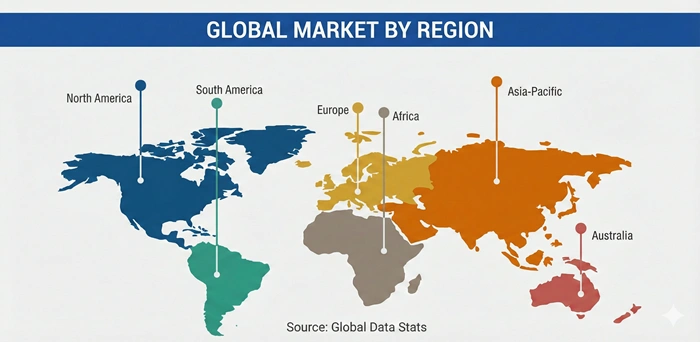
Asia Pacific commands the polypropylene market with dominant share exceeding 56%, driven by concentrated manufacturing capacity across China, India, Japan, and South Korea where integrated petrochemical complexes serve regional packaging, automotive, textile, and consumer goods industries. China alone accounts for over 40% of global polypropylene production through state-owned and private producers including Sinopec, PetroChina, and Shenhua Chemical operating facilities with combined capacity exceeding 30 million tons annually. The region benefits from vertical integration spanning propylene production through polymer conversion, with major crackers, propane dehydrogenation units, and refinery operations supplying competitively priced feedstock. India represents fastest-growing market within Asia Pacific as packaging, automotive, and construction sectors consume increasing polypropylene volumes driven by population growth, urbanization, and economic development.
China maintains technological and production leadership through companies including Sinopec, PetroChina, and Wanhua Chemical advancing high-performance grades, recycled content integration, and circular economy initiatives. Reliance Industries dominates Indian polypropylene production with Jamnagar facility expansion adding 5.2 million tons annual capacity targeting domestic demand growth across packaging and automotive sectors. Southeast Asian nations including Thailand, Vietnam, and Indonesia develop polypropylene manufacturing supporting regional automotive supply chains and export-oriented packaging production. Japan and South Korea focus on specialty polypropylene grades for electronics, medical devices, and high-performance automotive applications commanding premium pricing. The region's market dominance continues strengthening through 2033 as domestic consumption growth, export competitiveness, and technology advancement create favorable dynamics supporting continued leadership.
North America
Manufacturing Reshoring and Sustainability Initiatives Drive Regional Market Emergence as Fastest-Growing Geography
North America emerges as the fastest-growing regional polypropylene market with projected CAGR of 5.8% through 2033, propelled by manufacturing reshoring, substantial food packaging demand, automotive lightweighting initiatives, and medical device applications. The United States dominates regional market activity through integrated petrochemical producers including LyondellBasell, ExxonMobil Chemical, Braskem America, and Formosa Plastics Texas operating Gulf Coast facilities leveraging advantaged propane and ethane feedstocks from shale gas production. Polypropylene production capacity exceeds 8 million tons annually serving domestic packaging, automotive, construction, and consumer goods manufacturers while supporting exports to Latin America and Asia. Medical device applications drive high-value polypropylene consumption for syringes, IV components, surgical instruments, and pharmaceutical packaging where sterilizability and biocompatibility enable healthcare applications.
United States polypropylene market specifically benefits from sustainability initiatives as consumer brands and retailers mandate minimum recycled content percentages in packaging applications. LyondellBasell's partnership with EEW Energy develops advanced recycling infrastructure converting mixed plastic waste into circular polypropylene addressing collection and processing challenges. Automotive manufacturers including General Motors, Ford, and Stellantis specify recycled polypropylene for interior components meeting corporate sustainability targets while maintaining performance specifications. Canada contributes to North American market growth through packaging, automotive, and oil and gas applications. Mexico represents substantial manufacturing hub as automotive suppliers produce polypropylene components for North American assembly operations. Leading international producers maintain regional technical centers and customer support operations enabling formulation optimization and application development supporting continued market expansion throughout the forecast period.
Top Key Players
-
LyondellBasell Industries (United States)
-
SABIC (Saudi Arabia)
-
ExxonMobil Chemical Company (United States)
-
Braskem S.A. (Brazil)
-
LG Chem Ltd. (South Korea)
-
Sinopec (China Petrochemical Corporation) (China)
-
Reliance Industries Limited (India)
-
Formosa Plastics Corporation (Taiwan)
-
INEOS Group Holdings S.A. (United Kingdom)
-
Borealis AG (Austria)
-
TotalEnergies SE (France)
-
Sumitomo Chemical Company (Japan)
-
SABIC SK Nexlene Company (South Korea)
-
Lotte Chemical Corporation (South Korea)
-
PTT Global Chemical Public Company Limited (Thailand)
Recent Developments
-
LyondellBasell Industries (2025): Launched strategic partnership with EEW Energy from Waste to create high-quality recycled polypropylene from mixed plastic waste through advanced recycling technology, expanding circular product portfolio addressing growing demand for sustainable materials across packaging and automotive applications while advancing circular economy transformation.
-
SABIC (2024): Established collaboration with Plastic Energy and Intraplás to scale up certified circular polypropylene production for food-grade applications utilizing advanced recycling technology, supporting commitments to process one million metric tons annually of TRUCIRCLE products from bio-based or recycled feedstock by 2030 as part of sustainability strategy.
-
Borealis (2023): Extended collaboration with Tomra and Zimmerman Recycling to boost closed-loop polypropylene systems across Europe, targeting production increase to 600000 metric tons per year of circular products by 2025 and 1.8 million metric tons by 2030 through mechanically recycled, chemically recycled, and renewable feedstock sources.
-
ExxonMobil Chemical (2022): Formed strategic partnership with Cyclyx International to improve feedstock collection infrastructure for advanced recycling supporting Exxtend technology that converts plastic waste into virgin-equivalent polymers, addressing quality limitations of mechanical recycling while expanding circular polypropylene production capabilities.
-
TotalEnergies and Honeywell (2024): Announced joint development initiative to commercialize pyrolysis-based polypropylene recycling technology converting mixed plastic waste into propylene monomers enabling virgin-quality polymer production, advancing circular economy solutions addressing end-of-life challenges across packaging and automotive sectors.
Market Trends
Circular Economy Transformation and Lightweight Innovation Reshape Industry Value Propositions and Competitive Dynamics
The polypropylene market experiences transformative trends centered on circular economy integration as major producers invest billions in mechanical and chemical recycling infrastructure addressing sustainability mandates and corporate commitments. LyondellBasell, SABIC, ExxonMobil, and Borealis commercialize certified circular polypropylene grades incorporating 25-100% recycled content through mass balance approaches enabling food-contact and automotive applications. Advanced recycling technologies including pyrolysis thermally decompose mixed plastic waste into propylene monomers that undergo conventional polymerization producing virgin-equivalent polymers free from contamination limitations constraining mechanical recycling. These chemical recycling pathways accept diverse waste streams including automotive shredder residue, carpet backing, and multi-layer packaging representing 70% of polypropylene currently landfilled, creating circular supply chains reducing fossil feedstock dependence. Extended producer responsibility regulations across Europe and emerging North American jurisdictions mandate minimum recycled content percentages driving market pull while collection infrastructure investments improve material availability.
Material innovation trends reshape the polypropylene market as producers develop high-performance grades enabling automotive lightweighting and packaging downgauging applications. Long fiber polypropylene incorporating glass reinforcement achieves stiffness and impact resistance approaching engineering thermoplastics at costs enabling mass-market automotive applications including battery enclosures and structural components. Controlled rheology polypropylene grades optimized for thin-wall molding enable package weight reductions exceeding 30% while maintaining drop impact performance and barrier properties. Metallocene catalyst technology produces polypropylene with narrow molecular weight distributions delivering enhanced clarity, stiffness, and processability for flexible films and rigid containers. Bio-based polypropylene utilizing renewable propylene from plant sugars or biomass gasification achieves greenhouse gas emissions reductions exceeding 100% compared to fossil-based production, though commercial viability awaits production scale-up reducing cost premiums below sustainable market thresholds throughout the forecast period.
Segments Covered in the Report
By Product Type
-
Homopolymer Polypropylene
-
Copolymer Polypropylene
-
Random Copolymer
By Process
-
Injection Molding
-
Blow Molding
-
Extrusion
-
Thermoforming
-
Others
By Application
-
Films and Sheets
-
Fibers and Filaments
-
Containers and Packaging
-
Automotive Components
-
Consumer Goods
-
Others
By End-Use Industry
-
Packaging
-
Automotive and Transportation
-
Electrical and Electronics
-
Construction
-
Healthcare and Medical
-
Textiles
-
Consumer Products
-
Others
By Region
-
North America (United States, Canada, Mexico)
-
Europe (Germany, United Kingdom, France, Italy, Spain, Rest of Europe)
-
Asia Pacific (China, India, Japan, South Korea, Southeast Asia, Rest of Asia Pacific)
-
Latin America (Brazil, Argentina, Rest of Latin America)
-
Middle East & Africa (Saudi Arabia, UAE, South Africa, Rest of MEA)
Frequently Asked Questions
Question 1: What is the projected size of the polypropylene market by 2033?
Answer: The global polypropylene market is expected to reach approximately USD 293.24 billion by 2033, growing from USD 204.05 billion in 2026. This substantial expansion reflects increasing adoption across packaging, automotive, electronics, and healthcare applications demanding lightweight, durable, and cost-effective materials.
Question 2: Which region dominates the polypropylene market currently?
Answer: Asia Pacific leads the polypropylene market with over 56% share, driven by concentrated manufacturing capacity in China, India, and Japan serving regional packaging, automotive, and textile industries. Leading producers including Sinopec, Reliance Industries, and LG Chem maintain dominant regional positions.
Question 3: What are the primary drivers of polypropylene market growth?
Answer: Key growth drivers include e-commerce packaging expansion, automotive lightweighting mandates improving fuel efficiency, circular economy adoption through recycling initiatives, and healthcare applications leveraging sterilizability and biocompatibility. Consumer preferences for cost-effective, recyclable materials further accelerate polypropylene adoption globally.
Question 4: Which end-use industry holds the largest polypropylene market share?
Answer: Packaging dominates with approximately 45% market share due to polypropylene's moisture resistance, clarity, cost efficiency, and recyclability across flexible films, rigid containers, and caps-closures. Food, beverage, personal care, and pharmaceutical sectors drive sustained packaging demand.
Question 5: How does circular polypropylene benefit sustainability initiatives?
Answer: Circular polypropylene incorporating recycled content reduces fossil feedstock dependence by up to 100% while achieving greenhouse gas emissions reductions exceeding 120% through renewable feedstock substitution. Chemical recycling technologies enable virgin-equivalent polymer production from mixed plastic waste, addressing end-of-life challenges while supporting corporate net-zero commitments.