
Pharmaceutical Water Market Overview
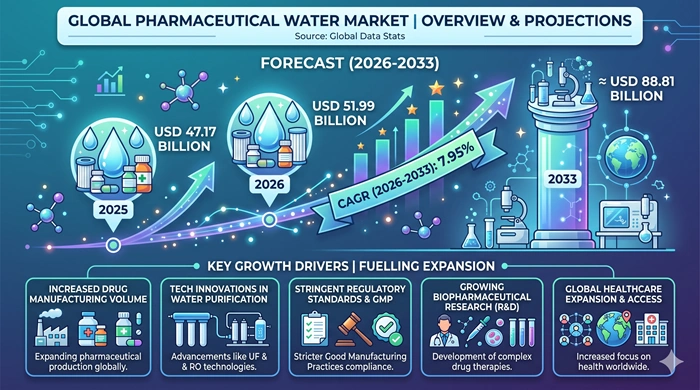
The global pharmaceutical water market size is valued at USD 47.17 billion in 2025 and is predicted to increase from USD 51.99 billion in 2026 to approximately USD 88.81 billion by 2033, growing at a CAGR of 7.95% from 2026 to 2033. Increasing pharmaceutical and biopharmaceutical production volumes, rising demand for ultra-pure water in sterile drug manufacturing, and tightening global regulatory standards are the primary factors driving consistent market expansion across all regions.
AI Impact on the Pharmaceutical Water Industry
Artificial Intelligence and Smart Water Management Technologies Are Transforming Purity Standards, Process Efficiency, and Compliance Monitoring Across the Pharmaceutical Water Industry*
AI is playing a transformative role in how pharmaceutical manufacturers monitor, manage, and maintain the purity of water used in their production processes. Intelligent sensor networks, real-time quality monitoring systems, and machine learning algorithms are now being deployed to detect microbial contamination, predict equipment maintenance needs, and ensure continuous compliance with pharmacopoeial standards. This shift toward data-driven water system management is reducing costly batch failures and regulatory non-conformances that have historically been a significant operational challenge for large pharmaceutical manufacturers.
Beyond quality control, AI-powered digital twins are being developed to simulate entire pharmaceutical water system environments, enabling engineers to test process changes virtually before implementing them in live production settings. Companies such as Veolia Water Technologies and Thermo Fisher Scientific are actively investing in AI-integrated water purification platforms that combine automated controls, predictive analytics, and remote system monitoring. As AI adoption in manufacturing operations accelerates, the pharmaceutical water industry is expected to benefit from lower operational costs, improved system uptime, and stronger overall compliance records.
Growth Factors
Expanding Pharmaceutical and Biopharmaceutical Manufacturing, Stringent Global Water Quality Regulations, and Rising Demand for Sterile Water Are Creating Sustained Growth in the Market*
The primary growth driver for the pharmaceutical water market is the rapid expansion of the global pharmaceutical and biopharmaceutical industries, both of which require large volumes of highly purified water for drug formulation, cleaning, sterilization, and laboratory use. The global rise in chronic disease prevalence — including cancer, cardiovascular disorders, and autoimmune diseases — is driving increased drug production, which in turn intensifies demand for validated, high-purity water systems. Manufacturing facilities are scaling up capacities globally, particularly in North America, Europe, and Asia Pacific, creating consistent demand for advanced water purification infrastructure.
Stringent regulatory requirements from bodies such as the U.S. FDA, the European Medicines Agency (EMA), and the World Health Organization (WHO) are compelling pharmaceutical manufacturers to adopt validated water systems that meet pharmacopoeial specifications for purified water, Water for Injection (WFI), and highly purified water. These compliance obligations are not optional — they are prerequisites for market access in major global markets. This regulatory pressure is a powerful driver of demand for high-quality water purification technologies, from reverse osmosis and distillation systems to electrodeionization and UV oxidation units.
Market Outlook
The Long-Term Outlook Remains Strongly Positive, Driven by Biopharmaceutical Expansion, Emerging Market Growth, and Increasing Adoption of Advanced Water Purification Technologies*
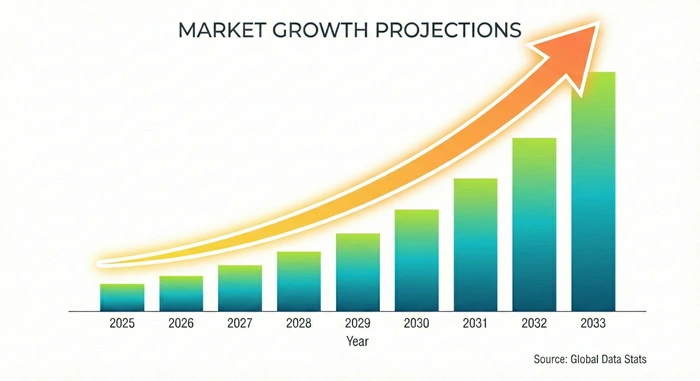
The long-term outlook for the pharmaceutical water market remains highly favorable through 2033 and beyond. The global biopharmaceutical sector — encompassing monoclonal antibodies, vaccines, gene therapies, and cell-based products — is one of the fastest-growing segments of the healthcare industry, and all of these products require water of the highest purity, particularly WFI-grade water. As biopharmaceutical pipeline activity intensifies and manufacturing capacity expands globally, demand for advanced and validated water systems is expected to grow in parallel, supporting strong revenue growth for leading water technology providers.
Emerging economies — particularly in Asia Pacific and Latin America — represent enormous untapped potential for the market. India, China, Brazil, and South Korea are all experiencing rapid pharmaceutical manufacturing growth, supported by government-led industrial policies, increasing healthcare investment, and growing exports of generic drugs and active pharmaceutical ingredients. Companies are actively expanding their water treatment infrastructure in these geographies, and the growing domestic pharmaceutical sectors in these countries are expected to contribute meaningfully to overall market revenues through the forecast period.
Expert Speaks
-
"Water quality is not negotiable in pharmaceutical manufacturing. At Merck, we continue to invest in advanced purification systems and digital monitoring tools to ensure that our water systems meet the most stringent pharmacopoeial standards globally." — Belén Garijo, CEO, Merck KGaA
-
"The growing biologics pipeline demands water systems that are reliable, validated, and scalable. Thermo Fisher Scientific is committed to providing pharmaceutical manufacturers with the water purification technologies they need to support the next generation of lifesaving medicines." — Marc Casper, CEO, Thermo Fisher Scientific
-
"As pharmaceutical production expands globally — particularly in emerging markets — the importance of robust water infrastructure cannot be overstated. At Veolia, we are focused on delivering innovative, sustainable water solutions that help manufacturers maintain compliance and operational efficiency." — Estelle Brachlianoff, CEO, Veolia
Key Report Takeaways
-
North America dominates the global pharmaceutical water market, holding approximately 36% of total market share in 2026, driven by its world-class pharmaceutical manufacturing base, strict FDA and USP regulatory enforcement, and high adoption rates of advanced water purification technologies.
-
Asia Pacific is the fastest-growing regional market, expanding at a CAGR of approximately 10.1% through 2033, supported by the rapid expansion of pharmaceutical and generic drug manufacturing in China and India, increasing healthcare investments, and favorable government policies for industrial growth.
-
Pharmaceutical and biotechnology companies are the dominant end users in the market, accounting for the largest revenue share due to their continuous, high-volume demand for purified water, WFI, and highly purified water across drug formulation, sterile manufacturing, and laboratory operations.
-
Water for Injection (WFI) is the leading product type segment, contributing approximately 42–45% of overall revenues in 2025, owing to its critical and mandatory role in the preparation of injectable drugs, intravenous solutions, and parenteral biologic products.
-
Drug formulation and manufacturing is the top application segment, representing the highest share of market demand as it encompasses the broadest range of water quality needs across oral solid dosage, injectable, biologic, and topical product manufacturing.
-
The electrodeionization (EDI) technology segment is set to grow quickly over the forecast period, expected to expand at a CAGR of approximately 9.8% through 2033, gaining market share as manufacturers prioritize chemical-free, continuous and energy-efficient purification solutions that align with sustainability and compliance objectives.
Market Scope
| Report Coverage | Details |
|---|---|
| Market Size by 2025 | USD 47.17 Billion |
| Market Size by 2026 | USD 51.99 Billion |
| Market Size by 2033 | USD 88.81 Billion |
| Market Growth Rate (2026–2033) | CAGR of 7.95% |
| Dominating Region | North America |
| Fastest Growing Region | Asia Pacific |
| Base Year | 2025 |
| Forecast Period | 2026 to 2033 |
| Segments Covered | Product Type, Technology, Application, End User, Region |
| Regions Covered | North America, Europe, Asia Pacific, Latin America, Middle East & Africa |
Market Dynamics
Drivers Impact Analysis
Rising Pharmaceutical Production Volumes, Strict Regulatory Compliance Requirements, and the Biologics Boom Are the Core Forces Propelling the Pharmaceutical Water Market Forward*
| Driver | ≈% Impact on CAGR Forecast | Geographic Relevance | Impact Timeline |
|---|---|---|---|
| Growing pharmaceutical and biopharmaceutical production | ~34% | Global, highest in North America & Asia Pacific | Near to long-term |
| Stringent regulatory requirements (FDA, EMA, WHO, USP) | ~27% | North America, Europe | Near to medium-term |
| Rising demand for WFI in injectable and biologic drugs | ~20% | Global | Medium to long-term |
| Expansion of generic drug manufacturing in emerging markets | ~12% | Asia Pacific, Latin America | Medium-term |
| Adoption of sustainable and energy-efficient purification technologies | ~7% | Global | Long-term |
The pharmaceutical water market is firmly supported by the sustained global growth of pharmaceutical and biopharmaceutical manufacturing. Every drug product — whether a simple oral tablet, a complex biologic injection, or a sterile inhalation solution — requires high-purity water at one or more stages of its production cycle. With the global pharmaceutical industry continuing to expand in response to growing disease burden and aging populations, the underlying demand for validated, high-quality water systems is structurally strong and growing.
Regulatory requirements from agencies including the U.S. FDA, EMA, and the WHO are a constant and powerful force driving market growth. These agencies mandate the use of specific grades of pharmaceutical water — purified water, highly purified water, WFI, and pure steam — and require manufacturers to validate their water systems, monitor water quality in real time, and demonstrate ongoing compliance. Non-compliance carries severe penalties including product recalls, facility shutdowns, and loss of market access, which means that investment in pharmaceutical water systems is not discretionary but regulatory-mandated.
Restraints Impact Analysis
High Capital Costs, Complex Validation Requirements, and Energy-Intensive Purification Processes Pose Significant Challenges for Market Growth*
| Restraint | ≈% Impact on CAGR Forecast | Geographic Relevance | Impact Timeline |
|---|---|---|---|
| High initial capital investment for water systems | ~36% | Global, most acute in emerging markets | Near to medium-term |
| Complex regulatory validation and documentation | ~30% | North America, Europe | Near to medium-term |
| High energy consumption of distillation and purification processes | ~20% | Global | Medium-term |
| Risk of microbial contamination and system failure | ~14% | Global | Near-term |
The installation and commissioning of pharmaceutical-grade water systems — particularly WFI generation systems based on multi-effect distillation or vapor compression — requires significant capital expenditure that can be a barrier for smaller manufacturers and those in developing markets. Beyond hardware costs, the qualification and validation of water systems to regulatory standards demands specialized expertise, extensive documentation, and significant time investment, which can delay production facility start-up timelines and add to overall project costs.
The energy intensity of pharmaceutical water production is another notable restraint. Distillation-based WFI systems are energy-heavy, and operational costs can be substantial for large manufacturing plants running continuous production schedules. While newer technologies like membrane distillation and reverse osmosis-based WFI systems offer improved energy efficiency, their broader regulatory acceptance and adoption have been gradual. These factors collectively moderate the pace of market growth, particularly in cost-sensitive and infrastructure-constrained regions.
Opportunities Impact Analysis
Emerging Market Pharmaceutical Expansion, Green Water Technologies, and Biopharmaceutical Manufacturing Growth Offer High-Value Opportunities in the Market*
| Opportunity | ≈% Impact on CAGR Forecast | Geographic Relevance | Impact Timeline |
|---|---|---|---|
| Pharmaceutical manufacturing expansion in Asia Pacific & Latin America | ~35% | Asia Pacific, Latin America | Medium to long-term |
| Adoption of green and energy-efficient purification technologies | ~28% | Global | Long-term |
| Growth in contract manufacturing organizations (CMOs) | ~22% | North America, Europe, Asia Pacific | Near to medium-term |
| Rising demand for single-use water systems in biomanufacturing | ~15% | North America, Europe | Medium to long-term |
Asia Pacific and Latin America present the most compelling growth opportunities for the pharmaceutical water market over the forecast period. Rapidly growing pharmaceutical manufacturing sectors in China, India, Brazil, and South Korea — fueled by government investments, rising healthcare access, and growing export capabilities — are driving massive investment in new manufacturing facilities, all of which require certified water systems. Global water technology companies are establishing local partnerships, service centers, and manufacturing presences in these regions to capture this expanding opportunity.
The growing adoption of contract manufacturing organizations (CMOs) and contract development and manufacturing organizations (CDMOs) globally is also creating strong incremental demand for pharmaceutical water systems. As originators outsource manufacturing to specialized partners, these facilities must invest in validated, compliant water infrastructure to meet client quality requirements and regulatory standards. The shift toward single-use bioprocessing systems in biomanufacturing — which require sterile WFI-grade water for preparation and rinsing — adds another layer of demand growth in the biopharmaceutical segment.
Segment Analysis
By Product Type
Water for Injection Dominates Product Revenue While Highly Purified Water and Pure Steam Gain Rapid Ground Across Biopharmaceutical Applications*
Water for Injection (WFI) is the dominant product type in the pharmaceutical water market, accounting for approximately 42–45% of total revenues in 2025, and it is expected to maintain this leadership through 2033 at a CAGR of approximately 8.4%. WFI's market position is firmly anchored in its essential role in the preparation of sterile injectable drugs, parenteral nutrition solutions, intravenous medicines, and biologic drug products — applications where even trace impurities can cause life-threatening patient harm. North America is the leading geography for WFI demand, given its large injectable drug manufacturing industry and strict USP and FDA compliance requirements. Major companies active in WFI system supply in this region include Veolia Water Technologies, MECO Incorporated, and GEA Group AG, all of which maintain strong project pipelines in the U.S. and Canada.
Highly purified water (HPW) is the fastest-growing product type in the pharmaceutical water market, expanding at a CAGR of approximately 9.2% through 2033, driven by its growing adoption in European biopharmaceutical manufacturing as a practical, cost-effective alternative to WFI for non-injectable applications. European Pharmacopoeia standards permit the use of HPW in certain applications where WFI-grade quality is not mandated, making it an economically attractive choice for manufacturers seeking to balance compliance with operational efficiency. The Asia Pacific region is also registering strong growth in HPW adoption, particularly in India and China, as local pharmaceutical companies upgrade their manufacturing facilities to meet international quality standards required for export. Companies including Sartorius AG and BWT Pharma & Biotech GmbH are among the key players supplying HPW systems in both the European and Asia Pacific markets.
By Application
Drug Formulation and Manufacturing Leads Application Revenues While Laboratory and Research Use Expands Rapidly with Growing R&D Investment*
The drug formulation and manufacturing application segment holds the largest share within the pharmaceutical water market, contributing approximately 50–52% of total revenues in 2025. This segment's dominance reflects its breadth across all pharmaceutical product categories — oral solid dosage forms, injectables, topicals, inhalation products, and biologics all rely on purified water or WFI at multiple critical manufacturing stages. North America and Europe are the core demand centers for this application, home to the world's largest pharmaceutical manufacturing networks and the most stringent regulatory oversight environments. Companies such as Thermo Fisher Scientific, Merck KGaA, and Evoqua Water Technologies supply a wide range of purification and WFI generation systems to pharmaceutical manufacturers in these regions, maintaining long-term service and maintenance contracts that ensure recurring revenue streams. The segment is projected to grow at approximately 7.8% CAGR through 2033.
The laboratory reagent application segment is the second most important demand area in the pharmaceutical water market and is growing at a CAGR of approximately 9.1% through 2033, driven by rapid expansion in pharmaceutical R&D, bioanalytical testing, and quality control laboratory activities globally. HPLC-grade water and ultra-pure water used in chromatography, dissolution testing, and microbiological analysis are in consistently high demand as pharmaceutical companies expand their analytical capabilities. Asia Pacific — particularly China, India, and South Korea — is registering the fastest growth in laboratory water demand, fueled by rising R&D investment, growing CRO and CDMO activities, and the expansion of bioanalytical testing laboratories. Key players including Millipore Sigma (Merck), Thermo Fisher Scientific, and ELGA LabWater are dominant suppliers in this application segment.
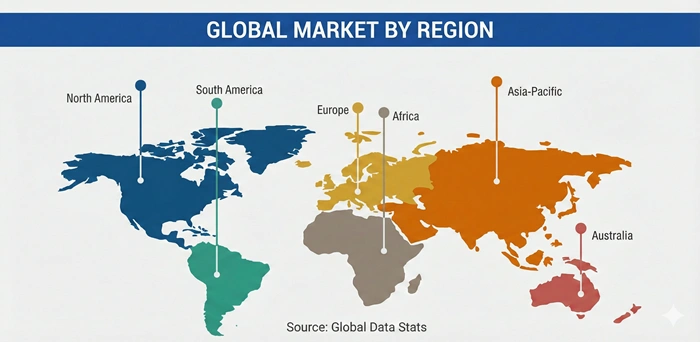
Regional Insights
North America
North America Leads the Pharmaceutical Water Market with the Largest Revenue Share, Backed by a World-Class Manufacturing Base, Strict Regulatory Environment, and High Technology Adoption*
North America holds the dominant position in the global pharmaceutical water market, accounting for approximately 36% of global market share in 2026 and growing at a CAGR of approximately 7.6% through 2033. The United States is the world's largest pharmaceutical producer and home to many of the world's top biopharmaceutical companies — including Pfizer, Johnson & Johnson, Merck & Co., Eli Lilly, and AbbVie — all of which operate large-scale manufacturing facilities requiring continuous, validated pharmaceutical water supply. The strict enforcement of pharmacopoeial water standards by the U.S. FDA, combined with the high prevalence of injectable drug manufacturing and biologics production, sustains exceptionally strong and growing demand for WFI systems, purified water skids, and water quality monitoring technologies in this region.
Canada contributes meaningfully to North America's pharmaceutical water revenues, with a growing domestic pharmaceutical manufacturing sector and strong adoption of USP-compliant water systems. The region's mature healthcare infrastructure, well-developed cold chain networks, and advanced contract manufacturing ecosystem further support sustained water technology investments. Leading water system suppliers including MECO Incorporated, Evoqua Water Technologies, and Veolia Water Technologies maintain strong North American presences through direct sales, service networks, and long-term manufacturing supply partnerships.
Asia Pacific
Asia Pacific Emerges as the Fastest-Growing Region in the Pharmaceutical Water Market, Driven by Manufacturing Scale-Up, Rising Healthcare Investment, and Expanding Regulatory Compliance Needs*
Asia Pacific is the fastest-growing regional market for pharmaceutical water, projected to expand at a CAGR of approximately 10.1% through 2033, with a current market share of approximately 22–24% in 2026. China and India are the twin engines of regional growth — both countries have dramatically expanded their pharmaceutical manufacturing capabilities over the past decade and are continuing to invest in new, globally compliant production facilities. As these countries target both domestic market growth and increasing share of global pharmaceutical exports, their pharmaceutical water infrastructure investment is growing correspondingly. Key regional players such as Praj Industries (India) and local subsidiaries of Veolia and Thermo Fisher Scientific are actively supporting this expansion through technology transfer, localized system design, and ongoing validation support.
Japan and South Korea add technological sophistication to Asia Pacific's pharmaceutical water landscape, with strong adoption of advanced purification systems in precision pharmaceutical manufacturing and highly active biopharmaceutical sectors. Japan in particular maintains high pharmacopoeial standards aligned with international requirements, driving demand for validated WFI and purified water systems from leading global suppliers. The pharmaceutical water market in Asia Pacific also benefits from supportive government policies in China and India aimed at upgrading pharmaceutical manufacturing quality standards and aligning with international GMP requirements, which is expected to sustain above-average growth rates well through the forecast period.
Top Key Players
-
Veolia Water Technologies (France)
-
SUEZ Water Technologies & Solutions (France)
-
Thermo Fisher Scientific Inc. (United States)
-
Merck KGaA (Germany)
-
Evoqua Water Technologies LLC (United States)
-
Pall Corporation (Danaher Corporation) (United States)
-
Sartorius AG (Germany)
-
GEA Group AG (Germany)
-
MECO Incorporated (United States)
-
BWT Pharma & Biotech GmbH (Germany)
-
Parker Hannifin Corporation (United States)
-
Aquafine Corporation (Trojan Technologies) (Canada)
-
ELGA LabWater (Veolia) (United Kingdom)
-
Aquatech International LLC (United States)
-
H2O Innovation Inc. (Canada)
Recent Developments
-
2024 – Veolia Water Technologies announced the expansion of its pharmaceutical water system service network across Southeast Asia, establishing dedicated technical support centers in India and Malaysia to serve the growing demand from biopharmaceutical manufacturing clients in the region.
-
2024 – Thermo Fisher Scientific launched a new line of high-purity water purification systems specifically designed for biopharmaceutical cleanroom environments, featuring integrated real-time monitoring and automated compliance reporting capabilities.
-
2024 – Merck KGaA expanded its MilliporeSigma water purification portfolio with an upgraded Milli-Q IQ 7000 series system, integrating cloud-based data management for enhanced USP and EP pharmacopoeial compliance tracking in laboratory settings.
-
2025 – Sartorius AG completed the integration of its recently acquired bioprocess water management technologies, introducing a modular WFI generation system aimed at flexible, scalable biopharmaceutical manufacturing facilities.
-
2025 – Evoqua Water Technologies (now part of Xylem Inc.) strengthened its pharmaceutical water division by introducing an updated reverse osmosis-based WFI generation platform that offers up to 30% energy savings compared to conventional multi-effect distillation systems, targeting both new-build and retrofit manufacturing facility projects.
Market Trends
Sustainable Water Systems, Single-Use Technologies, and Digitally Connected Purification Platforms Are Reshaping the Future of the Pharmaceutical Water Market*
One of the most important and accelerating trends in the pharmaceutical water market is the shift toward sustainable, energy-efficient water purification technologies. Traditional multi-effect distillation systems, while reliable and well-validated, consume significant energy and water. Next-generation reverse osmosis-based WFI systems, membrane distillation units, and electrodeionization platforms are gaining traction as manufacturers seek to reduce their environmental footprint and energy costs without compromising compliance. Regulatory acceptance of membrane-based WFI production has expanded in both the European Pharmacopoeia and USP frameworks, opening the door for widespread adoption of these greener technologies across the global manufacturing base.
Digital connectivity and Industry 4.0 principles are also reshaping how pharmaceutical water systems are designed, operated, and maintained. Real-time water quality monitoring, automated alert systems, cloud-based compliance dashboards, and remote diagnostics are becoming standard features of modern pharmaceutical water systems offered by leading suppliers. These digital capabilities reduce the risk of undetected quality deviations, streamline regulatory audit preparation, and lower the total cost of system ownership over time. As pharmaceutical manufacturers seek to digitize and integrate their manufacturing operations, the demand for smart, connected water systems is expected to grow rapidly through the forecast period.
Segments Covered in the Report
By Product Type:
-
Water for Injection (WFI)
-
Purified Water
-
Highly Purified Water
-
HPLC Grade Water
-
Water for Inhalation
-
Pure Steam
-
Pretreated Water
-
Other Product Types
By Technology:
-
Distillation
-
Reverse Osmosis (RO)
-
Membrane Filtration
-
Electrodeionization (EDI)
-
UV Oxidation
-
Ion Exchange
-
Other Technologies
By Application:
-
Drug Formulation and Manufacturing
-
Laboratory Reagent
-
Cleaning and Sterilization
-
Analytical Testing
-
Other Applications
By End User:
-
Pharmaceutical Companies
-
Biotechnology Companies
-
Contract Manufacturing Organizations (CMOs)
-
Research Laboratories
-
Academic and Government Institutions
-
Other End Users
By Region:
-
North America
-
United States
-
Canada
-
-
Europe
-
Germany
-
United Kingdom
-
France
-
Italy
-
Spain
-
Rest of Europe
-
-
Asia Pacific
-
China
-
India
-
Japan
-
South Korea
-
Australia
-
Rest of Asia Pacific
-
-
Latin America
-
Brazil
-
Mexico
-
Rest of Latin America
-
-
Middle East & Africa
-
GCC Countries
-
South Africa
-
Rest of Middle East & Africa
-
Frequently Asked Questions
Question 1: What is the current size of the pharmaceutical water market and what growth is expected through 2033?
Answer: The pharmaceutical water market is valued at USD 47.17 billion in 2025 and is projected to reach USD 88.81 billion by 2033. It is expected to expand at a CAGR of 7.95% from 2026 to 2033.
Question 2: What are the main types of water used in the pharmaceutical water market?
Answer: The pharmaceutical water market includes several key product types such as Water for Injection (WFI), purified water, highly purified water, HPLC grade water, and pure steam. WFI is the most critical and widely demanded type, particularly in injectable and biologic drug manufacturing.
Question 3: What factors are driving growth in the pharmaceutical water market?
Answer: The most significant drivers include expanding pharmaceutical and biopharmaceutical manufacturing, rising regulatory requirements for water purity, and growing demand for sterile injectable products. Increasing pharmaceutical production in emerging markets like China and India is further fueling global demand.
Question 4: Which region leads the pharmaceutical water market, and which is growing fastest?
Answer: North America leads the pharmaceutical water market with approximately 36% share in 2026, driven by its large-scale pharmaceutical manufacturing base and rigorous FDA and USP compliance requirements. Asia Pacific is the fastest-growing region, expanding at around 10.1% CAGR through 2033.
Question 5: Who are the leading companies in the pharmaceutical water market?
Answer: Key players in the pharmaceutical water market include Veolia Water Technologies, Thermo Fisher Scientific, Merck KGaA, Evoqua Water Technologies, Sartorius AG, Pall Corporation, and MECO Incorporated, among others. These companies compete on the basis of system technology, regulatory expertise, and global service capabilities.