
Pharmaceutical Blister Packaging Market Overview
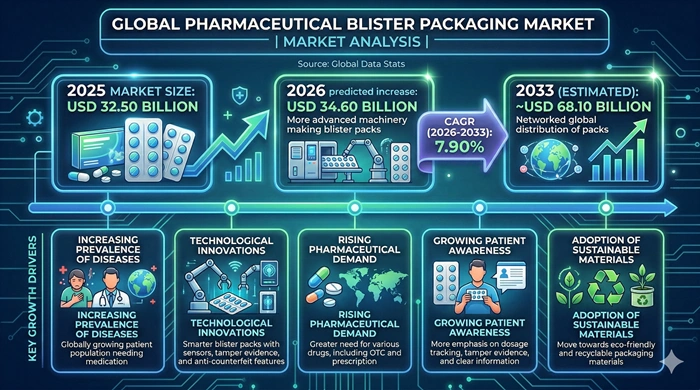
The global Pharmaceutical Blister Packaging market size is valued at USD 32.50 billion in 2025 and is predicted to increase from USD 34.60 billion in 2026 to approximately USD 68.10 billion by 2033, growing at a CAGR of 7.90% from 2026 to 2033.
Pharmaceutical blister packaging is one of the most widely used and commercially critical drug packaging formats in the global pharmaceutical industry — encompassing pre-formed plastic or aluminum cavities that individually house and protect solid oral dosage forms including tablets, capsules, softgels, and lozenges, as well as medical devices, diagnostic kits, and nutraceutical products. These packages seal the product within a forming film and a lidding material — typically aluminum foil, paper, or a combination thereof — providing tamper evidence, moisture barrier protection, light protection, and unit-dose dispensing convenience that collectively protect drug stability, support patient medication adherence, and facilitate regulatory compliance. The Pharmaceutical Blister Packaging market is experiencing sustained and strong growth driven by rising global pharmaceutical production volumes, expanding generic drug manufacturing, growing consumer preference for unit-dose packaging convenience, stringent pharmaceutical regulatory requirements, and advancing cold-form aluminum and child-resistant packaging innovations.
AI Impact on the Pharmaceutical Blister Packaging Industry
Artificial Intelligence Is Transforming Blister Packaging Quality Inspection, Predictive Maintenance of Packaging Lines, Intelligent Serialization and Track-and-Trace Systems, and Sustainable Material Design Optimization in Ways That Are Measurably Improving Packaging Line Efficiency, Drug Safety, and Regulatory Compliance Across the Global Pharmaceutical Packaging Ecosystem*
Artificial intelligence is making increasingly impactful contributions to the Pharmaceutical Blister Packaging market through the deployment of machine vision and deep learning-powered automated quality inspection systems on high-speed pharmaceutical blister packaging lines — where AI-powered camera and sensor arrays inspect every individual blister cavity in real time for defects including missing tablets, broken or chipped dosage forms, incorrect fill weights, sealing defects, label misalignment, and compromised packaging integrity at production speeds that exceed the reliable detection capability of conventional non-AI inspection systems. These AI quality inspection platforms are achieving defect detection accuracy levels significantly superior to traditional rule-based machine vision systems — with neural network models trained on large datasets of packaging defect images demonstrating robust generalization to novel defect morphologies and performing consistently across varying lighting conditions, package colors, and product configurations that previously required time-consuming manual inspection rule reconfiguration. Pharmaceutical manufacturers are deploying these AI inspection systems to meet the increasingly stringent quality assurance requirements of regulatory authorities including the FDA, EMA, and PMDA — where documented defect detection performance and complete inspection audit trails are becoming standard expectations in pharmaceutical manufacturing facility compliance inspections.
AI is simultaneously advancing pharmaceutical blister packaging operations through predictive maintenance applications that analyze real-time data streams from packaging line equipment — including forming station temperature and pressure sensors, sealing roller condition monitors, die punch wear indicators, and film tension control systems — to identify emerging equipment degradation patterns that precede unplanned line stoppages before they occur. By enabling planned maintenance interventions at operationally convenient times rather than reactive emergency repairs following unplanned equipment failures, AI predictive maintenance systems are delivering meaningful improvements in blister packaging line overall equipment effectiveness (OEE) — with documented improvements of 10–25% in packaging line uptime that translate directly into pharmaceutical manufacturer capacity utilization and production cost efficiency. AI-powered digital twin simulation platforms are also being applied to pharmaceutical blister packaging line design and process optimization — enabling virtual testing of new package formats, material specifications, and line speed parameters before physical implementation, reducing costly and time-consuming physical trial-and-error development cycles and accelerating the time-to-market for new pharmaceutical packaging configurations.
Growth Factors
Rising Global Pharmaceutical Production, Expanding Generic Drug Manufacturing, Growing Patient Medication Adherence Focus, Stringent Regulatory Packaging Requirements, and Cold-Form Aluminum Innovation Are the Core Growth Drivers of the Pharmaceutical Blister Packaging Market*
The most foundational and commercially durable growth driver of the Pharmaceutical Blister Packaging market is the continuously rising global pharmaceutical production volume — driven by aging global demographics generating increasing chronic disease management medication demand, expanding access to prescription and over-the-counter medicines in emerging markets, growing biologics and specialty pharmaceutical production, and the extraordinary volume of new drug approvals across oncology, immunology, neurology, and cardiovascular therapeutic areas that collectively generate expanding packaging material and equipment demand. The global generic drug manufacturing industry — now representing well over 80% of prescription drug volume dispensed in the United States and similarly dominant shares in European and Asian markets — is a particularly important and commercially significant driver of pharmaceutical blister packaging market demand growth, as generic manufacturers package virtually all solid oral dosage forms in blister configurations that meet both cost efficiency and patient convenience requirements. Generic drug production volumes are expanding rapidly across emerging manufacturing hubs in India, China, and Eastern Europe — generating growing blister packaging material and equipment procurement demand from these manufacturing centers that is a major contributor to Asia Pacific's strong regional market growth.
Growing pharmaceutical regulatory emphasis on patient medication adherence — and the increasing clinical and pharmacoeconomic evidence linking poor medication adherence to poor chronic disease management outcomes and preventable healthcare costs — is reinforcing pharmaceutical manufacturer and pharmacist preference for unit-dose blister packaging formats that enable patients to easily track daily medication consumption, identify missed doses, and understand proper dosing schedules. Unit-dose blister packs printed with day-of-week and date indicators — so-called compliance blister or calendar blister formats — are being adopted more broadly across cardiovascular, diabetes, hypertension, psychiatric, and contraceptive medication packaging programs specifically to address the widely recognized medication adherence challenge. The simultaneous expansion of pharmaceutical regulatory requirements across major drug markets — including serialization and track-and-trace mandates, child-resistant packaging requirements, tamper-evident seal standards, and moisture barrier performance specifications — is creating additional technical complexity and material innovation requirements in pharmaceutical blister packaging that drive both material and equipment procurement investment throughout the Pharmaceutical Blister Packaging market supply chain.
Market Outlook
With Cold-Form Aluminum Adoption Expanding, Sustainable Recyclable Blister Material Innovations Accelerating, Emerging Market Pharma Manufacturing Growing, and Serialization Compliance Investment Driving Technology Upgrades, the Pharmaceutical Blister Packaging Market Outlook Is Robustly Positive Through 2033*
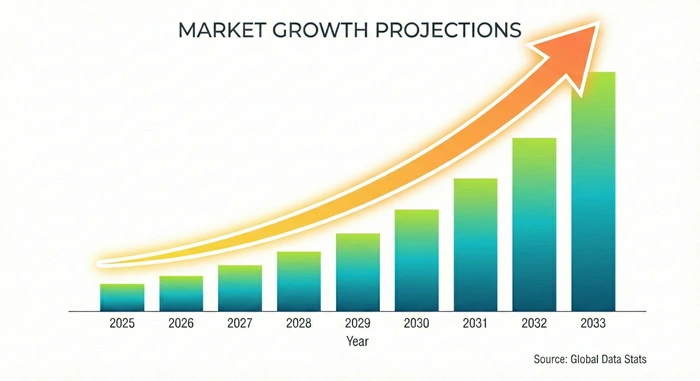
The long-term outlook for the Pharmaceutical Blister Packaging market is firmly positive, supported by multiple converging structural, regulatory, and innovation-driven growth catalysts expected to sustain strong revenue expansion throughout the 2026–2033 forecast period. Cold-form aluminum blister packaging — which provides superior moisture barrier, light barrier, and oxygen barrier protection compared to thermoform plastic blister alternatives — is gaining accelerating adoption for moisture-sensitive pharmaceutical products including biologics, oncology drugs, and hygroscopic tablet formulations that require the enhanced protection cold-form packaging delivers to ensure drug stability throughout shelf life. As pharmaceutical pipelines progressively generate more complex, moisture-sensitive, and high-value drug molecules that require superior packaging protection — particularly in the rapidly growing biologics, oncology, and specialty pharmaceutical segments — the cold-form aluminum blister packaging category is expected to grow at a meaningfully faster rate than the overall market throughout the forecast period, generating premium pricing and material revenue growth opportunities for leading suppliers including Amcor, Constantia Flexibles, and Klöckner Pentaplast.
The pharmaceutical packaging industry's accelerating focus on sustainability — driven by both pharmaceutical company ESG commitments and the growing regulatory and consumer pressure to reduce plastic packaging waste — is simultaneously creating significant innovation investment in recyclable and mono-material blister packaging formats that maintain the performance characteristics required for pharmaceutical protection while improving end-of-life recyclability. Leading packaging material suppliers are investing in the development of high-barrier recyclable PET and polypropylene mono-material blister films — as well as paper-based blister packaging innovations — that can meet pharmaceutical moisture and oxygen barrier requirements while qualifying for mainstream recycling streams. This sustainability innovation imperative is progressively reshaping material specification decisions in pharmaceutical packaging procurement — creating new premium material revenue opportunities for suppliers that can demonstrate both regulatory-compliant barrier performance and credible sustainability improvement in their next-generation blister packaging material portfolios throughout the forecast period.
Expert Speaks
-
Albert Manifold, CEO, CRH plc (packaging materials) — "The pharmaceutical packaging sector — including blister pack formats for solid dose drugs — continues to demonstrate exceptional demand resilience driven by healthcare's fundamental growth dynamics and the non-discretionary nature of pharmaceutical purchasing that insulates blister packaging demand from typical consumer spending cyclicality. We see the convergence of regulatory serialization requirements, cold-form barrier material adoption, and sustainability-driven recyclable packaging innovation creating a period of significant capital investment and technology renewal in pharmaceutical blister packaging manufacturing that will sustain above-market industry growth through the decade."
-
Ron Delia, CEO, Amcor plc — "Pharmaceutical packaging — and blister packaging specifically — represents one of Amcor's most strategically important and commercially attractive market segments, where the combination of non-discretionary end-market demand, stringent regulatory performance requirements, and continuous innovation in barrier materials, sustainability, and patient-convenience formats creates a durable and competitively differentiated business. The growing cold-form aluminum and high-barrier flexible film blister packaging categories are generating strong volume and pricing growth that reflects the pharmaceutical industry's investment in protecting increasingly complex and valuable drug molecules throughout the supply chain."
-
Miles White, Former CEO, Abbott Laboratories — "The importance of blister packaging in supporting patient medication adherence — through unit-dose format clarity, day-of-week dosing indicators, and tamper-evident convenience — is increasingly recognized by pharmaceutical manufacturers and healthcare systems as a meaningful contributor to treatment outcome and public health quality metrics. As the pharmaceutical industry develops increasingly potent and sensitive drug molecules that require superior packaging protection, the technical performance and innovation requirements for blister packaging materials and manufacturing equipment are rising — creating growing investment and premium revenue opportunities for suppliers at the leading edge of blister packaging technology."
Key Report Takeaways
-
Europe dominates the Pharmaceutical Blister Packaging market, holding approximately 34.20% of global market share in 2025, driven by the world's highest blister packaging adoption rates for pharmaceutical solid oral dosage forms, the most stringent pharmaceutical packaging regulatory requirements under EMA oversight including comprehensive serialization and child-resistant packaging mandates, a strong domestic pharmaceutical manufacturing base across Germany, Switzerland, France, Italy, and the United Kingdom, and the presence of leading global blister packaging material and equipment suppliers with deep regional pharmaceutical customer relationships.
-
Asia Pacific is the fastest-growing regional market for pharmaceutical blister packaging, projected to expand at a CAGR of approximately 9.40% from 2026 to 2033, driven by India and China's extraordinary generic drug manufacturing volume growth generating massive blister packaging material and equipment procurement demand, rapidly expanding domestic pharmaceutical consumption in both markets driven by rising middle-class healthcare access and government universal healthcare program expansion, and progressive adoption of serialization and track-and-trace packaging requirements across Asian pharmaceutical regulatory systems that are driving technology investment and compliance packaging upgrades.
-
PVC plastic remains the dominant material segment, accounting for approximately 38.60% of total market revenue in 2025, reflecting PVC's combination of thermoformability, optical clarity, cost efficiency, and adequate barrier performance for a wide range of standard pharmaceutical blister packaging applications — with PVC film remaining the most broadly used forming film material in mainstream pharmaceutical solid oral dosage form packaging across global markets despite growing regulatory and sustainability scrutiny of PVC's chlorine content and limited recyclability.
-
Prescription drugs represent the largest end-use segment, contributing approximately 52.80% of total market revenue in 2025, driven by the enormous volume of prescription solid oral medications — including cardiovascular, antidiabetic, antihypertensive, oncology, and psychiatric drugs — packaged in blister configurations that meet both the performance requirements of sensitive pharmaceutical formulations and the regulatory compliance, serialization, and child-resistant packaging requirements of major pharmaceutical regulatory jurisdictions globally.
-
Cold-form aluminum foil blister packaging is the fastest-growing material category, projected to expand at a CAGR of approximately 10.20% through 2033, driven by the pharmaceutical industry's progressively moisture-sensitive and oxygen-sensitive drug pipeline — particularly in biologics, oncology, and specialty pharmaceutical segments — that demands superior barrier protection performance that only cold-form aluminum packaging can consistently deliver compared to thermoform plastic alternatives that have inherent moisture vapor transmission rate limitations regardless of barrier coating enhancements.
-
Nutraceuticals and dietary supplements represent the fastest-growing end-use segment beyond prescription pharma, expected to expand at a CAGR of approximately 11.60% through 2033, driven by the extraordinary global consumer health and wellness spending growth that is generating strong volume expansion in vitamins, minerals, supplements, and functional nutrition products that are increasingly packaged in pharmaceutical-grade blister formats that signal product quality, protect against moisture and oxidation, and deliver unit-dose convenience that premium consumer supplement brands are leveraging as a packaging differentiation and shelf impact strategy.
Market Scope
| Report Coverage | Details |
|---|---|
| Market Size by 2033 | USD 68.10 Billion |
| Market Size by 2025 | USD 32.50 Billion |
| Market Size by 2026 | USD 34.60 Billion |
| Market Growth Rate (2026–2033) | CAGR of 7.90% |
| Dominating Region | Europe |
| Fastest Growing Region | Asia Pacific |
| Base Year | 2025 |
| Forecast Period | 2026–2033 |
| Segments Covered | Material, Packaging Type, End Use |
| Regions Covered | North America, Europe, Asia Pacific, Latin America, Middle East & Africa |
Market Dynamics
Drivers Impact Analysis
Rising Pharmaceutical Production Volumes, Generic Drug Manufacturing Expansion, Regulatory Serialization Mandates, and Cold-Form Barrier Material Adoption Are the Four Pillars Powering Pharmaceutical Blister Packaging Market Growth*
| Driver | ≈ % Impact on CAGR Forecast | Geographic Relevance | Impact Timeline |
|---|---|---|---|
| Rising global pharmaceutical production and new drug approval volumes | ~33% | Global | Short to Long-term |
| Expanding generic drug manufacturing in India, China, and Eastern Europe | ~28% | Asia Pacific, Europe | Short to Long-term |
| Regulatory serialization, child-resistant, and compliance packaging mandates | ~26% | North America, Europe, Asia Pacific | Short to Medium-term |
| Cold-form aluminum and high-barrier material adoption for sensitive drug formulations | ~13% | Global — especially Europe, North America | Short to Long-term |
The most enduring and structurally powerful driver of the Pharmaceutical Blister Packaging market is the continuously rising global pharmaceutical production volume — driven by aging demographics generating expanding chronic disease medication demand, rapidly growing pharmaceutical access in emerging markets through generic drug programs and government universal healthcare initiatives, and extraordinary new drug approval activity across oncology, immunology, and metabolic disease therapeutic areas that collectively generate escalating packaging material and equipment procurement demand. India's pharmaceutical manufacturing sector — now the world's largest generic drug supplier by volume and the primary source of affordable generic medicines for global health programs — is generating particularly significant and rapidly growing blister packaging material demand as Indian manufacturers scale production of solid oral dosage forms for both domestic consumption and export markets across the United States, Europe, Africa, and Southeast Asia. China's pharmaceutical manufacturing expansion — driven by domestic healthcare reform, generic drug quality upgrade programs, and growing international regulatory market access — is similarly generating substantial incremental blister packaging demand that is a key contributor to Asia Pacific's strong regional market growth trajectory.
Regulatory serialization and track-and-trace packaging mandates — implemented in the United States through the Drug Supply Chain Security Act (DSCSA), in Europe through the EU Falsified Medicines Directive (FMD) serialization requirements, and progressively in Asian pharmaceutical regulatory jurisdictions — are creating significant technology investment demand for pharmaceutical manufacturers upgrading their blister packaging lines with serialization printing, vision verification, and data management systems that meet regulatory compliance requirements. These mandates are generating capital equipment investment cycles across pharmaceutical blister packaging line infrastructure globally — as manufacturers that have not yet fully implemented serialization-compliant packaging operations must invest in technology upgrades to maintain market access — creating a durable and compliance-driven equipment procurement demand wave that sustains strong packaging technology investment in the Pharmaceutical Blister Packaging market throughout the near-term forecast period.
Restraints Impact Analysis
Volatile Raw Material Prices, PVC Environmental Regulatory Pressure, Complex Regulatory Compliance Requirements, and Sustainability Transition Costs Restrain Faster Pharmaceutical Blister Packaging Market Growth*
| Restraint | ≈ % Impact on CAGR Forecast | Geographic Relevance | Impact Timeline |
|---|---|---|---|
| Volatile aluminum and plastic resin raw material prices affecting packaging cost economics | ~34% | Global | Short to Long-term |
| Growing regulatory and environmental pressure on PVC blister packaging materials | ~28% | Europe, North America | Short to Medium-term |
| Complex pharmaceutical packaging regulatory compliance requirements increasing market entry barriers | ~26% | Global | Short to Long-term |
| High capital investment required for sustainable recyclable packaging material transition | ~12% | Global | Short to Medium-term |
The most immediately commercially impactful restraint on the Pharmaceutical Blister Packaging market is the significant and persistent volatility of raw material prices — particularly aluminum, PVC resin, PVDC, and PET film — that are subject to global commodity market fluctuations driven by energy price volatility, supply chain disruptions, currency movements, and geopolitical factors that create challenging procurement cost management conditions for blister packaging material suppliers and pharmaceutical packaging buyers. Aluminum price volatility is particularly significant for pharmaceutical blister packaging market economics — as aluminum foil is a critical component in virtually all blister package constructions as the lidding material and in cold-form configurations as both the forming and lidding material — with aluminum price spikes directly impacting packaging material cost and compressing supplier margins when contractual pricing arrangements constrain the speed of raw material cost pass-through to pharmaceutical manufacturer customers. The compounding effect of simultaneously volatile energy costs — which directly impact both plastic film extrusion and aluminum rolling manufacturing process costs — and raw material price instability creates persistent margin pressure throughout the pharmaceutical blister packaging supply chain that constrains profitability improvement and limits the pace of packaging innovation investment.
Growing regulatory and environmental scrutiny of PVC as a pharmaceutical blister packaging material — driven by European chemical regulation frameworks including REACH, expanding EU plastic packaging waste regulations, and pharmaceutical company sustainability commitments to reduce PVC use in their packaging portfolios — is creating a progressive material substitution challenge for the pharmaceutical blister packaging industry that involves significant technical complexity and capital investment. Replacing PVC with more sustainable alternatives — including PVDC-coated PET, OPA, polypropylene, or novel recyclable mono-material films — requires pharmaceutical manufacturers to conduct equivalence studies, stability testing, and regulatory filing updates for every product reformulated on alternative blister packaging materials, creating substantial regulatory submission workload and timeline challenges that slow the practical pace of PVC transition despite strong strategic commitment from pharmaceutical companies to reduce their PVC packaging footprint.
Opportunities Impact Analysis
Sustainable Recyclable Blister Packaging Innovation, Cold-Form Barrier Growth for Sensitive Drug Pipelines, Emerging Market Pharma Packaging Expansion, and Smart Connected Blister Package Development Create Major Opportunities*
| Opportunity | ≈ % Impact on CAGR Forecast | Geographic Relevance | Impact Timeline |
|---|---|---|---|
| Sustainable recyclable mono-material and paper-based blister packaging innovation | ~33% | Europe, North America | Short to Medium-term |
| Cold-form aluminum blister adoption growth for biologics and specialty drug pipelines | ~28% | Global — especially North America, Europe | Short to Medium-term |
| Emerging market pharmaceutical packaging demand driven by generic drug production | ~27% | Asia Pacific, Latin America | Medium to Long-term |
| Smart connected blister packaging with NFC, RFID, and adherence monitoring electronics | ~12% | North America, Europe | Medium to Long-term |
The development and commercialization of sustainable recyclable blister packaging formats — encompassing mono-material PET or PP blister systems, paper-based blister innovations, and bio-based forming films — represents one of the most commercially significant and strategically important near-term opportunities in the Pharmaceutical Blister Packaging market. Major pharmaceutical companies including Pfizer, AstraZeneca, Novartis, and Roche have publicly committed to comprehensive pharmaceutical packaging sustainability programs that include specific targets for PVC elimination and recyclable packaging adoption — creating strong and commercially backed pull demand for packaging material suppliers capable of delivering regulatory-compliant, performance-equivalent sustainable alternatives to conventional PVC-aluminum blister packaging. Packaging material suppliers including Amcor, Constantia Flexibles, and Klöckner Pentaplast are investing substantially in sustainable blister packaging portfolio development — recognizing that early commercial leadership in recyclable pharmaceutical blister packaging materials positions them favorably in a market where pharmaceutical company sustainability commitments are progressively translating into procurement specification requirements.
Smart connected blister packaging — incorporating near-field communication (NFC) chips, printed electronics, or RFID technology into blister package designs — represents an emerging but commercially compelling innovation frontier in the pharmaceutical blister packaging market. These smart packaging systems can communicate with patient smartphones to record dose-taking events, remind patients of scheduled doses, generate medication adherence reports for healthcare providers, and enable real-time supply chain track-and-trace visibility beyond basic serialization — addressing simultaneously the medication adherence challenge, the counterfeit medicine security challenge, and the healthcare system's growing demand for real-world drug utilization data. While smart blister packaging remains in relatively early commercialization stages, the growing pharmacoeconomic evidence for the healthcare system cost savings achievable through improved medication adherence — combined with digital health reimbursement model developments and pharmaceutical manufacturer interest in adherence program support — is progressively building the commercial rationale for smart packaging investment that is expected to generate meaningful market revenue during the later years of the forecast period.
Segment Analysis
By Material
PVC Plastic Leads the Pharmaceutical Blister Packaging Market Material Revenue While Cold-Form Aluminum Registers the Fastest Premium Growth*
PVC film holds the dominant position in the Pharmaceutical Blister Packaging market material segment, accounting for approximately 38.60% of total global market revenue in 2025, reflecting PVC's combination of excellent thermoformability on standard blister packaging machinery, optical clarity that enables visual tablet inspection, broad chemical compatibility with diverse pharmaceutical formulations, low material cost per unit, and adequate moisture barrier performance for the majority of standard pharmaceutical solid oral dosage form packaging applications that do not require the superior barrier performance of cold-form aluminum alternatives. PVC's processing advantages — including consistent forming behavior, wide thermoforming temperature windows, and compatibility with standard pharmaceutical packaging line equipment — have made it the default forming film material specification for standard pharmaceutical blister packaging globally, with displacement requiring pharmaceutical manufacturers to invest in stability testing, regulatory filing updates, and sometimes machine modification that creates significant inertia favoring continued PVC use in standard applications. North America and Europe lead PVC blister film consumption — driven by the largest pharmaceutical production volumes in these regions — while regulatory and sustainability pressure is progressively motivating material substitution in European markets. Klöckner Pentaplast, Bilcare, Amcor, and Uflex are among the leading global PVC pharmaceutical blister film suppliers maintaining strong customer relationships across North American and European pharmaceutical packaging markets.
Cold-form aluminum foil blister packaging represents the fastest-growing material category in the Pharmaceutical Blister Packaging market, projected to expand at a CAGR of approximately 10.20% from 2026 to 2033, driven by the pharmaceutical industry's progressively complex and moisture-sensitive specialty drug pipeline — including hygroscopic tablets, effervescent formulations, oncology drugs, immunology medications, and select biologics — that require the near-zero moisture vapor transmission rate and complete light barrier that cold-form aluminum packaging uniquely provides among commercially viable pharmaceutical blister packaging material options. Cold-form aluminum blister packaging adoption is growing fastest in Europe — where the long-established preference for aluminum packaging across pharmaceutical markets, combined with the strong pipeline of moisture-sensitive specialty drugs developed by the region's large pharmaceutical manufacturers, creates particularly favorable conditions for cold-form blister adoption — with Constantia Flexibles, Amcor Flexibles, and Huhtamaki being key suppliers of pharmaceutical-grade cold-form aluminum lidding and forming foil in the European market. North America is experiencing accelerating cold-form adoption — driven by the growing biologics and oncology drug production that requires superior barrier protection — while Asia Pacific is the fastest-growing cold-form adoption region as Indian and Chinese pharmaceutical manufacturers upgrade packaging specifications for export-market regulatory compliance and domestic premium drug brand positioning.
By End Use
Prescription Drugs Lead the Pharmaceutical Blister Packaging Market End-Use Revenue While Nutraceuticals Register the Fastest Segment Growth*
Prescription drugs represent the largest and most commercially significant end-use segment in the Pharmaceutical Blister Packaging market, accounting for approximately 52.80% of total global market revenue in 2025, driven by the enormous and continuously expanding volume of prescription solid oral dosage forms — tablets, capsules, and softgels — packaged in blister configurations that meet the performance, regulatory compliance, child-resistant packaging, and serialization requirements mandated by pharmaceutical regulatory authorities in major drug markets worldwide. The prescription drug end-use segment encompasses a diverse range of therapeutic areas — cardiovascular, antidiabetic, antihypertensive, central nervous system, oncology, immunology, and infectious disease — each generating distinct blister packaging material performance requirements that drive diverse material, format, and equipment procurement decisions by pharmaceutical manufacturers. Europe leads prescription drug blister packaging revenue globally — supported by the highest blister pack adoption rates for pharmaceutical products, the most comprehensive serialization and child-resistant packaging regulatory requirements, and the most established pharmaceutical blister packaging supply chain ecosystem — while Asia Pacific is the fastest-growing region driven by generic drug production expansion. Major pharmaceutical companies including Pfizer, AstraZeneca, Novartis, and Sanofi are key prescription drug blister packaging end-use customers — each managing complex blister packaging specification portfolios across multiple products, markets, and regulatory jurisdictions.
The nutraceuticals and dietary supplements end-use segment is the fastest-growing category in the Pharmaceutical Blister Packaging market, projected to expand at a CAGR of approximately 11.60% from 2026 to 2033, driven by the extraordinary consumer health and wellness spending growth globally that is generating strong volume expansion in vitamins, minerals, omega-3 supplements, probiotics, sports nutrition products, and functional food ingredients that premium supplement brands are increasingly packaging in pharmaceutical-grade blister formats. The adoption of blister packaging in the nutraceutical segment reflects premium brand strategy — where unit-dose blister pack presentation conveys product quality, clinical efficacy, and pharmaceutical-grade manufacturing standards that differentiate premium supplement brands from commodity bulk bottle presentations in competitive retail and e-commerce environments. Asia Pacific is the fastest-growing region for nutraceutical blister packaging adoption — driven by the extraordinary consumer wellness market growth in China, India, South Korea, and Japan where rising middle-class disposable income, growing preventive healthcare awareness, and the strong cultural tradition of dietary supplement use in Asian markets are generating rapid nutraceutical production volume and blister packaging procurement growth. Leading packaging suppliers serving the nutraceutical blister segment include Amcor, Berry Global, Constantia Flexibles, and Uflex — competing on barrier performance, print quality, format innovation, and sustainable material development for premium supplement brand customers.
Regional Insights
Europe
Europe Commands the Global Pharmaceutical Blister Packaging Market With the World's Highest Blister Pack Adoption Rates, Most Stringent Pharmaceutical Packaging Regulatory Requirements, and the Strongest Pharmaceutical Manufacturing and Packaging Supply Chain Ecosystem*
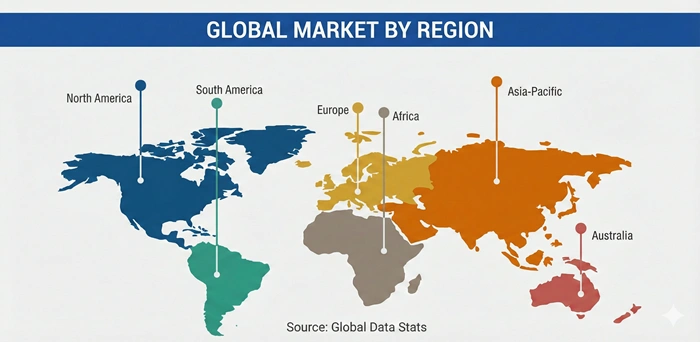
Europe holds the dominant position in the global Pharmaceutical Blister Packaging market, accounting for approximately 34.20% of total global market revenue in 2025, and is projected to maintain steady market leadership at a CAGR of approximately 7.40% from 2026 to 2033. Germany, Switzerland, France, Italy, and the United Kingdom collectively represent the core of European pharmaceutical blister packaging demand — driven by the concentration of major multinational pharmaceutical manufacturers including Roche, Novartis, AstraZeneca, Sanofi, and Bayer that collectively generate enormous and diverse blister packaging procurement volumes. The European Pharmaceutical Blister Packaging market is characterized by the world's most stringent pharmaceutical packaging regulatory standards — including the EU Falsified Medicines Directive serialization requirements, comprehensive child-resistant packaging regulations, and progressively expanding sustainable packaging mandates — that collectively drive high technology investment in advanced blister packaging materials, equipment, and compliance systems. Leading companies commanding the European blister packaging market include Amcor Flexibles, Constantia Flexibles, Klöckner Pentaplast, Huhtamaki, and Bilcare — each maintaining strong pharmaceutical customer relationships through technical service capabilities, regulatory expertise, and comprehensive product portfolios spanning PVC, PVDC, cold-form aluminum, and sustainable material blister packaging solutions.
The European market is at the forefront of pharmaceutical blister packaging sustainability innovation — with EU packaging regulation evolution, pharmaceutical company sustainability commitments, and consumer environmental awareness collectively driving the most intensive investment in recyclable and PVC-free blister packaging material development anywhere in the global market. European blister packaging material suppliers are investing in high-barrier recyclable PET mono-material films, paper-based blister innovations, and bio-based forming films that can meet EU pharmaceutical packaging performance requirements while qualifying for mainstream recycling infrastructure — positioning Europe as the lead commercial market for sustainable blister packaging technology development and adoption that progressively influences global pharmaceutical packaging material specifications throughout the forecast period.
Asia Pacific
Asia Pacific Is the Fastest-Growing Pharmaceutical Blister Packaging Market, Driven by India and China's Generic Drug Manufacturing Dominance, Rapidly Expanding Domestic Pharmaceutical Consumption, and Progressive Regulatory Serialization Compliance Investment*
Asia Pacific is the fastest-growing regional segment in the Pharmaceutical Blister Packaging market, projected to expand at a CAGR of approximately 9.40% from 2026 to 2033 — the highest of any region globally. India is the most commercially dynamic and rapidly growing Asia Pacific blister packaging market — where the world's largest generic drug manufacturing industry is generating massive and continuously expanding blister packaging material and equipment procurement demand from pharmaceutical manufacturers scaling production across Hyderabad, Ahmedabad, Mumbai, and other pharmaceutical manufacturing hubs for both domestic consumption and export to regulated markets in North America, Europe, and Africa. China's pharmaceutical manufacturing sector is simultaneously generating substantial incremental blister packaging demand — driven by domestic healthcare reform creating universal medication access programs, generic drug quality upgrade initiatives requiring pharmaceutical-grade packaging compliance, and growing international regulatory market entry driving export-oriented pharmaceutical production investment. Key companies serving Asia Pacific Pharmaceutical Blister Packaging market growth include Uflex Limited, Bilcare Limited, Cosmo Films, and rapidly expanding domestic packaging suppliers in China alongside global players including Amcor and Klöckner Pentaplast establishing regional manufacturing capabilities to serve growing Asia Pacific pharmaceutical customer demand.
South Korea and Japan represent technically sophisticated and commercially mature Asia Pacific blister packaging markets — with well-established pharmaceutical industries, advanced packaging material technology capabilities, and strong domestic blister packaging supply chain ecosystems that serve both domestic pharmaceutical production and export market requirements. Southeast Asian pharmaceutical manufacturing expansion — particularly in Singapore, Thailand, and Vietnam — is progressively generating first-time pharmaceutical-grade blister packaging procurement demand as healthcare infrastructure investment and pharmaceutical manufacturing sector development accelerate across the region. The combination of India and China's generic drug manufacturing scale, Southeast Asia's manufacturing emergence, and Japan and South Korea's premium pharmaceutical packaging sophistication collectively positions Asia Pacific as the most commercially diverse and fastest-growing regional market in global pharmaceutical blister packaging through 2033.
Top Key Players
-
Amcor plc (Switzerland / United States)
-
Constantia Flexibles GmbH (Austria)
-
Klöckner Pentaplast Group (Germany)
-
Huhtamaki Oyj (Finland)
-
Bilcare Limited (India)
-
Uflex Limited (India)
-
Berry Global Group Inc. (United States)
-
WestRock Company (United States)
-
Sealed Air Corporation (United States)
-
Winpak Ltd. (Canada)
-
ACG Worldwide (India)
-
Tekni-Plex Inc. (United States)
Recent Developments
-
Amcor plc (2025) — Announced a significant advancement in its pharmaceutical sustainable packaging portfolio through the commercial launch of AmLite Ultra Recyclable pharmaceutical blister packaging — a high-barrier recyclable aluminum-free foil lidding material for pharmaceutical blister packs designed to meet pharmaceutical stability requirements while qualifying for aluminum-free recycling streams — representing a major milestone in Amcor's pharmaceutical packaging sustainability program and responding to pharmaceutical company customer commitments to eliminate PVC and aluminum from their packaging portfolios in line with EU sustainable packaging regulation timelines.
-
Constantia Flexibles (2024) — Launched its EcoLid sustainable pharmaceutical blister lidding range — featuring paper-based and recyclable aluminum-coated alternatives to conventional aluminum foil pharmaceutical blister lidding that meet EU pharmaceutical child-resistant packaging and moisture barrier requirements — reinforcing Constantia's leadership in sustainable pharmaceutical flexible packaging innovation and responding to growing pharmaceutical manufacturer demand for credible, regulatory-compliant sustainable blister packaging alternatives that support pharmaceutical company sustainability reporting commitments.
-
Klöckner Pentaplast (2025) — Announced the commercial availability of its kpPharma RX series of next-generation PVDC-free high-barrier pharmaceutical blister films — featuring significantly improved moisture barrier performance compared to standard PVDC-coated PVC alternatives while eliminating chlorinated polymer content — designed to address both performance requirements of moisture-sensitive oral solid dosage forms and pharmaceutical company sustainability commitments to reduce halogenated material use in their packaging portfolios across European and North American regulated markets.
-
Bilcare Limited (2024) — Completed a significant capacity expansion of its pharmaceutical blister packaging film manufacturing facilities in India — adding new extrusion and coating lines for PVC, PVDC, and cold-form aluminum foil products — in response to the extraordinary growth of Indian generic pharmaceutical manufacturing driving domestic blister packaging material procurement, while simultaneously expanding its technical service capabilities to support Indian pharmaceutical manufacturers in regulatory submission packaging stability studies for US FDA and EMA market access applications.
-
ACG Worldwide (2025) — Announced the expansion of its Pharmaready blister packaging line engineering and equipment business into Southeast Asian markets — establishing technical support and demonstration centers in Singapore and Thailand to serve pharmaceutical manufacturers in the region seeking to upgrade blister packaging line technology for compliance with progressive regulatory serialization requirements — reinforcing ACG's position as the leading Asia Pacific-based integrated pharmaceutical blister packaging material and equipment supplier serving emerging pharmaceutical manufacturing markets.
Market Trends
The Accelerating Transition to Sustainable Recyclable Blister Packaging Material Formats and the Progressive Integration of Serialization and Smart Track-and-Trace Technology Into Pharmaceutical Blister Packaging Lines Are the Two Most Commercially Significant Trends Reshaping the Pharmaceutical Blister Packaging Market*
The most transformative structural trend reshaping the Pharmaceutical Blister Packaging market is the pharmaceutical industry's accelerating commitment to sustainable packaging — where pharmaceutical company ESG investment programs, evolving EU packaging regulations, and growing stakeholder pressure to reduce plastic and aluminum packaging waste are collectively driving unprecedented investment in recyclable, PVC-free, and paper-based blister packaging material innovation. Leading packaging material suppliers are racing to commercialize pharmaceutical-grade recyclable blister packaging solutions — including mono-material PET and PP high-barrier systems, paper-based blister innovations, and bio-based forming films — that can meet the rigorous moisture barrier, light protection, mechanical strength, and regulatory stability testing performance requirements of pharmaceutical applications while qualifying for mainstream recycling collection and processing infrastructure. As early commercial recyclable pharmaceutical blister packaging launches accumulate stability validation data and regulatory filing acceptance track records, the adoption barrier for sustainable material substitution is progressively declining — accelerating the pace of pharmaceutical company product reformulation onto sustainable blister packaging platforms throughout the forecast period.
The progressive global rollout of pharmaceutical serialization and track-and-trace regulatory mandates — including DSCSA in the United States, EU FMD in Europe, and equivalent legislation in India, China, South Korea, Turkey, and Saudi Arabia — is simultaneously driving significant technology investment in pharmaceutical blister packaging line serialization printing, vision inspection, aggregation, and data management system integration. Pharmaceutical manufacturers that have not yet fully achieved serialization compliance across all packaging line operations — including many mid-size and smaller generic manufacturers in Asia Pacific markets where serialization mandate implementation timelines are still being phased in — represent a large and commercially significant capital equipment upgrade opportunity for blister packaging line technology and serialization system suppliers throughout the near-term forecast period. The emerging integration of NFC and RFID connected packaging technology into pharmaceutical blister packs — enabling patient adherence monitoring, real-world drug utilization tracking, and supply chain event recording beyond standard serialization — represents the next technology frontier that leading pharmaceutical packaging equipment and material companies are actively investing in to serve the pharmaceutical industry's growing digital health and patient engagement program requirements.
Segments Covered in the Report
By Material:
-
Plastic
-
PVC
-
PVDC
-
PET
-
Cyclic Olefin Copolymer
-
Aluminum
-
Cold Form Foil
-
Thermoform Foil
-
Paper & Paperboard
-
Others
By Packaging Type:
-
Clamshell Blister
-
Face Seal Blister
-
Full Face Seal Blister
-
Trapped Blister
By End Use:
-
Prescription Drugs
-
Over-the-Counter Drugs
-
Nutraceuticals and Dietary Supplements
-
Medical Devices and Diagnostics
By Region:
-
North America
-
Europe
-
Asia Pacific
-
Latin America
-
Middle East & Africa
Frequently Asked Questions
Question 1: What is the current size of the Pharmaceutical Blister Packaging market and what is its projected value by 2033?
Answer: The Pharmaceutical Blister Packaging market was valued at USD 32.50 billion in 2025 and is projected to reach USD 68.10 billion by 2033, growing at a CAGR of 7.90% from 2026 to 2033. This growth is driven by rising global pharmaceutical production, expanding generic drug manufacturing in India and China, growing regulatory compliance packaging requirements, and accelerating cold-form aluminum and sustainable recyclable blister packaging innovation.
Question 2: Which material dominates the Pharmaceutical Blister Packaging market?
Answer: PVC plastic film holds the dominant material position in the Pharmaceutical Blister Packaging market with approximately 38.60% of total revenue in 2025 — driven by PVC's combination of thermoformability, optical clarity, cost efficiency, and adequate barrier performance for standard pharmaceutical solid oral dosage form packaging applications. Cold-form aluminum foil is the fastest-growing material segment, driven by the pharmaceutical industry's progressively moisture-sensitive and oxygen-sensitive drug pipeline that requires superior barrier protection beyond what thermoform plastic alternatives can reliably deliver.
Question 3: Which region leads the Pharmaceutical Blister Packaging market and which is growing the fastest?
Answer: Europe dominates the Pharmaceutical Blister Packaging market with approximately 34.20% of global revenue in 2025 — driven by the world's highest blister pack adoption rates, the most stringent pharmaceutical packaging regulatory requirements, and the strongest pharmaceutical manufacturing and packaging supply chain ecosystem across Germany, Switzerland, France, and the UK. Asia Pacific is the fastest-growing region at approximately 9.40% CAGR through 2033 — powered by India and China's generic drug manufacturing expansion, rapidly growing domestic pharmaceutical consumption, and progressive regulatory serialization compliance investment.
Question 4: How is the sustainability trend impacting the Pharmaceutical Blister Packaging market?
Answer: The pharmaceutical industry's sustainability commitments — driven by EU packaging regulations, pharmaceutical company ESG programs, and growing environmental stakeholder pressure — are creating unprecedented investment in recyclable PVC-free and paper-based blister packaging material innovations that maintain pharmaceutical-grade barrier performance while improving end-of-life recyclability within the Pharmaceutical Blister Packaging market. Leading suppliers including Amcor, Constantia Flexibles, and Klöckner Pentaplast are commercially launching recyclable and PVDC-free pharmaceutical blister film portfolios — with adoption progressively accelerating as pharmaceutical manufacturers accumulate regulatory stability validation data supporting material substitution decisions on their packaging-critical drug products.
Question 5: What role does serialization play in driving investment in the Pharmaceutical Blister Packaging market?
Answer: Pharmaceutical serialization and track-and-trace regulatory mandates — including DSCSA in the United States, EU FMD in Europe, and equivalent legislation across Asia Pacific and Middle Eastern pharmaceutical markets — are driving significant capital equipment investment in blister packaging line serialization printing, vision verification, and data management system upgrades that represent a major near-term growth catalyst for the Pharmaceutical Blister Packaging market. Mid-size and smaller generic pharmaceutical manufacturers in Asia Pacific markets where serialization mandate timelines are still being phased in represent a large and commercially significant technology upgrade opportunity for packaging line equipment and serialization system suppliers throughout the 2026–2033 forecast period.