
Personalized Testing and Supplements Market Overview
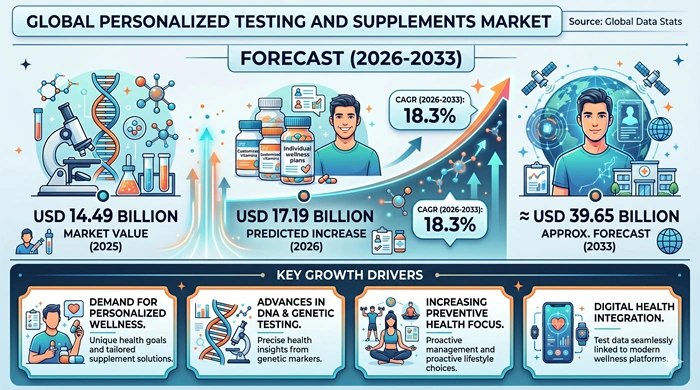
The global personalized testing and supplements market size is valued at USD 14.49 billion in 2025 and is predicted to increase from USD 17.19 billion in 2026 to approximately USD 39.65 billion by 2033, growing at a CAGR of 18.3% from 2026 to 2033.
The personalized testing and supplements market is undergoing a remarkable transformation, driven by a fundamental shift in how consumers approach their health and wellness. Rather than accepting one-size-fits-all supplement regimens, individuals are increasingly demanding scientifically validated, data-driven nutritional guidance tailored to their unique genetics, microbiome composition, metabolic profile, and lifestyle factors. This convergence of advanced diagnostics with targeted supplementation is creating a high-growth market with exceptional commercial momentum through 2033.
AI Impact on the Personalized Testing and Supplements Industry
Artificial Intelligence Is Fundamentally Transforming How Personalized Health Data Is Analyzed, Supplement Formulations Are Developed, and Consumer Wellness Journeys Are Managed at Scale
Artificial intelligence is at the heart of the personalized testing and supplements market's rapid evolution. AI-powered platforms are now capable of processing vast and complex health datasets — including genetic sequences, blood biomarker panels, gut microbiome profiles, and wearable device outputs — and translating this information into highly individualized nutritional recommendations within minutes. Companies like Care/of, Persona Nutrition, and Rootine are leveraging machine learning algorithms to continuously refine supplement recommendations as new consumer health data is generated, creating adaptive wellness programs that evolve alongside a user's changing biology and lifestyle.
Beyond recommendation engines, AI is accelerating innovation in supplement formulation itself. Generative AI tools are helping researchers identify novel ingredient combinations, predict bioavailability across different population segments, and model interaction effects between supplements and pharmaceutical medications — capabilities that were impractical without computational assistance. AI-driven consumer behavior analytics are also helping brands optimize subscription retention, identify upsell opportunities, and personalize marketing communications at scale, making the economics of direct-to-consumer personalized nutrition businesses increasingly compelling for investors and incumbents alike.
Growth Factors
Rising Consumer Health Consciousness, Rapid Advances in Genomic and Microbiome Testing Technologies, and the Democratization of Precision Health Are the Primary Forces Fueling the Personalized Testing and Supplements Market
The most powerful driver of growth in the personalized testing and supplements market is the deep and accelerating shift in consumer health behavior toward proactive, preventive wellness management. The COVID-19 pandemic permanently elevated public awareness of the relationship between nutritional status, immune function, and overall health resilience — creating a generation of consumers who actively seek data about their bodies and are willing to invest in personalized solutions that address their specific deficiencies. This consumer behavioral shift is not limited to affluent demographics; digital health platforms and declining testing costs are making personalized nutrition accessible to middle-income consumers across developed and emerging markets alike.
Technological advancements in DNA testing, microbiome analysis, continuous glucose monitoring, and comprehensive blood biomarker panels are the second major catalyst. The cost of genome sequencing has declined precipitously over the past decade, making genetic-based nutrition recommendations commercially viable at consumer price points. Simultaneously, gut microbiome testing platforms have matured significantly, with companies like Viome and Atlas Biomed offering consumer-friendly microbiome analysis that can distinguish between hundreds of bacterial species and translate that data into specific dietary and supplement recommendations. The convergence of these diagnostics into unified digital health platforms is creating powerful, defensible business models that are reshaping the personalized testing and supplements landscape.
Market Outlook
The Personalized Testing and Supplements Market Is Set for Exceptional Long-Term Expansion Through 2033, Backed by Digital Health Platform Proliferation, Subscription Model Growth, and Emerging Market Penetration
The outlook for the personalized testing and supplements market through 2033 is exceptionally positive, with growth rates that consistently outpace the broader dietary supplements sector. The rapid proliferation of digital health ecosystems — encompassing wearables, telehealth platforms, electronic health records, and AI nutrition apps — is creating a rich data infrastructure that makes increasingly sophisticated personalization possible for a growing consumer base. Healthcare professionals, corporate wellness programs, and insurance companies are also beginning to integrate personalized nutritional testing and supplementation into formal care pathways, opening important new B2B distribution channels that supplement the existing direct-to-consumer model.
Subscription-based business models are proving highly effective at building customer lifetime value in this market, as ongoing health monitoring naturally requires continuous supplement replenishment and periodic retesting. Companies that successfully retain subscribers through engaging health progress reporting, AI-driven recommendation updates, and proactive customer outreach are building durable revenue streams with strong unit economics. The international expansion of leading platforms — particularly into Europe, Asia-Pacific, and the Middle East — combined with the localization of testing and formulation capabilities for regional dietary preferences, is expected to unlock substantial new addressable market opportunity through 2033.
Expert Speaks
-
James Collins, CEO, Herbalife Nutrition Ltd. — "Personalization is rapidly becoming the defining differentiator in the nutrition supplement market. Consumers expect products and programs designed specifically for their bodies, and companies that invest in the science and technology to deliver genuine personalization will capture the most loyal and highest-value customers in the coming years."
-
Noel Wallace, CEO, Colgate-Palmolive — "The intersection of diagnostics, data, and nutrition is creating some of the most exciting commercial opportunities in the consumer health space. We are closely watching the personalized wellness segment as it matures, and the growth trajectory of personalized testing and supplement platforms is genuinely impressive."
-
David Zurick, CEO, Nature's Sunshine Products — "We are seeing a fundamental change in how consumers engage with supplements — they no longer want generic formulations, they want proof that what they're taking is right for their specific biology. The combination of accessible testing and AI-driven personalization is what will define the next decade of growth in this industry."
Key Report Takeaways
-
North America dominates the personalized testing and supplements market, accounting for approximately 40% of global revenue in 2025, driven by high consumer health awareness, strong purchasing power for premium wellness products, widespread adoption of DNA and microbiome testing services, and the presence of market-leading direct-to-consumer personalized nutrition platforms
-
Asia-Pacific is the fastest-growing region, projected to expand at a CAGR of over 21.5% through 2033, fueled by rising middle-class health consciousness in China, India, Japan, and South Korea, increasing smartphone penetration enabling digital health platform access, and growing cultural emphasis on preventive wellness and functional nutrition
-
Direct-to-consumer (DTC) platforms are the dominant distribution channel, accounting for the largest revenue share in the personalized testing and supplements market in 2025, driven by the convenience of at-home testing kits, digital result delivery, and seamless online supplement subscription fulfillment
-
Personalized supplements are the leading service segment, contributing approximately 54% of total service-based revenue in 2025, reflecting the strong consumer preference for customized vitamin, mineral, and botanical supplement formulations derived from their individual test results
-
Genetic and DNA-based testing is the most widely adopted testing technology, holding approximately 38% of testing technology revenue in 2025, as declining genome sequencing costs and growing consumer interest in nutrigenomics drive broad adoption of DNA-informed supplement recommendations
-
Microbiome testing and gut health supplements represent the fastest-growing future segment in the personalized testing and supplements market, projected to grow at a CAGR of 23.8% through 2033 and reach approximately 18% of total market share by 2033, driven by rapidly expanding scientific evidence linking gut microbiome composition to systemic health outcomes and supplement efficacy
Market Scope
| Report Coverage | Details |
|---|---|
| Market Size by 2033 | USD 39.65 Billion |
| Market Size by 2025 | USD 14.49 Billion |
| Market Size by 2026 | USD 17.19 Billion |
| Market Growth Rate (2026–2033) | CAGR of 18.3% |
| Dominating Region | North America |
| Fastest Growing Region | Asia-Pacific |
| Base Year | 2025 |
| Forecast Period | 2026 – 2033 |
| Segments Covered | Service, Testing Technology, Application, Distribution Channel, End User |
| Regions Covered | North America, Europe, Asia-Pacific, Latin America, Middle East & Africa |
Market Dynamics
Drivers Impact Analysis
Consumer Shift Toward Preventive Healthcare, Genomic Testing Accessibility, and Digital Health Platform Integration Are the Core Forces Driving the Personalized Testing and Supplements Market Forward
| Driver | ≈ % Impact on CAGR Forecast | Geographic Relevance | Impact Timeline |
|---|---|---|---|
| Rising consumer demand for proactive and personalized health management | ~30% | Global, especially North America and Europe | Short to Long-term |
| Declining costs of genetic and microbiome testing technologies | ~25% | Global | Short to Medium-term |
| Growth of digital health platforms and wearable health monitoring | ~20% | North America, Europe, Asia-Pacific | Short to Medium-term |
| Increasing prevalence of chronic diseases and nutritional deficiencies | ~15% | Global | Medium to Long-term |
| Expansion of subscription-based personalized wellness business models | ~10% | North America, Europe | Short to Long-term |
The profound consumer behavioral shift toward preventive, data-driven health management is the most powerful structural driver shaping the personalized testing and supplements market. Post-pandemic health consciousness has translated into sustained consumer investment in understanding their own biology — with millions of individuals now actively purchasing at-home DNA tests, blood biomarker kits, and microbiome analysis services to gain actionable insights into their nutritional needs. This behavioral shift is reinforced by social media health culture, the growing influence of wellness influencers, and increased direct-to-consumer marketing sophistication from leading personalized supplement platforms.
Technological democratization is the complementary driver. The cost of whole-genome sequencing has fallen from thousands of dollars to under USD 100 in less than a decade, while at-home microbiome test kits are now commercially available for under USD 200 globally. This dramatic cost reduction is expanding the addressable consumer base for personalized testing beyond affluent early adopters into mainstream demographics. As testing becomes more affordable and the AI platforms interpreting these results become more sophisticated and reliable, the percentage of supplement consumers who choose personalized formulations over generic alternatives is expected to grow significantly through the forecast period.
Restraints Impact Analysis
Data Privacy Concerns, Regulatory Ambiguity Around Health Claims, and Consumer Skepticism About Scientific Validity Are the Primary Factors Moderating Growth in the Personalized Testing and Supplements Market
| Restraint | ≈ % Impact on CAGR Forecast | Geographic Relevance | Impact Timeline |
|---|---|---|---|
| Consumer data privacy and genetic information security concerns | ~30% | Global, especially Europe and North America | Ongoing |
| Regulatory uncertainty around personalized nutrition health claims | ~26% | USA, EU, Asia-Pacific | Medium to Long-term |
| Consumer skepticism about scientific rigor of personalized recommendations | ~22% | Global | Ongoing |
| High price premium of personalized products vs. generic supplements | ~14% | Emerging markets, price-sensitive consumers | Short to Medium-term |
| Limited clinical evidence base for some personalized supplement formulations | ~8% | Global | Medium to Long-term |
Consumer data privacy represents one of the most sensitive restraints in the personalized testing and supplements market. Genetic and health biomarker data is among the most personal and potentially sensitive information an individual can share, and concerns about how this data is stored, used, and potentially shared with third parties — including insurance companies, employers, or government agencies — create meaningful resistance among a segment of otherwise interested consumers. High-profile data breaches at consumer genomics companies have amplified these concerns, and regulatory frameworks like GDPR in Europe impose strict requirements on how health data is handled, creating compliance cost burdens for platform operators.
The regulatory landscape for personalized nutrition claims remains complex and inconsistent across major markets. While supplement companies can make general structure-function health claims, making specific disease prevention or treatment claims based on individual genetic or biomarker data is heavily restricted in most jurisdictions. This limits the marketing language available to personalized supplement companies and creates legal uncertainty for platforms attempting to communicate the clinical relevance of their personalized recommendations — a constraint that moderates consumer conversion rates and slows market penetration, particularly in highly regulated markets like the European Union and the United States.
Opportunities Impact Analysis
Corporate Wellness Program Integration, Healthcare Provider Partnerships, and Expanding Microbiome Science Represent the Most Compelling Growth Opportunities in the Personalized Testing and Supplements Market
| Opportunity | ≈ % Impact on CAGR Forecast | Geographic Relevance | Impact Timeline |
|---|---|---|---|
| Corporate wellness program adoption of personalized nutrition services | ~30% | North America, Europe | Short to Medium-term |
| Healthcare provider and telehealth platform integration | ~28% | North America, Europe, Asia-Pacific | Medium to Long-term |
| Microbiome science advancement expanding gut-health supplement applications | ~22% | Global | Medium to Long-term |
| Emerging market expansion with localized formulation capabilities | ~12% | Asia-Pacific, Latin America, MEA | Medium to Long-term |
| Insurance and payer coverage expansion for preventive nutrition testing | ~8% | North America, Europe | Medium to Long-term |
Corporate wellness programs represent a large, relatively underpenetrated distribution channel for the personalized testing and supplements market. Employers in North America and Europe are increasingly incorporating comprehensive health screening and personalized nutritional support into their employee wellness programs as evidence grows that targeted nutritional interventions can reduce absenteeism, improve productivity, and lower long-term healthcare costs. Platforms capable of offering enterprise-grade privacy compliance, group testing economics, and scalable supplement fulfillment are well-positioned to capture this B2B channel, which represents a fundamentally different and potentially more scalable customer acquisition model than individual direct-to-consumer marketing.
The integration of personalized nutrition testing into telehealth and primary care workflows is another high-impact opportunity. As telehealth becomes a mainstream component of healthcare delivery globally, nutritional assessment and personalized supplement recommendations are being incorporated into virtual consultation frameworks — particularly for patients managing chronic conditions like type 2 diabetes, cardiovascular disease, and autoimmune disorders where nutrition plays a documented therapeutic role. Healthcare systems and insurance companies that recognize the cost-effectiveness of preventive nutritional intervention are beginning to fund personalized testing services, creating institutional revenue streams for market leaders that go well beyond consumer discretionary spending.
Segment Analysis
By Service
Personalized Supplements Lead the Personalized Testing and Supplements Market as the Highest-Revenue Service Category, Driven by Subscriber Growth and Expanding Ingredient Innovation
The personalized supplements service segment is the largest revenue contributor within the personalized testing and supplements market, accounting for approximately 54% of total service-based revenue in 2025. This segment is projected to sustain a robust CAGR of 18.7% through 2033, driven by the high recurring revenue characteristics of supplement subscription models and the increasing sophistication of AI-driven formulation personalization. North America leads this segment with the largest regional revenue share, home to major platforms including Persona Nutrition (Nestlé Health Science), Care/of (Bayer), Rootine, and Gainful — all of which offer individualized supplement packs or formulations derived from consumer health questionnaires, biomarker testing, or DNA analysis. These companies have invested heavily in manufacturing capabilities, supply chain integration, and digital customer experience to build defensible competitive positions.
Europe is the second-largest geography for personalized supplement adoption, with Germany, the United Kingdom, and the Netherlands leading regional demand. Asia-Pacific is the fastest-growing region within this segment, where rapidly rising health consciousness among urban millennials and Gen Z consumers in China, Japan, and South Korea is driving strong subscriber growth for both international and domestically developed platforms. Companies like Inessa Wellness (UK) and Ombré Nutrition (Netherlands) are expanding their European market presence, while Supplement manufacturing conglomerates in Japan are developing personalized supplement lines tailored to Asian dietary patterns and micronutrient deficiency profiles. The long-term commercial opportunity in personalized supplement subscriptions is enormous, and this segment will remain the primary revenue driver in the overall personalized testing and supplements market through 2033.
By Testing Technology
Genetic and DNA-Based Testing Holds the Leading Position in the Personalized Testing and Supplements Market, While Microbiome Testing Emerges as the Fastest-Growing Diagnostic Technology
Genetic and DNA-based testing is the dominant testing technology segment within the personalized testing and supplements market, contributing approximately 38% of testing technology revenue in 2025. This segment is projected to grow at a CAGR of 17.9% through 2033, driven by the combination of declining sequencing costs, growing consumer familiarity with direct-to-consumer DNA testing services, and the expanding clinical evidence base linking specific genetic variants to nutrient metabolism, vitamin absorption, and supplement responsiveness. North America dominates this segment, anchored by consumer genetics companies that have integrated nutrition recommendation capabilities into their platforms, and by established players like Nutrigenomix and Genomind that specifically target the clinical nutrition application of genetic data. Europe also represents a strong market, particularly in the United Kingdom and Germany where nutrigenomics is gaining traction in both consumer and clinical settings.
Microbiome testing is the fastest-growing testing technology in the personalized testing and supplements market, projected to grow at a CAGR of 23.8% through 2033 as awareness of the gut-health-nutrition connection reaches mainstream consumer audiences. Asia-Pacific is the most dynamic regional market for microbiome testing adoption, where companies like Viome, Atlas Biomed, and Biomesight are expanding their commercial reach into markets with high consumer interest in functional health management. The rapidly growing body of published research linking specific gut microbial profiles to immune function, mood, metabolic health, and supplement efficacy is creating compelling consumer narratives that drive testing adoption. As microbiome science matures and the precision of gut-derived supplement recommendations improves, this testing technology is expected to capture an increasing share of the overall personalized testing and supplements market revenue.
Regional Insights
North America
North America Leads the Global Personalized Testing and Supplements Market With the Highest Revenue Share, Supported by High Health Awareness, Advanced Digital Health Infrastructure, and Market-Leading DTC Platforms
North America holds the dominant position in the global personalized testing and supplements market, accounting for approximately 40% of total revenue in 2025 and projected to maintain a CAGR of 17.4% through 2033. The United States is by far the largest single national market, driven by exceptionally high consumer spending on health and wellness, a mature direct-to-consumer digital marketing ecosystem, and deep consumer familiarity with health testing concepts established by the success of consumer genetics companies. Canada contributes meaningfully to regional demand, with growing urban consumer interest in evidence-based nutrition and expanding telehealth integration of nutritional counseling services. Leading companies shaping the North American personalized testing and supplements market include Persona Nutrition (a Nestlé Health Science brand), Care/of (acquired by Bayer), Rootine, Gainful, Thorne HealthTech, and Viome — all of which maintain sophisticated digital platforms that combine health data collection, AI-driven analysis, and subscription supplement fulfillment into seamless consumer experiences.
The region benefits from a dynamic venture capital ecosystem that has consistently funded innovation in the personalized health and nutrition space, producing a steady pipeline of technology-forward startups that raise industry standards for platform sophistication and consumer engagement. Healthcare providers and major insurance companies in the United States are also beginning to explore coverage frameworks for preventive nutritional testing — a development that could unlock substantial new institutional revenue streams for leading market players. The combination of consumer demand, technological infrastructure, and evolving healthcare integration makes North America's leadership position in the personalized testing and supplements market highly durable throughout the forecast period.
Asia-Pacific
Asia-Pacific Is the Fastest-Growing Region in the Personalized Testing and Supplements Market, Driven by Rising Middle-Class Health Investment, Digital Platform Accessibility, and Rapid Adoption of Nutrigenomics
Asia-Pacific represents the highest-growth regional market in the personalized testing and supplements landscape, projected to expand at a CAGR of 21.5% from 2026 to 2033 — the fastest pace of any global region. The region currently accounts for approximately 24% of global market revenue, with China, Japan, South Korea, and India serving as the primary national demand centers. China's enormous and increasingly health-conscious middle-class population is driving exceptional growth in personalized nutrition digital platforms, supported by the country's advanced mobile commerce infrastructure and strong cultural traditions around preventive health management. Japan's longstanding fascination with functional foods and precision health is translating naturally into consumer adoption of genetic and biomarker-based supplement personalization services, with domestic companies like Kagome and Snow Brand developing personalized nutrition product lines. Key international players including Viome, Nestlé Health Science, and Herbalife are rapidly expanding their Asia-Pacific commercial operations to capitalize on this high-growth regional opportunity.
India is emerging as a particularly exciting growth market within Asia-Pacific, where a rapidly growing urban middle class, increasing smartphone penetration, and rising awareness of the link between nutrition and chronic disease management are creating strong consumer demand for accessible personalized health solutions. Regional supplement manufacturers in India and South Korea are developing localized personalized supplement formulations tailored to the specific micronutrient deficiency patterns common in Asian diets. Government digital health initiatives across multiple Asia-Pacific nations are also creating supporting infrastructure for the broader adoption of personalized testing and nutrition services, reinforcing the region's trajectory as the most dynamic and rapidly expanding geography in the global personalized testing and supplements market through 2033.
Top Key Players
-
Nestlé Health Science — Persona Nutrition (Switzerland)
-
Bayer AG — Care/of (Germany)
-
Thorne HealthTech Inc. (United States)
-
Viome Life Sciences Inc. (United States)
-
Rootine Inc. (United States)
-
Gainful Health Inc. (United States)
-
Herbalife Nutrition Ltd. (United States)
-
Nutrigenomix Inc. (Canada)
-
Amway Corporation (United States)
-
GNC Holdings LLC (United States)
-
Nature's Sunshine Products Inc. (United States)
-
Inessa Wellness Ltd. (United Kingdom)
-
Atlas Biomed Group (United Kingdom)
-
Metagenics Inc. (United States)
Recent Developments
-
Nestlé Health Science — Persona Nutrition (2025) — Launched an upgraded AI-powered supplement recommendation engine incorporating continuous glucose monitor data integration and updated microbiome testing compatibility, significantly enhancing the precision of personalized supplement protocols for subscribers managing metabolic health and weight management goals
-
Bayer AG — Care/of (2025) — Expanded its direct-to-consumer platform into three new European markets including Germany, the Netherlands, and Sweden, introducing localized product formulations and multilingual health assessment questionnaires designed to address the specific nutritional deficiency profiles prevalent in Northern European populations
-
Thorne HealthTech (2025) — Completed a strategic partnership with a major US telehealth provider to integrate Thorne's health testing and personalized supplement protocols into the telehealth platform's primary care consultation framework, marking a significant milestone in moving personalized nutrition from consumer wellness into formal clinical care pathways
-
Viome Life Sciences (2024) — Secured a major Series D funding round to accelerate the development of its transcriptomic microbiome analysis platform and expand clinical validation studies demonstrating the efficacy of microbiome-derived personalized supplement recommendations for immune health, cognitive function, and metabolic wellness
-
Herbalife Nutrition (2025) — Launched a new line of AI-personalized nutrition products in the Asia-Pacific market incorporating regional dietary biomarker data and cultural food preference mapping, with initial commercial launches in China, Japan, and South Korea as part of the company's broader precision nutrition strategy for the region
Market Trends
Subscription Platform Consolidation, Integration of Wearable Health Data Into Supplement Personalization, and the Rise of Condition-Specific Personalized Protocols Are the Defining Trends in This Market
One of the most prominent structural trends in the personalized testing and supplements market is the rapid consolidation of direct-to-consumer supplement subscription platforms as larger nutrition and pharmaceutical companies acquire innovative startups to build comprehensive digital health portfolios. Bayer's acquisition of Care/of and Nestlé's expansion of Persona Nutrition are emblematic of this trend, which is expected to accelerate as major consumer health companies seek to protect their supplement market share from technology-forward challengers. This consolidation dynamic is raising average platform sophistication and marketing investment levels, which benefits consumers through better products and services but also creates higher barriers to entry for new independent platforms.
The integration of real-time wearable health data — from continuous glucose monitors, sleep trackers, heart rate variability sensors, and stress biomarker wearables — into personalized supplement recommendation algorithms is the second major trend reshaping this market. Rather than providing a static supplement recommendation based on a one-time test, leading platforms are evolving toward dynamic, continuously updated protocols that adjust supplement recommendations in response to real-time physiological signals. This shift from episodic to continuous personalization represents a significant upgrade in the value proposition of the personalized testing and supplements market and is expected to drive meaningfully higher subscriber retention rates and willingness to pay premium prices.
Segments Covered in the Report
By Service:
-
Personalized Testing
-
Personalized Recommendations
-
Personalized Supplements
By Testing Technology:
-
Genetic and DNA-Based Testing
-
Microbiome Testing
-
Blood Biomarker Testing
-
Continuous Glucose Monitoring
-
Comprehensive Metabolic Panel Testing
-
Others
By Application:
-
Immunity and General Wellness
-
Digestive Health and Gut Microbiome
-
Weight Management and Metabolism
-
Sports Performance and Recovery
-
Cognitive Health and Mental Wellness
-
Skin, Hair, and Beauty
-
Others
By Distribution Channel:
-
Direct-to-Consumer (DTC) Online Platforms
-
Healthcare Provider and Telehealth Channels
-
Retail Pharmacies and Health Stores
-
Corporate Wellness Programs
-
Others
By End User:
-
Individual Consumers
-
Healthcare Professionals
-
Corporate Wellness Programs
-
Athletes and Sports Professionals
-
Others
By Region:
-
North America (United States, Canada, Mexico)
-
Europe (Germany, United Kingdom, France, Italy, Netherlands, Rest of Europe)
-
Asia-Pacific (China, Japan, India, South Korea, Australia, Rest of Asia-Pacific)
-
Latin America (Brazil, Argentina, Rest of Latin America)
-
Middle East & Africa (UAE, Saudi Arabia, South Africa, Rest of MEA)
Frequently Asked Questions
Question 1: What is the current size of the global personalized testing and supplements market?
Answer: The global personalized testing and supplements market is valued at USD 14.49 billion in 2025 and is projected to reach USD 39.65 billion by 2033. The market is growing at a CAGR of 18.3% from 2026 to 2033, driven by rising consumer demand for data-driven, individualized health and nutrition solutions.
Question 2: Which region leads the personalized testing and supplements market globally?
Answer: North America holds the dominant position in the personalized testing and supplements market, accounting for approximately 40% of global revenue in 2025. High consumer health awareness, advanced digital health infrastructure, and the presence of leading direct-to-consumer personalized nutrition platforms are the primary foundations of this regional leadership.
Question 3: What testing technologies are most widely used in the personalized testing and supplements market?
Answer: Genetic and DNA-based testing currently leads the personalized testing and supplements market, holding approximately 38% of testing technology revenue in 2025. Microbiome testing is the fastest-growing diagnostic method, driven by expanding scientific evidence linking gut health to systemic wellness outcomes and supplement responsiveness.
Question 4: What are the key growth drivers in the personalized testing and supplements market?
Answer: The personalized testing and supplements market is primarily driven by rising consumer demand for proactive, preventive health management and significant declines in the cost of genetic and microbiome testing technologies. The growth of AI-powered digital health platforms and subscription-based business models are also critical forces accelerating market expansion globally.
Question 5: What future innovations are expected to shape the personalized testing and supplements market through 2033?
Answer: The integration of real-time wearable health data into dynamic, continuously updated supplement protocols is the most transformative expected innovation in the personalized testing and supplements market. Corporate wellness program adoption and the integration of personalized nutrition into telehealth clinical pathways are also expected to open significant new institutional revenue channels through 2033.