
Particle Therapy Market Overview
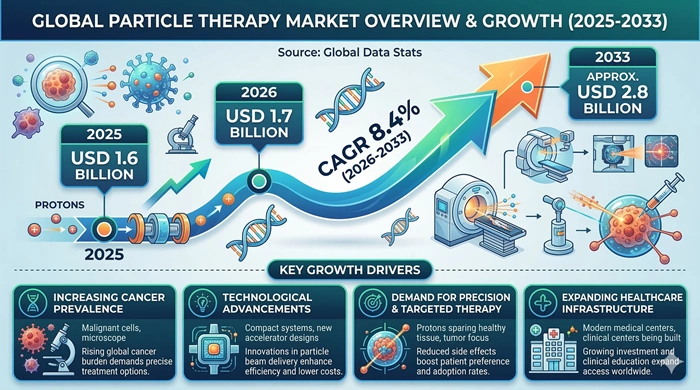
The global particle therapy market size is valued at USD 1.6 billion in 2025 and is predicted to increase from USD 1.7 billion in 2026 to approximately USD 2.8 billion by 2033, growing at a CAGR of 8.4% from 2026 to 2033.
Particle therapy is emerging as one of the most precise and effective forms of radiation treatment available for cancer patients today. Unlike conventional X-ray-based radiation, particle therapy uses charged particles such as protons and carbon ions to target tumors with exceptional accuracy, minimizing damage to surrounding healthy tissue. As global cancer incidence continues to rise and clinical outcomes data becomes increasingly compelling, healthcare providers and governments worldwide are investing significantly in expanding particle therapy infrastructure.
AI Impact on the Particle Therapy Industry
Artificial Intelligence Is Revolutionizing Treatment Planning, Dose Delivery, and Patient Outcomes in Particle Therapy, Setting a New Standard for Precision Oncology Worldwide
Artificial intelligence is becoming deeply embedded in the particle therapy workflow, fundamentally improving how clinicians plan and deliver treatment. AI-powered treatment planning systems can now generate optimal dose distribution maps in a fraction of the time previously required, enabling faster patient throughput and more consistent clinical outcomes. Machine learning algorithms are also being applied to real-time beam tracking, helping systems adapt dynamically to tumor movement caused by breathing or organ shifts during treatment. This level of adaptive precision is significantly reducing the risk of under-dosing tumors or over-exposing healthy tissue, which has historically been one of the key challenges in radiation oncology.
Beyond treatment planning, AI is contributing to broader operational improvements across particle therapy centers. Predictive analytics tools are being used to schedule system maintenance before equipment failures occur, reducing costly downtime in facilities where accelerator uptime is critical. AI-assisted imaging integration is also helping oncologists detect subtle changes in tumor morphology across treatment sessions, enabling timely adjustments to therapy protocols. As these capabilities mature, AI is expected to play an even greater role in making particle therapy more accessible, efficient, and clinically effective across diverse healthcare settings worldwide.
Growth Factors
Rising Global Cancer Burden, Technological Advancements in Accelerator Systems, and Increasing Government Support Are the Core Pillars Driving Sustained Expansion of the Particle Therapy Market
The most fundamental driver of the particle therapy market is the relentless rise in global cancer cases. Cancer remains one of the leading causes of death worldwide, and with conventional chemotherapy and standard radiation therapy often causing significant collateral damage to healthy tissue, demand for more precise oncological treatment options is growing rapidly. Particle therapy, particularly proton therapy, has demonstrated superior outcomes in treating pediatric cancers, head and neck tumors, and brain tumors where proximity to critical structures makes precision non-negotiable. Oncologists and patients alike are increasingly advocating for access to these advanced therapies, pushing healthcare systems to invest in new treatment infrastructure.
Technological innovation in accelerator design is also making particle therapy more commercially viable than ever before. Compact proton therapy systems — significantly smaller and less expensive than traditional cyclotron-based facilities — are lowering the capital barrier for hospitals that previously could not justify the cost of a full-scale particle therapy installation. Single-room proton therapy systems from manufacturers like Varian Medical Systems and Mevion Medical Systems have made it possible for community cancer centers to offer this treatment. Simultaneously, ongoing improvements in carbon ion therapy are demonstrating even greater biological effectiveness against radio-resistant tumors, opening up a new frontier of clinical applications that further expands the addressable market.
Market Outlook
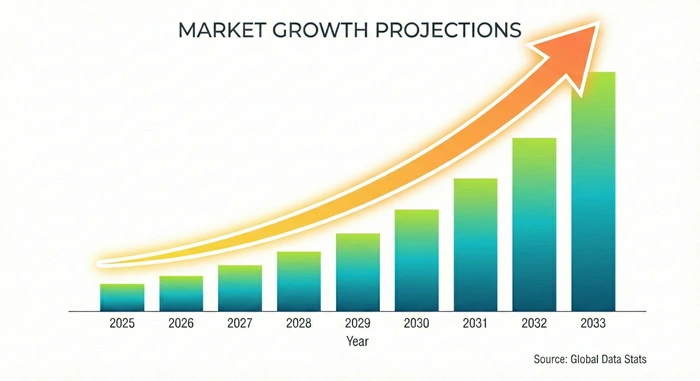
The Particle Therapy Market Is on a Strong Growth Trajectory Through 2033, Supported by Expanding Clinical Evidence, New Facility Installations, and Growing Patient Access Globally
The long-term outlook for the particle therapy market is highly promising, with a steady pipeline of new treatment center installations planned across North America, Europe, and Asia Pacific. Governments in several countries are actively subsidizing the construction of proton and carbon ion therapy centers as part of national cancer control strategies, recognizing the long-term cost benefits of reducing recurrence rates and treatment-related complications. The growing body of peer-reviewed clinical evidence supporting particle therapy's superiority over conventional radiotherapy for specific cancer indications is expected to further accelerate physician adoption and reimbursement approvals throughout the forecast period.
Emerging markets are also beginning to make their presence felt in the global particle therapy landscape. Countries such as China, India, and Brazil are investing in their first domestic particle therapy centers, driven by rapidly growing cancer patient populations and rising healthcare budgets. As the cost of technology continues to decline with increasing competition among manufacturers and advances in superconducting magnet technology, particle therapy is gradually transitioning from an elite, high-cost treatment option to a more broadly accessible standard of care. This democratization of access will be a critical factor in sustaining above-average market growth through 2033.
Expert Speaks
-
Siemens Healthineers CEO Bernd Montag stated that precision oncology is one of the most important frontiers in modern medicine, and that advanced radiation technologies including proton therapy are increasingly central to delivering the kind of targeted, personalized cancer care that patients deserve and that healthcare systems need to invest in.
-
Varian Medical Systems (Siemens Healthineers subsidiary) President Chris Toth noted that the expansion of single-room and compact proton therapy systems is a game changer for the industry, making it possible for a much wider range of hospitals and cancer centers to offer this life-changing treatment to patients who previously had no access.
-
IBA (Ion Beam Applications) CEO Olivier Lechien emphasized that the particle therapy market is entering a new phase of maturity, with clinical outcomes data now robust enough to support broader reimbursement coverage and that IBA remains committed to driving down the total cost of ownership for proton therapy centers to accelerate global adoption.
Key Report Takeaways
-
North America leads the particle therapy market, holding the largest revenue share globally, driven by a high concentration of proton therapy centers, strong reimbursement frameworks, and significant R&D investment in advanced oncology technologies.
-
Asia Pacific is the fastest-growing region, with China, Japan, and South Korea investing heavily in new particle therapy facility construction and government-backed cancer treatment modernization programs driving exceptional growth momentum.
-
Proton therapy is the dominant therapy type, representing the largest share of the particle therapy market due to its well-established clinical evidence base, broader availability, and lower cost compared to carbon ion therapy.
-
Cancer treatment centers and specialized proton therapy facilities are the leading end users, accounting for the highest share of market revenue as they house the majority of installed particle therapy systems globally.
-
Prostate cancer and brain tumor applications contribute the largest share of clinical indications treated with particle therapy, benefiting most from the precise dose delivery that minimizes damage to adjacent critical organs.
-
Pediatric cancer is the fastest-growing application segment, expected to register a CAGR above the market average through 2033, as the long-term benefits of reduced radiation exposure in young patients make particle therapy the strongly preferred treatment modality among pediatric oncologists, with this segment holding approximately 18% market share and growing at a CAGR of approximately 9.6%.
Market Scope
| Report Coverage | Details |
|---|---|
| Market Size by 2033 | USD 2.8 Billion |
| Market Size by 2025 | USD 1.6 Billion |
| Market Size by 2026 | USD 1.7 Billion |
| Market Growth Rate (2026–2033) | CAGR of 8.4% |
| Dominating Region | North America |
| Fastest Growing Region | Asia Pacific |
| Base Year | 2025 |
| Forecast Period | 2026 to 2033 |
| Segments Covered | Type, Application, End User |
| Regions Covered | North America, Europe, Asia Pacific, Latin America, Middle East & Africa |
Market Dynamics
Drivers Impact Analysis
Rising Cancer Incidence, Compact System Innovation, and Expanding Reimbursement Coverage Are Collectively Powering Long-Term Growth Across the Global Particle Therapy Market
| Driver | ≈ % Impact on CAGR Forecast | Geographic Relevance | Impact Timeline |
|---|---|---|---|
| Rising global cancer incidence | ~32% | Global | Near to Long-term |
| Growing preference for precision radiation oncology | ~26% | North America, Europe | Near to Mid-term |
| Technological advances in compact accelerator systems | ~21% | Global | Mid to Long-term |
| Favorable reimbursement expansion | ~13% | North America, Europe | Near-term |
| Government investments in cancer treatment infrastructure | ~8% | Asia Pacific, Europe | Long-term |
The surging global incidence of cancer is the most powerful and sustained driver of the particle therapy market. With over 20 million new cancer cases estimated globally each year and conventional radiotherapy often causing unacceptable collateral damage, demand for advanced precision radiation solutions is intensifying across every geography. Proton therapy's ability to deliver maximum radiation dose directly to the tumor while sparing surrounding healthy tissue makes it especially valuable for treating cancers located near critical structures, and this clinical advantage is becoming more widely recognized among oncologists globally.
The development and commercialization of compact, single-room proton therapy systems has been a transformative driver that is actively reshaping the competitive landscape of the particle therapy market. These systems require significantly less space and capital investment compared to traditional multi-room facilities, making particle therapy accessible to mid-sized hospitals and cancer centers that previously could not justify the financial commitment. Companies such as Mevion Medical Systems and ProTom International have been instrumental in advancing this trend, and the growing installed base of compact systems is directly translating into broader patient access and accelerating overall market expansion.
Restraints Impact Analysis
Exceptionally High Capital Costs, Limited Reimbursement in Emerging Markets, and Prolonged Facility Construction Timelines Remain the Most Significant Barriers Facing the Particle Therapy Market
| Restraint | ≈ % Impact on CAGR Forecast | Geographic Relevance | Impact Timeline |
|---|---|---|---|
| Very high capital and operational costs | ~38% | Emerging Markets, Global | Near to Mid-term |
| Limited reimbursement in developing regions | ~28% | Asia Pacific, Latin America, MEA | Near-term |
| Long facility construction and installation timelines | ~20% | Global | Ongoing |
| Shortage of trained medical physicists and operators | ~14% | Global, especially Emerging Markets | Long-term |
The extraordinarily high cost of establishing a particle therapy center remains the most formidable restraint in the market. A full-scale multi-room proton therapy facility can cost anywhere from USD 100 million to over USD 200 million to construct and equip, placing it far beyond the financial reach of most hospitals in low- and middle-income countries. Even in developed markets, the high upfront investment creates significant risk for healthcare providers, particularly in the absence of guaranteed reimbursement, and has resulted in several planned projects being delayed or cancelled due to funding challenges.
Reimbursement inconsistency is compounding this challenge significantly. While major payers in the United States, Germany, and Japan have established coverage pathways for proton therapy in certain cancer indications, many countries across Asia Pacific, Latin America, and the Middle East still lack formal reimbursement policies for particle-based radiation treatment. This forces patients to self-fund enormously expensive treatment courses, creating an access barrier that limits utilization even where treatment centers exist. Addressing this reimbursement gap through health technology assessments and clinical outcome benchmarking will be essential for the market to achieve its full long-term growth potential.
Opportunities Impact Analysis
Emerging Market Expansion, Carbon Ion Therapy Commercialization, and Public-Private Partnerships Represent the Most Compelling Growth Opportunities in the Particle Therapy Market
| Opportunity | ≈ % Impact on CAGR Forecast | Geographic Relevance | Impact Timeline |
|---|---|---|---|
| Expansion in emerging markets | ~34% | Asia Pacific, Latin America | Mid to Long-term |
| Carbon ion therapy clinical development | ~27% | Europe, Asia Pacific | Long-term |
| Public-private partnerships for facility funding | ~22% | Global | Mid-term |
| AI-driven treatment planning optimization | ~17% | North America, Europe | Mid to Long-term |
Emerging markets represent one of the most exciting and underexplored opportunities in the global particle therapy market. Countries such as China, India, South Korea, and Brazil are in various stages of planning or constructing their first particle therapy facilities, motivated by rapidly growing cancer patient populations, rising healthcare budgets, and government ambitions to modernize national cancer care capabilities. China in particular is aggressively investing in proton and carbon ion therapy infrastructure, with multiple centers already operational and many more in the pipeline, creating a substantial demand wave that global equipment manufacturers are positioning to capture.
Carbon ion therapy, though less commercially widespread than proton therapy, represents a significant long-term opportunity given its demonstrated superior biological effectiveness against radio-resistant tumor types such as sarcomas and salivary gland cancers. As clinical evidence continues to build and the cost of carbon ion systems gradually decreases through technological improvements, adoption is expected to expand beyond the current small number of centers in Japan, Germany, and China. Manufacturers investing in next-generation carbon ion systems with smaller footprints and lower operating costs are well-positioned to unlock a new wave of facility installations throughout the forecast period.
Segment Analysis
By Type
Proton Therapy Dominates the Particle Therapy Market With the Largest Installed Base and Broadest Clinical Acceptance, While Carbon Ion Therapy Gains Momentum as a High-Potential Emerging Modality
Proton therapy holds approximately 72% of the total particle therapy market share and is the unambiguous leader in this segment, driven by its well-established clinical evidence base, relatively broader availability, and lower cost compared to carbon ion systems. The segment is expected to grow at a CAGR of approximately 8.1% through 2033, sustained by a growing number of treatment center installations worldwide and expanding reimbursement coverage for additional cancer indications. North America leads proton therapy adoption with the largest concentration of operational facilities globally. Industry leaders such as Varian Medical Systems, IBA, and Mevion Medical Systems are the dominant suppliers in this region, continually advancing compact system designs and AI-integrated treatment planning platforms.
The Asia Pacific region is emerging as the most dynamic growth market for proton therapy within the broader particle therapy space, with China, Japan, and South Korea accounting for a rapidly growing share of new facility investments. Japan has long been a pioneer in particle therapy, having operated some of the world's first carbon ion and proton facilities for decades, and continues to expand its network of treatment centers with strong government support. China is now aggressively scaling its proton therapy infrastructure, with several domestic manufacturers also entering the market to compete with established global players. This regional momentum is expected to contribute substantially to the global proton therapy segment's growth through 2033, making Asia Pacific a strategically critical market for all major industry participants.
By Application
Pediatric Cancer Emerges as the Fastest-Growing Application Segment, While Prostate and Brain Tumor Indications Sustain the Largest Overall Revenue Contribution in the Particle Therapy Market
Prostate cancer and brain tumor applications collectively represent the largest application segment in the particle therapy market, contributing approximately 36% of total market revenue. These indications benefit most directly from particle therapy's precision dose delivery, as both cancer types are often situated in close proximity to critical neural and vascular structures where minimizing collateral radiation damage is clinically paramount. This segment is expected to grow at a steady CAGR through 2033, supported by increasing physician training in particle-based oncology and a growing body of comparative effectiveness research. Key companies driving adoption in this segment include Varian Medical Systems, IBA, and Hitachi, Ltd., which supply the majority of installed systems treating prostate and brain tumor patients globally.
Pediatric cancer is the fastest-growing application within the particle therapy market, anticipated to register a CAGR of approximately 9.6% through 2033 and holding roughly 18% of total application-level market share. Children treated with conventional radiotherapy face a lifelong risk of secondary cancers and developmental complications from radiation exposure to healthy growing tissues — risks that particle therapy dramatically reduces. This compelling clinical argument is driving pediatric oncologists and hospital administrators worldwide to prioritize access to proton therapy for young patients, and several dedicated pediatric cancer centers in North America and Europe have made proton therapy a core element of their treatment infrastructure. Asia Pacific is also witnessing rapid growth in pediatric particle therapy adoption, particularly in Japan and South Korea, where government-backed pediatric oncology programs are actively expanding access to this treatment.
Regional Insights
North America
North America Maintains a Commanding Lead in the Global Particle Therapy Market, Driven by the World's Largest Concentration of Proton Therapy Centers, Strong Clinical Research Output, and Robust Private and Public Reimbursement Support
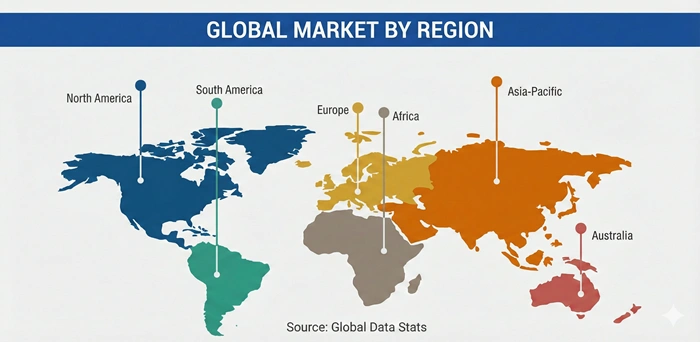
North America holds approximately 45% of the global particle therapy market share and is expected to retain its dominant position through 2033, growing at a CAGR of approximately 7.9%. The United States alone accounts for the vast majority of this regional share, home to the largest number of operational proton therapy centers in the world and a highly active clinical research community continuously expanding the evidence base for particle-based oncology. Strong reimbursement coverage from both private insurers and Medicare for key indications including pediatric cancers and prostate tumors underpins consistent demand. Leading companies in this region include Varian Medical Systems (U.S.), Mevion Medical Systems (U.S.), ProTom International (U.S.), and IBA (Belgium) — all of which maintain significant commercial and clinical partnerships with major U.S. cancer centers.
Canada is also contributing meaningfully to North America's leadership position, with several major academic cancer centers having commissioned or planning proton therapy installations under publicly funded oncology programs. The broader North American market benefits from a favorable regulatory environment where the FDA has established clear pathways for particle therapy device approvals, encouraging continued manufacturer investment in next-generation system development. As clinical outcomes data from the large volume of U.S.-treated patients continues to mature and reinforce the value proposition of particle therapy, North America's dominance in both clinical volumes and technology innovation is expected to remain unchallenged through the forecast period.
Asia Pacific
Asia Pacific Is the Fastest-Growing Region in the Global Particle Therapy Market, With China, Japan, and South Korea Driving Exceptional Facility Expansion and Government-Backed Oncology Modernization Programs
Asia Pacific is the fastest-growing region in the particle therapy market, projected to register a CAGR of approximately 9.8% through 2033. Japan has historically been the regional leader, operating the world's first heavy ion therapy facility and maintaining an extensive network of proton and carbon ion treatment centers backed by strong government funding and a sophisticated medical physics workforce. South Korea has also emerged as a significant market, with major university hospitals and cancer institutes investing in state-of-the-art proton therapy systems. Key players active in the Asia Pacific region include Hitachi Ltd. (Japan), Sumitomo Heavy Industries (Japan), and Toshiba (Japan), alongside global suppliers including IBA and Varian who have established strong regional distribution and service networks.
China represents the single largest growth opportunity within Asia Pacific and arguably within the entire global particle therapy market. The Chinese government has identified particle therapy as a strategic healthcare priority and is actively funding the construction of new treatment centers across major cities as part of its national cancer control plan. Several domestically manufactured proton therapy systems are also under development, which could significantly reduce technology costs and accelerate local adoption over the medium term. India and Southeast Asia are at earlier stages of market development but represent compelling longer-term opportunities as healthcare infrastructure investments accelerate and awareness of advanced cancer treatment options grows among both clinicians and patients.
Top Key Players
-
Varian Medical Systems (Siemens Healthineers) (United States)
-
Ion Beam Applications (IBA) (Belgium)
-
Hitachi Ltd. (Japan)
-
Mevion Medical Systems (United States)
-
Sumitomo Heavy Industries Ltd. (Japan)
-
ProTom International (United States)
-
Elekta AB (Sweden)
-
Toshiba Energy Systems & Solutions Corporation (Japan)
-
Advanced Oncotherapy plc (United Kingdom)
-
ViewRay Inc. (United States)
-
Optivus Proton Therapy (United States)
-
Provision Healthcare (United States)
Recent Developments
-
Varian Medical Systems / Siemens Healthineers (2025): Siemens Healthineers announced the next-generation ProBeam 360° proton therapy system featuring AI-integrated adaptive treatment planning and enhanced pencil beam scanning capabilities, significantly improving treatment precision and workflow efficiency for clinical teams globally.
-
IBA (2024): IBA secured a major contract to supply its Proteus ONE compact proton therapy system to a leading cancer center in the Middle East, marking an important milestone in expanding particle therapy access into new geographic markets outside the traditional strongholds of North America and Europe.
-
Hitachi Ltd. (2024–2025): Hitachi completed the installation and commissioning of a new carbon ion therapy system at a major Japanese university hospital, reinforcing its leadership position in heavy ion therapy and expanding the clinical capacity for treating radio-resistant tumors in the Asia Pacific region.
-
Mevion Medical Systems (2025): Mevion Medical Systems announced a significant software upgrade to its HYPERSCAN pencil beam scanning technology, incorporating machine learning-based real-time adaptive treatment adjustments, enabling faster and more accurate treatment delivery for patients across its global installed base.
-
Advanced Oncotherapy (2024): Advanced Oncotherapy received key regulatory clearances for its LIGHT proton therapy system — based on compact linac accelerator technology — in preparation for first clinical installations, representing a potential breakthrough in further reducing the footprint and cost of proton therapy infrastructure.
Market Trends
Compact System Design, AI-Driven Adaptive Radiotherapy, and the Commercialization of Carbon Ion Therapy Are the Defining Trends Shaping the Evolution of the Particle Therapy Market Through 2033
The most visible and commercially significant trend reshaping the particle therapy market is the ongoing miniaturization of accelerator technology. The introduction of superconducting cyclotrons and compact synchrocyclotrons has drastically reduced the physical footprint and construction cost of proton therapy facilities, enabling a new generation of single-room treatment centers to emerge within existing hospital buildings. This shift is democratizing access to particle therapy by making it viable for community oncology centers and regional hospitals that previously could not justify full-scale facility investments. Manufacturers investing in next-generation compact systems are gaining a clear competitive advantage as healthcare providers worldwide seek more affordable and space-efficient ways to offer advanced cancer treatment.
Concurrently, the clinical adoption of AI-powered adaptive radiotherapy is accelerating rapidly within particle therapy centers. Real-time tumor tracking systems, automated plan adaptation algorithms, and AI-assisted quality assurance tools are collectively reducing treatment times, improving dose accuracy, and enabling same-day plan modifications in response to anatomical changes. These capabilities are particularly valuable in particle therapy, where even small deviations in beam targeting can have outsized clinical consequences compared to conventional radiotherapy. As clinical workflows increasingly rely on AI to manage complexity and improve consistency, particle therapy systems with deeply integrated digital health capabilities are becoming the preferred choice for newly commissioned treatment centers around the world.
Segments Covered in the Report
By Type
-
Proton Therapy
-
Carbon Ion Therapy
-
Others
By Application
-
Prostate Cancer
-
Lung Cancer
-
Brain Tumors
-
Breast Cancer
-
Pediatric Cancer
-
Others
By End User
-
Hospitals & Cancer Treatment Centers
-
Proton Therapy Centers
-
Research Centers & Academic Institutes
-
Others
By Region
-
North America
-
Europe
-
Asia Pacific
-
Latin America
-
Middle East & Africa
Frequently Asked Questions
Question 1: What is the current value of the global particle therapy market and what is its forecast by 2033?
Answer: The global particle therapy market is valued at USD 1.6 billion in 2025 and is expected to reach USD 2.8 billion by 2033. It is projected to grow at a CAGR of 8.4% during the forecast period from 2026 to 2033.
Question 2: What are the key factors driving growth in the particle therapy market?
Answer: The primary growth drivers include the rising global burden of cancer and increasing demand for precision radiation therapies that minimize damage to healthy tissue. Technological advancements in compact accelerator systems and expanding reimbursement coverage are also significantly accelerating market adoption.
Question 3: Which region dominates the particle therapy market and which is expected to grow the fastest?
Answer: North America currently dominates the particle therapy market, holding approximately 45% of global revenue share. Asia Pacific is the fastest-growing region, driven by major facility investments in China, Japan, and South Korea.
Question 4: What is the difference between proton therapy and carbon ion therapy in the context of the particle therapy market?
Answer: Proton therapy uses protons to precisely target tumors and is the most widely adopted form of particle therapy due to its established clinical evidence and relatively lower cost. Carbon ion therapy uses heavier carbon particles that deliver greater biological effectiveness against radio-resistant tumors, though it remains less commercially widespread due to higher system costs.
Question 5: Which cancer application is growing the fastest within the particle therapy market?
Answer: Pediatric cancer is the fastest-growing application segment in the particle therapy market, expected to grow at a CAGR of approximately 9.6% through 2033. The significant long-term benefits of reduced radiation exposure in young patients make particle therapy the strongly preferred treatment choice among pediatric oncologists worldwide.