
Over the Counter (OTC) Drugs Market Overview
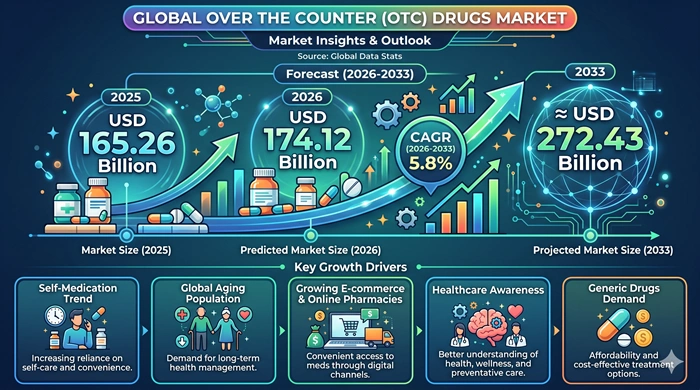
The global over the counter (OTC) drugs market size is valued at USD 165.26 billion in 2025 and is predicted to increase from USD 174.12 billion in 2026 to approximately USD 272.43 billion by 2033, growing at a CAGR of 5.8% from 2026 to 2033.
Rising consumer preference for self-medication, growing health awareness among global populations, expanding retail pharmacy networks, and increasing availability of non-prescription medicines across both developed and emerging markets are collectively driving sustained demand for OTC pharmaceutical products. The ongoing shift from prescription-dependent healthcare toward more proactive, consumer-directed health management is transforming how people purchase and use everyday medicines, creating a broad and expanding market opportunity for OTC drug manufacturers, retailers, and distributors worldwide.
AI Impact on the Over the Counter (OTC) Drugs Industry
Artificial Intelligence Is Personalizing the Self-Medication Experience and Reshaping How OTC Drug Brands Develop, Market, and Distribute Non-Prescription Products*
Artificial intelligence is bringing significant change to the over the counter drugs landscape, particularly in the areas of consumer personalization, demand forecasting, and product development. AI-powered symptom checker apps and digital health platforms are now guiding consumers toward the most appropriate OTC products for their specific symptoms, effectively acting as a virtual pharmacist available around the clock. These tools — offered by major consumer health brands, pharmacy chains, and health tech companies — are improving purchase decisions, reducing inappropriate self-medication, and building deeper loyalty between brands and digitally engaged consumers.
In product development, AI is accelerating the identification of new OTC drug candidates by screening large chemical libraries and analyzing real-world consumer health data to identify unmet therapeutic needs in the self-care market. Machine learning models are also improving the accuracy of supply chain demand forecasting, helping OTC drug manufacturers avoid costly stockouts and overstocking situations — a challenge that became acutely apparent during the COVID-19 pandemic. As AI integration deepens across marketing, manufacturing, and distribution functions, the most forward-thinking consumer health companies are using these technologies to compete more effectively in an increasingly fragmented and rapidly evolving OTC market landscape.
Growth Factors
Rising Self-Medication Culture, Expanding Retail Distribution Networks, and the Surge in Preventive Health Consciousness Are Powering Consistent OTC Drug Market Expansion*
The over the counter (OTC) drugs market is growing on the strength of a global cultural shift toward self-care and personal health management. Modern consumers — empowered by readily available online health information, symptom checkers, and pharmacy consultation services — are increasingly comfortable managing common, non-life-threatening conditions such as headaches, cold and flu symptoms, digestive discomfort, and minor skin issues without visiting a physician. This behavioral shift is reducing the burden on formal healthcare systems while simultaneously driving strong, consistent volume growth in the consumer health and OTC pharmaceutical categories. The post-pandemic era has permanently elevated health awareness levels globally, creating a permanently larger and more engaged self-medication consumer base.
The rapid expansion of e-commerce and digital pharmacy channels has further accelerated OTC drug market growth by making non-prescription products easier to discover, compare, and purchase. Online pharmacy platforms, direct-to-consumer health brand websites, and marketplace integrations on platforms like Amazon, Flipkart, and Alibaba are reaching consumers in geographies and market segments that were previously underserved by traditional retail pharmacy infrastructure. Simultaneously, the growing pipeline of prescription-to-OTC switch candidates — in which well-established drugs with strong safety profiles are reclassified to allow direct consumer purchase without a prescription — continues to expand the breadth of the OTC category, bringing new treatment options across allergy, heartburn, smoking cessation, and migraine management into the self-care market.

Market Outlook
From Digital Health Integration to Emerging Market Penetration, the OTC Drugs Market's Future Is Defined by Convenience, Consumer Empowerment, and Therapeutic Expansion*
The long-term outlook for the over the counter drugs market is very positive, driven by powerful and converging trends that show no signs of abating through 2033. The growing global geriatric population — which requires consistent management of multiple chronic and acute conditions and tends to rely heavily on OTC analgesics, digestive remedies, and vitamins and supplements — will continue to be one of the most important demographic drivers of OTC spending. At the same time, rising health consciousness among millennials and Generation Z consumers is creating entirely new purchasing occasions for preventive health OTC products including immune support supplements, sleep aids, probiotics, and stress management formulations.
Emerging markets across Asia Pacific, Latin America, and Africa represent the most powerful long-term expansion opportunity for OTC drug companies. The growing middle class, improving literacy and health awareness, expanding pharmacy networks, and favorable government policies toward self-medication in countries like India, China, Brazil, and Indonesia are creating first-time demand for branded non-prescription medicines at scale. As regulatory frameworks in these regions progressively align with international OTC standards, more therapeutic categories are expected to become eligible for self-care treatment, further broadening the addressable market. Companies that combine strong brand equity, broad distribution reach, and affordable pricing strategies will be best positioned to capture the most durable long-term growth opportunities in the global OTC market through 2033.
Expert Speaks
Leading executives from global consumer health and pharmaceutical companies are expressing strong confidence in the OTC drugs market's trajectory:
-
"Consumer health is one of the most resilient and growing segments in all of healthcare. We are seeing strong demand across our OTC portfolio globally, particularly in emerging markets where rising health awareness and pharmacy access are creating new growth opportunities that we believe are sustainable for many years to come." — CEO, Haleon plc
-
"The self-care revolution is real and it is accelerating. Consumers want trusted, science-backed non-prescription solutions they can count on — and that is exactly what we are focused on delivering through continuous product innovation, responsible marketing, and expanding our presence in high-growth markets worldwide." — CEO, Kenvue Inc.
-
"Our OTC portfolio continues to outperform expectations, driven by strong brand recognition, growing consumer health literacy, and our investment in digital commerce capabilities. We remain committed to making high-quality, affordable self-care products accessible to more consumers across every market we serve." — CEO, Bayer AG
Key Report Takeaways
-
North America leads the global over the counter (OTC) drugs market, holding approximately 38% of total global market revenue in 2025, driven by very high consumer health awareness, a mature retail pharmacy ecosystem, high per-capita OTC spending, and a consistently expanding prescription-to-OTC switch pipeline supported by the FDA
-
Asia Pacific is the fastest-growing region, recording the highest regional CAGR during 2026–2033, propelled by rapidly growing middle-class populations, rising health awareness, expanding modern retail pharmacy infrastructure, and a large untapped consumer base in China, India, and Southeast Asia actively seeking affordable self-medication solutions
-
Adults represent the dominant end-user segment, accounting for the largest share of OTC drug consumption globally as working-age individuals manage everyday health concerns such as pain, cold and flu, digestive discomfort, and skin conditions without the need for physician visits
-
Cough, cold, and flu products hold the highest product-level share of the OTC drugs market, representing approximately 18% of total market revenue in 2025, driven by the global ubiquity of respiratory infections, seasonal illness patterns, and strong brand recall for products like NyQuil, Robitussin, and Lemsip
-
Tablets represent the most widely used dosage form, accounting for the largest share of OTC dosage form revenue globally due to their ease of use, long shelf life, accurate dosing, and wide availability across all retail formats and price points
-
The vitamins, minerals, and supplements (VMS) segment is the fastest-growing product sub-segment, projected to expand at the highest CAGR within the OTC market through 2033, capturing increasing market share as consumers globally embrace preventive health and immune support supplementation — with the VMS segment estimated to account for over 24% of total OTC product market share by 2033, growing at an estimated CAGR of approximately 7.2%
Market Scope
| Report Coverage | Details |
|---|---|
| Market Size by 2025 | USD 165.26 Billion |
| Market Size by 2026 | USD 174.12 Billion |
| Market Size by 2033 | USD 272.43 Billion |
| Market Growth Rate (2026–2033) | CAGR of 5.8% |
| Dominating Region | North America |
| Fastest Growing Region | Asia Pacific |
| Base Year | 2025 |
| Forecast Period | 2026 to 2033 |
| Segments Covered | Product Type, Dosage Form, Distribution Channel, End User |
| Regions Covered | North America, Europe, Asia Pacific, Latin America, Middle East & Africa |
Market Dynamics
Drivers Impact Analysis
Growing Consumer Preference for Self-Medication, Expanding Prescription-to-OTC Switch Activity, and Rising Preventive Health Awareness Are the Primary Forces Accelerating the OTC Drugs Market*
| Driver | ≈ % Impact on CAGR Forecast | Geographic Relevance | Impact Timeline |
|---|---|---|---|
| Rising self-medication culture and consumer health empowerment | ~30% | Global, especially North America & Europe | Short to Long-Term |
| Expansion of e-commerce and digital pharmacy distribution | ~25% | Asia Pacific, North America | Short to Mid-Term |
| Prescription-to-OTC switch pipeline expansion | ~22% | North America, Europe | Short to Long-Term |
| Growing aging and geriatric population globally | ~13% | Europe, North America, Asia Pacific | Mid to Long-Term |
| Increasing penetration of modern pharmacy retail in emerging markets | ~10% | Asia Pacific, Latin America, MEA | Mid-Term |
The growing global culture of self-medication is the most powerful and durable driver behind the expansion of the over the counter (OTC) drugs market. As healthcare access costs continue to rise — particularly in the United States, where out-of-pocket physician visit costs and prescription drug copays are high — consumers are increasingly motivated to manage common, non-serious health conditions through accessible, affordable non-prescription products. This dynamic is further supported by the proliferation of health information through digital channels, which has made consumers better informed about appropriate OTC treatment options for a wide range of everyday ailments. Post-pandemic, a permanently elevated consumer focus on health maintenance, immune support, and proactive wellness has created new purchasing occasions for preventive OTC products across all demographics.
The FDA's prescription-to-OTC switch program continues to be one of the most structurally impactful drivers of OTC market growth in North America and, by policy precedent, globally. High-profile recent OTC switches — including Narcan (naloxone) for opioid overdose reversal and Opill (norgestrel) as the first OTC oral contraceptive in the United States — demonstrate the ongoing policy momentum toward expanding consumer access to previously prescription-only medications. Each successful switch adds entirely new consumer health categories to the OTC market, attracting new buyers and substantially expanding total addressable market volume. European regulatory bodies including the EMA are similarly reviewing OTC switch applications across allergy, hormonal health, and cardiovascular risk reduction categories, further reinforcing this structural growth driver through the 2026–2033 forecast period.

Restraints Impact Analysis
Counterfeit Drug Risks, Regulatory Complexity, and Consumer Misuse of OTC Products Continue to Create Meaningful Barriers to Market Growth*
| Restraint | ≈ % Impact on CAGR Forecast | Geographic Relevance | Impact Timeline |
|---|---|---|---|
| Prevalence of counterfeit and substandard OTC drugs in emerging markets | ~32% | Latin America, MEA, parts of Asia Pacific | Short to Mid-Term |
| Risk of self-medication misuse and adverse drug interactions | ~27% | Global | Short to Long-Term |
| Stringent and varying OTC regulatory frameworks across markets | ~23% | Global, particularly Europe, Asia Pacific | Mid to Long-Term |
| Increasing raw material costs affecting OTC product pricing | ~18% | Global | Short-Term |
The prevalence of counterfeit and substandard non-prescription drugs in developing markets represents a significant risk to both consumer safety and legitimate OTC drug market growth. In countries across Southeast Asia, Sub-Saharan Africa, and parts of Latin America, inadequate pharmaceutical supply chain oversight and weak enforcement of drug quality standards allow counterfeit versions of popular OTC products — including analgesics, cough remedies, and vitamins — to circulate widely through informal retail channels. These products not only harm consumers but also undermine trust in branded OTC products and complicate market penetration strategies for legitimate pharmaceutical companies operating in these regions.
Consumer misuse of OTC drugs — including intentional or unintentional overdose, inappropriate combination with prescription medications, and prolonged use beyond recommended durations — represents another persistent restraint on market confidence and regulatory permissiveness. High-profile safety signals around commonly used OTC ingredients, including concerns about high-dose acetaminophen hepatotoxicity and decongestant cardiovascular effects, have led to label changes, dosage restrictions, and in some cases reclassification of products back to prescription status in certain markets. These safety-related regulatory actions create uncertainty for OTC product manufacturers and can significantly reduce revenue for affected product categories, moderating the overall market growth trajectory in affected regions.
Opportunities Impact Analysis
Emerging Market Expansion, Growing VMS and Preventive Health Category, and Prescription-to-OTC Switch Pipeline Are the Most Compelling Growth Opportunities in the OTC Drugs Market*
| Opportunity | ≈ % Impact on CAGR Forecast | Geographic Relevance | Impact Timeline |
|---|---|---|---|
| Penetration of OTC drug retail in emerging Asia Pacific and African markets | ~32% | Asia Pacific, Latin America, MEA | Mid to Long-Term |
| Growth of vitamins, minerals, and supplements (VMS) preventive health category | ~27% | Global, especially North America & Asia Pacific | Short to Long-Term |
| Expansion of direct-to-consumer digital health and online pharmacy channels | ~22% | North America, Europe, Asia Pacific | Short to Mid-Term |
| New OTC switch approvals in allergy, contraception, and cardiovascular health | ~19% | North America, Europe | Short to Mid-Term |
Emerging markets represent the most significant untapped opportunity for OTC drug companies seeking to grow beyond their saturated home markets. Asia Pacific, in particular, is in the early stages of a massive OTC market expansion, driven by a large and rapidly urbanizing population with growing disposable incomes, rising health literacy, and increasing access to modern pharmacy retail formats. India's nationwide pharmacy chain expansion — led by companies such as Apollo Pharmacy and MedPlus — is making branded OTC products accessible in semi-urban and rural areas for the first time, dramatically expanding the addressable consumer base. Sub-Saharan African markets are similarly beginning to attract investment from major OTC companies looking to establish early market positions ahead of anticipated healthcare access growth over the coming decade.
The vitamins, minerals, and supplements category represents an especially compelling near-term growth opportunity within the broader OTC market, as consumer interest in immune health, gut health, energy support, and healthy aging supplements has accelerated materially since the COVID-19 pandemic. The normalization of daily supplement use across all age groups — combined with the emergence of personalized nutrition platforms that recommend individual supplement regimens based on health goals, lifestyle, and even genetic data — is creating a virtuous cycle of growth for the VMS segment. Companies including Haleon, Kenvue (Johnson & Johnson Consumer), and Bayer are investing heavily in expanding their VMS portfolios through both organic product development and strategic acquisitions of fast-growing supplement brands, recognizing the segment's superior CAGR potential compared to traditional OTC therapeutic categories.

Segment Analysis
By Product Type
Cough Cold and Flu Products Lead Total OTC Drug Revenue While the Vitamins Minerals and Supplements Segment Emerges as the Most Rapidly Growing Product Category Globally*
The cough, cold, and flu products segment holds the dominant position within the over the counter (OTC) drugs market by product type, accounting for approximately 18% of total product revenue in 2025, reflecting the universal and year-round consumer demand for non-prescription remedies for the world's most commonly experienced acute illness category. These products — including expectorants, decongestants, antihistamines, cough suppressants, and multi-symptom combination formulas — benefit from strong and consistent seasonal demand cycles that drive predictable purchase volumes for both branded and private-label players across all major retail formats. North America holds the largest regional share of cough and cold OTC product revenue, where strong brand recognition for products from companies like Procter & Gamble's Vicks, Pfizer's Advil Cold & Sinus, and Reckitt's Mucinex drives premium pricing and high consumer loyalty. The ongoing development of new delivery formats including dissolvable powders, rapid-release liquids, and non-drowsy formula variants is further sustaining category growth by attracting new consumer segments and expanding usage occasions.
The vitamins, minerals, and supplements segment represents the most dynamic and rapidly expanding product category within the OTC drugs ecosystem, driven by a fundamental and enduring shift in how consumers approach their health — moving from reactive illness treatment toward proactive, daily health maintenance and disease prevention. This segment encompasses a diverse range of products including multivitamins, vitamin D, omega-3 fatty acids, zinc, magnesium, probiotics, and increasingly sophisticated condition-specific supplement formulations targeting immune health, cognitive performance, cardiovascular wellness, and joint health. Asia Pacific is the fastest-growing regional market for VMS products, where a combination of traditional herbal supplement culture, growing middle-class purchasing power, and rapidly expanding e-commerce distribution is driving extraordinary volume growth, with companies including Blackmores (Australia), Amway (USA), and Nature's Sunshine (USA) capturing significant market presence. Major global OTC companies are accelerating their VMS portfolio investments through acquisitions and partnerships with specialist supplement brands, recognizing this segment's outsized CAGR relative to the overall OTC market average.
By Distribution Channel
Retail Pharmacies Remain the Dominant OTC Drug Distribution Channel While Online Pharmacies Record the Fastest Revenue Growth Across All Major Markets*
Retail pharmacies hold the dominant position in the over the counter drugs distribution landscape, accounting for approximately 46% of total channel revenue in 2026, serving as the primary physical touchpoint where consumers purchase non-prescription medicines across all regions. The retail pharmacy channel benefits from pharmacist consultation services, product availability assurance, consumer trust in professionally curated product selections, and the convenience of combining prescription pickup with OTC purchases in a single visit. North America leads in retail pharmacy OTC revenue, with major chains including CVS Pharmacy, Walgreens, and Rite Aid in the United States generating massive OTC product sales volumes across their extensive national store networks, supported by strong private-label OTC product lines that compete effectively with branded offerings. European retail pharmacy chains — particularly in Germany, the United Kingdom, and France — similarly drive high OTC purchase volumes, often supported by pharmacist recommendation of specific branded products that reinforces consumer trust and premium pricing power.
Online pharmacies and digital retail channels are the fastest-growing distribution segment for OTC drugs globally, growing at a CAGR that substantially exceeds the overall market average as consumers increasingly prefer the convenience, price comparison capability, and discreet purchase options offered by digital platforms. Asia Pacific is leading online OTC drug retail growth, with China's dominant e-health platforms — including JD Health, Alibaba Health, and DTP online pharmacies — processing massive volumes of OTC drug orders, particularly for VMS, dermatology, and digestive health products. Global consumer health leaders including Haleon, Kenvue, and Bayer have all invested significantly in their direct-to-consumer digital commerce capabilities, building branded health advice content, AI-powered product recommendation engines, and subscription-based OTC product delivery services that are shifting an increasing proportion of their revenue toward higher-margin digital channels. The continued growth of quick-commerce platforms offering sub-one-hour OTC drug delivery in major urban markets globally is further accelerating the structural shift in consumer OTC purchasing behavior toward digital channels.

Regional Insights
North America
North America Commands the Global OTC Drugs Market With the Highest Revenue Share, Backed by High Per-Capita Health Spending, Mature Pharmacy Networks, and an Active OTC Switch Pipeline*
North America holds the dominant position in the global over the counter (OTC) drugs market, accounting for approximately 38% of total global market revenue in 2025, and sustaining a consistent CAGR through 2033 supported by a deeply mature consumer health ecosystem and continuously expanding product innovation. The United States is the undisputed regional leader, where one of the world's highest per-capita spending levels on healthcare — combined with strong consumer health awareness, a well-developed retail pharmacy infrastructure, and an active FDA prescription-to-OTC switch program — creates an exceptionally favorable environment for OTC drug market growth. Major OTC market leaders headquartered in the region include Kenvue (USA), Procter & Gamble (USA), Prestige Consumer Healthcare (USA), and Church & Dwight (USA), all of which maintain extensive consumer health brand portfolios that dominate category leadership positions across analgesics, cold remedies, digestive health, and personal care OTC segments. Canada contributes meaningfully to the North American OTC market as well, with Health Canada's progressive OTC policy framework enabling new product categories and facilitating a strong bilingual retail pharmacy market.
The United States market has been particularly dynamic in recent years due to landmark OTC switch decisions, with the 2023 approval of Narcan as the first-ever OTC naloxone product and the 2024 launch of Opill as the first OTC oral contraceptive representing historic expansions of consumer self-care access. These approvals have created entirely new OTC market categories with significant commercial scale, attracting investment from both major consumer health companies and specialty pharmaceutical manufacturers. The strong digital health infrastructure in the United States — including the integration of OTC recommendations into major telehealth platforms, pharmacy apps, and retail health clinic networks — is further reinforcing North America's position as the most sophisticated and commercially valuable OTC drug market in the world.
Asia Pacific
Asia Pacific Is the Fastest-Growing Region in the OTC Drugs Market, Driven by Rising Health Awareness, Expanding Pharmacy Infrastructure, and an Enormous Untapped Consumer Base*
Asia Pacific is the fastest-growing region in the global OTC drugs market, recording the highest regional CAGR during the 2026–2033 forecast period, led by China, India, Japan, South Korea, and key Southeast Asian economies as the primary market drivers. China is the largest individual OTC market within Asia Pacific, with a massive domestic consumer health industry increasingly dominated by both international brands including Johnson & Johnson, Bayer, and Reckitt, as well as powerful domestic OTC companies such as Yunnan Baiyao, China Resources OTC Medicine Holdings, and Tasly Pharmaceutical Group. India is the region's most rapidly expanding sub-market, where growing health literacy, rapid pharmacy chain expansion, Ayurvedic-influenced consumer health preferences, and the government's push for self-medication as a strategy to reduce burden on the public healthcare system are creating extraordinary OTC volume growth. Leading Indian OTC companies including Cipla Health, Dr. Reddy's, Dabur, and Himalaya Drug Company are capitalizing on this growth through aggressive product launches, rural distribution expansion, and digital marketing investment.
Japan and South Korea represent mature but consistently growing OTC markets within Asia Pacific, characterized by highly sophisticated consumers who are among the world's highest per-capita spenders on vitamins, supplements, and cosmeceutical OTC products. Southeast Asian markets including Indonesia, Thailand, Vietnam, and Malaysia are at an earlier stage of OTC market development but are growing rapidly, driven by the rapid expansion of modern pharmacy retail chains, rising disposable incomes, and growing awareness of branded non-prescription healthcare products through social media and digital commerce channels. The Asia Pacific OTC drugs market is also a hotbed of product format innovation, with Japanese and South Korean consumer health companies consistently introducing novel delivery mechanisms, functional ingredient combinations, and lifestyle-oriented health supplement formats that are subsequently adopted in other markets globally, reinforcing the region's role as an incubator of consumer health innovation.
Top Key Players
-
Haleon plc (United Kingdom)
-
Kenvue Inc. (United States)
-
Bayer AG (Germany)
-
Procter & Gamble Company (United States)
-
Reckitt Benckiser Group plc (United Kingdom)
-
Pfizer Inc. (United States)
-
Johnson & Johnson MedTech Consumer (United States)
-
Abbott Laboratories (United States)
-
Church & Dwight Co. Inc. (United States)
-
Prestige Consumer Healthcare Inc. (United States)
-
Sanofi S.A. (France)
-
Nestlé Health Science S.A. (Switzerland)
-
Boehringer Ingelheim GmbH (Germany)
-
Takeda Pharmaceutical Company Limited (Japan)
-
Himalaya Drug Company (India)
Recent Developments
-
2025 – Haleon plc announced the strategic acquisition of Arma Pharma, a leading Eastern European consumer health company, significantly expanding its OTC product distribution footprint across Poland, Czech Republic, and Hungary, and reinforcing its position as the market leader in European consumer health.
-
2025 – Kenvue Inc. completed the consolidation of its brand portfolio following its spin-off from Johnson & Johnson, launching a global brand rejuvenation campaign for its Tylenol, Motrin, Neutrogena, and Listerine OTC franchises while reporting strong double-digit revenue growth in its Asia Pacific OTC markets.
-
2025 – Reckitt Benckiser announced plans to split its consumer health and hygiene businesses into separate publicly traded entities, allowing its OTC drug portfolio — which includes Mucinex, Strepsils, Gaviscon, and Nurofen — to pursue a more focused growth strategy with dedicated capital allocation and management attention.
-
2025 – Bayer AG launched an expanded over the counter product line under its consumer health division in India, introducing localized formulations of Aspirin, Aleve, and Claritin tailored to Indian consumer preferences, as part of a broader strategic push to capture growth in the rapidly expanding Indian self-medication market.
-
2026 – Procter & Gamble's Vicks brand completed the rollout of its AI-powered symptom assessment and product recommendation platform globally, integrating real-time consumer health guidance directly into its brand app and partnering with major online pharmacy platforms to enable seamless conversion from symptom identification to OTC product purchase.
Market Trends
From Precision Nutrition to Digital Health Integration, the OTC Drugs Market Is Being Reshaped by Consumer-Led Innovation and Technology-Driven Personalization*
One of the most significant trends shaping the over the counter (OTC) drugs market today is the convergence of non-prescription drugs with the broader wellness and functional health movement. Consumers are increasingly looking beyond traditional symptomatic relief products toward OTC solutions that support long-term health optimization — including immune system support, gut microbiome health, cognitive clarity, sleep quality improvement, and hormonal balance. This has given rise to an entirely new category of "health optimization" OTC products that sit at the intersection of pharmaceuticals, nutraceuticals, and functional foods, attracting a new generation of health-conscious consumers who are willing to spend premium prices on evidence-backed self-care formulations. OTC brands that successfully navigate the transition from purely symptomatic treatment to holistic wellness enablement are capturing disproportionately strong growth and brand loyalty.
The rise of private-label and direct-to-consumer OTC brand models is also fundamentally reshaping competitive dynamics in the market. Major pharmacy retailers including CVS, Walgreens, Boots, and Amazon Pharmacy have substantially invested in their own private-label OTC product lines, which offer consumers clinically equivalent alternatives to branded products at significantly lower price points. These private-label products are capturing increasing market share in mature markets where brand loyalty is weakening and price sensitivity among consumers is rising. In response, branded OTC manufacturers are doubling down on innovation, premium ingredient sourcing, digital engagement, and condition-specific product customization to justify their pricing premiums. This competitive tension between branded and private-label OTC products is expected to be one of the defining market dynamics through the end of the 2033 forecast period, driving ongoing investment in product differentiation and consumer marketing across the global OTC drugs landscape.
Segments Covered in the Report
By Product Type:
-
Analgesics (Acetaminophen, NSAIDs, Topical Analgesics)
-
Cough, Cold & Flu Products (Expectorants, Decongestants, Antihistamines, Multi-Symptom)
-
Digestive Health Products (Antacids, Anti-Diarrhea, Laxatives, Probiotics)
-
Vitamins, Minerals & Supplements (Multivitamins, Vitamin D, Omega-3, Probiotics, Specialty Supplements)
-
Dermatology Products (Topical Antifungals, Wound Care, Acne Treatment, Skin Moisturizers)
-
Ophthalmic Products (Eye Drops, Artificial Tears, Eye Allergy Relief)
-
Others (Sleep Aids, Smoking Cessation Products, Oral Care)
By Dosage Form:
-
Tablets
-
Capsules & Softgels
-
Liquids & Syrups
-
Ointments & Creams
-
Powders & Sachets
-
Others (Patches, Sprays, Drops)
By Distribution Channel:
-
Retail Pharmacies
-
Hospital Pharmacies
-
Online Pharmacies & E-Commerce
-
Supermarkets & Hypermarkets
-
Others (Convenience Stores, Specialty Health Stores, Direct Sales)
By End User:
-
Adults
-
Pediatrics
-
Geriatrics
By Region:
-
North America (United States, Canada, Mexico)
-
Europe (Germany, France, United Kingdom, Italy, Spain, Rest of Europe)
-
Asia Pacific (China, Japan, South Korea, India, Australia, Rest of Asia Pacific)
-
Latin America (Brazil, Argentina, Rest of Latin America)
-
Middle East & Africa (UAE, Saudi Arabia, South Africa, Rest of MEA)
Frequently Asked Questions
Question 1: What is the current size of the global over the counter (OTC) drugs market and how fast is it expected to grow through 2033?
Answer: The global over the counter (OTC) drugs market was valued at USD 165.26 billion in 2025 and is projected to reach USD 272.43 billion by 2033. The market is expected to grow at a CAGR of 5.8% from 2026 to 2033.
Question 2: Which region dominates the global over the counter (OTC) drugs market and why?
Answer: North America leads the OTC drugs market with approximately 38% of global revenue in 2025, driven by high consumer health awareness, mature pharmacy retail infrastructure, and an active prescription-to-OTC switch regulatory pipeline. The United States is the primary revenue contributor, home to major OTC leaders including Kenvue, Procter & Gamble, and Prestige Consumer Healthcare.
Question 3: What are the key growth drivers of the over the counter (OTC) drugs market?
Answer: The main drivers of the OTC drugs market include rising consumer preference for self-medication, expanding e-commerce pharmacy channels, growing demand for preventive health and wellness supplements, and an active prescription-to-OTC switch pipeline. The post-pandemic surge in health awareness globally has also created a permanently elevated base of consumer demand for non-prescription health products.
Question 4: Which product type holds the largest share of the over the counter (OTC) drugs market?
Answer: Cough, cold, and flu products hold the largest product-type share of the OTC drugs market, accounting for approximately 18% of total revenue in 2025. Strong year-round and seasonal demand for multi-symptom cold and flu remedies drives consistent high-volume sales across all major retail channels globally.
Question 5: What is the fastest-growing segment in the over the counter (OTC) drugs market through 2033?
Answer: The vitamins, minerals, and supplements segment is the fastest-growing product category within the OTC drugs market, driven by rising consumer interest in immune support, preventive health, and daily wellness maintenance. Growing e-commerce distribution, personalized nutrition trends, and post-pandemic health awareness are expected to sustain this segment's outsized CAGR through 2033.