
Outdoor Commercial Grills Market Overview
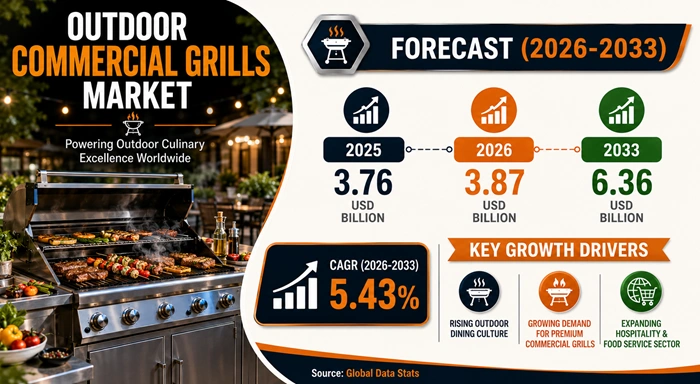
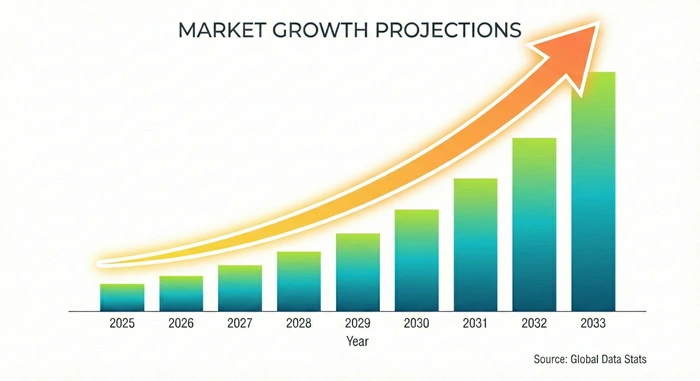
The global outdoor commercial grills market size is valued at USD 3.76 billion in 2025 and is predicted to increase from USD 3.87 billion in 2026 to approximately USD 6.36 billion by 2033, growing at a CAGR of 5.43% from 2026 to 2033.
Outdoor commercial grills are professional-grade cooking equipment designed specifically for commercial establishments such as restaurants, hotels, catering services, and food trucks. These high-performance grills deliver exceptional durability, versatility, and cooking efficiency for preparing diverse food offerings. The outdoor commercial grills market is experiencing remarkable expansion driven by rising consumer preference for outdoor dining experiences, rapid growth of the foodservice industry, and continuous innovation in smart and energy-efficient grill technologies by leading manufacturers.
Embracing Innovation While Meeting Growing Outdoor Dining Demand Across Global Foodservice Operations
The outdoor commercial grills market has successfully transitioned from post-pandemic recovery into a phase of sustainable growth driven by permanent changes in consumer behavior. As hospitality businesses recognize outdoor dining as a lasting revenue stream rather than a temporary trend, investment in high-quality commercial grilling equipment continues to accelerate. Manufacturers who successfully combine rugged durability with advanced smart technology features are positioning themselves as industry leaders in this evolving landscape.
The sector is witnessing significant technological advancement with integration of Internet of Things (IoT) and artificial intelligence capabilities into commercial grills. These innovations enable precision cooking, real-time temperature monitoring, and predictive maintenance systems that enhance operational efficiency and food safety compliance. Additionally, the growing emphasis on sustainability is pushing manufacturers to develop energy-efficient models with low-emission burners and recyclable materials, aligning with environmental regulations and consumer consciousness.
Capitalizing on Hospitality Expansion and Evolving Consumer Preferences in Commercial Foodservice
Market outlook for the outdoor commercial grills industry remains highly favorable through 2033, supported by substantial investment in outdoor dining infrastructure across urban areas. The increasing popularity of alfresco dining experiences, food trucks, and outdoor event venues is creating sustained demand for versatile commercial grilling solutions. Furthermore, the rising disposable income in emerging economies is fueling adoption of premium outdoor cooking equipment in the hospitality sector.
The outdoor commercial grills market is benefiting from a robust pipeline of hospitality projects globally, with thousands of hotel developments and restaurant expansions incorporating outdoor cooking facilities into their core design specifications. This trend reflects the industry's recognition that outdoor grills serve not merely as kitchen equipment but as front-of-house assets that enhance guest experiences and support premium menu pricing strategies.
AI Impact on the Outdoor Commercial Grills Industry
Revolutionizing Commercial Kitchen Operations Through Intelligent Automation and Enhanced Safety Protocols
Artificial intelligence is fundamentally transforming the outdoor commercial grills market by introducing predictive maintenance systems that analyze equipment usage patterns and detect potential failures before they occur. AI-powered monitoring tracks critical components like burners and ignition systems, helping commercial operators prevent unexpected downtime that could disrupt service during peak hours. These intelligent systems send real-time alerts when grill temperatures deviate from safe operating ranges, significantly reducing accident risks and ensuring consistent food safety compliance.
IoT sensors integrated with AI capabilities enable commercial kitchens to maintain precise temperature control across multiple cooking zones simultaneously. This technology allows chefs to monitor and adjust grill performance remotely through connected devices, optimizing cooking efficiency and food quality. AI-driven analytics also help operators understand usage patterns, energy consumption, and maintenance schedules, enabling data-informed decisions that improve overall kitchen productivity and reduce operational costs in the outdoor commercial grills market.
Growth Factors
Expanding Foodservice Infrastructure and Cultural Shift Toward Experiential Outdoor Dining
The outdoor commercial grills market is experiencing robust growth driven by the expanding foodservice infrastructure across urban centers and tourist destinations worldwide. Consumer preferences have shifted dramatically toward experiential dining, with outdoor grilling experiences becoming a key differentiator for restaurants and hospitality venues. This cultural transformation is particularly evident in regions with strong barbecue traditions, where commercial establishments are investing heavily in high-performance outdoor cooking equipment to meet customer expectations for authentic grilled flavors.
Rising disposable incomes in emerging markets are enabling foodservice operators to invest in premium commercial grilling equipment with advanced features. The outdoor commercial grills market is further propelled by the proliferation of food trucks and mobile kitchen concepts that require portable yet high-capacity grilling solutions. Additionally, the trend of hosting outdoor events, festivals, and corporate gatherings has created sustained demand for commercial-grade grills that can handle high-volume cooking while delivering consistent quality and performance.
Market Outlook
Strategic Equipment Investments Driving Revenue Optimization in Outdoor Dining Spaces
The outdoor commercial grills market outlook through 2033 is characterized by operators recognizing outdoor cooking equipment as strategic revenue-generating assets rather than simple kitchen tools. Restaurants and hotels are increasingly positioning visible outdoor grills in patio and terrace areas to create engaging dining experiences that attract customers and increase dwell time. This approach transforms previously underutilized outdoor spaces into premium seating areas that command higher check averages and improve overall revenue per available seat hour.
Equipment manufacturers in the outdoor commercial grills market are responding to evolving operator needs by developing modular, customizable grill systems that can be configured for specific operational requirements. Weather-resilient designs with advanced canopies, wind screens, and integrated heating solutions are extending the operational season for outdoor cooking stations, improving return on investment for commercial operators. The convergence of sustainability imperatives with technological innovation is creating opportunities for manufacturers who can deliver eco-friendly, high-efficiency grills that meet both regulatory requirements and operator performance expectations.
Expert Speaks
-
Timothy FitzPatrick, CEO of Middleby Corporation, highlighted that outdoor commercial grills represent a critical growth segment as hospitality operators invest in equipment that enhances guest experiences and operational efficiency, noting the company generated record operating cash flows exceeding USD 687 million in 2024.
-
Chris Scherzinger, CEO of Weber Inc., emphasized that the 2025 product lineup combines expert engineering with quality craftsmanship to deliver versatile, high-performance outdoor cooking solutions that bring enhanced value to commercial operations and continue setting industry standards.
-
Jeremy Andrus, Former CEO of Traeger Grills, stated that smart pellet grill technology with advanced controls and connectivity features is transforming commercial kitchen operations by enabling precision cooking and remote monitoring capabilities that modern foodservice businesses demand.
Key Report Takeaways
-
North America leads the outdoor commercial grills market with the largest regional share of approximately 44% in 2025, driven by established barbecue culture, high consumer spending on outdoor dining, and well-developed foodservice infrastructure across the region.
-
Asia Pacific represents the fastest-growing region with an expected CAGR of 7.5% during the forecast period, propelled by rapid urbanization, rising disposable incomes, and increasing adoption of Western-style outdoor grilling influenced by social media trends and global culinary exposure.
-
Freestanding grills dominate the product type segment with over 51% market share in 2025, favored by commercial operators for their versatility, portability, and flexibility across various foodservice settings including restaurants, catering services, and outdoor events.
-
Gas grills hold the largest fuel type share at approximately 40% in 2025, preferred for their operational efficiency, precise temperature control, quick ignition, and cleaner combustion profile that meets increasingly stringent emissions regulations.
-
Restaurants account for the highest end-user segment with 43% to 47% market share in 2025, driven by demand for high-volume grilling solutions that support diverse menus, premium pricing strategies, and experiential dining concepts.
-
The hotels and resorts segment is expected to witness the fastest growth with a CAGR exceeding 7% through 2033, fueled by increasing demand for premium guest experiences including live cooking demonstrations and customizable outdoor grilling setups.
Market Scope
| Report Coverage | Details |
|---|---|
| Market Size by 2033 | USD 6.36 Billion |
| Market Size by 2025 | USD 3.76 Billion |
| Market Size by 2026 | USD 3.87 Billion |
| Market Growth Rate from 2026 to 2033 | CAGR of 5.43% |
| Dominating Region | North America |
| Fastest Growing Region | Asia Pacific |
| Base Year | 2025 |
| Forecast Period | 2026 to 2033 |
| Segments Covered | Product Type, Fuel Type, Application, End-User, Distribution Channel, and Region |
| Regions Covered | North America, Europe, Asia-Pacific, Latin America, and Middle East & Africa |
Market Dynamics
Drivers Impact Analysis
Surging Consumer Preference for Outdoor Dining and Experiential Foodservice Concepts
The outdoor commercial grills market is witnessing significant momentum from the fundamental shift in consumer dining preferences toward outdoor and experiential eating environments. Modern consumers increasingly value authentic culinary experiences where they can observe food preparation, creating demand for visible outdoor cooking stations in restaurants and hotels. This trend transforms outdoor grills from back-of-house equipment into front-of-house attractions that enhance ambiance and justify premium menu pricing, directly supporting revenue growth for foodservice operators.
Commercial establishments are leveraging outdoor grilling as a strategic differentiator in competitive markets, recognizing that open-flame cooking creates strong sensory connections through visual appeal and aromatic engagement. The outdoor commercial grills market benefits as operators invest in high-quality equipment that delivers both performance and presentation value. Furthermore, the growing popularity of fast-casual dining concepts and food trucks that emphasize made-to-order grilled items is expanding the addressable market beyond traditional sit-down restaurants to include mobile and temporary foodservice operations.
| Driver | ≈ % Impact on CAGR Forecast | Geographic Relevance | Impact Timeline |
|---|---|---|---|
| Rising outdoor dining preference | 35-40% | Global, strongest in North America and Europe | 2026-2033 |
| Foodservice infrastructure expansion | 25-30% | Asia Pacific, Latin America, Middle East | 2026-2033 |
| Smart technology integration | 20-25% | North America, Europe, developed urban centers | 2027-2033 |
| Sustainability and energy efficiency | 15-20% | Europe, North America, Asia Pacific | 2026-2033 |

Restraints Impact Analysis
High Initial Capital Investment and Maintenance Requirements Present Adoption Barriers
The outdoor commercial grills market faces challenges related to substantial upfront capital requirements for commercial-grade equipment, particularly for establishments with limited budgets or new market entrants. Premium commercial grills with advanced features such as smart controls, multi-zone temperature management, and durable stainless steel construction command significantly higher prices compared to standard residential units. This cost differential can deter smaller operators from upgrading their outdoor cooking capabilities, potentially slowing market penetration in price-sensitive segments.
Ongoing maintenance requirements and the need for specialized service technicians add to the total cost of ownership for outdoor commercial grills. Equipment exposed to outdoor elements faces accelerated wear from weather conditions, requiring more frequent servicing and component replacement compared to protected indoor equipment. Additionally, regulatory compliance costs related to ventilation systems, safety inspections, and emissions standards can create financial burdens that impact adoption rates, particularly in regions with stringent commercial kitchen regulations.
| Restraint | ≈ % Impact on CAGR Forecast | Geographic Relevance | Impact Timeline |
|---|---|---|---|
| High initial equipment costs | -15 to -20% | Emerging markets, small operators | 2026-2033 |
| Maintenance and operating expenses | -10 to -15% | All regions, particularly harsh climates | 2026-2033 |
| Regulatory compliance complexity | -8 to -12% | Europe, North America, developed markets | 2026-2033 |
| Weather dependency limitations | -5 to -8% | Northern regions, monsoon-affected areas | 2026-2030 |
Opportunities Impact Analysis
Emerging Markets and Hospitality Expansion Create Substantial Growth Avenues
The outdoor commercial grills market is positioned to capitalize on massive hospitality infrastructure development occurring across emerging economies in Asia Pacific, Latin America, and the Middle East. With thousands of hotel projects and restaurant expansions in development pipelines globally, equipment manufacturers have unprecedented opportunities to establish long-term supply partnerships and specification preferences at the design stage. This strategic positioning enables vendors to secure multi-year revenue streams as hospitality projects move from planning through construction to operational phases.
Sustainability-focused product innovation presents another significant opportunity in the outdoor commercial grills market, as operators increasingly prioritize energy-efficient equipment that reduces operational costs while meeting environmental regulations. Manufacturers developing electric and hybrid grills with low emissions, recyclable materials, and smart energy management systems can differentiate their offerings and capture premium market segments. Additionally, the growing popularity of plant-based and health-conscious menu items creates demand for specialized grilling equipment with precise temperature controls and versatile cooking zones that support diverse culinary applications beyond traditional meat-centric offerings.
| Opportunity | ≈ % Impact on CAGR Forecast | Geographic Relevance | Impact Timeline |
|---|---|---|---|
| Emerging market hospitality expansion | 30-35% | Asia Pacific, Middle East, Latin America | 2026-2033 |
| Smart and connected equipment | 25-30% | North America, Europe, urban Asia | 2027-2033 |
| Sustainable and eco-friendly solutions | 20-25% | Europe, North America, Australia | 2026-2033 |
| Modular and customizable systems | 15-20% | Global, multi-unit operators | 2026-2033 |
Segment Analysis
Freestanding Grills Segment
Capital Flexibility and Franchise Standardization Drive Dominant Market Position
The freestanding grills segment maintains commanding leadership in the outdoor commercial grills market with over 51% share in 2025, primarily because multi-unit operators prioritize capital asset flexibility over permanent infrastructure investments. Franchise restaurant groups and chain operators favor equipment that remains on their balance sheets as movable assets rather than immovable leasehold improvements that cannot be recovered when locations close or require relocation. This strategic approach aligns with modern commercial real estate dynamics where lease terms are shortening and landlords maintain stricter control over structural modifications to their properties.
Freestanding grills enable foodservice operators to standardize cooking platforms across diverse location footprints, significantly simplifying training programs, food safety protocols, and preventive maintenance planning. The outdoor commercial grills market benefits from operators' ability to redeploy freestanding units from underperforming stores to new growth markets, improving overall asset utilization rates and return on equipment investment. North America leads adoption of freestanding commercial grills with approximately 44% regional market share, where established restaurant chains and catering companies particularly value the operational flexibility these units provide. Leading manufacturers including Weber, Traeger, and Napoleon are capturing market share by offering ruggedized freestanding models with advanced features like multi-zone cooking, smart controls, and weather-resistant construction.
Freestanding grills are experiencing robust growth at an expected CAGR of approximately 5.5% through 2033, driven by the proliferation of food trucks, mobile catering services, and temporary event venues that require portable yet high-performance cooking equipment. As municipal permitting processes for permanent outdoor kitchen installations become more complex and time-consuming, operators increasingly view modular freestanding systems as the fastest path to expand outdoor cooking capacity without construction delays. This segment's growth is particularly strong in Asia Pacific markets where rapid urbanization and the emerging food truck culture are creating new opportunities for mobile outdoor cooking solutions in the outdoor commercial grills market.
Gas Grills Segment
Operational Reliability and Culinary Versatility Secure Dominant Fuel Type Position
Gas grills command the largest fuel type share in the outdoor commercial grills market at approximately 40% in 2025, establishing dominance through superior operational reliability and elimination of daily fuel sourcing uncertainties. High-volume restaurants, hotels, and catering operations benefit from hard-plumbed natural gas lines or stable propane tank systems that remove the logistical complexity of procuring, storing, and replenishing solid fuels like charcoal or wood. This predictability becomes critically important during peak service periods when any disruption in fuel availability can cascade into menu limitations, service delays, and revenue losses that directly impact profitability.
Modern gas grill platforms have evolved significantly beyond basic open burner designs into sophisticated multi-zone cooking systems incorporating infrared heating zones, precision multi-ring burners, and fine-tuned temperature controls that rival the performance of indoor commercial kitchen equipment. These technological enhancements provide chefs in the outdoor commercial grills market with confidence to execute diverse menu offerings from high-heat seared proteins to delicate vegetables on a single integrated platform. In jurisdictions implementing stricter air quality and emissions regulations, gas grills' cleaner combustion profile relative to particulate-heavy solid fuels reduces regulatory compliance risk and potential operational restrictions. North America and Europe drive gas grill adoption with combined market share exceeding 60%, where established natural gas infrastructure and regulatory frameworks favor gas-powered commercial equipment. Key players including Crown Verity, Blackstone, and Lynx Grills are expanding their gas grill product lines with enhanced efficiency and connectivity features to meet evolving commercial operator requirements.
The gas grills segment is projected to maintain steady growth at a CAGR of approximately 5.2% through 2033, supported by continuous innovation in burner technology, smart ignition systems, and energy-efficient designs that reduce operational costs. Growing adoption in Asia Pacific markets, particularly in China where natural gas infrastructure is expanding rapidly, presents significant growth opportunities for gas grill manufacturers in the outdoor commercial grills market. The segment's growth is further reinforced by the increasing number of outdoor dining installations in urban environments where gas connections are readily available and cleaner-burning fuels are mandated by local regulations.
Regional Insights
North America
Established Barbecue Culture and Premium Dining Trends Sustain Regional Market Leadership
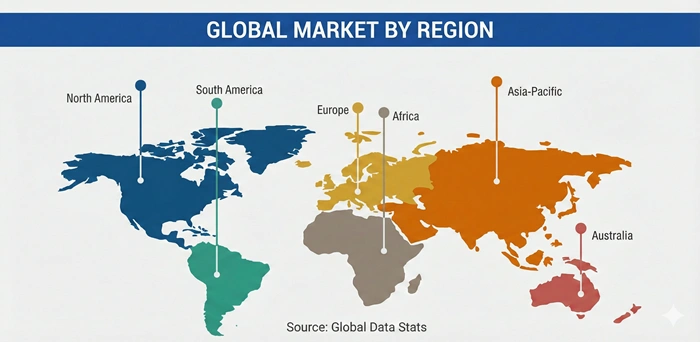
North America dominates the outdoor commercial grills market with approximately 44% to 45% regional share in 2025, valued at over USD 1.65 billion, driven fundamentally by deeply rooted barbecue culture and high consumer spending on outdoor dining experiences. The region's foodservice industry has fully embraced outdoor grilling as a permanent fixture rather than seasonal amenity, with restaurants, hotels, and event venues investing significantly in premium commercial-grade equipment that enhances guest experiences and supports menu premiumization strategies. Barbecuing represents a cultural cornerstone across North America, closely associated with family gatherings, holidays, and social celebrations, translating into consistently strong commercial demand for high-performance outdoor cooking solutions.
The outdoor commercial grills market in North America benefits from well-established natural gas infrastructure, favorable commercial kitchen regulations, and a sophisticated distribution network connecting manufacturers with end-users. The United States leads regional growth with over 6300 active hotel development projects and substantial restaurant expansion activity, particularly in growth markets like Texas, Florida, and California where outdoor dining culture is strongest. Major manufacturers including Weber-Stephen Products, Traeger Pellet Grills, Napoleon, and Middleby Corporation maintain significant market presence across North America, leveraging strong brand recognition and extensive dealer networks. The region's market is characterized by premiumization trends, with operators increasingly adopting smart grills featuring IoT connectivity, predictive maintenance capabilities, and advanced temperature control systems that optimize kitchen efficiency.
North America is expected to maintain market leadership through 2033 with a projected CAGR of approximately 5.8%, supported by continued investment in outdoor dining infrastructure and growing consumer preference for experiential restaurant concepts. The outdoor commercial grills market in this region is witnessing increased adoption of sustainable equipment solutions, including energy-efficient models and low-emission designs that align with environmental regulations in states like California implementing strict air quality standards. Rising disposable incomes and the trend toward outdoor entertainment spaces in both commercial and high-end residential settings continue driving demand for professional-grade grilling equipment across the region.
Asia Pacific
Rapid Urbanization and Western Culinary Influence Drive Fastest Regional Growth
Asia Pacific represents the fastest-growing region in the outdoor commercial grills market with an expected CAGR of 7.5% during the forecast period 2026 to 2033, propelled by accelerated urbanization, rising middle-class incomes, and increasing exposure to Western dining concepts. The region's foodservice industry is experiencing rapid transformation as consumers embrace modern lifestyle trends including outdoor dining and recreational cooking experiences previously uncommon in traditional Asian culinary culture. Social media influence and international travel are introducing Western-style barbecue and grilling concepts to younger demographics across major cities in China, India, Southeast Asia, and Australia, creating substantial new market opportunities.
China leads Asia Pacific's expansion in the outdoor commercial grills market, serving as both a major manufacturing hub and rapidly growing consumption market. Chinese manufacturers including BBQ Industry Co. and Ningbo Huige Outdoor Products Co. are expanding production capacity to meet domestic demand and support global exports of commercial grilling equipment. The outdoor commercial grills market in Asia Pacific is characterized by strong growth in hotel and resort development, with thousands of hospitality projects incorporating outdoor dining facilities into core design specifications. Countries including Singapore, Thailand, Japan, and South Korea are experiencing robust growth in rooftop restaurants, outdoor event venues, and food court concepts that require commercial-grade grilling equipment. Regional manufacturers and international brands are competing aggressively to establish distribution networks and brand presence across this high-growth market.
The Asia Pacific outdoor commercial grills market is expected to surpass USD 2 billion by 2033, driven by continued expansion of quick-service restaurants, food trucks, and catering services that utilize outdoor cooking as a key differentiator. Regional growth is supported by improving commercial kitchen infrastructure, increasing availability of natural gas connections in urban areas, and growing awareness of food safety standards that favor modern commercial grilling equipment over traditional cooking methods. Australia and New Zealand contribute significantly to regional market value with established outdoor dining cultures and high adoption rates of premium commercial grills in the hospitality sector.
Top Key Players
-
Weber-Stephen Products LLC (United States)
-
Traeger Pellet Grills LLC (United States)
-
Napoleon (Canada)
-
Middleby Corporation (United States)
-
Crown Verity (Canada)
-
Blackstone (United States)
-
Lynx Grills Inc. (United States)
-
Char-Broil LLC (United States)
-
Pit Boss Grills (United States)
-
Kamado Joe (United States)
-
Louisiana Grills (Canada)
-
Meadow Creek (United States)
-
Southern Pride (United States)
-
R&V Works (United States)
-
Old Country BBQ Pits (United States)
-
Dyna-Glo (United States)
-
Holstein Manufacturing (United States)
-
Magikitch'n (United States)
-
Backyard Pro (United States)
-
Nuke BBQ (United States)
Recent Developments
-
Weber LLC unveiled its comprehensive 2025 lineup of grills, smokers, griddles, and accessories in January 2025, combining expert engineering and quality craftsmanship to deliver versatile, high-performance products that enhance outdoor cooking experiences and maintain the company's position as a global leader in outdoor cooking technology.
-
Current launched the Model G+ Dual-Zone Electric Grill in October 2025, representing the world's first electric outdoor cooking company's most advanced all-electric grill featuring expanded color options including the popular Slate finish and new matte black Eclipse Edition, building on patented technology with enhanced dual-zone cooking capabilities.
-
Middleby Corporation reported record financial performance for 2024, generating USD 687 million in operating cash flows for the full year with fourth-quarter operating cash flow of USD 240 million, demonstrating strong market demand and operational efficiency that supports continued investment in product innovation and market expansion.
-
Traeger Pellet Grills expanded its smart grill technology platform in 2024, introducing advanced IoT connectivity features and AI-powered temperature monitoring systems that enable remote cooking management and predictive maintenance capabilities for commercial operators seeking enhanced operational efficiency.
-
Napoleon Grills received VESTA awards for "Best Gas Grill" and "Best in Show" recognition for their built-in grill lines in 2024, validating the company's innovation leadership and reinforcing brand preference among commercial buyers at major industry trade events.
Market Trends
Integration of Smart Technology and Sustainability Priorities Reshape Equipment Development
The outdoor commercial grills market is experiencing fundamental transformation through integration of smart technologies that enhance operational efficiency and cooking precision. IoT-enabled grills with cloud connectivity allow commercial operators to monitor equipment performance, track maintenance needs, and optimize energy consumption through real-time data analytics. AI-powered predictive maintenance systems are becoming standard features in premium commercial grills, helping operators avoid costly downtime by identifying potential equipment failures before they occur. This technological evolution is particularly valued by multi-unit restaurant chains and hotel groups that require consistent performance across distributed operations.
Sustainability has emerged as a critical market trend driving product development in the outdoor commercial grills market, with manufacturers prioritizing energy-efficient designs, low-emission burners, and recyclable materials in response to regulatory pressures and operator preferences. Electric and hybrid grill models are gaining traction in urban markets where air quality regulations restrict traditional fuel types, offering commercial operators cleaner alternatives without sacrificing cooking performance. The trend toward modular and customizable grill systems enables operators to configure equipment precisely for their menu requirements and space constraints, improving capital efficiency and operational flexibility. Additionally, manufacturers are developing weather-resistant designs with advanced materials and protective features that extend equipment lifespan in challenging outdoor environments, addressing a key concern for commercial operators making long-term capital investments.
Segments Covered in the Report
By Product Type
-
Freestanding Grills
-
Built-In Grills
-
Portable/Mobile Grills
By Fuel Type
-
Gas Grills
-
Charcoal Grills
-
Electric Grills
-
Hybrid Grills
By Application
-
Outdoor Cooking
-
Grilling & Barbecue
-
Fast Food & Quick Service
-
Entertainment & Hospitality
By End-User
-
Restaurants
-
Hotels & Resorts
-
Catering Services
-
Food Trucks/Mobile Kitchens
-
Event Venues
By Distribution Channel
-
Direct Sales
-
Retail Stores
-
Online Sales/E-Commerce
By Region
-
North America
-
United States
-
Canada
-
Mexico
-
-
Europe
-
Germany
-
United Kingdom
-
France
-
Spain
-
Italy
-
Rest of Europe
-
-
Asia-Pacific
-
China
-
Japan
-
South Korea
-
India
-
Singapore
-
Thailand
-
Indonesia
-
Australia
-
New Zealand
-
Rest of Asia-Pacific
-
-
Latin America
-
Brazil
-
Argentina
-
Rest of Latin America
-
-
Middle East & Africa
-
UAE
-
Saudi Arabia
-
South Africa
-
Rest of Middle East & Africa
-
Frequently Asked Questions
Question 1: What is the outdoor commercial grills market size expected to reach by 2033?
Answer: The outdoor commercial grills market is projected to reach approximately USD 6.36 billion by 2033, growing from USD 3.87 billion in 2026 at a CAGR of 5.43% during the forecast period.
Question 2: Which region dominates the outdoor commercial grills market currently?
Answer: North America dominates the outdoor commercial grills market with approximately 44-45% market share in 2025, driven by established barbecue culture and strong foodservice infrastructure across the region.
Question 3: What are the key drivers fueling outdoor commercial grills market growth?
Answer: Key drivers include rising consumer preference for outdoor dining experiences, expansion of foodservice infrastructure, integration of smart technologies, and increasing adoption of sustainable and energy-efficient grilling solutions.
Question 4: Which end-user segment holds the largest share in the outdoor commercial grills market?
Answer: The restaurants segment accounts for the largest share at 43-47% in the outdoor commercial grills market, driven by demand for high-volume grilling solutions and premium menu positioning strategies.
Question 5: What product type leads the outdoor commercial grills market and why?
Answer: Freestanding grills dominate with over 51% market share in the outdoor commercial grills market because they offer capital flexibility, portability, and operational versatility valued by multi-unit operators and franchise chains.