
Oilfield Chemicals Market Overview
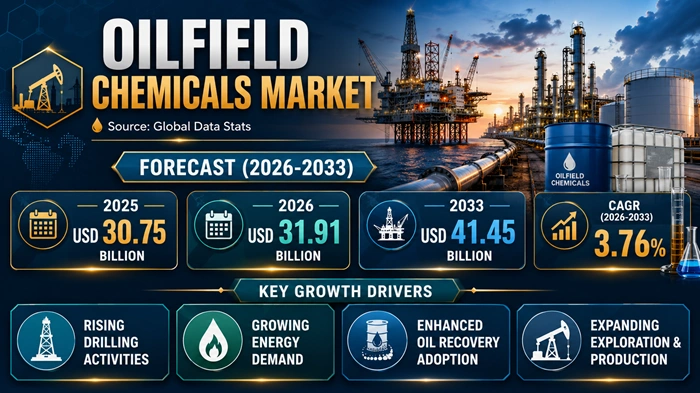
The global oilfield chemicals market size is valued at USD 30.75 billion in 2025 and is predicted to increase from USD 31.91 billion in 2026 to approximately USD 41.45 billion by 2033, growing at a CAGR of 3.76% from 2026 to 2033.
This steady growth reflects rising upstream exploration and production activity, growing adoption of enhanced oil recovery techniques in mature fields, and the industry's continued shift toward more environmentally sustainable drilling and production chemistry. As oil and gas operators push into deeper offshore reserves and unconventional shale plays, demand for specialized oilfield chemicals used in drilling, cementing, stimulation, and production continues expanding across nearly every major producing region.
AI Impact on the Oilfield Chemicals Industry
Artificial Intelligence Is Optimizing Chemical Dosage Management, Improving Reservoir Response Prediction, and Strengthening Real-Time Fluid Monitoring Across the Oilfield Chemicals Landscape — Fundamentally Changing How Operators Manage Chemical Consumption in the Field
Artificial intelligence has become an increasingly valuable tool for optimizing chemical dosage decisions in upstream operations, with predictive models now able to analyze real-time fluid composition data and reservoir characteristics to determine the exact quantity of corrosion inhibitors, scale inhibitors, or demulsifiers needed at any given production stage. This precision-driven approach matters considerably since over-dosing chemicals wastes money and creates unnecessary environmental burden, while under-dosing risks equipment damage and reduced production efficiency. Companies building AI-driven dosage optimization directly into their digital field monitoring platforms are increasingly differentiating themselves through measurable cost savings for operators.
Beyond dosage management, AI is also improving reservoir response prediction, with machine learning algorithms now capable of analyzing historical stimulation data to forecast how specific chemical formulations will perform under particular reservoir conditions before field deployment. This capability has proven valuable for operators planning hydraulic fracturing and enhanced oil recovery campaigns, since better predictive modeling reduces costly trial-and-error in chemical selection. As these AI-driven monitoring and prediction tools continue maturing, they are becoming an increasingly important factor shaping operational efficiency across the broader oilfield chemicals market.
Growth Factors
Rising Enhanced Oil Recovery Adoption and Expanding Deepwater Exploration Continue Driving Sustained Demand
The most significant growth factor supporting the oilfield chemicals market is the growing adoption of enhanced oil recovery techniques across mature oil fields, as operators increasingly rely on specialized chemical formulations including polymers, surfactants, and demulsifiers to extract additional reserves from wells that have already passed their peak natural production phase. With many established basins in North America and the Middle East now well past initial production peaks, this recovery-focused chemical demand has become an increasingly important revenue driver for suppliers.
A second important growth factor is the continued expansion of deepwater and unconventional shale exploration activity, as operators pursue increasingly complex drilling environments that require more sophisticated drilling fluids, cementing additives, and completion chemicals to manage extreme pressure and temperature conditions safely. This growing operational complexity, combined with rising global energy demand supporting continued upstream investment, has broadened the addressable market for specialized oilfield chemistry considerably. This combination of rising enhanced oil recovery adoption and expanding deepwater exploration continues to strengthen demand across the oilfield chemicals market.
Market Outlook
Sustainable Chemistry Innovation and Expanding Shale Development Point Toward Sustained Growth Through 2033
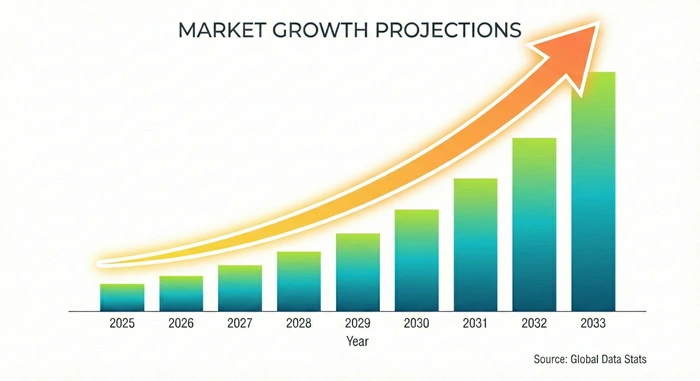
Looking ahead through the forecast period, the oilfield chemicals industry is expected to benefit substantially from continued advancement in sustainable and biodegradable chemical formulations, as regulatory pressure and operator environmental commitments push suppliers to develop lower-toxicity alternatives to traditional drilling and production chemicals without sacrificing performance. This shift toward green chemistry is likely to reshape competitive positioning considerably as more operators favor suppliers with strong environmental compliance credentials.
At the same time, continued expansion of shale development activity across North America and emerging unconventional plays elsewhere is expected to create substantial new demand for hydraulic fracturing fluids, friction reducers, and proppant transport chemicals. Companies that can deliver both high-performance formulations and demonstrated environmental responsibility are increasingly well positioned to capture this growth. Manufacturers combining strong chemical innovation with broad global manufacturing footprints are likely to lead growth within the broader oilfield chemicals market through 2033.
Expert Speaks
-
"Our continued investment in specialty chemistry reflects our commitment to helping operators maximize recovery while meeting increasingly strict environmental standards." — CEO, Baker Hughes Company
-
"As reservoir conditions grow more complex, our production chemical portfolio remains focused on delivering measurable efficiency gains for operators worldwide." — CEO, Halliburton Company
-
"We remain dedicated to advancing sustainable chemical solutions that support both operational performance and the industry's broader environmental commitments." — CEO, SLB (Schlumberger Limited)
Key Report Takeaways
-
North America leads the global oilfield chemicals market, holding approximately 34% market share in 2025, supported by extensive shale development activity and mature enhanced oil recovery operations
-
Middle East & Africa is the fastest-growing region, projected to expand at a CAGR near 5.4% through 2033, driven by expanding upstream investment and rising offshore exploration activity
-
Onshore application customers use these chemicals the most, accounting for roughly 58% share, given the extensive shale and conventional drilling activity concentrated in land-based operations
-
Production chemicals contribute the most to overall demand, reflecting their continuous use throughout a well's operational lifecycle for corrosion and scale management
-
Water-based drilling fluid formulations remain the most widely adopted process, valued for their lower environmental impact and cost efficiency compared to oil-based alternatives
-
Enhanced oil recovery chemical segments will grow the fastest among application categories, holding close to 19% market share with a CAGR near 6.1% through the forecast period, driven by rising demand for mature field recovery optimization
Market Scope
| Report Coverage | Details |
|---|---|
| Market Size by 2033 | USD 41.45 Billion |
| Market Size by 2025 | USD 30.75 Billion |
| Market Size by 2026 | USD 31.91 Billion |
| Market Growth Rate from 2026 to 2033 | CAGR of 3.76% |
| Dominating Region | North America |
| Fastest Growing Region | Middle East & Africa |
| Base Year | 2025 |
| Forecast Period | 2026 to 2033 |
| Segments Covered | Product Type, Application, Function, Region |
| Regions Covered | North America, Europe, Asia Pacific, Latin America, Middle East & Africa |
Market Dynamics
Drivers Impact Analysis
Rising Enhanced Oil Recovery Demand and Expanding Upstream Exploration Remain the Two Strongest Forces Behind Market Momentum
| Driver | (≈) % Impact on CAGR Forecast | Geographic Relevance | Impact Timeline |
|---|---|---|---|
| Growing adoption of enhanced oil recovery techniques in mature fields | ~33% | North America, Middle East | Medium to long-term |
| Expanding deepwater and unconventional shale exploration activity | ~28% | North America, Latin America | Short to medium-term |
| Rising global energy demand supporting continued upstream investment | ~25% | Global | Short to long-term |
| Growing complexity of drilling environments requiring specialized formulations | ~14% | Global | Medium-term |
Growing adoption of enhanced oil recovery techniques continues to serve as the primary engine behind sustained growth in the oilfield chemicals market, as operators managing mature fields increasingly rely on specialized polymers and surfactants to extract additional reserves beyond natural production decline. This recovery-focused chemical demand has translated directly into rising revenue for suppliers serving basins across North America and the Middle East.
Expanding deepwater and unconventional shale exploration represents the second major driver, as operators pursuing increasingly complex drilling environments require more sophisticated drilling fluids and completion chemicals to manage extreme pressure and temperature conditions safely. This exploration-driven demand, combined with rising global energy consumption, continues reinforcing steady demand growth across the broader oilfield chemicals market.
Restraints Impact Analysis
Oil Price Volatility and Stringent Environmental Regulation Continue to Moderate Broader Investment
| Restraint | (≈) % Impact on CAGR Forecast | Geographic Relevance | Impact Timeline |
|---|---|---|---|
| Volatility in crude oil prices affecting upstream capital expenditure | ~36% | Global | Short to medium-term |
| Stringent environmental regulations governing chemical discharge and disposal | ~28% | North America, Europe | Medium to long-term |
| Growing global transition toward renewable energy sources | ~22% | Global | Medium to long-term |
| High costs associated with developing biodegradable chemical alternatives | ~14% | Global | Short to medium-term |
The most persistent restraint facing the oilfield chemicals market is the ongoing volatility in crude oil prices, which directly influences how much operators are willing to invest in upstream drilling and production activity during periods of price weakness. This budget sensitivity remains particularly pronounced for exploratory and enhanced oil recovery projects that require substantial upfront chemical investment.
Stringent environmental regulations governing chemical discharge and disposal represent a second significant restraint, since compliance with increasingly strict standards around produced water treatment and chemical toxicity often requires costly reformulation and additional testing before market approval. Combined with the broader global transition toward renewable energy sources, these restraints continue moderating how quickly upstream investment expands across the global oilfield chemicals market.
Opportunities Impact Analysis
Sustainable Formulation Development and Expanding Offshore Exploration Represent the Clearest Paths to Growth
| Opportunity | (≈) % Impact on CAGR Forecast | Geographic Relevance | Impact Timeline |
|---|---|---|---|
| Developing biodegradable and low-toxicity chemical formulations | ~38% | North America, Europe | Medium to long-term |
| Expanding offshore and deepwater exploration across Middle East and Africa | ~32% | Middle East & Africa | Medium-term |
| Growing digital fluid monitoring and dosage optimization technology adoption | ~30% | Global | Short to medium-term |
Developing biodegradable and low-toxicity chemical formulations represents one of the most substantial opportunities within the oilfield chemicals market, as suppliers creating environmentally responsible alternatives stand to capture significant share from operators facing increasingly strict discharge regulations. This sustainable chemistry innovation is expected to meaningfully reshape competitive positioning among leading suppliers over the coming years.
Expanding offshore and deepwater exploration across Middle East and African waters presents a second substantial opportunity, as national oil companies and international operators continue investing in new production capacity requiring specialized completion and stimulation chemistry. Growing adoption of digital fluid monitoring and dosage optimization technology further broadens the opportunity landscape, particularly for suppliers able to bundle chemical products with data-driven service offerings. Companies pursuing these parallel opportunities are well positioned to capture meaningful growth within the broader oilfield chemicals market through the forecast period.
Segment Analysis
By Application: Production Chemicals
Production Chemicals Continue to Anchor the Application Landscape, Reflecting Their Continuous Use Throughout a Well's Operating Life
Production chemicals hold the largest share within the application segment of the oilfield chemicals market, accounting for approximately 39% of total segment revenue in 2025. This dominance reflects the continuous and repeated use of corrosion inhibitors, scale inhibitors, demulsifiers, and biocides throughout a well's entire operational lifecycle, which creates a steady, recurring revenue stream that persists long after drilling and completion activities have concluded. In markets like the United States and Saudi Arabia, operators increasingly favor combination production chemical packages that address multiple flow assurance challenges simultaneously to reduce field service visits. Leading suppliers such as Baker Hughes, Halliburton, and Ecolab continue to dominate this segment through expanded digital dosage monitoring and formulation improvements.
Growth within this segment remains particularly strong in North America, where extensive shale production and mature conventional fields continue generating sustained demand for ongoing flow assurance chemistry across thousands of active wells. The region's combination of vast well count and established service relationships has helped production chemicals maintain their leading position despite growing interest in enhanced oil recovery alternatives. As digital monitoring technology continues improving dosage precision, production chemicals are expected to remain the dominant category within the broader oilfield chemicals market throughout the forecast period.
By Application: Enhanced Oil Recovery Chemicals
Enhanced Oil Recovery Chemicals Represent the Fastest-Growing Application Segment, Reflecting Rising Demand for Mature Field Optimization
Enhanced oil recovery chemicals represent the fastest-growing application within the oilfield chemicals market, holding close to 19% share in 2025 with a projected CAGR near 6.1% through the forecast period as operators increasingly turn to specialized polymers and surfactants to extend the productive life of aging fields. Unlike primary and secondary recovery methods that rely mainly on natural reservoir pressure and water injection, enhanced oil recovery chemicals actively alter fluid properties to mobilize previously unrecoverable oil trapped within reservoir formations. This mobilization-focused approach has generated substantial operator interest, particularly across mature basins where natural production has already declined significantly below peak levels.
Growth in this segment remains especially strong in the Middle East, where national oil companies continue investing heavily in chemical enhanced oil recovery programs to maximize output from long-producing conventional fields. Companies like Baker Hughes and SLB have expanded their enhanced oil recovery chemical portfolios significantly to serve this growing regional demand, often partnering directly with national oil companies on pilot recovery programs. As mature field optimization continues gaining strategic priority, this application segment is expected to remain the fastest-growing category within the broader oilfield chemicals market.
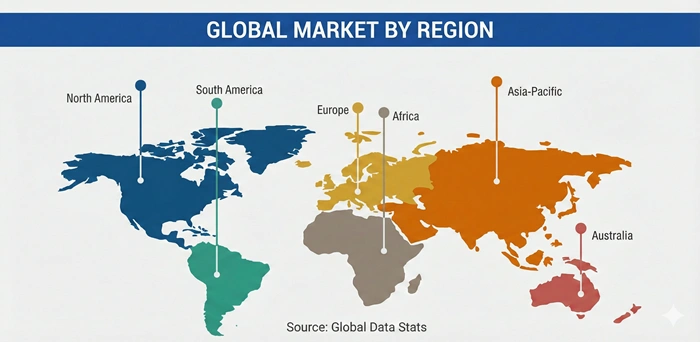
Regional Insights
North America
Extensive Shale Development and Mature Field Recovery Operations Keep North America Firmly in the Lead
North America commands the leading position in the global oilfield chemicals market, holding approximately 34% share in 2025, supported by extensive shale development activity, mature enhanced oil recovery operations, and a dense concentration of leading chemical suppliers. The United States drives the overwhelming majority of regional demand, backed by continued Permian Basin drilling activity and thousands of active production wells requiring ongoing flow assurance chemistry. Companies with strong regional presence include Baker Hughes, Halliburton, SLB, and Ecolab, each maintaining deep relationships with major operators across the country.
Canada also contributes meaningfully to regional demand, supported by continued oil sands production and growing enhanced oil recovery investment in mature conventional fields. The region's combination of vast well count, established service infrastructure, and continuous chemical innovation ensures North America's leadership position within the oilfield chemicals market remains firmly intact through the remainder of the forecast period.
Middle East & Africa
Expanding Offshore Investment and Rising Upstream Exploration Position Middle East & Africa as the Fastest-Growing Region
Middle East & Africa is projected to register the fastest CAGR within the global oilfield chemicals market through 2033, expanding at a rate near 5.4% as expanding upstream investment and rising offshore exploration activity create substantial new demand across the region. Saudi Arabia and the UAE lead much of this regional growth, supported by national oil company investment in enhanced oil recovery programs and continued expansion of production capacity across established conventional fields. Regional and international chemical suppliers alike have expanded their presence to serve this growing demand, often establishing local manufacturing facilities to reduce supply chain costs.
African offshore basins contribute further depth to regional growth, with countries pursuing deepwater exploration projects that require specialized completion and stimulation chemistry suited to challenging subsea conditions. Growing national oil company investment across several Middle Eastern markets continues to accelerate chemical demand for both conventional and enhanced recovery operations alike. This combination of rising upstream investment, expanding offshore activity, and growing enhanced recovery focus positions Middle East & Africa as the clear growth leader within the broader oilfield chemicals market through the forecast period.
Customization Available for This Report
Region-Specific and Country-Specific Versions of This Report Are Available to Deliver a Sharper, More Localized View of Market Dynamics
This report can be tailored on a region-by-region and country-by-country basis, providing localized market sizing, competitive mapping, and upstream demand trend analysis that a global overview alone cannot fully capture.
Clients seeking a more focused breakdown can request a customized version covering any of the following regions and countries, complete with demand forecasting, competitor landscape review, and adoption trend analysis tied specifically to the oilfield chemicals keyword focus:
North America
-
U.S. — Detailed review of shale development activity and production chemical demand trends
-
Canada — Coverage of oil sands production and enhanced recovery investment patterns
-
Mexico — Analysis of emerging offshore exploration investment trends
Europe
-
U.K. — Review of North Sea offshore production chemistry and regulatory trends
-
Germany — Coverage of specialty chemical manufacturing investment
-
France — Insights into oilfield chemical distribution and supply trends
-
Italy — Analysis of regional upstream chemical investment trends
-
Rest of Europe — Country-level view of emerging demand across Eastern Europe and the Nordics
Asia Pacific
-
China — Coverage of expanding shale gas development and chemical demand
-
India — Analysis of growing offshore exploration and chemical adoption
-
Japan — Review of established chemical manufacturing infrastructure trends
-
South Korea — Assessment of oilfield chemical investment and adoption
-
Australia — Insights into offshore gas production chemistry trends
-
Rest of Asia Pacific — Country-level breakdown covering Indonesia, Malaysia, and Vietnam
Latin America
-
Brazil — Coverage of expanding pre-salt offshore chemical demand and adoption
-
Argentina — Analysis of Vaca Muerta shale development chemical investment trends
-
Rest of Latin America — Country-level sizing across Colombia, Peru, and Chile
Middle East & Africa
-
UAE — Review of enhanced oil recovery investment and chemical adoption trends
-
Saudi Arabia — Coverage of expanding upstream chemical modernization initiatives
-
Rest of MEA — Country-level view of African offshore exploration expansion
Top Key Players
-
Baker Hughes Company (United States)
-
Halliburton Company (United States)
-
SLB - Schlumberger Limited (United States)
-
BASF SE (Germany)
-
ChampionX Corporation (United States)
-
Ecolab Inc (United States)
-
Clariant AG (Switzerland)
-
Solvay SA (Belgium)
-
Huntsman Corporation (United States)
-
Dow Inc (United States)
-
Kemira Oyj (Finland)
-
Chevron Phillips Chemical Company LLC (United States)
Recent Developments
-
In 2025, Baker Hughes secured a major multi-year contract to supply specialty production chemicals for offshore developments in the Stabroek Block, strengthening its offshore chemical portfolio
-
In 2025, SLB offered divestment and licensing commitments to regulatory authorities to address competition concerns tied to its proposed acquisition of ChampionX Corporation
-
In 2025, Halliburton expanded its corrosion and scale inhibitor product line with next-generation formulations aimed at prolonging asset life
-
In 2025, BASF advanced its specialty polymer and rheology modifier portfolio to enhance drilling fluid stability for complex well environments
-
In 2026, Ecolab broadened its Nalco Champion production chemical division with new demulsifier technology aimed at improving fluid separation efficiency
Market Trends
Sustainable Chemistry Development and Digital Fluid Monitoring Are Reshaping Formulation Priorities
One of the clearest trends shaping the oilfield chemicals market is the accelerating shift toward biodegradable and low-toxicity chemical formulations, as regulatory pressure and operator sustainability commitments push suppliers to develop greener alternatives without sacrificing drilling and production performance. Companies are investing heavily in research targeting reduced environmental footprint, recognizing that sustainable chemistry has become an increasingly important competitive differentiator as global energy operations face mounting environmental scrutiny.
A second significant trend is the growing integration of digital fluid monitoring and dosage optimization technology into standard field operations, as operators seek to reduce chemical waste and improve cost efficiency through real-time data-driven adjustment. This trend toward smarter chemical management is particularly meaningful for operators managing large well counts across sprawling shale basins, continuing to support steady expansion across the broader oilfield chemicals market as digital adoption continues deepening.
Segments Covered in the Report
By Product Type
-
Inhibitors
-
Polymers
-
Surfactants
-
Biocides
-
Rheology Modifiers
-
Other Product Types
By Application
-
Drilling Fluids
-
Cementing
-
Stimulation
-
Production Chemicals
-
Enhanced Oil Recovery Chemicals
-
Workover and Completion
By Function
-
Onshore
-
Offshore
By Region
-
North America (U.S., Canada, Mexico)
-
Europe (U.K., Germany, France, Italy, Rest of Europe)
-
Asia Pacific (China, India, Japan, South Korea, Australia, Rest of Asia Pacific)
-
Latin America (Brazil, Argentina, Rest of Latin America)
-
Middle East & Africa (UAE, Saudi Arabia, Rest of MEA)
❝ Built for Every Level — From Startups to Industry Giants ❞
Here Is Exactly How This Report Works for You
-
For tier 1 companies, investors, and established market leaders, this report delivers detailed competitor revenue analysis, upstream investment trend mapping, and geopolitical risk context that support confident decisions around product expansion, pricing strategy, and long-term positioning within the oilfield chemicals space
-
For tier 2 and tier 3 companies, startups, and mid-sized suppliers, this report highlights the most commercially promising application categories and underserved regional opportunities, giving you a practical framework to compete against larger established players without overextending limited resources
-
For every decision maker across the value chain, this report explains exactly how oil price volatility, sustainability regulation, and competitor contract wins are shaping market direction through 2033, equipping you to plan investment and go-to-market decisions with genuine confidence
Frequently Asked Questions
Question 1: How large is the global oilfield chemicals market expected to become by 2033?
Answer: The global oilfield chemicals market was valued at USD 30.75 billion in 2025 and is projected to reach USD 41.45 billion by 2033. This growth is driven largely by rising enhanced oil recovery adoption and expanding deepwater exploration activity.
Question 2: What is driving growth in the oilfield chemicals market right now?
Answer: Growth in the oilfield chemicals market is being driven by growing enhanced oil recovery adoption and expanding shale and deepwater exploration. Rising global energy demand supporting upstream investment is further reinforcing this expansion.
Question 3: Which region currently dominates the oilfield chemicals market?
Answer: North America currently leads the oilfield chemicals market with roughly 34% share, supported by extensive shale development. Middle East & Africa is growing the fastest, driven by expanding offshore exploration and upstream investment.
Question 4: Which application segment generates the most revenue in the oilfield chemicals market?
Answer: Production chemicals generate the largest share of revenue in the oilfield chemicals market, reflecting their continuous use throughout a well's operating life. Enhanced oil recovery chemicals remain the fastest-growing application segment.
Question 5: Who are the leading companies competing in the oilfield chemicals market?
Answer: Leading companies in the oilfield chemicals market include Baker Hughes, Halliburton, SLB, BASF, and Ecolab. These companies compete through continuous innovation in sustainable formulations and digital fluid monitoring technology.