
Offshore Mooring Systems Market Overview
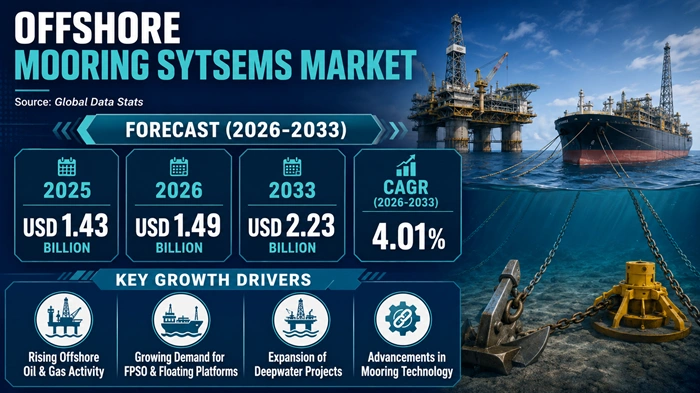
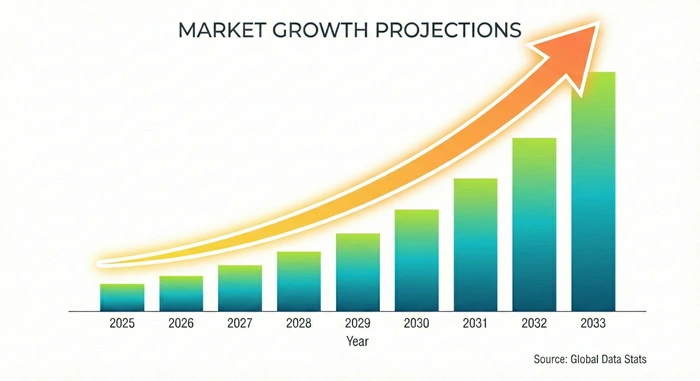
The global offshore mooring systems market size is valued at USD 1.43 billion in 2025 and is predicted to increase from USD 1.49 billion in 2026 to approximately USD 2.23 billion by 2033, growing at a CAGR of 4.01% from 2026 to 2033.
Offshore mooring systems comprise specialized equipment and technologies anchoring floating offshore structures including production platforms, drilling rigs, and renewable energy installations to the seabed. These critical systems incorporate mooring lines, anchors, connectors, and positioning equipment designed to withstand extreme marine environments while maintaining structural integrity. The technology ensures operational stability for floating production storage offloading vessels, tension leg platforms, and emerging floating wind turbines across diverse water depths and challenging oceanic conditions worldwide.
AI Impact On The Offshore Mooring Systems Industry
Revolutionizing Predictive Maintenance And Real-Time Performance Monitoring Through Digital Intelligence
Artificial intelligence transforms offshore mooring operations by enabling predictive maintenance capabilities that dramatically reduce unplanned downtime and catastrophic failure risks. Machine learning algorithms analyze vast datasets from embedded sensors monitoring tension loads, corrosion progression, and fatigue accumulation across mooring line components. These intelligent systems identify subtle degradation patterns invisible to traditional inspection methods, generating maintenance alerts months before critical failures occur. The offshore mooring systems market benefits from AI-driven digital twins creating virtual replicas of physical mooring configurations, allowing engineers to simulate extreme weather scenarios, optimize component replacement schedules, and validate design modifications without costly physical testing or operational interruptions.
Autonomous underwater vehicles integrated with AI-powered vision systems conduct mooring inspections with unprecedented precision and efficiency. Computer vision algorithms detect microscopic cracks, wear patterns, and material degradation across anchor chains, synthetic ropes, and connector assemblies submerged thousands of meters below surface. The offshore mooring systems market witnesses operational cost reductions exceeding 25% as AI eliminates manual inspection requirements, shortens maintenance windows, and extends component operational lifespans through optimized usage patterns. Real-time condition monitoring platforms aggregate data across entire mooring arrays, enabling operators to make informed decisions regarding load redistribution, emergency response protocols, and strategic component upgrades maintaining platform safety while maximizing asset utilization throughout extended offshore campaigns.
Growth Factors
Deepwater Exploration Expansion And Floating Wind Farm Deployment Driving Market Momentum
Offshore oil and gas exploration pushes into ultra-deepwater frontiers exceeding 1500 meters where conventional fixed platforms prove economically unfeasible. Floating production systems requiring sophisticated mooring solutions dominate development strategies across Brazil's pre-salt provinces, Guyana's Stabroek Block, and East Mediterranean gas fields. These challenging environments demand advanced catenary and taut-leg mooring configurations managing extreme loads while accommodating vessel motion across six degrees of freedom. The offshore mooring systems market expands as operators commission purpose-built floating production storage offloading vessels featuring integrated turret mooring systems, spread mooring arrays, and hybrid designs combining steel chain with lightweight synthetic fiber sections optimizing weight distribution and installation efficiency.
Renewable energy transition accelerates floating offshore wind farm deployment creating entirely new market segments for mooring technology. Wind energy developers secure seabed leases across Europe, Asia Pacific, and North America Atlantic coast targeting deepwater locations offering superior wind resources unsuitable for bottom-fixed turbine foundations. The offshore mooring systems market captures growing demand from floating wind platforms requiring specialized mooring designs balancing turbine thrust loads, environmental forces, and dynamic positioning requirements. Government policies supporting offshore renewable energy through feed-in tariffs, carbon pricing mechanisms, and renewable energy mandates drive substantial capital investment into floating wind infrastructure, with mooring systems representing critical enabling technology determining project technical feasibility and economic viability across diverse marine environments and regulatory jurisdictions.
Market Outlook
Technological Innovation And Diversified Applications Positioning Industry For Sustained Growth
Material science breakthroughs revolutionize mooring component performance as manufacturers develop high-performance synthetic fiber ropes delivering equivalent strength to steel chain while achieving 80% weight reduction. Polyester and high-modulus polyethylene ropes enable mooring configurations previously impossible due to weight constraints, reducing installation vessel requirements and accelerating deployment schedules. The offshore mooring systems market benefits from synthetic fiber adoption addressing corrosion challenges inherent in steel components while offering superior fatigue resistance and inspection capabilities through integrated fiber optic sensing technology. Advanced connector designs featuring quick-release mechanisms and automated tensioning systems reduce installation complexity while improving emergency disconnect capabilities critical for operator safety during severe weather events.
Industry consolidation reshapes competitive dynamics as major engineering contractors pursue vertical integration strategies acquiring anchor manufacturers, rope suppliers, and installation service providers. Strategic mergers create comprehensive solution providers offering turnkey mooring design, procurement, installation, and life-of-field maintenance services. The offshore mooring systems market witnesses enhanced collaboration between offshore oil and gas operators, renewable energy developers, and mooring technology suppliers driving standardization efforts, performance benchmarking, and knowledge transfer across industry segments. Regulatory frameworks evolve addressing offshore renewable energy growth, establishing certification procedures, and defining safety standards specific to floating wind mooring applications, providing clarity supporting investment decisions and accelerating commercial deployment across global markets throughout the forecast period.
Expert Speaks
-
Bruno Chabas, CEO at SBM Offshore, emphasized during recent investor presentations that the company's strategic focus on floating production solutions and mooring technology innovation positions the organization to capitalize on growing demand from both traditional oil and gas developments and emerging renewable energy applications, particularly floating offshore wind where proven mooring expertise translates directly into competitive advantages.
-
Yuji Kozai, President and CEO at MODEC Inc., highlighted how decades of experience delivering floating production storage offloading systems across challenging marine environments provides unique insights into mooring design optimization, noting that successful FPSO operations depend fundamentally on reliable mooring performance ensuring production continuity while managing extreme environmental loads throughout multi-decade operational lifespans.
-
Marco Villa, CEO at BW Offshore Limited, noted through company communications that expanding offshore exploration into frontier regions combined with energy transition dynamics creates diverse opportunities for mooring technology deployment, emphasizing how adaptable mooring solutions enable operators to develop marginal fields economically while supporting floating renewable energy infrastructure addressing global decarbonization objectives.
Key Report Takeaways
-
North America dominates the offshore mooring systems market capturing approximately 38% regional share valued around USD 0.54 billion in 2025, driven by extensive deepwater drilling activity across Gulf of Mexico, expanding offshore wind development along Atlantic coast, mature marine infrastructure, and robust regulatory frameworks supporting offshore operations.
-
Asia Pacific emerges as fastest-growing region with projected CAGR exceeding 4.6% through 2033, fueled by coastal industrialization programs, offshore oil and gas exploration expansion across South China Sea, aggressive floating wind farm deployment targets in China, Japan, and South Korea, and substantial government infrastructure investments supporting blue economy development.
-
Spread mooring represents the largest mooring type segment accounting for approximately 43% market share due to proven reliability across diverse applications, adaptability to varying water depths, cost-effectiveness compared to alternative configurations, and compatibility with multiple floating platform designs including FPSOs and semi-submersibles.
-
Floating production storage offloading applications contribute the most significant demand representing roughly 37% of total market as FPSO installations dominate deepwater oil and gas development strategies, requiring sophisticated mooring systems managing production continuity, weather vaning capabilities, and operational flexibility across extended field lifecycles.
-
Anchors maintain dominant component position commanding nearly 40% market share owing to critical role as foundation elements securing mooring systems, substantial material requirements for heavy-duty applications, and technological innovation in drag embedment, suction, and vertical load anchor designs optimizing holding capacity.
-
Renewable energy segment exhibits fastest end-user growth projected to expand at 5.6% CAGR through 2033 with market share reaching approximately 28%, driven by floating offshore wind farm deployment, wave energy platform development, and policy support for marine renewable energy infrastructure creating new mooring application markets beyond traditional oil and gas sectors.
Market Scope
| Report Coverage | Details |
|---|---|
| Market Size by 2033 | USD 2.23 Billion |
| Market Size by 2025 | USD 1.43 Billion |
| Market Size by 2026 | USD 1.49 Billion |
| Market Growth Rate from 2026 to 2033 | CAGR of 4.01% |
| Dominating Region | North America |
| Fastest Growing Region | Asia Pacific |
| Base Year | 2025 |
| Forecast Period | 2026 to 2033 |
| Segments Covered | Mooring Type, Component, Depth, Application, End-User Industry, Region |
| Regions Covered | North America, Europe, Asia-Pacific, Latin America, Middle East and Africa |
Market Dynamics
Drivers Impact Analysis
Ultra-Deepwater Development And Floating Wind Expansion Accelerating Technology Adoption
| Factor | (≈) % Impact on CAGR Forecast | Geographic Relevance | Impact Timeline |
|---|---|---|---|
| FPSO deployment in deepwater fields | 18-23% | South America, West Africa, Asia Pacific | 2026-2033 |
| Floating offshore wind projects | 15-20% | Europe, North America, Asia Pacific | 2027-2033 |
| Synthetic fiber rope adoption | 12-16% | Global markets | 2026-2033 |
Floating production storage offloading vessel backlog reaches record levels as operators develop ultra-deepwater discoveries across Brazil, Guyana, Mozambique, and emerging frontier basins. These projects demand advanced mooring systems managing extreme water depths exceeding 2000 meters, complex subsea architecture integration, and harsh environmental conditions including strong currents, cyclonic storms, and iceberg threats in certain regions. The offshore mooring systems market expands rapidly as FPSO designs incorporate sophisticated turret mooring systems allowing vessels to weathervane around single mooring points while hybrid spread mooring configurations optimize load distribution across multiple anchor points. Purpose-built mooring components including ultra-high-strength chains, specialized connectors, and dynamic positioning systems ensure operational continuity throughout 20-plus year field lifecycles.
Floating offshore wind capacity projections indicate exponential growth from current demonstration-scale installations toward commercial gigawatt-scale wind farms by 2030. European markets lead deployment with France, UK, Norway, and Spain securing seabed leases supporting multi-gigawatt floating wind development. The offshore mooring systems market benefits from wind-specific mooring designs addressing unique loading patterns including turbine thrust, wave-induced motion, and wind variability requiring enhanced damping characteristics compared to traditional oil and gas applications. Shared anchor configurations, reusable mooring components, and modular installation methods reduce capital costs while polyester-chain hybrid designs minimize seabed disturbance addressing environmental regulations. Government renewable energy mandates, carbon reduction commitments, and offshore wind auction mechanisms provide long-term revenue certainty supporting substantial infrastructure investment throughout the forecast period.
Restraints Impact Analysis
Supply Chain Constraints And Installation Vessel Scarcity Limiting Deployment Pace
| Factor | (≈) % Impact on CAGR Forecast | Geographic Relevance | Impact Timeline |
|---|---|---|---|
| Anchor and chain manufacturing bottlenecks | -10 to -15% | Global, concentrated in Asia Pacific | 2026-2028 |
| Specialized installation vessel shortage | -8 to -12% | Global markets | 2026-2030 |
| Insurance premium escalation | -6 to -9% | North Sea, Gulf of Mexico | 2026-2033 |
Manufacturing capacity constraints affect anchor and chain production as limited forge facilities capable of producing ultra-large diameter chains and specialized anchors create extended lead times reaching 18 to 24 months. Component suppliers operate near maximum capacity serving concurrent oil and gas, renewable energy, and marine infrastructure projects competing for limited manufacturing slots. The offshore mooring systems market faces project delays as developers struggle securing timely component deliveries, particularly for custom designs requiring specialized metallurgy, heat treatment processes, and quality certification meeting stringent offshore standards. Supply chain concentration in Asia Pacific creates geopolitical vulnerability and logistics complexity for projects in distant regions, driving vertical integration strategies and regional manufacturing capacity investments by major contractors.
Specialized heavy-lift installation vessels required for mooring deployment and anchor handling command premium day rates exceeding USD 500000 due to limited global fleet availability. Vessel scarcity intensifies as simultaneous offshore wind farm construction campaigns, oil and gas development projects, and decommissioning activities compete for installation capacity. The offshore mooring systems market experiences cost overruns and schedule delays as operators compromise on optimal weather windows, extend installation campaigns across multiple mobilizations, or modify mooring designs accommodating less-capable vessels. Newbuild vessel construction timelines stretch multiple years while costs exceed USD 700 million per unit, limiting fleet expansion pace despite strong demand signals. Installation constraints particularly impact floating wind projects requiring coordinated turbine foundation and mooring deployment within narrow installation windows dictated by seasonal weather patterns and environmental restrictions.
Opportunities Impact Analysis
Decommissioning Markets And Digital Monitoring Services Creating Revenue Diversification
| Factor | (≈) % Impact on CAGR Forecast | Geographic Relevance | Impact Timeline |
|---|---|---|---|
| Offshore platform decommissioning | +12 to +17% | North Sea, Gulf of Mexico | 2026-2033 |
| Digital twin and monitoring services | +11 to +15% | Global markets | 2026-2033 |
| Multi-purpose energy hubs | +9 to +13% | Europe, Asia Pacific | 2028-2033 |
Aging offshore infrastructure creates substantial decommissioning opportunities as thousands of platforms, floating production systems, and subsea installations reach end-of-life requiring mooring system removal, recycling, and seabed restoration. North Sea mature basins, Gulf of Mexico legacy fields, and Asia Pacific aging infrastructure generate consistent demand for decommissioning services including mooring disconnection, anchor recovery, and environmental remediation. The offshore mooring systems market captures service revenue from specialized contractors offering turnkey decommissioning solutions while component manufacturers develop standardized recovery tools, reusable anchor designs, and eco-friendly materials facilitating end-of-life processing. Regulatory frameworks increasingly mandate complete infrastructure removal and seabed restoration creating legal obligations driving decommissioning expenditure throughout coming decades.
Digital monitoring services emerge as high-margin recurring revenue opportunities as operators adopt condition-based maintenance strategies replacing time-based inspection schedules. Integrated sensor systems embedded within mooring components continuously transmit performance data to cloud platforms applying machine learning algorithms predicting failure risks and optimizing maintenance interventions. The offshore mooring systems market benefits from digital twin applications creating virtual mooring system replicas enabling real-time performance analysis, scenario simulation, and life extension strategies maximizing asset value. Service providers offer monitoring subscriptions generating annuity income streams complementing traditional equipment sales while building data repositories supporting future design improvements. Multi-purpose offshore energy hubs combining oil and gas production, renewable generation, hydrogen production, and carbon storage create complex mooring requirements driving custom engineering solutions and premium pricing for integrated system providers capable of managing diverse operational demands.
Segment Analysis
By Mooring Type: Spread Mooring
Proven Reliability And Versatile Applications Maintaining Segment Leadership
Spread mooring systems dominate the offshore mooring systems market capturing approximately 43% share valued around USD 0.62 billion in 2025 due to widespread adoption across floating production storage offloading vessels, semi-submersibles, and drilling units. Multiple mooring lines extending radially from floating structures provide superior load distribution, minimize vessel drift, and accommodate directional environmental forces from winds, waves, and currents. Design simplicity, proven operational track record spanning decades, and compatibility with diverse vessel types establish spread mooring as default configuration for many offshore applications. Manufacturing standardization enables cost-effective component sourcing while installation methodologies benefit from extensive industry experience and established best practices.
North America and Asia Pacific lead spread mooring deployment with Gulf of Mexico FPSO installations and South China Sea production platforms representing major market concentrations. Companies including SBM Offshore, MODEC, and BW Offshore routinely specify spread mooring configurations for newbuild FPSO projects and floating production conversions. The offshore mooring systems market sees this segment maintaining steady growth near 3.8% CAGR through 2033 despite emerging competition from alternative mooring types. Technology evolution includes hybrid designs combining traditional chain with synthetic fiber segments reducing suspended weight, advanced monitoring sensors providing real-time tension data, and optimized anchor patterns minimizing seabed footprint while maintaining equivalent holding capacity. Retrofit opportunities arise as aging spread mooring systems undergo component replacement and performance upgrades extending operational lifespans matching production facility life extensions.
By Component: Anchors
Foundational Role And Technical Complexity Driving Segment Dominance
Anchors command the largest component share within the offshore mooring systems market at approximately 40%, valued near USD 0.57 billion in 2025 owing to critical function as primary load-bearing elements securing entire mooring configurations. Anchor designs vary substantially including drag embedment types achieving holding capacity through progressive seabed penetration, suction anchors utilizing differential pressure for installation, and vertical load anchors optimized for taut-leg mooring applications. Manufacturing complexity, substantial material requirements for large-scale anchors exceeding 200 tonnes, and specialized fabrication facilities capable of precision machining and heat treatment contribute to segment value concentration. The offshore mooring systems market benefits from continuous anchor innovation improving holding efficiency, reducing installation complexity, and accommodating challenging seabed conditions.
Europe and North America dominate anchor technology development with companies including Vryhof Anchors and STEVMARINE leading drag embedment and suction anchor design evolution. Asia Pacific manufacturing facilities produce substantial anchor volumes serving regional offshore development while export markets support global projects. The offshore mooring systems market witnesses this segment expanding at robust 4.2% CAGR through 2033 driven by ultra-deepwater projects requiring larger anchor sizes, floating wind farms deploying multiple anchor points per turbine, and specialized applications demanding custom anchor solutions. Material innovations incorporating corrosion-resistant alloys and composite structures extend operational lifespans while reducing maintenance requirements. Digital monitoring integration enables real-time anchor load measurement supporting predictive maintenance strategies and life extension programs maximizing asset utilization across challenging marine environments throughout extended operational campaigns.
Regional Insights
North America
Mature Infrastructure And Offshore Wind Momentum Cementing Regional Leadership
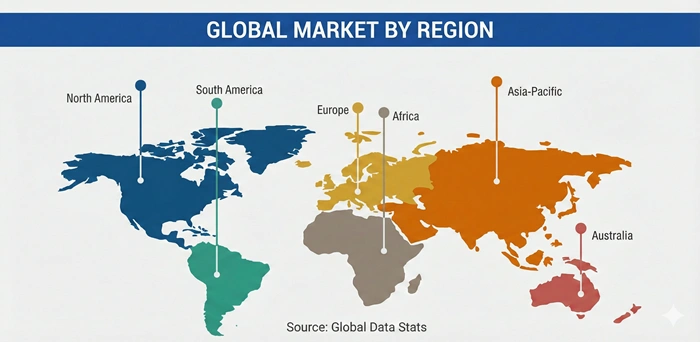
North America dominates the offshore mooring systems market commanding approximately 38% global share valued at USD 0.54 billion in 2025, projected to reach USD 0.85 billion by 2033 growing at 3.9% CAGR. United States leads regional market through extensive Gulf of Mexico deepwater oil and gas operations featuring numerous FPSO installations, semi-submersible platforms, and tension leg platforms requiring sophisticated mooring solutions. Offshore wind development accelerates along Atlantic coast with federal lease auctions securing gigawatts of capacity across Massachusetts, New York, and mid-Atlantic regions targeting commercial operation dates throughout late 2020s and early 2030s. The offshore mooring systems market benefits from established marine infrastructure, experienced engineering workforce, and mature supply chains supporting both traditional energy operations and emerging renewable applications.
Regulatory clarity improves as Bureau of Ocean Energy Management establishes offshore wind permitting frameworks while Coast Guard defines safety requirements and operational standards. Major contractors including NOV Inc., InterMoor, and Delmar Systems maintain substantial North American presence providing design, installation, and maintenance services. The offshore mooring systems market witnesses technology innovation centers across Houston, Aberdeen, and East Coast maritime clusters driving mooring design optimization, digital monitoring platform development, and installation methodology improvements. Canadian offshore developments including Newfoundland oil projects and Pacific coast floating wind investigations contribute to regional growth while Mexican deep Gulf opportunities present future expansion possibilities. North America's combination of mature offshore expertise, renewable energy ambitions, and supportive policy frameworks positions the region for sustained market leadership throughout the forecast period.
Asia Pacific
Coastal Industrialization And Renewable Energy Targets Driving Fastest Regional Growth
Asia Pacific emerges as the fastest-growing region in the offshore mooring systems market with CAGR exceeding 4.6% from 2026 to 2033, with market value expanding from approximately USD 0.46 billion in 2025 toward USD 0.72 billion by 2033. China leads regional expansion through aggressive offshore oil and gas exploration across South China Sea, Bohai Bay, and East China Sea combined with world-leading floating offshore wind deployment targets exceeding 5 gigawatts by 2030. Government industrial policies support domestic manufacturing capacity development across mooring components, anchor fabrication, and synthetic rope production while substantial infrastructure investments modernize port facilities and installation vessel fleets. The offshore mooring systems market captures momentum from India's offshore exploration initiatives, Southeast Asian oil and gas development, and Japan's floating wind demonstration projects advancing commercial-scale deployment.
Regional manufacturing concentration establishes Asia Pacific as global supply hub for chains, anchors, and connector components serving worldwide project demand. Companies including local fabricators and international contractors including Trelleborg and Mampaey Offshore establish regional operations accessing cost-competitive production capabilities while serving growing local markets. The offshore mooring systems market benefits from technology transfer initiatives, joint venture partnerships, and academic research collaboration advancing mooring design methodologies and installation techniques tailored to regional environmental conditions including typhoon-prone waters, seismically active zones, and challenging seabed geology. South Korea's floating wind ambitions, Taiwan's offshore renewable energy targets, and Vietnam's shallow water oil development contribute to diversified regional demand. Government renewable energy mandates, energy security priorities, and blue economy development strategies position Asia Pacific as primary growth engine for global offshore mooring systems expansion throughout the forecast period.
Top Key Players
-
SBM Offshore N.V. (Netherlands)
-
MODEC Inc. (Japan)
-
BW Offshore Limited (Norway)
-
NOV Inc. (United States)
-
Delmar Systems Inc. (United States)
-
InterMoor Inc. (United States)
-
Mampaey Offshore Industries (Netherlands)
-
Trelleborg Marine & Infrastructure (Sweden)
-
Bluewater Energy Services B.V. (Netherlands)
-
SOFEC Inc. (United States)
-
Saipem S.p.A. (Italy)
-
TechnipFMC plc (United Kingdom)
-
Vryhof Anchors B.V. (Netherlands)
-
Offspring International Limited (United Kingdom)
-
Cavotec SA (Switzerland)
Recent Developments
-
Saipem and Subsea7 (July 2025): Completed merger forming Saipem7, creating combined entity with EUR 43 billion project backlog integrating offshore construction expertise, mooring engineering capabilities, and subsea infrastructure services, positioning merged company as leading offshore EPCI contractor serving oil and gas and renewable energy markets with enhanced scale and technical capabilities.
-
SBM Offshore (July 2025): Finalized Ocean-Power investment partnership establishing collaborative framework advancing floating offshore wind mooring technology development, combining SBM's proven FPSO mooring expertise with renewable energy sector requirements, targeting commercial-scale floating wind projects requiring robust mooring solutions adapted from oil and gas industry experience.
-
Technip Energies (June 2025): Secured PAREF floating wind project contract emphasizing reusable anchor technology and shared mooring configurations reducing capital costs and environmental impact, demonstrating industry shift toward sustainable installation methods and modular component designs enabling rapid deployment and simplified decommissioning procedures.
-
Chevron Corporation (April 2025): Commenced production at Ballymore deepwater Gulf of Mexico field utilizing advanced catenary mooring system managing ultra-deep water depths and complex subsea architecture, validating mooring technology capabilities supporting frontier oil and gas development while demonstrating operational reliability in challenging marine environments.
-
Gazelle Wind Power and Titan Wind Energy (October 2025): Announced partnership advancing industrialization of innovative floating wind platform merging tension leg stability with spar hydrodynamic efficiency, targeting substantial cost reductions in floating wind mooring systems through optimized design enabling broader commercial deployment across global offshore wind markets.
Market Trends
Synthetic Fiber Integration And Hybrid Mooring Configurations Reshaping Industry Standards
Material innovation accelerates synthetic fiber rope adoption throughout the offshore mooring systems market as polyester and high-modulus polyethylene products demonstrate equivalent strength to steel chain while delivering dramatic weight reductions exceeding 80%. Installation efficiency improves substantially as lighter mooring components enable smaller anchor-handling vessels, reduced lift counts, and shortened deployment schedules cutting project costs and carbon emissions from vessel operations. Hybrid mooring designs combining steel chain in abrasion-prone touchdown zones with synthetic fiber segments in suspended sections optimize performance characteristics while addressing specific environmental loading conditions. The offshore mooring systems market witnesses growing confidence in synthetic fiber durability as operational experience accumulates, certification standards mature, and inspection methodologies incorporating integrated fiber optic sensing technology enable continuous condition monitoring throughout operational lifespans.
Floating wind mooring requirements differ fundamentally from traditional oil and gas applications driving specialized design evolution addressing turbine-specific loading patterns. Wind thrust generates cyclical horizontal forces rather than constant loads characteristic of production platforms, necessitating enhanced damping systems preventing resonance and fatigue accumulation. The offshore mooring systems market adapts through development of shared anchor configurations serving multiple turbines simultaneously, quick-connect systems enabling rapid maintenance interventions, and modular component designs facilitating efficient supply chain management across large wind farm arrays. Environmental considerations gain prominence as regulators emphasize seabed disturbance minimization, marine mammal protection, and decommissioning planning requirements influencing mooring layout optimization, anchor selection criteria, and materials sourcing decisions throughout project lifecycles.
Segments Covered In The Report
By Mooring Type
-
Spread Mooring
-
Single Point Mooring
-
Dynamic Positioning
-
Catenary Mooring
-
Taut Leg Mooring
-
Semi-Taut Mooring
By Component
-
Anchors
-
Chains
-
Connectors
-
Synthetic Fiber Ropes
-
Buoys
-
Others
By Depth
-
Shallow Water (Up to 400 meters)
-
Deep Water (400 to 1500 meters)
-
Ultra-Deep Water (Above 1500 meters)
By Application
-
Floating Production Storage and Offloading (FPSO)
-
Tension Leg Platforms (TLP)
-
Semi-Submersibles
-
Spar Platforms
-
Floating Wind Turbines
-
Others
By End-User Industry
-
Oil and Gas
-
Renewable Energy
-
Marine and Defense
-
Others
By Region
-
North America (United States, Canada, Mexico)
-
Europe (United Kingdom, Germany, France, Spain, Norway, Rest of Europe)
-
Asia-Pacific (China, India, Japan, South Korea, Australia, Southeast Asia, Rest of Asia-Pacific)
-
Latin America (Brazil, Argentina, Rest of Latin America)
-
Middle East and Africa (Saudi Arabia, UAE, Qatar, South Africa, Rest of MEA)
Frequently Asked Questions
Question 1: What is the expected size of the offshore mooring systems market by 2033?
Answer: The global offshore mooring systems market is projected to reach approximately USD 2.23 billion by 2033, expanding from USD 1.49 billion in 2026. This growth reflects increasing deepwater oil and gas exploration, accelerating floating offshore wind farm deployment, and technological advancements in mooring component design and installation methodologies.
Question 2: Which region dominates the offshore mooring systems market currently?
Answer: North America dominates the offshore mooring systems market with approximately 38% market share due to extensive Gulf of Mexico deepwater operations and expanding Atlantic coast offshore wind development. The region benefits from mature marine infrastructure, established engineering expertise, and supportive regulatory frameworks governing offshore activities.
Question 3: What CAGR will the offshore mooring systems market experience from 2026 to 2033?
Answer: The offshore mooring systems market will grow at a compound annual growth rate of 4.01% from 2026 to 2033. This expansion reflects continued deepwater exploration, floating production system deployment, renewable energy infrastructure investment, and technological innovation improving mooring performance and installation efficiency.
Question 4: Which mooring type holds the largest share in the offshore mooring systems market?
Answer: Spread mooring systems command the largest market share at approximately 43% due to proven reliability across diverse applications including FPSOs and semi-submersibles. This mooring configuration benefits from design simplicity, versatile deployment capabilities, effective load distribution characteristics, and extensive operational track record spanning multiple decades.
Question 5: What are the primary growth drivers for the offshore mooring systems market?
Answer: Primary drivers include FPSO deployment in ultra-deepwater fields, floating offshore wind project expansion, and synthetic fiber rope technology adoption. The offshore mooring systems market also benefits from digital monitoring innovation, decommissioning service opportunities, and multi-purpose offshore energy hub development creating diverse application requirements and revenue streams.