
NPL Management Market Overview
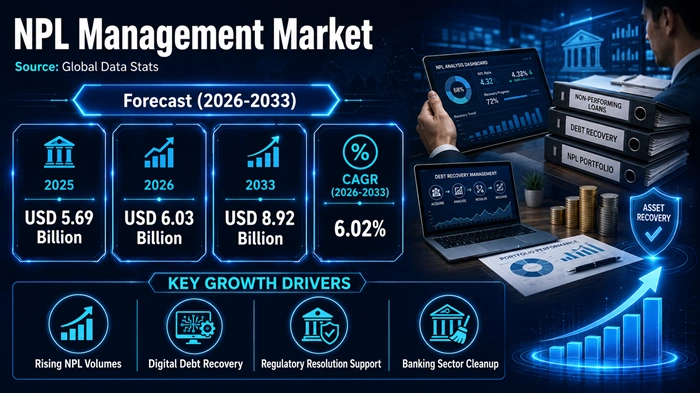
The global NPL management market size is valued at USD 5.69 billion in 2025 and is predicted to increase from USD 6.03 billion in 2026 to approximately USD 8.92 billion by 2033, growing at a CAGR of 6.02% from 2026 to 2033.
Non-performing loan (NPL) management encompasses the full spectrum of strategies, technologies, and services that banks and financial institutions use to identify, resolve, recover, and restructure loans that have remained unpaid for 90 days or longer. Rising global debt levels, stricter banking regulations requiring clean balance sheets, escalating defaults in emerging economies, and the accelerating adoption of AI-powered and cloud-based recovery platforms are together driving consistent and commercially meaningful expansion across this market through the forecast period.
AI Impact on the NPL Management Industry
AI-Powered Predictive Analytics, Automated Workflow Management, and Machine Learning-Driven Borrower Segmentation Are Fundamentally Transforming How Financial Institutions Identify, Prioritize, and Resolve Non-Performing Loan Portfolios
Artificial intelligence is reshaping every operational dimension of the NPL management market by enabling data-driven decision-making at a scale and speed that manual processes and traditional rule-based systems cannot match. AI models trained on credit behavior data, macroeconomic variables, borrower demographics, and collateral characteristics can now predict with meaningful accuracy which loans are at risk of becoming non-performing weeks before the first missed payment — allowing banks to initiate early intervention outreach that prevents NPL formation rather than reacting to it after default. Machine learning algorithms, including random forest and gradient boosting models, are demonstrating superior performance over conventional credit scoring models in NPL probability assessment, enabling financial institutions to allocate recovery resources more precisely across loan portfolios and to sequence resolution strategies — from proactive restructuring to debt sale — based on objective predicted recovery probability rather than portfolio-wide heuristics.
Beyond analytics, AI is transforming NPL servicing workflows through intelligent automation that reduces the manual labor intensity of NPL case management. Natural language processing tools are automating borrower communication — generating personalized outreach messages, scheduling follow-ups, and managing document collection workflows across large NPL portfolios simultaneously. Robotic process automation (RPA) is streamlining legal documentation, compliance reporting, and data entry tasks that historically consumed significant staff hours in NPL servicing operations. AI-powered digital trading platforms are also emerging in the NPL management market, connecting sellers of NPL portfolios with institutional investors through AI-driven valuation tools that accelerate price discovery and reduce transaction friction in NPL secondary market transactions. These capabilities collectively translate into faster resolution timelines, lower operational costs per NPL case, and improved recovery rates — metrics that directly influence bank profitability and regulatory standing.
Growth Factors
Surging Global Loan Default Rates, Stringent Regulatory Balance Sheet Clean-Up Mandates, and Rapid Technology Adoption Are the Three Structural Forces Sustaining Consistent NPL Management Market Growth
The escalating volume of non-performing loans globally is the most direct and commercially consequential driver of the NPL management market. In emerging economies — particularly India, China, Brazil, Indonesia, and several sub-Saharan African nations — rapid credit expansion over the past decade has been accompanied by rising default rates linked to borrower overextension, economic volatility, and sector-specific stress in real estate, SME lending, and consumer finance. India's gross non-performing asset ratio in the banking sector, China's property sector loan defaults, and post-pandemic retail credit deterioration across multiple economies are each contributing independently to the global NPL stock. Each increment of NPL formation creates demand for the full range of NPL management services — from loan workout and restructuring advisory to debt collection technology, portfolio valuation, and secondary market transaction execution.
Regulatory pressure on banks to actively manage down their NPL ratios is a second powerful commercial driver that operates independently of underlying default trends. Banking regulators in the EU (through the European Banking Authority and ECB), the U.S. (through the OCC and Federal Reserve), and increasingly in Asia Pacific markets are requiring banks to hold higher capital provisions against NPLs, imposing transparency and disclosure requirements on NPL portfolios, and in some cases establishing NPL ratio reduction targets with supervisory consequences for non-compliance. This regulatory push compels banks to act on NPL resolution rather than deferring it — generating recurring demand for NPL management software, advisory services, and portfolio sale transactions. European regulatory frameworks have been particularly impactful in this regard, driving significant NPL secondary market development and specialized servicer industry growth across the EU over the past decade.
Market Outlook
The NPL Management Market Is Positioned for Sustained Growth Through 2033, Driven by Emerging Market Credit Stress, Secondary Market Expansion, and the Commercialization of Next-Generation AI Recovery Platforms
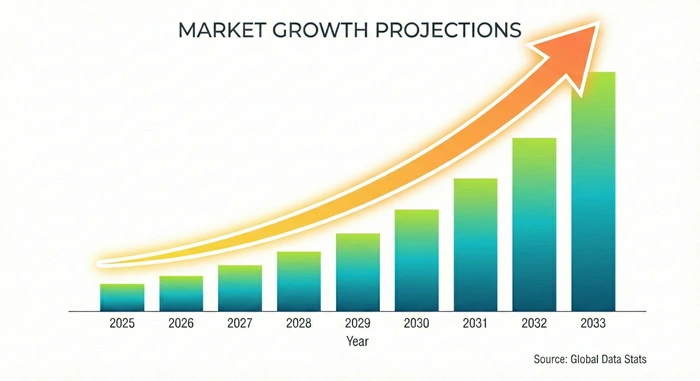
The outlook for the NPL management market through 2033 is shaped by a convergence of cyclical credit stress events and structural technology transformation that together create consistent demand for advanced NPL management capabilities across both developed and emerging geographies. In the near term, rising interest rate environments in North America and Europe — combined with the lagged credit quality deterioration that typically follows periods of rapid rate increases — are expected to elevate NPL formation rates in residential mortgage, commercial real estate, and SME lending portfolios. This cyclical credit stress is creating incremental NPL inventory that financial institutions must actively manage, driving demand for both in-house NPL management technology investments and outsourced servicer relationships.
Over the medium to long term, the progressive expansion of the global NPL secondary market — where banks sell NPL portfolios to specialized investors and asset reconstruction companies — represents the most significant structural growth opportunity in the NPL management ecosystem. Secondary market transaction volumes have grown substantially in Europe over the past decade, driven by regulatory incentives, improving portfolio valuation methodology, and the development of digital platforms that reduce transaction costs. As secondary market infrastructure matures in Asia Pacific, Latin America, and the Middle East — supported by regulatory reforms allowing foreign NPL investment and the development of data standards that enable transparent portfolio marketing — NPL management service demand associated with portfolio preparation, valuation, and transaction execution will expand substantially in these regions, creating new commercial opportunities for servicers, advisory firms, and technology providers throughout the forecast period.
Expert Speaks
-
"Rising interest rates and persistent economic uncertainty are translating into higher loan default rates across multiple asset classes, and the demand for sophisticated NPL management capabilities — from early warning analytics to portfolio restructuring and secondary market execution — is growing at a pace that we have not seen in this sector for many years. Our investments in AI-driven credit monitoring and workout platforms reflect our conviction that banks need more powerful tools to manage the NPL challenges ahead." — CEO, Accenture plc
-
"The NPL management market is entering a period of accelerated technology adoption, where the institutions that invest in AI-powered recovery analytics, automated workflow management, and digital borrower engagement platforms will achieve meaningfully superior recovery outcomes compared to those relying on conventional manual processes. We are committed to providing the technology and advisory expertise that financial institutions need to navigate this environment effectively and profitably." — CEO, Deloitte (Global Chair)
-
"Non-performing loan challenges are a reality for banks across virtually every market we operate in, and the regulatory environment is unambiguously pushing institutions toward faster, more transparent, and more technology-enabled resolution approaches. The growth of NPL secondary markets is creating new investment opportunities, and the firms that can provide high-quality portfolio analytics and transaction advisory services in this space are well-positioned for strong commercial performance." — CEO, KPMG International
Key Report Takeaways
-
North America leads the global NPL management market with approximately 35% revenue share in 2025, anchored by its well-established financial ecosystem, early adoption of AI-driven debt recovery technologies, mature legal frameworks facilitating NPL acquisition and resale, and the sophisticated data-driven portfolio analytics capabilities deployed by leading servicers and advisory firms across the U.S. and Canada
-
Asia Pacific is the fastest-growing regional market, projected to expand at approximately 7.5% CAGR through 2033, driven by surging NPL volumes in China's real estate and SME lending sectors, rising retail credit defaults in India and Southeast Asia, rapidly maturing credit regulatory frameworks mandating bank balance sheet clean-up, and growing adoption of AI-based NPL servicing platforms by regional financial institutions
-
Corporate assets represent the dominant asset type segment, holding approximately 40% of total asset type revenue in 2025, driven by the substantial value and complexity of defaulted corporate loan portfolios, the premium recovery potential achievable through business restructuring and turnaround strategies, and the active demand from specialized corporate NPL investors for high-value distressed portfolio transactions
-
Reorganization and restructuring leads the application segment with approximately 55% of total application revenue in 2025, reflecting the strategic preference of banks and regulators for proactive value-preservation approaches over immediate liquidation — supported by evidence that well-executed debt restructuring achieves superior recovery rates while reducing the systemic economic disruption associated with large-scale corporate liquidation
-
Debt collection software dominates the solution type segment in 2025, powered by AI-enhanced automation that improves recovery rates by up to 25%, reduces resolution times, and enables high-volume NPL portfolio management through behavioral segmentation, predictive payment probability modeling, and personalized multi-channel borrower communication strategies
-
Cloud-based deployment is the fastest-growing deployment segment, expanding at the highest CAGR through 2033 as financial institutions prioritize scalability, operational flexibility, lower infrastructure investment, automatic regulatory compliance updates, and advanced data security frameworks that modern cloud NPL platforms deliver
Market Scope
| Report Coverage | Details |
|---|---|
| Market Size by 2033 | USD 8.92 Billion |
| Market Size by 2025 | USD 5.69 Billion |
| Market Size by 2026 | USD 6.03 Billion |
| Market Growth Rate from 2026 to 2033 | CAGR of 6.02% |
| Dominating Region | North America |
| Fastest Growing Region | Asia Pacific |
| Base Year | 2025 |
| Forecast Period | 2026 to 2033 |
| Segments Covered | Asset Type, Solution Type, Application, Deployment Mode, End User, Region |
| Regions Covered | North America, Europe, Asia Pacific, Latin America, Middle East & Africa |
Market Dynamics
Drivers Impact Analysis
Rising Loan Default Volumes in Emerging Markets and Regulatory Mandates Requiring Active NPL Resolution Are the Two Most Powerful Commercial Catalysts in the NPL Management Market
| Driver | ≈ % Impact on CAGR Forecast | Geographic Relevance | Impact Timeline |
|---|---|---|---|
| Rising global NPL volumes from economic stress and interest rate cycles | ~35% | Global, led by Asia Pacific, Europe | Short to long-term |
| Regulatory pressure on banks to reduce NPL ratios and clean balance sheets | ~28% | Europe, North America, Asia Pacific | Short to medium-term |
| AI and cloud technology adoption improving recovery efficiency | ~24% | Global | Medium to long-term |
| Growth of NPL secondary markets enabling portfolio monetization | ~13% | Europe, Asia Pacific, Latin America | Medium to long-term |
The escalating volume of non-performing loans driven by global economic stress cycles — including rising interest rates, post-pandemic credit deterioration, and sector-specific shocks in real estate, SME, and consumer finance — is the most direct demand driver in the NPL management market. When banks accumulate higher NPL ratios, they face multiple compounding pressures: increased regulatory capital requirements tied to NPL provisioning reduce capital available for new lending, deteriorating asset quality damages credit ratings and borrowing costs, and supervisory scrutiny intensifies when NPL ratios exceed regulatory thresholds. These pressures create an urgent commercial imperative to resolve NPL portfolios — either through active workout and restructuring, outright debt sale to secondary market investors, or technology-enabled self-managed recovery — and this imperative drives consistent demand for NPL management services regardless of the specific economic cycle causing the NPL elevation.
Regulatory frameworks specifically targeting NPL management quality are a second independent driver that creates structural commercial demand in the market. The European Banking Authority's NPL guidance, the ECB's supervisory expectations for NPL provisioning timelines, Basel III capital adequacy frameworks, and IFRS 9 expected credit loss accounting standards collectively require banks to implement systematic, documented, and auditable NPL management processes that meet defined regulatory standards. Compliance with these frameworks requires investment in NPL management software platforms, training programs, reporting infrastructure, and in many cases external advisory and servicing partnerships — all of which represent direct commercial revenue for NPL management market participants. As regulatory frameworks tighten further in Asia Pacific and Latin American markets in alignment with international banking standards, this compliance-driven demand will expand geographically, adding new revenue pools to the market across the forecast period.
Restraints Impact Analysis
Cross-Jurisdictional Regulatory Complexity and the Operational Challenge of Integrating Advanced AI Technology into Legacy Banking Infrastructure Are the Two Primary Barriers Constraining Market Expansion
| Restraint | ≈ % Impact on CAGR Forecast | Geographic Relevance | Impact Timeline |
|---|---|---|---|
| Complex and divergent regulatory frameworks across geographies | ~38% | Global, especially Latin America, MEA, APAC | Medium to long-term |
| Legacy banking IT infrastructure limiting AI and cloud adoption speed | ~30% | Global | Short to medium-term |
| Bank reluctance to disclose high NPL ratios due to reputational concerns | ~20% | Global, especially emerging markets | Short-term |
| Pricing pressure from growing competition among NPL service providers | ~12% | Europe, North America | Ongoing |
The regulatory complexity inherent in operating NPL management strategies across multiple jurisdictions is one of the most persistent structural challenges in the NPL management market. NPL resolution mechanisms — including legal enforcement timelines, insolvency procedures, collateral realization rights, and restrictions on NPL secondary market participation — vary enormously between countries and in many cases between states or provinces within countries. A bank managing a cross-border NPL portfolio must navigate a distinct legal and regulatory landscape for each geography, requiring specialized local legal expertise and compliance monitoring infrastructure that significantly increases the operational cost and complexity of global NPL management programs. This regulatory fragmentation creates barriers to the scalable platform business models that would otherwise drive efficiency and margin improvement for global NPL management service providers.
Legacy banking IT infrastructure presents a second significant operational constraint on NPL management market growth, particularly as the market transitions toward AI-driven platforms. Many established banks — particularly in Europe and emerging markets — operate core banking systems built on architectures from the 1980s and 1990s that were not designed to support real-time data analytics, API-based integration, or cloud-based deployment architectures. Integrating modern NPL management software platforms with these legacy systems requires substantial custom development, data migration, and change management effort — creating delays, cost overruns, and organizational resistance that slow adoption timelines and reduce the operational ROI of technology investments. Smaller regional banks in lower-income markets face an amplified version of this challenge, as they lack both the technical resources and the financial capacity to execute complex technology transformation programs while simultaneously managing day-to-day NPL resolution activities.
Opportunities Impact Analysis
Emerging Market NPL Secondary Market Development, ESG-Aligned Borrower Management Innovation, and Fintech NPL Platform Commercialization Are the Three Most Commercially Promising Growth Opportunities
| Opportunity | ≈ % Impact on CAGR Forecast | Geographic Relevance | Impact Timeline |
|---|---|---|---|
| Development of NPL secondary markets in Asia Pacific, Latin America, MEA | ~42% | Asia Pacific, Latin America, MEA | Medium to long-term |
| Fintech and regtech platforms disrupting traditional NPL servicing | ~34% | Global | Short to medium-term |
| ESG-aligned NPL management approaches improving borrower outcomes | ~24% | Europe, North America, Asia Pacific | Medium to long-term |
The development of functioning NPL secondary markets in Asia Pacific, Latin America, and the Middle East represents the single largest structural growth opportunity in the NPL management market over the 2026–2033 forecast period. In Europe, secondary market development over the past decade created an entirely new ecosystem of specialized NPL investors, servicers, valuation specialists, and legal advisors that generated billions of dollars in annual market revenue while simultaneously reducing banking system NPL ratios to historically low levels. Replicating this secondary market development journey in economies where NPL stocks are growing rapidly — particularly in India, Southeast Asia, Brazil, and Gulf states — requires regulatory reforms enabling foreign investment in NPL portfolios, data standardization that enables transparent portfolio marketing, and the development of local specialized servicer capacity. As these enabling conditions progressively fall into place across multiple emerging markets, the associated demand for NPL management platform technology, advisory services, and transaction execution support will generate significant incremental revenue growth.
Fintech and regtech platforms disrupting traditional NPL servicing models represent a second high-velocity growth opportunity. Technology-native startups and scale-up companies are developing cloud-native NPL management platforms with AI-integrated workflows, real-time borrower engagement tools, digital portfolio marketplaces, and automated regulatory reporting capabilities that deliver superior speed and cost efficiency compared to legacy servicer platforms. These platforms are particularly attractive to mid-tier and smaller banks that lack the scale to build proprietary technology but need access to sophisticated NPL management capabilities to meet regulatory requirements. As cloud-based fintech NPL platforms achieve regulatory certifications and build track records at major financial institution clients, their commercial adoption is expected to accelerate, creating a technology platform revenue segment that grows above the overall market CAGR through 2033.
Segment Analysis
By Asset Type
Corporate Assets Dominate the NPL Management Market by Value Due to the Scale, Recovery Complexity, and Premium Restructuring Opportunity of Large-Scale Defaulted Corporate Loan Portfolios
The corporate assets segment leads the NPL management market by asset type, accounting for approximately 40% of total asset type revenue in 2025 and expanding at a steady CAGR through 2033. Corporate NPL portfolios command dominant revenue share because large-scale defaulted corporate loans represent the highest absolute value recovery opportunities, require the most sophisticated workout, restructuring, and legal advisory services, and attract the most active participation from specialized institutional investors seeking distressed asset premium returns. When a major corporate borrower defaults, banks must deploy comprehensive restructuring capabilities — including financial modeling, business viability assessment, creditor coordination, debt-equity conversion, and turnaround management — that represent significant advisory fee revenue for NPL management service providers. North America leads corporate asset NPL management revenue, driven by the depth of the U.S. distressed debt investment market and the presence of world-leading restructuring advisory firms including EY, Deloitte, KPMG, PwC, and Accenture.
The personal assets (retail) segment currently holds approximately 35% of asset type revenue and is projected to grow at the fastest CAGR of approximately 11.10% through the forecast period, driven by rising consumer credit defaults linked to cost-of-living pressures, high-interest-rate mortgage stress, and expanding retail lending in emerging markets. Asia Pacific is the fastest-growing region for personal asset NPL management, as rapidly expanding consumer credit markets in China, India, Vietnam, and Indonesia are generating growing volumes of retail and mortgage NPLs that require systematic collection, restructuring, and resolution. Companies including Intrum AB, Hoist Finance AB, KRUK S.A., and Encore Capital Group are the dominant commercial participants in retail NPL management globally, deploying AI-enhanced debt collection software and digital borrower engagement platforms to manage high-volume, geographically dispersed retail NPL portfolios cost-effectively.
By Deployment Mode
Cloud-Based NPL Management Platforms Are the Fastest-Growing Deployment Segment, Displacing Traditional On-Premises Systems Through Superior Scalability, Cost Efficiency, and AI Integration Capabilities
On-premises deployment currently dominates the NPL management market by deployment mode, accounting for approximately 58% of total deployment revenue in 2025, reflecting the historical preference of large financial institutions for maintaining full control over sensitive borrower data, collateral records, and compliance documentation within their own secure data environments. Financial institutions subject to strict banking secrecy laws, data localization regulations, and sovereignty requirements — particularly in Europe and regulated Asian markets — have maintained a strong preference for on-premises NPL management systems that eliminate concerns about third-party data access and ensure audit trail integrity within institution-controlled infrastructure. Companies including FICO, Experian, and SAP maintain substantial on-premises NPL software installation bases at large commercial banks globally.
The cloud-based deployment segment is growing at the highest CAGR within the NPL management market, driven by the compelling combination of lower upfront infrastructure costs, pay-as-you-go pricing models, rapid deployment timelines, and the seamless integration of AI and machine learning capabilities that cloud platforms enable. Mid-sized and smaller banks — which collectively represent a large and underserved portion of the total NPL management market — are particularly receptive to cloud-based platforms that provide enterprise-grade NPL management capabilities without the capital expenditure and IT maintenance burden of on-premises systems. Cloud platform providers are also delivering continuous feature updates and regulatory compliance module updates that reduce the compliance burden on bank technology teams, making cloud adoption an increasingly compelling operational choice beyond pure cost considerations. The Asia Pacific and Latin American markets are exhibiting the strongest cloud NPL platform adoption momentum as newly established and mid-tier banks in these regions adopt cloud-first technology strategies from the outset.
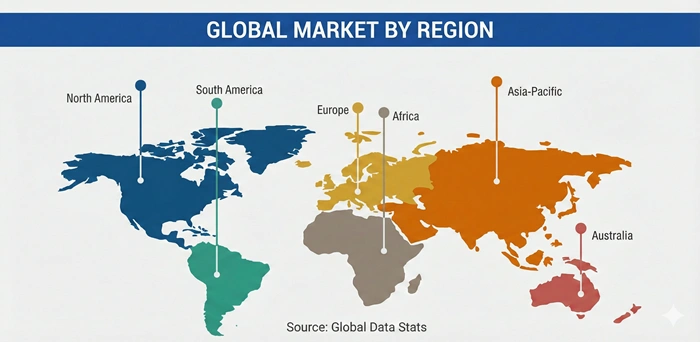
Regional Insights
North America
North America's Dominant Market Position in NPL Management Is Built on the Most Advanced Financial Technology Ecosystem, Mature Legal Frameworks for Distressed Asset Recovery, and High Regulatory Standards Driving Consistent NPL Management Investment
North America holds approximately 35% of global NPL management market revenue in 2025, expanding at a regional CAGR of approximately 5.8% through 2033. The United States drives the vast majority of regional revenue, supported by the world's most developed distressed debt investment market, a legal framework — including the U.S. Bankruptcy Code and state-level foreclosure laws — that provides clear and enforceable pathways for NPL resolution, and a highly sophisticated ecosystem of specialized NPL servicers, investment firms, and technology providers. Leading companies in the North American NPL management market include PRA Group, Encore Capital Group, Accenture, Deloitte, KPMG, EY, and PwC — each serving the major U.S. commercial and investment banking institutions with a combination of technology platforms, advisory services, and outsourced servicing capabilities.
Rising interest rates and commercial real estate stress in the U.S. banking system are generating elevated NPL formation in 2025–2026, creating cyclical demand tailwinds that complement the market's structural technology adoption drivers. Canada's banking regulatory environment — with OSFI actively monitoring NPL ratios and requiring active remediation — supports consistent NPL management investment among the major Canadian chartered banks. The North American market is also the primary testing ground for next-generation AI NPL management platforms, with several U.S.-based fintech companies developing and commercially deploying machine learning-enhanced debt collection, early warning, and portfolio valuation solutions that are subsequently being adapted for international market deployment.
Asia Pacific
Asia Pacific Is the Fastest-Growing Region in the NPL Management Market, Powered by Surging Credit Defaults Across Real Estate, SME, and Consumer Finance Sectors Combined with Accelerating Regulatory and Technology Development
Asia Pacific is projected to register the highest regional CAGR globally at approximately 7.5% through 2033, making it the most important strategic growth market in the NPL management sector for the current decade. China represents the largest and most commercially significant individual country market within the region, where NPL challenges in the property development sector, local government financing vehicles, and SME lending portfolios have reached scales requiring industrial-strength resolution infrastructure. Chinese state banks and joint-stock commercial banks are making substantial investments in NPL management platforms, data analytics infrastructure, and outsourced servicing partnerships — creating major commercial opportunities for both domestic NPL technology providers and international advisory firms operating in the Chinese financial market.
India is the second most strategically important Asia Pacific market, where the Reserve Bank of India's sustained regulatory pressure on bank NPL recognition and provisioning standards has driven significant investment in NPL management capabilities by both public sector banks and private sector lenders. Indian asset reconstruction companies (ARCs) — operating under the SARFAESI Act framework — represent a mature domestic NPL secondary market ecosystem that is progressively adopting digital platforms and AI-driven valuation tools. Japan and South Korea contribute stable, mature NPL management market revenue, while emerging markets including Vietnam, Indonesia, Thailand, and the Philippines are at earlier stages of NPL secondary market development but show strong growth potential as regulatory frameworks evolve and banking sector credit quality is increasingly subject to international standard monitoring and oversight.
Customization Available for This Report
This report offers comprehensive region-wise and country-wise customization, providing tailored market intelligence on NPL volume trends, regulatory environment, technology adoption patterns, secondary market development, competitive landscape, and growth opportunities specifically relevant to your selected geography and the NPL management market keyword combination.
Customized versions of this report are available for each region and country listed below, delivering actionable, geography-specific insights for banks, NPL servicers, technology vendors, distressed asset investors, and regulatory affairs teams:
North America
-
U.S. — Federal and state NPL regulatory framework, commercial real estate NPL trends, AI-driven debt collection platform adoption, major servicer competitive landscape, and distressed debt investment market analysis
-
Canada — OSFI regulatory standards, major chartered bank NPL management practices, distressed asset market development, and technology platform adoption analysis
-
Mexico — CNBV regulatory framework, banking sector NPL trends, and emerging NPL secondary market development opportunity analysis
Europe
-
U.K. — FCA regulatory framework for NPL management, post-Brexit NPL servicing landscape, secondary market activity, and major servicer competitive dynamics
-
Germany — BaFin NPL supervisory standards, Pfandbriefbank and Landesbank NPL management practices, and corporate NPL restructuring market analysis
-
France — ACPR regulatory framework, French banking sector NPL trends, secondary market activity, and key NPL servicer competitive landscape
-
Italy — Banca d'Italia NPL supervisory approach, Garanzia Cartolarizzazione Sofferenze (GACS) scheme impact, and specialized Italian NPL servicer market analysis
-
Rest of Europe — Eastern European banking sector NPL trends, EU Directive on credit servicers implementation analysis, and secondary market development progress
Asia Pacific
-
China — CBIRC NPL regulatory framework, property sector NPL resolution strategies, ARC market development, and domestic technology platform competitive landscape
-
India — RBI NPL recognition norms, SARFAESI Act framework, ARC market competitive analysis, and technology platform adoption trends
-
Japan — FSA regulatory environment, regional bank NPL management challenges, and domestic servicer competitive landscape
-
South Korea — FSC regulatory framework, corporate restructuring mechanisms, and NPL market competitive dynamics
-
Australia — APRA NPL supervisory standards, major bank NPL management practices, and digital platform adoption analysis
-
Rest of Asia Pacific — Country-level NPL management market analysis for Vietnam, Indonesia, Thailand, and the Philippines
Latin America
-
Brazil — BACEN regulatory framework, banking sector NPL trends, secondary market development status, and technology platform adoption analysis
-
Argentina — Banking sector NPL challenges, economic environment impact on default rates, and market opportunity analysis
-
Rest of Latin America — Colombia, Chile, Peru NPL market sizing and secondary market development opportunity analysis
Middle East & Africa
-
UAE — CBUAE regulatory standards, regional financial hub NPL management practices, and technology adoption landscape
-
Saudi Arabia — SAMA regulatory framework, Vision 2030 financial sector NPL implications, and corporate NPL restructuring market analysis
-
Rest of MEA — Sub-Saharan African banking sector NPL trends, mobile-first collection technology adoption, and emerging NPL management market opportunity analysis
Top Key Players
-
Intrum AB (Sweden)
-
Hoist Finance AB (Sweden)
-
Arrow Global Group PLC (United Kingdom)
-
KRUK S.A. (Poland)
-
B2Holding ASA (Norway)
-
Axactor SE (Norway)
-
PRA Group Inc. (United States)
-
Encore Capital Group Inc. (United States)
-
Cabot Credit Management (United Kingdom)
-
Lowell Group (United Kingdom)
-
EOS Group (Germany)
-
Cerved Group S.p.A. (Italy)
-
Banca IFIS S.p.A. (Italy)
-
Pepper Group (Australia)
-
Accenture plc (Ireland / United States)
-
Deloitte Touche Tohmatsu Limited (United Kingdom / United States)
-
KPMG International (Netherlands / Global)
-
Ernst & Young (EY) (United Kingdom / Global)
-
PricewaterhouseCoopers (PwC) (United Kingdom / Global)
Recent Developments
-
In February 2026, an Indian bank-led consortium launched a Swiss challenge auction process for NPL portfolios linked to a distressed thermal power project, with the auction managed by BOB Capital Markets and structured to attract banks, NBFCs, and asset reconstruction companies as eligible bidders — reflecting the growing sophistication and institutionalization of India's NPL secondary market transaction mechanisms and the increasing use of competitive auction processes to maximize recovery values for stressed assets
-
In January 2026, the European Commission's NPL Advisory Panel published updated research confirming that EU banking sector NPL ratios had declined from 6.5% in 2014 to 1.9% in Q4 2024, attributing this sustained improvement primarily to the successful development of NPL secondary market infrastructure — validating the commercial model of specialized NPL servicers and secondary market investors that has driven the European NPL management industry's growth over the past decade
-
In March 2025, Intrum AB completed a significant portfolio restructuring of its own balance sheet debt, selling a package of NPL servicing contracts and restructuring its capital structure — demonstrating that even leading NPL management specialists must apply rigorous portfolio and financial management discipline, and signaling a period of industry consolidation among large European NPL servicers as market conditions evolve
-
In October 2024, KRUK S.A. expanded its geographic footprint in Asia Pacific by establishing a new operational partnership in India with a domestic financial institution to jointly develop retail NPL collection and restructuring services — marking one of the first significant entries by a major European NPL servicer into the rapidly growing Indian distressed debt market
-
In November 2024, Encore Capital Group Inc. announced a technology partnership with an AI-driven debt recovery platform company to integrate predictive analytics and digital borrower engagement capabilities into its U.S. collection operations — representing one of the more significant technology adoption commitments by a major North American NPL servicer and signaling broader industry movement toward AI-enhanced recovery methodologies
Market Trends
Two Dominant Trends Are Reshaping the NPL Management Market: The Rapid Adoption of AI-Powered Digital NPL Platforms and the Progressive Institutionalization of ESG Considerations in NPL Resolution Strategies
The most commercially transformative trend reshaping the NPL management market is the accelerating industry-wide transition from manual, rule-based NPL management processes to AI-powered digital platforms that deliver measurable efficiency and recovery performance improvements. Financial institutions that have deployed machine learning-enhanced early warning systems, AI-driven borrower segmentation tools, and automated workflow management platforms are reporting recovery rate improvements of 15–30% and resolution time reductions of 20–40% compared to conventional approaches. This performance differential is creating competitive pressure across the industry — banks and servicers that do not invest in technology modernization risk falling behind peers in regulatory compliance efficiency, operating cost structures, and NPL resolution outcomes. The trend is accelerating the commercialization of cloud-native NPL management platforms developed by both established technology vendors and fintech challengers, creating a dynamic and rapidly evolving technology landscape within the broader NPL services market.
The integration of environmental, social, and governance (ESG) principles into NPL resolution strategies represents a second emerging but increasingly important structural trend. Financial regulators in Europe — and progressively in Asia Pacific and North America — are encouraging banks to adopt borrower-centric NPL management approaches that prioritize sustainable resolution outcomes, including payment plan restructuring, financial hardship support programs, and responsible foreclosure practices that minimize avoidable economic harm to borrowers. Beyond regulatory pressure, institutional investors in the NPL secondary market are increasingly applying ESG screens to their portfolio acquisition decisions, preferring servicers that demonstrate transparent, fair, and responsible borrower management practices. This trend is driving NPL servicers to invest in borrower welfare management capabilities, digital self-service resolution platforms, and ESG reporting infrastructure that both satisfies regulatory expectations and supports positive investor relations — creating new product and service development opportunities throughout the NPL management market.
Segments Covered in the Report
By Asset Type
-
Corporate Assets
-
Large Corporate Defaulted Loans
-
SME (Small and Medium Enterprise) Credit Facilities
-
-
Personal / Retail Assets
-
Residential Mortgage NPLs
-
Consumer Credit and Personal Loan Defaults
-
Credit Card Delinquencies
-
-
Government / Sovereign Assets
-
Sovereign and Quasi-Sovereign Guaranteed Loan Defaults
-
By Solution Type
-
Debt Collection Software
-
AI-Enhanced Automated Collection Workflows
-
Multi-Channel Borrower Communication Platforms
-
-
Analytics and Reporting Tools
-
Predictive Recovery Analytics
-
Portfolio Performance Dashboard and Reporting Systems
-
-
Predictive Recovery Platforms
-
Machine Learning Borrower Risk Scoring
-
Early Warning System Platforms
-
-
Loan Workout and Restructuring Software
-
Debt Restructuring Case Management Systems
-
Creditor Coordination and Documentation Platforms
-
-
Others
By Application
-
Reorganization and Restructuring
-
Debt-Equity Conversion and Business Turnaround
-
Payment Plan Renegotiation and Tenure Extension
-
-
Bankrupt and Liquidation
-
Judicial and Out-of-Court Insolvency Management
-
Collateral Realization and Asset Disposal
-
-
Debt Sale and Portfolio Transfer
-
NPL Secondary Market Transaction Support
-
Portfolio Valuation and Due Diligence Services
-
-
Others
By Deployment Mode
-
On-Premises
-
Bank-Hosted Internal NPL Management Systems
-
-
Cloud-Based
-
SaaS NPL Management Platforms
-
Hybrid Cloud Deployment Models
-
By End User
-
Commercial Banks
-
Retail and Corporate Banking Divisions
-
-
Investment Banks and Asset Management Firms
-
Distressed Debt Fund Management
-
-
Specialized NPL Service Providers
-
Independent Debt Collection and Servicing Agencies
-
-
Credit Unions and Cooperative Banks
-
Others
By Region
-
North America (U.S., Canada, Mexico)
-
Europe (U.K., Germany, France, Italy, Rest of Europe)
-
Asia Pacific (China, India, Japan, South Korea, Australia, Rest of Asia Pacific)
-
Latin America (Brazil, Argentina, Rest of Latin America)
-
Middle East and Africa (UAE, Saudi Arabia, Rest of MEA)
❝ Built for Every Level — From Startups to Industry Giants ❞
Here Is Exactly How This Report Works for You
-
For tier 1 global banks, institutional distressed debt investors, and senior financial sector strategy executives, this report delivers granular competitor revenue analysis — including service-line and geography-level revenue breakdowns for Intrum, Encore Capital, PRA Group, Arrow Global, and leading advisory firms — alongside a structured geopolitical and regulatory risk assessment covering how Basel IV capital frameworks, EU NPL Directive implementation, and emerging market regulatory reforms are reshaping the commercial landscape for NPL management service providers, enabling confident M&A targeting, portfolio investment, and market entry decisions
-
For tier 2, tier 3 banks, regional NPL servicers, fintech NPL platform developers, and distressed asset advisory boutiques, this report maps the highest-growth application categories, most commercially accessible geographic markets, and most strategically significant technology adoption trends within the NPL management market — providing a data-driven roadmap for expanding service capability, winning new institutional mandates, and building competitive positioning in a market that rewards early technology investment and specialized sector expertise
-
For all decision-makers across the NPL management value chain — from chief risk officers and NPL portfolio managers to commercial development heads and technology investment directors — this report translates complex market dynamics including AI platform adoption curves, secondary market development timelines, regulatory NPL ratio compliance deadlines, and emerging market credit stress trajectories into actionable intelligence that enables smarter product development, partnership strategy, and capital allocation decisions through 2033
Frequently Asked Questions
Question 1: What is the current size of the global NPL management market and what is the projected value by 2033?
Answer: The global NPL management market was valued at USD 5.69 billion in 2025 and is projected to reach approximately USD 8.92 billion by 2033, growing at a CAGR of 6.02% from 2026 to 2033. This growth is driven by rising loan default volumes, increasing regulatory pressure on banks to actively manage NPL ratios, and accelerating adoption of AI-powered and cloud-based NPL resolution platforms across both developed and emerging markets.
Question 2: What are the main services and solutions covered in the NPL management market?
Answer: The NPL management market encompasses a broad range of services including debt collection software, predictive recovery analytics, loan workout and restructuring advisory, portfolio valuation, secondary market transaction support, and compliance and regulatory reporting platforms. These solutions collectively address the full lifecycle of non-performing loan management — from early warning identification and borrower engagement through restructuring, portfolio sale, and final asset recovery or liquidation.
Question 3: Which region dominates the NPL management market and which is growing fastest?
Answer: North America leads the global NPL management market with approximately 35% revenue share in 2025, driven by its mature financial ecosystem, advanced legal frameworks for distressed asset recovery, and strong institutional adoption of AI-enhanced NPL technology platforms. Asia Pacific is the fastest-growing region at approximately 7.5% CAGR through 2033, propelled by surging NPL volumes in China and India, evolving regulatory frameworks, and rapid adoption of digital NPL management solutions across the region's expanding banking sector.
Question 4: How is artificial intelligence changing the NPL management market?
Answer: AI is transforming the NPL management market by enabling predictive early warning systems that identify at-risk loans before default, machine learning-driven borrower segmentation that personalizes recovery outreach, and automated workflow management that accelerates resolution timelines while reducing operational costs by 20–40%. AI-powered platforms are also enhancing secondary market transaction efficiency through intelligent portfolio valuation tools and digital marketplace platforms that connect NPL portfolio sellers with institutional investors more quickly and transparently than conventional processes.
Question 5: What are the key growth opportunities in the NPL management market through 2033?
Answer: The largest growth opportunities in the NPL management market include the development of NPL secondary market infrastructure in Asia Pacific, Latin America, and the Middle East — where regulatory reforms enabling foreign NPL investment and data standardization improvements are progressively creating functioning portfolio transaction markets comparable to Europe's mature secondary market. The commercialization of cloud-native AI NPL management platforms serving mid-tier and smaller financial institutions represents a second major opportunity, as these institutions gain access to enterprise-grade recovery capabilities through cost-effective SaaS delivery models that were previously out of their financial and technical reach.