
Non-UV Dicing Tapes Market Overview
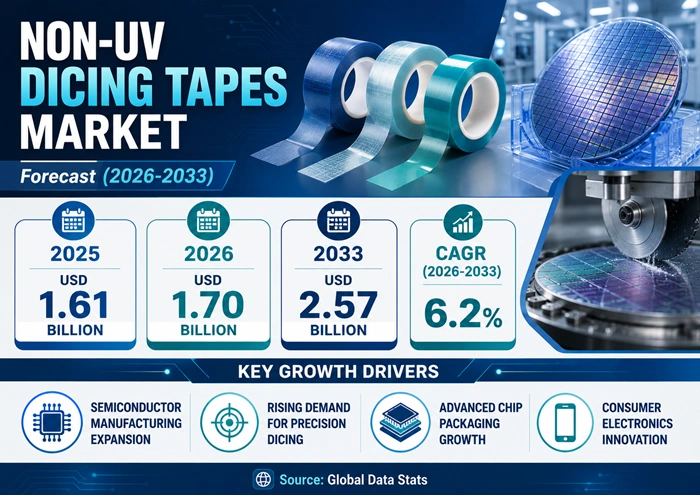
The global non-UV dicing tapes market size is valued at USD 1.61 billion in 2025 and is predicted to increase from USD 1.70 billion in 2026 to approximately USD 2.57 billion by 2033, growing at a CAGR of 6.2% from 2026 to 2033.
The market is experiencing steady demand from the semiconductor and electronics manufacturing industries, where non-UV dicing tapes play a critical role in wafer dicing, semiconductor packaging, and MEMS device fabrication. Unlike UV-release tapes, these products do not require ultraviolet light for adhesive release, making them a preferred choice in applications where UV exposure could compromise sensitive components.
AI Impact on the Non-UV Dicing Tapes Industry
Artificial Intelligence Is Reshaping Semiconductor Manufacturing Workflows, Driving Greater Precision Demand and Opening New Application Frontiers for Non-UV Dicing Tape Producers
Artificial intelligence is quietly but meaningfully changing the semiconductor fabrication ecosystem, which directly influences how the non-UV dicing tapes market evolves. AI-powered inspection systems now detect micro-defects during wafer dicing with a level of accuracy that was not achievable with manual processes just a few years ago. This shift toward precision-driven manufacturing is pushing semiconductor fabs to adopt higher-specification materials, including dicing tapes that can maintain consistent adhesion across increasingly thin and fragile wafers.
Beyond inspection, AI-driven process optimization is enabling semiconductor manufacturers to reduce waste and improve throughput during dicing operations. As chip designs become more complex — particularly with the proliferation of heterogeneous integration and multi-chip modules — the materials used throughout the dicing process, including non-UV tapes, must meet tighter dimensional and adhesive tolerances. AI-assisted R&D is also accelerating the pace at which tape manufacturers can develop and validate new formulations, compressing the time from material innovation to market deployment.
Growth Factors
Surging Semiconductor Demand, Miniaturization Trends, and the Expansion of Advanced Packaging Technologies Are Fueling Strong and Consistent Growth in This Specialized Tape Segment
The most powerful growth engine for the non-UV dicing tapes market is the accelerating global demand for semiconductors. From consumer electronics and automotive chips to AI processors and IoT devices, the world's appetite for advanced semiconductors continues to grow at a pace that is putting enormous pressure on wafer fabrication and packaging facilities. Every wafer diced at a semiconductor fab requires specialized tape to hold the wafer during cutting, and non-UV variants are increasingly favored for processes involving heat-sensitive or UV-sensitive chip designs.
The trend toward semiconductor miniaturization is another important driver. As chip architectures shrink to increasingly smaller nodes, wafers must be diced with greater precision, and the tape used must provide uniform adhesion without leaving residue on delicate surfaces. PVC-based and PO-based non-UV tapes are gaining ground in these high-precision applications. Additionally, the rapid growth of MEMS manufacturing, advanced sensor production, and compound semiconductor fabrication is expanding the total addressable market for non-UV dicing tapes well beyond traditional silicon wafer applications.
Market Outlook
The Non-UV Dicing Tapes Market Is on a Firm Growth Trajectory Through 2033, Supported by Expanding Semiconductor Fabs, Technological Upgrades, and Rising Demand From Emerging Electronics Hubs
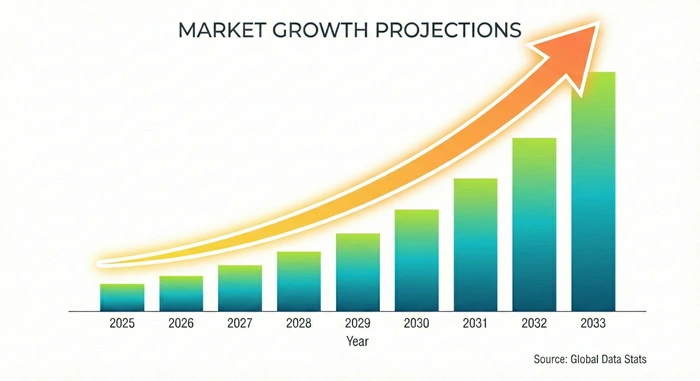
The non-UV dicing tapes market outlook through 2033 remains firmly positive. Asia Pacific, and East Asia in particular, will continue to anchor global demand as countries like South Korea, Japan, China, and Taiwan invest heavily in semiconductor manufacturing capacity. Government-backed initiatives such as chip sovereignty programs in the United States and Europe are also expected to fuel new fab construction over the coming years, which will expand the installed base of equipment requiring non-UV dicing tape consumables.
At the same time, product innovation is intensifying among leading tape manufacturers. Companies are focusing on developing thinner, cleaner-release, and higher-thermal-stability tapes that can support next-generation packaging formats such as wafer-level chip-scale packaging (WLCSP) and fan-out wafer-level packaging (FOWLP). As these advanced packaging formats become mainstream, the specifications required from dicing tape products will rise accordingly, creating opportunities for manufacturers that can stay ahead of the technology curve through sustained R&D investment.
Expert Speaks
-
"The materials that support semiconductor dicing are not glamorous, but they are absolutely mission-critical. As we push into sub-5nm manufacturing, every element of the process stack — including the tape — must perform flawlessly. We are increasing our materials procurement standards significantly." — CEO, Taiwan Semiconductor Manufacturing Company (TSMC)
-
"Advanced packaging is the next frontier of semiconductor innovation, and the consumable materials ecosystem that supports it needs to evolve in lockstep. We are actively collaborating with tape and materials suppliers to co-develop solutions that match our future packaging roadmap." — CEO, Intel Corporation
-
"South Korea remains a global hub for memory and logic chip production. Our investment in new fab capacity over the next several years will naturally drive strong demand for high-performance process materials, including next-generation dicing tapes that can support ultra-thin wafer handling." — CEO, Samsung Electronics
Key Report Takeaways
-
Asia Pacific leads the non-UV dicing tapes market with approximately 46% of global market share in 2025, driven by the presence of major semiconductor fabs in South Korea, Japan, China, and Taiwan, supported by government investments in domestic chip production capacity
-
Asia Pacific is also the fastest-growing region, expanding at a CAGR of approximately 7.8% from 2026 to 2033, as new fab construction accelerates across China, India, and Southeast Asia and demand for advanced semiconductor packaging grows rapidly
-
Semiconductor packaging is the dominant application segment, accounting for approximately 54% of total market share, as high-volume chip packaging operations at leading OSATs and IDMs generate consistent and growing demand for non-UV dicing tape products
-
PVC-based tapes contribute the most among material type segments, holding approximately 50% share in 2025, owing to their established adhesive compatibility, clean peel characteristics, and broad applicability across standard wafer dicing processes
-
Single-sided coating type is the most widely used, commanding approximately 60% share of the coating type segment due to its simpler handling and compatibility with the majority of conventional wafer dicing equipment setups
-
MEMS manufacturing is the fastest-growing application segment in the non-UV dicing tapes market, projected to expand at a CAGR of approximately 8.3% from 2026 to 2033, capturing close to 20% market share by 2033 as IoT, medical devices, and automotive sensor demand accelerates
Market Scope
| Report Coverage | Details |
|---|---|
| Market Size by 2033 | USD 2.57 Billion |
| Market Size by 2025 | USD 1.61 Billion |
| Market Size by 2026 | USD 1.70 Billion |
| Market Growth Rate (2026–2033) | CAGR of 6.2% |
| Dominating Region | Asia Pacific |
| Fastest Growing Region | Asia Pacific (China & India sub-regions) |
| Base Year | 2025 |
| Forecast Period | 2026 – 2033 |
| Segments Covered | Material Type, Thickness, Coating Type, Application |
| Regions Covered | North America, Europe, Asia Pacific, Latin America, Middle East & Africa |
Market Dynamics
Drivers Impact Analysis
Semiconductor Industry Expansion, Advanced Packaging Adoption, and the Rise of MEMS and Compound Semiconductors Are the Core Structural Forces Propelling the Non-UV Dicing Tapes Market
| Driver | ≈ % Impact on CAGR Forecast | Geographic Relevance | Impact Timeline |
|---|---|---|---|
| Surging global semiconductor demand and fab capacity expansion | ~38% | Asia Pacific, North America, Europe | Short to Medium Term |
| Growth of advanced semiconductor packaging (WLCSP, FOWLP) | ~28% | South Korea, Taiwan, Japan, USA | Medium to Long Term |
| Expanding MEMS and compound semiconductor manufacturing | ~20% | Asia Pacific, North America | Medium to Long Term |
| Miniaturization trends driving demand for high-spec dicing materials | ~14% | Global | Long Term |
The non-UV dicing tapes market continues to gain momentum primarily because semiconductor manufacturing is expanding at an unprecedented pace globally. Government programs in the United States, Europe, Japan, and India are actively subsidizing the construction of new chip fabrication plants, which will add substantial new capacity over the coming years. Each new fab brings with it an ongoing demand for process consumables, including wafer dicing tapes, creating a durable and growing customer base for non-UV tape manufacturers.
The shift toward advanced semiconductor packaging formats is amplifying this demand further. Technologies such as wafer-level chip-scale packaging, system-in-package, and fan-out wafer-level packaging require tighter process controls and higher-performance materials throughout the assembly chain. Non-UV dicing tapes that can handle ultra-thin wafers without adhesive residue or wafer damage are in particularly strong demand in these processes. As packaging complexity continues to rise with each new generation of chip architecture, the performance bar for dicing tapes will keep rising, creating long-term structural demand for product innovation.
Restraints Impact Analysis
Raw Material Cost Volatility, Technical Complexity of Next-Gen Applications, and Competition From UV-Release Alternatives Create Meaningful Headwinds for Non-UV Dicing Tape Producers
| Restraint | ≈ % Impact on CAGR Forecast | Geographic Relevance | Impact Timeline |
|---|---|---|---|
| Raw material price volatility (PVC, PET, PO resins) | ~35% | Global | Short Term |
| Technical barriers in ultra-thin wafer and sub-5nm process compatibility | ~30% | North America, Asia Pacific, Europe | Medium Term |
| Competition from UV-release and thermally releasable tape alternatives | ~22% | Global | Short to Medium Term |
| Limited supplier diversity and dependence on East Asian manufacturers | ~13% | North America, Europe, Latin America | Long Term |
One of the most persistent challenges facing the non-UV dicing tapes market is the volatility of raw material prices, particularly for the polymer resins that form the base film of these tapes. PVC, PET, and polyolefin pricing can fluctuate significantly based on crude oil prices, supply chain disruptions, and geopolitical events. These cost swings are difficult for tape manufacturers to absorb entirely, which can compress margins or require price adjustments that affect customer procurement decisions.
The technical demands placed on dicing tape materials are also intensifying in ways that create real development challenges. Ultra-thin wafers, sometimes below 50 microns in thickness, require tapes with extremely precise and uniform adhesion profiles to prevent cracking during cutting. Developing materials that can meet these exacting specifications while remaining cost-competitive with UV-release tape alternatives requires substantial R&D investment that smaller manufacturers may struggle to sustain. This dynamic tends to concentrate innovation and market leadership within a small group of technically advanced producers.
Opportunities Impact Analysis
New Fab Construction Programs, Emerging Electronics Hubs in India and Southeast Asia, and Rising Demand for Compound Semiconductors Present High-Value Growth Opportunities Across the Non-UV Dicing Tapes Market
| Opportunity | ≈ % Impact on CAGR Forecast | Geographic Relevance | Impact Timeline |
|---|---|---|---|
| Government-backed semiconductor fab construction in US, Europe, and India | ~36% | USA, Germany, India, Japan | Medium to Long Term |
| Rapid expansion of MEMS and power semiconductor manufacturing | ~28% | Asia Pacific, Europe | Medium Term |
| Growing demand from automotive and EV semiconductor supply chains | ~22% | Germany, Japan, South Korea, China | Short to Long Term |
| Emerging semiconductor hubs in India, Vietnam, and Malaysia | ~14% | South and Southeast Asia | Long Term |
The non-UV dicing tapes market stands to benefit enormously from the wave of new semiconductor fabs currently under construction or planned globally. The US CHIPS Act, Europe's Chips Act, and India's Semiconductor Mission are collectively committing hundreds of billions of dollars to domestic chip production capacity. As these fabs come online between 2026 and 2030, they will create a new and geographically diversified customer base for non-UV dicing tape suppliers who have traditionally been most concentrated in East Asia.
The automotive sector represents another important opportunity frontier. The transition to electric vehicles and the growing complexity of automotive electronics systems are driving strong demand for power semiconductors, radar chips, and sensor ICs — all of which require wafer dicing as part of their manufacturing process. Automotive-grade semiconductor applications often require particularly reliable and residue-free dicing tapes to meet the stringent quality standards of the automotive supply chain. Manufacturers that can develop dicing tape products certified for automotive semiconductor applications will be well-positioned to capture a share of this rapidly growing end market.
Segment Analysis
By Material Type
PVC Dominates the Material Landscape While Polyolefin-Based Tapes Emerge as the Premium Growth Segment Driven by Ultra-Thin Wafer and Advanced Packaging Process Requirements
PVC-based non-UV dicing tapes hold the largest share of the material type segment at approximately 50% in 2025, a position that reflects decades of established use across standard wafer dicing operations. PVC tapes are widely valued for their adhesive compatibility, dimensional stability, and reliable clean-peel performance across a broad range of dicing conditions. In North America and Europe, demand for PVC-based non-UV dicing tapes remains stable, supported by ongoing semiconductor packaging operations at established facilities. The PVC segment is expected to grow at a CAGR of approximately 5.8% from 2026 to 2033, with Asia Pacific accounting for the largest volume consumption due to the concentration of high-volume semiconductor fabs in South Korea, Japan, and China. Key players supplying PVC-based products in this region include Lintec Corporation (Japan), Nitto Denko Corporation (Japan), and Furukawa Electric Co., Ltd. (Japan), all of which maintain strong production infrastructure and long-term supply relationships with leading semiconductor manufacturers.
Polyolefin (PO) and PET-based tapes represent the fastest-growing material categories within the non-UV dicing tapes market, driven by the increasing adoption of advanced packaging formats and the growing need to dice ultra-thin and fragile wafers without mechanical stress or contamination. PO-based tapes offer superior low-temperature performance and cleaner adhesive release compared to standard PVC options, making them increasingly preferred in high-value semiconductor packaging applications such as FOWLP and WLCSP. The PO segment is projected to grow at a CAGR of approximately 7.5% through 2033, with the fastest adoption seen in South Korea and Taiwan, where leading-edge semiconductor packaging is most concentrated. Denka Company Limited (Japan) and Sumitomo Bakelite Co., Ltd. (Japan) are among the key suppliers actively developing next-generation PO-based non-UV tape formulations to capture share in this premium growth segment.
By Application
Semiconductor Packaging Anchors Revenue Generation While MEMS Manufacturing Emerges as the Fastest-Growing and Most Technically Dynamic Application Segment in the Dicing Tape Ecosystem
Semiconductor packaging is the dominant application segment within the non-UV dicing tapes market, accounting for approximately 54% of total market share in 2025. This segment encompasses the high-volume dicing operations carried out at outsourced semiconductor assembly and test (OSAT) facilities, as well as at integrated device manufacturers (IDMs) that handle both fabrication and packaging in-house. The sheer volume of chips packaged globally each year — running into hundreds of billions of units — creates a massive and recurring demand for dicing tape consumables that is largely immune to short-term market fluctuations. The semiconductor packaging segment is growing at a CAGR of approximately 6.0% from 2026 to 2033, with Asia Pacific, particularly South Korea and China, accounting for the majority of volume. Lintec Corporation, Nitto Denko Corporation, and Furukawa Electric are the most prominent suppliers in this application segment, benefiting from multi-year supply agreements with major chip makers.
MEMS manufacturing is rapidly emerging as the most technically dynamic and fastest-growing application segment in the non-UV dicing tapes market, projected to grow at a CAGR of approximately 8.3% from 2026 to 2033. MEMS devices — including gyroscopes, pressure sensors, microphones, and optical MEMS — are used in smartphones, wearables, medical devices, and automotive systems, and their production involves dicing extremely thin and fragile substrates that demand tapes with exceptional adhesion uniformity and zero contamination transfer. The growing adoption of MEMS in electric vehicles, medical diagnostics, and industrial IoT sensors is a major demand catalyst. Japan and the United States are the leading hubs for MEMS manufacturing, with companies like Denka Company Limited and Sumitomo Bakelite supplying specialty tapes specifically engineered for MEMS substrate handling.
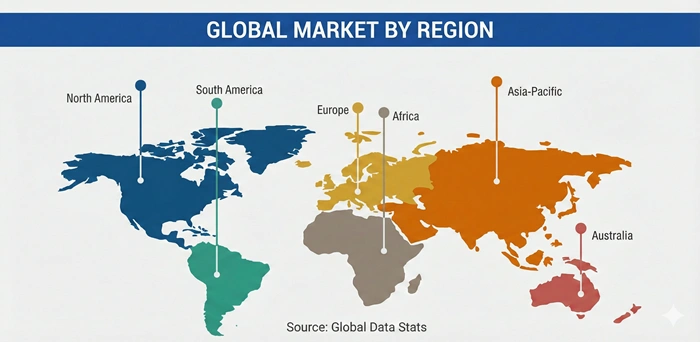
Regional Insights
Asia Pacific's Manufacturing Supremacy and North America's Strategic Reinvestment Are Defining the Regional Competitive Landscape of the Non-UV Dicing Tapes Market Through 2033
Asia Pacific
Asia Pacific Commands the Largest Share of the Global Non-UV Dicing Tapes Market, Backed by Its Unrivaled Concentration of Semiconductor Fabs, Electronics Manufacturers, and Tape Suppliers
Asia Pacific is the dominant region in the non-UV dicing tapes market, holding approximately 46% of global market share in 2025 and growing at a regional CAGR of approximately 7.0% through 2033. The region's supremacy is rooted in its dense concentration of semiconductor manufacturing assets — South Korea alone is home to Samsung Electronics and SK Hynix, two of the world's largest memory chip producers, while Japan hosts a deep ecosystem of materials, equipment, and packaging companies. China's rapid expansion of domestic semiconductor capacity under its chip self-sufficiency programs is also contributing significant additional demand for wafer dicing tape consumables. Leading non-UV dicing tape suppliers in this region include Lintec Corporation (Japan), Nitto Denko Corporation (Japan), Furukawa Electric Co., Ltd. (Japan), and Denka Company Limited (Japan), all of which benefit from direct proximity to their largest customers and well-established distribution networks.
India and Southeast Asia are the fastest-growing sub-regions within Asia Pacific for the non-UV dicing tapes market. India's government has committed billions of dollars to building domestic semiconductor fabrication and packaging capacity, with projects from Tata Electronics and others expected to come online between 2026 and 2028. Vietnam and Malaysia are also attracting significant semiconductor assembly and test investments from global electronics companies seeking supply chain diversification. These developments are progressively expanding the geographic demand base for non-UV dicing tape products within Asia Pacific, creating new distribution and supply chain opportunities for both established Japanese suppliers and emerging regional players.
North America
North America Is Undergoing a Strategic Semiconductor Manufacturing Renaissance That Is Creating Fresh and Growing Demand for Non-UV Dicing Tape Products Across a Widening Customer Base
North America holds approximately 22% of global non-UV dicing tapes market share in 2025, with the United States representing the vast majority of regional demand. The US market is growing at a steady CAGR of approximately 5.7% through 2033, supported by the ongoing expansion of domestic semiconductor manufacturing capacity driven by the CHIPS and Science Act. Major fab construction projects by TSMC, Intel, Samsung, and Micron across Arizona, Ohio, Texas, and Idaho are creating an entirely new layer of demand for semiconductor process consumables, including non-UV dicing tapes, that did not previously exist within the United States.
Key players supplying the North American market include Lintec Corporation (Japan), Nitto Denko Corporation (Japan), and 3M Company (USA), the latter of which has a significant presence in specialty tapes for the electronics industry. North America is also a leading hub for MEMS manufacturing and advanced compound semiconductor production — applications that generate disproportionately high per-unit demand for premium dicing tape products. Canada and Mexico are smaller but growing contributors to regional demand, with Mexico in particular attracting electronics manufacturing investment that is creating incremental tape consumption.
Customization Available by Region and Country
This Non-UV Dicing Tapes Market Report Can Be Fully Customized to Deliver Region-Specific and Country-Level Intelligence Tailored Precisely to Your Business Objectives and Geographic Focus Areas
Our non-UV dicing tapes market report is available with complete region-wise and country-wise customization, allowing clients to obtain in-depth analysis, localized market sizing, demand trend mapping, competitive landscape assessments, regulatory environment reviews, and growth opportunity identification tailored to their specific geography. Whether you need a focused country study or a multi-region comparison, the report structure adapts fully to your requirements.
-
Customized regional and country-level reports are available for all the following geographies:
North America
-
United States, Canada, Mexico — country-level non-UV dicing tapes market sizing, demand forecasts, semiconductor fab pipeline analysis, key buyer profiles, and regulatory environment specifics for each country
Europe
-
United Kingdom, Germany, France, Italy, Rest of Europe — region-specific analysis of semiconductor and electronics manufacturing activity, tape procurement patterns, EU regulatory frameworks, and country-level competitive dynamics for leading European markets
Asia Pacific
-
China, India, Japan, South Korea, Australia, Rest of Asia Pacific — detailed country breakdowns covering fab construction pipelines, MEMS manufacturing activity, local supplier analysis, import/export dynamics, and sub-regional growth forecasts
Latin America
-
Brazil, Argentina, Rest of Latin America — market sizing, demand growth forecasts, electronics manufacturing investment activity, and supplier landscape analysis tailored to each key Latin American market
Middle East & Africa
-
UAE, Saudi Arabia, Rest of MEA — insights into technology manufacturing investments, electronics sector growth programs, government digital infrastructure initiatives, and demand potential for non-UV dicing tape products across the MEA region
Top Key Players
-
Lintec Corporation (Japan)
-
Nitto Denko Corporation (Japan)
-
Furukawa Electric Co., Ltd. (Japan)
-
Denka Company Limited (Japan)
-
Sumitomo Bakelite Co., Ltd. (Japan)
-
Mitsui Chemicals Tohcello, Inc. (Japan)
-
Adhesives Research, Inc. (United States)
-
3M Company (United States)
-
Pantech Tape Co., Ltd. (South Korea)
-
KGK Chemical Corporation (Japan)
-
AI Technology, Inc. (United States)
-
Ultron Systems, Inc. (United States)
Recent Developments
-
In 2025, Lintec Corporation expanded its non-UV dicing tape product line to address evolving specification requirements across advanced semiconductor packaging applications, strengthening its supply position with major OSAT customers in Asia Pacific.
-
In 2025, Furukawa Electric Co., Ltd. invested in manufacturing capacity upgrades and process technology improvements at its specialty tape division, aiming to improve product performance for ultra-thin wafer dicing operations and reduce adhesive residue in premium packaging formats.
-
In 2026, Denka Company Limited entered a strategic long-term supply agreement with a major semiconductor packaging customer in South Korea, securing multi-year procurement commitments for its PO-based non-UV dicing tape products across priority application segments.
-
In 2025, Nitto Denko Corporation launched a new line of high-thermal-stability non-UV dicing tapes specifically engineered for compound semiconductor and power device manufacturing, targeting the fast-growing electric vehicle and 5G infrastructure supply chains.
-
In 2024–2025, Sumitomo Bakelite Co., Ltd. completed R&D validation and pilot production for a next-generation PET-based dicing tape with improved dimensional stability at elevated process temperatures, targeting advanced wafer-level packaging customers in Japan and Taiwan.
Market Trends
Transition to Ultra-Thin Wafer Compatibility and the Emergence of Eco-Friendly Tape Materials Are the Two Most Defining Trends Reshaping Product Development and Procurement in This Market
The most transformative trend in the non-UV dicing tapes market is the growing demand for materials that can handle increasingly thin wafers without introducing mechanical stress or contamination. As leading-edge chip architectures require wafers to be ground down to below 75 microns in many advanced packaging flows, the tape must provide perfectly uniform adhesion across the entire wafer surface while releasing cleanly without leaving any adhesive trace. This technical requirement is pushing manufacturers toward proprietary polymer blends, specialty coating processes, and precision-engineered liner materials that are significantly more complex to produce than conventional dicing tape products.
A second meaningful trend is the growing interest in environmentally compliant tape materials, driven by tightening regulations in Europe and Japan on the use of halogenated polymers, particularly PVC. Some semiconductor manufacturers are proactively moving toward PO or PET-based alternatives that offer comparable process performance with a lower environmental footprint. Tape manufacturers that can offer non-halogenated formulations with equivalent or superior technical performance will have a competitive advantage in markets with strong sustainability mandates. This shift is gradual but directional, and it is already influencing product roadmaps at leading tape suppliers.
Segments Covered in the Report
-
By Material Type
-
PVC
-
PET
-
PO (Polyolefin)
-
Others (EVA, etc.)
-
-
By Thickness
-
Below 85 Micron
-
85–125 Micron
-
126–150 Micron
-
Above 150 Micron
-
-
By Coating Type
-
Single Sided
-
Double Sided
-
-
By Application
-
Semiconductor Packaging
-
Wafer Dicing
-
MEMS Manufacturing
-
-
By Region
-
North America (U.S., Canada, Mexico)
-
Europe (U.K., Germany, France, Italy, Rest of Europe)
-
Asia Pacific (China, India, Japan, South Korea, Australia, Rest of Asia Pacific)
-
Latin America (Brazil, Argentina, Rest of Latin America)
-
Middle East & Africa (UAE, Saudi Arabia, Rest of MEA)
-
❝ Built for Every Level — From Startups to Industry Giants ❞
Here Is Exactly How This Report Works for You
-
Whether you are a Tier 1 global tape manufacturer benchmarking your product portfolio against competitors, a Tier 2 regional supplier assessing geographic expansion, or a startup seeking to identify underserved application niches within the non-UV dicing tapes market, this report delivers competitor revenue analysis, revenue source breakdowns, supply-demand gap mapping, and geopolitical risk assessment — giving every stakeholder in the value chain the clarity needed to make high-confidence decisions.
-
For investors and mid-level companies evaluating capital allocation, the report provides a rigorous analysis of how demand shifts across material types, applications, and regions translate into actual revenue opportunity — including how raw material supply volatility and fab construction timelines are impacting the short and medium-term supply-demand balance across key geographies.
-
For high-level executives and strategic planners at IDMs, OSATs, and material suppliers, the report maps how geopolitical developments — from US CHIPS Act investments to China's chip self-sufficiency push — are reshaping regional procurement patterns and supply chain strategies, and provides a clear framework for making proactive market positioning decisions that will define competitive standing through 2033.
Frequently Asked Questions
Question 1: What is the current size of the non-UV dicing tapes market globally?
Answer: The non-UV dicing tapes market is valued at USD 1.61 billion in 2025. It is projected to grow to USD 2.57 billion by 2033, registering a CAGR of 6.2% from 2026 to 2033.
Question 2: What factors are driving the growth of the non-UV dicing tapes market?
Answer: The primary drivers include surging global semiconductor demand, the adoption of advanced packaging technologies, and the expansion of MEMS manufacturing. Government-backed fab construction programs in the US, Europe, and India are also creating significant new demand for non-UV dicing tape consumables.
Question 3: Which region leads the non-UV dicing tapes market?
Answer: Asia Pacific dominates the non-UV dicing tapes market with approximately 46% global share in 2025. The region's leadership is supported by its high concentration of semiconductor fabs in South Korea, Japan, China, and Taiwan.
Question 4: Which material type holds the largest share in the non-UV dicing tapes market?
Answer: PVC-based tapes hold the largest material type share at approximately 50% in 2025. Their established adhesive compatibility, clean peel performance, and cost-effectiveness across standard dicing operations make them the most widely adopted material type.
Question 5: Who are the leading companies in the non-UV dicing tapes market?
Answer: The leading companies in the non-UV dicing tapes market include Lintec Corporation, Nitto Denko Corporation, Furukawa Electric, Denka Company Limited, and Sumitomo Bakelite Co., Ltd. These firms maintain strong competitive positions through manufacturing scale, technical expertise, and long-standing customer relationships with major semiconductor producers.