
Next-Generation Sequencing Library Preparation Market Overview
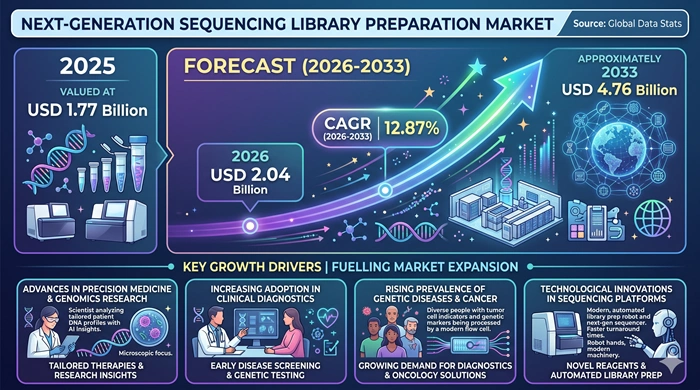
The global next-generation sequencing library preparation market size is valued at USD 1.77 billion in 2025 and is predicted to increase from USD 2.04 billion in 2026 to approximately USD 4.76 billion by 2033, growing at a CAGR of 12.87% from 2026 to 2033. Rapidly expanding genomics research programs, surging demand for precision medicine applications, the declining cost of sequencing, and growing clinical adoption of NGS-based diagnostics are the primary forces driving consistent double-digit growth across the NGS library preparation ecosystem globally.
AI Impact on the Next-Generation Sequencing Library Preparation Industry
Artificial Intelligence Is Accelerating Workflow Automation, Quality Control, and Data Interpretation Across the Entire NGS Library Preparation Value Chain*
AI is transforming the next-generation sequencing library preparation landscape at multiple levels — from automated liquid handling and intelligent quality monitoring during library construction to AI-powered bioinformatics pipelines that process the sequencing output. Machine learning algorithms embedded in automated library preparation platforms are now capable of detecting suboptimal DNA or RNA input quality, adjusting fragmentation parameters in real time, and flagging adapter ligation inefficiencies before they compromise sequencing run performance. This level of intelligent automation is dramatically reducing manual technician intervention, lowering error rates, and enabling consistent high-quality library outputs even from challenging sample types such as low-input, degraded, or formalin-fixed paraffin-embedded (FFPE) samples. Companies like Illumina, Thermo Fisher Scientific, and QIAGEN are actively embedding AI-assisted quality monitoring into their NGS workflow instruments and software platforms.
On the data analysis side, AI tools are helping researchers and clinicians make sense of the enormous volumes of sequencing data generated by modern NGS runs. Deep learning models trained on large genomic datasets are improving variant calling accuracy, detecting structural variations, identifying somatic mutations in oncology applications, and flagging copy number alterations with greater sensitivity than traditional bioinformatics approaches. The integration of AI into the next-generation sequencing library preparation ecosystem is fundamentally shortening the path from sample to insight, enabling faster research discoveries, more reliable clinical diagnoses, and higher-throughput genomic workflows that would not be achievable through manual processes alone.
Growth Factors
Expanding Genomics Research Programs, Rising Clinical NGS Adoption, Declining Sequencing Costs, and Government Investment in Precision Medicine Are the Core Pillars of Market Growth*
The next-generation sequencing library preparation market is underpinned by the extraordinary global expansion of genomics research. Government-funded large-scale genomic initiatives — including national genome sequencing programs in the United States, United Kingdom, China, India, and several European nations — are generating massive and sustained demand for high-quality NGS library preparation reagents, kits, and instruments. The growing field of population genomics, rare disease research, cancer genomics, infectious disease surveillance, and pharmacogenomics is translating directly into high-volume library preparation workflow demand across academic research institutes, biotech companies, and clinical diagnostic laboratories. As the number of active genomic studies and clinical NGS programs grows worldwide, so does the consumption of library preparation consumables and the adoption of automated preparation systems.
The rapid decline in the cost of sequencing — with the cost of sequencing a human genome having fallen from USD 3 billion in 2003 to less than USD 200 today — is making NGS broadly accessible for research and clinical applications that were previously cost-prohibitive. This democratization of sequencing is expanding the user base for library preparation products beyond elite genomics centers to mid-tier research universities, hospital laboratories, and even point-of-care diagnostic settings. Additionally, the booming oncology diagnostics sector — where NGS-based liquid biopsy and tumor profiling tests are becoming standard of care at major cancer centers — is creating particularly strong and growing demand for specialized cancer genomics library preparation kits optimized for circulating tumor DNA (ctDNA) and FFPE tissue samples.
Market Outlook
Sustained Double-Digit Growth Is Expected Through 2033, Supported by Automation Adoption, Expanding Clinical Applications, and Growing Genomic Medicine Infrastructure in Emerging Economies*
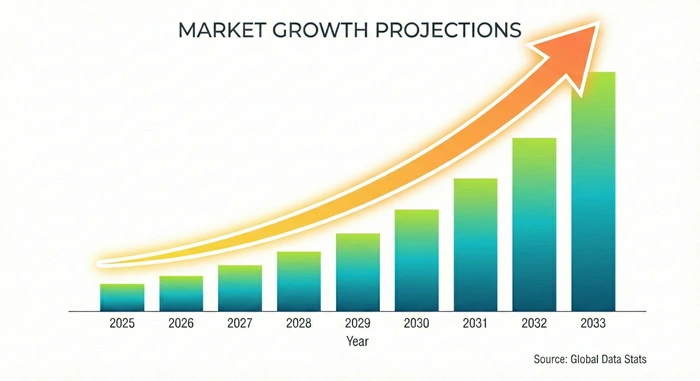
The long-term market outlook for the next-generation sequencing library preparation sector is exceptionally strong. The pipeline of clinical NGS applications is expanding rapidly — encompassing hereditary disease screening, newborn genomic screening, prenatal diagnostics, infectious disease pathogen characterization, minimal residual disease monitoring in oncology, and pharmacogenomic testing — all of which drive repeat, high-volume consumption of library preparation products. As regulatory approvals for NGS-based clinical tests multiply and reimbursement frameworks for clinical sequencing mature in North America and Europe, the transition of NGS from a primarily research tool to a routine clinical diagnostic modality is accelerating, creating an enormous and growing installed base of library preparation product users.
Automation is a defining structural trend that will shape the next-generation sequencing library preparation market through 2033. The shift from manual bench-top library preparation to fully automated, high-throughput robotic platforms is gaining strong momentum in high-volume clinical and pharmaceutical laboratories. Automated library preparation systems — such as those offered by Hamilton Company, Beckman Coulter, and Agilent Technologies — significantly reduce hands-on time, minimize technical variability between samples, and enable the processing of hundreds of libraries per day with minimal staffing requirements. As automation platforms become more affordable and user-friendly, their adoption is expected to extend into mid-sized clinical labs and emerging market research institutions, expanding the market's growth trajectory well into the next decade.
Expert Speaks
-
"Library preparation is the critical first step that determines the success of every sequencing experiment, and we are committed to making this step faster, simpler, and more reliable. Illumina's investments in integrated library prep and sequencing workflows are designed to remove complexity and democratize access to high-quality genomic data for researchers and clinicians globally." — Jacob Thaysen, CEO, Illumina Inc.
-
"At Thermo Fisher Scientific, we see the NGS library preparation segment as one of the most dynamic growth areas in our life science tools portfolio. The accelerating clinical adoption of NGS across oncology, rare disease, and infectious disease testing is driving consistent demand for our Ion Torrent and other library preparation solutions, and we continue to invest in automation and assay development to meet this demand." — Marc Casper, CEO, Thermo Fisher Scientific
-
"QIAGEN is uniquely positioned at the intersection of sample preparation and NGS library construction, and we see immense opportunity as clinical laboratories worldwide adopt standardized NGS workflows. Our QIAseq library preparation portfolio is designed to set the standard for sensitivity, reproducibility, and workflow integration in the next generation of clinical genomics." — Thierry Bernard, CEO, QIAGEN N.V.
Key Report Takeaways
-
North America leads the global next-generation sequencing library preparation market, holding the largest revenue share of approximately 42–44% in 2026, driven by its world-class genomics research infrastructure, strong clinical NGS adoption at major cancer centers and hospital systems, robust NIH research grant funding, and the concentrated presence of dominant market players including Illumina, Thermo Fisher Scientific, and QIAGEN.
-
Asia Pacific is the fastest-growing regional market, expanding at a CAGR of approximately 15.2% through 2033, powered by major government-funded genomics programs in China and India, rapidly expanding university and hospital research infrastructure, and growing domestic NGS instrument and reagent manufacturing sectors across China, South Korea, and Japan.
-
Biotechnology and pharmaceutical companies are the dominant end-user segment, accounting for the largest share of NGS library preparation product consumption as drug discovery, target identification, and biomarker development programs generate continuous and high-volume sequencing workflow demand within the global biopharma R&D ecosystem.
-
Library preparation reagents and kits contribute the most to total market revenues, commanding approximately 50% of product revenues in 2025, as the consumable nature of these products — requiring repurchase with every sequencing experiment — generates a highly recurring and volume-driven revenue stream for manufacturers.
-
Illumina-compatible library preparation kits dominate the sequencing platform compatibility segment, holding approximately 45% of market share, reflecting Illumina's commanding installed base of short-read sequencing instruments globally and the broad ecosystem of third-party kit manufacturers that develop products to Illumina's sequencing chemistry specifications.
-
The automated and high-throughput library preparation segment is set to grow the fastest, projected to expand at a CAGR of approximately 14.2% through 2033, capturing growing share as pharmaceutical companies, national genomics programs, and high-volume clinical diagnostic laboratories transition from manual bench-top preparation to fully automated robotic library construction platforms.
Market Scope
| Report Coverage | Details |
|---|---|
| Market Size by 2025 | USD 1.77 Billion |
| Market Size by 2026 | USD 2.04 Billion |
| Market Size by 2033 | USD 4.76 Billion |
| Market Growth Rate (2026–2033) | CAGR of 12.87% |
| Dominating Region | North America |
| Fastest Growing Region | Asia Pacific |
| Base Year | 2025 |
| Forecast Period | 2026 to 2033 |
| Segments Covered | Product Type, Library Preparation Type, Sequencing Platform Compatibility, Application, End User, Region |
| Regions Covered | North America, Europe, Asia Pacific, Latin America, Middle East & Africa |
Market Dynamics
Drivers Impact Analysis
Explosive Growth in Genomics Research, Declining Sequencing Costs, Expanding Clinical NGS Diagnostics, and Government Precision Medicine Investment Are the Foundational Growth Drivers*
| Driver | ≈% Impact on CAGR Forecast | Geographic Relevance | Impact Timeline |
|---|---|---|---|
| Expanding genomics and precision medicine research programs | ~32% | Global, highest in North America & Europe | Near to long-term |
| Declining cost of next-generation sequencing | ~24% | Global | Near to medium-term |
| Growing clinical adoption of NGS-based diagnostics | ~22% | North America, Europe, Asia Pacific | Near to medium-term |
| Government investment in population genomics programs | ~14% | Global | Medium to long-term |
| Expanding oncology liquid biopsy and ctDNA sequencing applications | ~8% | North America, Europe | Near-term |
The next-generation sequencing library preparation market is one of the most consistently high-growth sectors in the life sciences tools industry, driven by the fundamental role that library preparation plays at the start of every NGS workflow. Without high-quality library preparation, sequencing data quality degrades dramatically — making reliable library preparation reagents, kits, and instruments an indispensable part of every NGS experiment. As the number of active sequencing projects worldwide grows — spanning basic research, translational science, clinical diagnostics, agrigenomics, and environmental monitoring — the cumulative consumption of library preparation products scales accordingly, creating a structurally expanding demand base.
The accelerating adoption of NGS in clinical oncology is a particularly powerful near-term market driver. Comprehensive genomic profiling of tumor tissue, ctDNA liquid biopsy testing, and minimal residual disease monitoring are becoming standard components of cancer diagnosis and treatment management at leading cancer centers, creating high-volume and clinically regulated demand for specialized oncology library preparation kits. Regulatory approvals of NGS-based companion diagnostic tests by the U.S. FDA are further accelerating clinical lab adoption, as reimbursement frameworks mature and clinical evidence for NGS-guided treatment decisions accumulates in major cancer indications.
Restraints Impact Analysis
High Reagent and Instrument Costs, Technical Complexity of Library Preparation, and Regulatory Hurdles for Clinical NGS Testing Are Moderating Market Growth*
| Restraint | ≈% Impact on CAGR Forecast | Geographic Relevance | Impact Timeline |
|---|---|---|---|
| High cost of NGS library preparation reagents and instruments | ~36% | Emerging markets, smaller research labs | Near to medium-term |
| Technical complexity requiring skilled personnel | ~27% | Emerging markets, clinical labs | Near to medium-term |
| Regulatory complexity for clinical NGS test validation | ~22% | North America, Europe | Near-term |
| Data storage, management, and bioinformatics bottlenecks | ~15% | Global | Medium-term |
The high cost of NGS library preparation — particularly for specialized kits designed for low-input, single-cell, or clinical applications — remains a significant barrier to adoption in smaller research laboratories, budget-constrained academic institutions, and healthcare systems in developing markets. Premium library preparation kits for clinical oncology applications can cost several hundred dollars per sample, which creates meaningful per-run costs that limit adoption outside well-funded clinical genomics centers. While reagent costs are declining gradually as market competition increases, the price gap between premium kits and commodity alternatives introduces a quality versus cost tradeoff that complicates purchasing decisions for many laboratory managers.
The technical complexity inherent in NGS library preparation — involving multiple enzymatic steps including DNA/RNA fragmentation, end-repair, adapter ligation, size selection, and PCR amplification, each of which must be executed precisely to yield a sequencing-ready library — requires skilled molecular biology personnel and careful quality control processes. This complexity can be a barrier in clinical settings where laboratory staff may not have deep NGS expertise, and in developing markets where trained bioinformaticians and molecular biologists are in limited supply. These workforce and technical barriers slow the rate of clinical and research NGS uptake in regions where laboratory training and professional development infrastructure are still maturing.
Opportunities Impact Analysis
Automated Library Preparation, Single-Cell Genomics, Long-Read Sequencing Compatibility, and Emerging Market Expansion Represent High-Value Growth Opportunities*
| Opportunity | ≈% Impact on CAGR Forecast | Geographic Relevance | Impact Timeline |
|---|---|---|---|
| Growing adoption of automated high-throughput library preparation systems | ~33% | North America, Europe, Asia Pacific | Near to medium-term |
| Single-cell sequencing library preparation growth | ~27% | North America, Europe | Near to medium-term |
| Long-read sequencing platform library prep kit development | ~22% | Global | Medium to long-term |
| Expanding NGS adoption in Asia Pacific and Latin America | ~18% | Asia Pacific, Latin America | Medium to long-term |
The shift toward automated library preparation is the single most transformative opportunity within the next-generation sequencing library preparation market in the near term. As library preparation workflows are increasingly performed on robotic liquid handling platforms from companies like Hamilton, Beckman Coulter, and PerkinElmer, the per-sample cost declines, throughput increases dramatically, and inter-sample consistency improves significantly compared to manual protocols. Pharmaceutical companies and national genomics programs — both of which operate at massive scale — are driving the fastest adoption of automated library preparation, creating strong demand for instruments and compatible automated reagent kits.
The explosive growth of single-cell sequencing applications is another outstanding opportunity. Single-cell RNA sequencing (scRNA-seq) and single-cell ATAC-seq require specialized library preparation protocols that differ substantially from bulk sequencing approaches, and the demand for validated, high-sensitivity single-cell library preparation kits is expanding rapidly as this technology moves from early-adopter research groups into mainstream genomics workflows. Companies including 10x Genomics, Parse Biosciences, and Illumina are driving rapid innovation in this space, with the single-cell library preparation reagent segment expected to be one of the highest-growth product categories within the broader market through 2033.
Segment Analysis
By Product Type
Library Preparation Reagents and Kits Command the Dominant Market Share While Automation Instruments Drive the Fastest Revenue Growth in the NGS Library Preparation Market*
The reagents and consumables segment — primarily encompassing DNA library preparation kits, RNA library preparation kits, enrichment kits, and associated reagents — holds the dominant position in the next-generation sequencing library preparation market, accounting for approximately 50–52% of total revenues in 2025 at a CAGR of approximately 12.4% through 2033. The consumable nature of these products, which must be repurchased for every sequencing experiment, generates a highly predictable and growing revenue stream that scales directly with sequencing run volumes. North America leads global reagent and kit revenues, with Illumina, QIAGEN, and Thermo Fisher Scientific maintaining the largest product portfolios and strongest commercial positions across both research and clinical end-user segments. The high diversity of applications — from whole-genome sequencing to targeted panel sequencing, RNA-seq, ChIP-seq, and methylation sequencing — creates demand for a wide range of specialized kit formats, enabling suppliers to capture broad market coverage through comprehensive product lines.
The automation and library preparation instruments segment is the fastest-growing product category within the next-generation sequencing library preparation market, expanding at a CAGR of approximately 13.8% through 2033, driven by strong demand from high-volume pharmaceutical laboratories, clinical reference labs, and national genomics sequencing centers. Automated liquid handling systems purpose-built or optimized for NGS library preparation — including platforms from Hamilton Company, Beckman Coulter Life Sciences, Agilent Technologies, and Analytik Jena — are gaining rapid adoption as laboratories seek to increase throughput, reduce hands-on time, and minimize library preparation variability. Asia Pacific is registering the fastest growth in instrument adoption, particularly in China and South Korea, where government-funded genomics centers and rapidly scaling biotech companies are investing in automated sequencing infrastructure to support large-scale population and disease genomics initiatives.
By Application
Cancer Genomics Leads Application Revenue While Infectious Disease Diagnostics and Single-Cell Sequencing Applications Drive the Fastest Growth*
The cancer genomics application segment is the largest and most revenue-generating application within the next-generation sequencing library preparation market, accounting for approximately 35–38% of total revenues in 2025 at a CAGR of approximately 13.2% through 2033. The adoption of NGS-based comprehensive genomic profiling, tumor mutational burden (TMB) assessment, microsatellite instability (MSI) testing, and liquid biopsy ctDNA analysis in oncology clinical and research settings is creating intensive, high-volume demand for specialized cancer genomics library preparation kits. North America is the dominant geography for cancer genomics library preparation, where leading cancer genomics centers such as Memorial Sloan Kettering Cancer Center, MD Anderson, and Dana-Farber Cancer Institute operate high-volume sequencing programs, and commercial liquid biopsy test providers including Guardant Health, Foundation Medicine, and Grail are performing millions of library preparation procedures annually. Companies including Illumina, QIAGEN (QIAseq), and Integrated DNA Technologies (IDT) are the market leaders in oncology-focused library preparation product development.
The infectious disease and pathogen genomics application segment is the fastest-growing application category within the next-generation sequencing library preparation market, driven by the heightened global awareness of pathogen surveillance following the COVID-19 pandemic, expanding use of NGS for antimicrobial resistance (AMR) monitoring, and growing adoption of metagenomic sequencing for unbiased pathogen identification in clinical settings. Public health agencies, national genomics surveillance programs, and hospital infection control laboratories are increasingly deploying NGS workflows — including specialized metagenomic and amplicon-based library preparation approaches — to track pathogen evolution, outbreak investigation, and AMR gene profiling in real time. Europe is a strong growth market for infectious disease NGS applications, particularly in Germany, the UK, and the Netherlands, which have invested significantly in national pathogen genomics infrastructure following the pandemic-era experience.
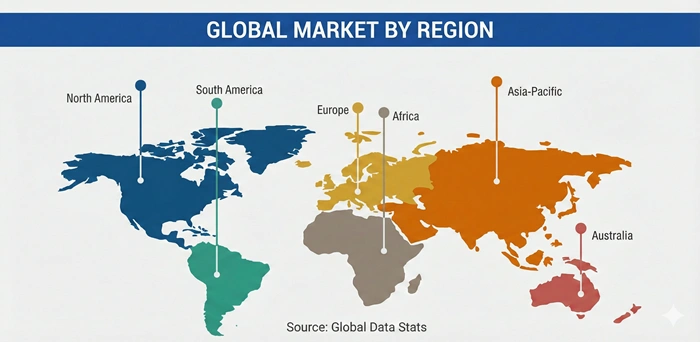
Regional Insights
North America
North America Dominates the NGS Library Preparation Market, Anchored by World-Class Genomics Infrastructure, Major Market Players, and High Clinical NGS Adoption*
North America leads the global next-generation sequencing library preparation market with approximately 42–44% of total revenues in 2026 and a CAGR of approximately 12.6% through 2033. The United States is the largest single country market, home to the world's highest concentration of genomics research universities, NCI-designated cancer centers, major genome sequencing platforms, and the NIH's National Human Genome Research Institute (NHGRI), which funds large-scale sequencing programs that generate consistent demand for library preparation products. Dominant market players including Illumina, Thermo Fisher Scientific, QIAGEN, and Integrated DNA Technologies (IDT) are headquartered or operate major research and commercial hubs in the United States, creating a virtuous cycle of product innovation, clinical validation, and market development. Canada also contributes meaningfully to the regional market, with Genome Canada–funded research centers and major academic institutions in Toronto, Vancouver, and Montreal generating growing NGS library preparation volumes.
The United States' leadership in precision medicine — exemplified by the All of Us Research Program, NIH-funded Cancer Moonshot initiatives, and the FDA's growing approval pipeline for NGS-based companion diagnostics — is generating structural and growing clinical demand for validated next-generation sequencing library preparation products and workflows that meet regulatory compliance requirements. The well-developed reimbursement environment for clinical NGS testing in the U.S. is making clinical sequencing economically viable at scale, further driving the transition from research to clinical adoption and sustaining the region's market leadership position through 2033.
Asia Pacific
Asia Pacific Is the Fastest-Growing Market for NGS Library Preparation, Driven by Government Genomics Investment, Expanding Research Infrastructure, and Rapid Biotech Industry Growth*
Asia Pacific is the fastest-growing regional market for next-generation sequencing library preparation, projected to expand at a CAGR of approximately 15.2% through 2033, with a current market share of approximately 20–22% in 2026. China is the dominant country market within the region, driven by massive government investment in genomics and biotechnology through the 14th Five-Year Plan, rapid expansion of hospital-based clinical NGS testing, and the growth of domestic genomics companies such as MGI Tech (BGI Group), Berry Genomics, and Novogene that are developing locally manufactured library preparation reagents and instruments. The Chinese government's ambitions in precision medicine, agricultural genomics, and national disease genomics databases are generating a scale of sequencing activity that demands continuous high-volume library preparation reagent supply and automation infrastructure investment.
India, Japan, and South Korea are also significant contributors to Asia Pacific's growth in the next-generation sequencing library preparation market. South Korea's advanced biotechnology sector — home to companies including Macrogen and Theragen Bio — is a major consumer of NGS library preparation products for both clinical and agricultural genomics applications. India is registering rapid growth driven by expanding hospital genomics programs, government biotech funding, and a growing population of skilled molecular biologists trained in NGS workflows. As domestic manufacturing of NGS reagents develops in China and India, the regional market is becoming more self-sufficient while simultaneously attracting continued investment from global leaders seeking to capture share in these high-growth markets.
Top Key Players
-
Illumina Inc. (United States)
-
Thermo Fisher Scientific Inc. (United States)
-
QIAGEN N.V. (Netherlands / United States)
-
Agilent Technologies Inc. (United States)
-
F. Hoffmann-La Roche Ltd. (Roche Sequencing) (Switzerland)
-
Integrated DNA Technologies Inc. (IDT, Danaher) (United States)
-
New England Biolabs Inc. (United States)
-
Beckman Coulter Life Sciences (Danaher) (United States)
-
Oxford Nanopore Technologies plc (United Kingdom)
-
Pacific Biosciences of California Inc. (PacBio) (United States)
-
PerkinElmer Inc. (United States)
-
Takara Bio Inc. (Japan)
-
Meridian Bioscience Inc. (United States)
-
MGI Tech Co. Ltd. (BGI Group) (China)
-
10x Genomics Inc. (United States)
Recent Developments
-
2024 – Illumina Inc. launched its XLEAP-SBS chemistry upgrade for the NovaSeq X Series platform, improving sequencing accuracy and read length while introducing enhanced compatible library preparation protocols that reduce adapter-dimer artifacts and enable sequencing of even lower DNA input amounts for demanding oncology and rare disease research applications.
-
2024 – QIAGEN N.V. expanded its QIAseq clinical oncology library preparation portfolio with the launch of QIAseq DIRECT SARS-CoV-2 Plus assay kits optimized for metagenomic and targeted sequencing of respiratory pathogens, further strengthening its position in the rapidly growing infectious disease NGS diagnostic segment.
-
2024 – Agilent Technologies released the SureSelect Cancer CGP (Comprehensive Genomic Profiling) library preparation kit targeting clinical laboratory customers seeking CE-IVD-compliant comprehensive tumor genomic profiling solutions, enabling hospitals and reference labs in Europe to deploy clinically validated NGS-based oncology panel testing workflows.
-
2025 – Thermo Fisher Scientific announced the integration of its Ion Torrent Genexus Integrated Sequencer with an upgraded onboard library preparation module, enabling fully automated sample-to-result NGS workflows for clinical microbiology and oncology applications within a single benchtop instrument footprint.
-
2025 – 10x Genomics Inc. launched Chromium GEM-X Single Cell Gene Expression Flex kits with enhanced multiplexing capacity and compatibility with FFPE tissue samples, significantly expanding the accessible sample types for single-cell NGS library preparation and strengthening 10x Genomics' position in the rapidly growing single-cell sequencing reagents segment.
Market Trends
Automation-Driven Workflow Standardization, Long-Read Platform Compatibility, and the Rise of Methylation and Epigenomic Library Preparation Are the Defining Trends in the NGS Library Preparation Market*
One of the most significant trends reshaping the next-generation sequencing library preparation market is the accelerating standardization of automated library preparation workflows, particularly in high-volume clinical and pharmaceutical laboratory environments. Integrated, walk-away automated platforms that perform all library preparation steps from DNA/RNA input through to PCR-amplified, indexed, and pooled libraries — without manual intervention — are reducing the variability, skill dependency, and turnaround time traditionally associated with NGS library preparation. As these automated systems become more accessible in terms of price and ease of use, their adoption is expanding from large genomics centers into routine clinical molecular labs, driving strong growth in the automation instruments and compatible reagent kit segments.
The rapid growth of long-read sequencing platforms — particularly Oxford Nanopore Technologies' MinION and PromethION systems, and PacBio's Revio platform — is creating a growing adjacent demand for library preparation kits specifically optimized for long-read sequencing requirements. Long-read library preparation differs substantially from short-read protocols, requiring careful DNA size selection, specialized ligation chemistries, and gentle mechanical handling to preserve long DNA fragments. As long-read sequencing finds expanding applications in structural variant detection, repeat expansion analysis, full-length isoform sequencing, and real-time pathogen surveillance, demand for validated long-read library preparation reagents and instruments is growing rapidly — opening a significant product development and market capture opportunity for both established and emerging players in the next-generation sequencing library preparation space.
Segments Covered in the Report
By Product Type:
-
Library Preparation Kits and Reagents
-
DNA Library Preparation Kits
-
RNA Library Preparation Kits
-
Other Reagents and Consumables
-
-
Automation and Library Preparation Instruments
-
Other Product Types
By Library Preparation Type:
-
Manual / Bench-Top Preparation
-
Automated / High-Throughput Preparation
By Sequencing Platform Compatibility:
-
Illumina-Compatible Library Preparation
-
Oxford Nanopore Technologies-Compatible Preparation
-
Pacific Biosciences (PacBio)-Compatible Preparation
-
Ion Torrent (Thermo Fisher)-Compatible Preparation
-
Other Platform-Compatible Preparation
By Application:
-
Cancer Genomics and Oncology
-
Rare Disease and Genetic Disorder Research
-
Infectious Disease and Pathogen Genomics
-
Reproductive Health and Prenatal Diagnostics
-
Agricultural and Environmental Genomics
-
Drug Discovery and Pharmacogenomics
-
Other Applications
By End User:
-
Academic and Research Institutes
-
Biotechnology and Pharmaceutical Companies
-
Clinical and Diagnostic Laboratories
-
Government and Public Health Organizations
-
Contract Research Organizations (CROs)
-
Other End Users
By Region:
-
North America
-
United States
-
Canada
-
-
Europe
-
Germany
-
United Kingdom
-
France
-
Italy
-
Spain
-
Rest of Europe
-
-
Asia Pacific
-
China
-
India
-
Japan
-
South Korea
-
Australia
-
Rest of Asia Pacific
-
-
Latin America
-
Brazil
-
Mexico
-
Rest of Latin America
-
-
Middle East & Africa
-
GCC Countries
-
South Africa
-
Rest of Middle East & Africa
-
"Built for Every Level — From Startups to Industry Giants"
Here Is Exactly How This Report Works for You
-
For Tier 1 multinational genomics companies, large biopharma organizations, and institutional investors, this report delivers granular competitor revenue analysis, product revenue source breakdowns, market share benchmarking across all library preparation product categories and platforms, and a clear-eyed view of which technology segments, geographic markets, and application areas are set to generate the highest growth returns — enabling precise capital allocation, portfolio strategy, and M&A target identification in one of life science tools' fastest-growing segments.
-
For Tier 2 and Tier 3 NGS reagent suppliers, emerging genomics startups, and mid-level CDMO and CRO organizations, this report provides detailed supply-demand dynamics analysis, raw material and enzyme supply chain risk assessment, competitive pricing benchmarks, and white-space application mapping — giving growing companies the intelligence needed to optimize product development roadmaps, prioritize geographic market entry, and build commercially competitive NGS library preparation offerings.
-
For all decision-makers operating in today's geopolitically complex environment, this report delivers direct analysis of how export controls on sequencing technology, intellectual property disputes, regional regulatory divergence, and macroeconomic pressures are impacting the NGS library preparation supply chain and competitive landscape — equipping businesses to anticipate disruptions, develop risk-resilient strategies, and make confident decisions even as the global genomics market evolves rapidly.
Frequently Asked Questions
Question 1: What is the current market size of the next-generation sequencing library preparation market and what is the forecast through 2033?
Answer: The next-generation sequencing library preparation market is valued at USD 1.77 billion in 2025 and is projected to reach USD 4.76 billion by 2033. It is expected to expand at a CAGR of 12.87% from 2026 to 2033.
Question 2: What are the key drivers of growth in the next-generation sequencing library preparation market?
Answer: The next-generation sequencing library preparation market is primarily driven by expanding genomics research programs, falling sequencing costs, and growing clinical adoption of NGS-based diagnostics in oncology and rare disease applications. Government investment in precision medicine initiatives and population genomics programs globally is further accelerating demand for library preparation products and automated workflows.
Question 3: Which product type holds the largest share in the next-generation sequencing library preparation market?
Answer: Library preparation kits and reagents hold the largest product share, accounting for approximately 50–52% of total revenues in 2025, driven by their consumable nature and broad applicability across diverse sequencing applications. Automation and library preparation instruments are the fastest-growing product category, expanding at approximately 13.8% CAGR through 2033.
Question 4: Which region leads the next-generation sequencing library preparation market and which is growing fastest?
Answer: North America leads the next-generation sequencing library preparation market with approximately 42–44% of global revenues in 2026, supported by leading genomics research institutions, dominant market players, and robust clinical NGS adoption. Asia Pacific is the fastest-growing region, expanding at approximately 15.2% CAGR through 2033.
Question 5: Who are the leading companies in the next-generation sequencing library preparation market?
Answer: Key companies in the next-generation sequencing library preparation market include Illumina, Thermo Fisher Scientific, QIAGEN, Agilent Technologies, Roche Sequencing, Integrated DNA Technologies, New England Biolabs, Oxford Nanopore Technologies, and 10x Genomics, among others. These companies compete through continuous reagent innovation, platform-specific kit development, automation compatibility, and clinical validation of their library preparation workflows.