
Neurorehabilitation Devices Market Overview
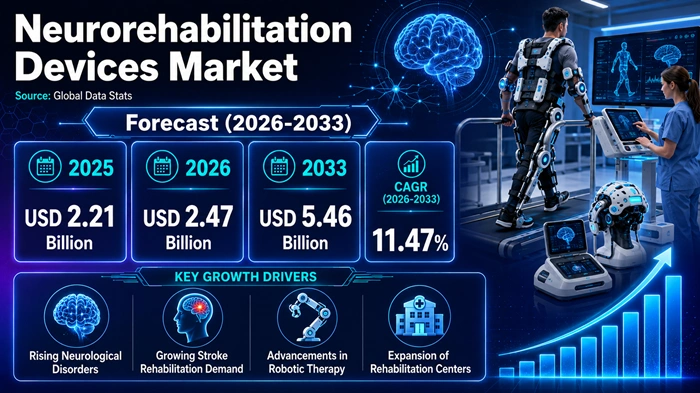
The global neurorehabilitation devices market size is valued at USD 2.21 billion in 2025 and is predicted to increase from USD 2.47 billion in 2026 to approximately USD 5.46 billion by 2033, growing at a CAGR of 11.47% from 2026 to 2033.
This robust expansion is being driven by a rising global incidence of neurological disorders — including stroke, traumatic brain injury, spinal cord injury, multiple sclerosis, and Parkinson's disease — combined with rapid technological innovation in robotics, neurostimulation, brain-computer interfaces, and immersive virtual reality-based rehabilitation platforms. As healthcare systems globally shift toward outcome-based rehabilitation models and patients increasingly seek faster, more effective neurological recovery, the commercial and clinical importance of advanced neurorehabilitation technology continues to grow at a compelling pace.
AI Impact on the Neurorehabilitation Devices Industry
Artificial Intelligence Is Fundamentally Transforming Neurorehabilitation by Enabling Adaptive, Personalized Therapy Protocols That Respond Dynamically to Individual Patient Recovery Progress
Artificial intelligence is reshaping the neurorehabilitation devices landscape by enabling a new generation of rehabilitation systems that learn from patient performance data and adjust therapy parameters in real time. Traditional rehabilitation protocols apply standardized exercise repetitions and stimulation patterns regardless of individual patient response — a one-size-fits-all approach that can lead to suboptimal recovery in patients whose neuroplasticity trajectories vary widely based on injury severity, patient age, and therapy compliance. AI-powered rehabilitation platforms use machine learning algorithms to continuously analyze patient movement quality, electromyography signals, and performance metrics, dynamically recalibrating exercise difficulty, stimulation intensity, and session duration to keep patients within their optimal therapeutic window — maximizing neuroplasticity while minimizing fatigue-related setbacks.
Beyond in-session adaptation, AI is enabling predictive outcome modeling that is transforming clinical decision-making in neurorehabilitation. Predictive models trained on large patient outcome datasets can now estimate with meaningful accuracy which patients are likely to respond to specific rehabilitation device interventions, how many sessions are required to reach specific functional milestones, and which combination of therapies — such as exoskeleton-assisted gait training paired with neurostimulation — is likely to achieve superior outcomes for a given patient profile. This capability is reducing trial-and-error in rehabilitation program design, improving resource allocation in rehabilitation centers, and providing the evidence base needed to justify premium neurorehabilitation device utilization to healthcare payers and hospital administrators in cost-constrained environments.
Growth Factors
Rising Neurological Disorder Burden, Aging Demographics, and Accelerating Innovation in Robotics and Neurostimulation Are the Three Pillars Sustaining This Market's Double-Digit Growth Trajectory
The global burden of neurological disorders is the primary commercial engine driving consistent, strong growth in the neurorehabilitation devices market. Stroke alone affects approximately 15 million people annually worldwide, with a significant proportion of survivors requiring months to years of active physical and cognitive rehabilitation to recover lost motor, speech, and cognitive functions. Traumatic brain injury, spinal cord injury, and progressive neurological conditions including Parkinson's disease and multiple sclerosis collectively add tens of millions more patients annually to the rehabilitation population. As medical advances improve survival rates for stroke and traumatic brain injury, the surviving patient population requiring intensive rehabilitation is growing — creating a structurally expanding addressable market for devices that support neurological recovery across inpatient, outpatient, and homecare settings.
A second major growth driver is the convergence of robotics, neuroscience, and digital health into integrated neurorehabilitation platforms that are demonstrably superior in clinical outcomes to conventional manual therapy. Robotic exoskeletal systems that support weight-bearing gait training, functional electrical stimulation (FES) devices that restore voluntary movement through precise electrical muscle activation, and immersive virtual reality environments that engage neuroplasticity through task-based motor relearning are all achieving strong clinical evidence bases that are influencing rehabilitation guideline recommendations. As this evidence accumulates and as technology costs decline through manufacturing scale-up and competitive market pressure, these advanced neurorehabilitation systems are being adopted beyond academic medical centers into community rehabilitation clinics and homecare programs — substantially expanding the device's commercial addressable market.

Market Outlook
The Neurorehabilitation Devices Market Is Poised for Sustained High-Growth Through 2033, Anchored by Homecare Expansion, Emerging Market Infrastructure, and Next-Generation BCI Commercialization
The long-term outlook for the neurorehabilitation devices market through 2033 reflects a sector in the midst of a profound technology transformation. The growing global trend toward homecare and community-based rehabilitation — accelerated by post-pandemic shifts in healthcare delivery models and by patient preference for recovering in familiar environments — is creating strong demand for portable, user-friendly neurorehabilitation devices that can be safely operated without continuous clinical supervision. Wearable exoskeletons, home-use functional electrical stimulation systems, and app-connected neurostimulation devices are enabling patients to continue high-quality rehabilitation at home between clinical sessions, extending the intensity and duration of therapy without proportionally increasing healthcare resource consumption. This homecare expansion is opening an entirely new commercial channel for neurorehabilitation device manufacturers.
The progressive commercialization of brain-computer interface (BCI) technology represents the most transformative long-term opportunity within the market. Implantable and non-invasive BCI systems are enabling patients with severe motor impairment from spinal cord injury, ALS, or locked-in syndrome to control rehabilitation devices and assistive technologies directly through decoded neural signals — bypassing damaged motor pathways entirely. While fully commercial closed-loop BCI neurorehabilitation systems remain in early clinical deployment phases, milestone regulatory approvals and landmark clinical outcomes reported in recent trials are rapidly building clinical and investor confidence. The commercialization of BCI-integrated rehabilitation devices over the coming decade is expected to open a high-value premium market tier within the broader neurorehabilitation devices market that could substantially accelerate sector revenue growth beyond current forecast assumptions.
Expert Speaks
-
"The intersection of robotics, AI, and neuroscience is creating a new paradigm for rehabilitation — one that is fundamentally more personalized, more effective, and more accessible than anything that has existed before. We believe the neurorehabilitation devices market is entering its most commercially and clinically productive decade, and our investment strategy reflects that conviction deeply." — CEO, Medtronic plc
-
"Stroke and traumatic brain injury survivors deserve rehabilitation technology that matches the ambition of their recovery goals. The neurorehabilitation devices sector is responding to that demand with a generation of robotic, AI-powered, and wearable systems that are achieving outcomes once thought impossible, and we are committed to advancing that frontier as a company." — CEO, Ekso Bionics Holdings Inc.
-
"The aging of the global population and the rising incidence of neurological conditions are creating powerful and enduring tailwinds for the neurorehabilitation market. Equally important is the growing clinical evidence base that supports reimbursement for advanced rehabilitation devices — which is translating research-validated technology into commercial revenue at a pace we have not seen in this sector before." — CEO, Abbott Laboratories
Key Report Takeaways
-
North America leads the global neurorehabilitation devices market with approximately 37% revenue share in 2025, driven by the highest per-capita incidence of stroke and traumatic brain injury among its aging population, a robust network of inpatient rehabilitation facilities and outpatient rehabilitation centers, strong FDA-regulated device innovation, and favorable Medicare and commercial insurance reimbursement for neurorehabilitation technologies
-
Asia Pacific is the fastest-growing regional market, expected to expand at approximately 12.6% CAGR through 2033, propelled by rapidly aging populations in China, Japan, and South Korea, rising stroke and neurological disease incidence, expanding hospital rehabilitation infrastructure, and growing government and private healthcare investment in advanced rehabilitation technology
-
Neurorobotic systems are the leading device type segment, commanding approximately 34% of total device type revenue in 2025, reflecting their clinical dominance in gait rehabilitation and upper-limb motor recovery, their strong clinical evidence base for stroke and spinal cord injury rehabilitation, and the active product portfolio investments by leading companies including Hocoma, Ekso Bionics, and ReWalk Robotics
-
Stroke rehabilitation is the dominant application segment, holding approximately 42% of total application revenue in 2026, anchored by the massive global stroke burden, the well-established clinical role of intensive motor rehabilitation in post-stroke recovery, and the broad compatibility of neurorobotic, neurostimulation, and VR-based therapy systems with stroke rehabilitation protocols
-
Rehabilitation centers represent the largest end-user segment with approximately 39% of end-user share in 2025, as specialized inpatient and outpatient rehabilitation facilities maintain the highest concentration of advanced neurorehabilitation equipment and provide the intensive therapy regimens that require the full capabilities of robotic and neurostimulation systems
-
The homecare setting segment is expected to be the fastest-growing end-user category, expanding at above-average CAGR through 2033 as wearable and portable neurorehabilitation devices specifically designed for home use gain regulatory clearance, clinical validation, and insurance reimbursement in North America and Europe
Market Scope
| Report Coverage | Details |
|---|---|
| Market Size by 2033 | USD 5.46 Billion |
| Market Size by 2025 | USD 2.21 Billion |
| Market Size by 2026 | USD 2.47 Billion |
| Market Growth Rate from 2026 to 2033 | CAGR of 11.47% |
| Dominating Region | North America |
| Fastest Growing Region | Asia Pacific |
| Base Year | 2025 |
| Forecast Period | 2026 to 2033 |
| Segments Covered | Device Type, Application, End User, Technology, Region |
| Regions Covered | North America, Europe, Asia Pacific, Latin America, Middle East & Africa |
Market Dynamics
Drivers Impact Analysis
Surging Neurological Disease Incidence and the Proven Clinical Superiority of Advanced Neurorehabilitation Devices Over Conventional Manual Therapy Are the Two Strongest Market Growth Catalysts
| Driver | ≈ % Impact on CAGR Forecast | Geographic Relevance | Impact Timeline |
|---|---|---|---|
| Rising global incidence of stroke, TBI, and spinal cord injuries | ~36% | Global, led by North America, Asia Pacific | Short to long-term |
| Growing clinical evidence base supporting advanced device reimbursement | ~26% | North America, Europe | Medium to long-term |
| Aging global population increasing neurological disease prevalence | ~23% | North America, Europe, Asia Pacific | Medium to long-term |
| Healthcare system shift toward outcome-based rehabilitation models | ~15% | North America, Europe | Short to medium-term |
The escalating global incidence of neurological conditions is the single most powerful structural demand driver in the neurorehabilitation devices market. Stroke — one of the leading causes of adult disability worldwide — produces significant motor, cognitive, and speech impairments in millions of survivors annually, all of whom require active rehabilitation to achieve maximum functional recovery. Traumatic brain injury, a major source of acquired disability particularly among younger adults and the elderly (fall-related), and spinal cord injury together add millions more patients annually who need intensive, technology-assisted rehabilitation across the full recovery continuum from acute inpatient to long-term community-based care. As survival rates improve across all these conditions through advances in emergency and acute care medicine, the number of patients requiring extended rehabilitation support continues to grow — directly expanding the device market's addressable patient population year after year.
The growing clinical evidence base for advanced neurorehabilitation technologies is a second independent driver that operates through a different but equally important commercial mechanism — it converts clinical interest into reimbursement-backed procurement. Randomized controlled trial evidence demonstrating that robotic gait training, functional electrical stimulation, and transcranial magnetic stimulation produce superior motor recovery outcomes versus conventional physiotherapy alone has reached a critical mass in major therapeutic categories. This evidence is directly influencing national rehabilitation guideline updates in the U.S., Germany, Japan, and the UK, translating into formal clinical recommendations for device-based therapy that trigger insurance coverage decisions and hospital procurement investments. As guideline-supported reimbursement expands into more geographic markets and more therapeutic indications, the commercial conversion of clinical evidence into device revenue will accelerate.

Restraints Impact Analysis
High Device Costs, Insufficient Reimbursement in Emerging Markets, and Specialist Training Requirements Are the Three Primary Barriers Limiting Broader Neurorehabilitation Device Adoption
| Restraint | ≈ % Impact on CAGR Forecast | Geographic Relevance | Impact Timeline |
|---|---|---|---|
| High acquisition and maintenance costs of neurorehabilitation systems | ~39% | Global, especially emerging markets | Short to medium-term |
| Inadequate insurance reimbursement in most non-Western markets | ~29% | Latin America, MEA, Southeast Asia | Medium to long-term |
| Requirement for specialized clinical training to operate advanced devices | ~20% | Global | Short to medium-term |
| Regulatory approval timelines for novel BCI and robotic rehabilitation devices | ~12% | North America, Europe | Medium-term |
The high capital cost of advanced neurorehabilitation systems is the most immediate and widely felt barrier to market penetration. Premium exoskeletal robotic gait training systems and digital cholangioscopy-guided platforms can carry acquisition prices in the range of several hundred thousand dollars, placing them beyond the procurement budget of the vast majority of rehabilitation facilities in middle- and low-income countries. Even in high-income markets, community rehabilitation clinics and smaller specialty centers often struggle to justify the capital expenditure for advanced neurorehabilitation technology when conventional manual therapy remains the reimbursed standard of care. This pricing barrier concentrates advanced device utilization in tertiary academic medical centers and large private rehabilitation networks, significantly limiting the market's penetration depth beyond flagship institutions.
The requirement for specialized clinician training to effectively operate and clinically interpret advanced neurorehabilitation device outputs is a second meaningful constraint. Robotic rehabilitation systems, BCI-based devices, and complex neurostimulation platforms require therapists with specific technical competencies that go beyond conventional physiotherapy training. The time and cost associated with staff training programs, combined with the risk of sub-therapeutic device utilization in settings where trained operators are unavailable or leave the facility, create real procurement hesitancy — particularly in markets where therapist turnover is high or where specialist training infrastructure is limited. Manufacturers investing in streamlined training programs, remote support services, and intuitive device interfaces are making progress on reducing this barrier, but it remains a meaningful adoption friction in the neurorehabilitation devices market globally.
Opportunities Impact Analysis
Homecare-Optimized Wearable Devices, BCI Commercialization for Severe Motor Impairment, and Emerging Market Infrastructure Investment Are the Three Highest-Value Growth Opportunities
| Opportunity | ≈ % Impact on CAGR Forecast | Geographic Relevance | Impact Timeline |
|---|---|---|---|
| Development of homecare-designed wearable neurorehabilitation devices | ~43% | North America, Europe, Asia Pacific | Short to medium-term |
| BCI technology commercialization for severe neurological impairment | ~34% | North America, Europe | Long-term |
| Emerging market healthcare infrastructure expansion | ~23% | Asia Pacific, Latin America, MEA | Medium to long-term |
The commercial opportunity in homecare-designed wearable neurorehabilitation devices is the most actionable near-term growth opportunity in the market. As regulatory agencies in the U.S. and Europe grant clearances for homecare-specific wearable exoskeletons, functional electrical stimulation garments, and portable transcranial stimulation devices, manufacturers are creating entirely new revenue channels outside the institutional rehabilitation center and hospital context. These devices enable patients to maintain rehabilitation intensity and frequency between clinic visits — or to conduct their full rehabilitation program at home under remote therapist supervision through telemedicine platforms. The combination of clinical effectiveness, patient convenience, and lower cost-per-therapy-session compared to in-clinic device use is making homecare rehabilitation an increasingly compelling option for both patients and payers. This trend is particularly powerful in North America and Northern Europe, where telehealth reimbursement frameworks are already mature.
Emerging market infrastructure investment is a second large-scale opportunity that will become progressively more commercially significant over the forecast period. China, India, Brazil, and several Gulf states are making substantial investments in building specialized inpatient and outpatient rehabilitation capacity — including dedicated neurorehabilitation units equipped with advanced robotic and neurostimulation systems — as part of broader healthcare modernization programs. These investments are creating procurement demand for neurorehabilitation devices in markets where device utilization has historically been minimal due to infrastructure limitations. International manufacturers that establish local regulatory approvals, distribution partnerships, and clinical education programs in these high-growth markets early in the expansion cycle will build durable competitive advantages that will be difficult for later entrants to displace.

Segment Analysis
By Device Type
Neurorobotic Systems Lead Device Type Revenue and Are the Defining Technology Platform of Modern Evidence-Based Neurorehabilitation Practice Globally
Neurorobotic systems hold the dominant position in the neurorehabilitation devices market by device type, accounting for approximately 34% of total device segment revenue in 2025. This leadership reflects decades of clinical validation across gait rehabilitation and upper-limb motor recovery, the comprehensive clinical guideline endorsements for robotic-assisted therapy in post-stroke and spinal cord injury rehabilitation, and the active product investment by leading companies including Hocoma AG, Ekso Bionics, ReWalk Robotics, and Bionik Laboratories. Robotic exoskeletal systems — including treadmill-based gait robots for lower-limb training and end-effector robotic arms for upper-limb rehabilitation — are the workhorses of specialized inpatient rehabilitation units, used across multiple therapy sessions daily to deliver high-repetition, precisely controlled motor training that manual therapy cannot replicate at the required intensity and consistency. North America leads regional revenue in this segment, supported by strong hospital rehabilitation investment and Medicare reimbursement frameworks that support robotic rehabilitation utilization.
Asia Pacific is the fastest-growing regional market for neurorobotic systems, expanding at approximately 12.9% CAGR through 2033, driven by rapid construction of specialized neurological rehabilitation centers in China, South Korea, and Japan, and by strong government programs promoting rehabilitation technology adoption in aging society healthcare planning. Chinese domestic manufacturers are beginning to develop cost-competitive robotic rehabilitation systems that compete effectively with international brands in the public hospital tender market, while international companies including Hocoma and ReWalk are pursuing regulatory approvals and distribution partnerships for the premium private hospital segment. The wearable neurorehabilitation device subsegment is also growing rapidly, with several companies launching portable exoskeletal systems and functional garments designed for homecare and community rehabilitation settings that extend robotic-quality therapy beyond the specialist center context.
By Application
Stroke Rehabilitation Dominates Application Revenue and Is the Largest Single Clinical Driver of Neurorehabilitation Device Adoption Across All Geographies
Stroke rehabilitation holds the leading application position in the neurorehabilitation devices market, accounting for approximately 42% of total application revenue in 2026 and expanding at a strong CAGR throughout the forecast period. Stroke remains the world's second leading cause of death and the leading cause of adult long-term disability, with over 80 million stroke survivors globally living with varying degrees of motor, cognitive, and communication impairment. The clinical imperative to maximize neurological recovery in stroke survivors — combined with the strong evidence that intensive, repetition-rich rehabilitation using robotic, neurostimulation, and virtual reality tools produces meaningfully better motor outcomes than conventional therapy — drives very high adoption of advanced neurorehabilitation technologies in this indication. Companies including Hocoma, Cyberdyne Inc., and Tyromotion GmbH have built deep clinical credibility in stroke rehabilitation through peer-reviewed outcome data and rehabilitation center partnerships that support premium pricing and contractual renewal.
Europe is a particularly strong regional contributor to stroke rehabilitation device revenue, expanding at approximately 11.2% CAGR, driven by well-funded public health rehabilitation systems in Germany, France, and the Nordic countries that prioritize technology-enhanced rehabilitation for stroke survivors as a cost-effective long-term disability prevention strategy. Traumatic brain injury rehabilitation is the second-largest application segment and is growing at above-average rates, driven by rising rates of sports-related brain injury awareness, improved trauma center survival outcomes, and growing military TBI rehabilitation programs in the U.S. and allied nations. The spinal cord injury rehabilitation segment, while smaller, is growing rapidly with the emergence of BCI-integrated rehabilitation approaches that are achieving landmark outcomes in clinical trials — attracting significant investor and manufacturer attention to this segment as a platform for next-generation device development.

Regional Insights
North America
North America's Leadership in Clinical Research, Reimbursement Frameworks, and Advanced Rehabilitation Infrastructure Secures Its Position as the Global Dominant Market for Neurorehabilitation Devices
North America commands approximately 37% of global neurorehabilitation devices market revenue in 2025, expanding at a regional CAGR of approximately 10.8% through 2033. The United States accounts for the overwhelming majority of regional demand, shaped by the world's highest per-capita rates of stroke and traumatic brain injury, a mature and well-capitalized inpatient and outpatient rehabilitation system, and FDA regulatory pathways that have enabled consistent new device approvals in robotics, neurostimulation, and brain-computer interface categories. Major companies dominating the North American market include Medtronic, Abbott Laboratories, Ekso Bionics, Bionik Laboratories, and ReWalk Robotics, all of which maintain direct hospital relationships, rehabilitation center contracts, and clinical specialist teams that drive product adoption across the full spectrum of neurological rehabilitation indications.
Medicare and Medicaid coverage decisions — alongside progressive expansion of commercial insurance reimbursement for robotic rehabilitation and neurostimulation therapy — are directly enabling procurement budget allocation for advanced neurorehabilitation systems at hospitals and rehabilitation centers that would otherwise prioritize lower-cost conventional approaches. Canada contributes growing demand through provincial health ministry investments in rehabilitation technology and aging society healthcare planning, while Mexico's expanding private hospital sector is introducing advanced neurorehabilitation technology to a market that has historically relied exclusively on manual physiotherapy. The U.S. Department of Veterans Affairs rehabilitation programs represent a particularly significant institutional procurement channel, investing substantially in advanced neurorehabilitation technology for veterans managing stroke, TBI, and spinal cord injury across the VA healthcare network.
Asia Pacific
Asia Pacific's Rapidly Aging Population, Rising Neurological Disease Burden, and Ambitious Healthcare Modernization Programs Are Creating the Fastest-Growing Neurorehabilitation Devices Market in the World
Asia Pacific is projected to register the highest regional CAGR globally at approximately 12.6% through 2033, making it the most strategically important geographic growth frontier for the neurorehabilitation devices market. China is the primary growth engine, driven by an enormous and rapidly aging population in which stroke incidence and age-related neurological disease rates are rising sharply, combined with a national government commitment to building world-class neurological rehabilitation infrastructure within its Healthy China 2030 initiative. Domestic companies including Beijing Ryzur Medical and several emerging Chinese robotic rehabilitation startups are competing alongside international players including Hocoma, Ekso Bionics, and Cyberdyne, with international brands maintaining advantages in premium private hospital segments while domestic players focus on cost-competitive products for the far larger public hospital market.
Japan and South Korea are mature but high-value Asia Pacific markets, characterized by aging populations with very high neurological disease prevalence, advanced healthcare systems that prioritize rehabilitation quality, and strong domestic medical technology innovation ecosystems. Cyberdyne Inc.'s HAL exoskeletal robotic suit — one of the world's most clinically validated robotic rehabilitation systems — has achieved its strongest clinical deployment in Japan's specialized neurological rehabilitation centers, supported by Japanese government-backed clinical trial programs and national health insurance coverage for select rehabilitation indications. India is an emerging high-growth market, with rapidly expanding private hospital investment in rehabilitation infrastructure, a large and growing stroke patient population, and increasing physician and patient awareness of advanced neurorehabilitation technology benefits — creating a significant addressable market that international and regional manufacturers are beginning to prioritize in their Asia Pacific commercial strategies.
Customization Available for This Report
This report offers comprehensive region-wise and country-wise customization, delivering in-depth market intelligence on device adoption trends, healthcare infrastructure analysis, competitive landscape, reimbursement frameworks, and growth opportunities precisely tailored to your selected geography and the neurorehabilitation devices keyword combination.
A fully customized report version can be prepared for any region or country below, providing actionable and geographically specific insights:
North America
-
U.S. — FDA regulatory pathway analysis, Medicare and VA reimbursement frameworks, hospital and rehabilitation center procurement trends, and competitive device landscape
-
Canada — Provincial health investment in rehabilitation technology, aging population demand, and key manufacturer and distributor analysis
-
Mexico — Private hospital rehabilitation technology adoption, growing neurological disease burden, and market entry strategy analysis
Europe
-
U.K. — NHS rehabilitation technology investment, MHRA regulatory framework, and stroke and TBI device adoption trends
-
Germany — Statutory health insurance rehabilitation coverage, advanced neurorobotic system adoption, and domestic research ecosystem analysis
-
France — HAS reimbursement for advanced rehabilitation devices, public hospital procurement, and competitive landscape
-
Italy — Regional health system rehabilitation investment, device adoption by indication, and key distributor analysis
-
Rest of Europe — Eastern European rehabilitation infrastructure development, EU MDR compliance, and emerging market growth analysis
Asia Pacific
-
China — Healthy China 2030 infrastructure programs, NMPA regulatory pathway, domestic vs. international competition, and hospital tier analysis
-
India — Private hospital rehabilitation expansion, government health scheme coverage, and cost-competitive device demand analysis
-
Japan — Cyberdyne and domestic innovation ecosystem, national health insurance rehabilitation coverage, and aging society demand projection
-
South Korea — KFDA regulatory framework, advanced hospital technology adoption, and rehabilitation center market analysis
-
Australia — TGA regulatory environment, NDIS-funded rehabilitation technology, and hospital and community clinic demand
-
Rest of Asia Pacific — Country-level analysis for Vietnam, Thailand, Indonesia, Philippines, and Malaysia
Latin America
-
Brazil — ANVISA regulatory framework, SUS and private hospital rehabilitation investment, and neurological disease-driven demand
-
Argentina — Healthcare access dynamics, rehabilitation technology adoption, and market entry opportunity analysis
-
Rest of Latin America — Colombia, Peru, Chile, and Mexico rehabilitation technology market sizing
Middle East & Africa
-
UAE — Premium private healthcare rehabilitation market, medical tourism-driven demand, and international device brand penetration
-
Saudi Arabia — Vision 2030 hospital infrastructure investment, specialist rehabilitation center development, and device procurement landscape
-
Rest of MEA — Sub-Saharan Africa healthcare infrastructure growth, NGO-supported rehabilitation programs, and emerging demand analysis
Top Key Players
-
Medtronic plc (Ireland / United States)
-
Abbott Laboratories (United States)
-
Ekso Bionics Holdings Inc. (United States)
-
Hocoma AG (Switzerland)
-
ReWalk Robotics Ltd (Israel / United States)
-
Cyberdyne Inc. (Japan)
-
Bionik Laboratories Corp. (Canada)
-
Tyromotion GmbH (Austria)
-
Bioventus LLC (United States)
-
Helius Medical Technologies Inc. (United States)
-
Stryker Corporation (United States)
-
Natus Medical Incorporated (United States)
-
Siemens Healthineers AG (Germany)
-
Kinestica (Ireland)
-
Halo Neuroscience Inc. (United States)
Recent Developments
-
In March 2025, Ekso Bionics Holdings announced FDA 510(k) clearance for its updated EksoNR exoskeletal rehabilitation system incorporating a new adaptive motor assist algorithm that automatically adjusts gait assistance levels based on real-time patient effort detection, enabling more precise patient-active therapy delivery for stroke and spinal cord injury rehabilitation patients in acute and subacute hospital settings
-
In January 2025, Medtronic plc completed the acquisition of Stimgenics LLC, a company developing differential target multiplexed spinal cord stimulation technology, significantly expanding Medtronic's neurostimulation portfolio with intellectual property directly applicable to both pain management and neurorehabilitation applications across spinal cord injury and chronic neurological condition management
-
In November 2024, Hocoma AG — the Swiss robotic rehabilitation system leader — launched its updated Lokomat Pro FreeD Edition with enhanced pelvic movement degrees of freedom and an upgraded real-time patient performance visualization dashboard, enabling rehabilitation therapists to deliver more naturalistic gait training and monitor patient engagement and motor quality metrics with substantially greater clinical detail
-
In April 2025, Cyberdyne Inc. received expanded reimbursement approval from Japan's Ministry of Health, Labour and Welfare for its HAL robotic exoskeletal system across two additional neurological rehabilitation indications — progressive neurological disease rehabilitation and post-surgical spinal rehabilitation — significantly expanding the commercial addressable patient population for the HAL system within the Japanese national health insurance reimbursement framework
-
In September 2024, Helius Medical Technologies Inc. entered into a distribution partnership with a major European medical technology distributor to accelerate commercial deployment of its Portable Neuromodulation Stimulator (PoNS) device — which delivers non-invasive neurostimulation through the tongue to support balance and gait rehabilitation in multiple sclerosis patients — across UK, German, and French rehabilitation market channels
Market Trends
Two Defining Trends Are Reshaping the Neurorehabilitation Devices Market: The Rapid Rise of Homecare and Remote Rehabilitation Delivery and the Convergence of Virtual Reality with Evidence-Based Motor Learning Therapy
The most commercially consequential trend in the neurorehabilitation devices market over the current forecast period is the accelerating shift from exclusive institutional rehabilitation delivery toward homecare and remotely supervised rehabilitation models. Driven by post-pandemic healthcare delivery changes, patient preference for recovering in familiar home environments, and the maturation of telemedicine reimbursement frameworks, medical device companies are increasingly designing neurorehabilitation systems specifically for home use — portable, connected, and intuitive enough for patients and caregivers to operate safely without constant clinical supervision. Wearable functional electrical stimulation systems, home-use transcranial direct current stimulation headsets, and compact exoskeletal gloves for hand rehabilitation are among the device categories seeing the fastest commercial momentum in the homecare segment, with several products having achieved FDA clearance and insurance reimbursement coverage for home-based neurorehabilitation indications in the U.S. and select European markets.
The integration of immersive virtual reality with evidence-based motor learning theory is the second transformative trend reshaping the rehabilitation technology landscape. VR-based rehabilitation platforms are creating engaging, gamified environments where patients perform task-oriented motor exercises that simultaneously stimulate neuroplasticity through repetitive, goal-directed activity and provide real-time performance biofeedback that conventional physiotherapy cannot deliver. Clinical evidence for VR-enhanced rehabilitation in stroke, TBI, and cerebral palsy is accumulating rapidly, and several VR rehabilitation systems have achieved reimbursement or clinical protocol endorsement in North American and European rehabilitation centers. The ability to deliver measurably superior patient engagement, higher exercise repetition volumes, and quantifiable clinical progress tracking through VR systems is creating strong differentiation versus conventional therapy and is attracting growing investment from both established device manufacturers and medtech startups competing within the broader neurorehabilitation devices sector.
Segments Covered in the Report
By Device Type
-
Neurorobotic Systems
-
Exoskeletal Robotic Gait Training Systems
-
Upper-Limb Robotic Rehabilitation Devices
-
End-Effector Robotic Platforms
-
-
Brain-Computer Interface (BCI) Devices
-
Implantable BCI Systems
-
Non-Invasive EEG-Based BCI Devices
-
-
Wearable Neurorehabilitation Devices
-
Wearable Functional Exoskeletons
-
Wearable FES Garments
-
-
Neurostimulation Devices
-
Transcranial Magnetic Stimulation (TMS) Systems
-
Transcranial Direct Current Stimulation (tDCS) Devices
-
Spinal Cord Stimulation Devices
-
-
Brain Mapping Devices
-
EEG and qEEG Mapping Systems
-
Functional Near-Infrared Spectroscopy (fNIRS) Devices
-
By Application
-
Stroke Rehabilitation
-
Acute Post-Stroke Motor Recovery
-
Chronic Stroke Upper and Lower Limb Therapy
-
-
Traumatic Brain Injury (TBI)
-
Acute TBI Cognitive and Motor Rehabilitation
-
Sports and Military TBI Rehabilitation
-
-
Spinal Cord Injury
-
Cervical and Thoracic SCI Rehabilitation
-
BCI-Integrated SCI Motor Recovery
-
-
Multiple Sclerosis
-
Balance and Gait MS Rehabilitation
-
Fatigue and Spasticity Management
-
-
Cerebral Palsy
-
Pediatric Motor and Gait Rehabilitation
-
-
Parkinson's Disease
-
Movement Disorder Gait Therapy
-
-
Others
By End User
-
Hospitals and Clinics
-
Inpatient Neurological Rehabilitation Units
-
Outpatient Neurology Clinics
-
-
Rehabilitation Centers
-
Inpatient Specialized Rehabilitation Facilities
-
Outpatient Community Rehabilitation Centers
-
-
Homecare Settings
-
Remote Supervised Home Rehabilitation
-
Self-Managed Wearable Device Programs
-
-
Research Institutions
-
Academic Medical Center Clinical Trials
-
Government-Funded Neuroscience Research Programs
-
By Technology
-
Functional Electrical Stimulation (FES)
-
Transcranial Magnetic Stimulation (TMS)
-
Transcranial Direct Current Stimulation (tDCS)
-
Virtual Reality-Based Therapy
-
Robotics-Assisted Therapy
-
Others
By Region
-
North America (U.S., Canada, Mexico)
-
Europe (U.K., Germany, France, Italy, Rest of Europe)
-
Asia Pacific (China, India, Japan, South Korea, Australia, Rest of Asia Pacific)
-
Latin America (Brazil, Argentina, Rest of Latin America)
-
Middle East and Africa (UAE, Saudi Arabia, Rest of MEA)
❝ Built for Every Level — From Startups to Industry Giants ❞
Here Is Exactly How This Report Works for You
-
For tier 1 medical device corporations, institutional healthcare investors, and senior commercial strategy leaders, this report delivers granular competitor revenue analysis — including product-line and geography-level revenue breakdowns for Medtronic, Ekso Bionics, Hocoma, Cyberdyne, and other key players — alongside structured geopolitical supply chain risk assessment and a comprehensive supply-demand dynamics framework, enabling confident decisions on neurorehabilitation device portfolio investment, geographic market entry, partnership targeting, and acquisition strategy
-
For tier 2, tier 3 businesses, neurorehabilitation startups, specialty rehabilitation technology developers, and healthcare distributors, this report maps the most commercially accessible device segments, highest-growth application indications, and underserved regional markets — providing a clear evidence-based strategic roadmap to build market position, access new customer channels, and achieve scalable revenue growth in a sector where clinical evidence, reimbursement navigation, and strategic distribution partnerships are the decisive competitive success factors
-
For all decision-makers across the neurorehabilitation value chain, this report translates complex market signals — including BCI commercialization timelines, homecare reimbursement expansion trajectories, VR therapy clinical adoption curves, and emerging market infrastructure investment milestones — into clear, prioritized strategic intelligence that supports smarter product development investment decisions, better partner selection, and more effective geographic expansion strategies through 2033 and beyond
Frequently Asked Questions
Question 1: What is the projected market size of the global neurorehabilitation devices market by 2033?
Answer: The global neurorehabilitation devices market is projected to reach approximately USD 5.46 billion by 2033, growing from USD 2.21 billion in 2025 at a CAGR of 11.47%. This strong growth reflects rising neurological disease incidence, aging demographics, and accelerating innovation in robotic, neurostimulation, and brain-computer interface rehabilitation technologies.
Question 2: What are the primary growth drivers of the neurorehabilitation devices market?
Answer: The neurorehabilitation devices market is primarily driven by the rising global burden of stroke, traumatic brain injury, and spinal cord injury, combined with the growing clinical evidence base supporting device-based rehabilitation over conventional manual therapy. Aging demographics globally, increasing healthcare investment in rehabilitation infrastructure, and the shift toward homecare rehabilitation delivery models are additional high-impact structural growth catalysts.
Question 3: Which device type leads the neurorehabilitation devices market and why?
Answer: Neurorobotic systems lead the neurorehabilitation devices market with approximately 34% device segment share in 2025, driven by their strong clinical guideline endorsements for post-stroke and spinal cord injury rehabilitation. Their ability to deliver high-repetition, precisely controlled motor training at intensities that manual therapy cannot match — and the accumulating randomized controlled trial evidence of their superior outcomes — supports both clinical adoption and institutional procurement investment.
Question 4: Which region is growing fastest in the neurorehabilitation devices market?
Answer: Asia Pacific is the fastest-growing region in the neurorehabilitation devices market, expected to expand at approximately 12.6% CAGR through 2033, led by China, Japan, and South Korea. Rapidly aging populations, rising neurological disease incidence, ambitious hospital rehabilitation infrastructure programs, and growing government investment in healthcare modernization are collectively driving this strong regional growth momentum.
Question 5: How is AI technology impacting the neurorehabilitation devices market?
Answer: AI is transforming the neurorehabilitation devices market by enabling adaptive rehabilitation platforms that dynamically personalize therapy intensity and stimulation parameters based on real-time patient performance data — replacing standardized protocols with individualized treatment optimization. Beyond in-session adaptation, AI-driven predictive outcome modeling is helping clinicians select the most effective device-based therapy combinations for individual patients, improving both clinical outcomes and device utilization justification for healthcare payers.