
Motor Lamination Market Overview
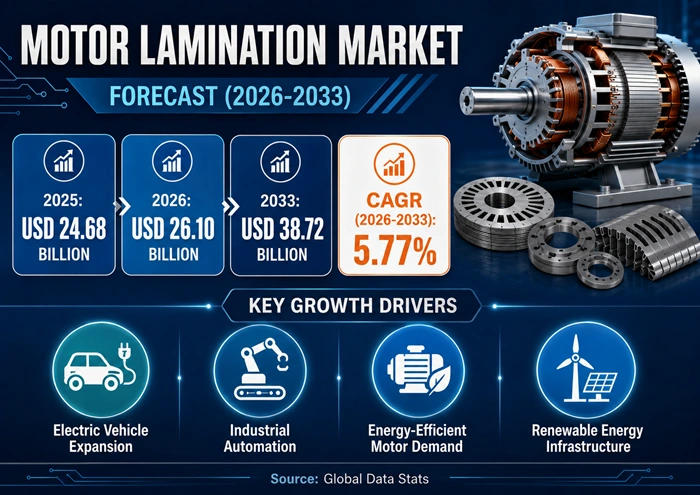
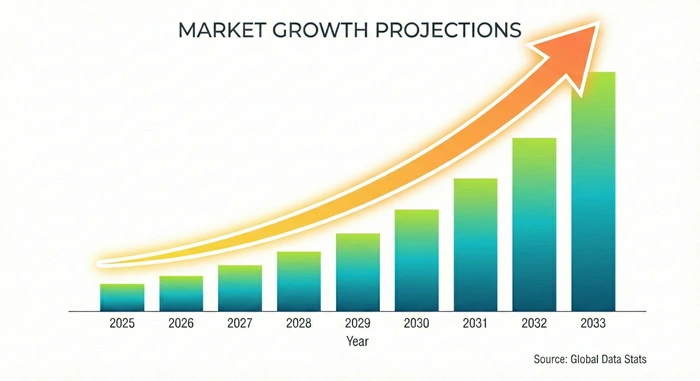
The global motor lamination market size is valued at USD 24.68 billion in 2025 and is predicted to increase from USD 26.10 billion in 2026 to approximately USD 38.72 billion by 2033, growing at a CAGR of 5.77% from 2026 to 2033.
Motor laminations — thin, precision-stamped or laser-cut sheets of electrical steel stacked together to form the core of electric motors, generators, and transformers — are a foundational component in virtually every electromechanical system in operation today. The accelerating global transition toward electric vehicles, the rapid buildout of renewable energy infrastructure, and increasingly stringent government energy efficiency mandates are collectively driving strong and sustained demand for high-quality laminated motor cores. As manufacturers across the automotive, industrial, and consumer electronics sectors invest in next-generation motor technologies, the motor lamination market is benefiting from expanding application volumes, tighter performance specifications, and growing requirements for advanced electrical steels that minimize energy loss through eddy current and hysteresis effects.
AI Impact on the Motor Lamination Industry
Artificial Intelligence Is Transforming Motor Lamination Manufacturing Through Intelligent Process Optimization, Predictive Quality Control, and Advanced Material Design That Directly Improves Energy Efficiency Outcomes
Artificial intelligence is reshaping manufacturing operations across the motor lamination industry in ways that are delivering measurable improvements in product quality, production efficiency, and material utilization. Traditional lamination stamping and laser-cutting operations relied on manual quality inspection and reactive process adjustments — approaches that tolerated significant scrap rates and dimensional variability that degraded motor performance. AI-powered machine vision systems are now deployed across leading lamination manufacturing facilities, using deep learning models trained on thousands of defect images to detect surface blemishes, dimensional deviations, burr formation, and insulation coating defects at the single-lamination level with precision and speed that human inspectors cannot match. These systems enable real-time rejection of defective laminations before they enter stacked core assemblies, dramatically reducing warranty claims, rework costs, and efficiency losses in end-product motors.
Beyond quality control, AI is enabling a new generation of motor lamination design tools that compress the development cycle for new motor core geometries. Historically, optimizing lamination profiles — including slot shapes, tooth geometry, back iron thickness, and stacking patterns — required extensive empirical testing across physical prototypes, a process that could consume months of engineering time. AI-assisted generative design platforms can now simulate electromagnetic performance, thermal behavior, and structural integrity across thousands of lamination geometry variations within hours, identifying optimal designs that minimize core losses while meeting weight and manufacturing cost constraints. This capability is particularly valuable in the electric vehicle sector, where motor designers face intense pressure to maximize range efficiency from every drivetrain component. As AI design tools become standard in leading motor engineering firms, the motor lamination market will see faster introduction of high-performance, low-loss core designs that expand material value and support premium pricing.
Growth Factors
The Global Electric Vehicle Revolution, Renewable Energy Infrastructure Expansion, and Industrial Energy Efficiency Mandates Are Creating Powerful, Interlocking Growth Drivers That Sustain Long-Term Market Demand
The single most powerful growth driver for the motor lamination market is the worldwide acceleration of electric vehicle adoption. Every battery electric vehicle requires one or more traction motors — each built around a laminated electrical steel core — along with multiple auxiliary motor drives for cooling, power steering, braking, and HVAC systems. As annual global EV production volumes scale from tens of millions toward a near-total replacement of internal combustion engine vehicles over the coming decades, the cumulative demand for precision motor laminations is expanding exponentially. Automakers including BYD, Tesla, Volkswagen, and General Motors are simultaneously increasing both the number of motors per vehicle and the performance specifications of individual traction motors — demanding higher-grade non-oriented electrical steels with lower core losses that only specialized lamination suppliers can consistently produce. This automotive electrification wave is the defining structural demand force shaping the motor lamination market's trajectory through 2033 and beyond.
The concurrent global investment in renewable energy generation infrastructure is amplifying this demand from a second, equally important direction. Wind turbine generators, which are among the largest and most demanding applications for motor laminations in terms of core size and electrical steel grade requirements, are being installed at record annual volumes as countries accelerate their energy transition programs. Solar energy systems require laminated cores in the transformers and power inverters that convert and distribute generated electricity. Energy storage systems and grid-scale power conditioning equipment similarly rely on high-quality laminated cores for their transformer and reactor components. Industrial energy efficiency programs — driven by progressively tightening minimum energy performance standards (MEPS) regulations across the EU, U.S., China, and India — are accelerating the replacement of aging, low-efficiency motors with IE3 and IE4-class premium efficient motors that require higher-grade lamination materials. Each of these demand streams contributes independently to the growth of the motor lamination market, creating a diversified and resilient demand foundation that is not dependent on any single industry cycle.
Market Outlook
The Motor Lamination Market Is Entering a Phase of Structural Elevation Driven by Premium Electrical Steel Demand, EV Supply Chain Localization, and Next-Generation Motor Efficiency Standards
The motor lamination market's outlook through 2033 is defined by an underlying shift from volume-driven growth toward quality-driven growth, as motor designers and OEMs increasingly prioritize core loss performance over unit cost considerations in response to efficiency regulations and EV range optimization pressures. This shift is elevating demand for higher-grade silicon steels — including high-silicon non-oriented grades, grain-oriented materials for specialized applications, and emerging amorphous and nanocrystalline alloy laminations — all of which command substantially higher price points than conventional grades. Suppliers with the metallurgical expertise and precision manufacturing capabilities to consistently produce these advanced materials are well-positioned to capture expanding margins as the product mix in the motor lamination market shifts toward premium grades.
Geopolitical supply chain resilience considerations are reshaping the motor lamination market's competitive geography in important ways. The concentration of high-grade electrical steel production capacity in China and a small number of Japanese and Korean steelmakers has exposed the vulnerability of global motor supply chains to trade policy disruptions — a concern that accelerated significantly following recent U.S.-China trade tensions and EU critical materials security initiatives. In response, North American and European governments are actively subsidizing the construction of domestic electrical steel production capacity and providing incentive frameworks that favor locally manufactured motor components in EV and renewable energy equipment supply chains. This supply chain localization trend is expected to create substantial new manufacturing investment opportunities in North America and Europe through 2033, diversifying the motor lamination market's production geography and supporting premium pricing for regionally certified supply.
Expert Speaks
-
"The quality and consistency of motor lamination materials directly determines the efficiency and performance ceiling of any electric drivetrain. As we scale EV production to tens of millions of units annually, the ability of our lamination supply chain to deliver zero-defect, high-grade electrical steel at global scale is one of our most strategically important engineering and procurement priorities." — Mary Barra, CEO, General Motors
-
"The energy transition is fundamentally a motor and transformer story. Every wind turbine, every EV traction motor, every premium-efficient industrial drive requires precision-laminated electrical steel cores. Our investment in advanced lamination materials and manufacturing is one of the most important things we can do to accelerate the world's path to net zero." — Varun Laroyia, CFO, FLIR / Teledyne Technologies (representing industrial technology sector)
-
"Electrical steel quality is not just a materials specification — it is a competitive advantage. Companies that secure reliable, high-performance motor lamination supply chains will build more efficient motors, win more EV platform awards, and create lasting differentiation in a market where energy efficiency is increasingly the deciding purchase criterion." — Günther Hasenfuss, CEO, voestalpine AG
Key Report Takeaways
-
Asia Pacific dominates the motor lamination market with approximately 45.6% of global 2024 revenues, driven by the world's largest concentration of electric motor manufacturing, the highest EV production volumes globally in China, and a deep ecosystem of electrical steel producers, precision stamping specialists, and motor OEMs operating within the region's integrated manufacturing supply chains.
-
North America is the fastest-growing region in the motor lamination market, recording a CAGR above the global average through 2033, driven by the Inflation Reduction Act's domestic manufacturing incentives, rapid scaling of U.S.-based EV production by Tesla, GM, and Ford, and substantial new investment in domestic electrical steel production capacity.
-
The automotive end-user segment is the dominant revenue contributor, accounting for approximately 42.3% of total 2024 motor lamination market revenues, with electric and hybrid vehicle traction motor applications representing the fastest-growing sub-segment as global EV production scales toward full-market replacement volumes.
-
Non-oriented electrical steel (NOES) is the most widely used lamination material type, representing over 68.7% of market volumes, as its isotropic magnetic properties make it the standard choice for rotating machine applications including traction motors, industrial motors, and generator rotors across all end-user sectors.
-
Progressive die stamping is the most commonly used manufacturing technology, holding approximately 55.4% of production volume share due to its cost efficiency for high-volume lamination production in standardized geometries — though laser cutting is gaining share rapidly in prototype and low-volume production applications requiring tight dimensional tolerances.
-
The renewable energy end-user segment is projected to be the fastest-growing future application vertical, expected to sustain a CAGR of approximately 7.8% through 2033, with approximately 14.2% market share in 2024, as wind turbine and solar infrastructure installations accelerate globally under government net-zero commitments.
Market Scope
| Report Coverage | Details |
|---|---|
| Market Size by 2033 | USD 38.72 Billion |
| Market Size by 2025 | USD 24.68 Billion |
| Market Size by 2026 | USD 26.10 Billion |
| Market Growth Rate from 2026 to 2033 | CAGR of 5.77% |
| Dominating Region | Asia Pacific |
| Fastest Growing Region | North America |
| Base Year | 2025 |
| Forecast Period | 2026 – 2033 |
| Segments Covered | By Material Type, By Motor Type, By Technology, By End-User, By Region |
| Regions Covered | North America, Europe, Asia Pacific, Latin America, Middle East & Africa |
Market Dynamics
Drivers Impact Analysis
Electric Vehicle Adoption, Renewable Energy Deployment, and Premium Efficiency Motor Regulations Are the Structural Growth Forces Powering Long-Term Motor Lamination Market Expansion
| Driver | ≈ % Impact on CAGR Forecast | Geographic Relevance | Impact Timeline |
|---|---|---|---|
| Accelerating global EV production driving traction motor lamination volumes | ~38% | Global; China, North America, Europe lead | Long Term (≥ 4 years) |
| Rapid expansion of wind, solar, and grid infrastructure | ~27% | Global; Europe, China, North America, India | Long Term |
| Industrial energy efficiency regulations driving premium motor replacements | ~22% | EU, U.S., China, India | Medium to Long Term |
| Rising demand for high-performance electrical steel grades in advanced motor designs | ~13% | Global; APAC and Europe dominate supply | Medium Term (2–4 years) |
The automotive sector's transition to electric powertrains is reshaping the motor lamination market's demand landscape more fundamentally than any development in the industry's history. A conventional ICE vehicle contains roughly a dozen small electric motors for auxiliary functions, each requiring modest lamination volumes. A battery electric vehicle, by contrast, includes a high-performance traction motor operating at kilowatt-scale power levels that requires a precisely engineered laminated core built from premium-grade non-oriented electrical steel — along with multiple smaller but equally demanding auxiliary drive motors. As BEV market penetration increases from current levels toward projected 40–60% new vehicle sales shares in major markets by 2033, the cumulative uplift in motor lamination demand represents one of the most predictable and structurally supported growth stories in the advanced materials sector. Tier 1 automotive suppliers and motor manufacturers are actively investing in capacity expansions to ensure supply chain readiness for this demand wave.
Industrial motor replacement programs driven by escalating energy efficiency regulations represent an equally important but often underappreciated demand driver. The IEC 60034-30 standard has progressively raised minimum efficiency thresholds for industrial motors from IE1 to IE3 and is moving toward mandatory IE4 classification in major markets — a transition that requires higher-grade lamination materials to achieve the lower core losses that define premium efficiency performance. The EU's Ecodesign Regulation, U.S. Department of Energy motor efficiency rulings, and China's GB 18613 standards are all moving in the same direction — creating a regulatory imperative for motor manufacturers to upgrade their lamination material specifications across hundreds of millions of installed motors. This regulatory replacement cycle is generating large, predictable order flows for electrical steel producers and precision lamination manufacturers that will sustain meaningful growth contributions to the motor lamination market through the entire forecast period.
Restraints Impact Analysis
Electrical Steel Supply Concentration, Raw Material Price Volatility, and Precision Manufacturing Scalability Constraints Are the Key Friction Points Moderating Market Growth Rate
| Restraint | ≈ % Impact on CAGR Forecast | Geographic Relevance | Impact Timeline |
|---|---|---|---|
| Geographic concentration of high-grade electrical steel production in China and East Asia | ~36% | Global; impacts North America and Europe most | Short to Medium Term |
| Silicon steel and rare earth raw material price volatility | ~30% | Global | Short to Medium Term |
| Precision manufacturing capacity constraints for advanced laser-cut and thin-gauge laminations | ~22% | Global; most acute outside APAC | Medium Term (2–4 years) |
| Trade policy and tariff uncertainty affecting cross-border material and component flows | ~12% | North America, Europe | Short Term |
The motor lamination market faces a structural supply-side vulnerability in the form of highly concentrated high-grade electrical steel production capacity. China accounts for the majority of global non-oriented electrical steel output, with a small number of additional major producers in Japan, South Korea, Germany, and Brazil. This geographic concentration creates meaningful supply chain risk for motor manufacturers in North America and Europe who are dependent on trans-Pacific or long-haul supply chains for their most critical lamination materials. Geopolitical trade tensions — including U.S. Section 232 steel tariffs, EU anti-dumping measures, and China's potential export controls on strategic materials — can create sudden supply disruptions and price spikes that are difficult for motor OEMs to absorb in competitive, margin-constrained markets. While domestic capacity investment programs are underway in response to these risks, significant new production capacity will take years to come online, leaving vulnerability in the near-to-medium term.
Silicon content and processing costs in electrical steel production are directly linked to commodity silicon and scrap steel markets, both of which have historically exhibited significant price volatility driven by global industrial cycle dynamics. During periods of elevated raw material costs, lamination manufacturers face compressed margins as they are unable to immediately pass cost increases through to OEM customers operating under long-term fixed-price supply agreements. The growing demand for thin-gauge, high-silicon, and low-loss electrical steels — which require more complex and energy-intensive rolling and annealing processes — is further concentrating production capability among a small number of technologically advanced steelmakers. This supply concentration gives leading electrical steel producers significant pricing power that can periodically squeeze lamination converters operating in the middle of the motor lamination market value chain.
Opportunities Impact Analysis
Advanced Material Innovation, EV Supply Chain Localization, and Emerging Market Industrialization Are the Most Compelling Strategic Opportunities for Motor Lamination Market Participants Through 2033
| Opportunity | ≈ % Impact on CAGR Forecast | Geographic Relevance | Impact Timeline |
|---|---|---|---|
| Amorphous metal and nanocrystalline alloy laminations for ultra-high-efficiency applications | ~33% | North America, Europe, Japan | Medium to Long Term |
| Supply chain localization incentives creating new domestic production investment | ~30% | North America, Europe | Short to Medium Term |
| Industrial motors upgrade cycle in emerging markets under efficiency regulations | ~24% | India, Southeast Asia, LATAM, MEA | Medium Term (2–4 years) |
| Advanced thin-gauge laminations for high-speed EV motor and aerospace applications | ~13% | Global; led by North America and Europe | Long Term |
Amorphous metal and nanocrystalline alloy laminations represent the most technologically differentiated opportunity segment in the evolving motor lamination market. These advanced materials offer core losses up to 80% lower than conventional silicon steel at comparable flux densities — a performance advantage that is compelling for applications in EV chargers, solid-state transformer networks, power conditioning equipment, and high-efficiency servo motors where minimizing energy loss is paramount regardless of material cost premium. Several leading electrical equipment manufacturers are actively qualifying amorphous core designs for their next-generation product platforms, and as production scale increases, the cost premium associated with amorphous materials is expected to narrow, broadening the addressable application range substantially. Vendors that develop cost-competitive manufacturing processes for amorphous and nanocrystalline laminations will command premium pricing and benefit from high switching costs that create durable competitive advantages.
The industrial motor upgrade cycle in rapidly industrializing emerging markets represents a large and growing demand opportunity that is expected to contribute meaningfully to the motor lamination market's growth through 2033. India, Vietnam, Indonesia, Brazil, and countries across the Middle East and Africa are implementing their own versions of industrial energy efficiency standards that mandate replacement of low-efficiency motor fleets with IE2 and IE3-class premium units. These regulatory programs are creating large, time-bounded replacement demand across industrial facilities in countries with enormous installed bases of aging, inefficient motors — generating predictable order flows for lamination producers who establish supply relationships with regional motor manufacturers. As these markets' manufacturing sectors grow and domestic motor production capacity expands, the regional lamination demand base will develop from import-dependent to domestically supplied, creating both direct sales opportunities and attractive manufacturing investment locations for global lamination producers seeking to establish local presences.
Segment Analysis
By Material Type
Non-Oriented Electrical Steel Commands the Largest Volume Share While Grain-Oriented and Advanced Alloy Grades Drive the Highest Value Growth in the Motor Lamination Market
The non-oriented electrical steel (NOES) segment holds approximately 68.7% of total 2024 motor lamination market volumes, reflecting its universal suitability for rotating machine applications across the automotive, industrial, and consumer appliance sectors. NOES is characterized by uniform magnetic properties in all directions within the rolling plane — a feature that is essential for efficient motor operation, as the rotating magnetic flux in a motor core passes through the steel in continuously changing directions during operation. The segment encompasses a wide range of silicon content grades from standard 0.5–2.0% Si grades used in commodity industrial motors to premium 3.0–6.5% Si grades required for high-efficiency EV traction motors and premium industrial drives. The segment is growing steadily at a mid-single-digit CAGR, with upward price migration from standard to premium grades representing the key value growth driver alongside volume expansion. Asia Pacific dominates NOES production and consumption, with Baowu Steel Group (China), POSCO (South Korea), and Nippon Steel Corporation (Japan) collectively accounting for the majority of global high-grade NOES output — supplying the region's enormous motor manufacturing base.
The grain-oriented electrical steel (GOES) segment represents approximately 18.3% of motor lamination market value despite lower volumes, reflecting its much higher price per unit weight. GOES is produced through a precisely controlled rolling and annealing process that aligns the crystallographic structure of the steel along the rolling direction, achieving core loss values up to 30% lower than non-oriented grades when the flux direction aligns with the grain orientation. This characteristic makes GOES the preferred material for large power transformers, distribution transformers, and specialized high-efficiency motor applications where magnetic flux paths are predominantly unidirectional. The segment is growing most rapidly in Europe and North America, where grid infrastructure modernization investments and the buildout of EV charging transformer networks are driving strong demand for low-loss transformer cores. Key companies supplying the GOES segment include voestalpine AG (Austria), Thyssenkrupp Electrical Steel GmbH (Germany), and AK Steel / Cleveland-Cliffs (United States) — all of which maintain specialized GOES production facilities with tightly controlled process parameters that create significant barriers to entry within the motor lamination market's premium materials tier.
By End-User
Automotive Leads in Revenue While Industrial Machinery and Renewable Energy Are Emerging as High-Growth Verticals Reshaping the Long-Term Motor Lamination Market Mix
The automotive end-user segment contributes approximately 42.3% of total 2024 motor lamination market revenues, establishing its dominant position through the combination of high per-unit lamination content in EV traction motors and the massive scale of global automotive production. Internal combustion engine vehicles require laminations for alternators, starter motors, and multiple auxiliary drives — but battery electric vehicles require substantially greater lamination volumes per vehicle when traction motor core specifications are included. The transition from ICE to EV production within the global automotive fleet is therefore creating a structural uplift in per-vehicle lamination content that goes beyond simple production volume growth. Europe is the fastest-growing automotive lamination market within the region, driven by stringent EU CO₂ fleet emission standards that are forcing rapid EV mix acceleration among European automakers. Leading companies serving the European automotive segment include voestalpine High Performance Metals GmbH (Austria), Tempel Steel Company (United States), and Eurogroup S.p.A. (Italy), which supply precision-stamped lamination assemblies directly to major European automotive OEMs and Tier 1 motor manufacturers. The automotive segment within the motor lamination market is growing at a CAGR of approximately 7.4% through 2033, driven by EV platform launches and expanding multi-motor drivetrain architectures across premium and mainstream vehicle segments.
The industrial machinery end-user segment holds the second-largest share at approximately 28.7% of 2024 revenues, serving a vast and diverse installed base of electric motors powering pumps, compressors, fans, conveyors, machine tools, and material handling equipment across every manufacturing industry globally. The industrial segment's growth is primarily driven by energy efficiency motor replacement programs and new capacity installations in rapidly industrializing economies. Asia Pacific dominates industrial motor lamination consumption by volume, with China alone accounting for the majority of the region's industrial motor production — supplied by electrical steel and lamination producers including Baowu Steel Group (China) and Baoshan Iron & Steel (China). The energy and power sub-segment within industrial applications is the most strategically significant growth driver, as the combination of wind turbine generator buildout and grid transformer network expansion creates large, sustained lamination demand flows that supplement the automotive sector's EV-driven growth contributions. Vendors with established supply relationships in the industrial power generation and grid equipment sectors are benefiting from record capital spending on energy transition infrastructure across all major global markets.
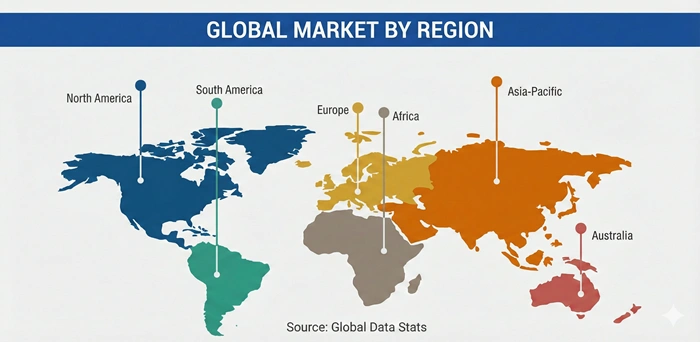
Regional Insights
Asia Pacific
Asia Pacific's Dominant Electric Motor Manufacturing Base, World-Leading EV Production, and Massive Industrial Sector Establish It as the Undisputed Leader of the Global Motor Lamination Market
China's Scale in Both Electrical Steel Production and Motor Manufacturing, Combined With Regional Industrialization Across India and Southeast Asia, Create a Self-Reinforcing Regional Market Leadership Position
Asia Pacific dominates the motor lamination market with approximately 45.6% of global 2024 revenues, a position anchored by China's unmatched combination of electrical steel production capacity, precision lamination manufacturing scale, and dominant position in EV and industrial motor production. China alone accounts for over 55% of global electric motor output by volume, and its domestic electrical steel producers — led by Baowu Steel Group and POSCO-CSPC — supply the vast majority of this enormous motor manufacturing base with high-grade lamination materials at competitive cost structures that are difficult for suppliers from higher-cost geographies to match. Japan and South Korea contribute sophisticated capabilities in premium-grade electrical steel and precision lamination for high-efficiency automotive and industrial applications, with companies including Nippon Steel Corporation (Japan), JFE Steel Corporation (Japan), and POSCO (South Korea) supplying the world's most demanding motor designers with state-of-the-art low-loss lamination materials. The Asia Pacific region is growing at a consistent mid-to-high single-digit CAGR within the motor lamination market, supported by the ongoing expansion of China's EV production, India's accelerating industrial electrification, and Southeast Asia's growing role as a motor manufacturing hub.
India represents the most compelling near-term growth opportunity within Asia Pacific, as the country's large and rapidly modernizing industrial sector, ambitious EV adoption program, and government-mandated energy efficiency upgrades create strong, multi-directional demand growth for motor laminations. India's Bureau of Energy Efficiency (BEE) has progressively tightened industrial motor efficiency standards, mandating IE2 and IE3-class minimums that are driving replacement procurement across hundreds of thousands of industrial facilities. India's domestic electrical steel production is currently insufficient to meet growing demand, making it a significant net importer of lamination materials from Japan, South Korea, and China — a supply gap that is simultaneously creating investment opportunities for domestic steelmaking capacity and commercial opportunities for established foreign electrical steel suppliers seeking to expand their regional footprints.
North America
North America's IRA-Backed EV Manufacturing Boom, Domestic Electrical Steel Investment, and Renewable Energy Infrastructure Expansion Are Making It the Fastest-Growing Motor Lamination Market Region
Strong Regulatory Support for Domestic Motor Component Supply Chains, Combined With Record EV Platform Launches, Is Reshaping North America's Position in the Global Motor Lamination Market
North America is the fastest-growing region in the motor lamination market, recording a CAGR above the global average through 2033, fueled by the extraordinary scale of EV manufacturing investment incentivized by the U.S. Inflation Reduction Act's domestic content requirements. The IRA's provision of substantial tax credits for EVs assembled in North America using domestically sourced battery and motor components is driving hundreds of billions in new automotive manufacturing investment — including multiple new gigafactories and motor assembly facilities that require regionally sourced lamination supply chains. This policy-driven onshoring of EV manufacturing is simultaneously stimulating investment in North American electrical steel production, with Cleveland-Cliffs (United States) and other domestic steelmakers expanding their grain-oriented and non-oriented electrical steel capacity to serve the growing regional demand. Key companies active in the North American motor lamination market include Tempel Steel Company (United States), United States Steel Corporation (United States), Cleveland-Cliffs (United States), and General Electric (United States) — all of which are positioning to benefit from the domestic content preference embedded in U.S. industrial policy.
Canada contributes to regional growth through significant wind energy infrastructure expansion and growing domestic EV assembly, while Mexico is emerging as a motor manufacturing hub for international automakers seeking cost-competitive North American production bases that qualify for IRA content requirements. The North American market is also benefiting from strong growth in renewable energy transformer and generator lamination demand, as both wind and solar power installations are expanding rapidly under state and federal clean energy mandates. The region's CAGR advantage over the global average is expected to persist through 2033, supported by continued policy stability, growing regional electrical steel capacity, and the sustained scaling of EV production volumes at facilities operated by Tesla (United States), General Motors (United States), Ford (United States), and multiple Asian automotive OEMs establishing North American production presences.
Report Customization Available for All Regions and Countries
This Report Offers Full Region-Wise and Country-Wise Customization, Providing Organizations With Targeted Motor Lamination Market Intelligence Precisely Aligned to Their Geographic Business Strategy
This report can be fully customized for any specific region or country listed below, delivering dedicated motor lamination market sizing, local competitive landscape analysis, country-specific demand driver assessments, regulatory environment intelligence, and supply chain opportunity mapping. Whether you are a lamination manufacturer evaluating production footprint expansion, an electrical steel producer assessing regional market entry, or an EV OEM building a resilient motor component supply chain, the customized report provides the geography-specific intelligence your team requires.
Customized reports are available for the following regions and countries, each offering detailed insights, market analysis, trends, and opportunities:
North America
-
Customized insights available for U.S., Canada, and Mexico, covering IRA domestic content incentive impacts, EV manufacturing investment trends, electrical steel capacity development, and country-level competitive intelligence for the motor lamination market.
Europe
-
Tailored analysis available for U.K., Germany, France, Italy, and Rest of Europe, including EU Ecodesign Regulation impacts, automotive electrification supply chain dynamics, domestic electrical steel investment programs, and country-level motor manufacturing competitiveness assessments.
Asia Pacific
-
Detailed coverage for China, India, Japan, South Korea, Australia, and Rest of Asia Pacific, encompassing electrical steel production capacity, EV motor demand forecasts, industrial motor efficiency regulation impacts, and regional supply chain intelligence.
Latin America
-
Country-level customization for Brazil, Argentina, and Rest of Latin America, covering industrial motor replacement program timelines, renewable energy project pipelines, emerging manufacturing sector growth, and regional electrical steel import dependency dynamics.
Middle East & Africa
-
Targeted intelligence for UAE, Saudi Arabia, and Rest of MEA, addressing industrial diversification program motor demand, renewable energy infrastructure investment, grid modernization transformer requirements, and regional motor manufacturing ecosystem development.
Top Key Players
-
Tempel Steel Company (United States)
-
United States Steel Corporation (United States)
-
Cleveland-Cliffs Inc. (United States)
-
voestalpine AG (Austria)
-
Thyssenkrupp Electrical Steel GmbH (Germany)
-
Nippon Steel Corporation (Japan)
-
JFE Steel Corporation (Japan)
-
POSCO (South Korea)
-
Baowu Steel Group Co. Ltd. (China)
-
Eurogroup S.p.A. (Italy)
-
Pitti Engineering Ltd. (India)
-
Godrej & Boyce Manufacturing Company Ltd. (India)
-
Precision Micro Ltd. (United Kingdom)
-
Nidec Corporation (Japan)
-
General Electric Company (United States)
Recent Developments
-
In March 2025, Cleveland-Cliffs announced a USD 700 million investment in expanding its grain-oriented electrical steel production capacity at its Middletown Works facility in Ohio, specifically targeting the growing demand from EV motor manufacturers and grid transformer producers seeking domestic U.S. supply that qualifies for IRA content requirements — representing one of the largest single investments in North American electrical steel capacity in over a decade.
-
In January 2025, voestalpine AG launched its new isovac® 280-50AP non-oriented electrical steel grade, specifically engineered for high-speed EV traction motor applications, offering core loss values 12% lower than the previous generation at equivalent silicon content — enabling motor designers to achieve IE5-level efficiency targets in compact drivetrain formats.
-
In November 2024, Nippon Steel Corporation completed the acquisition of a majority stake in a Brazilian electrical steel producer, establishing a South American production base that positions the company to serve the growing motor lamination demand from Brazil's expanding industrial motor and renewable energy equipment manufacturing sectors while gaining proximity to low-cost iron ore raw material supply.
-
In September 2024, Tempel Steel Company commissioned a new precision laser-cutting production line at its Chicago facility capable of processing ultra-thin 0.20mm gauge non-oriented electrical steel for next-generation high-speed EV motor laminations — expanding its advanced technology lamination manufacturing capacity to serve the growing North American EV supply chain.
-
In July 2024, POSCO announced a strategic co-development partnership with Hyundai Motor Group to create customized high-silicon non-oriented electrical steel grades optimized specifically for the motor designs in Hyundai's upcoming IONIQ 9 and Genesis GV90 EV platforms — a collaboration that deepens the integration between electrical steel producers and automotive OEMs in the premium EV motor lamination market.
Market Trends
Thin-Gauge Electrical Steel Adoption and Integrated Lamination-Motor Assembly Partnerships Are the Defining Technology and Commercial Trends Reshaping the Motor Lamination Market's Competitive Landscape
The most technically significant trend reshaping the motor lamination market is the progressive migration toward thinner-gauge electrical steel laminations in high-performance motor applications. Standard industrial motor laminations have historically been produced from 0.35mm or 0.50mm gauge silicon steel, but leading EV traction motor designs are now specifying 0.20mm and even 0.15mm gauge laminations to reduce high-frequency eddy current losses in motors operating at the high speeds and switching frequencies that maximize EV drivetrain efficiency. Producing thinner gauges without compromising mechanical integrity during stamping or stacking requires advanced rolling mill technology and tighter metallurgical process control — capabilities that only a small number of the world's most technologically advanced electrical steel producers currently possess. This technical barrier is reshaping the competitive landscape of the motor lamination market, concentrating premium traction motor lamination supply among a smaller number of highly capable suppliers while creating strong pricing power and durable supply relationships with leading automotive OEMs.
A second defining trend is the emergence of integrated lamination-to-assembly supply partnerships between electrical steel producers, precision lamination manufacturers, and motor OEMs — arrangements that are replacing traditional arms-length commodity procurement with collaborative supply chain models. Major EV manufacturers are increasingly co-developing lamination specifications with their tier 1 electrical steel suppliers through joint engineering programs, sharing performance targets and manufacturing constraint data that allow lamination materials to be designed in parallel with motor geometry. These partnerships create deep technical interdependencies that discourage supply chain switching and generate stable, long-duration revenue commitments for preferred suppliers. As EV production scales to millions of units annually at facilities across multiple continents, motor lamination procurement is transitioning from a spot-purchase commodity transaction to a strategically managed, partnership-governed supply relationship — a commercial evolution that will benefit well-positioned, technically differentiated lamination producers throughout the 2026 to 2033 forecast period.
Segments Covered in the Report
-
By Material Type
-
Non-Oriented Electrical Steel (NOES)
-
Standard Grade
-
Semi-Processed Grade
-
Fully Processed / Premium Grade
-
-
Grain-Oriented Electrical Steel (GOES)
-
Amorphous Metal Alloys
-
Nanocrystalline Alloys
-
Others
-
-
By Motor Type
-
AC Induction Motors
-
Permanent Magnet Synchronous Motors (PMSM)
-
Brushless DC Motors (BLDC)
-
Switched Reluctance Motors
-
Others
-
-
By Technology
-
Progressive Die Stamping
-
Laser Cutting
-
Fine Blanking
-
Wire EDM
-
Others
-
-
By End-User
-
Automotive (ICE, Electric & Hybrid Vehicles)
-
Industrial Machinery
-
Consumer Electronics & Appliances
-
Energy & Power (Wind, Transformers, Grid Equipment)
-
Aerospace & Defense
-
Others
-
-
By Region
-
North America (U.S., Canada, Mexico)
-
Europe (U.K., Germany, France, Italy, Rest of Europe)
-
Asia Pacific (China, India, Japan, South Korea, Australia, Rest of Asia Pacific)
-
Latin America (Brazil, Argentina, Rest of Latin America)
-
Middle East & Africa (UAE, Saudi Arabia, Rest of MEA)
-
❝ Built for Every Level — From Startups to Industry Giants ❞
Here Is Exactly How This Report Works for You
-
From precision lamination startups evaluating which end-user segments and geographies offer the highest growth potential, to Tier 1 electrical steel producers benchmarking their competitive position against global rivals, this report delivers the segment-level CAGR data, regional market share analysis, and competitor revenue intelligence required to identify exactly where the motor lamination market is generating the most value — and what product quality, manufacturing technology, and customer relationship strategies leading companies are deploying to capture that value ahead of the competitive field.
-
For investors, supply chain executives, and corporate development teams navigating the complex intersection of EV industry growth, geopolitical supply chain localization pressures, and escalating energy efficiency regulations, this report provides a structured analytical framework covering how these forces are reshaping competitive dynamics across North America, Europe, Asia Pacific, Latin America, and MEA — enabling confident, evidence-based decisions on manufacturing investment locations, strategic partnerships, and supply chain diversification strategies that reduce geopolitical exposure while capturing policy-supported growth.
-
The full purchased version of this report includes complete competitor revenue profiles with detailed revenue source breakdowns, supply-demand gap analysis by region and grade, country-level market size data, and a comprehensive scenario framework covering base-case and high-growth trajectories through 2033 — equipping product managers, procurement leaders, investors, and C-suite decision-makers with the intelligence needed to build winning strategies and maximize returns in the expanding global motor lamination market.
Frequently Asked Questions
Question 1: What is the current size of the motor lamination market and what growth is expected through 2033?
Answer: The global motor lamination market is valued at USD 24.68 billion in 2025 and is forecast to reach USD 38.72 billion by 2033, growing at a CAGR of 5.77% from 2026 to 2033. This growth is primarily driven by the global acceleration of electric vehicle production, expanding renewable energy infrastructure investment, and increasingly stringent industrial motor energy efficiency regulations.
Question 2: Which region dominates the motor lamination market?
Answer: Asia Pacific leads the motor lamination market with approximately 45.6% of global 2024 revenues, anchored by China's dominant position in both electrical steel production and electric motor manufacturing. North America is the fastest-growing region, driven by IRA-backed EV manufacturing investment, domestic electrical steel capacity expansion, and rapid renewable energy infrastructure buildout.
Question 3: What are the key growth drivers in the motor lamination market?
Answer: The motor lamination market is primarily driven by accelerating global EV production that substantially increases lamination content per vehicle, rapid expansion of wind turbine and grid transformer infrastructure, and government energy efficiency regulations mandating industrial motor upgrades to IE3 and IE4 premium efficiency classes. Rising demand for high-grade, low-loss non-oriented electrical steels in advanced motor designs is also supporting price-mix uplift alongside volume growth.
Question 4: What materials are most commonly used in motor lamination manufacturing?
Answer: Non-oriented electrical steel (NOES) is the dominant material in the motor lamination market, accounting for approximately 68.7% of total volumes due to its isotropic magnetic properties that make it ideal for rotating machine applications. Grain-oriented electrical steel holds a smaller but higher-value share for transformer and specialized motor applications, while amorphous and nanocrystalline alloys are emerging as high-performance alternatives for ultra-efficiency applications.
Question 5: How is the EV transition affecting the motor lamination market?
Answer: The EV transition is the single most transformational demand driver for the motor lamination market, as battery electric vehicles require significantly greater lamination volumes per vehicle compared to ICE vehicles, particularly due to high-performance traction motor core specifications that demand premium-grade electrical steels. Leading EV automakers are co-developing customized lamination grades with electrical steel producers through long-term partnership programs, reshaping procurement from commodity transactions to strategically managed supply relationships.