
Molecular Biology Enzymes Market Overview
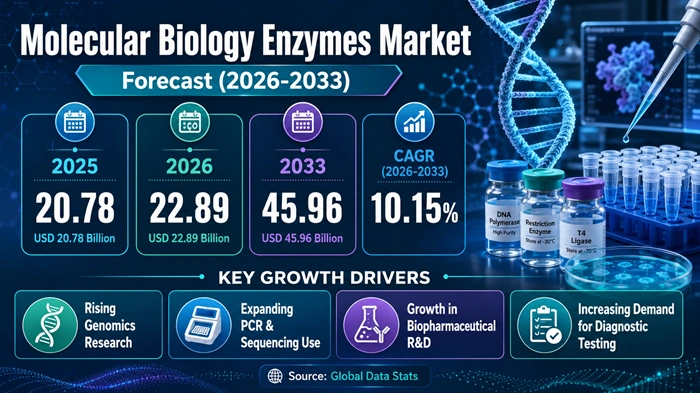
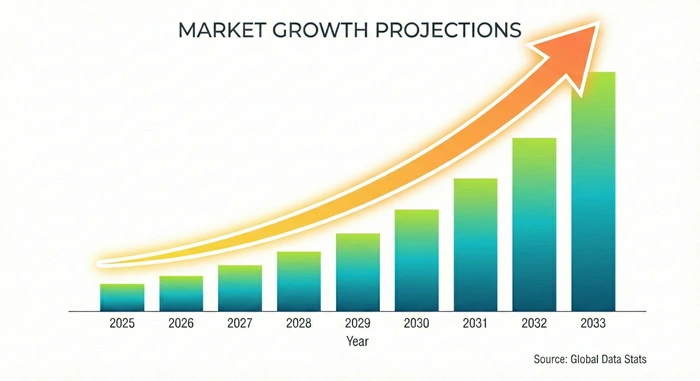
The global molecular biology enzymes market size is valued at USD 20.78 billion in 2025 and is predicted to increase from USD 22.89 billion in 2026 to approximately USD 45.96 billion by 2033, growing at a CAGR of 10.15% from 2026 to 2033.
This strong growth reflects the accelerating pace of genomics research, expanding molecular diagnostics testing volumes, and continued adoption of gene editing tools like CRISPR across academic, pharmaceutical, and biotechnology laboratories worldwide. As research institutions and diagnostic labs increasingly rely on enzymes such as polymerases, ligases, and restriction enzymes for everyday applications, demand for high-quality molecular biology enzymes continues expanding steadily across both established and emerging life sciences markets.
AI Impact on the Molecular Biology Enzymes Industry
Artificial Intelligence Is Accelerating Enzyme Engineering, Optimizing Protocol Design, and Strengthening Quality Prediction Across the Molecular Biology Enzymes Landscape — Fundamentally Changing How Researchers Develop and Select Laboratory Reagents
Artificial intelligence has become an increasingly powerful tool for enzyme manufacturers seeking to engineer improved variants with higher fidelity, greater thermal stability, or faster reaction times, using machine learning models that can predict how specific amino acid modifications will affect enzyme performance long before physical testing begins. This computational approach allows researchers to explore a vastly larger design space than traditional trial-and-error methods would permit, considerably shortening development timelines for next-generation polymerases and other specialty enzymes used across genomics workflows. Companies integrating these AI-driven protein engineering platforms into their research pipelines are increasingly gaining a meaningful edge in bringing improved enzyme products to market faster.
Beyond enzyme engineering itself, AI is also helping researchers optimize experimental protocols by analyzing large datasets of past reaction conditions to recommend ideal enzyme concentrations, reaction temperatures, and buffer compositions for specific applications like PCR amplification or next-generation sequencing library preparation. This capability reduces the trial-and-error burden researchers traditionally faced when troubleshooting inconsistent results, helping laboratories achieve more reliable outcomes with less wasted reagent. As these AI-driven engineering and protocol optimization tools continue maturing, they are becoming an increasingly important factor shaping innovation across the broader molecular biology enzymes market.
Growth Factors
Expanding Genomics Research and Rising Molecular Diagnostics Testing Volumes Continue Driving Sustained Demand
The most significant growth factor supporting the molecular biology enzymes market is the continued global expansion of genomics research activity, as academic institutions, pharmaceutical companies, and biotechnology firms increasingly rely on sequencing, PCR amplification, and gene editing techniques that all depend fundamentally on high-quality enzyme reagents. As genome sequencing costs continue declining and research funding keeps flowing into personalized medicine initiatives, the volume of laboratory work requiring these enzymes continues climbing steadily across research settings worldwide.
A second important growth factor is the rising global volume of molecular diagnostics testing, particularly for infectious disease detection and genetic screening, since these clinical applications depend heavily on polymerases and other enzymes to amplify and detect specific genetic sequences accurately. This growing diagnostic testing demand, combined with expanding adoption of CRISPR-based gene editing across research and therapeutic development programs, has broadened the addressable customer base for enzyme manufacturers considerably. This combination of expanding genomics research and rising diagnostic testing volumes continues to strengthen demand across the molecular biology enzymes market.
Market Outlook
CRISPR Technology Advancement and Expanding Personalized Medicine Adoption Point Toward Sustained Growth Through 2033
Looking ahead through the forecast period, the molecular biology enzymes industry is expected to benefit substantially from continued advancement in CRISPR-based gene editing technology, as researchers develop increasingly precise and efficient nuclease enzymes that expand the range of genetic modifications possible for both research and eventual therapeutic applications. This technology evolution is likely to continue driving demand for specialized enzymes engineered specifically to support next-generation gene editing workflows.
At the same time, the growing shift toward personalized medicine is expected to create substantial new demand for molecular diagnostics enzymes, as healthcare systems increasingly rely on genetic testing to guide individualized treatment decisions across oncology, rare disease, and pharmacogenomics applications. Companies that can deliver both cutting-edge research enzymes and reliable diagnostic-grade reagents are increasingly well positioned to capture this growth. Manufacturers combining strong protein engineering capabilities with broad application coverage are likely to lead growth within the broader molecular biology enzymes market through 2033.
Expert Speaks
-
"Our continued investment in enzyme innovation reflects the growing complexity of genomics research, and we remain committed to supporting scientists with the reliable reagents their work depends on." — CEO, Thermo Fisher Scientific Inc
-
"As molecular diagnostics testing volumes keep rising globally, our enzyme portfolio continues evolving to meet the precision and consistency researchers and clinicians require." — CEO, QIAGEN N.V
-
"Gene editing and genomic medicine are advancing faster than ever, and our enzyme development programs remain focused on enabling that next wave of scientific progress." — CEO, Merck KGaA
Key Report Takeaways
-
North America leads the global molecular biology enzymes market, holding approximately 47% market share in 2025, supported by strong biotechnology infrastructure and substantial research funding
-
Asia Pacific is the fastest-growing region, projected to expand at a CAGR near 12.6% through 2033, driven by rising government genomics investment across China and India
-
Academic and research institutes represent the dominant end-user segment, accounting for roughly 41% share, given their extensive reliance on enzymes for ongoing genomics and molecular biology studies
-
PCR-based applications contribute the most to overall demand, reflecting the widespread use of amplification enzymes across research and diagnostic settings
-
Kits and reagent bundles remain the most widely adopted product category, valued for the convenience and consistency they offer laboratory researchers
-
CRISPR and gene editing enzymes will grow the fastest among product segments, holding close to 24% market share with a CAGR near 15.5% through the forecast period, driven by rapidly expanding gene editing research and therapeutic development activity
Market Scope
| Report Coverage | Details |
|---|---|
| Market Size by 2033 | USD 45.96 Billion |
| Market Size by 2025 | USD 20.78 Billion |
| Market Size by 2026 | USD 22.89 Billion |
| Market Growth Rate from 2026 to 2033 | CAGR of 10.15% |
| Dominating Region | North America |
| Fastest Growing Region | Asia Pacific |
| Base Year | 2025 |
| Forecast Period | 2026 to 2033 |
| Segments Covered | Product Type, Application, End User, Region |
| Regions Covered | North America, Europe, Asia Pacific, Latin America, Middle East & Africa |
Market Dynamics
Drivers Impact Analysis
Expanding Genomics Research Activity and Rising Diagnostic Testing Volumes Remain the Two Strongest Forces Behind Market Momentum
| Driver | (≈) % Impact on CAGR Forecast | Geographic Relevance | Impact Timeline |
|---|---|---|---|
| Expanding genomics and personalized medicine research activity worldwide | ~35% | Global, strongest in North America, Europe | Short to long-term |
| Rising volume of molecular diagnostics testing for infectious disease and genetic screening | ~28% | Global | Medium to long-term |
| Growing adoption of CRISPR-based gene editing across research and therapeutic development | ~23% | North America, Asia Pacific | Medium-term |
| Increasing government and private research funding into genomics infrastructure | ~14% | Asia Pacific, Europe | Short to medium-term |
Expanding genomics and personalized medicine research activity continues to serve as the primary engine behind sustained growth in the molecular biology enzymes market, as academic institutions and biotechnology companies increasingly depend on polymerases, ligases, and nucleases to support sequencing and gene expression studies. This growing research volume has translated directly into rising enzyme consumption across laboratories worldwide.
Rising molecular diagnostics testing volumes represent the second major driver, as healthcare systems increasingly rely on PCR-based and sequencing-based diagnostic methods that require consistent, high-quality enzyme reagents to deliver accurate results. This diagnostic testing growth, combined with expanding CRISPR-based gene editing adoption, continues reinforcing steady demand growth across the broader molecular biology enzymes market.
Restraints Impact Analysis
High Reagent Costs and Stringent Regulatory Requirements Continue to Moderate Broader Adoption
| Restraint | (≈) % Impact on CAGR Forecast | Geographic Relevance | Impact Timeline |
|---|---|---|---|
| High cost of advanced molecular biology enzymes and reagent kits | ~34% | Emerging markets, resource-constrained settings | Short to medium-term |
| Stringent regulatory requirements for diagnostic-grade enzyme products | ~29% | North America, Europe | Medium to long-term |
| Limited laboratory infrastructure and technical expertise in developing regions | ~23% | Latin America, Africa, parts of Asia | Long-term |
| Enzyme stability and storage challenges affecting supply chain logistics | ~14% | Global | Short to medium-term |
The most persistent restraint facing the molecular biology enzymes market is the high cost associated with advanced enzyme products and reagent kits, which can limit accessibility for smaller academic laboratories and research institutions operating with constrained budgets, particularly in developing regions. This cost sensitivity continues to influence purchasing decisions among cost-conscious research buyers.
Stringent regulatory requirements for diagnostic-grade enzyme products represent a second significant restraint, since manufacturers must navigate lengthy approval processes and rigorous quality validation before diagnostic enzymes can reach clinical laboratory customers. Combined with limited laboratory infrastructure and technical expertise in certain developing regions, these restraints continue moderating how quickly broader adoption spreads across the global molecular biology enzymes market.
Opportunities Impact Analysis
Gene Editing Innovation and Expanding Emerging Market Research Investment Represent the Clearest Paths to Growth
| Opportunity | (≈) % Impact on CAGR Forecast | Geographic Relevance | Impact Timeline |
|---|---|---|---|
| Advancing CRISPR and next-generation gene editing enzyme technology | ~38% | North America, Europe, growing globally | Short to medium-term |
| Expanding government-backed genomics research investment across emerging economies | ~33% | Asia Pacific, Latin America | Medium to long-term |
| Growing demand for point-of-care molecular diagnostics enzyme applications | ~29% | Global | Medium-term |
Advancing CRISPR and next-generation gene editing enzyme technology represents one of the most substantial opportunities within the molecular biology enzymes market, as manufacturers developing more precise and efficient nuclease variants stand to capture significant share from researchers pursuing increasingly sophisticated genetic modification projects. This technology innovation is expected to meaningfully reshape competitive positioning among leading enzyme manufacturers over the coming years.
Expanding government-backed genomics research investment across emerging economies presents a second substantial opportunity, as countries like China and India continue funding biotechnology infrastructure and research capacity to strengthen their domestic life sciences industries. Growing demand for point-of-care molecular diagnostics further broadens the opportunity landscape, particularly as healthcare systems seek faster, more accessible genetic testing options. Companies pursuing these parallel opportunities are well positioned to capture meaningful growth within the broader molecular biology enzymes market through the forecast period.
Segment Analysis
By Application: PCR
PCR Applications Continue to Anchor the Application Landscape, Reflecting Their Central Role in Amplification-Based Research and Diagnostics
PCR-based applications hold the largest share within the application segment of the molecular biology enzymes market, accounting for approximately 39% of total segment revenue in 2025. This dominance reflects the fundamental and continuous role PCR amplification plays across nearly every stage of molecular biology work, from basic research and gene expression analysis to clinical diagnostic testing for infectious diseases and genetic disorders. In markets like the United States and Germany, research laboratories and diagnostic centers increasingly favor high-fidelity DNA polymerases that deliver faster amplification cycles with fewer errors. Leading suppliers such as Thermo Fisher Scientific, QIAGEN, and Roche continue to dominate this segment through continuous enzyme formulation innovation and expanded kit offerings.
Growth within this segment remains particularly strong in Asia Pacific, where rapidly expanding molecular diagnostics testing infrastructure across China and India continues driving demand for reliable, cost-effective PCR enzyme products suited to high-volume clinical testing. The region's combination of large patient populations and growing government investment in diagnostic capacity has helped PCR applications maintain their leading position despite growing interest in sequencing-based alternatives. As molecular diagnostics testing volumes continue expanding globally, PCR is expected to remain the dominant application within the broader molecular biology enzymes market throughout the forecast period.
By End User: Academic and Research Institutes
Academic and Research Institutes Remain the Leading End-User Category, Reflecting Their Central Role in Ongoing Genomics Studies
Academic and research institutes account for approximately 41% of end-user revenue within the molecular biology enzymes market, reflecting their essential and continuous reliance on enzymes for basic research, gene expression studies, and exploratory genomics work conducted across universities and independent research centers. These institutions consistently purchase a wide range of enzymes including polymerases, ligases, and restriction enzymes to support diverse ongoing research projects, making them a steady, high-volume customer base for enzyme manufacturers. This consistent research demand has made academic institutions the anchor end-user category for suppliers targeting laboratory reagent customers.
Growth in this end-user segment remains especially strong in North America, where well-funded research universities continue expanding genomics and molecular biology research programs supported by substantial government and private grant funding. Companies like Thermo Fisher Scientific and New England Biolabs have worked closely with academic institutions to provide bulk purchasing agreements and specialized product support tailored to research budgets. As academic research funding continues expanding globally, this end-user segment is expected to remain a primary demand driver within the broader molecular biology enzymes market.
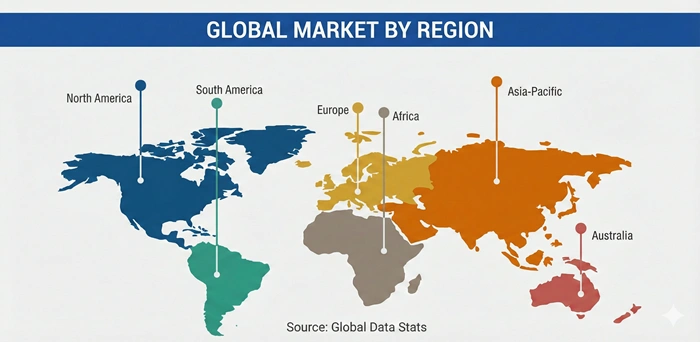
Regional Insights
North America
Strong Biotechnology Infrastructure and Substantial Research Funding Keep North America Firmly in the Lead
North America commands the leading position in the global molecular biology enzymes market, holding approximately 47% share in 2025, supported by strong biotechnology infrastructure, substantial research funding, and a dense concentration of leading pharmaceutical and academic institutions. The United States drives the overwhelming majority of regional demand, backed by robust government research grants and a thriving biotechnology startup ecosystem continuously expanding genomics research activity. Companies with strong regional presence include Thermo Fisher Scientific, QIAGEN, Bio-Rad Laboratories, and New England Biolabs, each maintaining deep relationships with research institutions and diagnostic laboratories across the country.
Canada also contributes meaningfully to regional demand, supported by growing government investment in genomics research infrastructure and expanding academic biotechnology programs. The region's combination of strong research funding, deep pharmaceutical industry presence, and continuous enzyme innovation ensures North America's leadership position within the molecular biology enzymes market remains firmly intact through the remainder of the forecast period.
Asia Pacific
Rising Government Genomics Investment and Expanding Diagnostic Infrastructure Position Asia Pacific as the Fastest-Growing Region
Asia Pacific is projected to register the fastest CAGR within the global molecular biology enzymes market through 2033, expanding at a rate near 12.6% as rising government genomics investment and expanding diagnostic infrastructure create substantial new demand across the region. China and India lead much of this regional growth, supported by significant government funding aimed at strengthening domestic biotechnology capabilities and reducing reliance on imported research reagents. Regional and international enzyme manufacturers alike have expanded their presence to serve this growing institutional demand, often establishing local manufacturing facilities to improve supply chain reliability.
Japan and South Korea contribute further depth to regional growth, both bringing advanced research infrastructure that increasingly incorporates next-generation sequencing and gene editing applications alongside traditional molecular biology techniques. Growing government-backed research initiatives across several Asia Pacific countries continue to accelerate enzyme adoption among expanding academic and diagnostic testing markets alike. This combination of rising government support, expanding diagnostic infrastructure, and growing research investment positions Asia Pacific as the clear growth leader within the broader molecular biology enzymes market through the forecast period.
Customization Available for This Report
Region-Specific and Country-Specific Versions of This Report Are Available to Deliver a Sharper, More Localized View of Market Dynamics
This report can be tailored on a region-by-region and country-by-country basis, providing localized market sizing, competitive mapping, and genomics research investment trend analysis that a global overview alone cannot fully capture.
Clients seeking a more focused breakdown can request a customized version covering any of the following regions and countries, complete with demand forecasting, competitor landscape review, and adoption trend analysis tied specifically to the molecular biology enzymes keyword focus:
North America
-
U.S. — Detailed review of research funding trends and academic institution adoption patterns
-
Canada — Coverage of government genomics investment and biotechnology program expansion
-
Mexico — Analysis of emerging biotechnology infrastructure modernization trends
Europe
-
U.K. — Review of research funding regulation and enzyme adoption trends
-
Germany — Coverage of research investment among leading pharmaceutical manufacturers
-
France — Insights into genomics research program modernization and adoption patterns
-
Italy — Analysis of regional biotechnology investment trends
-
Rest of Europe — Country-level view of emerging demand across Eastern Europe and the Nordics
Asia Pacific
-
China — Coverage of expanding government genomics investment and domestic manufacturing
-
India — Analysis of growing diagnostic infrastructure and research funding expansion
-
Japan — Review of established research infrastructure and enzyme adoption trends
-
South Korea — Assessment of research investment and enzyme adoption
-
Australia — Insights into biotechnology research funding and adoption trends
-
Rest of Asia Pacific — Country-level breakdown covering Thailand, Vietnam, Indonesia, and Malaysia
Latin America
-
Brazil — Coverage of expanding biotechnology research investment and adoption
-
Argentina — Analysis of early-stage research infrastructure modernization trends
-
Rest of Latin America — Country-level sizing across Colombia, Peru, and Chile
Middle East & Africa
-
UAE — Review of biotechnology research investment and adoption trends
-
Saudi Arabia — Coverage of expanding genomics research modernization initiatives
-
Rest of MEA — Country-level view of Sub-Saharan Africa biotechnology research expansion
Top Key Players
-
Thermo Fisher Scientific Inc (United States)
-
QIAGEN N.V (Netherlands)
-
F. Hoffmann-La Roche Ltd (Switzerland)
-
Merck KGaA (Germany)
-
Agilent Technologies Inc (United States)
-
New England Biolabs Inc (United States)
-
Takara Bio Inc (Japan)
-
Promega Corporation (United States)
-
Bio-Rad Laboratories Inc (United States)
-
Illumina Inc (United States)
-
GenScript Biotech Corporation (China)
-
Bruker Corporation (United States)
Recent Developments
-
In 2025, Thermo Fisher Scientific expanded its high-fidelity polymerase portfolio with enhanced formulations designed to improve PCR amplification accuracy
-
In 2025, QIAGEN strengthened its molecular diagnostics enzyme lineup through expanded research investment supporting infectious disease detection kits
-
In 2026, Merck KGaA deepened its investment in CRISPR-related enzyme technology to support growing gene editing research demand across biotechnology customers
-
In 2025, New England Biolabs advanced its restriction enzyme catalog with new high-purity formulations engineered for next-generation sequencing library preparation
-
In 2025, Takara Bio expanded its manufacturing capacity across Asia Pacific to support rising demand from rapidly growing genomics research markets
Market Trends
CRISPR Technology Growth and Expanding Point-of-Care Diagnostics Are Reshaping Enzyme Development Priorities
One of the clearest trends shaping the molecular biology enzymes market is the accelerating development of CRISPR-related enzyme technology, as researchers and manufacturers continue refining nuclease precision and efficiency to expand the range of gene editing applications possible across both research and therapeutic development settings. Companies are investing heavily in protein engineering research, recognizing that gene editing enzyme innovation has become an increasingly important competitive differentiator as genomic medicine advances.
A second significant trend is the growing development of enzymes optimized for point-of-care molecular diagnostics, as healthcare systems increasingly seek faster, more accessible genetic testing options that do not require centralized laboratory infrastructure. This trend toward decentralized testing is particularly meaningful for manufacturers targeting emerging markets with limited laboratory capacity, continuing to support steady expansion across the broader molecular biology enzymes market as diagnostic accessibility improves.
Segments Covered in the Report
By Product Type
-
Enzymes
-
Kits and Reagents
By Application
-
PCR
-
Sequencing
-
Cloning
-
Gene Editing and CRISPR
-
Other Applications
By End User
-
Academic and Research Institutes
-
Pharmaceutical and Biotechnology Companies
-
Diagnostic Laboratories
-
Other End Users
By Region
-
North America (U.S., Canada, Mexico)
-
Europe (U.K., Germany, France, Italy, Rest of Europe)
-
Asia Pacific (China, India, Japan, South Korea, Australia, Rest of Asia Pacific)
-
Latin America (Brazil, Argentina, Rest of Latin America)
-
Middle East & Africa (UAE, Saudi Arabia, Rest of MEA)
❝ Built for Every Level — From Startups to Industry Giants ❞
Here Is Exactly How This Report Works for You
-
For tier 1 companies, investors, and established market leaders, this report delivers detailed competitor revenue analysis, enzyme innovation trend mapping, and geopolitical risk context that support confident decisions around product expansion, pricing strategy, and long-term positioning within the molecular biology enzymes space
-
For tier 2 and tier 3 companies, startups, and mid-sized suppliers, this report highlights the most commercially promising application categories and underserved regional opportunities, giving you a practical framework to compete against larger established players without overextending limited resources
-
For every decision maker across the value chain, this report explains exactly how genomics research funding trends, regulatory developments, and competitor product launches are shaping market direction through 2033, equipping you to plan investment and go-to-market decisions with genuine confidence
Frequently Asked Questions
Question 1: How large is the global molecular biology enzymes market expected to become by 2033?
Answer: The global molecular biology enzymes market was valued at USD 20.78 billion in 2025 and is projected to reach USD 45.96 billion by 2033. This growth is driven largely by expanding genomics research and rising molecular diagnostics testing volumes.
Question 2: What is driving growth in the molecular biology enzymes market right now?
Answer: Growth in the molecular biology enzymes market is being driven by expanding genomics research activity and rising diagnostic testing volumes worldwide. Growing adoption of CRISPR-based gene editing is further reinforcing this expansion.
Question 3: Which region currently dominates the molecular biology enzymes market?
Answer: North America currently leads the molecular biology enzymes market with roughly 47% share, supported by strong biotechnology infrastructure. Asia Pacific is growing the fastest, driven by rising government genomics investment.
Question 4: Which application generates the most revenue in the molecular biology enzymes market?
Answer: PCR-based applications generate the largest share of revenue in the molecular biology enzymes market, reflecting their widespread use across research and diagnostics. Academic and research institutes also remain the leading end-user segment.
Question 5: Who are the leading companies competing in the molecular biology enzymes market?
Answer: Leading companies in the molecular biology enzymes market include Thermo Fisher Scientific, QIAGEN, Roche, Merck KGaA, and Agilent Technologies. These companies compete through continuous innovation in enzyme engineering and gene editing technology.