
Mobile Payments Market Overview
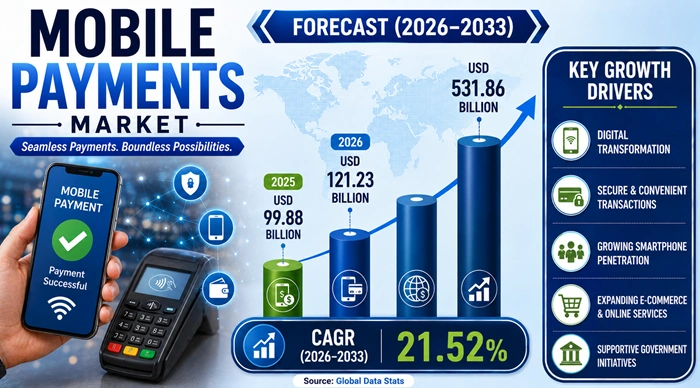
The global mobile payments market size is valued at USD 99.88 billion in 2025 and is predicted to increase from USD 121.23 billion in 2026 to approximately USD 531.86 billion by 2033, growing at a CAGR of 21.52% from 2026 to 2033. This remarkable growth trajectory reflects a fundamental transformation in how consumers and businesses transact, driven by accelerating smartphone adoption, expanding fintech ecosystems, and growing consumer preference for cashless, contactless payment experiences worldwide.
The mobile payments industry is no longer a niche alternative — it has become the preferred transaction method for billions of consumers across both developed and emerging economies. The combination of convenience, speed, security, and seamless integration with everyday apps has made mobile payments a cornerstone of the modern digital economy.
AI Impact on the Mobile Payments Industry
Artificial Intelligence Is Fundamentally Redefining Fraud Detection, Personalization, and Transaction Intelligence Across the Entire Mobile Payments Ecosystem
Artificial intelligence is reshaping the mobile payments market at a structural level, particularly in the areas of fraud detection and real-time risk assessment. Traditional rule-based fraud systems often flagged legitimate transactions or missed sophisticated fraud patterns. AI-powered models now analyze thousands of variables simultaneously — including transaction location, device fingerprint, behavioral biometrics, and spending history — to assess risk with far greater precision. The result is a significant reduction in false positives, faster transaction approvals, and improved trust between payment providers and their end users.
Beyond security, AI is enabling hyper-personalized payment experiences that were previously impossible at scale. Machine learning algorithms can now predict when a consumer is likely to make a purchase, suggest relevant payment methods, and surface cashback or reward opportunities in real time. For businesses, AI-driven analytics tools are helping merchants understand customer spending patterns, optimize checkout flows, and reduce cart abandonment in mobile commerce environments. As AI capabilities continue to mature, their integration into mobile payment platforms will increasingly become a key differentiator in an intensely competitive market landscape.
Growth Factors
Rising Smartphone Penetration, Expanding Digital Infrastructure, and Accelerating Shifts Away from Cash Are Creating Powerful Structural Tailwinds for Mobile Payment Adoption Globally
The most fundamental driver of the mobile payments market is the relentless growth in global smartphone ownership, combined with rapidly expanding mobile internet connectivity. As of 2026, over 6.5 billion people globally own smartphones, and a growing proportion of these users are accessing banking, shopping, and financial services exclusively through their mobile devices. In markets where formal banking infrastructure is limited — particularly in Sub-Saharan Africa, South and Southeast Asia, and parts of Latin America — mobile payment platforms have effectively become the primary financial access layer for hundreds of millions of previously underserved consumers.
Government-driven digital financial inclusion initiatives are reinforcing this momentum. Several of the world's largest economies — including India, China, Brazil, and Indonesia — have implemented national digital payment frameworks that incentivize mobile transaction adoption while building the back-end infrastructure to support high transaction volumes. India's Unified Payments Interface (UPI), for example, has processed billions of transactions monthly, demonstrating the transformative impact of government-backed mobile payment ecosystems. The post-pandemic acceleration in contactless and digital payment adoption has also proved to be a structural rather than temporary shift, with consumer behavior changes now deeply embedded across retail, healthcare, hospitality, and transportation sectors.
Market Outlook
The Convergence of 5G, Embedded Finance, and Open Banking Will Define the Next Evolutionary Phase of the Global Mobile Payments Market Through 2033
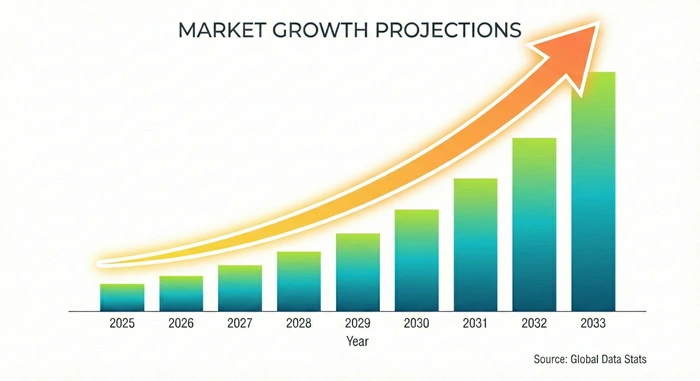
The outlook for the mobile payments market through 2033 is exceptionally strong, underpinned by the rollout of 5G networks that dramatically improve transaction speed and reliability, and the accelerating adoption of embedded finance — the integration of financial services directly into non-financial apps and platforms. As super-apps (single platforms combining messaging, commerce, banking, and entertainment) gain traction beyond Asia and into Western markets, mobile payment functionalities will become seamlessly embedded in consumers' daily digital routines, further deepening usage frequency and transaction volumes.
Open banking regulations in Europe, North America, and increasingly in Latin America and Asia Pacific are creating new opportunities for mobile payment providers to access customer financial data (with consent) and build richer, more integrated payment experiences. Buy Now Pay Later (BNPL) integrations within mobile wallets, cross-border payment capabilities with real-time FX conversion, and biometric-secured payment authentication are among the near-term innovations that will expand the functional scope of mobile payments well beyond simple transactions. Companies that invest in these capabilities now are building competitive moats that will be difficult to challenge as the market matures.
Expert Speaks
-
"Mobile payments are no longer a trend — they are the infrastructure of modern commerce. At Visa, we are investing heavily in tokenization, biometric authentication, and real-time payment rails to ensure that mobile transactions are as secure and seamless as possible for billions of users globally." — CEO, Visa Inc.
-
"The acceleration of digital wallets and mobile-first payment solutions is one of the most significant shifts we have seen in consumer finance. Our strategy at PayPal is to be the most trusted, flexible, and rewarding payment platform in the world — whether that is at checkout, in-app, or across borders." — CEO, PayPal Holdings Inc.
-
"Apple Pay and our broader Wallet platform represent the convergence of identity, security, and commerce on a single device. We believe that the smartphone is the future of the wallet, and we are building the most private and secure payment experience in the industry." — CEO, Apple Inc.
Key Report Takeaways
-
Asia Pacific leads the mobile payments market with the largest regional share of approximately 38% in 2025, driven by massive smartphone user bases in China and India, government digital payment mandates, and culturally embedded QR code payment adoption across retail, food service, and transportation sectors
-
Latin America is the fastest-growing region in the mobile payments landscape, projected to expand at a CAGR of over 26% from 2026 to 2033, supported by rising financial inclusion initiatives, smartphone penetration in Brazil and Mexico, and growing consumer trust in digital wallet platforms
-
B2C payment type dominates end-use in the mobile payments ecosystem, accounting for approximately 62% of transaction volume in 2025, as consumer-facing retail, food delivery, ride-hailing, and streaming subscription payments continue to drive the bulk of mobile transaction value
-
Retail & E-Commerce is the leading end-use segment, contributing the highest share at approximately 34% of market revenue in 2025, as mobile-first shopping experiences and one-click checkout solutions drive billions of mobile-initiated transactions each year
-
Near Field Communication (NFC) and digital wallets are the most widely adopted payment technologies, enabling tap-to-pay experiences at physical point-of-sale terminals across North America, Europe, and Australia, underpinned by Apple Pay, Google Pay, and Samsung Pay platforms
-
The QR code payment segment is expected to grow the fastest, projected to hold nearly 28% of market share by 2033 and grow at a CAGR of approximately 24%, driven by extremely low infrastructure costs, widespread adoption in Asia Pacific, and increasing rollout in Latin American and African markets
Market Scope
| Report Coverage | Details |
|---|---|
| Market Size by 2033 | USD 531.86 Billion |
| Market Size by 2025 | USD 99.88 Billion |
| Market Size by 2026 | USD 121.23 Billion |
| Market Growth Rate from 2026 to 2033 | CAGR of 21.52% |
| Dominating Region | Asia Pacific |
| Fastest Growing Region | Latin America |
| Base Year | 2025 |
| Forecast Period | 2026 – 2033 |
| Segments Covered | Payment Type, Location, Technology, End-Use, Region |
| Regions Covered | North America, Europe, Asia Pacific, Latin America, Middle East & Africa |
Market Dynamics
Drivers Impact Analysis
Accelerating Smartphone Penetration, Government Digital Payment Initiatives, and the Global Shift to Cashless Commerce Are Collectively Powering Sustained Expansion in the Mobile Payments Market
| Driver | ≈ % Impact on CAGR Forecast | Geographic Relevance | Impact Timeline |
|---|---|---|---|
| Smartphone and mobile internet adoption | ~30% | Global, strongest in Asia Pacific & Latin America | Short to Long Term |
| Government digital payment frameworks (UPI, PIX, etc.) | ~24% | India, Brazil, China, Indonesia | Short to Medium Term |
| Growth of e-commerce and mobile commerce | ~20% | North America, Asia Pacific, Europe | Short to Medium Term |
| Contactless payment infrastructure expansion | ~16% | North America, Europe, Australia | Medium to Long Term |
| Financial inclusion initiatives in emerging markets | ~10% | Africa, Southeast Asia, Latin America | Long Term |
The mobile payments market is benefiting enormously from the convergence of device proliferation and digital financial infrastructure. Consumers in both developed and emerging economies are increasingly defaulting to mobile-first payment behaviors not because they were forced to, but because the experience is genuinely superior — faster, more secure, and more convenient than cash or card alternatives. The expansion of app-based financial services has also lowered the barrier to mobile payment adoption significantly, as consumers no longer need a traditional bank account to access mobile payment functionality. Platforms like M-Pesa in Kenya, GCash in the Philippines, and MercadoPago in Latin America have demonstrated how mobile payment ecosystems can emerge organically to serve large unbanked populations.
Government frameworks are playing an equally important role in accelerating mobile transaction adoption. India's UPI platform and Brazil's PIX system have both processed trillions of transactions since launch, with transaction costs near zero and adoption rates that exceeded all projections. These policy-driven platforms have set a global benchmark for what open, interoperable mobile payment infrastructure can achieve when governments invest strategically in digital financial ecosystems. As more governments across Africa and Southeast Asia develop similar frameworks, the potential for exponential growth in mobile payment transaction volumes across the forecast period is significant.
Restraints Impact Analysis
Security Vulnerabilities, Regulatory Fragmentation, and Consumer Trust Barriers Represent the Most Significant Headwinds to Faster Growth in the Global Mobile Payments Ecosystem
| Restraint | ≈ % Impact on CAGR Forecast | Geographic Relevance | Impact Timeline |
|---|---|---|---|
| Cybersecurity risks and data privacy concerns | ~-24% | Global | Ongoing |
| Regulatory fragmentation across jurisdictions | ~-20% | Europe, Asia Pacific, North America | Medium to Long Term |
| Limited POS infrastructure in rural/emerging markets | ~-18% | Africa, South Asia, Latin America | Short to Medium Term |
| Consumer trust deficits among older demographics | ~-15% | North America, Europe | Short to Medium Term |
| Interoperability challenges between platforms | ~-12% | Global | Medium Term |
Despite its rapid expansion, the mobile payments market faces persistent headwinds rooted in security and consumer trust. High-profile data breaches and mobile fraud incidents have repeatedly shaken consumer confidence, particularly in markets where digital financial literacy is lower. Phishing attacks, SIM swap fraud, and account takeovers remain significant threat vectors that payment providers must continuously address with improved authentication technology and consumer education. The perception that mobile payments are inherently less secure than cash or chip-and-pin cards — however inaccurate for well-designed platforms — continues to slow adoption among certain demographic segments.
Regulatory complexity is another meaningful constraint. Payment service providers operating across multiple geographies must navigate a patchwork of data localization laws, licensing requirements, anti-money laundering (AML) frameworks, and consumer protection rules that vary significantly by country and region. Compliance costs for multi-market operators are high, and regulatory uncertainty in some jurisdictions makes it difficult to plan long-term technology investments with confidence. The European Union's Payment Services Directive (PSD2 and its evolving successors) and changing data governance rules in Asia Pacific are examples of regulatory environments that require constant monitoring and adaptation from mobile payment providers.
Opportunities Impact Analysis
The Rise of Embedded Finance, Cross-Border Mobile Payment Corridors, and Super-App Ecosystems Present Transformational Opportunities to Expand the Mobile Payments Market Beyond Its Current Boundaries
| Opportunity | ≈ % Impact on CAGR Forecast | Geographic Relevance | Impact Timeline |
|---|---|---|---|
| Super-app and embedded finance integration | ~+28% | Asia Pacific, Latin America | Short to Medium Term |
| Cross-border mobile payment corridors | ~+22% | Global, especially remittance corridors | Medium to Long Term |
| BNPL integration within mobile wallets | ~+20% | North America, Europe, Asia Pacific | Short to Medium Term |
| Biometric and wearable payment technologies | ~+17% | North America, Europe, East Asia | Medium to Long Term |
| Crypto and blockchain-based mobile payments | ~+13% | Global | Long Term |
The integration of mobile payment capabilities into super-apps represents one of the most transformational opportunities for the mobile payments market over the coming years. Super-apps — platforms that integrate messaging, social media, commerce, financial services, and entertainment within a single application — have already demonstrated their power in Asia through WeChat Pay and Alipay, and are now gaining traction in Western markets through emerging platforms and big-tech expansions. As users consolidate their digital activity within single ecosystems, the payment layer embedded within these apps becomes the default transaction mechanism, dramatically increasing payment frequency, volume, and stickiness.
Cross-border mobile payments represent another massive opportunity, particularly in the context of international remittances, which currently total over $800 billion annually. Traditional remittance channels are costly, slow, and inaccessible to many senders and receivers. Mobile payment platforms that can offer near-instant, low-cost cross-border transfers — enabled by blockchain rails, open banking APIs, or bilateral platform agreements — are positioned to capture a significant share of this high-value flow. Startups and established players alike are racing to build these capabilities, and the companies that establish dominant positions in key remittance corridors will unlock durable, high-frequency revenue streams well into the 2030s.
Segment Analysis
By Payment Type
B2C Mobile Payments Continue to Dominate Global Transaction Volumes, While B2B Mobile Payment Adoption Is Emerging as the Industry's Next High-Growth Frontier
The B2C (Business-to-Consumer) payment type commands the dominant position in the mobile payments market, accounting for approximately 62% of total market revenue in 2025, growing at a CAGR of approximately 20.8% through 2033. This dominance reflects the extraordinary scale of consumer-facing mobile commerce — from app-based retail purchases and food delivery payments to subscription services and in-game transactions — all of which are increasingly initiated and completed on mobile devices. Asia Pacific is the standout region for B2C mobile payment growth, with China and India generating the highest transaction volumes globally, supported by mature super-app ecosystems and widespread QR code infrastructure. Companies such as Alipay (Ant Group, China), WeChat Pay (Tencent, China), and PhonePe (India) have achieved near-universal consumer adoption in their respective markets by offering deeply integrated, reward-rich mobile payment experiences that span online and offline commerce.
B2B (Business-to-Business) mobile payments represent the market's most dynamic growth opportunity by segment, currently holding approximately 23% market share in 2025 but expected to grow at an accelerated CAGR of approximately 24% through 2033. The shift toward mobile-initiated supplier payments, digital invoice management, and real-time corporate disbursements is being driven by the broader digitization of enterprise finance, particularly among small and medium-sized enterprises that lack the ERP infrastructure of large corporations. North America is the leading geography for B2B mobile payment growth, with platforms such as Square (now Block, Inc.) and PayPal Business enabling SMEs to send and receive payments, manage cash flow, and access embedded financial services entirely through mobile interfaces. The elimination of paper-based payment processes — checks, fax-based wire transfers, and manual reconciliation — is creating efficiency gains that are making mobile-first B2B payment solutions increasingly attractive to businesses of all sizes.
By Technology
NFC-Based Contactless Payments Lead the Technology Landscape, While QR Code Payments Are Rapidly Gaining Ground as the Preferred Low-Cost, High-Scale Mobile Transaction Technology
Near Field Communication (NFC) technology holds the leading share in the mobile payments market by technology, accounting for approximately 36% of market revenue in 2025, driven by the widespread deployment of contactless-enabled point-of-sale terminals and the mass adoption of Apple Pay, Google Pay, and Samsung Pay across North America, Europe, and Australia. NFC-based payments offer an unmatched combination of speed, security, and convenience — enabling tap-to-pay transactions in under a second while leveraging tokenization to ensure that sensitive card data is never shared with merchants. The technology's growth trajectory remains strong, with a projected CAGR of around 21% through 2033, supported by continued terminal upgrades and expanding acceptance at transit systems, vending machines, and unattended retail environments. Companies including Apple (USA), Google (USA), and Samsung (South Korea) dominate the NFC payment landscape through their respective wallet platforms, which now collectively serve hundreds of millions of active users globally.
QR code payment technology is the fastest-growing segment, projected to capture approximately 28% of the mobile payments market by 2033 at a CAGR of approximately 24%, largely because of its minimal infrastructure requirements and versatility across income levels. Unlike NFC, QR code payments require no specialized terminal hardware — a printed or displayed QR code is sufficient to receive payments, making the technology accessible to street vendors, small farmers, and micro-merchants in developing economies. India's UPI QR code ecosystem, China's WeChat Pay and Alipay QR infrastructure, and Brazil's PIX system have collectively onboarded hundreds of millions of users onto QR-based payment rails, creating a foundational technology layer across three of the world's most populous markets. As these ecosystems mature and cross-border QR code interoperability agreements expand — such as those emerging between ASEAN countries — the technology's reach and transaction volume are expected to grow dramatically over the forecast period.
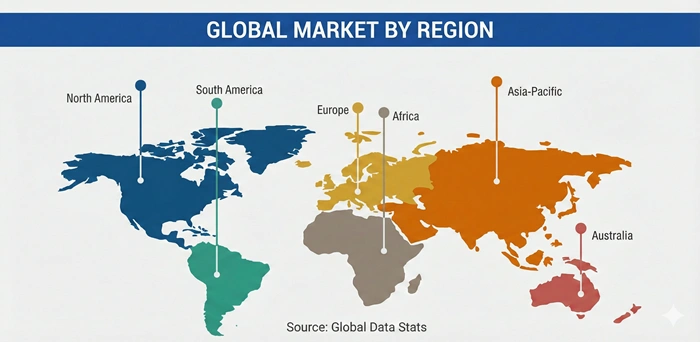
Regional Insights
Asia Pacific's Commanding Market Leadership and Latin America's Explosive Growth Rate Define the Two Most Strategically Critical Regional Dynamics Shaping the Global Mobile Payments Market
Asia Pacific
Asia Pacific's Deep Mobile Payment Infrastructure, Government-Backed Digital Finance Ecosystems, and Massive Consumer Scale Make It the Undisputed Global Leader in Mobile Transaction Volume and Value
Asia Pacific dominates the mobile payments market with approximately 38% of global market share in 2025 and is projected to maintain this leadership throughout the forecast period, growing at a CAGR of around 22% from 2026 to 2033. China alone accounts for the single largest country share globally, powered by the dominance of Alipay and WeChat Pay, which together process trillions of dollars in annual transaction value across consumer, merchant, and cross-border payment use cases. India is the region's most dynamic growth market, with UPI-based mobile payment transactions growing at extraordinary rates annually as smartphone-equipped consumers across urban and rural areas adopt digital payments for everything from utility bills to street food purchases. Japan, South Korea, and Australia contribute significant transaction volumes in the premium segment, with high adoption of NFC and digital wallet technologies among tech-savvy consumer bases.
Key players operating with a strong Asia Pacific footprint include Ant Group (Alipay, China), Tencent (WeChat Pay, China), PhonePe (India), Paytm (India), Kakao Pay (South Korea), Line Pay (Japan), and GCash (Philippines). These companies have built deeply integrated financial super-app ecosystems that extend far beyond payments to include lending, insurance, investment, and loyalty programs — creating powerful network effects that entrench their competitive positions. Regulatory frameworks across the region, while varied, are increasingly supportive of digital payment innovation, with central banks in India, Singapore, Thailand, and Indonesia actively developing real-time payment rails and cross-border interoperability agreements that are expanding the regional mobile payment ecosystem further.
Latin America
Latin America's Rapid Fintech Growth, Rising Financial Inclusion Momentum, and Government-Backed Digital Payment Platforms Are Powering the World's Fastest-Growing Mobile Payments Regional Market
Latin America is the fastest-growing region in the mobile payments market, projected to expand at a CAGR of over 26% from 2026 to 2033, significantly outpacing all other geographies. Brazil is the regional powerhouse, home to the PIX instant payment system — launched by Brazil's Central Bank — which has onboarded over 150 million users and redefined consumer expectations for mobile payment speed, cost, and accessibility. Mexico is the region's second-largest market, with a rapidly expanding ecosystem of fintech companies and growing smartphone penetration driving adoption of mobile wallets among a large unbanked population. Argentina, Colombia, and Chile are emerging as secondary growth markets as improving macroeconomic conditions and government digital inclusion policies support fintech sector development.
Leading players in Latin America include MercadoPago (Argentina/Brazil), PicPay (Brazil), Nubank (Brazil), Clip (Mexico), and regional operations of global players including PayPal and Google Pay. MercadoPago, in particular, has established a dominant position by combining e-commerce payment infrastructure with a full-featured digital wallet that serves tens of millions of consumers and merchants across the region. The convergence of youthful demographics, rapidly improving internet infrastructure, and strong government commitment to digital financial inclusion creates a compelling structural foundation for sustained high-growth mobile payment adoption across Latin America well into the 2033 forecast horizon.
Report Customization Available by Region and Country
This report is fully customizable to provide targeted mobile payments market intelligence for specific regions, countries, and geographies, delivering localized analysis, trends, competitive landscapes, and growth opportunity assessments tailored to your precise geographic focus.
Customized versions of this report are available for all major global regions and their constituent countries. Whether your business requires a deep-dive analysis of a single country market or a multi-region competitive landscape, the report can be tailored to deliver granular data, regulatory insights, top player profiles, and demand forecasts specific to the selected geography. This ensures your strategic and investment decisions are grounded in highly relevant, location-specific intelligence rather than broad global averages.
North America
-
United States — Largest NFC and digital wallet market globally, home to Apple Pay, Google Pay, and Venmo with high contactless terminal penetration
-
Canada — Rapidly growing mobile payment adoption with strong regulatory support for open banking and contactless payments
-
Mexico — High-potential emerging market with large unbanked population and expanding fintech ecosystem driving mobile wallet growth
Europe
-
United Kingdom — Advanced mobile payments infrastructure with deep contactless adoption, open banking leadership, and strong fintech ecosystem in London
-
Germany — Growing mobile payment adoption driven by increasing consumer shift away from cash and expanding NFC terminal deployment
-
France — Established mobile payment market with strong digital banking adoption and growing super-app integration in retail
-
Italy — Increasing mobile payment penetration supported by government cashless incentive programs and growing e-commerce activity
-
Rest of Europe — Includes high-growth Eastern European markets such as Poland and Romania with rapidly expanding digital payment user bases
Asia Pacific
-
China — Global mobile payment transaction leader, dominated by Alipay and WeChat Pay with near-universal consumer adoption
-
India — Fastest-growing country market globally, powered by UPI infrastructure and hundreds of millions of first-time digital payment users
-
Japan — Premium mobile payment market with high NFC adoption and strong consumer preference for secure, app-based wallets
-
South Korea — Advanced mobile payments ecosystem with high Kakao Pay and Samsung Pay adoption across retail and transit
-
Australia — Mature contactless payment market with strong Apple Pay and Google Pay penetration and progressive open banking regulation
-
Rest of Asia Pacific — Includes high-growth markets including Indonesia, Vietnam, Thailand, and the Philippines with rapidly expanding QR-based payment networks
Latin America
-
Brazil — Regional mobile payment leader, home to PIX instant payments and dominant fintech platforms including Nubank and MercadoPago
-
Argentina — Growing mobile payment ecosystem with expanding fintech adoption amid digital currency experimentation
-
Rest of Latin America — Includes Colombia, Chile, and Peru as fast-developing mobile payment markets with rising smartphone and fintech penetration
Middle East & Africa
-
UAE — Premium mobile payments market with high contactless adoption and strong government digital economy vision supporting fintech growth
-
Saudi Arabia — Rapidly growing mobile payment adoption supported by Vision 2030 digital transformation agenda and large young population
-
Rest of MEA — Includes South Africa, Kenya (M-Pesa), and Nigeria as leading African mobile payment markets with large unbanked populations being reached through mobile money platforms
Top Key Players
-
PayPal Holdings Inc. (United States)
-
Apple Inc. (United States)
-
Google LLC / Alphabet Inc. (United States)
-
Samsung Electronics Co. Ltd. (South Korea)
-
Visa Inc. (United States)
-
Mastercard Incorporated (United States)
-
Ant Group Co. Ltd. / Alipay (China)
-
Tencent Holdings Ltd. / WeChat Pay (China)
-
Amazon.com Inc. (United States)
-
Square / Block Inc. (United States)
-
PhonePe Pvt. Ltd. (India)
-
MercadoPago / MercadoLibre Inc. (Argentina)
-
Nubank (Brazil)
-
M-Pesa / Safaricom PLC (Kenya)
-
American Express Company (United States)
Recent Developments
-
In 2025, Apple Inc. expanded Apple Pay Later and introduced enhanced Tap to Pay capabilities across additional markets including India and several Southeast Asian countries, significantly growing its mobile payments footprint in high-growth emerging markets
-
In 2024, PayPal Holdings announced the acquisition of a leading BNPL platform to integrate flexible payment options within the PayPal Wallet, strengthening its competitive positioning against Affirm, Klarna, and emerging super-app wallet players
-
In 2025, Ant Group (Alipay) launched a next-generation AI-powered fraud detection system that reduced fraudulent mobile transactions by over 30%, and expanded Alipay's cross-border payment acceptance to additional Southeast Asian and European markets
-
In 2024, Block Inc. (Square) completed significant product enhancements to its Square for Retail and Cash App platforms, and deepened its B2B mobile payment offerings by launching instant business disbursement tools for SMEs across the United States and Australia
-
In 2025, Mastercard announced a strategic partnership with multiple African fintech players to build an interoperable mobile payment network spanning over 10 Sub-Saharan African countries, aiming to bring secure mobile payment access to an additional 50 million previously unbanked consumers
Market Trends
The Rapid Convergence of Biometric Security, Embedded Finance, and Real-Time Cross-Border Payment Capabilities Is Setting the Agenda for the Next Generation of the Mobile Payments Market
One of the most defining trends reshaping the mobile payments market is the shift toward biometric-secured and device-native authentication. Fingerprint scanning, facial recognition, and behavioral biometric technologies are replacing traditional PINs and passwords as the primary authentication method for high-value mobile transactions. This shift is being driven by both security imperatives and user experience demands — consumers want payment confirmation that is both instantaneous and effortless, and biometric authentication delivers on both fronts. Major platform providers including Apple, Google, and Samsung have already deeply integrated biometric authentication into their payment flows, and this capability is now spreading rapidly to banking apps, fintech wallets, and third-party payment platforms across all regions.
A second defining trend is the normalization of embedded payments — the integration of payment functionality directly into non-financial platforms and experiences without redirecting users to a separate payment screen or application. This concept is being realized through insurance apps that allow premium payments within the policy management interface, healthcare platforms where billing and insurance reimbursement happen in the background, and logistics apps that settle shipping invoices automatically upon delivery confirmation. These embedded payment experiences are designed to be invisible to the end user, eliminating friction from the transaction entirely. As open banking APIs and payment orchestration platforms mature, embedded payment capabilities will expand into virtually every industry vertical, fundamentally changing what it means to "make a payment" in a mobile-first world.
Segments Covered in the Report
-
By Payment Type
-
B2B
-
B2C
-
B2G
-
Others
-
-
By Location
-
Remote Payment
-
Proximity Payment
-
-
By Technology
-
Near Field Communication (NFC)
-
QR Code Payment
-
Mobile Banking
-
Digital Wallet
-
Others
-
-
By End-Use
-
BFSI
-
Retail & E-Commerce
-
Healthcare
-
Media & Entertainment
-
IT & Telecom
-
Transportation
-
Others
-
-
By Region
-
North America
-
U.S.
-
Canada
-
Mexico
-
-
Europe
-
U.K.
-
Germany
-
France
-
Italy
-
Rest of Europe
-
-
Asia Pacific
-
China
-
India
-
Japan
-
South Korea
-
Australia
-
Rest of Asia Pacific
-
-
Latin America
-
Brazil
-
Argentina
-
Rest of Latin America
-
-
Middle East & Africa
-
UAE
-
Saudi Arabia
-
Rest of MEA
-
-
❝ Built for Every Level — From Startups to Industry Giants ❞
Here Is Exactly How This Report Works for You
-
For investors, tier-1 enterprises, and high-level executives, this report delivers precise mobile payment market sizing, competitor revenue analysis, competitor revenue source breakdowns, and geopolitical risk mapping — equipping leadership teams with the intelligence needed to evaluate market entry timing, M&A targeting, and capital allocation decisions with measurable confidence, especially in the context of shifting cross-border regulatory environments and changing consumer transaction behaviors
-
For mid-market companies, tier-2 and tier-3 operators, and growing fintechs, the report provides detailed supply-demand dynamics, technology adoption curves, and region-specific growth opportunity analysis — helping decision-makers understand exactly where unmet demand exists in the mobile payment ecosystem, which technology segments are receiving disproportionate capital investment, and how incumbent platform strategies are creating both barriers and white-spaces that agile challengers can exploit
-
Startups and emerging payment innovators will gain a critical advantage from the report's segment-level CAGR projections, top player strategy profiles, and market entry readiness data — providing a clear roadmap of which geographies and use cases are most receptive to new entrants, how platform partnerships and API-driven distribution models are reshaping competitive dynamics, and how to position differentiated offerings for maximum traction in a high-growth but increasingly competitive mobile payments landscape
Frequently Asked Questions
Question 1: What is the projected size of the mobile payments market by 2033?
Answer: The mobile payments market is projected to reach approximately USD 531.86 billion by 2033. It is expected to grow from USD 121.23 billion in 2026 at a CAGR of 21.52% through 2033.
Question 2: Which technology segment is growing the fastest in the mobile payments market?
Answer: QR code payment technology is the fastest-growing segment in the mobile payments market, projected to grow at a CAGR of approximately 24% through 2033. Its low infrastructure requirements make it highly accessible for merchants and consumers in both developed and emerging markets.
Question 3: Which region dominates the mobile payments market globally?
Answer: Asia Pacific leads the mobile payments market with approximately 38% of global market share in 2025. The region's dominance is driven by China's Alipay and WeChat Pay ecosystems, India's UPI infrastructure, and strong government digital payment frameworks across Southeast Asia.
Question 4: What are the major factors driving growth in the mobile payments market?
Answer: The primary drivers of the mobile payments market include accelerating smartphone penetration, government-backed digital payment infrastructure, and the rapid expansion of e-commerce and mobile commerce globally. Growing consumer preference for contactless, cashless transactions and the rise of fintech-driven financial inclusion are also significant contributing factors.
Question 5: Who are the key players competing in the mobile payments market?
Answer: Leading companies in the mobile payments market include PayPal, Apple, Google, Visa, Mastercard, Ant Group (Alipay), WeChat Pay, Samsung, Amazon, and Block Inc. (Square). Regional champions such as PhonePe in India, MercadoPago in Latin America, and M-Pesa in Africa also hold significant market positions.