
Merchant Cash Advance Market Overview
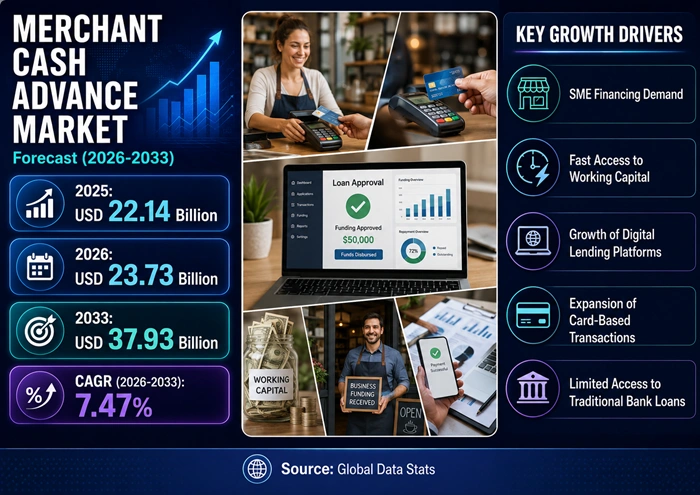
The global merchant cash advance market size is valued at USD 22.14 billion in 2025 and is predicted to increase from USD 23.73 billion in 2026 to approximately USD 37.93 billion by 2033, growing at a CAGR of 7.47% from 2026 to 2033. This consistent growth reflects the expanding base of small and medium-sized businesses (SMEs) worldwide that increasingly rely on alternative financing solutions for fast, flexible working capital access without the delays associated with traditional bank lending.
AI Impact on the Merchant Cash Advance Industry
Artificial Intelligence Is Redefining Risk, Speed, and Scale Across the Entire Merchant Cash Advance Lending Ecosystem
Artificial intelligence is fundamentally transforming the way merchant cash advance providers evaluate creditworthiness and manage risk. AI-powered underwriting models analyze real-time bank transaction histories, credit card sales data, and alternative financial data points to produce risk assessments in minutes rather than days. Machine learning algorithms can detect patterns in business behavior that traditional credit scoring methods often miss, enabling lenders to approve a broader spectrum of businesses while maintaining portfolio quality. Automated document processing and AI-driven CRM systems are eliminating manual workflows, reducing operational costs, and accelerating funding timelines to as little as 24 to 48 hours.
The growing integration of AI into the merchant cash advance sector is also improving fraud detection and portfolio performance monitoring. Predictive analytics tools help lenders anticipate potential defaults by tracking cash flow trends, seasonal performance dips, and industry-level risk indicators in real time. Natural language processing (NLP) is being used to extract useful information from unstructured business documents, while automated alerts help lenders intervene early when repayment patterns shift. As AI capabilities continue to mature, they are expected to make the MCA process faster, more transparent, and significantly more accessible to underserved business segments globally.
Growth Factors
Rising SME Formation, Digital Payment Adoption, and the Decline of Traditional Credit Access Are Collectively Fueling the Market's Upward Trajectory
The most powerful driver behind the growth of the merchant cash advance market is the ongoing global expansion of small and medium enterprises. Banks have been steadily tightening their lending criteria, making it harder for smaller businesses to qualify for conventional loans. This credit gap has created a robust demand for alternative financing tools that offer quick approvals and flexible repayment structures that align with daily revenue performance.
Digital payment adoption is another critical growth factor directly influencing the merchant cash advance industry. As card-based and mobile payment transactions proliferate across retail, hospitality, e-commerce, and service sectors, lenders gain access to more consistent, real-time revenue data. This transactional transparency makes it easier to assess merchant creditworthiness and structure repayments as a fixed percentage of daily sales. The rise of fintech-enabled digital lending platforms, the rapid expansion of e-commerce globally, and increasing government support for financial inclusion are also reinforcing this growth trend, particularly in Asia Pacific and Latin America.
Market Outlook
The Merchant Cash Advance Market Is Positioned for Steady Long-Term Expansion, Supported by Fintech Innovation and Diversifying End-Use Demand
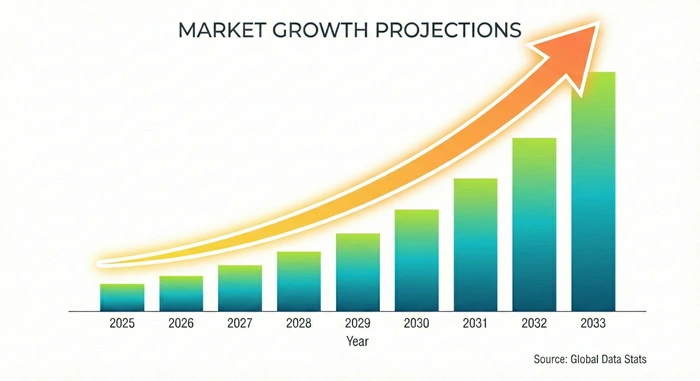
Looking ahead, the merchant cash advance market is expected to maintain consistent momentum through 2033 and beyond. The increasing use of data-driven credit risk assessment, cloud-based lending infrastructure, and embedded finance partnerships will progressively lower barriers to entry for new providers. At the same time, industry-specific MCA products tailored to healthcare, IT, logistics, and travel sectors are expanding the total addressable market. The combination of flexible repayment models and fast approval processes positions MCAs as a preferred short-term financing solution for businesses of all sizes.
Regulatory developments and transparency initiatives are likely to bring greater standardization to the merchant cash advance space, which in turn will foster broader institutional confidence and higher adoption rates. The convergence of open banking frameworks with alternative lending platforms will enable more sophisticated revenue-based underwriting. As more lenders integrate digital payment analytics and automated compliance tools, the overall market is expected to become more competitive, driving innovation in pricing, product design, and customer experience through the forecast period ending in 2033.
Expert Speaks
-
"The acceleration of digital payments and embedded finance is creating an entirely new tier of lending opportunity for businesses that traditional banks have historically underserved. The merchant cash advance model is a direct beneficiary of this structural shift."
— CEO, American Express -
"We are witnessing a fundamental reshaping of the SME financing landscape. Speed, transparency, and flexibility are no longer optional — they are table stakes in alternative lending. Fintech-driven underwriting is making MCA solutions more viable than ever before."
— CEO, PayPal Holdings Inc. -
"Data is the new collateral. As real-time transaction analytics become deeper and more reliable, providers in the cash advance space will be able to offer more competitive terms while managing default risk with much greater precision."
— CEO, Stripe
Key Report Takeaways
-
North America leads the merchant cash advance market with the largest regional revenue share in 2025, driven by a highly developed fintech ecosystem, a dense SME base, and early adoption of AI-based underwriting models
-
Asia Pacific is the fastest-growing region, with countries such as India, China, and Japan driving demand through rapid digitalization, rising smartphone penetration, and growing e-commerce activity supported by government-backed financial inclusion programs
-
Small and medium-sized enterprises (SMEs) are the dominant customer segment, accounting for the majority of MCA demand globally due to limited access to traditional bank credit and a strong need for quick working capital
-
The Retail and E-Commerce application segment contributes the most to market revenue, owing to the high volume of daily card-based transactions, seasonal cash flow fluctuations, and the rapid growth of online sales channels globally
-
The MCA Split repayment method remains the most popular, as it offers businesses a revenue-aligned repayment structure where a fixed percentage of daily credit card sales is automatically deducted, easing pressure during low-revenue periods
-
The Automated Clearing House (ACH) segment is projected to be the fastest-growing repayment method, with an estimated market share exceeding 28% and a CAGR of approximately 9.1% over the 2026–2033 period, driven by its structured, bank-linked repayment efficiency
-
The IT and Telecom segment is emerging as the next high-growth application, with tech-enabled SMEs increasingly seeking short-term capital for software subscriptions, project financing, and operational scaling, making it one of the most dynamic verticals going forward
Market Scope
| Report Coverage | Details |
|---|---|
| Market Size by 2033 | USD 37.93 Billion |
| Market Size by 2025 | USD 22.14 Billion |
| Market Size by 2026 | USD 23.73 Billion |
| Market Growth Rate from 2026 to 2033 | CAGR of 7.47% |
| Dominating Region | North America |
| Fastest Growing Region | Asia Pacific |
| Base Year | 2025 |
| Forecast Period | 2026 to 2033 |
| Segments Covered | Type (by Advance Amount), Repayment Method, Application |
| Regions Covered | North America, Europe, Asia Pacific, Latin America, Middle East & Africa |
Market Dynamics
Drivers Impact Analysis
Surging SME Demand, Digital Payment Growth, and AI-Driven Lending Are the Key Catalysts Propelling the Merchant Cash Advance Market Forward
| Driver | ≈ % Impact on CAGR Forecast | Geographic Relevance | Impact Timeline |
|---|---|---|---|
| Rising SME demand for quick capital access | ~32% | Global, especially North America & Asia Pacific | Immediate – Long-term |
| Growth of card-based and digital payment transactions | ~25% | North America, Europe, Asia Pacific | Short to Long-term |
| AI-powered underwriting and risk assessment | ~20% | North America, Asia Pacific | Medium to Long-term |
| Expansion of fintech-enabled digital lending platforms | ~15% | Asia Pacific, Latin America, MEA | Medium-term |
| Limited access to traditional bank credit | ~8% | Global, especially emerging markets | Immediate – Medium-term |
The merchant cash advance market is primarily driven by the sustained and growing demand from small and medium-sized businesses for fast, flexible, and accessible funding solutions. Traditional banks continue to tighten their credit standards, particularly for newer businesses or those with non-standard revenue streams. This structural credit gap is forcing millions of SMEs across North America, Asia Pacific, and Europe to seek alternative financing options. The merchant cash advance model fills this gap by offering approvals based on future revenue rather than credit history, making it uniquely attractive to businesses in retail, hospitality, and digital commerce that generate consistent daily card sales.
AI-driven underwriting is accelerating this growth trend by dramatically compressing decision timelines and improving the quality of lending decisions. Providers can now analyze thousands of data variables — from transaction frequency to social media activity — to assess a merchant's creditworthiness in real time. The integration of AI tools with digital payment analytics and cloud-based CRM platforms is helping lenders scale faster while managing default risk more effectively. As the fintech ecosystem continues to mature, particularly in high-growth regions like Southeast Asia and Latin America, the market is expected to attract both new entrants and established financial institutions seeking exposure to the alternative lending space.
Restraints Impact Analysis
High Factor Costs, Regulatory Scrutiny, and Repayment Risk Are Creating Headwinds That Could Moderate the Market's Growth Pace
| Restraint | ≈ % Impact on CAGR Forecast | Geographic Relevance | Impact Timeline |
|---|---|---|---|
| High effective cost of capital (factor rates) | ~35% | Global | Immediate – Long-term |
| Increasing regulatory scrutiny on disclosure | ~28% | North America, Europe | Medium to Long-term |
| Risk of debt traps for overleveraged businesses | ~22% | North America, Latin America | Immediate – Medium-term |
| Lack of standardized industry regulations | ~15% | Global, especially emerging markets | Medium-term |
One of the most significant restraints in the merchant cash advance market is the relatively high cost of capital associated with MCA products. Unlike traditional loans with fixed annual percentage rates (APRs), MCAs operate on factor rates that can translate into very high effective interest costs when expressed over an annualized period. This creates a barrier for financially sophisticated borrowers who may prefer more cost-effective alternatives once they qualify for conventional financing. The reputational risk of high-cost lending has also attracted regulatory attention, particularly in the United States and the European Union, where authorities are considering stricter disclosure requirements and interest rate caps for alternative lending products.
Regulatory uncertainty represents a growing risk for established players and new entrants alike. The merchant cash advance industry has traditionally operated in a gray area between commercial lending and commercial transactions, but regulatory bodies are increasingly pushing for clearer classification and transparency obligations. While this may lead to a more credible and better-regulated market in the long term, short-term compliance costs and operational adjustments could slow growth in key markets. Providers that proactively adopt transparent pricing, standardized disclosures, and ethical underwriting practices are likely to gain a competitive edge as the regulatory landscape evolves.
Opportunities Impact Analysis
Emerging Markets, Embedded Finance, and Industry-Specific MCA Products Present Multi-Billion Dollar Opportunities for Market Expansion
| Opportunity | ≈ % Impact on CAGR Forecast | Geographic Relevance | Impact Timeline |
|---|---|---|---|
| Expansion into underserved emerging markets | ~38% | Asia Pacific, Latin America, MEA | Medium to Long-term |
| Embedded finance and API-driven MCA integration | ~30% | Global, led by North America | Short to Long-term |
| Industry-specific MCA product development | ~20% | Global | Medium-term |
| Strategic fintech partnerships and acquisitions | ~12% | North America, Europe, Asia Pacific | Immediate – Medium-term |
The untapped potential across emerging markets represents one of the most compelling opportunities for the merchant cash advance market over the 2026–2033 forecast period. Countries across Southeast Asia, Sub-Saharan Africa, and Latin America are experiencing rapid SME growth alongside surging digital payment adoption, yet access to formal credit remains highly restricted. MCA providers that can adapt their underwriting models to mobile payment data and digital transaction records — rather than relying on traditional banking history — stand to capture significant first-mover advantages in these high-growth regions.
Embedded finance is reshaping how MCA products reach end customers, creating powerful new distribution channels. Platforms such as e-commerce marketplaces, point-of-sale systems, payroll processors, and accounting software providers are increasingly integrating merchant cash advance offerings directly into their core products. This approach allows MCA providers to access pre-qualified, data-rich merchant bases at significantly lower customer acquisition costs. As open banking frameworks expand globally and API-based financial infrastructure becomes more accessible, the merchant cash advance market is likely to see strong growth through embedded partnerships that bring alternative lending solutions directly to where businesses already manage their finances.
Segment Analysis
By Repayment Method
The MCA Split Segment Continues to Dominate While the ACH Repayment Method Emerges as the Fastest-Growing Alternative Among Technology-Driven Lenders and Borrowers
The MCA Split repayment method held the largest share of the merchant cash advance market in 2025, accounting for approximately 45% of total market revenue. This segment's dominance stems from its inherent alignment between repayment obligations and business revenue cycles. Under the split funding model, a fixed percentage of daily credit card or debit card sales is automatically remitted to the MCA provider, meaning that when a business earns more, it repays faster, and during slower periods, the repayment amounts naturally decline. This flexibility makes MCA Split particularly attractive to businesses in retail, food service, and hospitality, where revenue can fluctuate significantly by season or week. In North America, where card-based transactions account for the vast majority of consumer spending, the MCA Split model has found its deepest penetration, with providers like Square Capital, PayPal Working Capital, and CAN Capital leading this sub-segment. The region holds approximately 38% of the global MCA Split segment share, driven by mature payment infrastructure and high merchant terminal density.
The Automated Clearing House (ACH) repayment method is projected to grow at the fastest CAGR of approximately 9.1% from 2026 to 2033, reflecting a fundamental shift in how businesses and merchant cash advance providers approach repayment structuring. The ACH method involves fixed daily or weekly withdrawals from the merchant's bank account, offering predictability that appeals to lenders managing large portfolios. This repayment approach is gaining significant traction in Asia Pacific, where the expansion of digital banking infrastructure and government-led financial inclusion initiatives are accelerating the adoption of structured lending products. India, China, and Australia are key markets where ACH-based MCAs are growing rapidly, driven by the proliferation of fintech platforms and the increasing integration of real-time payment rails. Companies such as Fundbox, Credibly, and OnDeck Capital have been particularly active in expanding their ACH-based MCA product lines to cater to tech-savvy SME borrowers who prefer structured, bank-linked repayment over sales-linked deductions.
By Application
The Retail and E-Commerce Segment Leads the Market While IT and Telecom Emerges as a High-Growth Vertical Reshaping the Future of MCA Demand
The Retail and E-Commerce application segment is the dominant revenue contributor in the merchant cash advance market, holding approximately 34% of total market share in 2025. This leadership position is directly tied to the structural characteristics of the retail industry — high daily transaction volumes, card-based sales, seasonal demand spikes, and frequent inventory financing needs. Retailers and online merchants represent ideal MCA customers because their daily revenue streams provide lenders with clear, trackable repayment sources. The explosive growth of online commerce platforms across the United States, the United Kingdom, China, and India has expanded this segment substantially, as digital-native merchants frequently require short-term capital for advertising campaigns, inventory buildup ahead of peak seasons, and platform expansion. In the Asia Pacific region, where e-commerce penetration has grown dramatically over the past five years, players such as Lendio, Stripe Capital, and YouLend are actively pursuing retail merchants through embedded marketplace financing programs. The segment is expected to maintain a CAGR of approximately 7.8% through 2033.
The IT and Telecom application segment is positioned as the most dynamic and fastest-growing vertical within the merchant cash advance market, with an expected CAGR exceeding 10% from 2026 to 2033. Tech-enabled small businesses, software development firms, and telecom resellers regularly require short-term capital for software licenses, infrastructure upgrades, and project-based staffing — all needs that do not align well with traditional loan timelines. North America leads this segment, with Silicon Valley-adjacent SMEs and mid-market tech firms increasingly turning to MCA providers for bridge financing between contract milestones and client payment cycles. However, Asia Pacific is quickly emerging as a high-growth geography, where the expansion of India's IT startup ecosystem and Southeast Asia's growing SaaS sector are creating a large pool of tech SMEs that prefer fast, flexible financing over conventional banking products. Companies like Rapid Finance, Kabbage, and Biz2Credit are expanding their technology-sector MCA offerings to capitalize on this opportunity, providing structured short-term advances backed by contract receivables and digital transaction data.
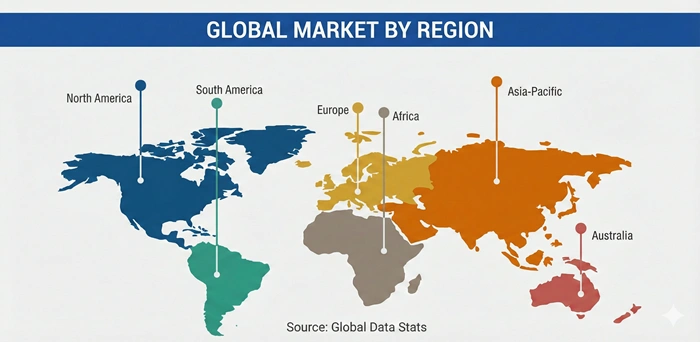
Regional Insights
Regional Growth Patterns in the Merchant Cash Advance Market Are Shaped by Digital Infrastructure Maturity, SME Density, and Evolving Alternative Lending Ecosystems Across Geographies
North America
North America holds the dominant position in the global merchant cash advance market, accounting for approximately 40% of total market revenue in 2025. The region's leadership is underpinned by a highly advanced fintech ecosystem, deep card-based transaction infrastructure, and a dense base of small and medium-sized businesses that regularly require short-term capital. The United States is the single largest country market globally, home to key players such as PayPal Working Capital, Square Capital, CAN Capital, OnDeck Capital, Fundbox, Credibly, Lendio, Rapid Finance, and National Business Capital, among others. These companies have built sophisticated AI-driven underwriting platforms that can assess merchant creditworthiness within hours and disburse funds within 24 to 48 hours. North America is expected to maintain a CAGR of approximately 6.8% from 2026 to 2033, supported by continuous fintech innovation, the growth of embedded finance partnerships, and increasing regulatory clarity around alternative lending disclosures.
Asia Pacific
Asia Pacific is the fastest-growing region in the merchant cash advance market and is projected to record the highest CAGR of approximately 9.6% from 2026 to 2033. The region's growth is driven by a massive and rapidly expanding SME sector, accelerating digital payment adoption, high smartphone penetration, and a growing appetite for alternative financing solutions among businesses that face significant barriers to traditional bank credit. China, India, Japan, South Korea, and Australia are the key markets, with India and China emerging as the most dynamic growth engines. In India, government-led digital payment initiatives and the rapid expansion of UPI-based fintech platforms are creating new data streams that MCA providers can leverage for credit assessment. In China, the combination of a large tech-enabled merchant base and an extensive digital commerce ecosystem is supporting rapid MCA adoption. Regional players such as CAN Capital's Asia-Pacific partners, PhonePe (through its SMFG collaboration), and local fintech firms are actively building out MCA infrastructure to serve this fast-growing demand base.
Report Customization by Region and Country
Unlock Tailored Market Intelligence for Your Specific Geography — Because One-Size-Fits-All Data Rarely Drives Precision Business Decisions
This report on the merchant cash advance market is available with comprehensive region-wise and country-wise customization to deliver granular insights specific to your target geography. Each customized report includes detailed market analysis, regional growth trends, competitive landscape assessments, investment opportunities, and demand-supply dynamics tailored to the selected market.
Customized reports are available for all the following regions and countries:
North America
-
Detailed merchant cash advance market analysis available for the U.S., Canada, and Mexico, including country-level revenue data, key player profiles, regulatory environment analysis, and growth forecasts through 2033
Europe
-
Customized regional insights available for the U.K., Germany, France, Italy, and Rest of Europe, covering fintech adoption trends, SME financing demand, and country-specific competitive landscapes
Asia Pacific
-
Country-level customization available for China, India, Japan, South Korea, Australia, and Rest of Asia Pacific, with detailed coverage of digital payment ecosystem development, government policy impacts, and alternative lending growth drivers
Latin America
-
Tailored market reports available for Brazil, Argentina, and Rest of Latin America, highlighting the expanding entrepreneurial ecosystem, rising fintech penetration, and demand for short-term business financing
Middle East & Africa
-
Geography-specific customization available for the UAE, Saudi Arabia, and Rest of MEA, with insights into Vision 2030 economic reform impacts, digital banking growth, and SME financing market maturity
Top Key Players
-
American Express Company (United States)
-
PayPal Holdings Inc. (United States)
-
Stripe Capital Inc. (United States)
-
Square Capital LLC (Block, Inc.) (United States)
-
OnDeck Capital Inc. (United States)
-
CAN Capital Inc. (United States)
-
Lendio Inc. (United States)
-
Kabbage Inc. (American Express) (United States)
-
Fundbox Inc. (United States)
-
Credibly Holdings LLC (United States)
-
Rapid Finance (United States)
-
Fora Financial LLC (United States)
-
YouLend (United Kingdom)
-
National Business Capital & Services (United States)
-
Libertas Funding LLC (United States)
-
Kalamata Capital Group LLC (United States)
-
Greenbox Capital LLC (United States)
-
Biz2Credit Inc. (United States)
Recent Developments
-
In September 2025, SMFG India Credit Company (SMICC) entered into a strategic partnership with PhonePe to provide collateral-free merchant cash advance products to micro merchants on PhonePe's 45-million-strong merchant network. The collaboration integrates digital transaction data with structured credit underwriting to enhance funding speed and accessibility for Tier 2 and Tier 3 merchants across India.
-
In November 2024, Ocrolus, a leader in AI-driven financial document automation, announced a strategic partnership with LendSaaS, a leading MCA origination and servicing platform. This integration brought Ocrolus's AI-powered cash flow analytics, document analysis, and fraud detection capabilities directly into the LendSaaS platform, enabling faster and more accurate merchant cash advance funding decisions.
-
In June 2023, Amazon Inc. partnered with YouLend to launch a merchant cash advance program in the United Kingdom, offering eligible UK-based Amazon sellers funding from £500 to £2 million with repayments tied to a percentage of future sales, a single fixed fee, and no fixed repayment term — delivering a fully embedded financing experience for marketplace merchants.
-
In July 2024, data confirmed that the United States had over 34.75 million small businesses, reinforcing the depth of the domestic MCA addressable market and prompting several leading providers to expand their product portfolios with new SME-focused advance tiers.
-
In 2025, multiple MCA providers accelerated their investments in AI-driven underwriting infrastructure, with companies including Fundbox, Credibly, and OnDeck expanding their machine learning-based risk scoring models to include real-time bank transaction histories and alternative data sources, aiming to reduce funding timelines and improve portfolio default rates across their merchant cash advance product lines.
Market Trends
Technological Innovation, Embedded Finance Integration, and Diversification Into New Industry Verticals Are Defining the Next Phase of Market Evolution for Merchant Cash Advance Providers
The merchant cash advance market is undergoing a fundamental transformation driven by three converging trends: AI-powered underwriting, embedded finance integration, and cross-industry diversification. Lenders are increasingly deploying machine learning models that analyze real-time transactional data, behavioral indicators, and alternative credit signals to make faster and more accurate funding decisions. Flexible, revenue-aligned MCA products are replacing rigid loan structures, and cloud-based platforms are enabling providers to serve business customers anywhere in the world. The growing preference for short-term, no-collateral working capital solutions over traditional bank loans is reinforcing this shift, particularly among digital-first businesses in retail, technology, and healthcare that require agile financing models.
At the same time, the merchant cash advance market is witnessing increasing convergence with broader fintech ecosystems. E-commerce platforms, payment processors, accounting software companies, and payroll providers are embedding MCA products directly into their service offerings, creating seamless financing experiences for merchants without requiring them to approach standalone lenders. This trend toward embedded lending is dramatically reducing customer acquisition costs for MCA providers and opening new distribution channels in underserved geographies. Regulatory developments across North America, Europe, and Asia Pacific are gradually introducing greater transparency into the alternative lending space, which is expected to build consumer trust and ultimately accelerate market adoption over the 2026–2033 forecast period.
Segments Covered in the Report
By Type (Advance Amount)
-
$5,000–$250,000 (Small-Scale Merchant Cash Advances, Short-Term Cash Advances)
-
$250,000–$500,000 (Medium-Scale Merchant Cash Advances, Mid-Term Cash Advances)
-
More Than $500,000 (Large-Scale Merchant Cash Advances, Long-Term Cash Advances)
By Repayment Method
-
MCA Split
-
Automated Clearing House (ACH)
-
MCA Lockbox
By Application
-
Retail and E-Commerce
-
Healthcare
-
Manufacturing
-
Travel and Hospitality
-
Energy and Utilities
-
Information Technology (IT) and Telecom
-
Other Applications
By Region
-
North America (U.S., Canada, Mexico)
-
Europe (U.K., Germany, France, Italy, Rest of Europe)
-
Asia Pacific (China, India, Japan, South Korea, Australia, Rest of Asia Pacific)
-
Latin America (Brazil, Argentina, Rest of Latin America)
-
Middle East & Africa (UAE, Saudi Arabia, Rest of MEA)
❝ Built for Every Level — From Startups to Industry Giants ❞
Here Is Exactly How This Report Works for You
-
Whether you are a startup evaluating market entry points, a mid-level company benchmarking against competitors, or a Tier 1 institution tracking alternative lending trends globally, this report delivers precise intelligence on merchant cash advance market size, segmental revenue breakdowns, regional growth dynamics, and competitive positioning — giving you the data-driven foundation to make high-confidence investment, expansion, and product decisions with clarity
-
Investors and high-level enterprises will benefit from detailed competitor revenue analysis, funding source breakdowns, geopolitical risk assessments, and supply-demand balance insights that reveal where market gaps and consolidation opportunities exist — allowing you to allocate capital strategically and respond to macro disruptions before they impact your business
-
For companies navigating uncertain market conditions, this report provides a granular understanding of how regulatory changes, cross-border payment infrastructure shifts, and fintech ecosystem dynamics are reshaping demand patterns — empowering decision-makers at every tier to build resilient strategies, optimize their go-to-market approach, and capture growth in the merchant cash advance market across all key geographies through 2033
Frequently Asked Questions
Question 1: What is the current size of the merchant cash advance market and how is it projected to grow through 2033?
Answer: The global merchant cash advance market is valued at USD 22.14 billion in 2025 and is expected to reach USD 37.93 billion by 2033. It is forecast to grow at a CAGR of 7.47% from 2026 to 2033, driven by rising SME demand and expanding digital payment ecosystems.
Question 2: What are the key factors driving growth in the merchant cash advance market?
Answer: The primary growth drivers include limited SME access to traditional bank credit and the rapid expansion of digital payment transactions that enable data-driven underwriting. Additionally, the widespread adoption of AI-powered lending platforms is accelerating approval timelines and improving credit risk management across the merchant cash advance industry.
Question 3: Which region dominates the global merchant cash advance market?
Answer: North America holds the largest revenue share in the merchant cash advance market, accounting for approximately 40% of global revenue in 2025. The region benefits from a mature fintech ecosystem, a high concentration of SMEs, and advanced card-based payment infrastructure that supports seamless MCA repayment models.
Question 4: Which application segment contributes the most to merchant cash advance market revenue?
Answer: The Retail and E-Commerce segment is the largest contributor, holding approximately 34% of the merchant cash advance market share in 2025. This dominance is driven by the high volume of daily card transactions, seasonal capital needs, and the rapid growth of online commerce globally.
Question 5: Who are the top companies operating in the merchant cash advance market?
Answer: Leading companies in the merchant cash advance market include American Express, PayPal Holdings, Stripe Capital, Square Capital, OnDeck Capital, Lendio, Fundbox, Credibly, Rapid Finance, and YouLend. These players are investing heavily in AI-driven underwriting and embedded finance integrations to strengthen their market positions.