
Membrane Separation Technology Market Overview
Technological Innovation and Sustainable Filtration Solutions Drive Global Water Treatment Transformation
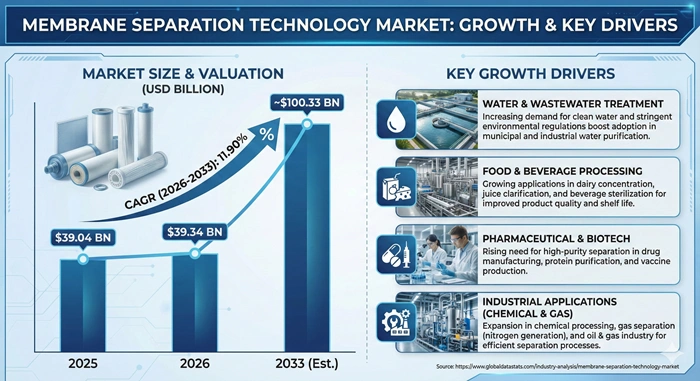
The global membrane separation technology market size is valued at USD 39.04 billion in 2025 and is predicted to increase from USD 39.34 billion in 2026 to approximately USD 100.33 billion by 2033, growing at a CAGR of 11.90% from 2026 to 2033. This industry represents a transformative approach to filtration processes, enabling efficient separation of particles, molecules, and ions from various liquids and gases. The technology employs semi-permeable barriers that selectively allow certain components to pass through while retaining others, making it indispensable across water treatment, pharmaceutical manufacturing, food processing, and industrial applications.
The membrane separation technology market has emerged as a critical solution addressing global challenges related to water scarcity, environmental sustainability, and industrial efficiency. These advanced filtration systems utilize specialized materials such as polymeric and ceramic membranes configured in various module designs to achieve precise separation at molecular levels. The versatility of membrane technology enables diverse applications ranging from desalination of seawater to purification of pharmaceutical compounds, positioning it as a cornerstone technology for sustainable development initiatives worldwide.
AI Impact on the Membrane Separation Technology Industry
Machine Learning Algorithms and Predictive Analytics Transform Membrane Performance Optimization and Fouling Prevention Strategies
Artificial intelligence is revolutionizing the membrane separation technology market by introducing predictive maintenance capabilities, optimized operational parameters, and enhanced material design. Machine learning algorithms analyze vast datasets encompassing membrane performance metrics, water quality parameters, and operational conditions to predict fouling patterns before they significantly impact system efficiency. These AI-driven insights enable operators to implement proactive cleaning protocols, adjust feed pressures dynamically, and optimize chemical dosing strategies, resulting in extended membrane lifespan and reduced operational costs. The integration of neural networks facilitates real-time monitoring of membrane integrity, detecting microscopic defects and performance degradation that traditional monitoring systems might overlook.
Advanced AI applications extend beyond operational optimization to accelerate membrane material innovation within the membrane separation technology market landscape. Computational modeling powered by artificial intelligence simulates molecular interactions between different polymer configurations and target contaminants, dramatically reducing the time and cost associated with developing next-generation membrane materials. Generative adversarial networks create novel membrane architectures with enhanced selectivity, permeability, and chemical resistance tailored to specific industrial applications. Furthermore, AI-enhanced process control systems optimize energy consumption by continuously adjusting transmembrane pressure, crossflow velocity, and recovery rates based on feed water characteristics, contributing to the sustainability objectives driving market expansion.
Growth Factors
Escalating Water Scarcity and Stringent Environmental Regulations Accelerate Membrane Technology Adoption Across Multiple Industries
The membrane separation technology market experiences robust growth propelled by intensifying global water scarcity challenges that compel municipalities and industries to adopt advanced water reuse and desalination solutions. Population growth coupled with climate change has created unprecedented pressure on freshwater resources, particularly in arid regions where conventional water sources prove insufficient to meet agricultural, industrial, and domestic demands. Membrane technologies such as reverse osmosis and nanofiltration provide economically viable pathways to convert brackish water and seawater into potable water supplies, while ultrafiltration and microfiltration systems enable wastewater reclamation for non-potable applications. Government initiatives worldwide prioritize water security through substantial infrastructure investments in membrane-based treatment facilities, creating sustained demand within the membrane separation technology market.
Increasingly stringent environmental regulations governing industrial discharge standards and drinking water quality parameters serve as powerful growth catalysts for the membrane separation technology market. Regulatory agencies worldwide have tightened permissible limits for contaminants including heavy metals, organic compounds, pathogens, and emerging pollutants such as pharmaceuticals and microplastics in treated effluents and drinking water. Membrane separation systems deliver superior contaminant removal compared to conventional treatment methods, enabling industries to achieve compliance with evolving standards while minimizing environmental footprints. The pharmaceutical and biotechnology sectors particularly drive demand for high-purity separation processes, where membrane technologies ensure product quality while meeting Good Manufacturing Practice requirements, thereby expanding market penetration across diverse industrial verticals.

Market Outlook
Technological Advancements and Sustainability Initiatives Position Membrane Solutions as Preferred Filtration Technology Through 2033
The membrane separation technology market outlook remains exceptionally positive as industries increasingly recognize the economic and environmental advantages of membrane-based separation processes over conventional alternatives. Technological innovations continue to address historical limitations such as membrane fouling, limited chemical tolerance, and energy intensity through development of novel materials including ceramic membranes, graphene-enhanced polymers, and biomimetic architectures. These advanced materials exhibit superior mechanical strength, broader pH tolerance, and enhanced fouling resistance, expanding application possibilities into challenging industrial processes previously unsuitable for membrane technology. The shift toward circular economy principles further amplifies demand as companies seek efficient recovery and recycling systems for valuable materials from industrial waste streams.
Investment trends within the membrane separation technology market reflect growing confidence in the technology's long-term viability across multiple sectors. Major water utilities allocate substantial capital expenditures toward membrane infrastructure replacement and capacity expansion to address aging treatment facilities and accommodate population growth. Industrial sectors including oil and gas, mining, and chemical manufacturing integrate membrane systems into zero liquid discharge configurations that eliminate wastewater disposal costs while recovering process chemicals and water for reuse. The convergence of digital technologies with membrane systems enables smart water management platforms that optimize performance across distributed treatment networks, creating new business models centered on membrane-as-a-service offerings that lower entry barriers for smaller municipalities and industries.
Expert Speaks
-
Frederic Van Heems, President and CEO of Veolia North America, emphasized the company's commitment to sustainability: "We are proud to leverage our expertise in energy management solutions to allow our industrial partners to move further towards achieving their sustainability goals while maintaining reliability and competitiveness of their energy use-related processes".
-
Peter Fiske, Executive Director of National Alliance for Water Innovation, highlighted emerging opportunities: "The next big step to get the desalination field where it needs to be in terms of footprint, cost, and sustainability has to involve looking at the membrane separation process with innovative approaches that give membranes the power to keep themselves clean".
-
Arian Edalat, Co-founder and CEO of Active Membranes, articulated the industry's future direction: "Our approach to active membrane technology represents a paradigm shift in addressing fouling challenges, which will significantly reduce operational costs and expand access to clean water for agricultural and industrial applications".
Key Report Takeaways
-
Asia Pacific dominates the membrane separation technology market with the largest regional share of approximately 37%, driven by rapid industrialization, population growth, and significant government investments in water infrastructure development across emerging economies including China, India, and Southeast Asian nations.
-
North America represents the fastest-growing regional market with an anticipated CAGR of 11% through 2033, propelled by infrastructure modernization initiatives, stringent water quality regulations enforced by the Environmental Protection Agency, and substantial adoption across pharmaceutical, food and beverage, and energy sectors.
-
Reverse osmosis technology leads membrane process applications accounting for the dominant market share due to widespread deployment in desalination projects, municipal water purification systems, and industrial wastewater treatment, with projected growth at a CAGR of 12.6% reflecting continued technological refinements and cost reductions.
-
Water and wastewater treatment applications constitute the primary end-use segment capturing over 45% market share, driven by escalating demand for potable water, increasingly stringent discharge regulations, and expanding wastewater reuse initiatives across municipal and industrial sectors worldwide.
-
Pressure-driven membrane technologies dominate the technical landscape representing approximately 60% of market applications, encompassing microfiltration, ultrafiltration, nanofiltration, and reverse osmosis processes that address diverse separation requirements across multiple industries with varying selectivity and energy profiles.
-
Ceramic membranes emerge as the fastest-growing material segment with projected CAGR exceeding 13% through 2033, attributed to superior chemical resistance, thermal stability, and extended operational lifespan that justify higher capital costs for harsh industrial applications including pharmaceutical manufacturing and chemical processing.
Market Scope
| Report Coverage Details | |
|---|---|
| Market Size by 2033 | USD 100.33 Billion |
| Market Size by 2025 | USD 39.04 Billion |
| Market Size by 2026 | USD 39.34 Billion |
| Market Growth Rate from 2026 to 2033 | CAGR of 11.90% |
| Dominating Region | Asia Pacific |
| Fastest Growing Region | North America |
| Base Year | 2025 |
| Forecast Period | 2026 to 2033 |
| Segments Covered | Technology, Material Type, Process, Application, End-Use Industry, Region |
| Regions Covered | North America, Europe, Asia Pacific, Latin America, Middle East & Africa |
Market Dynamics
Drivers Impact Analysis
Accelerating Urban Population Growth and Industrial Expansion Drive Unprecedented Demand for Advanced Water Treatment Infrastructure
| Impact Factor | (≈) % Impact on CAGR Forecast | Geographic Relevance | Impact Timeline |
|---|---|---|---|
| Water Scarcity and Desalination Demand | +3.2% | Middle East, Asia Pacific, North Africa | 2026-2033 |
| Stringent Environmental Regulations | +2.8% | North America, Europe, Developed Asia | 2026-2030 |
| Industrial Wastewater Treatment Requirements | +2.5% | Global, particularly Asia Pacific | 2026-2033 |
| Pharmaceutical and Biotechnology Growth | +1.8% | North America, Europe, Asia Pacific | 2027-2033 |
The membrane separation technology market experiences significant growth momentum driven by acute water scarcity challenges affecting billions of people worldwide, particularly in water-stressed regions where conventional freshwater sources cannot meet escalating demands from expanding populations and industrial activities. Municipal authorities increasingly turn to membrane-based desalination and water reuse systems as cost-effective alternatives to long-distance water conveyance projects or development of new reservoir capacity. The declining cost trajectory of membrane systems coupled with improvements in energy efficiency has made desalination economically competitive with traditional water supply options in many regions, accelerating adoption rates across Middle Eastern, Mediterranean, and Asia Pacific coastal communities facing chronic water deficits.
Stringent environmental regulations mandating reduced contaminant levels in industrial effluents and higher drinking water quality standards propel membrane separation technology market expansion across developed economies. Regulatory agencies continue tightening permissible limits for conventional pollutants while adding new parameters addressing emerging contaminants including pharmaceuticals, personal care products, and microplastics that conventional treatment processes inadequately remove. Membrane technologies such as nanofiltration and reverse osmosis provide robust barriers against diverse contaminant classes, enabling industries to achieve compliance while avoiding penalties and reputational risks associated with environmental violations. The pharmaceutical and food processing industries particularly benefit from membrane systems that simultaneously address water treatment requirements and product purification needs, creating dual value propositions that accelerate technology adoption within the membrane separation technology market landscape.

Restraints Impact Analysis
High Capital Costs and Membrane Fouling Challenges Limit Market Penetration in Price-Sensitive Applications
| Restraint Factor | (≈) % Impact on CAGR Forecast | Geographic Relevance | Impact Timeline |
|---|---|---|---|
| High Initial Capital Investment | -1.5% | Emerging Economies, Small Municipalities | 2026-2029 |
| Membrane Fouling and Replacement Costs | -1.2% | Global, Industrial Applications | 2026-2033 |
| Energy Intensity of Pressure-Driven Systems | -0.8% | Regions with High Energy Costs | 2026-2033 |
| Technical Expertise Requirements | -0.6% | Developing Regions, Remote Locations | 2026-2030 |
The membrane separation technology market faces growth constraints stemming from substantial capital expenditure requirements that pose barriers for smaller municipalities, industries, and developing regions with limited financial resources. Membrane system installations demand significant upfront investments encompassing membrane modules, pressure vessels, pumping equipment, pre-treatment systems, and associated instrumentation that collectively represent multiples of conventional treatment technology costs. While operational savings and superior treatment performance often justify investments over system lifetimes, budget constraints and competing capital priorities frequently delay or prevent membrane technology adoption, particularly in price-sensitive markets where stakeholders prioritize lowest initial cost over total cost of ownership considerations.
Membrane fouling represents a persistent operational challenge that constrains membrane separation technology market growth by increasing maintenance requirements, reducing system productivity, and necessitating periodic membrane replacement. Accumulation of suspended solids, organic matter, biological growth, and mineral scales on membrane surfaces progressively reduces permeate flux, requiring more frequent chemical cleaning cycles that consume resources while causing gradual membrane degradation. Industries processing highly contaminated feed streams encounter accelerated fouling rates that significantly elevate operational costs through increased chemical consumption, energy usage for maintaining production capacity, and shortened membrane lifespan requiring premature replacement. These fouling-related challenges prove particularly problematic in applications lacking adequate pre-treatment infrastructure or handling complex feed compositions that existing membrane materials struggle to process efficiently.
Opportunities Impact Analysis
Emerging Markets and Technological Innovations Create Substantial Growth Avenues for Advanced Membrane Solutions
| Opportunity Factor | (≈) % Impact on CAGR Forecast | Geographic Relevance | Impact Timeline |
|---|---|---|---|
| Circular Economy and Resource Recovery | +2.2% | Europe, North America, Advanced Asia | 2027-2033 |
| Emerging Market Infrastructure Development | +2.0% | India, Southeast Asia, Africa | 2026-2033 |
| Advanced Membrane Material Innovation | +1.5% | Global Technology Hubs | 2028-2033 |
| Smart Membrane Systems Integration | +1.3% | Developed Markets | 2027-2033 |
The membrane separation technology market stands to benefit substantially from growing emphasis on circular economy principles that prioritize resource recovery and reuse over disposal, creating demand for specialized membrane systems capable of extracting valuable materials from waste streams. Industries increasingly recognize economic value embedded in effluents that conventional treatment approaches merely neutralize before discharge, whereas membrane technologies enable selective recovery of metals, chemicals, nutrients, and water for reintegration into production processes. Zero liquid discharge configurations incorporating multiple membrane stages achieve near-complete water recovery while concentrating dissolved solids into manageable volumes for further processing or crystallization, transforming wastewater from liability into asset while simultaneously achieving environmental compliance.
Massive infrastructure development initiatives across emerging economies present exceptional growth opportunities for the membrane separation technology market as governments prioritize water security and environmental protection alongside economic development objectives. Nations including India, Indonesia, Vietnam, and multiple African countries undertake ambitious programs to expand urban water supply systems, construct wastewater treatment facilities, and upgrade industrial effluent management capabilities to support sustainable industrialization. International development organizations and multilateral banks increasingly condition infrastructure financing on adoption of environmentally sound technologies, creating favorable conditions for membrane system deployment. These emerging markets offer substantial long-term growth potential as membrane technology costs continue declining while rising incomes increase willingness to invest in advanced treatment solutions that deliver superior performance and reliability compared to conventional alternatives.

Segment Analysis
By Technology: Reverse Osmosis
Superior Contaminant Rejection and Declining Energy Costs Position Reverse Osmosis as Dominant Membrane Separation Process
Reverse osmosis technology commands the largest share within the membrane separation technology market, accounting for approximately 42% of global revenue, with continued expansion projected at a robust CAGR of 12.6% through 2033. This pressure-driven process utilizes semi-permeable membranes that reject dissolved salts, organic molecules, and microorganisms while allowing water molecules to pass through, achieving contaminant removal efficiencies exceeding 99% for most ionic species. The technology's dominance stems from versatility across diverse applications including seawater desalination, brackish water treatment, industrial process water purification, and wastewater reuse, where exceptional product water quality justifies higher operating pressures compared to other membrane processes. Asia Pacific leads reverse osmosis adoption with substantial market concentration in desalination-dependent Middle Eastern nations and rapidly industrializing economies including China and India, where membrane separation technology market growth addresses water scarcity through large-scale desalination facilities and industrial water recycling systems.
Leading manufacturers including DuPont, Toray Industries, Hydranautics, and LG Chem continuously advance reverse osmosis membrane performance through innovations in membrane chemistry, module design, and system configuration that reduce energy consumption while maintaining rejection rates. Recent developments include ultra-low pressure membranes requiring 20-30% less energy than conventional products, high-rejection membranes targeting specific contaminants like boron and silica, and fouling-resistant surface modifications that extend cleaning intervals. North American membrane separation technology market participants particularly emphasize reverse osmosis for municipal water treatment upgrades addressing emerging contaminants and stringent drinking water standards, while European applications focus on industrial process optimization and zero liquid discharge configurations. The technology's market leadership continues strengthening as energy recovery devices, advanced pre-treatment strategies, and intelligent control systems progressively reduce operational costs, expanding economic viability into applications previously considered marginal for membrane treatment approaches.
By Material: Ceramic Membranes
Exceptional Durability and Chemical Resistance Drive Ceramic Membrane Adoption in Harsh Industrial Applications
Ceramic membranes represent the fastest-growing material segment within the membrane separation technology market, projected to expand at a CAGR exceeding 13% through 2033, despite currently accounting for a smaller market share of approximately 18% compared to polymeric alternatives. These inorganic membranes fabricated from materials including alumina, titania, zirconia, and silicon carbide exhibit exceptional chemical stability across extreme pH ranges, withstand operating temperatures exceeding 400°C, and demonstrate mechanical robustness that enables harsh cleaning protocols impossible with polymeric membranes. The superior durability characteristics translate into extended operational lifetimes often exceeding ten years with minimal performance degradation, justifying substantially higher capital costs through reduced membrane replacement frequency and enhanced process reliability in demanding industrial environments.
Pharmaceutical manufacturing, chemical processing, and food and beverage industries drive ceramic membrane adoption within the membrane separation technology market due to stringent quality requirements and aggressive operating conditions that rapidly degrade conventional polymeric membranes. European manufacturers lead ceramic membrane production and application development, with significant market concentration in Germany, France, and the Netherlands where pharmaceutical and specialty chemical industries demand validated separation processes for high-value products. Asia Pacific emerges as the fastest-growing regional market for ceramic membranes, particularly in China and India where pharmaceutical manufacturing expansion and environmental regulation enforcement create demand for robust treatment solutions. Key industry participants including Pall Corporation, Metawater, and Jiangsu Jiuwu Hi-Tech invest heavily in ceramic membrane technology refinement, developing asymmetric structures with selective layers achieving nanofiltration and ultrafiltration performance while maintaining the mechanical advantages of ceramic materials that position this segment for continued rapid growth within the broader membrane separation technology market landscape.

Regional Insights
Asia Pacific
Rapid Industrialization and Water Infrastructure Investment Establish Asia Pacific as Dominant Membrane Technology Market
Asia Pacific dominates the membrane separation technology market with commanding market share of approximately 37%, driven by extraordinary industrial expansion, massive population concentrations, and acute water scarcity challenges that compel governments and industries to adopt advanced treatment solutions. The region encompasses diverse economies at different development stages, with China, Japan, and South Korea representing mature markets characterized by technology innovation and high-value applications, while India, Indonesia, Vietnam, and emerging Southeast Asian nations exhibit rapid growth as infrastructure development accelerates. Water stress affects hundreds of millions across the region, particularly in northern China, northwestern India, and densely populated river deltas where groundwater depletion and surface water pollution necessitate alternative water sources accessible only through membrane treatment technologies.
China leads regional membrane separation technology market expansion, accounting for over 45% of Asia Pacific revenue, with massive investments in municipal wastewater treatment infrastructure, industrial effluent management systems, and desalination capacity to address environmental degradation and water security concerns. Government mandates requiring industrial wastewater recycling and strict enforcement of discharge standards drive membrane adoption across textile, chemical, electronics, and pharmaceutical sectors concentrated in coastal provinces. India represents the fastest-growing national market within Asia Pacific, expanding at CAGR approaching 14% as Smart Cities initiatives, Namami Gange river restoration programs, and industrial pollution control measures create substantial demand for membrane systems. Major international players including DuPont, Toray, Nitto Denko, and Veolia maintain significant manufacturing and engineering presence across Asia Pacific, while regional manufacturers such as Origin Water, Memstar, and Econity increasingly compete in cost-sensitive market segments, collectively positioning Asia Pacific for continued membrane separation technology market leadership throughout the forecast period.
North America
Infrastructure Modernization and Regulatory Stringency Drive North America as Fastest-Growing Regional Market
North America emerges as the fastest-growing regional membrane separation technology market with projected CAGR of 11% through 2033, propelled by aging water infrastructure replacement needs, increasingly stringent water quality regulations, and substantial industrial adoption across diverse sectors. The United States dominates regional market activity with mature water utility sector undertaking comprehensive infrastructure modernization programs that increasingly favor membrane technologies over conventional treatment processes for reliability, footprint efficiency, and superior contaminant removal capabilities. Regulatory drivers including Environmental Protection Agency drinking water standards, state-level restrictions on industrial discharge parameters, and emerging contaminant regulations targeting PFAS, pharmaceuticals, and microplastics create compelling technical and compliance rationales for membrane system deployment across municipal and industrial applications.
The United States membrane separation technology market specifically exhibits robust growth at CAGR of 10.5%, with California, Texas, Florida, and southwestern states leading adoption due to water scarcity, population growth, and extensive experience with membrane technologies including operating the Western Hemisphere's largest seawater desalination plants. Industrial sectors including oil and gas, food and beverage, pharmaceuticals, and electronics manufacturing extensively deploy membrane systems for process water treatment, produced water management, and high-purity water production, with significant market concentration in Gulf Coast petrochemical complexes and biopharmaceutical hubs in Boston, San Francisco, and Research Triangle regions. Canada contributes meaningfully to North American membrane separation technology market growth through mining industry wastewater treatment, municipal system upgrades, and food processing applications. Leading market participants including DuPont, 3M, Pall Corporation, Evoqua Water Technologies, and Pentair maintain substantial North American operations encompassing manufacturing, research and development, and comprehensive service networks that support continued regional market expansion through technological innovation and superior customer support capabilities.
Top Key Players
-
DuPont (United States)
-
Toray Industries, Inc. (Japan)
-
Veolia Water Technologies & Solutions (France)
-
SUEZ Water Technologies & Solutions (France)
-
3M Company (United States)
-
Nitto Denko Corporation (Japan)
-
Pall Corporation (United States)
-
Koch Membrane Systems (United States)
-
Asahi Kasei Corporation (Japan)
-
Evoqua Water Technologies (United States)
-
Pentair plc (United Kingdom)
-
Hydranautics (United States)
-
GEA Group Aktiengesellschaft (Germany)
-
Evonik Industries (Germany)
-
LG Chem (South Korea)
Recent Developments
-
DuPont (2024): Completed strategic acquisition of specialized membrane technology firm to expand product portfolio and strengthen position in pharmaceutical separation applications, enabling enhanced offerings for biopharmaceutical manufacturing and high-purity water production markets.
-
Veolia and Siemens Energy (2024): Formed strategic partnership to jointly develop and commercialize advanced membrane technologies specifically targeting industrial water treatment and wastewater reuse projects, combining Siemens Energy's membrane expertise with Veolia's global operational capabilities.
-
Air Liquide (2025): Finalized acquisition of Membranes et Produits Chimiques (MPC), a French membrane technology specialist, for €240 million to strengthen market position in gas separation and water treatment applications, expanding capabilities in industrial gas purification.
-
Toray Industries (2025): Launched industry-leading reverse osmosis membrane featuring doubled chemical resistance and 10% reduced energy consumption through ultra-low pressure drop design, addressing customer demands for enhanced durability and operational cost reduction.
-
DuPont and Veolia Partnership (2022): Successfully completed long-term collaboration converting DuPont Spruance facility utility infrastructure from coal to natural gas, demonstrating membrane technology applications in sustainable industrial transformation and achieving 50% greenhouse gas emission reductions.
Market Trends
Integration of Smart Technologies and Sustainable Materials Transform Membrane System Capabilities and Market Dynamics
The membrane separation technology market experiences transformative trends centered on digitalization, sustainability, and advanced materials that collectively reshape industry practices and competitive dynamics. Internet of Things sensors, cloud computing platforms, and artificial intelligence algorithms integrate into membrane systems to enable real-time performance monitoring, predictive maintenance scheduling, and autonomous optimization of operating parameters including pressure, recovery rate, and cleaning protocols. These smart membrane systems generate continuous performance data streams that operators analyze to identify efficiency improvement opportunities, diagnose incipient failures before catastrophic breakdowns occur, and optimize chemical consumption while extending membrane lifespan. The digitalization trend particularly resonates with large industrial users and sophisticated municipal utilities seeking to maximize return on capital investments through operational excellence enabled by data-driven decision making that was previously impossible with conventional monitoring approaches limited to periodic manual measurements.
Sustainability considerations increasingly influence membrane separation technology market development as manufacturers respond to customer demands and regulatory pressures by developing environmentally responsible products and processes. Innovations include bio-based membrane materials derived from renewable feedstocks, energy-efficient module designs that reduce pumping requirements, and membrane chemistries that tolerate gentler cleaning agents reducing environmental impact of chemical discharges. Circular economy principles drive adoption of membrane systems for resource recovery applications where valuable materials including metals, nutrients, and chemicals are extracted from waste streams for beneficial reuse rather than disposal. The convergence of economic and environmental value propositions positions membrane technologies as preferred solutions for industries pursuing sustainability objectives while maintaining competitiveness, creating market opportunities that extend beyond traditional water treatment applications into diverse industrial processes where separation efficiency directly impacts environmental footprints and operating costs throughout the forecast period.
Segments Covered in the Report
By Technology
-
Pressure-Driven Membranes
-
Concentration-Driven Membranes
-
Electrically-Driven Membranes
By Material Type
-
Polymeric Membranes
-
Ceramic Membranes
-
Composite Membranes
By Process
-
Microfiltration
-
Ultrafiltration
-
Nanofiltration
-
Reverse Osmosis
-
Electrodialysis
-
Pervaporation
By Application
-
Water and Wastewater Treatment
-
Food and Beverage Processing
-
Pharmaceutical and Biotechnology
-
Chemical Processing
-
Gas Separation
-
Others
By End-Use Industry
-
Municipal Water Treatment
-
Industrial Manufacturing
-
Food and Beverage
-
Pharmaceuticals
-
Oil and Gas
-
Power Generation
-
Others
By Region
-
North America (United States, Canada, Mexico)
-
Europe (Germany, France, United Kingdom, Italy, Spain, Rest of Europe)
-
Asia Pacific (China, Japan, India, South Korea, Australia, Southeast Asia, Rest of Asia Pacific)
-
Latin America (Brazil, Argentina, Rest of Latin America)
-
Middle East & Africa (Saudi Arabia, UAE, South Africa, Rest of MEA)
Frequently Asked Questions
Question 1: What is the projected size of the membrane separation technology market by 2033?
Answer: The global market is expected to reach approximately USD 100.33 billion by 2033, growing from USD 39.34 billion in 2026. This substantial expansion reflects increasing adoption across water treatment, industrial processing, and pharmaceutical applications worldwide.
Question 2: Which region dominates the membrane separation technology market currently?
Answer: Asia Pacific leads the market with approximately 37% share, driven by rapid industrialization, population growth, and significant infrastructure investments in countries like China, India, and Southeast Asian nations. Water scarcity challenges and stringent environmental regulations further accelerate regional membrane technology adoption.
Question 3: What are the primary drivers of membrane separation technology market growth?
Answer: Key growth drivers include escalating water scarcity, stringent environmental regulations, increasing industrial wastewater treatment requirements, and expanding pharmaceutical manufacturing activities. These factors collectively create sustained demand for advanced membrane filtration solutions across multiple industries globally.
Question 4: Which membrane separation technology process holds the largest market share?
Answer: Reverse osmosis dominates the process segment with approximately 42% market share due to superior contaminant rejection capabilities and versatile applications in desalination, water purification, and industrial processing. The technology continues expanding through energy efficiency improvements and declining operational costs.
Question 5: How does AI impact the membrane separation technology market development?
Answer: Artificial intelligence enhances membrane system performance through predictive maintenance, optimized operating parameters, and accelerated material innovation. AI algorithms analyze performance data to prevent fouling, extend membrane lifespan, and reduce operational costs across diverse applications.