
Medical Clothing Market Overview
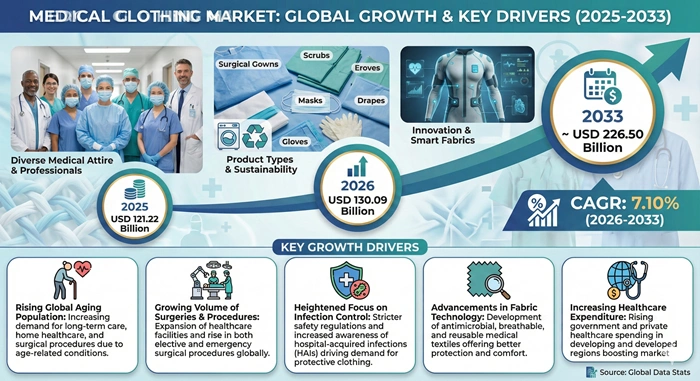
The global medical clothing market size is valued at USD 121.22 billion in 2025 and is predicted to increase from USD 130.09 billion in 2026 to approximately USD 226.50 billion by 2033, growing at a CAGR of 7.10% from 2026 to 2033.
Medical clothing encompasses specialized protective apparel designed for healthcare professionals and patients across clinical settings, including surgical scrubs, gowns, drapes, lab coats, patient examination garments, and other essential medical textiles. These garments serve critical functions including infection prevention, cross-contamination control, professional appearance maintenance, and patient comfort throughout medical procedures and daily healthcare operations. Healthcare facilities worldwide prioritize medical clothing as fundamental components of comprehensive infection control protocols, staff safety programs, and quality patient care delivery systems addressing evolving regulatory requirements and hygiene standards.
AI Impact on the Medical Clothing Industry
Transforming Supply Chain Management and Design Innovation Through Predictive Analytics and Smart Textile Technologies
Artificial intelligence revolutionizes the medical clothing market by introducing sophisticated inventory management systems that predict apparel consumption patterns across healthcare facilities based on historical usage data, seasonal variations, patient admission rates, and surgical procedure schedules, optimizing stock levels while minimizing wastage and preventing critical shortages. Machine learning algorithms analyze staff preferences, body measurements, and comfort feedback to recommend personalized uniform sizing and style selections, reducing return rates and improving healthcare worker satisfaction with their professional attire. AI-powered quality control systems inspect manufacturing processes using computer vision technologies that detect fabric defects, improper stitching, and contamination risks before products reach healthcare facilities, ensuring consistent quality standards and regulatory compliance across production batches. These technological innovations enable manufacturers to respond dynamically to demand fluctuations, customize products efficiently, and maintain rigorous safety standards required throughout medical textile production.
Smart textile development leveraging artificial intelligence incorporates embedded sensors monitoring environmental conditions, detecting body temperature changes, tracking movement patterns, and alerting wearers to potential contamination exposures through connected mobile applications. The medical clothing market benefits from AI-driven design optimization tools that analyze ergonomic requirements, durability testing results, and user experience feedback to develop improved garment patterns offering enhanced mobility, comfort, and protection during extended clinical shifts. Predictive maintenance algorithms assess hospital laundry equipment performance, schedule preventative service before breakdowns occur, and optimize washing protocols to extend medical garment lifecycles while maintaining antimicrobial effectiveness and fabric integrity. Natural language processing technologies analyze customer reviews, complaint patterns, and social media discussions to identify emerging product deficiencies, feature requests, and satisfaction drivers informing future development priorities throughout the competitive medical apparel landscape.
Growth Factors
Rising Infection Control Awareness and Healthcare Infrastructure Expansion Drive Robust Medical Clothing Market Growth
The medical clothing market experiences accelerated growth propelled by heightened global awareness regarding healthcare-associated infection prevention following the COVID-19 pandemic, which demonstrated critical importance of proper protective equipment and standardized apparel protocols across medical facilities worldwide. Healthcare organizations implement stringent infection control policies requiring regular uniform changes, disposable garment usage for high-risk procedures, and antimicrobial fabric specifications addressing concerns about pathogen transmission through contaminated clothing. Hospital accreditation standards and regulatory agencies including WHO, CDC, and national health authorities mandate comprehensive personal protective equipment programs incorporating appropriate medical clothing as fundamental infection prevention components. The market gains tremendous momentum from increasing surgical procedure volumes globally, driven by aging populations, rising chronic disease prevalence, expanding healthcare access in emerging economies, and advancing medical technologies enabling previously impossible interventions requiring specialized protective apparel.
Healthcare infrastructure development across Asia-Pacific, Latin America, Middle East, and African regions creates substantial demand as newly constructed hospitals, clinics, and specialized treatment centers require complete medical clothing inventories for staff uniforms, patient garments, and procedural protective equipment. The medical clothing market benefits from growing healthcare workforce populations worldwide, with millions of new doctors, nurses, technicians, and support staff entering profession annually requiring multiple uniform sets for daily rotations and backup needs. Rising healthcare expenditure globally enables facilities to invest in quality medical apparel moving beyond basic functionality toward premium products offering enhanced comfort, durability, antimicrobial properties, and professional aesthetics improving staff satisfaction and patient perceptions. Technological fabric innovations deliver improved performance characteristics including moisture-wicking properties, temperature regulation, stain resistance, antimicrobial treatments, and sustainable materials addressing environmental concerns while maintaining infection control effectiveness throughout extended use periods and multiple laundering cycles.

Market Outlook
Strategic Sustainability Initiatives and Product Differentiation Shape Promising Medical Clothing Market Trajectory
The medical clothing market outlook reflects optimistic projections supported by continuing healthcare sector expansion, persistent infection control emphasis, and evolving product innovations addressing comfort, sustainability, and performance requirements. Manufacturers invest substantially in research activities developing advanced textile technologies including nanofiber antimicrobial coatings, biocompatible fabric compositions, and intelligent sensing capabilities embedded directly into garment structures providing real-time health monitoring and contamination alerts. Market dynamics increasingly favor sustainable medical clothing solutions as healthcare organizations respond to environmental concerns by adopting reusable gown programs, biodegradable disposable options, and circular economy models incorporating textile recycling initiatives reducing medical waste volumes while maintaining rigorous safety standards.
The industry witnesses consolidation trends as larger healthcare supply companies acquire specialized medical apparel manufacturers, integrating production capabilities within comprehensive product portfolios serving hospital networks through single-source procurement relationships. The medical clothing market adapts to customization demands from healthcare facilities seeking branded uniforms reflecting organizational identity, color-coded departmental designations, and personalized sizing accommodating diverse staff body types across multicultural workforce populations. Digital commerce expansion transforms distribution channels as online marketplaces, direct-to-consumer platforms, and subscription services enable individual healthcare professionals to purchase personal medical clothing preferences outside institutional procurement systems, creating parallel retail market segments alongside traditional B2B supply channels. Regulatory landscapes continue evolving with enhanced product testing requirements, material composition restrictions eliminating harmful chemicals, and performance specifications ensuring adequate protection levels while accommodating regional compliance variations across international markets requiring manufacturers to maintain multiple product certifications.
Expert Speaks
-
Jason Hollar, CEO of Cardinal Health, emphasized the company's commitment to driving healthcare forward through focused execution on core businesses, stating that investments in at-home solutions including a new Texas distribution center with advanced automation, alongside operational focus on key growth areas, enable Cardinal Health to better serve customers and advance its mission as healthcare's most trusted partner.
-
Brad Mariam, Executive Vice President of Medline Industries, highlighted Medline's commitment to investing in emerging markets through strategic acquisitions like United Medco, expressing confidence that combining expertise positions the company to lead market growth and propel business forward by strengthening health plans offerings and better serving customers and patients across evolving post-acute care environments.
-
Raymond Chiu, Senior Vice President of Research & Development at 3M Health Care Business Group, discussed the company's pride in collaborating with civilian and military partners on infection prevention and wound management solutions, emphasizing that successful treatment requires easy-to-use dressings applicable at injury points, portable transport solutions, and sophisticated hospital-based options supporting patient rehabilitation and reintegration across various settings.
Key Report Takeaways
-
North America leads the medical clothing market with approximately 40 percent regional share, driven by stringent infection control regulations, advanced healthcare infrastructure, high-quality product availability, substantial healthcare expenditure, and strong emphasis on preventing healthcare-associated infections through comprehensive protective apparel protocols implemented across hospitals, surgical centers, and clinical facilities nationwide.
-
Asia-Pacific demonstrates the fastest growth trajectory in the medical clothing market, expanding at a CAGR of approximately 7.8 percent, propelled by rapidly developing healthcare infrastructure, increasing hospital construction, expanding medical workforce populations, rising patient volumes, and government initiatives improving healthcare access across China, India, Southeast Asian nations, and developing economies throughout the region.
-
Hospitals represent the largest end-user segment consuming medical clothing products with approximately 55 percent market share, as these facilities maintain extensive staff populations requiring daily uniform changes, perform high volumes of surgical procedures demanding sterile protective apparel, and implement comprehensive infection prevention programs mandating regular garment replacement cycles across multiple departments and specialties.
-
Surgical scrubs and gowns contribute the most substantial product segment share at approximately 48 percent, driven by universal requirements across operating rooms, emergency departments, intensive care units, and procedural areas where healthcare professionals require standardized protective clothing preventing pathogen transmission, maintaining sterile environments, and ensuring patient safety during medical interventions.
-
Disposable medical clothing dominates usage preferences as the most popular garment type, accounting for approximately 53 percent market share, based on superior infection control assurance through single-use protocols eliminating cross-contamination risks, convenience factors avoiding laundering burdens, and cost-effectiveness for high-volume facilities compared to reusable alternatives requiring extensive cleaning infrastructure.
-
The medical spas and wellness centers end-user segment will experience rapid future growth through 2033, expanding at a CAGR of approximately 8.4 percent and capturing increasing market share percentage as these facilities proliferate globally offering aesthetic treatments, therapeutic services, and preventative care requiring professional medical clothing maintaining clinical credibility while providing comfortable, stylish appearance appealing to wellness-focused clientele.
Market Scope
| Report Coverage Details | |
|---|---|
| Market Size by 2033 | USD 226.50 Billion |
| Market Size by 2025 | USD 121.22 Billion |
| Market Size by 2026 | USD 130.09 Billion |
| Market Growth Rate from 2026 to 2033 | CAGR of 7.10% |
| Dominating Region | North America |
| Fastest Growing Region | Asia-Pacific |
| Base Year | 2025 |
| Forecast Period | 2026 to 2033 |
| Segments Covered | By Product Type, By Usage Type, By End-User, By Distribution Channel, By Region |
| Regions Covered | North America, Europe, Asia-Pacific, Latin America, Middle East & Africa |
Market Dynamics
Drivers Impact Analysis
Escalating Healthcare-Associated Infection Concerns and Regulatory Mandates Propel Sustained Medical Clothing Market Momentum
The medical clothing market benefits tremendously from heightened global awareness regarding healthcare-associated infections affecting millions of patients annually, with studies documenting significant pathogen transmission through contaminated healthcare worker clothing necessitating stringent apparel protocols, regular uniform changes, and antimicrobial fabric specifications throughout clinical environments. Regulatory agencies worldwide implement mandatory guidelines requiring healthcare facilities to establish comprehensive infection prevention programs incorporating standardized medical clothing policies, proper laundering procedures, and documented compliance monitoring systems protecting patient safety and staff health. The COVID-19 pandemic fundamentally reshaped institutional approaches toward protective equipment and medical apparel, creating lasting cultural shifts prioritizing infection control investments, disposable garment adoption, and preparedness for future public health emergencies requiring surge capacity in protective clothing supplies.
Healthcare facility accreditation requirements from organizations including The Joint Commission, DNV Healthcare, and various national certification bodies mandate documented policies governing medical clothing usage, maintenance, and replacement cycles as fundamental quality assurance components. The medical clothing market gains momentum from increasing surgical procedure volumes globally, driven by aging demographics requiring more interventions, expanding access to healthcare services throughout emerging economies, and advancing medical technologies enabling complex surgeries previously considered impossible, all creating substantial demand for sterile surgical apparel. Rising healthcare expenditure worldwide enables institutions to invest beyond basic functional clothing toward premium products incorporating antimicrobial treatments, moisture-wicking fabrics, ergonomic designs, and durable construction extending garment lifecycles while improving healthcare worker comfort during long shifts. Growing healthcare workforce populations create sustained demand as millions of new professionals enter medical fields annually requiring complete uniform sets, with typical recommendations suggesting minimum three to five sets per person enabling daily changes while accommodating laundering cycles and backup needs.
| Driver Factor | ≈ Impact on CAGR Forecast | Geographic Relevance | Impact Timeline |
|---|---|---|---|
| Healthcare-associated infection prevention emphasis | +2.0% to +2.6% | Global, particularly strong in developed healthcare systems | Immediate and ongoing |
| Increasing surgical procedure volumes worldwide | +1.6% to +2.2% | Global with concentration in aging populations | Immediate and long-term |
| Healthcare infrastructure expansion in emerging markets | +1.2% to +1.6% | Primarily Asia-Pacific, Latin America, Middle East, Africa | Short to medium-term |
| Growing healthcare workforce populations | +0.8% to +1.2% | Global, especially regions with nursing shortages | Immediate and ongoing |
Restraints Impact Analysis
Budget Constraints and Sustainability Concerns Moderate Medical Clothing Market Growth Expectations
The medical clothing market confronts significant challenges from healthcare budget pressures affecting facility purchasing decisions, particularly impacting smaller hospitals, rural clinics, and resource-limited settings in developing countries where medical apparel represents discretionary spending competing against critical equipment, pharmaceuticals, and staffing investments. Economic constraints encourage extended garment usage beyond recommended replacement cycles, reduced per-person uniform allocations, and preference for lower-cost alternatives potentially compromising quality, comfort, and protective effectiveness as facilities prioritize immediate cost savings over long-term staff satisfaction and infection prevention benefits. The market experiences headwinds from reimbursement challenges as medical clothing expenses typically lack dedicated insurance coverage or government funding, requiring facilities to absorb costs from general operating budgets facing persistent pressure from rising labor expenses, pharmaceutical costs, and technology investments.
Environmental sustainability concerns create opposition toward disposable medical clothing generating substantial healthcare waste volumes, with critics highlighting ecological impacts including landfill burden, manufacturing resource consumption, and microplastic pollution from synthetic textile degradation. The medical clothing market faces resistance from healthcare workers and professional organizations advocating for reusable garment programs, uniform allowances enabling personal clothing ownership, and facility-provided laundering services eliminating individual maintenance burdens while ensuring proper sanitation. Supply chain vulnerabilities exposed during pandemic periods revealed market fragility to raw material shortages, manufacturing capacity constraints, transportation disruptions, and geopolitical tensions affecting international trade flows, creating procurement uncertainties and price volatility impacting budget planning reliability. Competition from alternative infection control approaches including improved facility ventilation systems, enhanced surface disinfection protocols, and advanced antimicrobial coatings on environmental surfaces may reduce perceived medical clothing importance as singular infection prevention strategy, potentially limiting future investment growth despite continuing baseline demand for professional healthcare apparel.
| Restraint Factor | ≈ Impact on CAGR Forecast | Geographic Relevance | Impact Timeline |
|---|---|---|---|
| Healthcare budget constraints and cost pressures | -0.9% to -1.3% | Strongest impact in resource-limited healthcare systems | Immediate and ongoing |
| Environmental sustainability concerns and waste opposition | -0.6% to -1.0% | Primarily developed markets with environmental focus | Medium to long-term |
| Supply chain vulnerabilities and price volatility | -0.5% to -0.8% | Global impact with regional variations | Immediate to short-term |
| Competition from alternative infection control methods | -0.3% to -0.6% | Developed healthcare markets with advanced infrastructure | Long-term |
Opportunities Impact Analysis
Sustainable Material Innovation and Smart Textile Development Create Substantial Medical Clothing Market Expansion Potential
The medical clothing market presents compelling opportunities through sustainable product innovation addressing environmental concerns while maintaining infection control effectiveness, including biodegradable disposable garments decomposing safely after landfill disposal, recycling programs converting used medical textiles into new products, and durable reusable alternatives featuring advanced antimicrobial treatments extending usable lifecycles significantly beyond traditional garments. Research initiatives focused on novel materials including bamboo-derived fabrics, organic cotton formulations, and innovative synthetic blends combining sustainability credentials with superior performance characteristics appeal to environmentally conscious healthcare organizations implementing green initiatives throughout operational practices. The market benefits from circular economy business models where manufacturers establish take-back programs collecting used medical clothing, professional cleaning services, and refurbishment processes creating closed-loop systems minimizing waste while generating recurring revenue streams.
Smart textile development incorporating embedded sensors, conductive fibers, and wireless connectivity enables real-time monitoring of healthcare worker physiological parameters including body temperature, heart rate, and fatigue indicators supporting staff wellness programs and early intervention for heat stress, dehydration, or physical exhaustion during demanding clinical shifts. The medical clothing market gains from customization opportunities as digital manufacturing technologies including 3D body scanning, automated cutting systems, and on-demand production enable personalized sizing, individual style preferences, and facility-specific branding at scale without traditional bulk order minimums restricting smaller organizations. Geographic expansion into underserved regions throughout Asia-Pacific, Africa, and Latin America represents substantial growth potential as healthcare infrastructure development, rising middle-class populations, and improving quality standards create demand for professional medical apparel replacing informal clothing previously worn by healthcare workers in resource-limited settings. Strategic partnerships between medical clothing manufacturers, healthcare systems, laundry service providers, and technology companies create integrated solutions combining product supply, maintenance services, inventory management platforms, and data analytics delivering comprehensive value propositions beyond transactional garment sales alone.
| Opportunity Factor | ≈ Impact on CAGR Forecast | Geographic Relevance | Impact Timeline |
|---|---|---|---|
| Sustainable material innovation and circular economy models | +1.4% to +1.9% | Global, particularly strong in environmentally conscious markets | Short to medium-term |
| Smart textile development with embedded monitoring | +1.0% to +1.4% | Technology-enabled developed healthcare markets | Medium to long-term |
| Customization capabilities through digital manufacturing | +0.8% to +1.2% | Developed markets with advanced manufacturing | Short to medium-term |
| Geographic expansion into underserved emerging markets | +0.6% to +1.0% | Asia-Pacific, Africa, Latin America | Short to medium-term |
Segment Analysis
By Product Type - Surgical Scrubs and Gowns
Universal Clinical Requirements and High Replacement Rates Establish Surgical Scrubs as Dominant Medical Clothing Market Segment
Surgical scrubs and gowns command approximately 48 percent of the medical clothing market share, expanding at a steady CAGR of 7.2 percent throughout the forecast period as these garments serve as fundamental protective apparel across operating rooms, emergency departments, intensive care units, and procedural areas requiring standardized clothing preventing pathogen transmission and maintaining sterile environments. Healthcare professionals including surgeons, nurses, anesthesiologists, and surgical technicians wear specialized scrubs during procedures, with facilities typically requiring complete garment changes between cases, multiple daily changes for staff working extended shifts, and immediate replacement following contamination exposure creating high-volume consumption patterns. The segment benefits from mandatory regulatory requirements governing surgical attire specifications including fabric barrier properties, sterility maintenance, and laundering protocols established by infection control organizations and surgical professional societies worldwide. Scrubs also serve as standard daily uniforms for healthcare workers across non-surgical departments, creating additional demand beyond procedural usage as facilities implement uniform policies promoting professional appearance, departmental identification through color coding, and hygiene standards requiring dedicated work clothing separate from street clothes.
North America maintains dominant surgical scrubs consumption within the medical clothing market, supported by extensive healthcare infrastructure, high surgical procedure volumes, stringent infection control standards, and established procurement relationships between major suppliers and hospital systems. Asia-Pacific demonstrates the fastest regional growth for surgical scrubs, driven by rapidly expanding surgical capacity throughout China, India, Southeast Asian nations, and developing economies where hospital construction, medical workforce growth, and rising surgical access create substantial new demand. Leading manufacturers serving the surgical scrubs segment include Medline Industries offering comprehensive uniform programs, Cardinal Health providing extensive product portfolios and distribution services, 3M Company supplying advanced protective apparel with proprietary technologies, Kimberly-Clark Corporation manufacturing disposable surgical gowns and patient drapes, and Standard Textile Co. Inc. producing durable reusable scrubs for institutional laundry programs. The medical clothing market benefits from ongoing fabric technology innovation delivering improved antimicrobial effectiveness, fluid-resistant barriers, breathable comfort properties, and color-fastness maintaining professional appearance throughout extended use cycles and repeated industrial laundering processes.
By End-User - Hospitals
Large Staff Populations and Comprehensive Infection Control Programs Position Hospitals as Primary Medical Clothing Market Consumer
Hospitals account for approximately 55 percent of the medical clothing market consumption, growing at a CAGR of 7.0 percent as these complex healthcare institutions maintain extensive staff populations spanning physicians, nurses, technicians, support personnel, and ancillary workers requiring appropriate medical clothing based on job functions and patient interaction levels. Large hospital systems with thousands of employees create substantial recurring demand for surgical scrubs, lab coats, patient gowns, isolation protective equipment, and specialized procedural apparel distributed across multiple departments including surgery, emergency medicine, critical care, labor and delivery, oncology, and diagnostic services. The segment encompasses both acute care hospitals performing complex surgical procedures demanding highest protection standards and community hospitals providing essential services requiring professional medical attire maintaining clinical credibility and infection control protocols. Hospitals implement comprehensive uniform management programs including centralized procurement, standardized specifications, departmental color coding, and laundering services creating predictable purchasing patterns and long-term supplier relationships.
North America maintains the largest hospital segment share for the medical clothing market, supported by extensive hospital networks throughout the United States and Canada where approximately 6,200 hospitals employ over 7 million healthcare workers requiring medical clothing for daily operations. Europe demonstrates strong hospital consumption patterns with established healthcare systems across Germany, United Kingdom, France, and other nations implementing rigorous uniform standards. Major medical clothing suppliers serving hospital markets include Medline Industries providing comprehensive supply chain solutions, Cardinal Health offering integrated procurement services, Owens & Minor distributing broad product selections, Kimberly-Clark Corporation supplying disposable protective apparel, and numerous regional manufacturers serving local hospital systems with specialized products. The hospital segment benefits from group purchasing organization relationships consolidating procurement across multiple facilities, standardizing product specifications, negotiating volume pricing, and streamlining administrative processes supporting consistent medical clothing availability throughout healthcare networks. Future growth reflects continuing hospital construction in emerging markets, aging facility renovations in developed regions requiring updated uniform programs, and expanding service lines creating additional staff positions demanding appropriate medical clothing throughout specialized treatment areas.
Regional Insights
North America
Advanced Healthcare Infrastructure and Stringent Regulatory Standards Establish North America as Dominant Medical Clothing Market Leader
North America commands approximately 40 percent of the global medical clothing market share, expanding at a CAGR of 6.9 percent from 2026 to 2033, driven by sophisticated healthcare infrastructure, stringent infection control regulations, high-quality product availability, and substantial healthcare expenditure supporting comprehensive protective apparel programs. The region benefits from extensive hospital networks, surgical centers, specialty clinics, and outpatient facilities maintaining large healthcare workforce populations requiring daily medical clothing for professional practice across diverse clinical specialties. United States represents the dominant country market within North America, consuming significant medical clothing volumes through approximately 6,200 hospitals, 5,500 ambulatory surgical centers, and countless physician offices employing over 18 million healthcare workers in various clinical and support roles. Healthcare consumers and regulatory agencies across North America demand high-quality medical apparel meeting rigorous performance standards, comfort specifications, and infection prevention capabilities established through industry consensus guidelines and federal regulatory requirements.
The North American medical clothing market features leading manufacturers and distributors including Cardinal Health operating extensive supply chain networks, Medline Industries providing comprehensive product portfolios and value-added services, 3M Company supplying innovative protective apparel with proprietary technologies, Owens & Minor distributing broad medical-surgical product selections, and Kimberly-Clark Corporation manufacturing disposable surgical gowns and protective equipment. Regulatory oversight through FDA, CDC, and state health departments establishes standards governing medical textile performance, manufacturing quality, and infection control effectiveness while providing market confidence supporting procurement decisions and patient safety priorities. The region demonstrates strong emphasis on infection prevention following high-profile healthcare-associated infection concerns, pandemic preparedness lessons, and continuous quality improvement initiatives prioritizing protective equipment adequacy throughout clinical environments. Market dynamics reflect competitive intensity among established suppliers, continuous product innovation cycles incorporating antimicrobial fabrics and ergonomic designs, and evolving procurement strategies as healthcare systems implement value analysis methodologies evaluating total cost of ownership beyond initial purchase prices alone.
Asia-Pacific
Rapid Healthcare Infrastructure Development and Large Population Bases Position Asia-Pacific as Fastest Growing Medical Clothing Market
Asia-Pacific demonstrates the fastest medical clothing market growth trajectory, expanding at a CAGR of 7.8 percent from 2026 to 2033, propelled by massive healthcare infrastructure investment, rapidly growing medical workforce populations, increasing patient volumes, and government initiatives improving healthcare access across China, India, Southeast Asian nations, and developing economies throughout the region. The region experiences fundamental healthcare system transformation as middle-income countries construct modern hospitals, expand medical education capacity, implement quality standards, and adopt international best practices including comprehensive infection prevention programs requiring standardized medical clothing for all clinical personnel. China represents the largest individual market opportunity based on population scale, rapid hospital construction pace, expanding health insurance coverage, and rising quality expectations demanding professional medical apparel replacing informal attire previously common in resource-limited facilities. India demonstrates tremendous growth potential with extensive hospital network expansion, growing private healthcare sector, increasing medical tourism attracting international patients, and large nursing workforce requiring uniform supplies.
The Asia-Pacific medical clothing market features diverse competitive dynamics combining multinational corporations including Medline Industries, Cardinal Health, and 3M Company establishing regional distribution alongside numerous domestic manufacturers including Halyard Health, Hogy Medical, Winner Medical Group, and countless smaller producers supplying local markets with cost-competitive products. Government health initiatives throughout the region implement quality improvement standards, infection control protocols, and healthcare workforce development programs indirectly supporting medical clothing market growth through professional practice requirements. Countries including Singapore, Japan, South Korea, and Australia maintain developed healthcare systems with established medical clothing procurement similar to Western markets, while developing nations throughout Southeast Asia, South Asia, and Pacific islands represent emerging opportunities as healthcare access expands. The region's market outlook remains exceptionally favorable based on continuing economic development, healthcare expenditure increases as percentage of GDP, expanding middle-class populations affording quality healthcare services, and growing integration with global medical supply chains supporting international quality standards and professional practice norms requiring appropriate medical clothing throughout clinical environments.
Top Key Players
-
Cardinal Health, Inc. (United States)
-
Medline Industries, Inc. (United States)
-
3M Company (United States)
-
Kimberly-Clark Corporation (United States)
-
Owens & Minor, Inc. (United States)
-
Ansell Limited (Australia)
-
Halyard Health, Inc. (United States)
-
Mölnlycke Health Care AB (Sweden)
-
Standard Textile Co., Inc. (United States)
-
DASS Medical Wear Pvt. Ltd. (India)
-
Superior Uniform Group, Inc. (United States)
-
Landau Uniforms (United States)
-
FIGS, Inc. (United States)
-
Barco Uniforms (United States)
-
Cherokee Uniforms (United States)
Recent Developments
-
Cardinal Health - 2025: Announced strategic investments in Medical Segment including at-home solutions business generating 2.6 billion USD annual revenue, implementing network expansion and new distribution centers in Texas with advanced automation and robotics, South Carolina opening, and recent Ohio facility launch supporting increased demand for home medical supplies and demonstrating commitment to driving healthcare forward through focused execution on core growth areas.
-
Medline Industries - 2024: Acquired United Medco, a national provider of supplemental benefits and member engagement solutions, strengthening health plans business and positioning company to lead emerging post-acute care markets through combined expertise, demonstrating continued commitment to investing in growth opportunities and propelling business forward by better serving customers and patients across evolving healthcare landscape.
-
3M Health Care - 2024: Received 34.2 million USD award from U.S. Army Medical Research Acquisition Activity to develop infection prevention, wound management, and healing solutions for austere settings including mass casualty and delayed evacuation situations, collaborating with University of Minnesota Medical School, military partners, and research institutions on product development supporting civilian and military healthcare applications.
-
Kimberly-Clark Corporation - 2024: Advanced surgical and infection prevention product portfolios through continued innovation in protective apparel technologies, implementing sustainable manufacturing initiatives, and expanding distribution partnerships serving healthcare facilities globally with disposable gowns, drapes, and procedural apparel meeting evolving quality standards and environmental responsibility expectations from institutional customers.
-
Owens & Minor - 2024: Strengthened market position through operational excellence initiatives, supply chain optimization, and strategic customer relationship development serving hospital systems and alternate care facilities with comprehensive medical-surgical product distributions including extensive medical clothing portfolios supporting infection prevention programs and professional uniform requirements across diverse clinical settings.
Market Trends
Antimicrobial Fabric Integration and Sustainability Focus Define Contemporary Medical Clothing Market Evolution
The medical clothing market increasingly emphasizes antimicrobial fabric technologies incorporating silver ion treatments, copper-infused fibers, and proprietary chemical finishes inhibiting bacterial growth on garment surfaces, reducing odor development, and potentially decreasing pathogen transmission risks throughout clinical environments. Manufacturers develop sophisticated testing protocols validating antimicrobial effectiveness through standardized methodologies, durability assessments ensuring treatment persistence through multiple laundering cycles, and safety evaluations confirming biocompatibility for prolonged skin contact during extended shifts. Healthcare facilities prioritize antimicrobial scrubs and gowns as infection control investments despite premium pricing, particularly for high-risk departments including surgery, intensive care, emergency medicine, and isolation units managing patients with drug-resistant organisms or communicable diseases requiring enhanced protective measures. The market witnesses growing consumer awareness as individual healthcare professionals purchasing personal uniforms outside institutional procurement increasingly request antimicrobial options supporting professional hygiene and personal confidence reducing concerns about carrying pathogens home to family members.
Sustainability initiatives transform medical clothing market dynamics as healthcare organizations respond to environmental concerns by implementing green procurement policies favoring products with recycled content, biodegradable materials, reduced packaging, and carbon-neutral manufacturing processes. Reusable medical clothing programs gain adoption as facilities invest in professional laundering infrastructure, advanced textile technologies extending garment lifecycles, and comprehensive tracking systems managing inventory across clinical departments ensuring adequate supply availability while minimizing excess holdings. The medical clothing market adapts to fashion-forward designs as younger healthcare professionals demand stylish scrubs, flattering fits, and contemporary aesthetics beyond traditional institutional uniforms, creating retail segments where medical apparel companies compete based on brand identity, style variety, and lifestyle marketing approaches resonating with millennial and Generation Z workforce demographics. Customization opportunities expand through digital printing technologies enabling facility logos, departmental identifiers, and personalized names without traditional embroidery limitations, while online platforms facilitate virtual fitting rooms, style preview tools, and convenient home delivery services transforming purchasing experiences from institutional procurement toward consumer retail models.
Segments Covered in the Report
By Product Type
-
Surgical Scrubs and Gowns
-
Lab Coats
-
Patient Examination Gowns
-
Isolation Gowns
-
Coveralls
-
Others
By Usage Type
-
Disposable Medical Clothing
-
Reusable Medical Clothing
By End-User
-
Hospitals
-
Ambulatory Surgical Centers
-
Clinics
-
Diagnostic Centers
-
Medical Spas and Wellness Centers
-
Others
By Distribution Channel
-
Direct Sales
-
Distributors
-
Online Retail
-
Specialty Stores
By Region
-
North America (United States, Canada, Mexico)
-
Europe (Germany, United Kingdom, France, Italy, Spain, Rest of Europe)
-
Asia-Pacific (China, India, Japan, South Korea, Australia, Southeast Asia, Rest of Asia-Pacific)
-
Latin America (Brazil, Argentina, Rest of Latin America)
-
Middle East & Africa (Saudi Arabia, UAE, South Africa, Rest of MEA)
Frequently Asked Questions
Question 1: What is the expected medical clothing market size by 2033?
Answer: The global medical clothing market is projected to reach approximately USD 226.50 billion by 2033, growing from USD 130.09 billion in 2026. This substantial expansion reflects increasing healthcare infrastructure development, rising infection control awareness, growing healthcare workforce populations, and continuous product innovations enhancing performance and sustainability characteristics.
Question 2: Which region dominates the medical clothing market currently?
Answer: North America dominates the medical clothing market with approximately 40 percent share, driven by stringent infection control regulations and advanced healthcare infrastructure. The region benefits from high-quality product availability, substantial healthcare expenditure, and comprehensive protective apparel programs implemented across extensive hospital networks and clinical facilities.
Question 3: What factors drive medical clothing market growth during the forecast period?
Answer: Healthcare-associated infection prevention emphasis, increasing surgical procedure volumes, healthcare infrastructure expansion in emerging markets, and growing healthcare workforce populations drive medical clothing market growth. These factors collectively create sustained demand for protective apparel, professional uniforms, and specialized garments supporting infection control and quality patient care delivery.
Question 4: Which product type segment holds the largest medical clothing market share?
Answer: Surgical scrubs and gowns represent the largest product segment with approximately 48 percent medical clothing market share based on universal requirements across operating rooms and procedural areas. These garments serve fundamental protective functions preventing pathogen transmission, maintaining sterile environments, and ensuring patient safety during medical interventions across diverse clinical specialties.
Question 5: How do hospitals contribute to the medical clothing market?
Answer: Hospitals account for approximately 55 percent of medical clothing market consumption as these institutions maintain extensive staff populations requiring daily uniforms. Large hospital systems create substantial recurring demand across multiple departments, implementing comprehensive uniform management programs with centralized procurement, standardized specifications, and laundering services supporting consistent protective apparel availability.