
Materials Informatics Market Overview
The global materials informatics market size is valued at USD 157.25 million in 2025 and is predicted to increase from USD 183.51 million in 2026 to approximately USD 1109.15 million by 2033, growing at a CAGR of 20.20% from 2026 to 2033. Materials informatics represents an advanced interdisciplinary field that combines data science, artificial intelligence, machine learning, and computational tools with materials science to accelerate the discovery, development, and optimization of innovative materials across multiple industries. This transformative approach reduces traditional material development timelines from 10-20 years to just 2-5 years, delivering significant competitive advantages in sectors where material innovation directly impacts product performance and market differentiation.
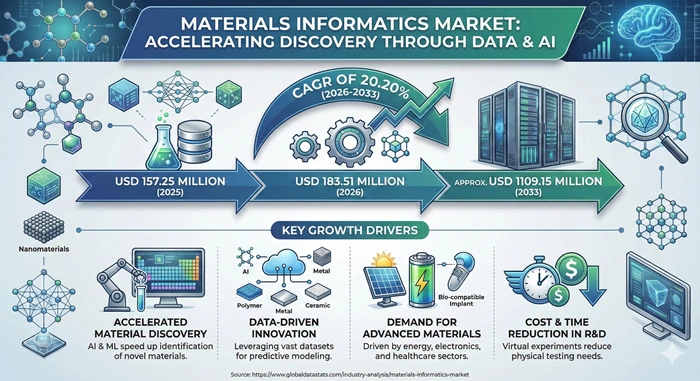
Accelerating Material Discovery Through Data-Driven Innovation and Computational Intelligence
Materials informatics leverages sophisticated AI algorithms, including graph neural networks and physics-informed neural networks, to analyze massive datasets and identify patterns that provide predictive insights into material behavior at the atomic level. The technology enables high-throughput screening, data-driven decision-making in materials chemistry, property estimation, and optimization processes that were previously impossible using conventional experimental methods. Industries ranging from aerospace and automotive to electronics, pharmaceuticals, and renewable energy are increasingly adopting materials informatics solutions to develop sustainable, high-performance, and cost-effective materials that meet stringent performance requirements while reducing environmental impact.
AI Impact on the Materials Informatics Industry
Transforming Research and Development Through Intelligent Automation and Predictive Analytics
Artificial intelligence has fundamentally transformed how the materials informatics market operates by empowering scientists and researchers to discover, evaluate, and manufacture new materials with unprecedented speed and accuracy. AI-powered tools can examine vast quantities of experimental data and accurately predict how materials will respond under different conditions and demonstrate specific characteristics, dramatically reducing the time and effort required to develop high-performing materials. Instead of conducting hundreds of laboratory tests on various material combinations, AI algorithms can identify the most promising candidates from thousands of potential options, allowing researchers to focus their experimental efforts on the materials with the highest probability of success.
Furthermore, AI technology enables companies to develop materials that deliver superior performance while being safer for human health and the environment. Machine learning algorithms can identify subtle patterns in materials data that human researchers might overlook, leading to more intelligent decision-making throughout the research and development process. The integration of AI with materials informatics accelerates problem-solving capabilities for real-world challenges across industries, from developing cobalt-free high-density batteries and smooth solid-state electrolytes to creating lightweight, heat-resistant composites for aerospace and automotive applications.
Growth Factors
Rising Demand for Sustainable Materials and Digital Transformation Initiatives
The materials informatics market is experiencing robust growth driven by the escalating demand for sustainable, eco-friendly materials that align with circular economy principles and environmental regulations. Industries worldwide are prioritizing the development of recyclable and low-carbon materials, and materials informatics provides the computational tools necessary to design these green alternatives more efficiently than traditional trial-and-error methods. Government investments in advanced material science and clean energy initiatives further strengthen market expansion, as public funding supports collaborative research between academia and industry to develop next-generation materials.
The increasing integration of cloud computing, big data analytics, and high-throughput experimentation has created an ecosystem that facilitates streamlined research and development processes. The combination of open-access materials databases and collaborative platforms democratizes the field, enabling researchers worldwide to share insights and accelerate innovation. Industries such as electronics, automotive, aerospace, and pharmaceuticals require continuous materials innovation to maintain competitive advantages, driving sustained investment in materials informatics platforms that can reduce development costs while improving material performance characteristics.
Market Outlook
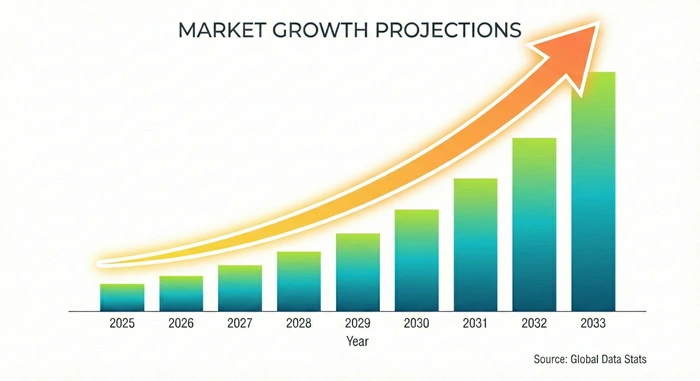
Strong Growth Trajectory Supported by Technological Advancements and Industrial Expansion
The materials informatics market demonstrates a strong growth trajectory with significant expansion opportunities across multiple geographic regions and industry verticals. North America currently dominates the market due to its advanced technological infrastructure, extensive research and development collaborations, and early adoption of digital transformation in material science. However, the Asia Pacific region is projected to experience the fastest growth during the forecast period, driven by rapid industrialization, increasing technology adoption, and substantial investments in electronics, energy, and automotive sectors.
Major investors in the materials informatics market include venture capital firms, corporate investors such as BASF and IBM Research, and strategic funding from government agencies supporting innovation in material science. The startup ecosystem is rapidly expanding, with emerging companies developing specialized AI-powered platforms for specific industry applications. The convergence of advanced computational methods, machine learning algorithms, and accessible cloud infrastructure positions the market for sustained growth as industries increasingly recognize the competitive advantages delivered by data-driven materials development approaches.
Expert Speaks
-
Greg Mulholland, CEO of Citrine Informatics, stated that "AI-driven materials development is the future of the materials industry and we are pleased with the BASF catalyst results. The companies who are first to invest in this technology will reap tremendous market rewards".
-
Dr. Mengting Yu, Digitalization Leader at BASF, emphasized that "We strongly believe that combining our technical knowledge and experimental data with AI can accelerate material discovery. The model rapidly screened thousands of new materials and became smarter in its predictions".
-
Industry experts across Fortune 500 companies agree that digital transformation has become a must-have imperative for organizations, with materials informatics representing a critical component of this transformation as companies seek competitive advantages through accelerated innovation and reduced development timelines.
Key Report Takeaways
-
North America leads the materials informatics market with the largest regional share, driven by robust research infrastructure, strong industry-academia partnerships, and significant investments in AI and computational technologies across pharmaceutical, electronics, and chemical sectors
-
Asia Pacific emerges as the fastest-growing region with the highest projected CAGR during the forecast period, fueled by rapid industrialization, technology adoption acceleration, and substantial government support for advanced manufacturing and clean energy initiatives
-
The inorganic materials segment holds the dominant market share at 50.48% due to extensive applications in energy storage systems, catalysis processes, and structural components, with materials such as ceramics, metal oxides, and alloys benefiting from data-driven optimization
-
Chemical industries represent the largest application segment at 29.81% market share, leveraging materials informatics to optimize catalysts, surfactants, polymers, and additives while reducing research and development costs
-
The electronics and semiconductor segment is projected to grow at the fastest CAGR, driven by constant demand for smaller, faster, and more energy-efficient components requiring advanced materials discovery
-
Statistical analysis techniques captured the largest market share at 46% in 2024, while deep tensor methods are anticipated to experience the highest growth rate as datasets become more complex and multi-dimensional
Market Scope
| Report Coverage | Details |
|---|---|
| Market Size by 2033 | USD 1109.15 Million |
| Market Size by 2025 | USD 157.25 Million |
| Market Size by 2026 | USD 183.51 Million |
| Market Growth Rate from 2026 to 2033 | CAGR of 20.20% |
| Dominating Region | North America |
| Fastest Growing Region | Asia Pacific |
| Base Year | 2025 |
| Forecast Period | 2026 to 2033 |
| Segments Covered | Material, Technique, Application, Deployment, End User, Region |
| Regions Covered | North America, Europe, Asia Pacific, Latin America, Middle East & Africa |
Market Dynamics
Drivers Impact Analysis
Integration of Advanced AI Technologies and Government Support for Clean Energy Materials
The increasing reliance on artificial intelligence technology to speed up material discovery and deployment serves as a primary driver propelling the materials informatics market forward. AI applications have demonstrated remarkable success in developing batteries, solar cells, and environmentally friendly materials by enabling the processing and examination of vast datasets to uncover patterns and relationships in material properties that were previously difficult to identify through conventional research methods. Data analytics capabilities allow researchers to predict material behaviors with high accuracy, significantly reducing the time required to bring new materials from concept to commercial application.
Rising government initiatives to provide low-cost clean energy materials represent another significant growth driver for the materials informatics market. Public sector investments in material science research, combined with funding programs supporting collaboration between research institutions and industry partners, create an enabling environment for innovation. The focus on sustainability and green materials development aligns with global environmental goals, as materials informatics enables the design of recyclable materials, optimization of resource utilization, and reduction of manufacturing waste. Industries seeking high-strength, lightweight composites for aerospace and automotive applications, along with heat-resistant alloys for enhanced performance and fuel efficiency, drive continuous demand for advanced materials informatics solutions.
| Driver | ≈ Impact on CAGR Forecast | Geographic Relevance | Impact Timeline |
|---|---|---|---|
| AI and Machine Learning Integration | High (+3-5%) | Global, particularly North America and Asia Pacific | Immediate to Long-term (2026-2033) |
| Government Clean Energy Initiatives | Medium (+2-3%) | North America, Europe, Asia Pacific | Medium to Long-term (2027-2033) |
Restraints Impact Analysis
High Implementation Costs and Technical Expertise Shortage
The high costs of implementation, maintenance, and services present significant restraints limiting widespread adoption of materials informatics solutions, particularly among small to mid-sized enterprises. Software platforms typically involve substantial subscription or license fees that vary based on services provided, number of users, and subscription duration. Organizations face additional expenses related to data acquisition and integration from multiple sources, including literature reviews, experimental results, and modeling outputs, along with costs for data standardization, normalization, and cleaning processes. Infrastructure expenditures for networking, storage, and hardware—whether deployed on-premises or through cloud-based solutions—add to the total cost of ownership, while consulting services for strategy formulation, implementation, and optimization further increase financial barriers to entry.
The shortage of technical experts with appropriate skill sets represents another critical restraint affecting market growth. Materials informatics requires complex integrated solutions that combine various software applications and digital tools with different database systems, demanding expertise in data science, materials science, computational chemistry, and AI technologies simultaneously. The limited availability of professionals possessing this unique combination of skills creates bottlenecks in effective implementation and utilization of materials informatics platforms across industries. Additionally, insufficient data volume and quality substantially impede development and adoption, as the accuracy and reliability of AI-based models depend directly on comprehensive, consistent datasets that are often proprietary, inconsistent across sources, or inadequate for training sophisticated machine learning algorithms.
| Restraint | ≈ Impact on CAGR Forecast | Geographic Relevance | Impact Timeline |
|---|---|---|---|
| High Implementation Costs | Medium (-2-3%) | Global, particularly emerging markets | Immediate to Medium-term (2026-2030) |
| Technical Expertise Shortage | Medium (-1-2%) | Global, more acute in developing regions | Immediate to Long-term (2026-2033) |
Opportunities Impact Analysis
Emerging Applications of Large Language Models and Sustainable Materials Development
The emerging applications of large language models in material development represent transformative opportunities that are changing material discovery, design, and optimization processes significantly. Businesses can leverage the power of large language models to speed up the discovery and design of new materials, providing substantial opportunities for market expansion and competitive differentiation. These advanced AI systems can examine huge datasets containing information on material properties, composition, and performance characteristics, enabling rapid identification of new materials with specific attributes tailored to particular application requirements.
The growing emphasis on sustainability and the development of sustainable materials creates substantial market opportunities as industries worldwide prioritize eco-friendly alternatives. AI-powered materials informatics platforms can expedite the discovery of sustainable materials more efficiently than traditional experimental methods, helping companies meet environmental regulations while maintaining product performance standards. The ease of building comprehensive material databases using digital technologies further enhances accessibility, allowing organizations to consolidate proprietary and public data into searchable formats that support collaborative research and accelerate innovation cycles. Healthcare represents another area of significant growth potential, with applications in discovering new pharmaceutical compounds, creating advanced materials for surgical instruments, and developing improved therapeutic delivery systems. The automotive and aerospace sectors also present opportunities for developing lighter, stronger materials that improve fuel efficiency and reduce emissions while meeting stringent safety requirements.
| Opportunity | ≈ Impact on CAGR Forecast | Geographic Relevance | Impact Timeline |
|---|---|---|---|
| Large Language Model Integration | High (+3-4%) | North America, Europe, Asia Pacific | Medium to Long-term (2027-2033) |
| Sustainable Materials Development | High (+2-4%) | Global, particularly Europe and North America | Immediate to Long-term (2026-2033) |
Segment Analysis
Material Analysis
Inorganic Materials Dominate While Hybrid Materials Show Fastest Growth Potential
The inorganic materials segment leads the materials informatics market with the largest share, primarily due to extensive use in energy storage systems, catalysis applications, and structural components across multiple industries. Materials such as ceramics, metal oxides, and various alloys possess complex property-performance relationships that make them ideal candidates for data-driven optimization approaches. Lithium-ion battery cathodes, frequently composed of layered metal oxides, have benefited significantly from machine learning models that accurately predict electrical conductivity and structural stability under different operating conditions. The vast datasets available for inorganic materials, combined with their critical importance in industrial applications ranging from energy generation to aerospace manufacturing, create a natural fit for informatics-based exploration and optimization. Industries continue to invest heavily in developing advanced inorganic materials with enhanced thermal resistance, mechanical strength, and chemical stability properties using AI-powered prediction tools.
The hybrid materials segment demonstrates the fastest projected growth rate during the forecast period, driven by versatile functionality and increasing relevance in high-performance applications. These innovative materials, including metal-organic frameworks and polymer composites, combine organic and inorganic properties to deliver superior strength, exceptional thermal stability, and tunable porosity characteristics. Their complex molecular structures require sophisticated computational modeling and advanced machine learning algorithms to predict behaviors accurately, making materials informatics an essential tool for their design and development processes. The growing market interest in sustainable packaging solutions, flexible electronics, and clean energy technologies accelerates adoption of hybrid materials that can meet multiple performance criteria simultaneously. North America and Europe lead in hybrid materials research and development, with Asia Pacific rapidly expanding investments as manufacturing capabilities advance and demand for multifunctional materials increases across electronics and automotive sectors.
Application Analysis
Chemical Industries Lead Market Share While Electronics and Semiconductor Segment Shows Rapid Expansion
The chemical industries segment holds the largest market share due to heavy reliance on materials innovation for formulation optimization, processing enhancement, and performance improvement. Chemical companies actively leverage materials informatics platforms to optimize catalysts, surfactants, polymers, and additives, enabling faster product development cycles and substantially reduced research and development costs. Materials informatics has been successfully applied to identify new corrosion-resistant coatings and eco-friendly plasticizers, helping chemical manufacturers meet environmental regulations and performance targets more efficiently than traditional experimental approaches. The integration of AI-driven predictive analytics allows chemical companies to screen thousands of material formulations virtually before conducting physical experiments, dramatically improving resource utilization and accelerating time-to-market for new products. The chemical sector's extensive historical datasets and well-established research infrastructure provide ideal conditions for implementing advanced materials informatics solutions across pharmaceutical development, specialty chemicals, and industrial catalysis applications.
The electronics and semiconductor segment exhibits the fastest projected growth rate, fueled by constant industry demand for smaller, faster, and more energy-efficient components. Materials informatics tools are increasingly used to discover high-k dielectrics, next-generation semiconductors, and thermally stable conductive materials that enable continued advancement in device miniaturization and performance enhancement. One notable application involves the search for alternatives to traditional silicon, where machine learning models have been instrumental in identifying two-dimensional materials like transition metal dichalcogenides with promising electrical properties for future semiconductor devices. The accelerated pace of innovation in consumer electronics, telecommunications infrastructure, and computing technologies makes materials informatics indispensable for companies seeking to maintain competitive advantages in performance and miniaturization capabilities. Asia Pacific leads growth in this segment, particularly driven by China, Japan, and South Korea, where concentrated semiconductor manufacturing and electronics production create substantial demand for advanced materials development.
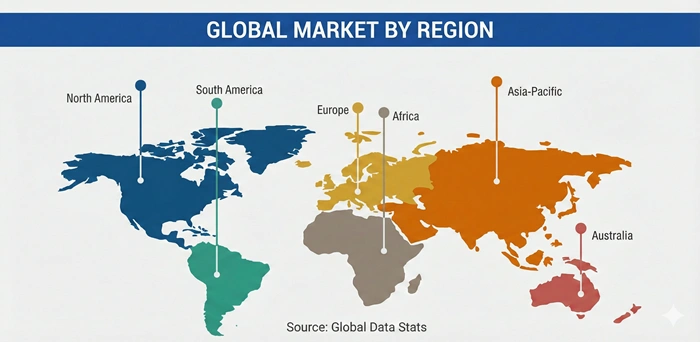
Regional Insights
North America
Strong Research Infrastructure and Early Technology Adoption Drive Regional Leadership
North America maintains the dominant position in the global materials informatics market, supported by cutting-edge technological infrastructure, extensive research and development collaborations, and early adoption of digital transformation initiatives in material science. The region benefits from strong industry-academia cooperation and sophisticated integration of artificial intelligence, machine learning, and computational tools into materials design processes. The United States leads the regional market with a robust innovation ecosystem that includes world-class research universities, government-funded research centers, and technology companies developing advanced materials for aerospace, automotive, electronics, and energy applications. Major aerospace companies headquartered in North America accelerate demand for materials informatics solutions, while the region's vast funding opportunities for chemical and materials research from federal agencies through contracts, grants, and cooperative agreements support sustained market expansion.
The North American materials informatics market holds approximately 39.20% global market share, with the United States valued at USD 69.65 million in 2025 and projected to reach USD 371.74 million by 2034 at a CAGR of 20.50%. The region's technology leadership and implementation of advanced technologies such as AI, machine learning, big data, and data analytics create an enabling environment for materials informatics adoption across electronics, chemicals, pharmaceuticals, and manufacturing sectors. Strong collaboration between technology firms, universities, and government programs facilitates rapid development and deployment of materials informatics solutions, particularly in energy storage, healthcare, and sustainable manufacturing applications. Key players including Schrödinger, Citrine Informatics, and Materials Design maintain significant operations in the region, driving innovation through strategic partnerships and continuous platform enhancements.
Asia Pacific
Rapid Industrialization and Technology Investments Position Region for Fastest Growth
Asia Pacific emerges as the fastest-growing region for the materials informatics market, driven by rapid industrialization, expanding manufacturing capabilities, and substantial government investments in technology development. The region's large and growing population increasingly utilizes smart devices and electric vehicles, creating substantial demand for advanced materials in consumer electronics, automotive, and clean energy applications. Countries across Asia Pacific are investing heavily in clean energy technologies, advanced electronics manufacturing, and healthcare infrastructure, all of which require innovative materials with enhanced performance characteristics. The combination of significant manufacturing capacity, accelerating technology adoption, and supportive government policies makes the region highly attractive for materials informatics solution providers.
China leads the Asia Pacific materials informatics market, valued at USD 11.99 million in 2024 and projected to reach USD 88.19 million by 2034 at a CAGR of 22.1%. The country has made substantial investments in research infrastructure, smart manufacturing capabilities, and artificial intelligence technologies that support advanced materials development. Chinese companies actively deploy AI-powered materials informatics platforms to enhance battery technologies, solar panels, and electronics components, with strong focus on green energy applications requiring environmentally sustainable materials. Partnerships between universities and industry in China accelerate the development of sophisticated AI tools for evaluating new materials, while the nation's extensive manufacturing operations provide opportunities to rapidly commercialize materials informatics innovations. Japan represents another significant market within the region, projected to grow from USD 3.67 million in 2024 to USD 31.38 million by 2034 at a CAGR of 23.9%, with strong capabilities in semiconductor materials, automotive composites, and advanced manufacturing technologies.
Top Key Players
-
Schrödinger, Inc. (United States)
-
Citrine Informatics (United States)
-
Dassault Systèmes (France)
-
BASF SE (Germany)
-
Exabyte.io (United States)
-
Kebotix Inc. (United States)
-
Materials Zone Ltd. (Israel)
-
Phaseshift Technologies (United Kingdom)
-
Materials Design, Inc. (United States)
-
AI Materia Inc. (Japan)
-
Nutonian Inc. (United States)
-
Alpine Electronics Inc. (Japan)
-
DeepMatter Group (United Kingdom)
-
Domo Chemicals (Belgium)
-
ANSYS, Inc. (United States)
Recent Developments
-
February 2025: Collins Aerospace, a division of RTX, announced the 2025 edition of its Powered by Collins Initiative at Aero India, inviting deep technology small and medium enterprises to partner in materials informatics and quantum-enabled navigation areas, and launched the Powered by Collins ecosystem on the Switchpitch platform to promote startup cohort engagement with investors and accelerators year-round
-
February 2025: ICL Industrial Products partnered with NobleAI to accelerate the discovery of safe, high-performance materials, utilizing NobleAI's Science-Based AI tools to reduce wasted resources and accelerate time-to-market for flame retardant development while promoting sustainability and improving research and development productivity
-
February 2025: 3M launched its Digital Materials Hub to transform how customers access verified material data cards, modeling data, and specifications, enabling engineers to compare performance of multiple products like tapes and adhesives with a user-friendly collaborative tool that improved modeling and simulation while reducing design costs for companies in automotive, aerospace, and other industries
-
December 2024: MaterialsZone announced the launch of its AI-guided product development feature, providing users with direct access to AI-generated experiment suggestions that streamline development cycles within existing workflows for lean research and development in materials innovation
-
December 2024: Materials Design, Inc. released MedeA 3.10, offering an integrated suite of multiscale modeling capabilities with advanced features empowering researchers to explore and design materials at unprecedented precision and efficiency levels
Market Trends
Cloud-Based Deployment and Integration with Digital Twin Technologies
The materials informatics market demonstrates significant trends toward cloud-based deployment models and integration with advanced simulation technologies. Cloud-based solutions captured 51.21% market share in 2024, reflecting enterprise preference for scalable infrastructure that enables collaborative research across distributed teams and reduces upfront capital investments in hardware. The cloud deployment model facilitates easier access to materials databases, supports real-time collaboration between researchers at different locations, and enables rapid scaling of computational resources for complex modeling tasks. Integration of materials informatics platforms with digital twin technologies allows for virtual testing and validation of materials prior to physical prototyping, significantly reducing development costs and accelerating innovation cycles. This combination enables engineers to simulate material performance under various conditions, predict failure modes, and optimize formulations before committing resources to experimental validation.
The growing emphasis on data-driven material discovery represents another prominent trend shaping the materials informatics market. Industries increasingly adopt approaches that leverage large datasets and comprehensive databases to identify promising new materials by recognizing patterns not apparent through traditional research methods. The focus on sustainable and green materials continues to intensify, with materials informatics being used to design eco-friendly alternatives, optimize resource utilization, and reduce manufacturing waste. Advanced AI and machine learning applications are expanding beyond property prediction to include generative design capabilities, where algorithms can propose entirely new material compositions that meet specified performance criteria while adhering to design constraints. The democratization of materials informatics through open-access databases and collaborative platforms enables broader participation from academic institutions and smaller companies, fostering innovation ecosystems that accelerate the pace of materials discovery across industries.
Segments Covered in the Report
By Material
-
Organic Materials
-
Inorganic Materials
-
Hybrid Materials
By Technique
-
Digital Annealer
-
Deep Tensor
-
Statistical Analysis
-
Genetic Algorithm
By Application
-
Chemical Industries
-
Dyes
-
Automotive
-
Electronics & Semiconductor
-
Aerospace
-
Research and Development Agencies
-
Others
By Deployment
-
Cloud-Based
-
On-Premises
By End User
-
Chemical & Petrochemical Industries
-
Pharmaceuticals
-
Energy
-
Manufacturing
By Region
-
North America (United States, Canada, Mexico)
-
Europe (Germany, United Kingdom, France, Italy, Spain, Rest of Europe)
-
Asia Pacific (China, Japan, India, South Korea, Australia, Rest of Asia Pacific)
-
Latin America (Brazil, Argentina, Rest of Latin America)
-
Middle East & Africa (UAE, Saudi Arabia, South Africa, Rest of Middle East & Africa)
Frequently Asked Questions
Question 1: What is the materials informatics market size and growth forecast?
Answer: The global materials informatics market is valued at USD 157.25 million in 2025 and is predicted to reach USD 1109.15 million by 2033, growing at a CAGR of 20.20% from 2026 to 2033.
Question 2: Which region dominates the materials informatics market globally?
Answer: North America dominates the global materials informatics market with approximately 39.20% market share, driven by advanced research infrastructure, strong industry-academia collaborations, and early adoption of AI technologies.
Question 3: What are the key applications driving materials informatics market growth?
Answer: Chemical industries lead with 29.81% market share, while electronics and semiconductor applications show the fastest growth due to demand for advanced materials in miniaturization and performance enhancement.
Question 4: How does AI impact the materials informatics market development?
Answer: AI dramatically reduces material development timelines from 10-20 years to 2-5 years by enabling predictive analytics, high-throughput screening, and automated identification of optimal material compositions.
Question 5: What challenges affect materials informatics market adoption rates?
Answer: High implementation costs, shortage of technical experts with interdisciplinary skills, and insufficient data volume and quality represent primary challenges limiting widespread adoption, particularly among smaller enterprises.