
Manufacturing Execution Systems Market Overview
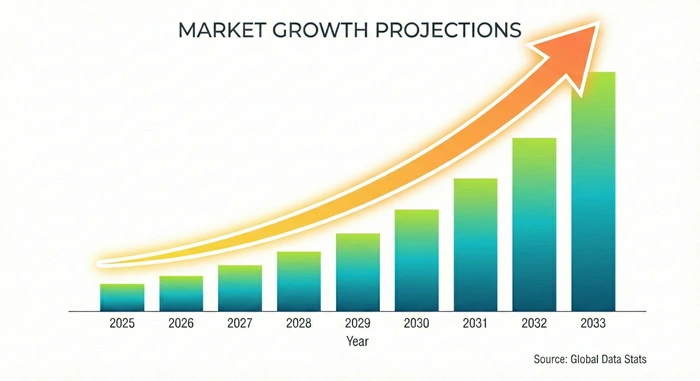
The global manufacturing execution systems market size is valued at USD 15.65 billion in 2025 and is predicted to increase from USD 16.81 billion in 2026 to approximately USD 29.58 billion by 2033, growing at a CAGR of 10.40% from 2026 to 2033.
The manufacturing execution systems market represents a critical technology segment that bridges enterprise resource planning systems with shop floor operations, enabling real-time production monitoring, quality management, inventory tracking, and performance optimization across diverse manufacturing environments. These sophisticated software platforms deliver comprehensive visibility into production processes, facilitate data-driven decision making, enhance regulatory compliance, and support the digital transformation initiatives that modern manufacturers require to remain competitive in increasingly complex global markets. The market's robust growth trajectory reflects accelerating Industry 4.0 adoption, rising demand for operational efficiency improvements, expanding industrial automation investments, and growing recognition that connected manufacturing operations deliver substantial competitive advantages.
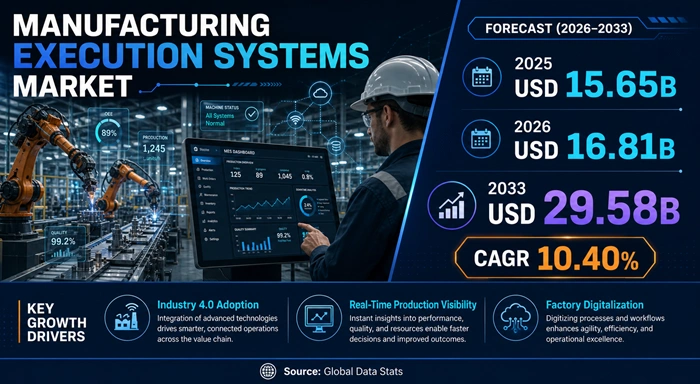
Orchestrating Smart Manufacturing Through Integrated Digital Production Management Solutions
Manufacturers worldwide are recognizing that traditional paper-based production systems and disconnected equipment cannot meet the performance, quality, and agility requirements of contemporary market dynamics. Manufacturing execution systems provide the essential middleware layer that connects planning systems with actual production activities, capturing real-time data from sensors, machines, and operators to create actionable insights that improve throughput, reduce waste, and ensure product quality. As organizations transition toward smart factories and digital manufacturing ecosystems, MES platforms incorporating artificial intelligence, predictive analytics, and cloud computing capabilities are becoming fundamental infrastructure components that enable responsive, efficient, and sustainable production operations.
AI Impact on the Manufacturing Execution Systems Industry
Transforming Production Intelligence Through Machine Learning and Predictive Analytics Integration
Artificial intelligence is revolutionizing the manufacturing execution systems market by introducing advanced capabilities that autonomously optimize production parameters, predict equipment failures, and enhance quality control beyond what human operators can achieve alone. Machine learning algorithms analyze vast datasets collected from production equipment, environmental sensors, and quality inspection systems to identify subtle patterns indicating process drift, equipment degradation, or quality issues before they impact production output. These AI-powered MES platforms enable predictive maintenance strategies that schedule interventions based on actual equipment condition rather than fixed time intervals, dramatically reducing unplanned downtime while extending asset lifespan. Leading manufacturers are deploying systems that automatically adjust machine settings in response to changing material properties or environmental conditions, maintaining optimal production parameters without manual intervention and delivering consistent product quality despite inherent process variability.
The integration of artificial intelligence extends beyond individual process optimization to encompass comprehensive production planning and scheduling capabilities that consider hundreds of variables simultaneously. Advanced AI systems analyze order backlogs, material availability, equipment capacities, labor resources, and delivery commitments to generate optimal production schedules that maximize throughput while minimizing changeover times and meeting customer deadlines. Natural language processing enables operators to interact with manufacturing execution systems through conversational interfaces, querying production status or requesting process adjustments using plain language rather than navigating complex menu structures. Computer vision systems integrated with MES platforms perform automated quality inspections at speeds and accuracy levels impossible for human inspectors, detecting defects measured in micrometers while maintaining 100% inspection coverage. This comprehensive application of AI throughout the manufacturing execution systems market is creating unprecedented opportunities for productivity improvements, quality enhancements, and competitive differentiation that justify substantial technology investments across all manufacturing sectors.
Growth Factors
Industry 4.0 Adoption and Regulatory Compliance Driving Systematic MES Implementation
The global manufacturing sector's widespread embrace of Industry 4.0 principles is creating extraordinary demand for manufacturing execution systems that serve as essential enablers of smart factory initiatives. Industry 4.0 represents a fundamental transformation from traditional manufacturing approaches toward cyber-physical production systems where digital technologies and physical processes seamlessly integrate to create responsive, adaptive manufacturing environments. Manufacturing execution systems provide the critical middleware connecting enterprise planning systems, production equipment, quality management platforms, and supply chain networks into cohesive digital ecosystems. Organizations implementing Industrial Internet of Things sensors, collaborative robots, additive manufacturing systems, and automated material handling equipment require sophisticated MES platforms capable of orchestrating these diverse technologies into coordinated production workflows. The proliferation of data generated by connected manufacturing equipment demands advanced analytics capabilities that MES solutions provide, transforming raw sensor readings into actionable intelligence supporting continuous improvement initiatives and real-time decision-making across production operations.
Stringent regulatory requirements across pharmaceutical, aerospace, medical device, and food processing industries are driving substantial manufacturing execution systems investments as organizations seek to automate compliance documentation and ensure production processes consistently meet quality standards. Regulatory agencies including the FDA, European Medicines Agency, and various aviation authorities mandate comprehensive traceability throughout production processes, requiring manufacturers to document material sources, process parameters, equipment conditions, and operator actions for every product unit. Manual documentation systems introduce transcription errors, consume substantial labor resources, and create audit vulnerabilities that MES platforms eliminate through automated data capture and electronic batch record generation. The pharmaceutical industry particularly relies on manufacturing execution systems to ensure Good Manufacturing Practice compliance, with validated systems providing the documented evidence regulators require during facility inspections. As global supply chains become more complex and product liability concerns intensify across all manufacturing sectors, organizations are recognizing that robust MES implementations represent essential risk management investments that protect brand reputation while ensuring consistent regulatory compliance regardless of production location or personnel changes.
Market Outlook
Positive Growth Trajectory Supported by Digital Transformation and Cloud Technology Adoption
The manufacturing execution systems market outlook remains exceptionally strong as manufacturers worldwide prioritize digital transformation initiatives that enhance operational visibility, improve agility, and deliver competitive advantages in increasingly dynamic market environments. The accelerating pace of technological change across artificial intelligence, cloud computing, edge analytics, and connectivity solutions is creating opportunities for MES vendors to develop innovative platforms that deliver capabilities impossible with previous generation systems. Cloud-based manufacturing execution systems are gaining rapid acceptance as organizations recognize the scalability benefits, reduced infrastructure requirements, and accessibility advantages these deployments provide compared to traditional on-premise installations. The software-as-a-service business model enables manufacturers to access enterprise-grade MES capabilities without massive upfront capital investments, democratizing advanced production management technologies that were previously only accessible to large corporations with substantial IT budgets. This cloud adoption trend is particularly pronounced among small and medium-sized manufacturers seeking to enhance competitiveness through digital capabilities.
Emerging applications in predictive quality management, energy optimization, and workforce productivity analytics are expanding the value proposition of manufacturing execution systems beyond traditional production tracking and quality control functions. Modern MES platforms incorporating advanced analytics can predict quality issues based on subtle process parameter variations, enabling corrective interventions before defective products are manufactured rather than detecting problems during post-production inspection. Energy management modules help manufacturers optimize production schedules based on electricity pricing, shift energy-intensive operations to off-peak periods, and identify equipment consuming excessive power. Workforce management capabilities track operator skill levels, training requirements, and productivity metrics, enabling data-driven decisions about staffing assignments and training investments. This functional expansion transforms manufacturing execution systems from operational tools into strategic platforms supporting comprehensive business optimization, creating sustained demand growth that extends well beyond cyclical manufacturing investment patterns. The market benefits from long replacement cycles and substantial switching costs that create stable recurring revenue streams for established vendors while creating barriers to entry that protect market positions.
Expert Speaks
-
Tobias Lange, Senior Vice President Manufacturing Operations Management at Siemens Digital Industries Software, emphasized that Siemens' recognition as a manufacturing execution system leader highlights its fast pace of innovation in providing customers with world-class integrated MES technology, with continued commitment to delivering open, configurable, easily deployable and inherently scalable software truly benefitting manufacturing organizations across the globe.
-
Lorenzo Veronesi, Associate Research Director at IDC Manufacturing Insights, stated that the need for shop floor processes to coordinate with rapidly evolving value chains requires manufacturing execution systems to work seamlessly with other enterprise and manufacturing-focused applications to ensure visibility from the shop floor to the top floor, with innovation drivers such as cloud computing, edge analytics, Industrial Internet of Things, and artificial intelligence significantly influencing MES development.
-
Christian Klein, CEO of SAP, highlighted that the company is witnessing accelerating customer demand for integrated business technology platforms connecting operational and financial systems, with manufacturing execution capabilities increasingly critical as organizations pursue end-to-end digitalization strategies that enhance agility, sustainability, and resilience across global production networks serving diverse markets and regulatory environments.
Key Report Takeaways
-
North America dominates the manufacturing execution systems market with approximately 38.6% market share valued at around USD 6.49 billion in 2026, driven by advanced manufacturing capabilities, stringent regulatory compliance requirements, extensive Industry 4.0 adoption, and significant technology investments across automotive, aerospace, pharmaceutical, and electronics industries concentrated throughout the United States and Canada.
-
Asia Pacific represents the fastest-growing regional market with a projected CAGR of 11.2%, fueled by rapid industrialization, government-backed smart manufacturing initiatives including China's Made in China 2025 and India's Make in India programs, expanding manufacturing capacity, and substantial investments in production modernization across automotive, semiconductor, and electronics sectors.
-
Software segment holds the largest product share accounting for approximately 63.5% of total market value, reflecting manufacturers' prioritization of core MES functionality including production scheduling, real-time monitoring, quality management, inventory tracking, and analytics capabilities that directly impact operational performance and competitive positioning.
-
Automotive application contributes the most significant revenue representing roughly 28.2% of total market value, as vehicle manufacturers deploy MES platforms to manage complex assembly processes involving thousands of components, ensure complete traceability, enforce strict quality control, and maximize efficiency aligned with lean manufacturing principles.
-
Cloud-based deployment is experiencing the fastest growth with a projected CAGR of 13.2%, gaining traction through scalability benefits, reduced infrastructure costs, accessibility advantages, and subscription pricing models that enable manufacturers to access enterprise-grade capabilities without massive upfront capital investments.
-
Healthcare segment will exhibit the strongest expansion trajectory expected to grow at a CAGR of 11.7% with expanding market share exceeding 12%, driven by stringent regulatory traceability requirements, serialization mandates, electronic batch record adoption, and Industry 4.0 technology integration enhancing pharmaceutical and medical device manufacturing operations.
Market Scope
| Report Coverage | Details |
|---|---|
| Market Size by 2033 | USD 29.58 Billion |
| Market Size by 2025 | USD 15.65 Billion |
| Market Size by 2026 | USD 16.81 Billion |
| Market Growth Rate from 2026 to 2033 | CAGR of 10.40% |
| Dominating Region | North America |
| Fastest Growing Region | Asia Pacific |
| Base Year | 2025 |
| Forecast Period | 2026 to 2033 |
| Segments Covered | Solution, Deployment, Application, Region |
| Regions Covered | North America, Europe, Asia Pacific, Latin America, Middle East & Africa |
Market Dynamics
Drivers Impact Analysis
Accelerating Industrial Automation and Operational Efficiency Requirements Propelling Market Expansion
| Driver | (≈) % Impact on CAGR Forecast | Geographic Relevance | Impact Timeline |
|---|---|---|---|
| Industry 4.0 adoption and smart manufacturing initiatives | +3.2% | Global | 2026-2033 |
| Rising demand for real-time production monitoring and optimization | +2.8% | North America, Europe, Asia Pacific | 2026-2033 |
| Stringent regulatory compliance requirements across industries | +2.1% | North America, Europe | 2026-2030 |
The manufacturing sector's aggressive pursuit of operational excellence through industrial automation is creating unprecedented demand for manufacturing execution systems that orchestrate complex production workflows involving robots, programmable logic controllers, automated material handling equipment, and quality inspection systems. Modern manufacturing facilities deploy hundreds of automated devices that must coordinate seamlessly to maintain continuous production flow, with manufacturing execution systems providing the essential control layer that schedules operations, tracks work-in-progress inventory, and ensures quality specifications are met throughout processing. Automation technologies offer substantial benefits including consistent output quality, reduced labor costs, improved worker safety, and enhanced production speeds that translate directly into competitive advantages. However, realizing these benefits requires sophisticated software platforms capable of programming production sequences, monitoring equipment status, and responding to exceptions without human intervention. The manufacturing execution systems market is benefiting enormously from this automation wave as organizations recognize that disconnected equipment and manual coordination cannot deliver the performance levels that integrated digital production management enables.
The intensifying competitive pressures compelling manufacturers to reduce costs, improve quality, and accelerate time-to-market are driving substantial investments in manufacturing execution systems that provide the real-time visibility and control necessary for continuous improvement initiatives. Traditional manufacturing approaches relying on periodic reporting and retrospective analysis cannot identify process variations quickly enough to prevent quality issues or production inefficiencies from accumulating into substantial losses. Modern MES platforms capture data from every production step in real-time, immediately highlighting deviations from expected performance and enabling corrective interventions before problems escalate. This real-time capability is particularly valuable in high-volume production environments where even minor efficiency improvements multiplied across millions of units deliver substantial financial benefits. Manufacturers implementing lean production methodologies depend on manufacturing execution systems to eliminate waste, reduce inventory levels, and maximize asset utilization through data-driven decision making. The market's growth trajectory remains supported by continuous pressure across all manufacturing sectors to enhance productivity and maintain competitiveness despite rising input costs, labor shortages, and increasingly sophisticated customer quality expectations.
Restraints Impact Analysis
High Implementation Costs and Integration Complexity Limiting Market Penetration
| Restraint | (≈) % Impact on CAGR Forecast | Geographic Relevance | Impact Timeline |
|---|---|---|---|
| Substantial capital investment and deployment complexity | -2.1% | Small Manufacturers, Emerging Markets | 2026-2029 |
| Integration challenges with legacy systems and customization requirements | -1.6% | Global | 2026-2033 |
| Data security concerns and cybersecurity vulnerabilities | -1.2% | Connected Manufacturing Environments | 2026-2028 |
The significant capital expenditures associated with manufacturing execution systems implementation represent a substantial barrier to market adoption, particularly among small and medium-sized manufacturers operating with limited technology budgets. Comprehensive MES deployments require investments in software licenses, server infrastructure, network equipment, mobile devices, sensors, and extensive services including system configuration, testing, training, and change management activities that collectively can exceed hundreds of thousands or even millions of dollars depending on facility size and complexity. These upfront costs must be justified through detailed return-on-investment analyses demonstrating how improved efficiency, enhanced quality, reduced waste, and better asset utilization will recover implementation expenses within acceptable timeframes. Many manufacturers struggle to quantify these benefits with sufficient confidence to secure executive approval, particularly when production operations are already meeting basic performance targets. The economic challenge intensifies for multi-site implementations where costs multiply across locations while coordination complexities increase substantially, potentially overwhelming organizations lacking extensive IT expertise or project management capabilities.
The technical complexity of integrating manufacturing execution systems with existing enterprise resource planning platforms, process control systems, quality management software, and legacy production equipment creates substantial implementation challenges that extend project timelines and increase failure risks. Successful MES deployments require seamless data exchange between systems utilizing different communication protocols, data formats, and integration architectures that may not have been designed with interoperability as a priority. Organizations must often develop custom interfaces, middleware applications, or data translation layers to bridge incompatibilities between systems, requiring specialized technical expertise that may not exist internally. Production equipment manufactured by different vendors frequently uses proprietary protocols that complicate connectivity efforts, forcing manufacturers to invest in additional hardware or software to enable data collection. The need for extensive customization to accommodate unique production processes, regulatory requirements, and business workflows further increases implementation complexity while creating ongoing maintenance challenges as systems require updates and enhancements over time. These technical barriers collectively slow market penetration rates particularly in industries with highly specialized production processes or extensive installed bases of legacy equipment.
Opportunities Impact Analysis
Cloud Computing and Artificial Intelligence Integration Creating Growth Potential
| Opportunity | (≈) % Impact on CAGR Forecast | Geographic Relevance | Impact Timeline |
|---|---|---|---|
| Cloud-based MES adoption and SaaS business model expansion | +2.4% | Global | 2027-2033 |
| AI and machine learning integration for predictive analytics | +2.0% | North America, Europe, Asia Pacific | 2026-2033 |
| Small and medium enterprise market penetration | +1.5% | Emerging Markets | 2028-2033 |
The rapid adoption of cloud computing technologies throughout the manufacturing sector is creating transformative opportunities for manufacturing execution systems vendors to deliver solutions through software-as-a-service business models that eliminate traditional deployment barriers. Cloud-based MES platforms offer manufacturers the ability to access enterprise-grade production management capabilities without investing in on-premise server infrastructure, reducing upfront capital requirements while shifting costs to predictable monthly subscription fees that align better with operational budget structures. These cloud deployments provide inherent scalability that enables manufacturers to add production lines, incorporate additional facilities, or expand user populations without major infrastructure upgrades, supporting business growth through flexible technology foundations. The cloud architecture facilitates remote access capabilities that enable production managers, quality engineers, and executives to monitor operations from any location using mobile devices, supporting distributed manufacturing operations and work-from-anywhere business continuity requirements. Cloud vendors assume responsibility for software updates, security patches, and infrastructure maintenance, reducing the IT burden on manufacturing organizations while ensuring systems remain current with latest capabilities and security standards. This deployment model is particularly appealing to small and medium-sized manufacturers who can leverage cloud MES platforms to achieve competitive parity with larger corporations despite resource constraints.
The integration of artificial intelligence and machine learning capabilities into manufacturing execution systems is opening substantial market opportunities as these technologies enable predictive and prescriptive capabilities far beyond traditional reactive monitoring approaches. AI-powered quality management modules analyze production data to predict which units are likely to fail quality inspections based on subtle process parameter patterns, enabling preemptive adjustments or automated rejections before defective products enter downstream processes. Predictive maintenance algorithms monitor equipment performance indicators to forecast failures days or weeks in advance, allowing scheduled interventions during planned downtime rather than emergency repairs during production runs. Production scheduling optimization engines utilizing machine learning can generate plans that balance multiple competing objectives including throughput maximization, delivery deadline compliance, changeover minimization, and energy cost reduction better than human planners despite vastly increased complexity. These AI capabilities deliver tangible business value through improved efficiency, enhanced quality, and reduced costs that create compelling investment justifications. Equipment manufacturers and MES vendors are increasingly embedding artificial intelligence directly into their products, creating differentiated offerings that command premium pricing while establishing competitive moats through proprietary algorithms and accumulated training data that improve continuously with usage.
Segment Analysis
Software Solution
Market Dominance Through Core Functionality and Continuous Innovation
The software segment commands the dominant position in the manufacturing execution systems market with an impressive 63.5% revenue share, reflecting the critical importance of core MES functionality including production scheduling, work order management, real-time monitoring, quality control, inventory tracking, and performance analytics that directly impact operational efficiency and product quality. This software provides the essential digital infrastructure connecting enterprise planning systems with shop floor operations, translating business requirements into executable production instructions while capturing actual performance data for analysis and reporting. Manufacturers prioritize software investments because these platforms deliver the intelligent automation, process standardization, and data visibility that manual systems cannot provide at scale. The segment benefits from continuous innovation as vendors incorporate advanced capabilities including artificial intelligence, predictive analytics, mobile interfaces, and cloud-native architectures that extend platform value propositions. North America represents the strongest regional market for MES software with approximately 39% of segment revenue, driven by sophisticated manufacturing operations across automotive, aerospace, pharmaceutical, and electronics industries that demand comprehensive production management capabilities. Leading software vendors including Siemens, Dassault Systèmes, SAP, Rockwell Automation, and Honeywell continuously enhance their platforms through internal development and strategic acquisitions that expand functional coverage and industry specialization.
The software segment is projected to maintain steady growth with a CAGR of 10.1% through 2033 as manufacturers pursue digital transformation initiatives requiring advanced production management capabilities that legacy systems cannot deliver. The ongoing transition from monolithic software architectures toward modular, microservices-based platforms is enabling manufacturers to adopt MES functionality incrementally, selecting specific modules addressing their highest priority requirements while preserving options to expand coverage over time. This architectural evolution reduces implementation complexity and financial risk compared to traditional all-or-nothing deployment approaches, accelerating adoption particularly among mid-sized manufacturers. The emergence of low-code and no-code configuration tools is democratizing MES customization, enabling production engineers and process specialists to adapt software behaviors without extensive programming expertise or dependence on IT departments. Asia Pacific is experiencing particularly robust software segment growth with a CAGR exceeding 11%, driven by massive manufacturing capacity expansion across China and India combined with government initiatives actively promoting smart factory technologies. The pharmaceutical and medical device sectors represent high-growth application areas as regulatory agencies increasingly expect electronic batch records and comprehensive traceability that MES software provides, creating compliance-driven demand that supports premium pricing and long-term customer relationships. The segment's expansion is further supported by recurring revenue models including maintenance subscriptions, software updates, and cloud service fees that provide stable income streams while aligning vendor incentives with customer success.
Automotive Application
Capturing Maximum Revenue Through Complex Assembly Requirements
The automotive application segment represents the largest end-use category in the manufacturing execution systems market, accounting for approximately 28.2% of total revenue, reflecting the extraordinary complexity of vehicle manufacturing processes that involve coordinating thousands of components, managing multiple parallel assembly lines, ensuring complete traceability for safety-critical parts, and maintaining stringent quality standards throughout production. Modern vehicle assembly facilities utilize manufacturing execution systems to orchestrate just-in-time material deliveries, sequence work instructions for hundreds of assembly stations, track every component installed in specific vehicles for warranty and recall purposes, and monitor quality metrics across welding, painting, and final assembly operations. The automotive industry's embrace of lean manufacturing principles creates particular dependence on MES platforms that minimize inventory levels, eliminate production waste, and maximize equipment utilization through real-time visibility and control. The transition toward electric vehicles is intensifying MES adoption as battery assembly processes require precise environmental controls, extensive testing protocols, and comprehensive documentation that traditional manufacturing approaches cannot efficiently deliver. North America and Europe collectively account for over 58% of automotive segment demand, concentrated in regions hosting major vehicle manufacturers and tier-one suppliers operating sophisticated production facilities. Leading automotive companies including Toyota, Volkswagen, General Motors, and Ford deploy advanced manufacturing execution systems across their global production networks, driving demand for multi-site platforms supporting standardized processes and centralized visibility.
The automotive segment is experiencing moderate growth with a CAGR of 9.8% through 2033 as established manufacturers modernize production facilities while new entrants including electric vehicle startups build advanced factories incorporating latest digital technologies. The industry's increasing emphasis on mass customization enabling customers to specify individual vehicle configurations creates production complexity that MES platforms help manage through flexible scheduling algorithms and comprehensive option tracking capabilities. Asia Pacific represents the fastest-growing regional market for automotive MES applications with a CAGR exceeding 10.5%, driven by enormous production volumes in China, substantial manufacturing investments in India, and sophisticated automotive industries throughout Japan and South Korea. The proliferation of advanced driver assistance systems, connected vehicle technologies, and autonomous driving capabilities is increasing electronic content per vehicle, creating additional complexity that manufacturing execution systems help manufacturers manage through enhanced component tracking and quality validation processes. Regulatory requirements for supply chain traceability are tightening globally in response to quality issues and counterfeit component concerns, compelling automotive manufacturers to implement comprehensive MES platforms that document material sources and processing histories for every part installed in vehicles. The segment benefits from long replacement cycles as automotive manufacturers typically maintain MES platforms for 10-15 years with continuous enhancements, creating substantial ongoing service revenue opportunities for vendors through support contracts, training programs, and functional upgrades.
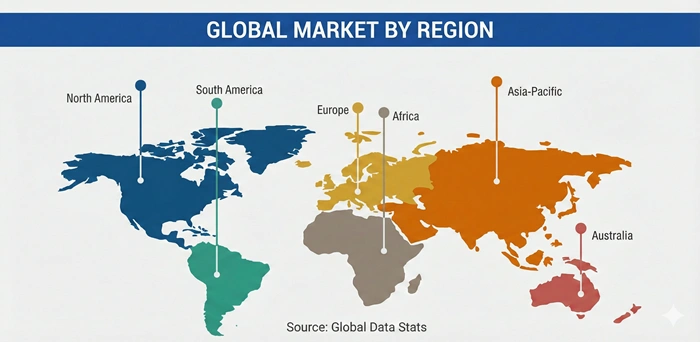
Regional Insights
North America
Maintaining Market Leadership Through Advanced Manufacturing and Regulatory Requirements
North America commands the dominant position in the global manufacturing execution systems market with approximately 38.6% revenue share valued at around USD 6.49 billion in 2026, driven by the region's sophisticated manufacturing capabilities across automotive, aerospace, pharmaceuticals, electronics, and food processing industries that prioritize operational excellence, quality assurance, and regulatory compliance. The United States accounts for over 70% of North American demand, hosting major manufacturing corporations operating hundreds of production facilities that have embraced digital transformation initiatives requiring comprehensive MES platforms. The region benefits from stringent regulatory environments enforced by agencies including the FDA, FAA, and OSHA that mandate extensive production documentation, traceability, and quality validation that MES software efficiently automates. North American manufacturers lead globally in Industry 4.0 adoption, investing heavily in connected equipment, advanced robotics, and data analytics capabilities that rely on manufacturing execution systems as essential integration layers. The region's manufacturing execution systems market is projected to grow at a CAGR of 10.0% through 2033 as established manufacturers upgrade aging systems while new production facilities incorporate latest cloud-based platforms with advanced artificial intelligence capabilities.
The concentration of leading MES vendors throughout North America creates distinct competitive advantages including proximity to major customers, extensive local engineering support, comprehensive partner ecosystems, and deep industry expertise accumulated through decades of implementation experience. Companies including Rockwell Automation, Honeywell, General Electric, and Oracle operate substantial development, sales, and service organizations throughout the United States and Canada, continuously innovating to maintain technology leadership positions. The region's pharmaceutical industry represents a particularly important market segment, with major drug manufacturers including Pfizer, Johnson & Johnson, and Merck deploying sophisticated MES platforms to ensure Good Manufacturing Practice compliance, manage clinical trial material production, and coordinate commercial manufacturing across multiple sites. The aerospace sector utilizes manufacturing execution systems extensively for managing complex assembly processes, tracking serialized components, and maintaining the comprehensive documentation that aviation regulators require. Canada contributes additional demand through its automotive and aerospace manufacturing clusters concentrated in Ontario and Quebec provinces. The North American market exhibits particularly strong adoption of advanced capabilities including predictive quality management, energy optimization, and workforce productivity analytics that extend MES value propositions beyond traditional production tracking functions. The region benefits from mature technology infrastructure, skilled workforce availability, and innovation-friendly business cultures that collectively support rapid adoption of emerging manufacturing technologies.
Asia Pacific
Experiencing Fastest Growth Through Industrialization and Government Initiatives
Asia Pacific represents the fastest-growing regional market for manufacturing execution systems with a projected CAGR of 11.2% from 2026 to 2033, propelled by rapid industrialization, massive manufacturing capacity expansion, and comprehensive government initiatives promoting smart factory adoption across China, India, Japan, South Korea, and Southeast Asian nations. China dominates regional demand with over 48% of Asia Pacific market share, driven by the country's position as the world's largest manufacturing economy and strategic initiatives including Made in China 2025 that explicitly promote advanced production technologies. The Chinese government provides substantial subsidies supporting MES implementations, recognizing these systems as essential enablers of the productivity improvements and quality enhancements necessary for the nation's manufacturing sector to transition from low-cost production toward higher-value activities. India contributes substantial growth momentum as its manufacturing sector expands rapidly supported by Make in India programs, foreign direct investment policies encouraging production localization, and increasing domestic consumption driving factory construction across automotive, consumer electronics, and pharmaceutical industries. The region currently captures approximately 35% of global market share valued near USD 5.88 billion in 2026, with growth acceleration expected as digitalization initiatives gain momentum across emerging manufacturing markets.
The presence of major manufacturing operations throughout Asia Pacific combined with growing local MES vendor capabilities is creating dynamic competitive environments with rapid innovation and aggressive pricing. Companies including Mitsubishi Electric, Yokogawa, and numerous Chinese software developers offer manufacturing execution systems specifically adapted to regional requirements including multi-language interfaces, local regulatory compliance features, and integration with popular Asian enterprise software platforms. Japan and South Korea maintain highly sophisticated manufacturing sectors with near-universal MES adoption across automotive, electronics, and semiconductor industries that demand exceptional precision and quality control. Southeast Asian nations including Thailand, Vietnam, and Indonesia are experiencing accelerating manufacturing investments as companies diversify supply chains beyond China, creating demand for modern production facilities incorporating latest digital technologies. The region exhibits particularly strong growth in electronics and semiconductor manufacturing applications where MES platforms manage complex assembly processes, coordinate material flows, and ensure quality standards for products exported to global markets. Asia Pacific benefits from substantial technical talent pools, rapidly improving digital infrastructure, and government policies actively supporting manufacturing modernization. The automotive industry across the region is deploying manufacturing execution systems extensively to support electric vehicle production ramps and manage increasing vehicle complexity driven by connectivity and autonomous driving features. The region's relatively lower labor costs compared to developed markets create strong economic incentives for automation investments that maximize equipment productivity, driving MES adoption as essential enablers of highly automated production environments.
Top Key Players
-
Siemens AG (Germany)
-
Dassault Systèmes SE (France)
-
SAP SE (Germany)
-
Rockwell Automation Inc. (United States)
-
Honeywell International Inc. (United States)
-
Schneider Electric SE (France)
-
ABB Ltd. (Switzerland)
-
General Electric Company (United States)
-
Oracle Corporation (United States)
-
Emerson Electric Co. (United States)
-
Yokogawa Electric Corporation (Japan)
-
Epicor Software Corporation (United States)
-
AVEVA Group plc (United Kingdom)
-
Parsec Automation Corp. (United States)
-
Dassault Systèmes DELMIA (France)
Recent Developments
-
Siemens AG (January 2025) was recognized as a Leader in the IDC MarketScape Worldwide Manufacturing Execution Systems 2024-2025 Vendor Assessment, highlighting the company's fast pace of innovation in delivering world-class integrated MES technology with continued commitment to providing open, configurable, easily deployable and inherently scalable software solutions benefitting customers across the globe through advanced digital manufacturing capabilities.
-
Schneider Electric SE (January 2023) completed the strategic acquisition of AVEVA, a leading industrial software solutions provider, aiming to drive digital transformation innovation and enhance value delivery to customers by providing comprehensive platforms, accelerating Schneider Electric's goal of becoming a Software-as-a-Service leader and transitioning to a subscription-only enterprise model in the manufacturing execution systems market.
-
Rockwell Automation Inc. (September 2023) announced the successful implementation of its Plex MES platform at BIC's Bizerte manufacturing plant, a major producer of shavers, lighters, and stationery products, with the deployment aimed at improving operations while focusing on efficiency and innovation by providing comprehensive 360-degree visibility into plant operations, with BIC planning to extend the partnership to digitize additional factories globally.
-
Emerson Electric Co. (April 2024) introduced DeltaV Workflow Management, a next-generation manufacturing execution system software specifically designed for early-stage development in the life sciences industry, enhancing the company's DeltaV automation platform and offering more scalable options for innovators developing biopharmaceuticals, vaccines, and advanced therapies requiring flexible production management capabilities.
-
Yokogawa Electric Corporation (October 2024) launched OpreX Batch MES, a new product in the OpreX Asset Operations and Optimization family, specifically designed for batch processing plants manufacturing specialty and fine chemicals, providing advanced production management capabilities tailored to the unique requirements of batch manufacturing operations including recipe management and process documentation.
Market Trends
Cloud-Native Architectures and Modular Deployment Models Reshaping Market Dynamics
The manufacturing execution systems market is experiencing a fundamental architectural transformation as vendors transition from monolithic on-premise software toward cloud-native platforms offering modular functionality, flexible deployment options, and subscription-based pricing models. Modern MES architectures leverage microservices designs that decompose comprehensive platform capabilities into independent functional modules communicating through standardized application programming interfaces, enabling manufacturers to select and implement specific capabilities addressing their highest priority requirements without deploying entire platform suites. This modular approach dramatically reduces implementation complexity, shortens deployment timelines, and lowers financial risks compared to traditional all-or-nothing implementation strategies that required massive upfront investments and multi-year projects. Cloud deployment models eliminate on-premise infrastructure requirements while providing inherent scalability that seamlessly accommodates business growth, additional production lines, or multi-site expansions without major system reconfigurations. The software-as-a-service business model shifts costs from capital expenditures to operational expenses with predictable monthly fees, improving financial accessibility particularly for small and medium-sized manufacturers previously priced out of enterprise MES markets. These architectural and business model innovations are democratizing access to advanced production management capabilities while accelerating adoption rates across all manufacturing sectors and company sizes.
The convergence of manufacturing execution systems with advanced technologies including artificial intelligence, digital twins, augmented reality, and edge computing is fundamentally expanding platform capabilities and value propositions beyond traditional production tracking and quality control functions. AI-powered predictive analytics modules forecast equipment failures, quality issues, and production bottlenecks days in advance, enabling proactive interventions that prevent problems rather than reacting after they occur. Digital twin capabilities create virtual representations of production processes that manufacturers use to simulate process changes, test new product introductions, and optimize production parameters without disrupting actual operations. Augmented reality interfaces project work instructions, quality specifications, and real-time production data onto displays visible to operators through smart glasses, enhancing productivity while reducing training requirements and error rates. Edge computing architectures distribute data processing closer to production equipment, reducing latency and bandwidth requirements while enabling real-time control and analytics even when cloud connectivity is interrupted. This technological convergence is transforming manufacturing execution systems from passive monitoring tools into active intelligence platforms that autonomously optimize production operations, creating compelling value propositions that justify substantial investments and drive sustained market growth across all manufacturing verticals.
Segments Covered in the Report
By Solution
-
Software
-
Services (Professional Services, Managed Services, System Integration, Maintenance & Support, Data Analytics)
By Deployment
-
On-Premise
-
Cloud-Based
-
Hybrid
By Application
-
Production Management
-
Quality Management
-
Material and Inventory Management
-
Maintenance Management
-
Performance Analysis
-
Labor Management
-
Others
By End-Use Industry
-
Automotive
-
Aerospace & Defense
-
Healthcare & Pharmaceuticals
-
Food & Beverages
-
Oil & Gas
-
Chemicals
-
Electronics & Semiconductors
-
Metals & Mining
-
Others
By Region
-
North America (United States, Canada, Mexico)
-
Europe (Germany, United Kingdom, France, Italy, Spain, Rest of Europe)
-
Asia Pacific (China, Japan, India, South Korea, Australia, Southeast Asia, Rest of Asia Pacific)
-
Latin America (Brazil, Argentina, Rest of Latin America)
-
Middle East & Africa (UAE, Saudi Arabia, South Africa, Rest of Middle East & Africa)
Frequently Asked Questions
Question 1: What is the expected manufacturing execution systems market size by 2033?
Answer: The global manufacturing execution systems market is projected to reach approximately USD 29.58 billion by 2033. This substantial growth from the 2026 baseline reflects accelerating Industry 4.0 adoption, rising demand for real-time production monitoring, expanding industrial automation, and increasing regulatory compliance requirements across manufacturing industries worldwide.
Question 2: Which region currently dominates the manufacturing execution systems market?
Answer: North America dominates the manufacturing execution systems market with approximately 38.6% market share. However, Asia Pacific is experiencing the fastest growth rate with a CAGR of 11.2%, driven by rapid industrialization, government smart manufacturing initiatives, and massive production capacity expansion across China, India, and Southeast Asian nations.
Question 3: What are the primary applications driving manufacturing execution systems market growth?
Answer: The automotive application represents the largest segment accounting for 28.2% of market revenue, serving complex assembly processes requiring component traceability and quality control. The healthcare and pharmaceutical segment is experiencing the fastest growth with a CAGR of 11.7%, driven by stringent regulatory compliance requirements and electronic batch record adoption.
Question 4: How is cloud computing impacting the manufacturing execution systems market?
Answer: Cloud-based manufacturing execution systems are experiencing the fastest growth with a CAGR of 13.2%, offering manufacturers scalability benefits, reduced infrastructure costs, and subscription pricing models. Cloud deployments eliminate on-premise server requirements while providing remote access capabilities and automatic software updates that reduce IT burden and accelerate adoption.
Question 5: What factors are restraining manufacturing execution systems market expansion?
Answer: Substantial capital investment requirements for implementation and complex integration challenges with legacy enterprise systems represent primary market restraints. Additionally, extensive customization needs for industry-specific processes and data security concerns in connected manufacturing environments create adoption barriers, particularly among small and medium-sized manufacturers with limited IT resources.