
Liquid Crystal Polymer Market Overview
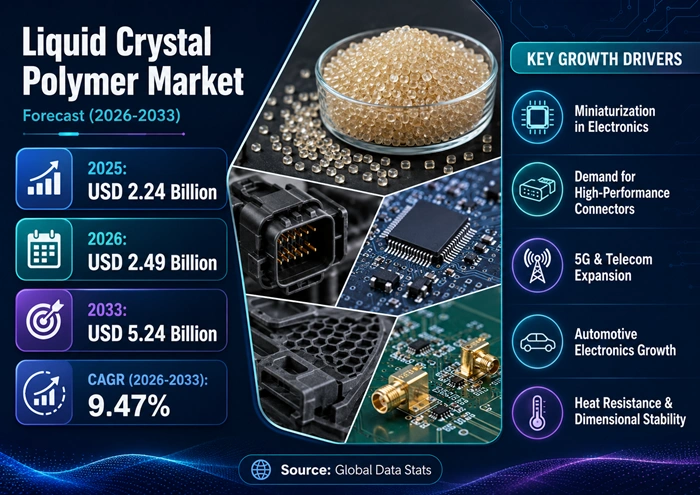
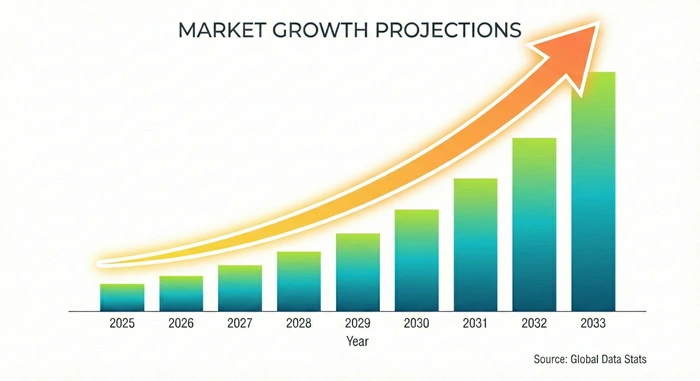
The global liquid crystal polymer market size is valued at USD 2.24 billion in 2025 and is predicted to increase from USD 2.49 billion in 2026 to approximately USD 5.24 billion by 2033, growing at a CAGR of 9.47% from 2026 to 2033. This consistent and strong growth trajectory is driven by the rapid miniaturization of electronic components, the surging demand for high-frequency and high-performance materials in 5G telecommunications infrastructure, the automotive industry's accelerating transition toward electric vehicles requiring heat-resistant specialty plastics, and the expanding use of LCP materials in medical devices and aerospace applications where extreme thermal, chemical, and dimensional stability are non-negotiable requirements.
Liquid crystal polymers are a unique class of aromatic polyesters that exhibit remarkable combinations of properties — including low melt viscosity for precision molding, outstanding thermal resistance, extremely low moisture absorption, excellent chemical resistance, and superior dimensional stability — that make them irreplaceable materials in applications where conventional engineering plastics simply cannot perform.
AI Impact on the Liquid Crystal Polymer Industry
Artificial Intelligence Is Accelerating LCP Material Discovery, Process Optimization, and Quality Control — Enabling Faster Development of Next-Generation Formulations That Meet the Increasingly Demanding Performance Requirements of 5G, EV, and Medical Device Applications
Artificial intelligence and machine learning are creating measurable new value across the liquid crystal polymer value chain — from material development through manufacturing and quality assurance. In materials science, AI-driven molecular simulation platforms can now screen thousands of potential LCP monomer combinations and copolymer architectures in computational time that would take decades using traditional experimental methods, dramatically accelerating the development of next-generation LCP formulations with optimized dielectric constants, lower signal loss at millimeter-wave frequencies, or improved processability for ultra-thin film applications. Companies including Celanese, Solvay, and Polyplastics are increasingly using machine learning tools to guide their LCP product development programs — predicting how changes in polymer chain architecture, filler composition, and processing parameters affect final mechanical, thermal, and electrical properties before expensive physical production trials are initiated. This AI-guided development approach is compressing product development timelines by 30–50% compared to traditional empirical approaches, enabling faster responses to the rapidly evolving performance specifications being demanded by leading 5G antenna and connector manufacturers.
In manufacturing, AI-powered process monitoring systems are improving the dimensional consistency and defect detection capabilities of LCP injection molding operations — addressing one of the most persistent quality challenges in LCP processing, which is controlling the highly anisotropic flow-induced molecular orientation that governs the final part's mechanical and thermal expansion properties. Machine vision systems combined with real-time process data analytics can now detect subtle warpage patterns, weld line defects, and dimensional deviations at production line speeds that human quality control inspection cannot match, reducing scrap rates and improving first-pass yield for precision LCP components in the demanding electronics connector and antenna substrate applications where tight dimensional tolerances are critical. As AI quality control platforms become standard production infrastructure for advanced plastics manufacturers, the liquid crystal polymer market will benefit from improved cost competitiveness versus competing high-performance material alternatives.
Growth Factors
5G Infrastructure Rollout Demand for Ultra-Low Dielectric Materials, EV Lightweighting Requirements, and the Explosive Growth of Miniaturized Electronics Are the Three Dominant Forces Driving Sustained Expansion in the Liquid Crystal Polymer Market
The global 5G network infrastructure buildout is creating the most powerful near-term demand driver the liquid crystal polymer market has seen in decades. Fifth-generation telecommunications systems operate at millimeter-wave frequencies — typically 24 GHz to 100 GHz — that impose dramatically stricter requirements on the dielectric properties of antenna substrates, connector housings, and circuit board materials than the lower-frequency 4G systems they replace. At these frequencies, even small increases in a material's dielectric loss tangent translate directly into significant signal attenuation and power dissipation losses that degrade network performance — making LCP's exceptionally low and frequency-stable dielectric constant one of the most commercially valuable material properties in the entire 5G components supply chain. LCP films are now the preferred substrate material for 5G antenna-in-package (AiP) modules, millimeter-wave radar systems, and high-speed flexible circuit board applications in smartphones, base station equipment, and automotive radar sensors — with major consumer electronics manufacturers including Samsung, Huawei, and Apple accelerating their adoption of LCP-based antenna substrates in flagship products.
The global automotive industry's transition toward electric and hybrid vehicles is simultaneously creating strong new demand for LCP materials across a range of thermal management, electrical insulation, and sensor housing applications that are unique to electrified powertrains. EV battery management systems require connectors, sensor housings, and cable management components that can withstand continuous operating temperatures above 150°C in close proximity to high-voltage battery packs — a thermal environment that exceeds the capability of most conventional engineering thermoplastics but is comfortably within LCP's continuous use temperature range. Advanced driver assistance systems (ADAS) and autonomous driving sensor arrays — including LiDAR, radar, and camera systems — require housing materials with precise dimensional stability, low dielectric loss at radar frequencies, and the ability to be molded to the extremely tight tolerances needed for optical and radar beam alignment accuracy. LCP resins and compounds are increasingly specified for these applications by leading automotive component suppliers including Bosch, Continental, and Aptiv, driving a structural increase in automotive sector consumption of LCP materials that is expected to grow strongly through the forecast period.
Market Outlook
The Convergence of Advanced Packaging Demand in Semiconductor Manufacturing, Growing Medical Device Miniaturization, and Expanding 5G Device Proliferation to Mid-Range Consumer Electronics Will Sustain Strong Demand Growth in the Liquid Crystal Polymer Market Through 2033
The medium and long-term outlook for the liquid crystal polymer market is anchored by several structural demand trends that are growing more powerful rather than moderating as the forecast period progresses. The advanced semiconductor packaging revolution — driven by chiplet architectures, heterogeneous integration, and the rapid adoption of 2.5D and 3D packaging formats by leading chip designers including Intel, TSMC, and AMD — is creating strong new demand for LCP-based packaging substrates, interposers, and high-density interconnect materials that can support the extreme signal density and thermal management requirements of next-generation chip packages. As these advanced packaging technologies scale from high-end data center and AI accelerator chips to mainstream consumer and mobile computing applications over the forecast period, the addressable market for LCP materials in semiconductor packaging will grow substantially beyond its current niche position in premium electronics applications.
Medical device miniaturization represents another high-value long-term growth opportunity for the liquid crystal polymer market. Implantable medical devices — including neurostimulators, cardiac rhythm management systems, cochlear implants, and minimally invasive surgical instruments — require housing and substrate materials that combine biocompatibility with extreme dimensional stability, resistance to sterilization processes, excellent barrier properties against body fluids, and the ability to be molded to the tiny, complex geometries required by implant form factor constraints. LCP's combination of these properties — combined with its ability to be molded into extremely thin-walled, complex components that maintain dimensional tolerances through repeated sterilization cycles — makes it an increasingly attractive material choice for medical device engineers developing next-generation miniaturized implantable and diagnostic systems. The global medical device market's sustained 6–8% annual growth trajectory, combined with the ongoing trend toward device miniaturization and implantable intelligence, is expected to drive a progressively larger share of LCP market growth through 2033.
Expert Speaks
-
"At Celanese, liquid crystal polymers represent one of the highest-performing material platforms in our specialty polymers portfolio. The demand signals we are receiving from 5G antenna manufacturers, EV component suppliers, and advanced electronics packaging customers are all pointing strongly upward, and we are investing significantly in new LCP production capacity and product development to meet what we see as a multi-year growth cycle in this market." — CEO, Celanese Corporation
-
"Solvay's high-performance polymer business, including our LCP portfolio, is benefiting from the extraordinary convergence of megatrends in electrification, connectivity, and miniaturization that are all simultaneously driving demand for materials with properties that only specialty polymers like LCP can deliver. We are particularly encouraged by the automotive electrification opportunity, where LCP adoption is broadening from connector applications into a wide range of new thermal and electrical management use cases." — CEO, Solvay SA
-
"Toray has been developing and manufacturing liquid crystal polymer materials for several decades, and we are now seeing the broadest and most diversified application demand environment for LCP in the history of this industry. The 5G telecommunications infrastructure buildout, the EV transition, and the expansion of medical device electronics are all creating strong simultaneous growth vectors that we believe will sustain above-market growth in the LCP segment for the foreseeable future." — CEO, Toray Industries Inc.
Key Report Takeaways
-
Asia Pacific dominates the liquid crystal polymer market with approximately 52% of global revenue share in 2025, driven by China and Japan's massive electronics manufacturing ecosystems, the concentration of leading LCP producers and processors in the region, high 5G infrastructure deployment activity, and the world's largest consumer electronics manufacturing base located in China, South Korea, Japan, and Taiwan
-
Asia Pacific is simultaneously the fastest-growing region, projected to expand at a CAGR of approximately 11.2% from 2026 to 2033, led by India's rapidly growing electronics manufacturing sector, China's continued dominance in 5G component production, and the region's accelerating EV adoption driving new automotive LCP applications across the supply chain
-
The electrical and electronics industry is the dominant end-user, accounting for approximately 55% of total liquid crystal polymer market revenue in 2025, driven by the critical role of LCP materials in precision connectors, high-frequency antenna substrates, flexible circuit boards, and semiconductor packaging applications that are the core components of modern electronic devices
-
Thermotropic LCP is the dominant type segment, contributing approximately 72% of total market revenue in 2025, as thermotropic grades are the primary materials used in injection-molded electronic connectors, antenna modules, sensor housings, and medical device components — the highest-volume commercial applications in the global LCP market
-
Electrical connector applications within the E&E segment are the most widely used application category, reflecting the central role of precision LCP connectors in smartphones, data center infrastructure, automotive electronics, and medical devices where dimensional accuracy, thermal stability, and signal integrity requirements exceed the performance capability of alternative polymer materials
-
The automotive application segment is expected to grow the fastest, projected at a CAGR of approximately 13.8% through 2033, capturing increasing market share as EV adoption expands globally, ADAS sensor system penetration increases across vehicle price points, and automotive engineers increasingly specify LCP for high-temperature powertrain electronics, battery system connectors, and radar sensor housings that require its unique combination of thermal, dimensional, and dielectric performance characteristics
Market Scope
| Report Coverage | Details |
|---|---|
| Market Size by 2033 | USD 5.24 Billion |
| Market Size by 2025 | USD 2.24 Billion |
| Market Size by 2026 | USD 2.49 Billion |
| Market Growth Rate from 2026 to 2033 | CAGR of 9.47% |
| Dominating Region | Asia Pacific |
| Fastest Growing Region | Asia Pacific |
| Base Year | 2025 |
| Forecast Period | 2026 – 2033 |
| Segments Covered | Type, Phase, Form/Shape, Application, End User, Region |
| Regions Covered | North America, Europe, Asia Pacific, Latin America, Middle East & Africa |
Market Dynamics
Drivers Impact Analysis
Surging 5G Component Demand, Automotive Electrification, and Advanced Electronics Miniaturization Are the Three Most Powerful Forces Driving the Liquid Crystal Polymer Market's Sustained Above-Average Annual Growth
| Driver | ≈ % Impact on CAGR Forecast | Geographic Relevance | Impact Timeline |
|---|---|---|---|
| 5G telecommunications component demand for low-loss dielectric materials | ~30% | Asia Pacific, North America, Europe | Short to Long Term |
| Automotive electrification and EV thermal/electronic components | ~25% | Global, strongest in Asia Pacific, Europe | Short to Long Term |
| Electronics miniaturization and advanced semiconductor packaging | ~22% | Asia Pacific, North America | Short to Long Term |
| Medical device miniaturization and implantable electronics growth | ~14% | North America, Europe | Medium to Long Term |
| Aerospace and defense lightweighting and high-performance materials adoption | ~9% | North America, Europe | Medium to Long Term |
The liquid crystal polymer market is fundamentally driven by the electronics industry's relentless pursuit of smaller, faster, and more reliable components that perform under increasingly demanding operating conditions. The shift from 4G to 5G communications technology has been particularly transformative for LCP demand because 5G's millimeter-wave frequencies expose the performance limitations of conventional substrate materials — including PTFE, polyimide, and standard FR4 — that performed acceptably at lower frequencies but cannot meet 5G's stringent dielectric and dimensional requirements. LCP's uniquely stable dielectric constant across a wide frequency range, combined with its ability to be molded into the ultra-thin, precisely dimensioned antenna substrate geometries required by antenna-in-package 5G modules, has positioned it as the material of choice for this critical component category. Major smartphone manufacturers have adopted LCP antenna substrates in their flagship 5G devices, and the expansion of 5G to mid-range and entry-level phone categories is expected to drive substantial volume growth in LCP consumption through the forecast period.
The automotive industry represents the most structurally transformative long-term demand driver for the liquid crystal polymer market, because the shift from internal combustion engine vehicles to battery electric vehicles is not merely replacing existing plastic component applications with LCP — it is creating entirely new categories of high-temperature, high-voltage electrical components that require LCP's specific combination of properties and that had no equivalent in traditional ICE vehicle architectures. Battery junction boxes, high-voltage connector systems, power distribution units, and thermal management components in EV battery packs all require materials that combine high continuous use temperature, excellent electrical insulation at elevated voltages, precision moldability, and flame retardancy — a combination that LCP delivers more reliably than most alternative engineering thermoplastic options. As global EV production volumes grow from approximately 14 million units in 2023 toward projected 40+ million units annually by the early 2030s, the structural uplift this creates for LCP demand in automotive electronics will become an increasingly important growth vector for the market.
Restraints Impact Analysis
High Material Cost Relative to Standard Engineering Plastics, Processing Complexity Due to LCP's Anisotropic Nature, and Competitive Pressure From Alternative High-Performance Polymer Materials Are the Primary Constraints on Faster Liquid Crystal Polymer Market Expansion
| Restraint | ≈ % Impact on CAGR Forecast | Geographic Relevance | Impact Timeline |
|---|---|---|---|
| High per-kilogram cost versus standard engineering thermoplastics | ~-28% | Global, strongest impact in cost-sensitive emerging markets | Ongoing |
| Processing complexity and anisotropic shrinkage/warpage challenges | ~-24% | Global | Ongoing |
| Competition from alternative high-performance polymers (PPS, PEEK, PI) | ~-20% | Global | Medium to Long Term |
| Limited raw material supplier base creating concentration risk | ~-16% | Global | Medium Term |
| Recycling and end-of-life sustainability challenges for thermoset LCP composites | ~-12% | Europe, North America | Medium to Long Term |
The high unit cost of LCP relative to conventional engineering thermoplastics — typically 3–8 times the price of more common materials like polyamide (PA) or polyphenylene sulfide (PPS) on a per-kilogram basis — is the most significant adoption barrier in cost-sensitive application segments and emerging market manufacturing environments. While LCP's superior performance characteristics typically justify its premium in high-specification applications, cost-conscious product designers in consumer electronics, household appliance, and automotive cost-reduction programs frequently evaluate whether performance requirements truly necessitate LCP or whether a lower-cost alternative can be engineered to meet a slightly relaxed specification. This cost substitution pressure is most acute in applications operating at moderate temperatures and frequencies where the performance gap between LCP and competing materials is smaller, and it has historically constrained LCP penetration in middle-tier consumer electronics and automotive applications where bill-of-materials cost is managed very aggressively.
The anisotropic processing behavior of LCP — in which the polymer molecules align strongly in the flow direction during injection molding, creating mechanical properties, thermal expansion coefficients, and shrinkage rates that differ significantly between flow and transverse directions — creates manufacturing challenges that require specialized tooling design, processing expertise, and quality control protocols that add complexity and cost to LCP component production. Weld lines in multi-gate LCP moldings are particularly problematic because they represent planes of weakness where differently oriented molecular domains meet with reduced interfacial bonding — creating potential failure points in structural applications that require careful part geometry design and process optimization to mitigate. This processing complexity limits the pool of contract manufacturers capable of reliably producing precision LCP components to specialists with significant experience and investment in LCP-specific tooling and process know-how — creating capacity constraints during periods of rapid demand growth and adding lead time risk to supply chains dependent on LCP components.
Opportunities Impact Analysis
LCP Film Adoption in 5G Antenna-in-Package Modules, Expansion Into Biodegradable and Circular LCP Formulations, and Growing Military/Aerospace Lightweight Structural Applications Represent the Three Most Strategically Valuable Growth Opportunities in the Liquid Crystal Polymer Market
| Opportunity | ≈ % Impact on CAGR Forecast | Geographic Relevance | Impact Timeline |
|---|---|---|---|
| LCP film adoption in 5G AiP antenna substrate and FPC applications | ~+32% | Asia Pacific, North America | Short to Medium Term |
| Automotive radar and LiDAR sensor housing material expansion | ~+26% | Global | Short to Medium Term |
| Medical device implantable electronics and minimally invasive tools | ~+20% | North America, Europe | Medium to Long Term |
| Military and aerospace lightweight structural composites | ~+14% | North America, Europe | Medium to Long Term |
| Sustainable and recycled LCP formulation development | ~+8% | Europe, North America | Long Term |
LCP films for flexible printed circuit boards (FPCs), antenna substrates, and millimeter-wave multilayer laminate applications represent the highest-growth near-term opportunity within the liquid crystal polymer market, driven by the extraordinary demand from 5G smartphone antenna-in-package (AiP) modules that require flexible, ultra-thin, low-loss substrates capable of operating at frequencies from 24 GHz to 90 GHz without the signal degradation that traditional polyimide FPC materials experience at these frequencies. The 5G AiP market is growing rapidly as smartphone manufacturers adopt millimeter-wave designs in their flagship devices, and the leading LCP film producers — including Kuraray (Japan), Murata Manufacturing (Japan), and Polyflex Circuits — are investing in new production capacity specifically to serve this high-growth application. The shift of 5G millimeter-wave technology from premium flagship smartphones to mid-range device segments will dramatically expand the per-unit volume of LCP film consumed in the global smartphone supply chain, creating a strong multi-year demand growth curve that is still in its early stages.
The expanding military and aerospace adoption of LCP-based composites and structural components represents a less immediately visible but increasingly significant long-term opportunity for liquid crystal polymer producers. LCP's exceptional strength-to-weight ratio when processed as fiber reinforcement — demonstrated by Kuraray's Vectran brand, which is used in applications ranging from deep-sea mooring lines to NASA spacecraft airbag systems — is finding growing new applications in next-generation military communication systems, UAV structural components, ballistic protection panels, and space satellite structures where extreme weight constraints, radiation resistance, and dimensional stability at cryogenic temperatures are required simultaneously. As defense spending on advanced technology platforms grows globally and the commercial space launch market expands, the addressable market for LCP fiber and composite materials in these high-value, specification-driven sectors will grow substantially beyond its current niche commercial scale.
Segment Analysis
By Application
Electrical and Electronics Dominates LCP Application Revenue While Automotive Applications Emerge as the Fastest-Growing Segment, Diversifying the Liquid Crystal Polymer Market Beyond Its Traditional Electronics Core
The electrical and electronics application segment holds approximately 55% of total liquid crystal polymer market revenue in 2025, growing at a CAGR of approximately 9.1% through 2033, anchored by the enormous global demand for precision LCP connectors in smartphones, tablets, data center infrastructure, and telecommunications equipment, and by the rapidly growing adoption of LCP antenna substrates and flexible circuit boards in 5G millimeter-wave applications. The connector application is the single largest volume use of LCP globally, consuming the majority of LCP resin production through hundreds of billions of ultra-miniature precision connectors used in consumer electronics devices manufactured predominantly in China, Taiwan, South Korea, and Japan. Asia Pacific dominates electronics application LCP consumption — accounting for over 60% of segment revenue in 2025 — driven by the region's unparalleled concentration of electronic device manufacturing capacity and the presence of leading LCP compounders and processors including Polyplastics (Japan), Toray Industries (Japan), Sumitomo Chemical (Japan), and Kuraray (Japan) that supply the precision molded component industry with the specialized LCP grades required for connector and antenna applications.
The automotive application segment currently accounts for approximately 18% of liquid crystal polymer market revenue in 2025 but is growing at a CAGR of approximately 13.8% — the fastest rate of any application segment — as electrification-driven demand for high-temperature electrical connectors, ADAS sensor housings, and battery system components expands LCP adoption into a much wider range of vehicle subsystem applications than the relatively narrow connector and sensor housing uses that represented the bulk of historical automotive LCP consumption. Europe is a particularly important and rapidly growing regional market for automotive LCP applications, driven by the region's stringent EV adoption targets, its leadership in premium and luxury vehicle production, and the presence of major automotive component suppliers including Bosch (Germany), Continental (Germany), and Aptiv (Ireland/USA) that are specifying LCP materials for next-generation EV powertrain and ADAS component platforms. Key LCP material suppliers serving the European automotive sector include Solvay (Belgium/France), BASF (Germany), and Celanese (USA, with major European production), each of which has developed automotive-grade LCP formulations specifically optimized for the thermal, electrical, and processing requirements of EV and ADAS component manufacturing.
Regional Insights
Asia Pacific's Manufacturing Dominance and Europe's Automotive Electrification Leadership Define the Two Regions That Will Most Significantly Shape the Trajectory of the Global Liquid Crystal Polymer Market Through 2033
Asia Pacific
Asia Pacific's World-Leading Electronics Manufacturing Ecosystem, Dominant LCP Production Base, and Accelerating 5G and EV Adoption Make It the Largest and Fastest-Growing Region in the Liquid Crystal Polymer Market
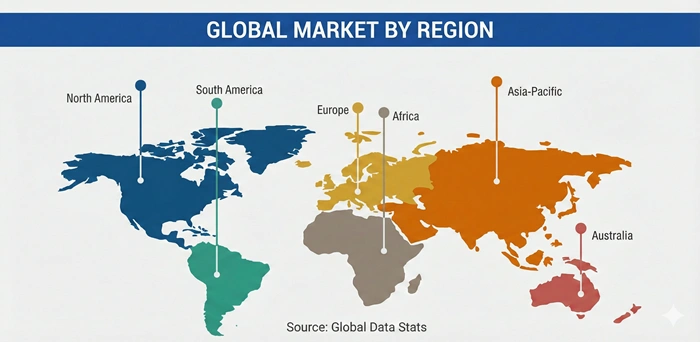
Asia Pacific dominates the liquid crystal polymer market with approximately 52% of global revenue in 2025 and a regional CAGR of approximately 11.2% from 2026 to 2033 — making it simultaneously the world's largest and fastest-growing regional market for LCP materials. China is the central driver of regional demand, as the world's largest manufacturer of consumer electronics, smartphones, telecommunications equipment, and electric vehicles — each product category consuming significant volumes of LCP connectors, antenna substrates, sensor housings, and precision components. Japan houses the majority of the world's primary LCP resin production capacity — including Polyplastics' VECTRA, Toray's Siveras, Sumitomo Chemical's Sumikasuper, and Kuraray's LCP Resin — making the region the essential upstream supplier for the global LCP value chain.
South Korea's major electronics conglomerates, including Samsung and LG Electronics, are high-volume consumers of LCP connector and antenna components in their smartphone and display product lines, while Taiwan's advanced semiconductor packaging industry is an increasingly important new application frontier for LCP materials in high-density interconnect substrates and fan-out packaging. India is emerging as a growing market for LCP applications as its electronics manufacturing capacity expands under the government's Production-Linked Incentive (PLI) scheme, and its rapidly growing EV market is beginning to generate automotive electronics demand that will translate into meaningful LCP consumption growth over the forecast period.
North America
North America's Advanced Semiconductor Industry, Defense Electronics Programs, and Strong Medical Device Manufacturing Base Establish It as the Second-Largest Revenue Region in the Liquid Crystal Polymer Market
North America holds approximately 22% of global liquid crystal polymer market revenue in 2025 and is growing at a regional CAGR of approximately 8.5% from 2026 to 2033, driven by the region's world-leading semiconductor design and packaging industry, large defense and aerospace electronics procurement programs, and highly developed medical device manufacturing ecosystem. The United States is the primary North American market, with demand concentrated in semiconductor advanced packaging applications — led by TSMC Arizona, Intel, and Amkor Technology — defense electronics systems procured by the U.S. Department of Defense, and medical device components manufactured by leading companies including Medtronic, Abbott, and Boston Scientific. Celanese Corporation — headquartered in the United States — is the only significant North American LCP primary producer and plays a key role in serving the regional connector, medical device, and specialty industrial markets.
Canada and Mexico contribute growing secondary demand, with Mexico in particular attracting increasing electronics and automotive component manufacturing investment that is generating new LCP consumption as foreign direct investment in the country's maquiladora manufacturing sector grows in response to nearshoring trends. North America's strong innovation culture in semiconductor packaging, aerospace, and medical device development ensures that it will remain the primary region for the highest-specification, highest-value LCP application development — even as volume consumption growth is led by Asia Pacific's manufacturing scale.
Report Customization Available by Region and Country
This report is fully customizable to deliver targeted liquid crystal polymer market intelligence for specific regions, countries, and geographies, providing localized demand analysis, competitive landscape profiles, raw material supply chain assessments, end-user industry growth forecasts, and strategic opportunity maps tailored to your precise geographic and application focus.
Customized versions of this report are available for every major global region and their constituent countries, providing detailed insights into the LCP supply chain, application demand drivers, regulatory environment, key manufacturer presence, and market growth opportunities specific to each target geography.
North America
-
United States — World's leading advanced semiconductor packaging and medical device LCP market, with Celanese as primary domestic producer and strong defense electronics demand
-
Canada — Growing industrial and automotive LCP applications, with increasing advanced manufacturing investment driving specialty polymer demand
-
Mexico — Rapidly expanding electronics and automotive component manufacturing base creating strong new LCP connector and sensor housing demand
Europe
-
United Kingdom — Active aerospace, defense electronics, and medical device LCP market, with growing automotive electrification demand from local OEM supply chains
-
Germany — Europe's largest automotive LCP market driven by BMW, Mercedes-Benz, and Volkswagen Group EV program expansion and ADAS sensor system development
-
France — Growing LCP market with automotive and aerospace applications, Solvay's European production supporting regional specialty polymer supply
-
Italy — Developing automotive and industrial LCP market with growing electrical component manufacturing and EV supply chain investment
-
Rest of Europe — Includes Netherlands, Belgium, and Switzerland as active markets for specialty polymer innovation, chemical production, and precision engineering LCP applications
Asia Pacific
-
China — World's largest LCP consumption market driven by electronics manufacturing scale, 5G infrastructure deployment, and rapidly growing EV production programs
-
India — Fastest-growing emerging LCP market with expanding electronics manufacturing under PLI scheme and growing EV industry creating new automotive polymer demand
-
Japan — Global LCP production hub with Polyplastics, Toray, Sumitomo Chemical, and Kuraray supplying the world's LCP resin requirements from domestic facilities
-
South Korea — Major LCP consumer through Samsung and LG Electronics connector and antenna substrate procurement for smartphone and display products
-
Australia — Developing LCP market with growing defense electronics, medical device, and industrial applications
-
Rest of Asia Pacific — Includes Taiwan, Singapore, and Malaysia as important electronics manufacturing markets with significant LCP component consumption
Latin America
-
Brazil — Largest Latin American electronics and automotive market with growing LCP demand in connector and sensor applications as domestic manufacturing capacity expands
-
Argentina — Developing market with increasing industrial and electronics applications for specialty polymer materials
-
Rest of Latin America — Includes Colombia, Chile, and Mexico as developing markets with growing manufacturing sector demand for high-performance polymer materials
Middle East & Africa
-
UAE — Advanced electronics distribution hub and growing defense technology market with increasing specialty polymer procurement for industrial and communications applications
-
Saudi Arabia — Expanding industrial and petrochemical sector with growing interest in specialty polymer value-added manufacturing as part of Vision 2030 diversification programs
-
Rest of MEA — Includes South Africa and Turkey as developing markets with growing electronics manufacturing and industrial polymer application adoption
Top Key Players
-
Celanese Corporation (United States)
-
Polyplastics Co. Ltd. (Japan)
-
Solvay SA (Belgium)
-
Toray Industries Inc. (Japan)
-
Sumitomo Chemical Co. Ltd. (Japan)
-
Kuraray Co. Ltd. (Japan)
-
RTP Company (United States)
-
UENO Fine Chemicals Industry Ltd. (Japan)
-
Zeus Industrial Products Inc. (United States)
-
TCI Chemicals (Japan / International)
-
BASF SE (Germany)
-
Ticona GmbH (a Celanese company) (Germany)
-
Shanghai PRET Composites Co. Ltd. (China)
-
Daikin Industries Ltd. (Japan)
-
Ensinger GmbH (Germany)
Recent Developments
-
In 2025, Celanese Corporation announced a strategic capacity expansion for its Vectra LCP resin product line at its European manufacturing facility, specifically targeting the rapidly growing demand from 5G antenna-in-package and automotive EV connector applications in the European market — reinforcing its position as the primary LCP supplier serving North American and European end-user industries
-
In 2025, Kuraray Co. Ltd. expanded commercial shipments of its next-generation LCP film products optimized for millimeter-wave 5G AiP antenna substrate applications, achieving improved dielectric uniformity and dimensional stability that enable reliable signal performance at frequencies up to 90 GHz in flagship smartphone and network equipment programs
-
In 2024, Polyplastics Co. Ltd. introduced a new series of automotive-grade VECTRA LCP compounds specifically formulated for high-voltage EV battery connector and junction box applications, delivering improved CTI (comparative tracking index) ratings, enhanced hydrolysis resistance, and UL94 V-0 flame retardancy at wall thicknesses required by next-generation EV power distribution architectures
-
In 2025, Toray Industries Inc. announced a research collaboration with a leading Japanese automotive OEM to develop the next generation of LCP-based ADAS radar sensor housings incorporating integrated electromagnetic shielding features, targeting the growing market for 77 GHz and 79 GHz automotive radar systems in Level 2+ and Level 3 autonomous vehicle platforms
-
In 2024, Sumitomo Chemical Co. Ltd. launched an expanded portfolio of Sumikasuper LCP grades for medical device applications — including new formulations with improved biocompatibility data packages, enhanced gamma radiation resistance for single-use device applications, and improved surface finish characteristics for precision surgical instrument components — expanding its addressable market in the high-growth medical device sector
Market Trends
The Accelerating Adoption of LCP Films in 5G Antenna Substrates, the Expansion of LCP Fiber Applications in Aerospace and Defense, and the Growing Sustainability Focus Driving Development of Recyclable LCP Formulations Are the Most Significant Trends Reshaping the Liquid Crystal Polymer Market
The transition of LCP from primarily a molded connector resin toward a multi-form-factor material platform — encompassing ultra-thin films, continuous fiber, fine-diameter fibers, and specialty laminates — is the most structurally significant trend in the liquid crystal polymer market today. LCP films are emerging as a critical substrate material for next-generation flexible circuits, 5G millimeter-wave antenna modules, and advanced semiconductor fan-out package redistribution layers — applications that collectively represent a much larger addressable market than traditional connector molding and that are growing at significantly higher rates. This product form diversification is enabling LCP producers to access new customer segments in the semiconductor packaging supply chain, the telecommunications equipment industry, and the defense electronics sector that were not historically part of the LCP market — broadening the revenue base and reducing dependence on the connector application cycle that has historically driven LCP demand volatility.
Sustainability is emerging as a growing market trend that is beginning to influence material selection decisions in the liquid crystal polymer space, particularly in European markets where extended producer responsibility legislation and corporate environmental sustainability commitments are creating pressure to evaluate the recyclability and lifecycle environmental impact of specialty polymer materials. While LCP's thermoplastic nature technically enables melt reprocessing, the high-temperature processing required and the tendency for molecular orientation and mechanical property degradation during recycling limit practical recyclability in current commercial infrastructure. Leading LCP producers including Celanese and Solvay are beginning to invest in research programs targeting bio-based LCP monomer pathways, improved recyclability formulations, and chemical recycling routes that could address these end-of-life challenges — positioning their LCP portfolios favorably against potential future regulatory requirements and corporate sustainability procurement criteria that will become increasingly important purchasing factors in European and North American markets through the forecast period.
Segments Covered in the Report
-
By Type
-
Thermotropic LCP
-
Lyotropic LCP
-
-
By Phase
-
Nematic Phase
-
Smectic Phase
-
Cholesteric Phase
-
Discotic Phase
-
-
By Form/Shape
-
Films & Laminates
-
Fibers (LCP Fiber)
-
Resins & Compounds (Injection Molding Grades)
-
Others
-
-
By Application
-
Electrical & Electronics
-
Connectors & Terminals
-
Antenna Elements & Substrates
-
Flexible Printed Circuits (FPC)
-
Circuit Board Materials
-
Others
-
-
Automotive
-
Sensor Housings (Radar, LiDAR, Camera)
-
EV Battery Connectors & Junction Boxes
-
Under-Hood Thermal Management Components
-
Others
-
-
Medical Devices
-
Industrial & Mechanical Components
-
Aerospace & Defense
-
Consumer Goods
-
Others
-
-
By End User
-
Electrical & Electronics Industry
-
Automotive Industry
-
Medical Industry
-
Aerospace & Defense Industry
-
Industrial Manufacturing
-
Others
-
-
By Region
-
North America (U.S., Canada, Mexico)
-
Europe (U.K., Germany, France, Italy, Rest of Europe)
-
Asia Pacific (China, India, Japan, South Korea, Australia, Rest of Asia Pacific)
-
Latin America (Brazil, Argentina, Rest of Latin America)
-
Middle East & Africa (UAE, Saudi Arabia, Rest of MEA)
-
❝ Built for Every Level — From Startups to Industry Giants ❞
Here Is Exactly How This Report Works for You
-
For global specialty chemical corporations, tier-1 automotive component manufacturers, and institutional investors assessing the LCP material opportunity, this report delivers precise market sizing by application and geography, competitor production capacity and pricing strategy analysis, raw material supply chain risk assessment, and geopolitical intelligence — including how U.S.-China trade policy tensions affecting semiconductor supply chains, Japan's export controls on specialty chemical technology, and EU circular economy regulations are reshaping competitive dynamics, sourcing strategy, and geographic market prioritization across the global liquid crystal polymer market
-
For mid-market compounders, specialty polymer distributors, and electronics component manufacturers dependent on LCP supply, the report provides detailed application demand forecasts by end-use sector, material grade selection benchmarking, key supplier capacity and capability profiling, and technology substitution risk analysis — enabling procurement, product management, and business development teams to make more informed decisions about LCP sourcing strategy, product portfolio positioning, and customer segment prioritization in a rapidly evolving competitive landscape
-
Startups and innovators developing novel LCP film processing technologies, bio-based LCP monomers, AI-driven LCP compound optimization platforms, or new application solutions for defense and medical device markets will find this report's technology white-space analysis, investment trend mapping, application adoption curve forecasting, and competitive entry barrier intelligence essential for validating market opportunity, attracting strategic investor interest, and building go-to-market strategies grounded in verified market size data for the growing liquid crystal polymer ecosystem
Frequently Asked Questions
Question 1: What is the projected size of the liquid crystal polymer market by 2033?
Answer: The liquid crystal polymer market is projected to reach approximately USD 5.24 billion by 2033, growing from USD 2.49 billion in 2026 at a CAGR of 9.47%. This growth is driven by surging demand from 5G telecommunications, automotive electrification, and advanced electronics miniaturization applications where LCP's unique thermal, dielectric, and dimensional properties are essential.
Question 2: What is driving the growth of the liquid crystal polymer market in the electronics sector?
Answer: The liquid crystal polymer market in electronics is being driven primarily by 5G millimeter-wave infrastructure deployment, which requires LCP's uniquely low and frequency-stable dielectric properties for antenna substrate and high-frequency connector applications that conventional engineering plastics cannot satisfy. The ongoing miniaturization of consumer electronics and the growth of advanced semiconductor packaging formats are also expanding LCP consumption in flexible circuits and interconnect substrate applications.
Question 3: Which region dominates the liquid crystal polymer market?
Answer: Asia Pacific dominates the liquid crystal polymer market with approximately 52% of global revenue in 2025, driven by the world's largest electronics manufacturing ecosystem in China, Japan, South Korea, and Taiwan, and supported by the concentration of primary LCP resin production capacity at major Japanese producers including Polyplastics, Toray, Sumitomo Chemical, and Kuraray. The region is simultaneously the fastest-growing market, expanding at approximately 11.2% CAGR from 2026 to 2033.
Question 4: What are the key types of liquid crystal polymers used commercially?
Answer: The liquid crystal polymer market is commercially dominated by thermotropic LCP grades — which form their liquid crystalline mesophase from heat and account for approximately 72% of market revenue in 2025 — used in injection-molded connectors, antenna substrates, and sensor housings across electronics and automotive applications. Lyotropic LCP grades, which form their liquid crystalline phase through dissolution in solvent, are used primarily in high-performance fiber applications including Vectran, which serves demanding applications in aerospace, marine, and ballistic protection sectors.
Question 5: How is automotive electrification impacting the liquid crystal polymer market?
Answer: Automotive electrification is creating strong new demand for the liquid crystal polymer market by requiring high-temperature, high-voltage electrical connectors, ADAS sensor housings, and battery management system components that need LCP's unique combination of thermal stability above 150°C, precision moldability, and low dielectric loss at radar frequencies. The automotive application segment is projected to grow at approximately 13.8% CAGR through 2033 — the fastest rate of any LCP application — as global EV production scales rapidly and ADAS technology penetrates across vehicle price segments.