
Life Insurance Market Overview
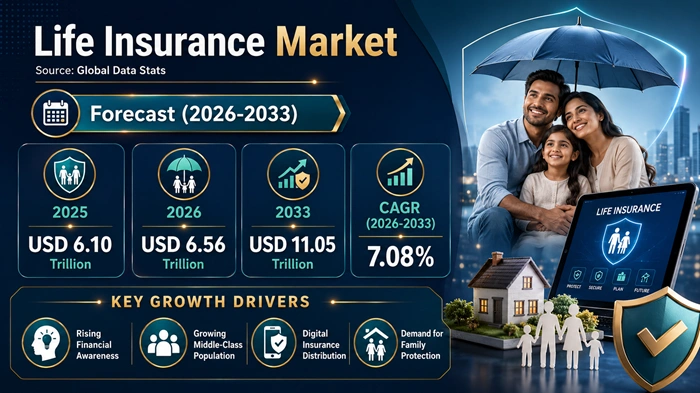
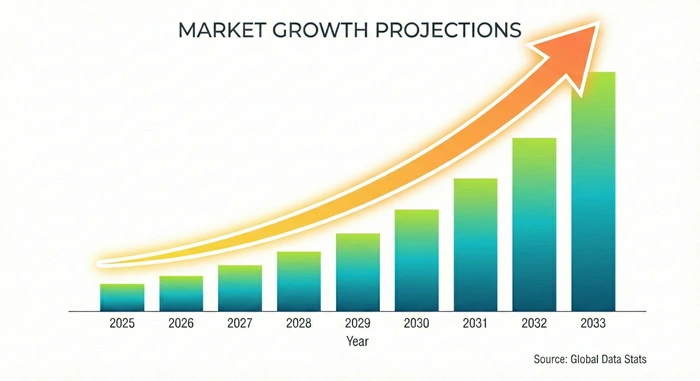
The global life insurance market size is valued at USD 6.10 trillion in 2025 and is predicted to increase from USD 6.56 trillion in 2026 to approximately USD 11.05 trillion by 2033, growing at a CAGR of 7.08% from 2026 to 2033.
This steady expansion reflects the growing recognition among individuals and families worldwide of the importance of long-term financial protection and retirement planning. Rising middle-class incomes, an aging global population, and increasing awareness around income replacement and wealth transfer are together pushing demand for life insurance products across both mature and emerging economies.
AI Impact on the Life Insurance Industry
Artificial Intelligence Is Quietly Transforming How Insurers Underwrite, Price, and Serve Policyholders
Artificial intelligence is beginning to play a meaningful role in reshaping how life insurance companies assess risk and process new policy applications. Machine learning models trained on vast datasets covering health records, lifestyle habits, and historical claims are helping underwriters price policies more accurately and issue coverage decisions in minutes rather than weeks, a process that traditionally required lengthy medical examinations and manual review. This accelerated underwriting is particularly valuable for younger, healthier applicants who increasingly expect fast, digital-first purchasing experiences comparable to other online financial services.
Beyond underwriting, AI-powered chatbots and virtual assistants are improving customer service by handling routine policy inquiries, premium payment reminders, and claims status updates without requiring human agents for every interaction. Insurers are also using predictive analytics to identify policyholders at risk of lapsing their coverage, allowing proactive outreach that improves retention and long-term customer relationships. The broader integration of AI into fraud detection systems is strengthening claims processing accuracy, an area that has become increasingly important as insurers manage rising claim volumes tied to an aging global population.
Growth Factors
Rising Financial Awareness, Demographic Shifts, and Digital Distribution Are Converging to Sustain Market Growth
The primary engine driving the life insurance market forward is the growing global awareness of the need for financial protection against unexpected loss of income. As more households in emerging economies enter the middle class, they increasingly seek products that protect their families from financial hardship and support long-term goals like education funding and retirement income. This awareness is reinforced by growing government and industry campaigns promoting financial literacy, which has helped normalize life insurance as an essential part of personal financial planning rather than an optional expense.
At the same time, demographic shifts are creating durable long-term demand for the life insurance market. Aging populations in developed markets like the United States, Japan, and much of Europe are driving strong demand for annuity and retirement income products, while younger populations in Asia Pacific and parts of Africa represent a large untapped customer base for traditional term and whole life coverage. The expansion of digital distribution channels, including direct-to-consumer online platforms and mobile-first insurance applications, is further widening market access by making policy comparison and purchase far more convenient than traditional agent-based sales models.
Market Outlook
Wealth Transfer Trends, Emerging Market Penetration, and Product Innovation Are Setting the Stage for Sustained Long-Term Growth
The life insurance industry is positioned for sustained long-term growth driven by several converging demographic and economic factors. As significant generational wealth transfer occurs over the coming decade, insurers are increasingly focused on products that combine protection with investment and estate planning features, appealing to a wealthier and more financially sophisticated customer base. This shift toward hybrid products that blend traditional life coverage with wealth accumulation features represents a meaningful evolution in how insurers position their offerings to attract higher-value policyholders.
Emerging markets will be a key battleground for growth through 2033. Countries across Asia Pacific, particularly India and China, are seeing rapid expansion of insurance penetration as rising disposable incomes and improving financial infrastructure make life insurance more accessible to a broader population. International insurers continue to expand their presence in these markets through joint ventures and digital partnerships that reduce distribution costs. Companies that invest early in affordable, digitally distributed life insurance products suited to price-sensitive emerging market consumers are likely to capture a disproportionate share of this expanding demand within the life insurance market.
Expert Speaks
-
"The demand for financial protection has never been stronger, and our industry is responding with products that combine traditional life coverage with modern digital convenience. Customers today expect the same speed and simplicity they get from other financial services." — CEO, MetLife Inc.
-
"Demographic shifts across Asia and aging populations in developed markets are reshaping how we think about product design. Annuities and retirement income solutions are becoming just as important as traditional protection coverage." — CEO, Prudential Financial Inc.
-
"Artificial intelligence has fundamentally changed how quickly we can underwrite new policies, and this speed is becoming a genuine competitive differentiator in attracting younger customers." — CEO, AIA Group Limited
Key Report Takeaways
-
Asia Pacific leads the global life insurance market, holding approximately 36% market share in 2025, supported by massive population scale, rising middle-class incomes, and rapidly improving insurance penetration across China and India
-
North America is a key growth region, driven by strong demand for annuity and retirement income products among an aging population alongside continued growth in digital insurance distribution
-
Individual policyholders represent the dominant customer segment, relying heavily on life insurance products to protect family income and plan for long-term financial goals
-
Term life insurance contributes the most to overall policy volume, reflecting continued consumer preference for affordable, straightforward income replacement coverage
-
Traditional agent and broker distribution remains the most widely used sales channel, prized for its ability to provide personalized advice for complex financial planning decisions
-
Digital and direct-to-consumer distribution will grow the fastest among distribution channel segments, holding close to 24% market share with a CAGR near 11% through the forecast period, driven by rising consumer comfort with online insurance purchasing
Market Scope
| Report Coverage | Details |
|---|---|
| Market Size by 2033 | USD 11.05 Trillion |
| Market Size by 2025 | USD 6.10 Trillion |
| Market Size by 2026 | USD 6.56 Trillion |
| Market Growth Rate from 2026 to 2033 | CAGR of 7.08% |
| Dominating Region | Asia Pacific |
| Fastest Growing Region | North America |
| Base Year | 2025 |
| Forecast Period | 2026 to 2033 |
| Segments Covered | Product Type, Distribution Channel, Policyholder Type, Provider Type, Region |
| Regions Covered | North America, Europe, Asia Pacific, Latin America, Middle East & Africa |
Market Dynamics
Drivers Impact Analysis
Rising Financial Protection Awareness and Aging Global Population Are Emerging as the Two Most Powerful Forces Propelling This Market Forward
| Driver | (≈) % Impact on CAGR Forecast | Geographic Relevance | Impact Timeline |
|---|---|---|---|
| Growing awareness of financial protection and income replacement needs | ~35% | Global, strongest in Asia Pacific | Short to long-term |
| Aging population driving demand for annuity and retirement products | ~28% | North America, Europe, Japan | Medium to long-term |
| Expansion of digital and direct-to-consumer distribution channels | ~20% | Global | Short to medium-term |
| Rising middle-class incomes in emerging economies | ~17% | Asia Pacific, Latin America | Medium to long-term |
The growing global awareness of financial protection needs is without question the single most powerful demand driver in the life insurance market. As more households recognize the financial risk that comes with losing a primary income earner, demand for term and whole life policies continues to climb steadily across both developed and developing economies. This awareness has been reinforced by widespread public education campaigns and employer-sponsored benefit programs that introduce life insurance to working populations earlier in their careers, expanding the overall customer base for insurers.
The aging global population is the second critical driver shaping the life insurance market. As birth rates decline and life expectancy rises across major economies like the United States, Japan, and much of Europe, demand for annuity products and guaranteed retirement income solutions continues to grow rapidly. This matters commercially because older policyholders often represent higher-value, longer-duration relationships for insurers, and product innovation around retirement income is becoming a central focus for major carriers. As demographic trends continue to shift, procurement of retirement-focused life insurance products is accelerating across mature markets.
Restraints Impact Analysis
Low Insurance Penetration in Emerging Markets and Regulatory Complexity Continue to Present Real-World Barriers to Full Market Growth
| Restraint | (≈) % Impact on CAGR Forecast | Geographic Relevance | Impact Timeline |
|---|---|---|---|
| Low insurance penetration and awareness in emerging economies | ~38% | Sub-Saharan Africa, parts of Latin America, South Asia | Short to medium-term |
| Complex, varying regulatory requirements across jurisdictions | ~30% | Global | Short to long-term |
| Rising interest rate volatility affecting product pricing | ~20% | Global | Medium-term |
| High distribution costs through traditional agent networks | ~12% | Global | Ongoing |
The most significant structural restraint in the life insurance market is the persistently low level of insurance penetration in many emerging economies, where cultural attitudes, limited disposable income, and low financial literacy continue to slow adoption. Many households in these regions view life insurance as a discretionary expense rather than an essential financial tool, creating a substantial gap between where insurers see growth potential and where consumers are actually ready to purchase coverage. This creates a persistent challenge for insurers trying to expand into underpenetrated markets without significant investment in consumer education.
Complex and varying regulatory requirements across different countries and states remain a persistent operational challenge for insurers operating internationally. Each jurisdiction often has distinct capital requirements, product approval processes, and consumer protection rules, which can slow product launches and increase compliance costs significantly. While digital distribution is helping reduce some traditional cost barriers, the combination of low penetration in emerging markets and regulatory fragmentation still limits how quickly the broader life insurance market can expand into new geographies.
Opportunities Impact Analysis
Digital Distribution Expansion and Emerging Market Penetration Represent the Most Commercially Significant Growth Opportunities
| Opportunity | (≈) % Impact on CAGR Forecast | Geographic Relevance | Impact Timeline |
|---|---|---|---|
| Expansion of digital and mobile-first insurance distribution | ~40% | Global, led by Asia Pacific, North America | Medium to long-term |
| Growth of insurance penetration in underserved emerging markets | ~35% | Asia Pacific, Latin America, MEA | Short to medium-term |
| Development of hybrid products combining protection and wealth accumulation | ~25% | Global, especially among affluent customers | Long-term |
The expansion of digital and mobile-first insurance distribution represents one of the most commercially attractive opportunities in the life insurance sector. Younger consumers increasingly expect to research, compare, and purchase insurance policies online without needing to meet an agent in person, and insurers that build seamless digital purchasing experiences stand to capture a growing share of this tech-savvy customer base. As InsurTech partnerships continue to mature, digital distribution is expected to broaden significantly across both developed and developing markets.
Growth of insurance penetration in underserved emerging markets is opening entirely new customer segments that established insurers have historically found difficult to reach profitably. Rising smartphone adoption and improving financial infrastructure in countries across Asia Pacific and Latin America are making it increasingly feasible to offer affordable, simplified life insurance products to lower-income populations. Companies that can deliver low-cost, easy-to-understand policies tailored to first-time insurance buyers will find significant commercial opportunity as awareness continues to spread in these high-potential regions.
Segment Analysis
By Product Type: Term Life Insurance
Term Life Insurance Leads the Product Landscape, Driven by Affordability and Straightforward Income Replacement Coverage
Term life insurance holds a leading position in the life insurance market, accounting for a substantial share of total policy volume in 2025 due to its straightforward structure and relatively low premium cost compared to permanent coverage options. This popularity is deeply rooted in consumer preference for affordable, easy-to-understand protection that covers a specific period, typically matching major financial obligations like mortgages or children's education expenses. In mature markets like the United States and the United Kingdom, term life policies remain the entry point for most first-time insurance buyers, creating steady, recurring demand for simplified underwriting products. Leading companies such as MetLife, Prudential Financial, and New York Life continue to dominate this segment through well-established distribution networks and strong brand recognition built over decades.
Asia Pacific is emerging as a strong growth region for term life insurance adoption, expanding rapidly as rising middle-class populations in China and India seek affordable protection products for the first time. The region's enormous population base, combined with improving financial literacy and growing smartphone-based insurance distribution, is generating significant demand for cost-effective term coverage. AIA Group and Ping An Insurance have strengthened their regional presence through digital partnerships and localized product design tailored to price-sensitive customers. The broader shift toward simplified, digitally underwritten term products is also being led by this segment, with instant-issue policies gaining traction among younger applicants seeking fast approval.
By Distribution Channel: Agent and Broker Networks
Agent and Broker Distribution Remains Central to the Life Insurance Market, Supporting Complex Financial Planning Needs
Agent and broker distribution channels continue to account for the largest share of overall life insurance sales in 2025, reflecting the continued importance of personalized financial advice for complex, long-term protection decisions. Many consumers, particularly those purchasing permanent life insurance or products involving investment components, prefer working directly with trained advisors who can explain policy features and help match coverage to individual financial goals. This channel operates with strong customer retention rates, supported by ongoing relationship management that digital-only platforms often struggle to replicate for higher-value policies.
North America remains a stronghold for agent-based distribution, supported by a mature financial advisory industry and strong consumer trust in personalized guidance for retirement and estate planning products. Companies like New York Life and Northwestern Mutual have built extensive advisor networks that continue to generate substantial premium volume through face-to-face client relationships. Europe also maintains strong broker-based distribution, particularly for corporate and group life insurance products sold through employee benefit consultants. Digital distribution, while growing quickly, continues to complement rather than fully replace traditional agent networks across most major life insurance market segments.
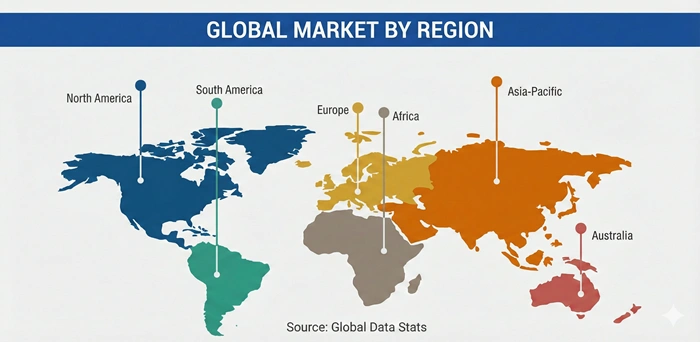
Regional Insights
Asia Pacific
Asia Pacific's Massive Population Base and Rising Insurance Penetration Make It the Global Market Leader
Asia Pacific holds the dominant position in the global life insurance market with approximately 36% market share in 2025 and continues to expand steadily through 2033. China and India drive much of the regional demand, supported by enormous population scale, rapidly rising middle-class incomes, and improving financial infrastructure that is making insurance products more accessible to first-time buyers. Key companies with strong Asia Pacific market presence include AIA Group, Ping An Insurance, and China Life Insurance, all of which maintain extensive distribution networks and growing digital partnerships across the region.
Japan and South Korea also contribute meaningfully to regional demand, both bringing mature insurance markets with high penetration rates and sophisticated product offerings tailored to aging populations. Insurers across the region continue to invest heavily in digital distribution and simplified underwriting to reach younger, price-sensitive customers who represent the next wave of growth. The combination of massive population scale, rising disposable incomes, and improving insurance awareness ensures Asia Pacific's leadership position in the life insurance market remains firmly intact through 2033.
North America
North America's Aging Population and Strong Retirement Product Demand Drive Steady Market Expansion
North America represents a key growth region in the global life insurance market, supported by a large and aging population that continues to drive strong demand for annuity and guaranteed retirement income products. The United States drives the majority of regional demand, backed by a mature financial advisory industry and growing consumer interest in combining life insurance protection with long-term wealth accumulation strategies. Companies like MetLife, Prudential Financial, and Northwestern Mutual maintain strong North American operations, offering a broad range of products tailored to both younger protection-focused buyers and older retirement-focused customers.
The United States and Canada represent the two markets most closely watched within the region, given the scale of retirement savings needs across their aging populations. The U.S. has seen growing interest in hybrid products that combine life insurance with long-term care benefits, reflecting shifting consumer priorities around aging-related financial planning. Canada's market, while smaller, benefits from similar demographic trends and continues to support steady demand growth across the broader North American life insurance market.
Customization Available for This Report
Region-Wise and Country-Wise Customization Ensures Every Client Gets Insights Tailored to Their Exact Market Focus
This report offers comprehensive region-wise and country-wise customization, providing tailored market insights, trends, competitive analysis, and opportunity assessments specific to your geography of interest.
Our team can deliver a fully customized version of this report for any of the following regions and countries, providing deep-dive market analysis, demand forecasting, regulatory landscape review, and competitive intelligence specific to the selected market and life insurance keyword combination:
North America
-
U.S. — Detailed analysis of annuity product demand, digital distribution trends, and advisor network dynamics
-
Canada — Insights into retirement planning trends and life insurance product adoption
-
Mexico — Growing insurance penetration and expanding distribution channel development
Europe
-
U.K. — Broker-based distribution trends and group life insurance product adoption
-
Germany — Advanced insurance product manufacturing landscape and regulatory environment
-
France — Retirement planning trends and life insurance premium growth dynamics
-
Italy — Growing demand for hybrid protection and investment-linked products
-
Rest of Europe — Emerging life insurance markets across Eastern Europe and the Baltics
Asia Pacific
-
China — Population scale, rising middle-class demand, and domestic insurer competitiveness
-
India — Growing insurance penetration, digital distribution expansion, and affordable term product demand
-
Japan — Mature insurance market adoption and retirement-focused product innovation
-
South Korea — Insurance product export industry and institutional distribution
-
Australia — Growing superannuation-linked life insurance demand and digital adoption
-
Rest of Asia Pacific — Country-level analysis covering Thailand, Vietnam, Indonesia, and Malaysia
Latin America
-
Brazil — Growing insurance market and expanding digital distribution adoption
-
Argentina — Early-stage life insurance market development
-
Rest of Latin America — Colombia, Mexico, Peru, and Chile country-level life insurance market sizing
Middle East & Africa
-
UAE — Growing insurance adoption and Vision-aligned financial sector investments
-
Saudi Arabia — Industrial modernization, insurance infrastructure investment, and distribution growth
-
Rest of MEA — Sub-Saharan Africa insurance access expansion and microinsurance program growth
Top Key Players
-
MetLife Inc (United States)
-
Prudential Financial Inc (United States)
-
AIA Group Limited (Hong Kong)
-
Ping An Insurance Company (China)
-
China Life Insurance Company Limited (China)
-
Allianz SE (Germany)
-
AXA SA (France)
-
Manulife Financial Corporation (Canada)
-
New York Life Insurance Company (United States)
-
Northwestern Mutual Life Insurance Company (United States)
-
Legal and General Group plc (United Kingdom)
-
Zurich Insurance Group AG (Switzerland)
Recent Developments
-
In 2025, MetLife expanded its digital underwriting platform to accelerate policy issuance timelines for term life applicants across several key markets
-
In 2026, Prudential Financial announced enhancements to its annuity product portfolio, targeting growing retirement income demand among aging policyholders
-
In 2025, AIA Group strengthened its regional presence across Southeast Asia through new digital distribution partnerships aimed at reaching first-time insurance buyers
-
In 2026, Ping An Insurance introduced AI-driven claims processing improvements designed to reduce settlement times for life insurance policyholders
-
In 2025, Allianz deepened its bancassurance partnerships across several European markets to expand distribution of hybrid protection and investment-linked products
Market Trends
The Life Insurance Market Is Rapidly Shifting Toward Digital Distribution and Hybrid Products That Match Evolving Consumer Financial Priorities
Two of the most consequential trends reshaping the life insurance landscape are the growth of digital, direct-to-consumer distribution and the rising popularity of hybrid products that combine protection with wealth accumulation features. Digital platforms that allow consumers to compare, apply for, and receive instant approval on policies are replacing traditional in-person sales processes for simpler term products, particularly among younger applicants. This trend is reducing distribution costs for insurers while improving accessibility for consumers who previously found the traditional application process too slow or complicated.
The second major trend is the growing consumer interest in products that blend life insurance protection with long-term investment or long-term care benefits, reflecting a broader shift toward comprehensive financial planning rather than single-purpose insurance products. This is opening new opportunities for insurers to deepen relationships with existing policyholders by cross-selling complementary financial products. At the same time, the expansion of insurance penetration into underserved emerging markets through mobile-based distribution is creating a new layer of growth opportunity for insurers willing to adapt their product design to lower-income, first-time buyers.
Segments Covered in the Report
By Product Type
-
Term Life Insurance
-
Whole Life Insurance
-
Universal Life Insurance
-
Endowment Plans
-
Annuity Products
By Distribution Channel
-
Agents and Brokers
-
Bancassurance
-
Digital and Direct-to-Consumer Platforms
By Policyholder Type
-
Individual Policyholders
-
Group and Corporate Policyholders
By Provider Type
-
Public Insurance Providers
-
Private Insurance Providers
By Region
-
North America (U.S., Canada, Mexico)
-
Europe (U.K., Germany, France, Italy, Rest of Europe)
-
Asia Pacific (China, India, Japan, South Korea, Australia, Rest of Asia Pacific)
-
Latin America (Brazil, Argentina, Rest of Latin America)
-
Middle East & Africa (UAE, Saudi Arabia, Rest of MEA)
❝ Built for Every Level — From Startups to Industry Giants ❞
Here Is Exactly How This Report Works for You
-
For tier 1 enterprises, investors, and high-level decision-makers, this report delivers competitor revenue analysis, detailed revenue source breakdowns, geopolitical risk assessments, and supply-demand dynamics that enable confident capital allocation, M&A targeting, and strategic market entry or expansion decisions in the life insurance space
-
For tier 2 and tier 3 companies, mid-level businesses, and startups, this report provides a practical roadmap of the most commercially viable segments, regional opportunities, and product investment priorities, helping you compete effectively against established players and identify white spaces before they become crowded
-
For all decision-makers across the value chain, this report explains exactly how regulatory shifts, demographic trends, interest rate movements, and competitor positioning are converging to shape market direction through 2033, giving you the intelligence framework to make proactive, evidence-based decisions rather than reactive ones
Frequently Asked Questions
Question 1: What is the current size of the global life insurance market and how is it expected to grow?
Answer: The global life insurance market was valued at USD 6.10 trillion in 2025 and is projected to reach USD 11.05 trillion by 2033. This growth is driven by rising financial protection awareness and demand for retirement income products.
Question 2: Which factors are driving growth in the life insurance market?
Answer: The primary drivers of the life insurance market include growing awareness of income replacement needs and an aging global population. Expanding digital distribution channels are further accelerating policy adoption across younger consumers.
Question 3: Which region holds the largest share in the life insurance market?
Answer: Asia Pacific currently dominates the life insurance market with approximately 36% market share, supported by massive population scale and rising incomes. North America remains a key growth region, driven by strong annuity and retirement product demand.
Question 4: What are the key product segments driving revenue in the life insurance market?
Answer: Term life insurance accounts for a substantial share of policy volume, reflecting consumer preference for affordable coverage. Agent and broker distribution also remains central to sales of complex, long-term financial planning products.
Question 5: Who are the leading companies operating in the life insurance market?
Answer: Leading players in the life insurance market include MetLife, Prudential Financial, AIA Group, Ping An Insurance, and China Life Insurance. These companies compete through broad product portfolios, extensive distribution networks, and continuous investment in digital underwriting technology.