
Laser Interferometer Market Overview
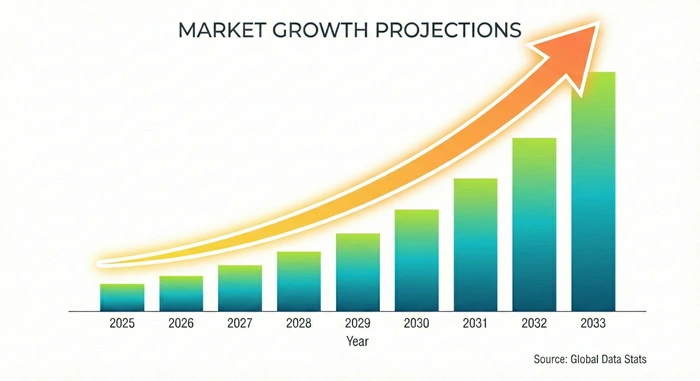
The global laser interferometer market size is valued at USD 281.78 million in 2025 and is predicted to increase from USD 339.70 million in 2026 to approximately USD 469.40 million by 2033, growing at a CAGR of 6.70% from 2026 to 2033.
The laser interferometer market is experiencing remarkable expansion driven by increasing precision requirements across semiconductor fabrication, aerospace engineering, automotive manufacturing, and medical diagnostics. These advanced optical measurement instruments utilize the interference patterns of coherent laser light to achieve nanometer-level accuracy in dimensional measurements, surface profiling, and quality inspection processes. Industries worldwide are adopting laser interferometry solutions to meet stringent quality standards, enhance production efficiency, and support the transition toward automated manufacturing environments.
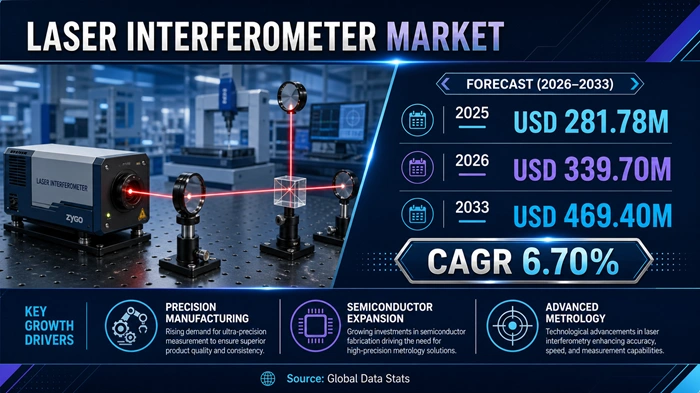
Empowering Industries Through Precision Optical Metrology and Advanced Manufacturing Intelligence
The rapid evolution of manufacturing technologies and the growing complexity of miniaturized electronic components are creating unprecedented demand for ultra-precise measurement tools. Laser interferometer systems provide non-contact, high-resolution measurement capabilities that traditional mechanical gauges cannot match. As manufacturing operations become increasingly automated through Industry 4.0 initiatives, laser interferometers are being integrated with intelligent control systems to enable real-time process monitoring and adaptive quality control. This technological convergence is transforming how manufacturers approach dimensional verification, equipment calibration, and defect detection across multiple production stages.
AI Impact on the Laser Interferometer Industry
Transforming Precision Measurement Through Intelligent Data Analysis and Predictive Maintenance
Artificial intelligence is revolutionizing the laser interferometer market by introducing advanced pattern recognition algorithms that can automatically identify measurement anomalies and surface defects with unprecedented accuracy. Machine learning models are being trained on vast datasets of interferometric patterns to distinguish between genuine surface irregularities and environmental noise, significantly improving measurement reliability in challenging industrial environments. AI-powered systems can now process complex interference fringe patterns in milliseconds, enabling real-time quality control decisions on high-speed production lines without human intervention.
The integration of AI with laser interferometry is also enabling predictive maintenance capabilities that extend equipment lifespan and reduce operational downtime. Intelligent systems continuously monitor interferometer performance parameters such as laser stability, detector sensitivity, and optical alignment to predict potential failures before they occur. These predictive algorithms analyze subtle changes in measurement consistency to schedule maintenance interventions at optimal times, minimizing disruptions to manufacturing operations. Additionally, AI-driven calibration routines are automating complex setup procedures that previously required skilled technicians, democratizing access to precision measurement technology across organizations of varying technical expertise.
Growth Factors
Accelerating Adoption Driven by Semiconductor Miniaturization and Quality Assurance Demands
The semiconductor industry's relentless pursuit of smaller transistor geometries and higher chip densities is creating enormous demand for measurement tools capable of sub-nanometer precision. Modern chip fabrication processes operate at dimensional tolerances that push the boundaries of physical measurement, requiring laser interferometers for critical tasks such as photomask alignment, wafer flatness verification, and lithography equipment calibration. As semiconductor manufacturers transition to advanced process nodes below 5 nanometers, the laser interferometer market is experiencing accelerated growth from investments in next-generation metrology infrastructure that can support these demanding manufacturing requirements.
The automotive industry's transformation toward electric vehicles and autonomous driving systems is generating substantial growth opportunities for precision measurement technologies. Electric powertrains require precise machining of battery housings, motor components, and power electronics assemblies to ensure optimal performance and safety. Laser interferometers enable automotive manufacturers to achieve the tight dimensional tolerances necessary for efficient thermal management, electromagnetic compatibility, and mechanical reliability in electric vehicle systems. Furthermore, the production of advanced driver assistance sensors and LiDAR systems relies heavily on optical measurement tools to verify surface quality and alignment specifications that directly impact safety-critical detection capabilities.
Market Outlook
Strong Expansion Trajectory Supported by Manufacturing Modernization and Research Investments
The laser interferometer market outlook remains exceptionally positive as manufacturers worldwide modernize their production facilities and research institutions expand their precision measurement capabilities. Government initiatives promoting advanced manufacturing competitiveness are driving substantial investments in metrology infrastructure across developed and emerging economies. Countries are recognizing that precision measurement capabilities represent critical enablers of technological innovation and industrial productivity, leading to increased funding for metrology research centers and calibration laboratories. This institutional support is creating stable long-term demand for sophisticated laser interferometry equipment beyond cyclical manufacturing trends.
Emerging applications in biotechnology and medical device manufacturing are opening new growth avenues for laser interferometer technology. The production of implantable medical devices, surgical instruments, and diagnostic equipment requires stringent dimensional verification to ensure patient safety and regulatory compliance. Laser interferometers provide the non-contact measurement capabilities necessary to inspect delicate medical components without contamination risks. Additionally, the growing field of bioprinting and tissue engineering is adopting interferometric techniques for precise characterization of cellular structures and biomaterial properties, expanding the addressable market for laser measurement systems into life sciences applications.
Expert Speaks
-
Dr. Pat McDonald, CEO of Renishaw plc, stated that the company is witnessing unprecedented demand for high-precision measurement solutions across semiconductor and aerospace sectors, with investments in multi-axis interferometry systems accelerating as manufacturers seek to enhance production accuracy and reduce quality control costs.
-
Satish Dhanasekaran, President and CEO of Keysight Technologies, emphasized that the convergence of precision measurement with digital transformation is creating new opportunities for intelligent metrology solutions, particularly in semiconductor testing applications where nanometer-level accuracy combined with real-time data analytics delivers significant competitive advantages.
-
Dr. Karl Lamprecht, President of ZEISS Industrial Quality Solutions, highlighted that global manufacturing trends toward miniaturization and complexity are driving sustained growth in optical metrology markets, with laser interferometers playing increasingly critical roles in ensuring product quality across automotive, medical device, and electronics manufacturing operations.
Key Report Takeaways
-
North America dominates the laser interferometer market with a substantial market share of approximately 38%, attributed to strong semiconductor manufacturing presence, advanced aerospace industries, and significant research and development investments across technology sectors in the United States and Canada.
-
Asia Pacific represents the fastest-growing regional market with an anticipated CAGR exceeding 7.9%, driven by rapid industrialization, expanding semiconductor fabrication capacity, automotive production growth, and increasing quality control standards across manufacturing operations in China, Japan, South Korea, and Taiwan.
-
Heterodyne interferometer technique holds the largest market share accounting for approximately 62% of total revenue, favored for its superior noise immunity, real-time measurement capabilities, and ability to provide high-resolution displacement tracking in dynamic industrial environments.
-
Surface topology applications contribute the most significant revenue representing roughly 41% of total market value, as industries increasingly require detailed surface characterization for quality assurance, defect detection, and optical component verification across manufacturing processes.
-
Fizeau interferometer type is experiencing the most rapid growth with a projected CAGR of 6.8%, gaining popularity for flatness testing, optical component inspection, and semiconductor wafer measurement applications that demand exceptional measurement accuracy and repeatability.
-
Electronics and semiconductor vertical will exhibit the strongest growth trajectory expected to expand at a CAGR of 7.2% with a growing market share of 34%, fueled by continuous device miniaturization, advanced packaging technologies, and the proliferation of photonic integrated circuits requiring ultra-precise dimensional verification.
Market Scope
| Report Coverage | Details |
|---|---|
| Market Size by 2033 | USD 469.40 Million |
| Market Size by 2025 | USD 281.78 Million |
| Market Size by 2026 | USD 339.70 Million |
| Market Growth Rate from 2026 to 2033 | CAGR of 6.70% |
| Dominating Region | North America |
| Fastest Growing Region | Asia Pacific |
| Base Year | 2025 |
| Forecast Period | 2026 to 2033 |
| Segments Covered | Technique, Type, Component, Application, Vertical, Region |
| Regions Covered | North America, Europe, Asia Pacific, Latin America, Middle East & Africa |
Market Dynamics
Drivers Impact Analysis
Escalating Precision Requirements in Semiconductor Manufacturing Driving Market Expansion
| Driver | (≈) % Impact on CAGR Forecast | Geographic Relevance | Impact Timeline |
|---|---|---|---|
| Growing semiconductor miniaturization and advanced node transitions | +2.1% | Asia Pacific, North America | 2026-2033 |
| Increasing automation and Industry 4.0 adoption | +1.8% | Global | 2026-2030 |
| Rising quality control standards across manufacturing | +1.5% | Europe, Asia Pacific | 2026-2033 |
The semiconductor industry's continuous push toward smaller transistor geometries and higher integration densities is creating extraordinary demand for measurement systems capable of atomic-level precision. As chip manufacturers transition to 3-nanometer process nodes and beyond, traditional measurement techniques become inadequate for verifying critical dimensions, wafer flatness, and photomask alignment. Laser interferometers provide the only practical solution for achieving the sub-nanometer measurement resolution required in advanced lithography systems and ion implantation equipment. This technological necessity ensures sustained investment in interferometric metrology regardless of economic cycles, as semiconductor manufacturers cannot compromise on dimensional accuracy without risking catastrophic yield losses.
The adoption of automated manufacturing systems and smart factory concepts is fundamentally changing how precision measurements are performed in the laser interferometer market. Modern production environments require measurement tools that can seamlessly integrate with robotic handling systems, programmable logic controllers, and manufacturing execution software to enable closed-loop quality control. Laser interferometers equipped with digital communication interfaces and embedded processing capabilities are becoming essential components of automated inspection stations that verify part dimensions without manual intervention. This integration enables manufacturers to achieve 100% inspection coverage while maintaining high production throughput, creating strong market demand for interferometry systems specifically designed for automation compatibility and reliable long-term unattended operation.
Restraints Impact Analysis
High Initial Investment and Technical Complexity Limiting Market Penetration
| Restraint | (≈) % Impact on CAGR Forecast | Geographic Relevance | Impact Timeline |
|---|---|---|---|
| Substantial capital investment requirements | -1.2% | Emerging Markets | 2026-2029 |
| Requirement for specialized technical expertise | -0.8% | Global | 2026-2033 |
| Environmental sensitivity and stability requirements | -0.6% | Industrial Settings | 2026-2028 |
The significant capital expenditure associated with acquiring and implementing advanced laser interferometer systems represents a considerable barrier to market adoption, particularly for small and medium-sized manufacturing enterprises with limited equipment budgets. Complete interferometry installations including the measurement system, environmental isolation equipment, vibration dampening platforms, and temperature control infrastructure can exceed several hundred thousand dollars. These substantial upfront costs must be justified through detailed return-on-investment analyses that consider measurement throughput, quality improvement benefits, and reduced scrap rates. Organizations operating on tight profit margins may postpone interferometer investments despite recognizing their technical advantages, instead relying on less capable but more affordable measurement alternatives.
The operation and maintenance of laser interferometer systems demand specialized knowledge in optical physics, metrology principles, and precision measurement techniques that many manufacturing organizations lack internally. Proper system setup requires careful attention to laser alignment, environmental compensation, and measurement uncertainty analysis to achieve specified performance levels. Organizations must invest in comprehensive training programs for technical staff or rely on external metrology specialists for critical measurement tasks, adding ongoing operational costs beyond the initial equipment purchase. This skills gap creates hesitation among potential adopters who worry about their ability to fully utilize advanced interferometry capabilities, slowing market penetration rates particularly in regions with limited access to specialized metrology training resources.
Opportunities Impact Analysis
Expanding Applications in Healthcare and Biotechnology Creating Growth Potential
| Opportunity | (≈) % Impact on CAGR Forecast | Geographic Relevance | Impact Timeline |
|---|---|---|---|
| Medical device manufacturing precision requirements | +1.3% | North America, Europe | 2027-2033 |
| Integration with artificial intelligence and machine learning | +1.1% | Global | 2026-2033 |
| Emerging markets industrialization and quality infrastructure | +0.9% | Asia Pacific, Latin America | 2028-2033 |
The medical device and biotechnology sectors present substantial growth opportunities for the laser interferometer market as these industries adopt increasingly sophisticated manufacturing processes requiring exceptional dimensional accuracy. The production of implantable cardiac devices, orthopedic implants, and minimally invasive surgical instruments involves complex geometries and stringent surface finish requirements that directly impact biocompatibility and clinical performance. Laser interferometers enable medical device manufacturers to verify critical dimensions and surface characteristics without physical contact that could introduce contamination or damage delicate components. Regulatory agencies worldwide are implementing more rigorous quality standards for medical devices, creating compliance-driven demand for traceable precision measurement capabilities that only optical metrology can provide.
The convergence of laser interferometry with artificial intelligence technologies is creating transformative opportunities to enhance measurement capabilities and expand addressable applications. Machine learning algorithms can analyze complex interference patterns to automatically detect subtle defects that human operators might overlook, improving inspection reliability while reducing labor requirements. AI-powered measurement systems can adapt their analysis parameters based on part geometry and material properties, enabling single platforms to handle diverse measurement tasks without extensive reconfiguration. These intelligent capabilities make advanced interferometry more accessible to organizations lacking deep metrology expertise, potentially expanding the laser interferometer market beyond traditional aerospace and semiconductor customers into general manufacturing sectors seeking to improve quality control processes.
Segment Analysis
Heterodyne Interferometer Technique
Achieving Market Leadership Through Superior Noise Immunity and Real-Time Measurement Performance
The heterodyne technique dominates the laser interferometer market with a commanding share exceeding 62%, attributed to its exceptional ability to provide stable, high-resolution measurements in challenging industrial environments where vibration and air turbulence degrade measurement quality. This interferometric approach employs two laser frequencies with a slight frequency offset, creating a beat frequency signal that can be electronically processed to extract displacement information with remarkable noise rejection capabilities. The heterodyne method enables continuous real-time tracking of moving targets without the directional ambiguity that affects simpler homodyne systems, making it the preferred choice for machine tool calibration and coordinate measuring machine verification where measurement axes undergo continuous motion. North America and Asia Pacific represent the strongest markets for heterodyne interferometers, with regional adoption exceeding 68% and 58% respectively, driven by concentration of semiconductor fabrication facilities and precision machining operations. Leading manufacturers including Keysight Technologies, Renishaw plc, and Zygo Corporation have invested extensively in heterodyne technology development, offering products with displacement resolution below one nanometer and measurement speeds exceeding one meter per second.
The heterodyne segment is projected to maintain robust growth with a CAGR of 6.9% through 2033 as manufacturing precision requirements continue to intensify across multiple industries. The technique's ability to perform accurate measurements over extended distances makes it particularly valuable for large-scale manufacturing equipment verification, aerospace component inspection, and civil engineering monitoring applications where traditional contact measurement methods prove impractical. Recent technological advances have produced compact heterodyne interferometer modules that integrate seamlessly with robotic systems and computer numerical control machines, enabling automated in-process measurement capabilities that were previously impossible. European manufacturers have been particularly aggressive in adopting heterodyne systems for automotive production line quality control, with Germany accounting for approximately 42% of regional market demand. The segment benefits from continuous innovation in laser stabilization technologies, detector sensitivity improvements, and digital signal processing algorithms that enhance measurement reliability while reducing susceptibility to environmental disturbances.
Surface Topology Application
Capturing Maximum Revenue Through Critical Role in Quality Assurance and Defect Detection
Surface topology applications represent the largest revenue contributor in the laser interferometer market, accounting for approximately 41% of total market value, reflecting the universal importance of surface quality verification across manufacturing industries. Laser interferometry provides unmatched capabilities for characterizing surface flatness, roughness, and form errors at nanometer resolution scales that determine functional performance of optical components, semiconductor wafers, and precision mechanical assemblies. The non-contact nature of interferometric measurement prevents surface damage while enabling rapid full-field characterization that would require hours using traditional stylus profilometry. Semiconductor wafer manufacturers represent the largest customer segment for surface topology interferometers, utilizing these systems to verify wafer flatness specifications that directly impact lithography depth-of-focus and subsequent chip yield. Asia Pacific dominates this application segment with over 45% market share, concentrated in Taiwan, South Korea, and Japan where major semiconductor foundries operate advanced fabrication facilities requiring continuous wafer metrology throughout production processes.
The surface topology segment is experiencing accelerated growth with a projected CAGR of 7.1% driven by emerging applications in additive manufacturing quality control and advanced optics production. Three-dimensional printing technologies are creating demand for interferometric systems capable of verifying complex freeform surfaces that cannot be adequately characterized using conventional coordinate measurement machines. Leading companies such as ZEISS, Bruker Corporation, and Zygo Corporation have developed specialized interferometry platforms optimized for rapid surface topology measurement with automated defect classification algorithms that streamline quality inspection workflows. The optics industry's transition toward aspherical and freeform lens designs for smartphone cameras, augmented reality displays, and autonomous vehicle sensing systems is driving substantial investments in advanced surface metrology equipment. North American aerospace and defense contractors represent another significant customer base, employing surface topology interferometers to verify mirror surfaces for satellite telescopes and laser communication systems where surface form errors measured in single-digit nanometers determine system performance. The segment benefits from ongoing miniaturization trends across electronics and photonics industries that continuously push surface quality requirements toward more stringent specifications.
Regional Insights
North America
Maintaining Market Leadership Through Semiconductor Manufacturing and Aerospace Technology Dominance
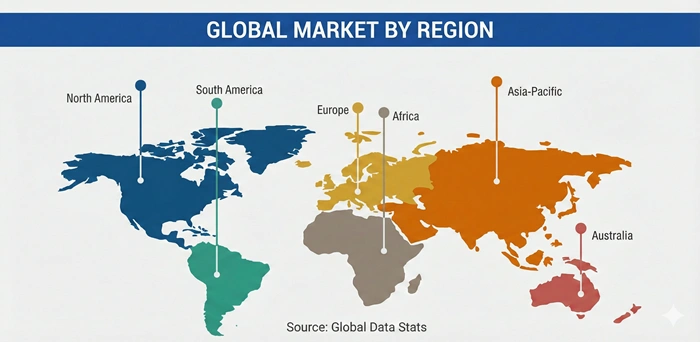
North America commands the dominant position in the global laser interferometer market with approximately 38% market share valued at around USD 129 million in 2026, driven by the region's extensive semiconductor fabrication infrastructure, aerospace manufacturing base, and concentration of advanced research institutions. The United States alone accounts for over 82% of North American demand, hosting major semiconductor companies, defense contractors, and precision manufacturing operations that require continuous investments in metrology equipment to maintain technological competitiveness. The region benefits from substantial government funding for manufacturing technology development through initiatives like the CHIPS Act, which allocated over USD 50 billion to strengthen domestic semiconductor production capabilities including essential metrology infrastructure. North America's laser interferometer market is projected to grow at a CAGR of 6.3% through 2033 as manufacturers modernize aging production facilities and adopt Industry 4.0 technologies requiring integrated precision measurement capabilities.
The concentration of leading laser interferometer manufacturers in North America creates distinct competitive advantages through proximity to major customer bases and collaborative research partnerships with universities and national laboratories. Companies including Zygo Corporation, Keysight Technologies, and various divisions of Renishaw plc maintain substantial research and development operations throughout the United States, continuously advancing interferometry technologies through close engagement with semiconductor manufacturers and aerospace prime contractors. The region's aerospace sector represents a particularly important market segment, with companies like Boeing, Lockheed Martin, and Northrop Grumman employing interferometric metrology for critical applications ranging from telescope mirror fabrication to aircraft component inspection. Canada's growing photonics industry and precision manufacturing sector contribute additional demand, particularly in Quebec and Ontario provinces where optical component manufacturers cluster around research centers specializing in laser technology development. The North American market exhibits strong adoption of advanced multi-axis interferometer systems and automated measurement platforms that integrate with manufacturing execution systems for real-time quality control.
Asia Pacific
Experiencing Fastest Growth Driven by Semiconductor Capacity Expansion and Manufacturing Modernization
Asia Pacific represents the fastest-growing regional market for laser interferometers with a projected CAGR of 7.9% from 2026 to 2033, propelled by aggressive semiconductor manufacturing capacity expansion, automotive industry modernization, and government-led initiatives to upgrade manufacturing technology infrastructure. The region currently captures approximately 34% of global market share valued near USD 115 million in 2026, with growth concentrated in China, Taiwan, South Korea, and Japan where massive investments in advanced manufacturing facilities are creating sustained demand for precision metrology equipment. Taiwan's position as the world's leading semiconductor foundry hub makes it the largest single-country market in the region, with companies like TSMC operating numerous fabrication facilities that collectively require hundreds of laser interferometer systems for wafer inspection, lithography alignment, and equipment calibration applications.
China's rapid industrial modernization and government emphasis on achieving self-sufficiency in semiconductor manufacturing technologies are driving extraordinary growth in laser interferometer adoption throughout the country. The "Made in China 2025" initiative specifically targets advanced manufacturing capabilities including precision measurement technologies, resulting in substantial subsidies and preferential policies that encourage domestic manufacturers to invest in sophisticated metrology infrastructure. Japanese manufacturers including companies in automotive, robotics, and optical industries maintain strong demand for laser interferometry systems, with particular emphasis on ultra-high precision applications requiring sub-nanometer measurement resolution. South Korea's concentration of memory chip manufacturers and display panel producers creates significant ongoing demand for surface topology interferometers used in wafer inspection and panel flatness verification. Leading global interferometer suppliers including Renishaw plc, ZEISS, and Keysight Technologies have established substantial regional operations to serve the Asia Pacific market, while domestic Chinese manufacturers are increasingly entering the market with competitively priced systems targeting mid-range applications. The region benefits from abundant skilled technical workforce, extensive manufacturing base, and supportive government policies that collectively create favorable conditions for sustained market expansion.
Top Key Players
-
Renishaw plc (United Kingdom)
-
Keysight Technologies (United States)
-
ZEISS Group (Germany)
-
Zygo Corporation (United States)
-
Bruker Corporation (United States)
-
Mahr GmbH (Germany)
-
SIOS Meßtechnik GmbH (Germany)
-
QED Technologies (United States)
-
MÖLLER-WEDEL OPTICAL GmbH (Germany)
-
SmarAct GmbH (Germany)
-
Micro-Epsilon (Germany)
-
TRIOPTICS GmbH (Germany)
-
Luna Innovations Incorporated (United States)
-
Festo AG (Germany)
-
HÜBNER Photonics (Germany)
Recent Developments
-
Zygo Corporation (2024) launched the Qualifire portable laser interferometer featuring smart accessory recognition technology, integrated phase measuring capability for enhanced stability, and user-friendly interface design that simplifies setup procedures and enables precise adjustments, with optional artifact reduction algorithms, autofocus functionality, and stable zoom capabilities designed to improve measurement efficiency in production environments.
-
Bruker Corporation (January 2023) introduced the NPFLEX-1000 white light interferometer specifically engineered for precision machining applications, offering accurate surface texture and roughness measurements optimized for automotive component inspection, medical device manufacturing, and large-scale additive manufacturing verification where surface quality directly impacts functional performance and regulatory compliance.
-
Bruker Corporation (January 2023) released the ContourX-1000 high-performance floor-standing white light interferometer designed to deliver fast and accurate three-dimensional surface texture and roughness measurements for quality control applications requiring rapid throughput without compromising measurement precision in production environments.
-
Zygo Corporation (September 2022) established a strategic collaboration with Digital Surf to integrate the Mountains Advanced Contour module into Zygo's Mx software platform, significantly enhancing geometric dimensioning and tolerancing capabilities of optical profilers and enabling precise measurement and analysis of critical dimensions to support tighter specification requirements across surface topology, industrial manufacturing, and semiconductor detection applications.
-
Keysight Technologies (January 2021) launched an advanced series of source/measure units specifically designed for testing applications demanding high accuracy, high resolution, and exceptional measurement flexibility, including current-voltage characterization units optimized for semiconductor device testing and non-linear material property analysis requiring precise electrical parameter control.
Market Trends
Convergence of Optical Metrology with Digital Manufacturing Ecosystems
The laser interferometer market is experiencing a fundamental transformation as measurement systems evolve from standalone instruments into integrated components of comprehensive digital manufacturing ecosystems. Modern interferometers increasingly feature standardized digital communication protocols, embedded analytics processors, and cloud connectivity that enable seamless data exchange with enterprise resource planning systems, statistical process control platforms, and predictive maintenance applications. This connectivity allows manufacturing organizations to aggregate measurement data from multiple interferometer stations across production lines, applying advanced analytics to identify systematic quality trends, correlate dimensional variations with process parameters, and optimize manufacturing operations in real-time. The integration trend is particularly pronounced in semiconductor fabrication environments where interferometric measurements of wafer flatness, lithography alignment, and thin film thickness feed directly into yield management systems that automatically adjust process recipes to maintain optimal production outcomes.
The miniaturization of laser interferometer technology is enabling new applications in portable metrology and in-process measurement scenarios previously considered impractical due to size and environmental constraints. Manufacturers are developing compact interferometer modules incorporating fiber-coupled laser sources, miniaturized optics, and ruggedized sensor packages that maintain measurement precision while occupying a fraction of the space required by traditional bench-mounted systems. These portable solutions are gaining adoption for field calibration of large machine tools, on-site verification of precision equipment installations, and quality inspection applications where parts cannot be easily transported to dedicated metrology laboratories. The aerospace industry has been particularly receptive to portable interferometry for large component inspection, utilizing lightweight systems to verify dimensional accuracy of aircraft structural assemblies and engine components directly on assembly fixtures. This portability trend is expanding the addressable market for laser interferometers beyond traditional laboratory and clean room environments into general manufacturing floors where environmental conditions previously prohibited optical measurement techniques.
Segments Covered in the Report
By Technique
-
Homodyne Interferometer
-
Heterodyne Interferometer
By Type
-
Michelson Interferometer
-
Fabry-Perot Interferometer
-
Fizeau Interferometer
-
Mach-Zehnder Interferometer
-
Sagnac Interferometer
-
Twyman-Green Interferometer
By Component
-
Laser Source
-
Photodetector
-
Optical Components
-
Electronics and Control Systems
By Application
-
Surface Topology
-
Engineering Precision
-
Applied Science
-
Biomedical Imaging
-
Semiconductor Detection
By Vertical
-
Automotive
-
Aerospace and Defense
-
Industrial Manufacturing
-
Healthcare and Life Sciences
-
Electronics and Semiconductors
-
Telecommunications
-
Marine
By Region
-
North America (United States, Canada, Mexico)
-
Europe (Germany, United Kingdom, France, Italy, Spain, Rest of Europe)
-
Asia Pacific (China, Japan, South Korea, Taiwan, India, Australia, Rest of Asia Pacific)
-
Latin America (Brazil, Argentina, Rest of Latin America)
-
Middle East & Africa (UAE, Saudi Arabia, South Africa, Rest of Middle East & Africa)
Frequently Asked Questions
Question 1: What is the projected laser interferometer market size by 2033?
Answer: The global laser interferometer market is expected to reach approximately USD 469.40 million by 2033. This represents substantial growth from the 2026 baseline driven by increasing precision measurement requirements across semiconductor manufacturing, aerospace engineering, and advanced manufacturing sectors.
Question 2: Which region dominates the laser interferometer market currently?
Answer: North America currently dominates the laser interferometer market with approximately 38% market share. However, Asia Pacific is experiencing the fastest growth rate with a CAGR of 7.9%, driven by semiconductor manufacturing expansion and industrial modernization initiatives.
Question 3: What are the primary applications driving laser interferometer market growth?
Answer: Surface topology applications represent the largest segment accounting for 41% of market revenue, primarily serving semiconductor wafer inspection and optical component verification. Engineering precision and semiconductor detection applications are experiencing rapid growth as manufacturing tolerance requirements become increasingly stringent.
Question 4: How is artificial intelligence impacting the laser interferometer market?
Answer: Artificial intelligence is transforming laser interferometer capabilities through automated defect detection, predictive maintenance algorithms, and intelligent measurement optimization. AI integration enables real-time pattern recognition in complex interference data, improving measurement reliability while reducing dependency on specialized technical expertise.
Question 5: What factors are restraining laser interferometer market expansion?
Answer: High initial capital investment requirements and specialized technical expertise needs represent primary market restraints. Environmental sensitivity requiring controlled measurement conditions and the availability of alternative measurement technologies also create adoption barriers, particularly among small and medium-sized manufacturing enterprises.